1
2
Introduction
• Purpose of origin of subject
• myths and wrong assumptions which need to be solved
scientifically
3
Definition
 Generally genetics is the science of study of inheritance.
 By definition “genetics is the science that deals with the
structure, organization, transmission and function of genes and
the origin of variation”.
4
Cytogenetics:- Study of various aspects of chromosomes and their
effects on the development of character of organisms
Pre-Mendelian theory
• Spontaneous generation
– Mid 19th century- de novo(afresh)
5
6
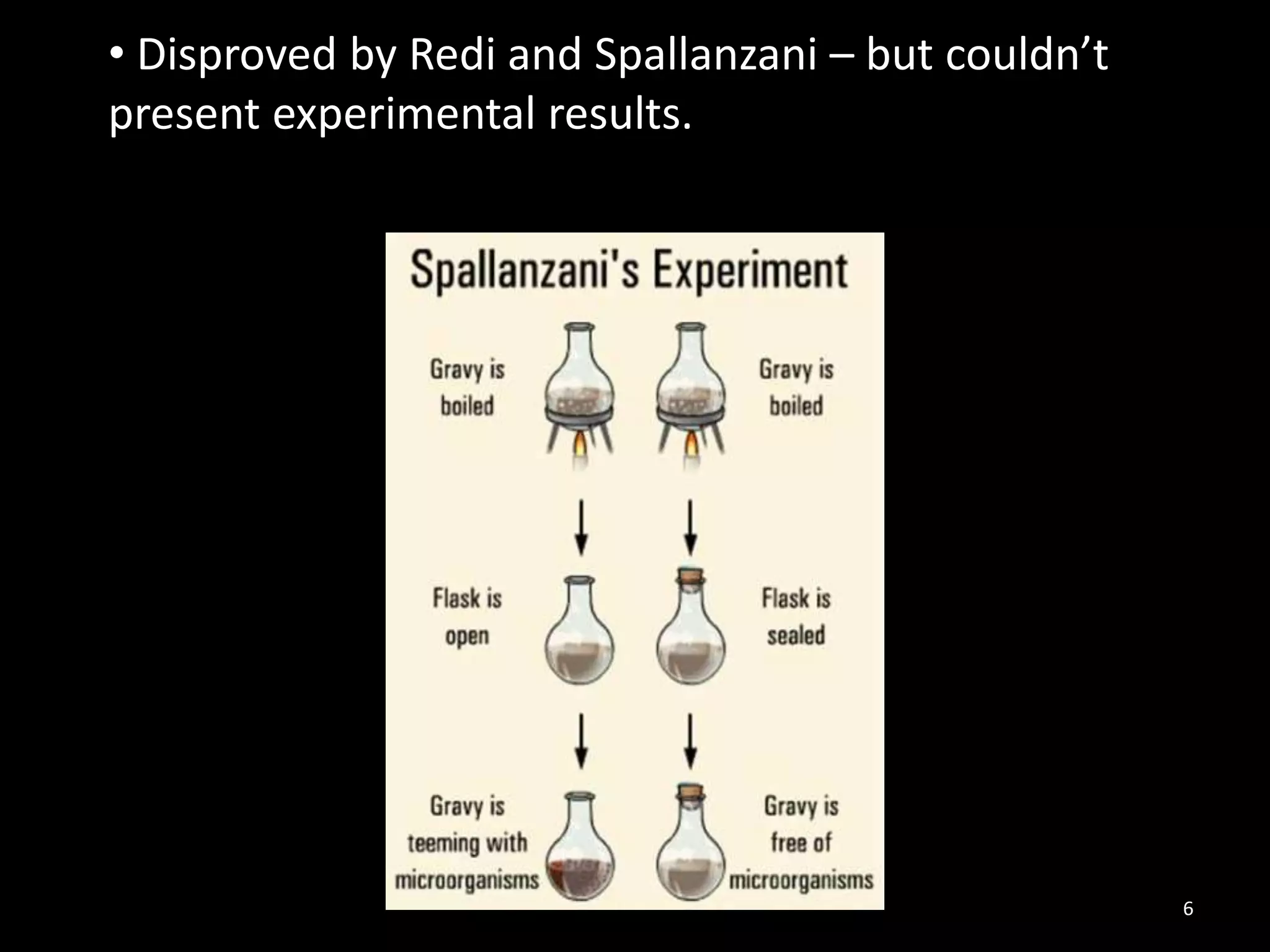
• Disproved by Redi and Spallanzani – but couldn’t
present experimental results.
7
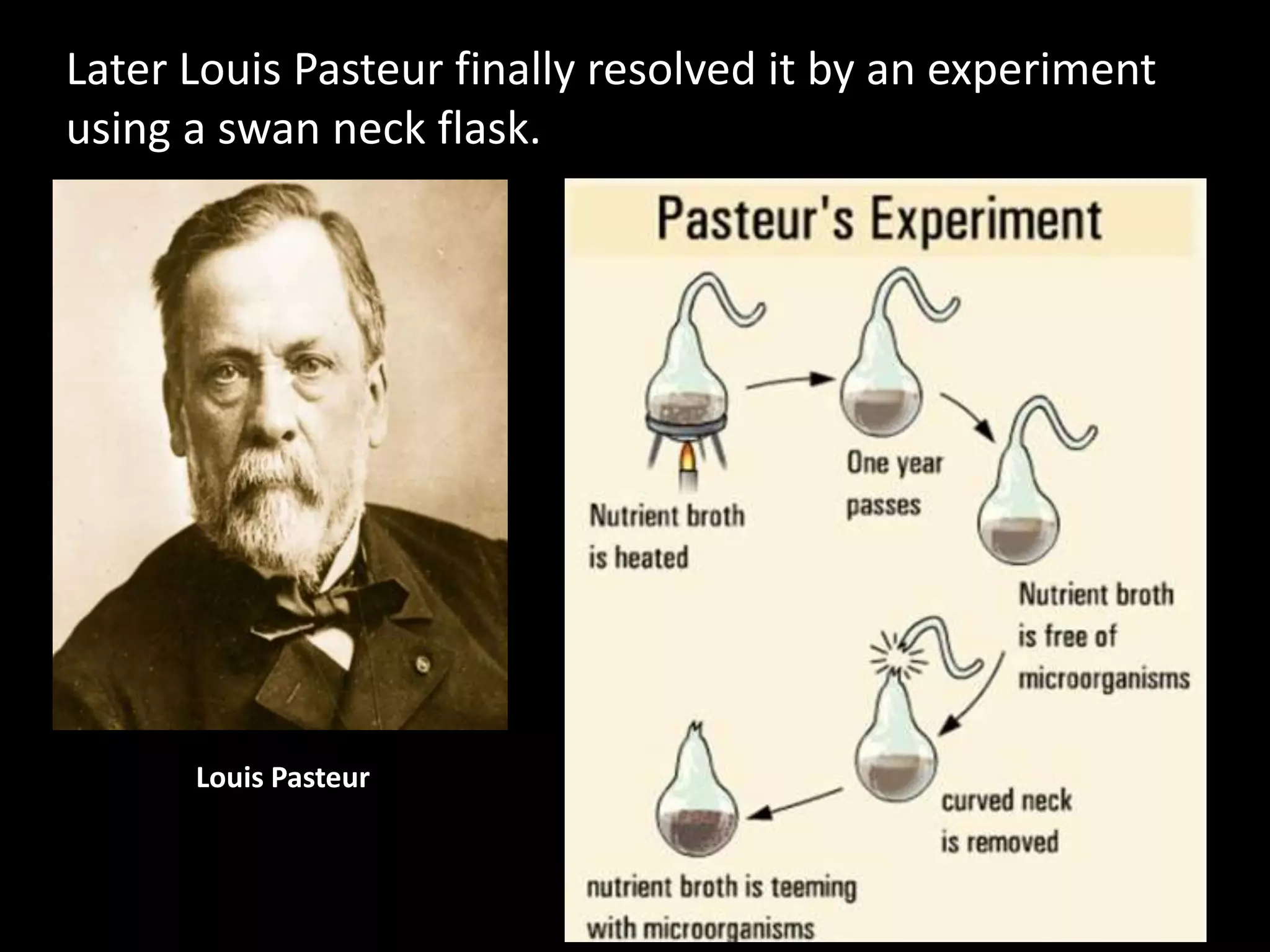
Later Louis Pasteur finally resolved it by an experiment
using a swan neck flask.
Louis Pasteur
8
Reproduction in plants and animals
Babylonians and Assyrians in 700 BC
9
• 1673 - De Graaf proved that the tiny vesicles on surface of
mammalian ovary were eggs.
• Malpighi and Swammwedam – discovered eggs in insects.
• 18755 – Oscar Hertwig proved the fusion of sperm and egg nuclei
in sea urchin.
O. Hertwig
10
• 1717 – first artificial hybridization was produced by Thomas
Fairchild, where in he crossed sweet Williams and carnation and
named it “Fairy child mule”.
• 1823 – Amici described the entry of pollen tube into the ovary.
11
Preformation theory
• Proposed by Swammerdam and Bonnet.
• Aristotle belief that progeny derived from semen (Animalculists).
• On the other hand Harley speculated that progenies are from egg
(Ovists).
• 1694 - Homunculus – miniature human figure.
• But no such things was seen under microscope.
Epigenesis
12
• proposed by Wolff.
• organs and tissues arose through a process called differentiation.
Ovum + egg zygote
Mass of
identical
cells
cell
division
Tissue or organ
differentiation
13
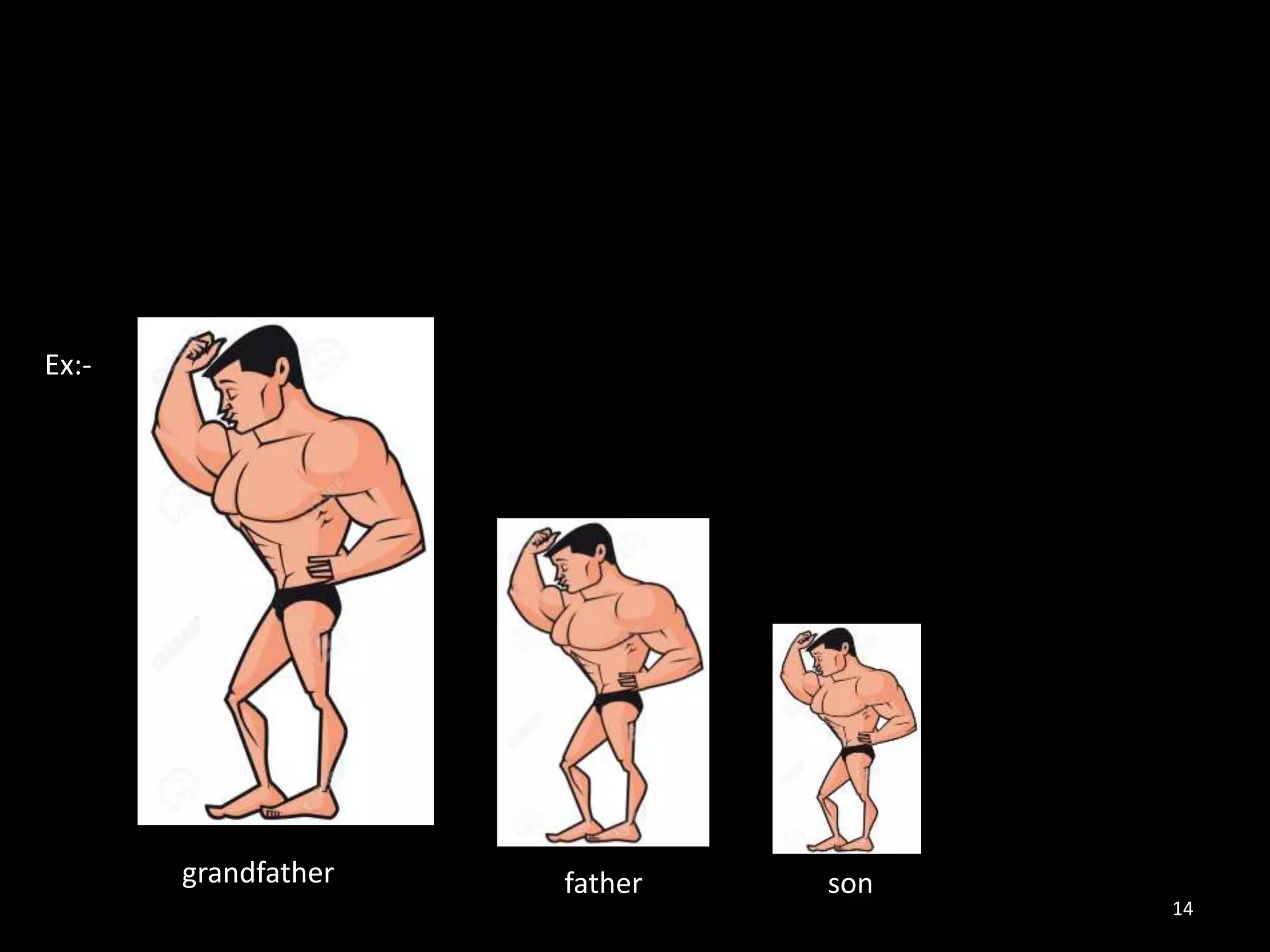
Inheritance of acquired character
• Proposed by Lamark.
• Characters acquired in one generation is passed on to the next.
• Lamarkism.
Lamark
14
Ex:-
grandfather father son
15
Pangenesis
• Theory proposed by Charles Darwin in his famous book “Origin of
species”(1859).
• He explored my places in search of evidence on Board beagle.
• He proposed the theory of evolution.
•Nature is the main cause of evolution, know as “survival of the
fittest.”
• this concept was universally accepted,,,,,, but,,,,,,,
• he proposed the concept of gemmule or pangene.
• According to him each gamete get one gemmule from one organ.
16
Charles Darwin
17
Germplasm theory
• August Friedrich Leopold Weismann in 1863.
• Before that he disproved Lamarkism.
18
• According to germplasm theory, the body of an individual was
divided into
 Somatoplasm
 Germplasm
August Friedrich Leopold Weismann
19
• Wide belief among the biologists during and before Mendel there
was the concept of blending inheritance.
• They thought that the medium of inheritance was liquid, possibly
blood.
• However this concept did not explain the appearance of variation
in F2.
20
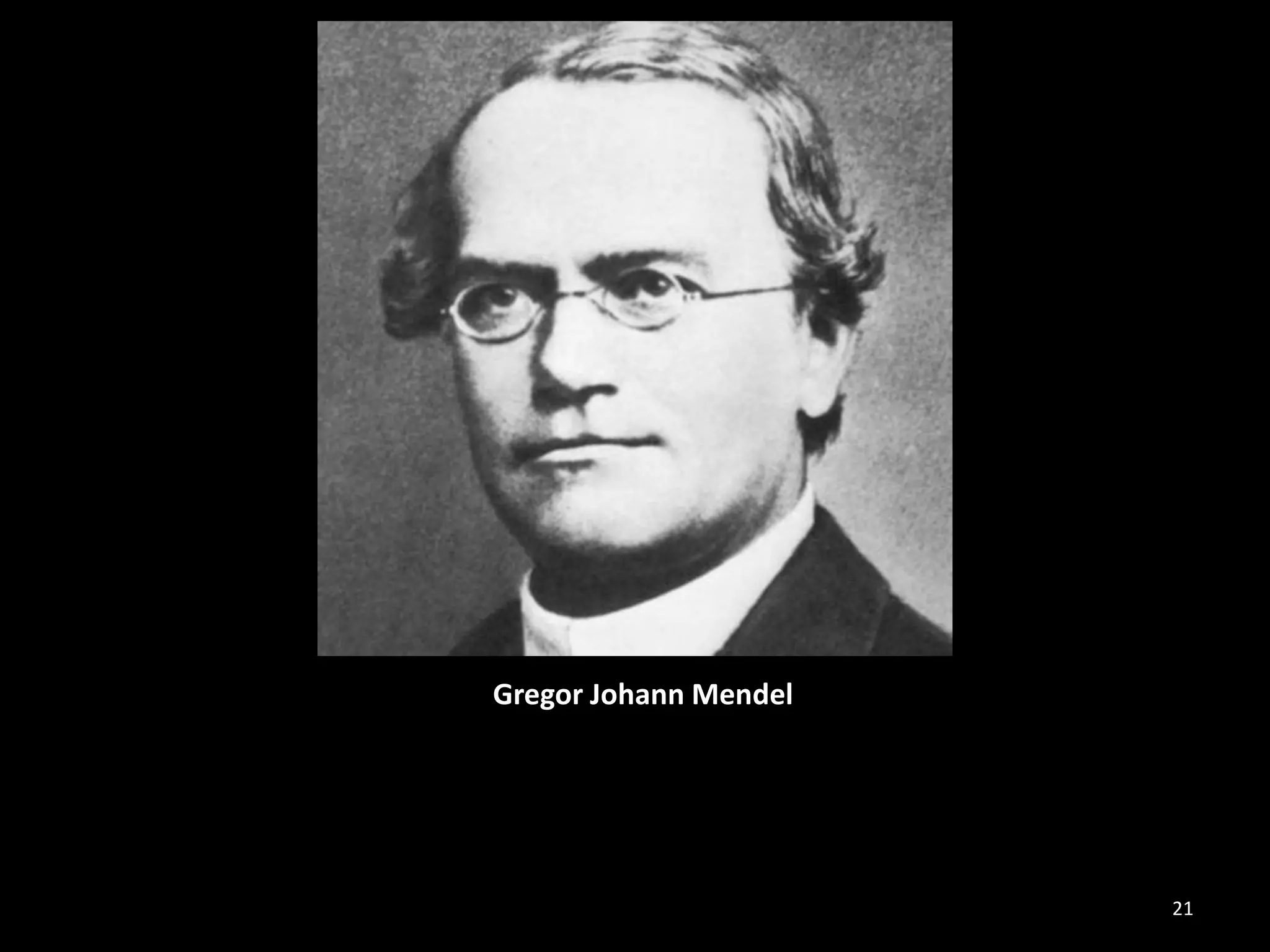
• Then came Mendel (1822 - 1884).
•Conducted a series of experiment and published his findings on pea
in 1866.
• He referred as the unit of inheritance as “factor”.
• Laws of Mendel.
• Father of genetics.
21
Gregor Johann Mendel
22
• After 34 years his findings was rediscovered independently by 3
scientists.
Carl Correns
(Germany)
Hugo De Vries
(Holland)
Tschermack
(Austira)
23
Cell theory
• Robert Hooke cut a thin section in cork and honeycomb
chambers. . . . . . CELL.
• Schlieden - Plant cell theory
• Schwan - animal cell theory
Nageli provided
logical extention of
cell theory
24
Some important discoveries
• Nucleous- Robert Brown in cell of Tradescantia.
• Nucleic acid- Meischer (renamed by Altman)
• Mitosis- Fleming
• Meiosis- Farmer and Moore
• Chromosomal theory of heridity- Walter Sutton
25
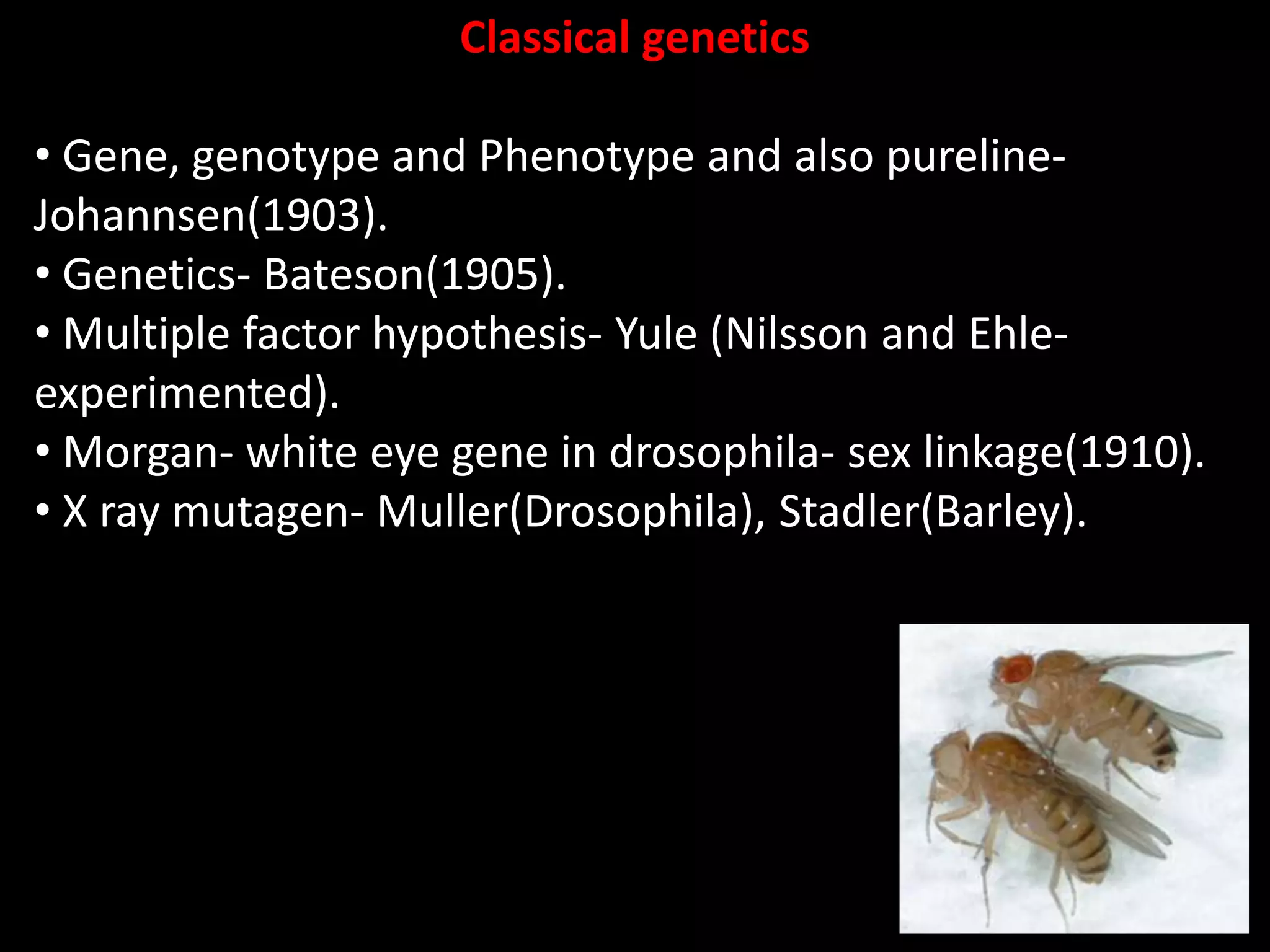
Classical genetics
• Gene, genotype and Phenotype and also pureline-
Johannsen(1903).
• Genetics- Bateson(1905).
• Multiple factor hypothesis- Yule (Nilsson and Ehle-
experimented).
• Morgan- white eye gene in drosophila- sex linkage(1910).
• X ray mutagen- Muller(Drosophila), Stadler(Barley).
26
Biochemical genetics
• Garrod- “Inborn errors in metabolism”.
Father of Human genetics.
• Beadle and tatum- one gene one enzyme(1941).
27
Molecular genetics
• Avery, MacLeod and McCarty- DNA as genetic material.
Rough strain
Smooth
strain
Heat
killed
smooth
strain
Rough strain and heat
killed smooth strain
28
Watson and Crick – DNA double helix model(1953)
This discovery lead to the new branch called MOLECULAR GENETICS
29
Barbara Mc Clintock discovered jumping genes
jumping gene
30
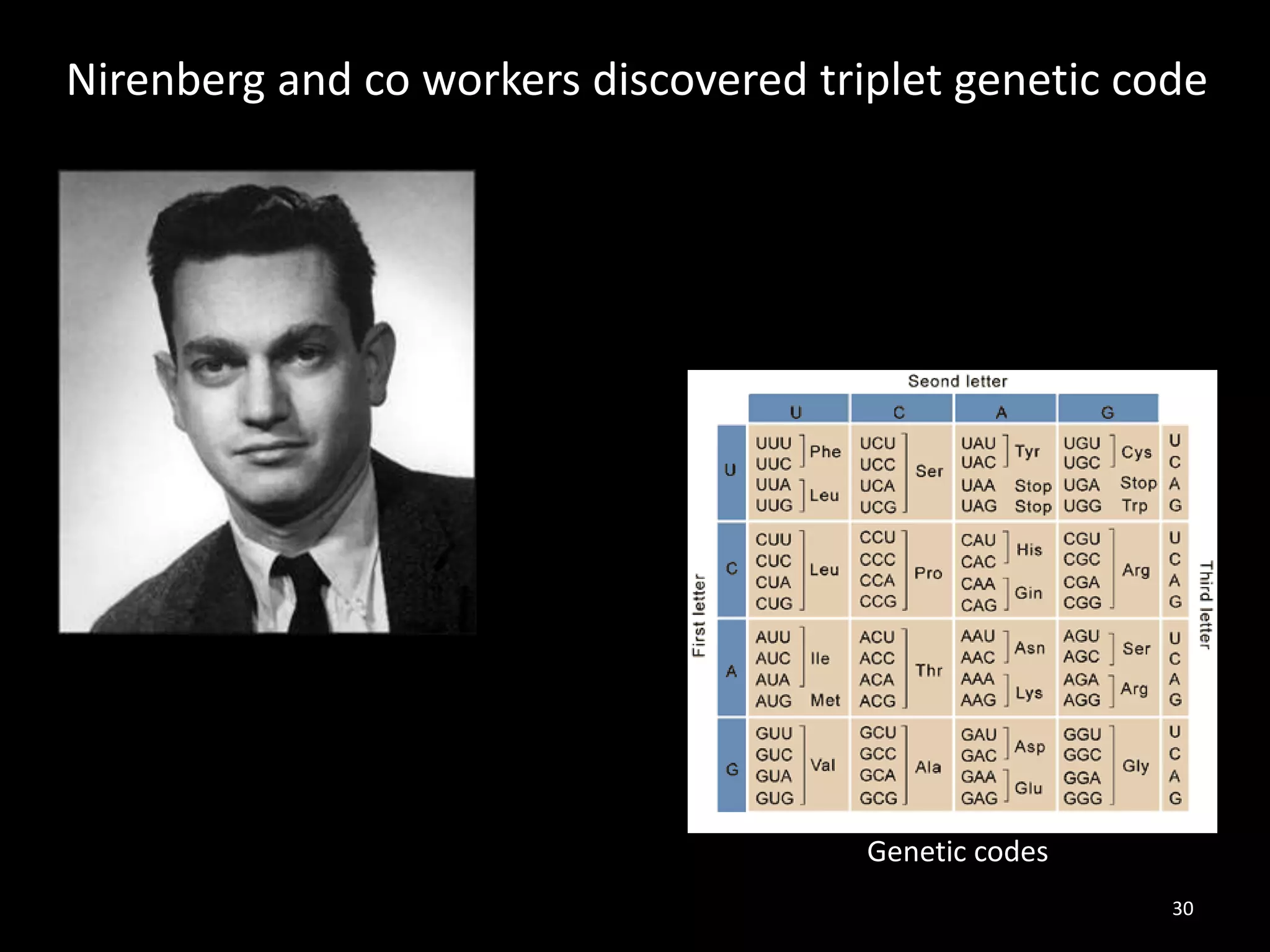
Nirenberg and co workers discovered triplet genetic code
Genetic codes
31
• Jacob and Monad – Lac operon concept (NP-1965).
• Benzer – Classified cistron, recon and muton.
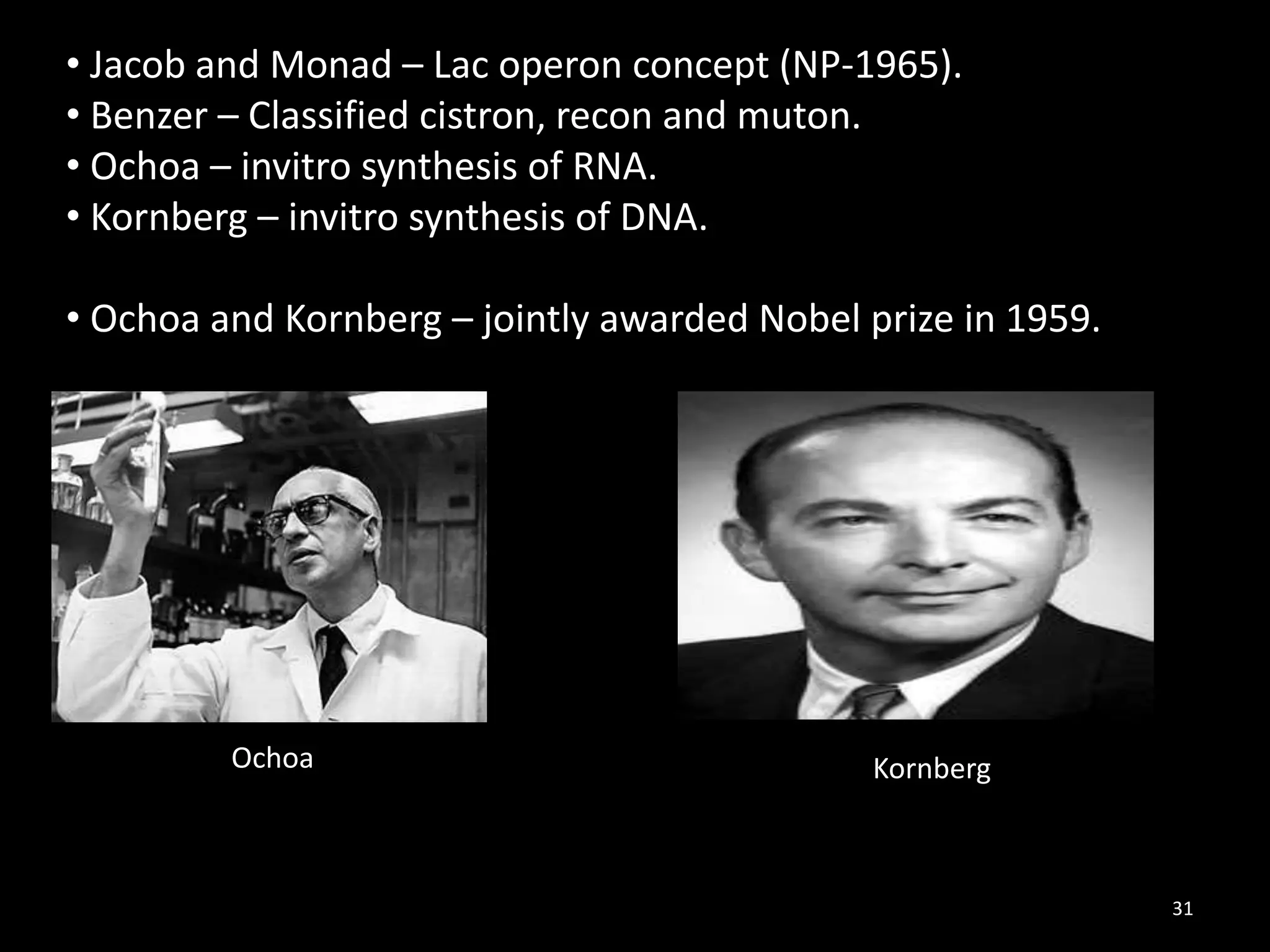
• Ochoa – invitro synthesis of RNA.
• Kornberg – invitro synthesis of DNA.
• Ochoa and Kornberg – jointly awarded Nobel prize in 1959.
Ochoa Kornberg
32
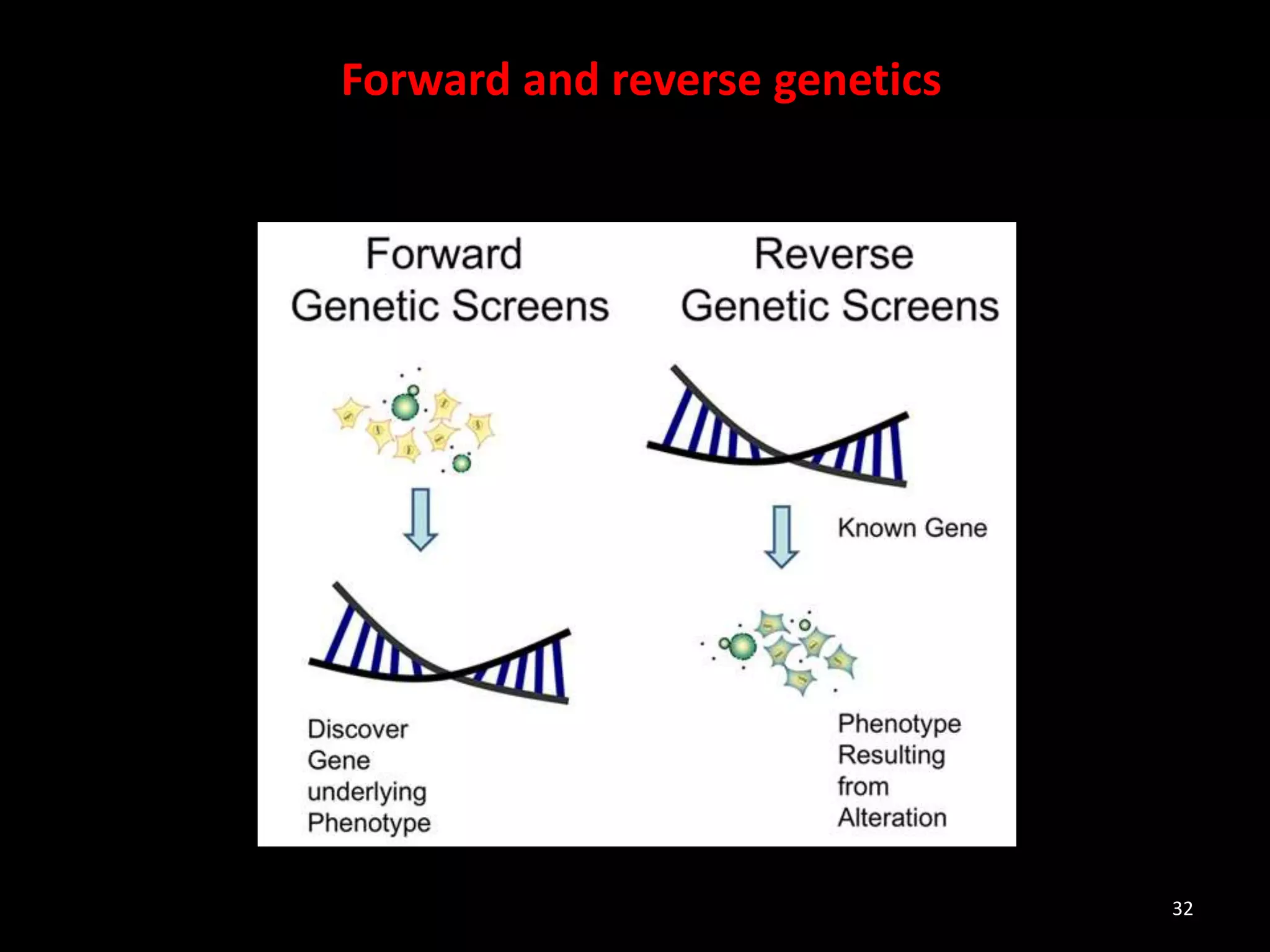
Forward and reverse genetics
33
Some Biotechnology aspects in genetics history
• Karl Ereky father of Biotechnology.
• He coined the term in 1919.
• The exploitation of biological processes for industrial and other
purposes, especially the genetic manipulation of microorganisms
for the production of antibiotics, hormones, etc.
34
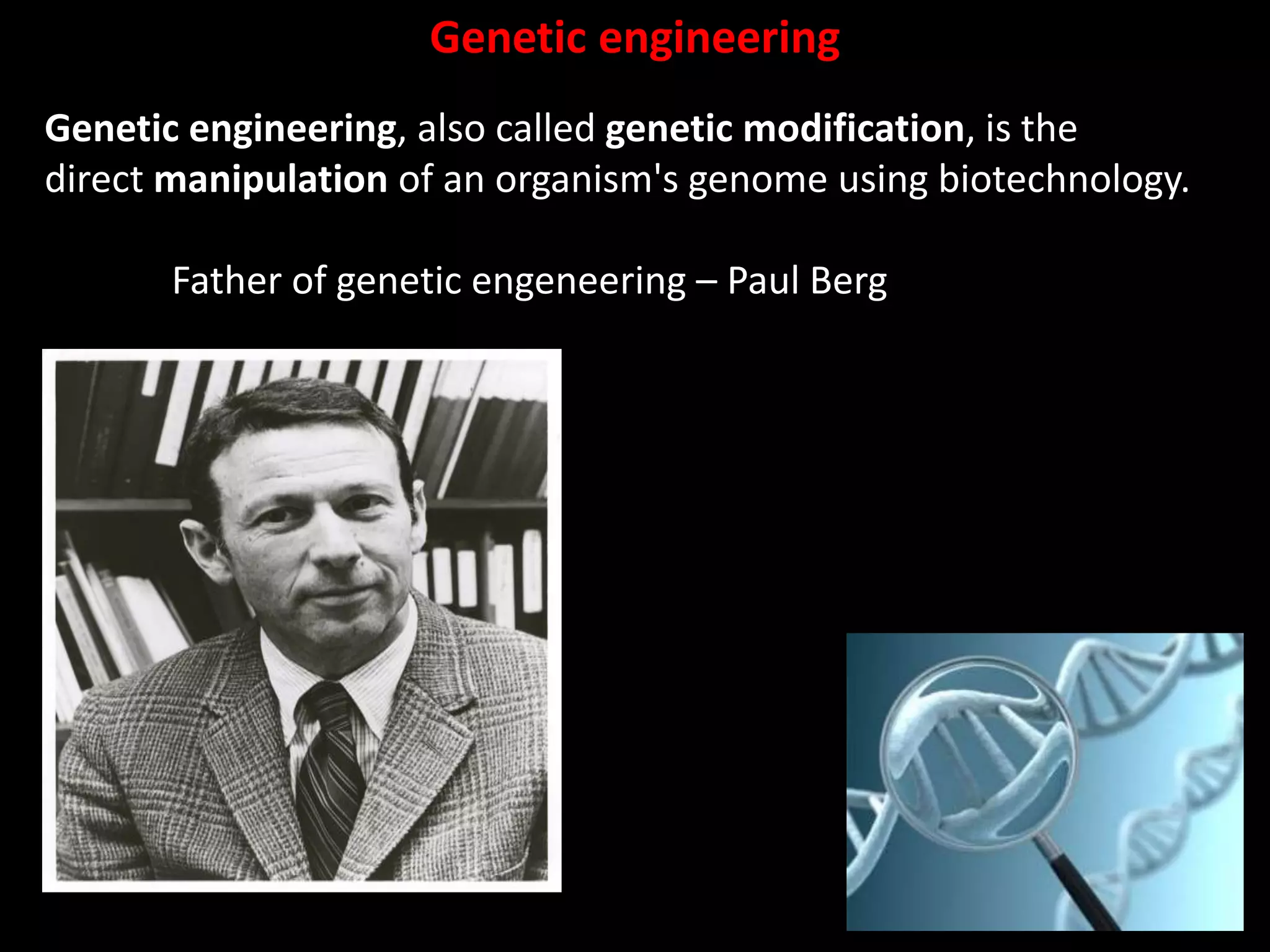
Genetic engineering
Genetic engineering, also called genetic modification, is the
direct manipulation of an organism's genome using biotechnology.
Father of genetic engeneering – Paul Berg
35
DNA fingerprinting
Technique used to identify individuals by characteristics of their DNA.
Professor Sir Alec John Jeffrey is the inventor of this.
36
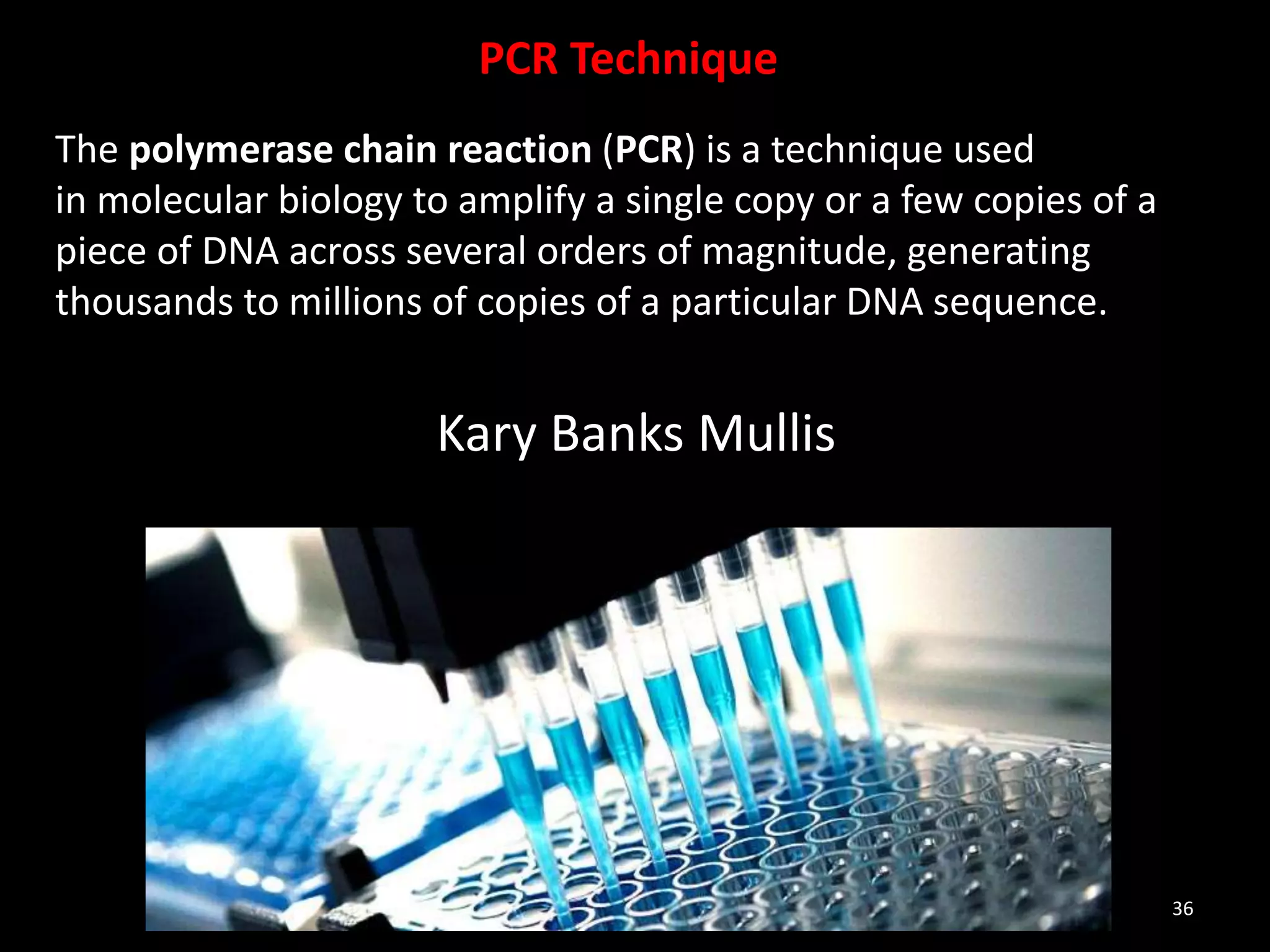
PCR Technique
The polymerase chain reaction (PCR) is a technique used
in molecular biology to amplify a single copy or a few copies of a
piece of DNA across several orders of magnitude, generating
thousands to millions of copies of a particular DNA sequence.
Kary Banks Mullis
37
Conclusion
Hence the study of history is the base for the future innovation,,,,
Study history. . .
Create history. . .

History genetics

  • 1.
  • 2.
  • 3.
    Introduction • Purpose oforigin of subject • myths and wrong assumptions which need to be solved scientifically 3
  • 4.
    Definition  Generally geneticsis the science of study of inheritance.  By definition “genetics is the science that deals with the structure, organization, transmission and function of genes and the origin of variation”. 4 Cytogenetics:- Study of various aspects of chromosomes and their effects on the development of character of organisms
  • 5.
    Pre-Mendelian theory • Spontaneousgeneration – Mid 19th century- de novo(afresh) 5
  • 6.
    6 • Disproved byRedi and Spallanzani – but couldn’t present experimental results.
  • 7.
    7 Later Louis Pasteurfinally resolved it by an experiment using a swan neck flask. Louis Pasteur
  • 8.
    8 Reproduction in plantsand animals Babylonians and Assyrians in 700 BC
  • 9.
    9 • 1673 -De Graaf proved that the tiny vesicles on surface of mammalian ovary were eggs. • Malpighi and Swammwedam – discovered eggs in insects. • 18755 – Oscar Hertwig proved the fusion of sperm and egg nuclei in sea urchin. O. Hertwig
  • 10.
    10 • 1717 –first artificial hybridization was produced by Thomas Fairchild, where in he crossed sweet Williams and carnation and named it “Fairy child mule”. • 1823 – Amici described the entry of pollen tube into the ovary.
  • 11.
    11 Preformation theory • Proposedby Swammerdam and Bonnet. • Aristotle belief that progeny derived from semen (Animalculists). • On the other hand Harley speculated that progenies are from egg (Ovists). • 1694 - Homunculus – miniature human figure. • But no such things was seen under microscope.
  • 12.
    Epigenesis 12 • proposed byWolff. • organs and tissues arose through a process called differentiation. Ovum + egg zygote Mass of identical cells cell division Tissue or organ differentiation
  • 13.
    13 Inheritance of acquiredcharacter • Proposed by Lamark. • Characters acquired in one generation is passed on to the next. • Lamarkism. Lamark
  • 14.
  • 15.
    15 Pangenesis • Theory proposedby Charles Darwin in his famous book “Origin of species”(1859). • He explored my places in search of evidence on Board beagle. • He proposed the theory of evolution. •Nature is the main cause of evolution, know as “survival of the fittest.” • this concept was universally accepted,,,,,, but,,,,,,, • he proposed the concept of gemmule or pangene. • According to him each gamete get one gemmule from one organ.
  • 16.
  • 17.
    17 Germplasm theory • AugustFriedrich Leopold Weismann in 1863. • Before that he disproved Lamarkism.
  • 18.
    18 • According togermplasm theory, the body of an individual was divided into  Somatoplasm  Germplasm August Friedrich Leopold Weismann
  • 19.
    19 • Wide beliefamong the biologists during and before Mendel there was the concept of blending inheritance. • They thought that the medium of inheritance was liquid, possibly blood. • However this concept did not explain the appearance of variation in F2.
  • 20.
    20 • Then cameMendel (1822 - 1884). •Conducted a series of experiment and published his findings on pea in 1866. • He referred as the unit of inheritance as “factor”. • Laws of Mendel. • Father of genetics.
  • 21.
  • 22.
    22 • After 34years his findings was rediscovered independently by 3 scientists. Carl Correns (Germany) Hugo De Vries (Holland) Tschermack (Austira)
  • 23.
    23 Cell theory • RobertHooke cut a thin section in cork and honeycomb chambers. . . . . . CELL. • Schlieden - Plant cell theory • Schwan - animal cell theory Nageli provided logical extention of cell theory
  • 24.
    24 Some important discoveries •Nucleous- Robert Brown in cell of Tradescantia. • Nucleic acid- Meischer (renamed by Altman) • Mitosis- Fleming • Meiosis- Farmer and Moore • Chromosomal theory of heridity- Walter Sutton
  • 25.
    25 Classical genetics • Gene,genotype and Phenotype and also pureline- Johannsen(1903). • Genetics- Bateson(1905). • Multiple factor hypothesis- Yule (Nilsson and Ehle- experimented). • Morgan- white eye gene in drosophila- sex linkage(1910). • X ray mutagen- Muller(Drosophila), Stadler(Barley).
  • 26.
    26 Biochemical genetics • Garrod-“Inborn errors in metabolism”. Father of Human genetics. • Beadle and tatum- one gene one enzyme(1941).
  • 27.
    27 Molecular genetics • Avery,MacLeod and McCarty- DNA as genetic material. Rough strain Smooth strain Heat killed smooth strain Rough strain and heat killed smooth strain
  • 28.
    28 Watson and Crick– DNA double helix model(1953) This discovery lead to the new branch called MOLECULAR GENETICS
  • 29.
    29 Barbara Mc Clintockdiscovered jumping genes jumping gene
  • 30.
    30 Nirenberg and coworkers discovered triplet genetic code Genetic codes
  • 31.
    31 • Jacob andMonad – Lac operon concept (NP-1965). • Benzer – Classified cistron, recon and muton. • Ochoa – invitro synthesis of RNA. • Kornberg – invitro synthesis of DNA. • Ochoa and Kornberg – jointly awarded Nobel prize in 1959. Ochoa Kornberg
  • 32.
  • 33.
    33 Some Biotechnology aspectsin genetics history • Karl Ereky father of Biotechnology. • He coined the term in 1919. • The exploitation of biological processes for industrial and other purposes, especially the genetic manipulation of microorganisms for the production of antibiotics, hormones, etc.
  • 34.
    34 Genetic engineering Genetic engineering,also called genetic modification, is the direct manipulation of an organism's genome using biotechnology. Father of genetic engeneering – Paul Berg
  • 35.
    35 DNA fingerprinting Technique usedto identify individuals by characteristics of their DNA. Professor Sir Alec John Jeffrey is the inventor of this.
  • 36.
    36 PCR Technique The polymerasechain reaction (PCR) is a technique used in molecular biology to amplify a single copy or a few copies of a piece of DNA across several orders of magnitude, generating thousands to millions of copies of a particular DNA sequence. Kary Banks Mullis
  • 37.
    37 Conclusion Hence the studyof history is the base for the future innovation,,,, Study history. . . Create history. . .