HISTORY OF GENETICS
SARIP TARITA A. AMPATUAN –ALI
(An Adapted Presentation from Keith King)
Objectives
• State the history of genetics;
• Describe major century events;
• Define terms used in genetics
History of Genetics
• People have known about inheritance for a long time.
• children resemble their parents
• domestication of animals and plants, selective breeding for good
characteristics
• Sumerian horse breeding records
• Egyptian data palm breeding
• Bible and hemophilia
Old Ideas
• A number of incorrect ideas had to be generated and overcome before
modern genetics could arise.
• 1. All life comes from other life
• Living organisms are not spontaneously generated from non-living
material. Big exception: origin of life.
• 2. Species concept: offspring arise only when two members of the
same species mate.
• Monstrous hybrids don’t exist.
More Old Ideas
• 3. Organisms develop by expressing information carried in their
hereditary material.
• As opposed to “preformation”, the idea that in each sperm (or egg) is a
tiny, fully-formed human that merely grows in size.
• 4. The environment can’t alter the hereditary material in a directed
fashion.
• There is no “inheritance of acquired characteristics”.
• Mutations are random events.
More Old Ideas
• 5. Male and female parents contribute equally
to the offspring.
• ancient Greek idea: male plants
a “seed” in the female “garden”.
• alleged New Guinea belief: sex is
not related to reproduction.
Mid 1800’s Discoveries
Three major events in the mid-1800’s led directly to the development of
modern genetics.
• 1859: Charles Darwin publishes The Origin of Species, which describes
the theory of evolution by natural selection.
• This theory requires heredity to work.
• 1866: Gregor Mendel publishes Experiments in Plant Hybridization,
which lays out the basic theory of genetics.
• It is widely ignored until 1900.
• 1871: Friedrich Miescher isolates “nucleic acid” from pus cells.
Major Events in the 20th Century
• 1900: rediscovery of Mendel’s work by Robert Correns, Hugo de
Vries, and Erich von Tschermak
• 1902: Archibald Garrod discovers that alkaptonuria, a human
disease, has a genetic basis.
• 1904: Gregory Bateson discovers linkage between genes. Also
coins the word “genetics”.
• 1910: Thomas Hunt Morgan proves that genes are located on the
chromosomes (using Drosophila).
More 20th Century Events
• 1918: R. A. Fisher begins the study of quantitative genetics by partitioning
phenotypic variance into a genetic and an environmental component.
• 1926: Hermann J. Muller shows that X-rays induce mutations.
• 1944: Oswald Avery, Colin MacLeod and Maclyn McCarty show that DNA
can transform bacteria, demonstrating that DNA is the hereditary material.
• 1953: James Watson and Francis Crick determine the structure of the DNA
molecule, which leads directly to knowledge of how it replicates
• 1966: Marshall Nirenberg solves the genetic code, showing that 3 DNA
bases code for one amino acid.
20th Century Events Continued
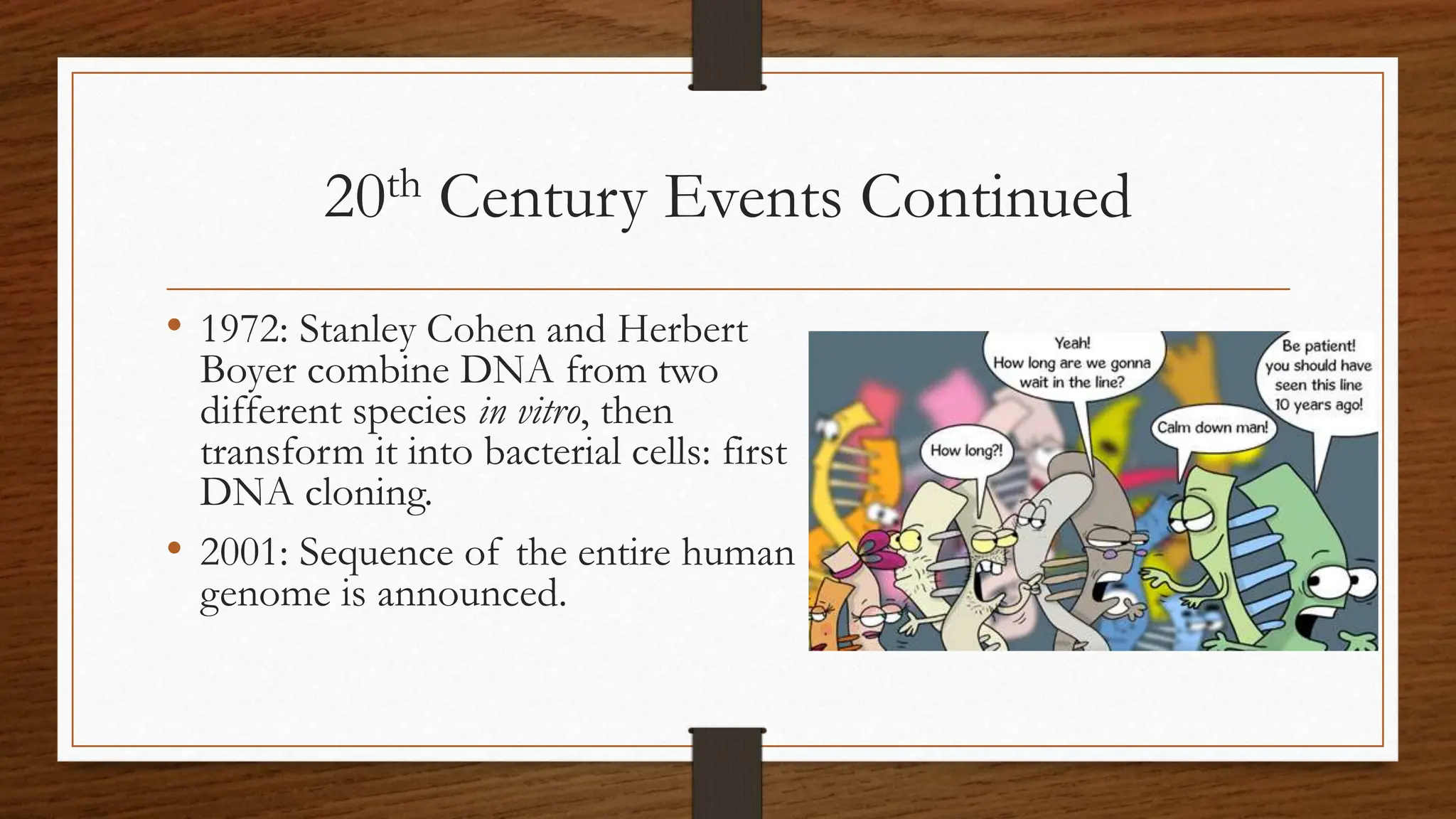
• 1972: Stanley Cohen and Herbert
Boyer combine DNA from two
different species in vitro, then
transform it into bacterial cells: first
DNA cloning.
• 2001: Sequence of the entire human
genome is announced.
Molecular Reality (current view)
• Almost all inheritance is based on DNA:
• the sequence of ACGT nucleotides encodes all instructions needed
to build and maintain an organism.
• A chromosome is a single DNA molecule together with other
molecules (proteins and RNA) needed to support and read the
DNA.
• A gene is a specific region of a chromosome that codes for a
single polypeptide.
• A polypeptide is a linear chain of amino acids
Molecular Reality (current view)
• Proteins are composed of one or more polypeptides, plus in some
cases other small helper molecules (co-factors). Proteins do most
of the work of the cell.
Gene Expression
• Genes are expressed in a 2 step process:
• First, an RNA copy of a single gene is made (transcription).
• Then, the nucleotide sequence of the RNA copy (messenger RNA) is
translated into the amino acid sequence of the polypeptide.
• the genetic code is a list of which 3 base DNA or RNA sequence
(codon) encodes which amino acid. The same genetic code is used in
(almost) all organisms.
• All cells in the body have the same DNA, but different genes are
expressed in different cells and under different conditions.
Gene Differences
• Genes often have several alleles: the same gene in the same
chromosomal location, but with minor nucleotide changes that
yield slightly different proteins.
• For a given gene, many different alleles can exist in a population
(members of the same species), but an individual diploid
organism can have 2 alleles at most: one from each parent.
Diploid = having 2 copies of each gene and each chromosome.
Other Chromosome Components
• Chromosomal DNA contains other things besides
genes:
• centromere (where the mitotic spindle attaches)
• telomeres (special structures on the ends of
chromosomes)
• origins of replication (where copying of DNA starts)
• pseudogenes (non-functional, mutated copies of genes)
• transposable elements a.k.a. transposons (intranuclear
parasites)
• genes that make small RNAs and not proteins
• “junk” (?)
Prokaryotes vs. Eukaryotes
• Prokaryotes:
• Eubacteria and Archaea. Usually unicellular.
• No internal membrane-bound compartments: DNA floats free in the
cytoplasm.
• 1 circular chromosome (plus optional plasmids, which are also circular)
• reproduction usually asexual
• sexual processes (mixing DNA from 2 individuals) occur, but with unequal
contributions from the 2 partners
• transcription and translation simultaneous
Prokaryotes vs. Eukaryotes
• Eukaryotes:
• Plants, animals, fungi, protists. Often multicellular.
• DNA contained within a membrane-bound nucleus.
• linear chromosomes (usually more than 1)
• careful division of chromosomes in cell division: mitosis and meiosis
• transcription separated from translation
• sexual reproduction: 2 partners contribute equally to offspring
• life cycle: alternation of haploid and diploid phases (i.e. 1 vs. 2 copies of
each gene and chromosome)
Mutation
• Mutations, which are any change in the DNA base sequence),
occur constantly in all cells and organisms. Offspring rarely get a
perfect copy of the DNA from its parents.
• but mutations are rare: about 1 DNA base change per 109 bases each cell
generation. (Humans have about 3 x 10⁹ bases and E. coli bacteria have
about 4 x 10⁶ bases).
• Some mutational changes are much larger: chromosome
rearrangements that include genes torn in half and moved to new
locations, sometimes combined with other genes.
Evolution
• Fitness: the ability to survive and reproduce. An individual’s fitness is
affected by its genes.
• Natural selection: more fit individuals tend to increase their numbers
each generation, at the expense of less fit individuals. Alleles that
confer higher fitness tend to take over in the population, causing a loss
of less fit genes.
• Large scale changes, new species, are thought to usually occur in small
isolated populations, where they don’t get swamped out or out-
competed by the “normal” individuals.
Objectives
• State the history of genetics;
• Describe major century events;
• Define terms used in genetics

BiologyEcology-222-Genetics-topic1a.pptx

  • 1.
    HISTORY OF GENETICS SARIPTARITA A. AMPATUAN –ALI (An Adapted Presentation from Keith King)
  • 2.
    Objectives • State thehistory of genetics; • Describe major century events; • Define terms used in genetics
  • 3.
    History of Genetics •People have known about inheritance for a long time. • children resemble their parents • domestication of animals and plants, selective breeding for good characteristics • Sumerian horse breeding records • Egyptian data palm breeding • Bible and hemophilia
  • 4.
    Old Ideas • Anumber of incorrect ideas had to be generated and overcome before modern genetics could arise. • 1. All life comes from other life • Living organisms are not spontaneously generated from non-living material. Big exception: origin of life. • 2. Species concept: offspring arise only when two members of the same species mate. • Monstrous hybrids don’t exist.
  • 5.
    More Old Ideas •3. Organisms develop by expressing information carried in their hereditary material. • As opposed to “preformation”, the idea that in each sperm (or egg) is a tiny, fully-formed human that merely grows in size. • 4. The environment can’t alter the hereditary material in a directed fashion. • There is no “inheritance of acquired characteristics”. • Mutations are random events.
  • 6.
    More Old Ideas •5. Male and female parents contribute equally to the offspring. • ancient Greek idea: male plants a “seed” in the female “garden”. • alleged New Guinea belief: sex is not related to reproduction.
  • 7.
    Mid 1800’s Discoveries Threemajor events in the mid-1800’s led directly to the development of modern genetics. • 1859: Charles Darwin publishes The Origin of Species, which describes the theory of evolution by natural selection. • This theory requires heredity to work. • 1866: Gregor Mendel publishes Experiments in Plant Hybridization, which lays out the basic theory of genetics. • It is widely ignored until 1900. • 1871: Friedrich Miescher isolates “nucleic acid” from pus cells.
  • 8.
    Major Events inthe 20th Century • 1900: rediscovery of Mendel’s work by Robert Correns, Hugo de Vries, and Erich von Tschermak • 1902: Archibald Garrod discovers that alkaptonuria, a human disease, has a genetic basis. • 1904: Gregory Bateson discovers linkage between genes. Also coins the word “genetics”. • 1910: Thomas Hunt Morgan proves that genes are located on the chromosomes (using Drosophila).
  • 9.
    More 20th CenturyEvents • 1918: R. A. Fisher begins the study of quantitative genetics by partitioning phenotypic variance into a genetic and an environmental component. • 1926: Hermann J. Muller shows that X-rays induce mutations. • 1944: Oswald Avery, Colin MacLeod and Maclyn McCarty show that DNA can transform bacteria, demonstrating that DNA is the hereditary material. • 1953: James Watson and Francis Crick determine the structure of the DNA molecule, which leads directly to knowledge of how it replicates • 1966: Marshall Nirenberg solves the genetic code, showing that 3 DNA bases code for one amino acid.
  • 10.
    20th Century EventsContinued • 1972: Stanley Cohen and Herbert Boyer combine DNA from two different species in vitro, then transform it into bacterial cells: first DNA cloning. • 2001: Sequence of the entire human genome is announced.
  • 11.
    Molecular Reality (currentview) • Almost all inheritance is based on DNA: • the sequence of ACGT nucleotides encodes all instructions needed to build and maintain an organism. • A chromosome is a single DNA molecule together with other molecules (proteins and RNA) needed to support and read the DNA. • A gene is a specific region of a chromosome that codes for a single polypeptide. • A polypeptide is a linear chain of amino acids
  • 12.
    Molecular Reality (currentview) • Proteins are composed of one or more polypeptides, plus in some cases other small helper molecules (co-factors). Proteins do most of the work of the cell.
  • 13.
    Gene Expression • Genesare expressed in a 2 step process: • First, an RNA copy of a single gene is made (transcription). • Then, the nucleotide sequence of the RNA copy (messenger RNA) is translated into the amino acid sequence of the polypeptide. • the genetic code is a list of which 3 base DNA or RNA sequence (codon) encodes which amino acid. The same genetic code is used in (almost) all organisms. • All cells in the body have the same DNA, but different genes are expressed in different cells and under different conditions.
  • 14.
    Gene Differences • Genesoften have several alleles: the same gene in the same chromosomal location, but with minor nucleotide changes that yield slightly different proteins. • For a given gene, many different alleles can exist in a population (members of the same species), but an individual diploid organism can have 2 alleles at most: one from each parent. Diploid = having 2 copies of each gene and each chromosome.
  • 15.
    Other Chromosome Components •Chromosomal DNA contains other things besides genes: • centromere (where the mitotic spindle attaches) • telomeres (special structures on the ends of chromosomes) • origins of replication (where copying of DNA starts) • pseudogenes (non-functional, mutated copies of genes) • transposable elements a.k.a. transposons (intranuclear parasites) • genes that make small RNAs and not proteins • “junk” (?)
  • 16.
    Prokaryotes vs. Eukaryotes •Prokaryotes: • Eubacteria and Archaea. Usually unicellular. • No internal membrane-bound compartments: DNA floats free in the cytoplasm. • 1 circular chromosome (plus optional plasmids, which are also circular) • reproduction usually asexual • sexual processes (mixing DNA from 2 individuals) occur, but with unequal contributions from the 2 partners • transcription and translation simultaneous
  • 17.
    Prokaryotes vs. Eukaryotes •Eukaryotes: • Plants, animals, fungi, protists. Often multicellular. • DNA contained within a membrane-bound nucleus. • linear chromosomes (usually more than 1) • careful division of chromosomes in cell division: mitosis and meiosis • transcription separated from translation • sexual reproduction: 2 partners contribute equally to offspring • life cycle: alternation of haploid and diploid phases (i.e. 1 vs. 2 copies of each gene and chromosome)
  • 18.
    Mutation • Mutations, whichare any change in the DNA base sequence), occur constantly in all cells and organisms. Offspring rarely get a perfect copy of the DNA from its parents. • but mutations are rare: about 1 DNA base change per 109 bases each cell generation. (Humans have about 3 x 10⁹ bases and E. coli bacteria have about 4 x 10⁶ bases). • Some mutational changes are much larger: chromosome rearrangements that include genes torn in half and moved to new locations, sometimes combined with other genes.
  • 19.
    Evolution • Fitness: theability to survive and reproduce. An individual’s fitness is affected by its genes. • Natural selection: more fit individuals tend to increase their numbers each generation, at the expense of less fit individuals. Alleles that confer higher fitness tend to take over in the population, causing a loss of less fit genes. • Large scale changes, new species, are thought to usually occur in small isolated populations, where they don’t get swamped out or out- competed by the “normal” individuals.
  • 20.
    Objectives • State thehistory of genetics; • Describe major century events; • Define terms used in genetics