DR VISHAL BATHMA [MBBS, MBA(HA), MD]
COMMUNITY MEDICINE
Socio-Economic Status Scale
2020
CPI 338 as on Aug-2020 base 2016=100
Introduction
• Socioeconomic status (SES) is an important
determinant of health
• SES influences accessibility, affordability,
acceptability, and actual utilization of available
health facilities.
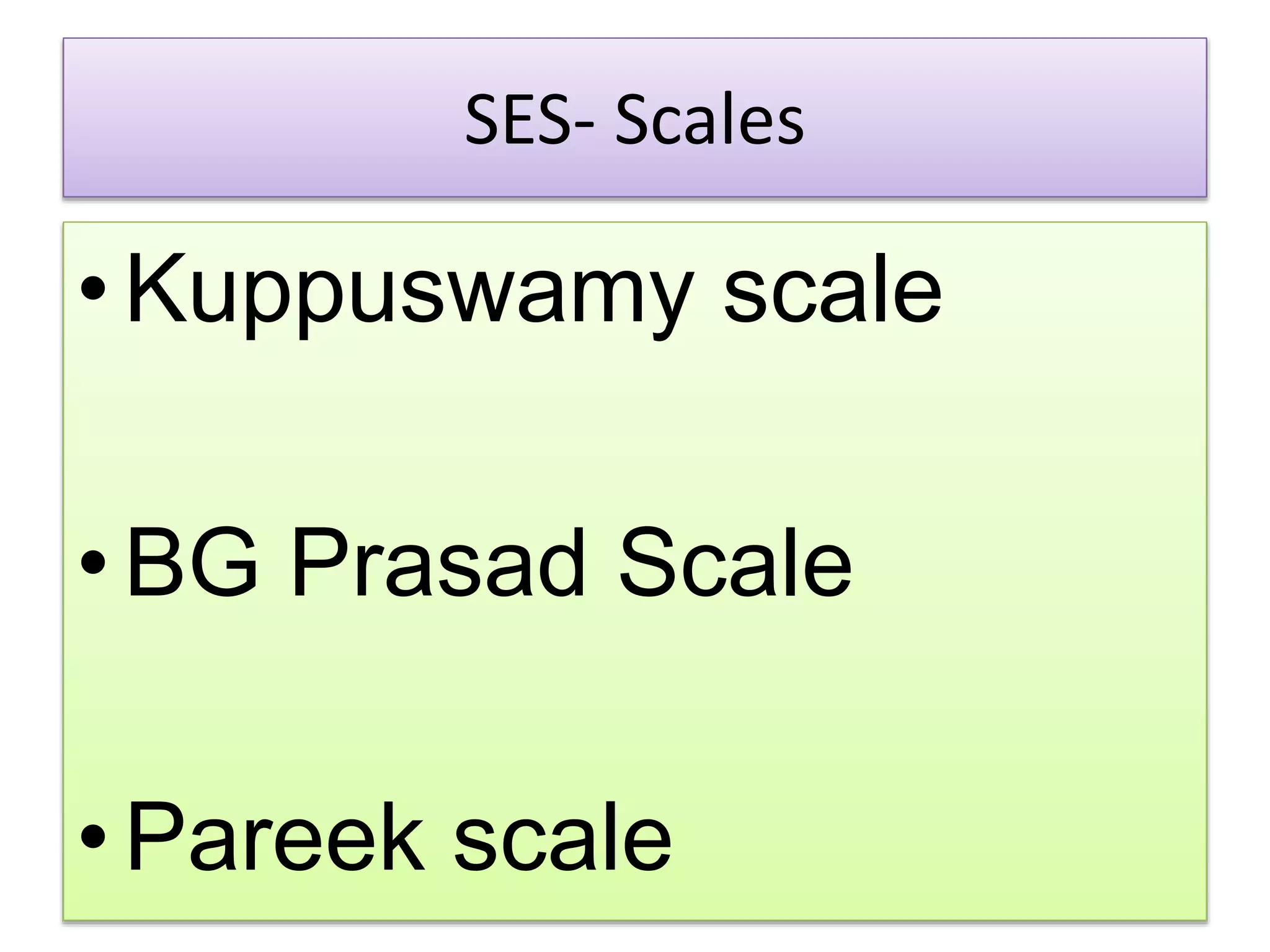
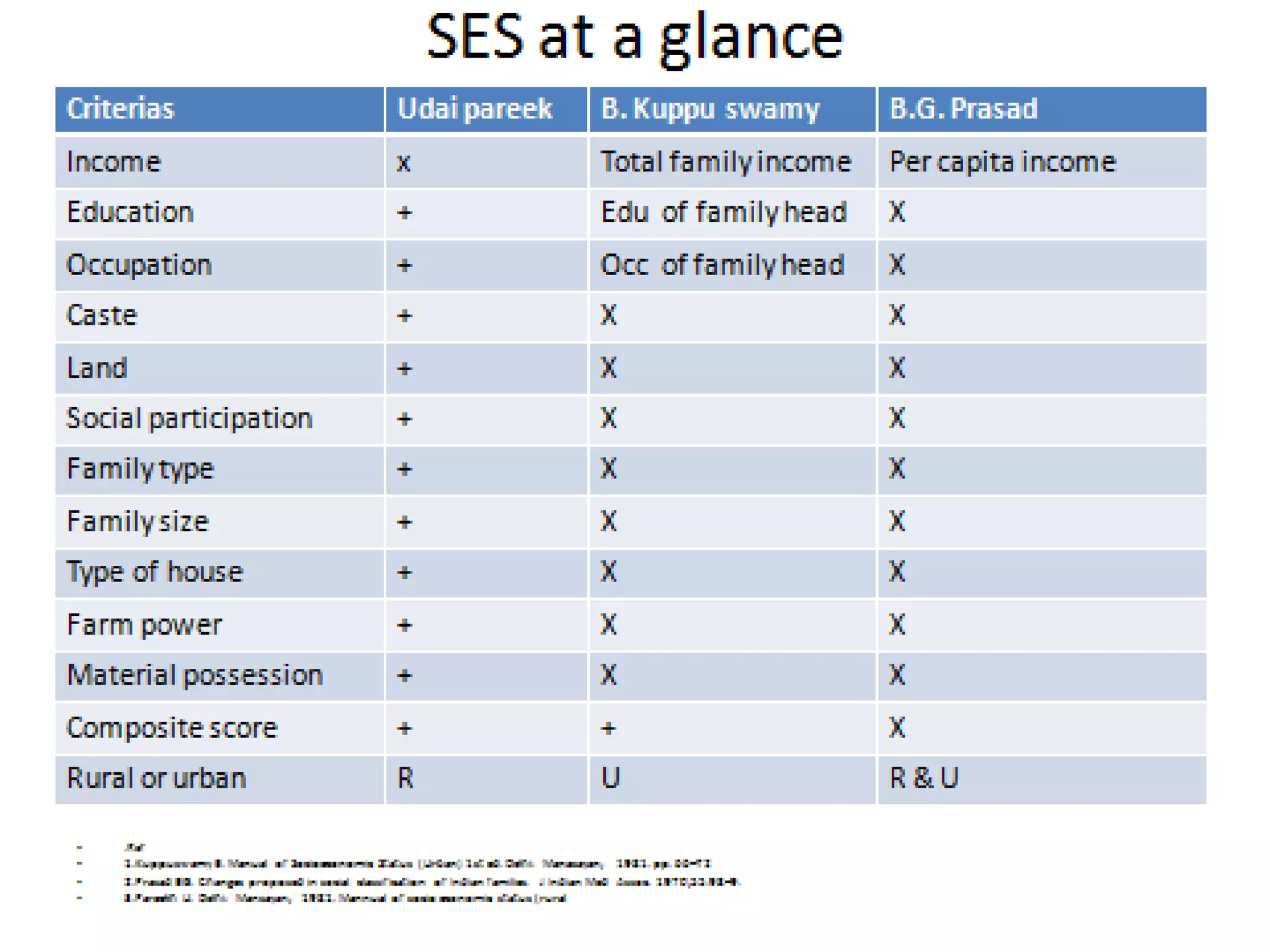
SES- Scales
•Kuppuswamy scale
•BG Prasad Scale
•Pareek scale
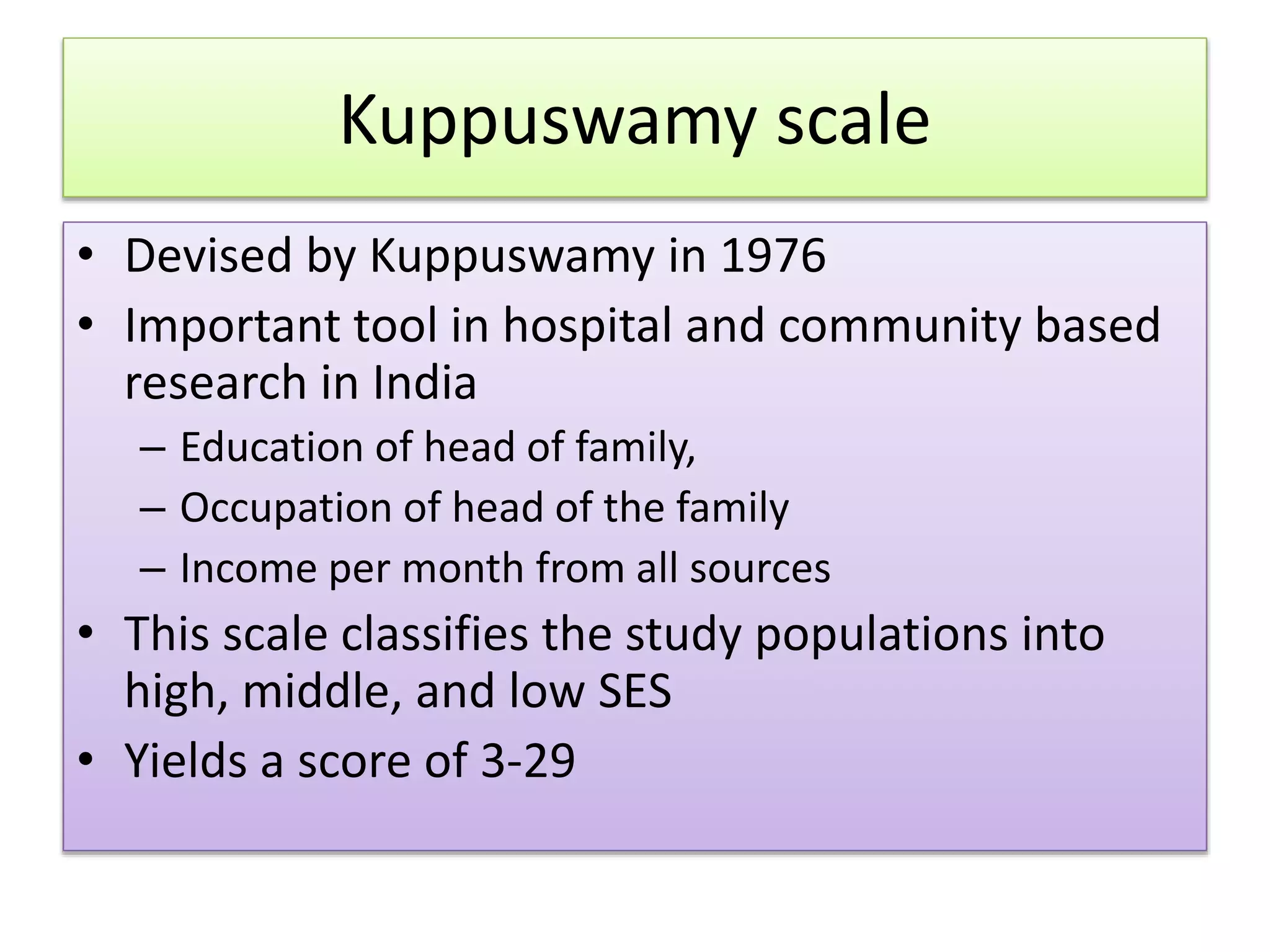
Kuppuswamy scale
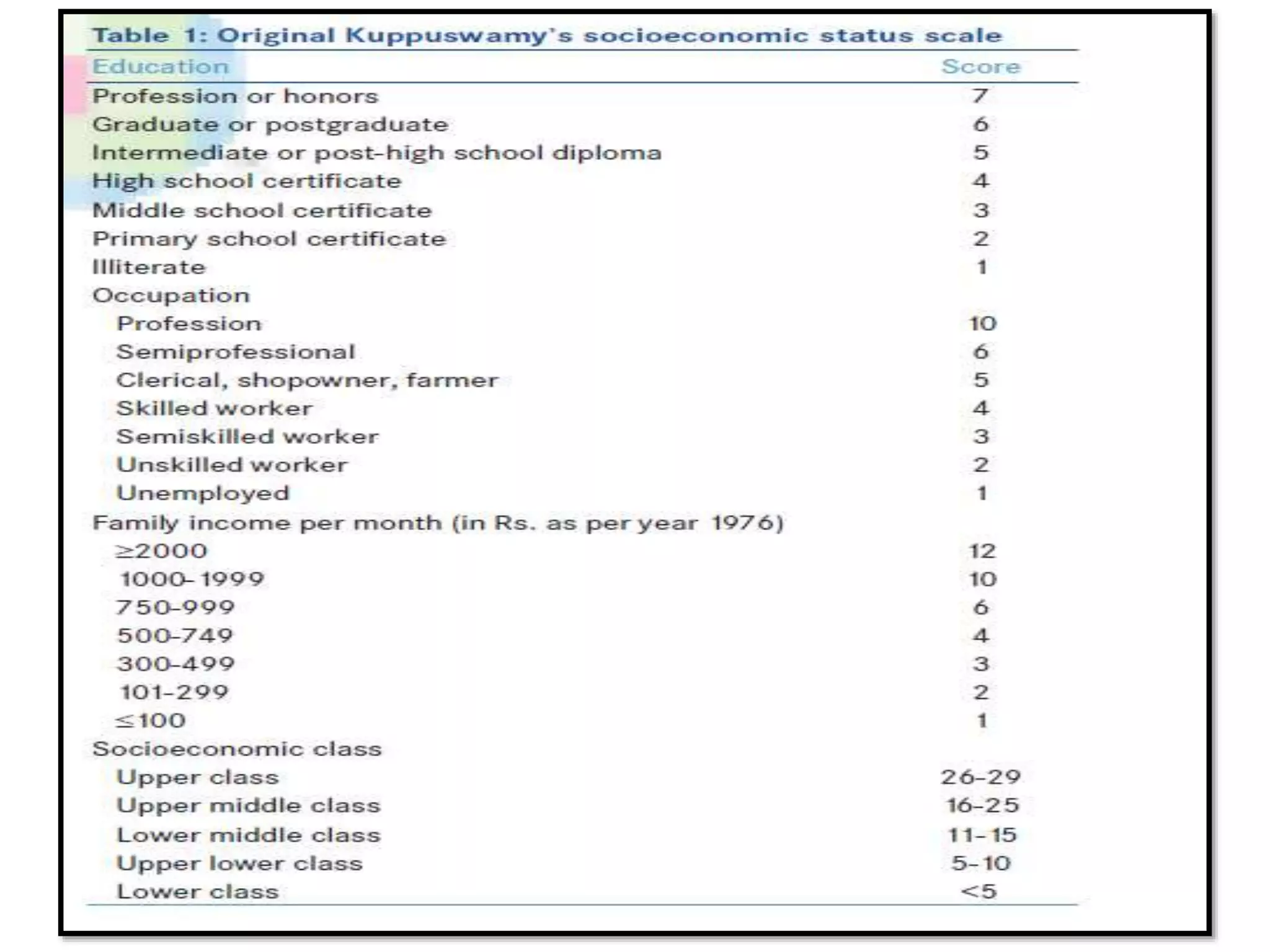
• Devised by Kuppuswamy in 1976
• Important tool in hospital and community based
research in India
– Education of head of family,
– Occupation of head of the family
– Income per month from all sources
• This scale classifies the study populations into
high, middle, and low SES
• Yields a score of 3-29
Why revision ?
• Rupee does not retain the same value each
year
• If it is not revised it will lose its utility.
• Revision is linked to the All India Average
Consumer Price Index for Industrial Workers
(CPI-IW).
• Presently the base year has been changed
from 1982, 2001 to current base year 2016
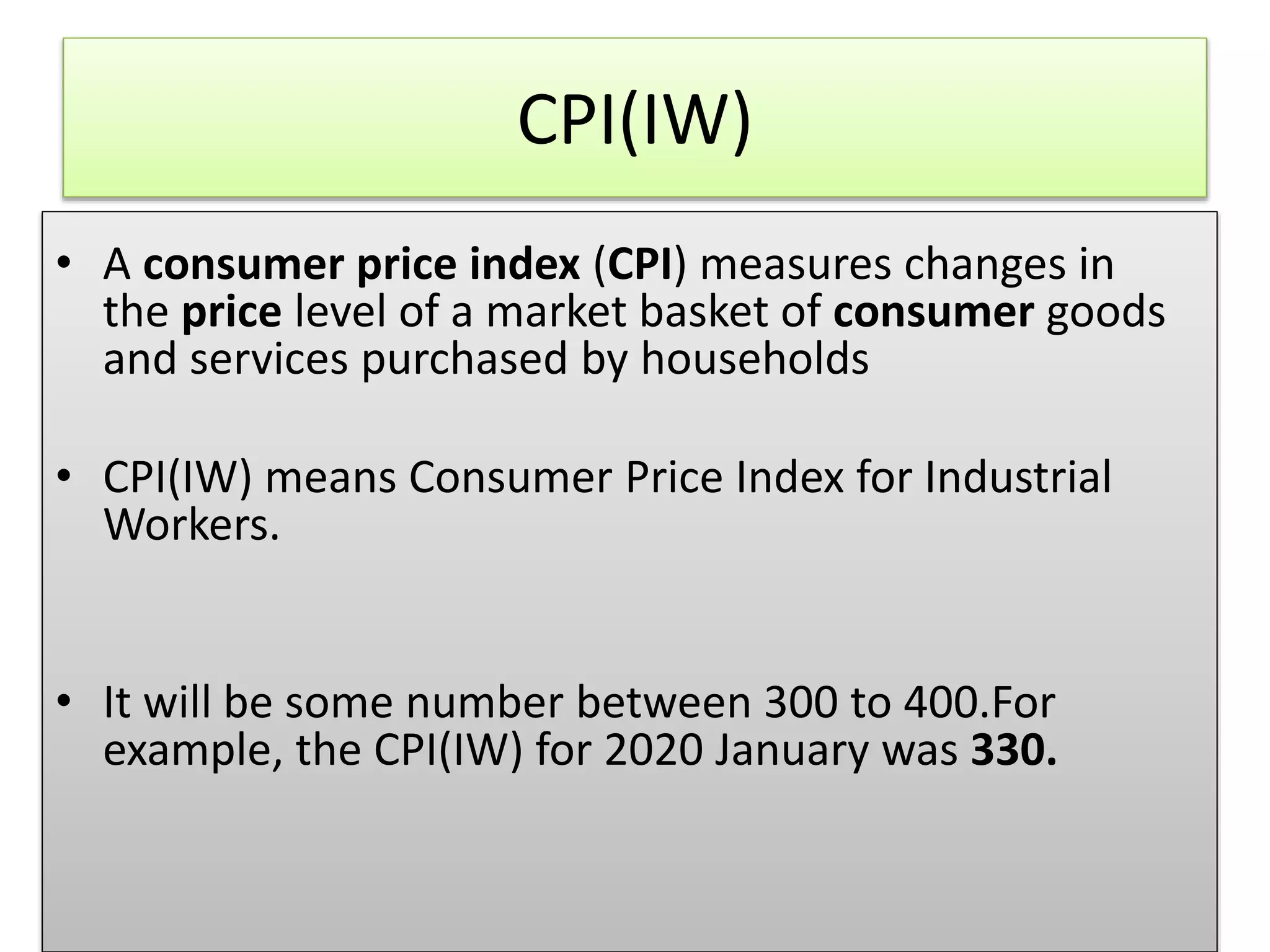
CPI(IW)
• A consumer price index (CPI) measures changes in
the price level of a market basket of consumer goods
and services purchased by households
• CPI(IW) means Consumer Price Index for Industrial
Workers.
• It will be some number between 300 to 400.For
example, the CPI(IW) for 2020 January was 330.
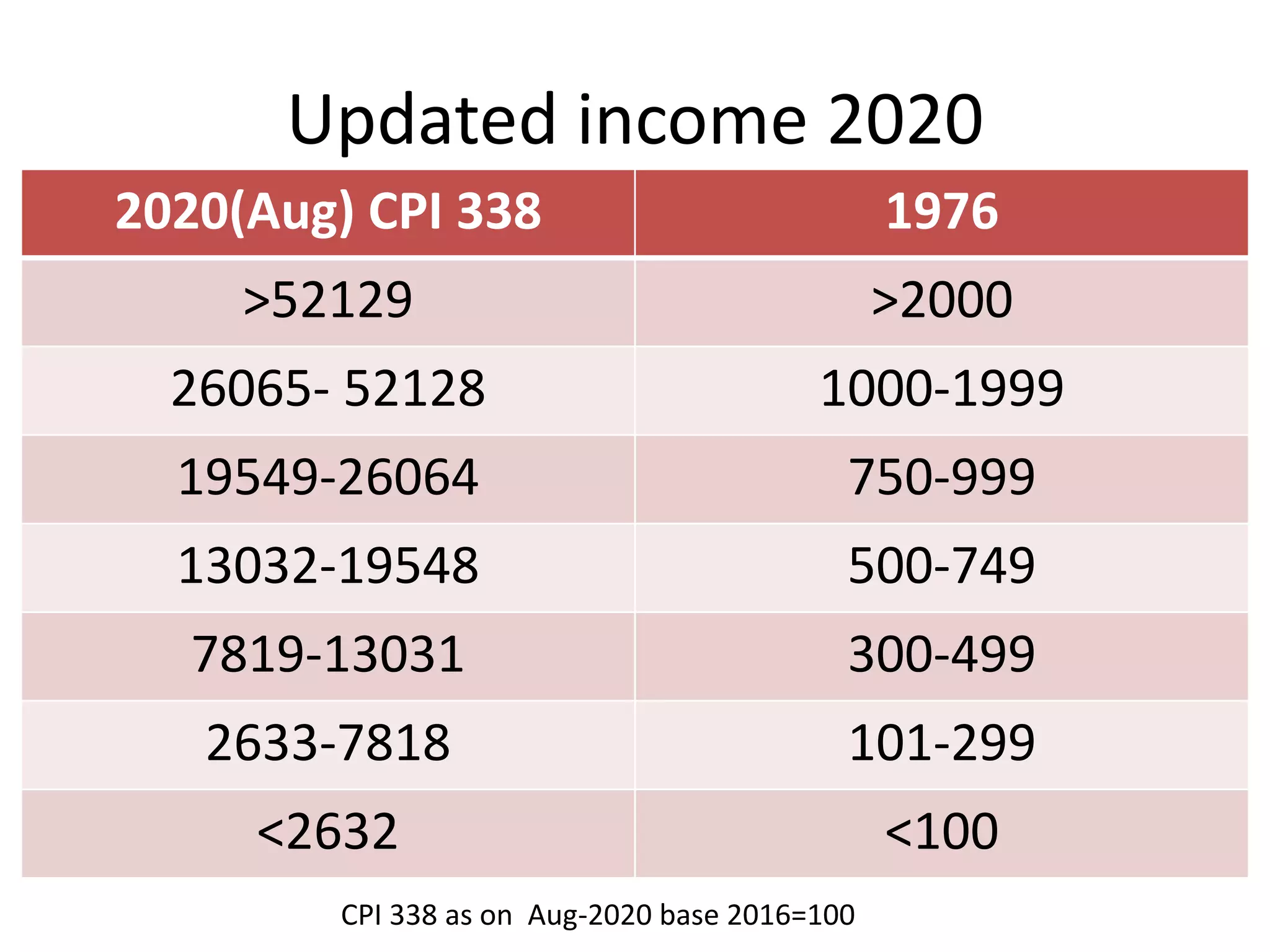
Updated income 2020
2020(Aug) CPI 338 1976
>52129 >2000
26065- 52128 1000-1999
19549-26064 750-999
13032-19548 500-749
7819-13031 300-499
2633-7818 101-299
<2632 <100
CPI 338 as on Aug-2020 base 2016=100
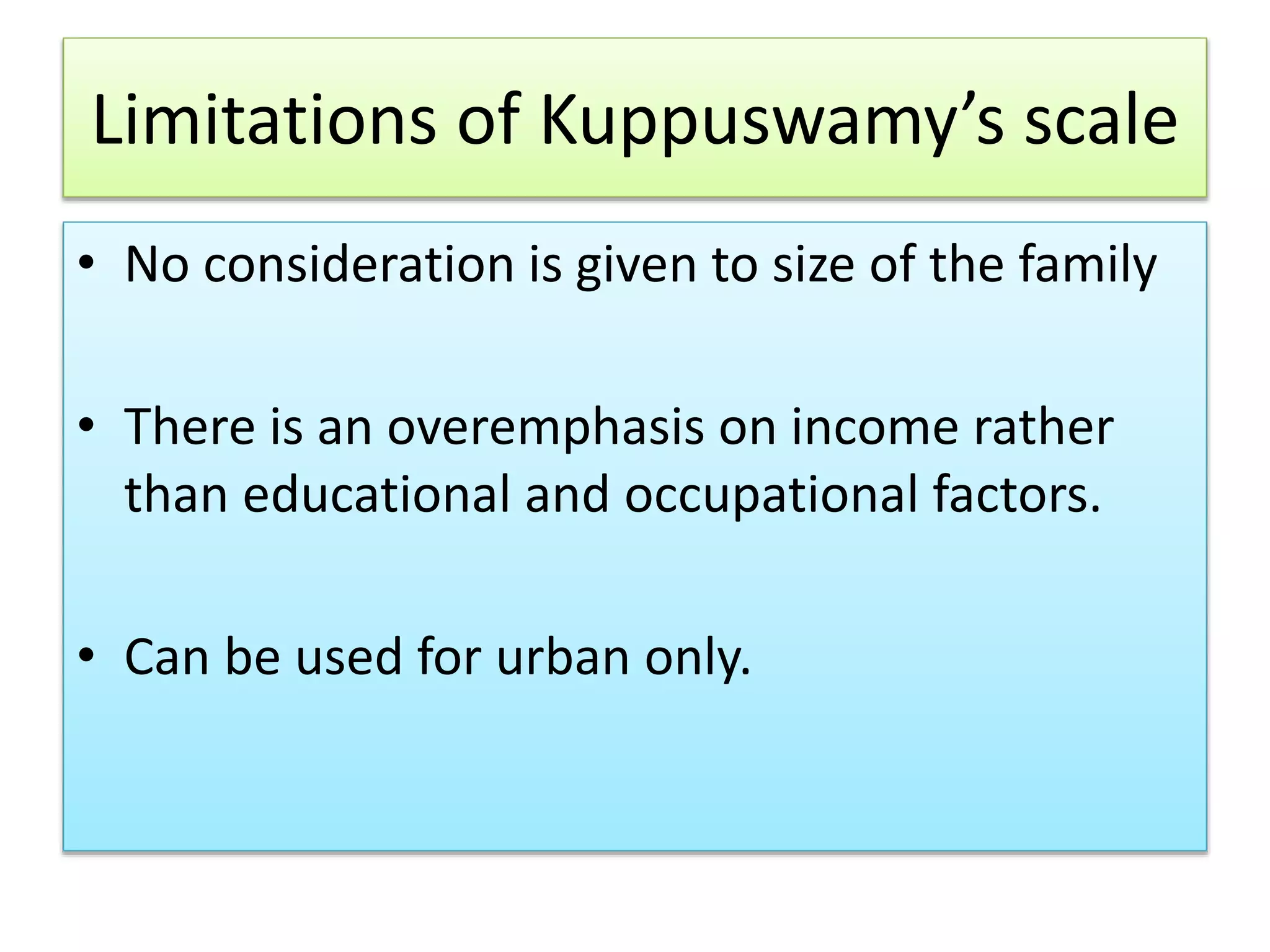
Limitations of Kuppuswamy’s scale
• No consideration is given to size of the family
• There is an overemphasis on income rather
than educational and occupational factors.
• Can be used for urban only.
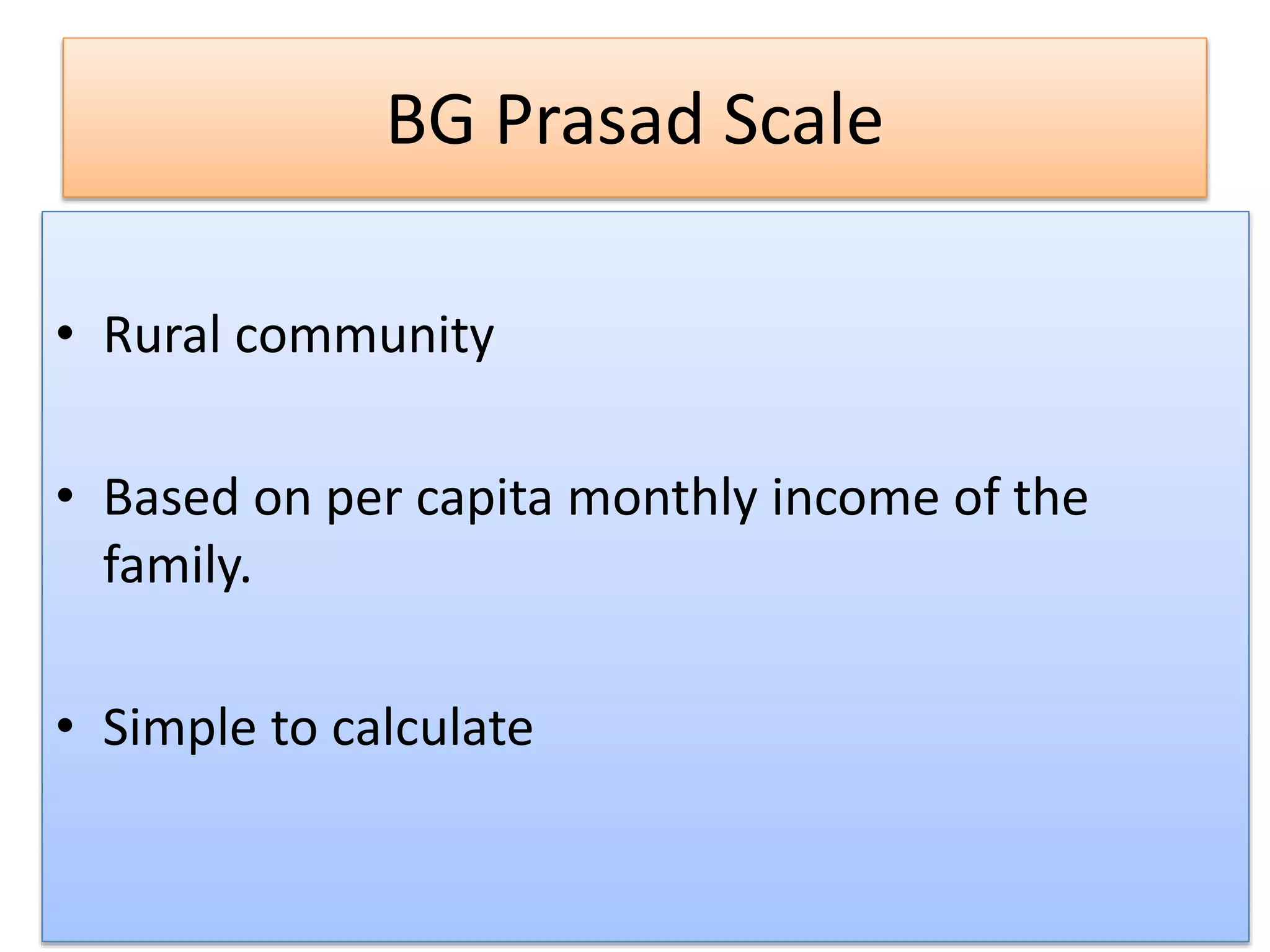
BG Prasad Scale
• Rural community
• Based on per capita monthly income of the
family.
• Simple to calculate
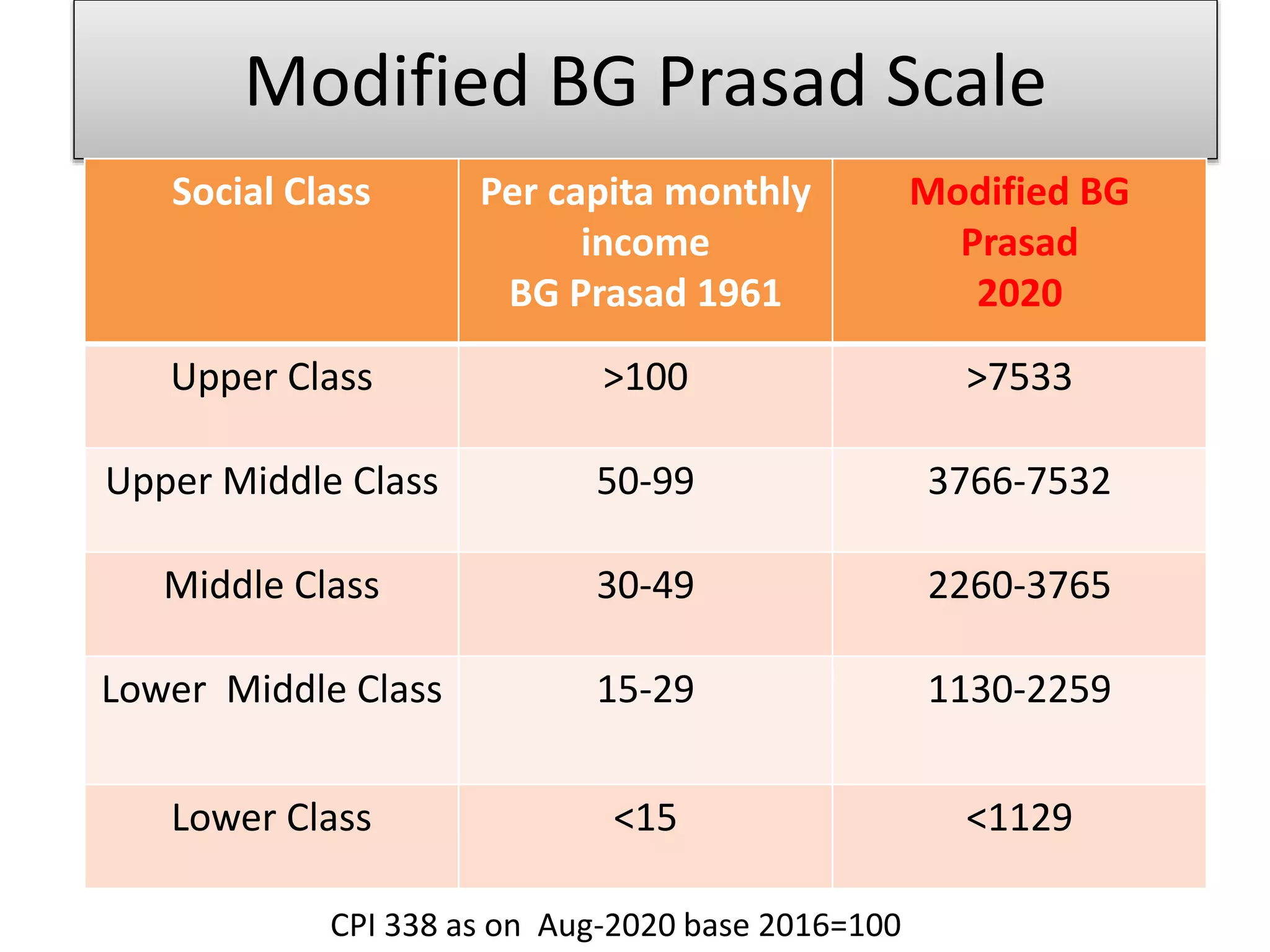
Modified BG Prasad Scale
Social Class Per capita monthly
income
BG Prasad 1961
Modified BG
Prasad
2020
Upper Class >100 >7533
Upper Middle Class 50-99 3766-7532
Middle Class 30-49 2260-3765
Lower Middle Class 15-29 1130-2259
Lower Class <15 <1129
CPI 338 as on Aug-2020 base 2016=100
By Udai Pareek and G. Trivedi (1964)
• Udai Pareek and G. Trivedi (1964) attempts to
examine the socio-economic status for the
rural population only
• This scale consists of a manual and one
information blank
• This scale has nine factors which assess the
socioeconomic status of the individual
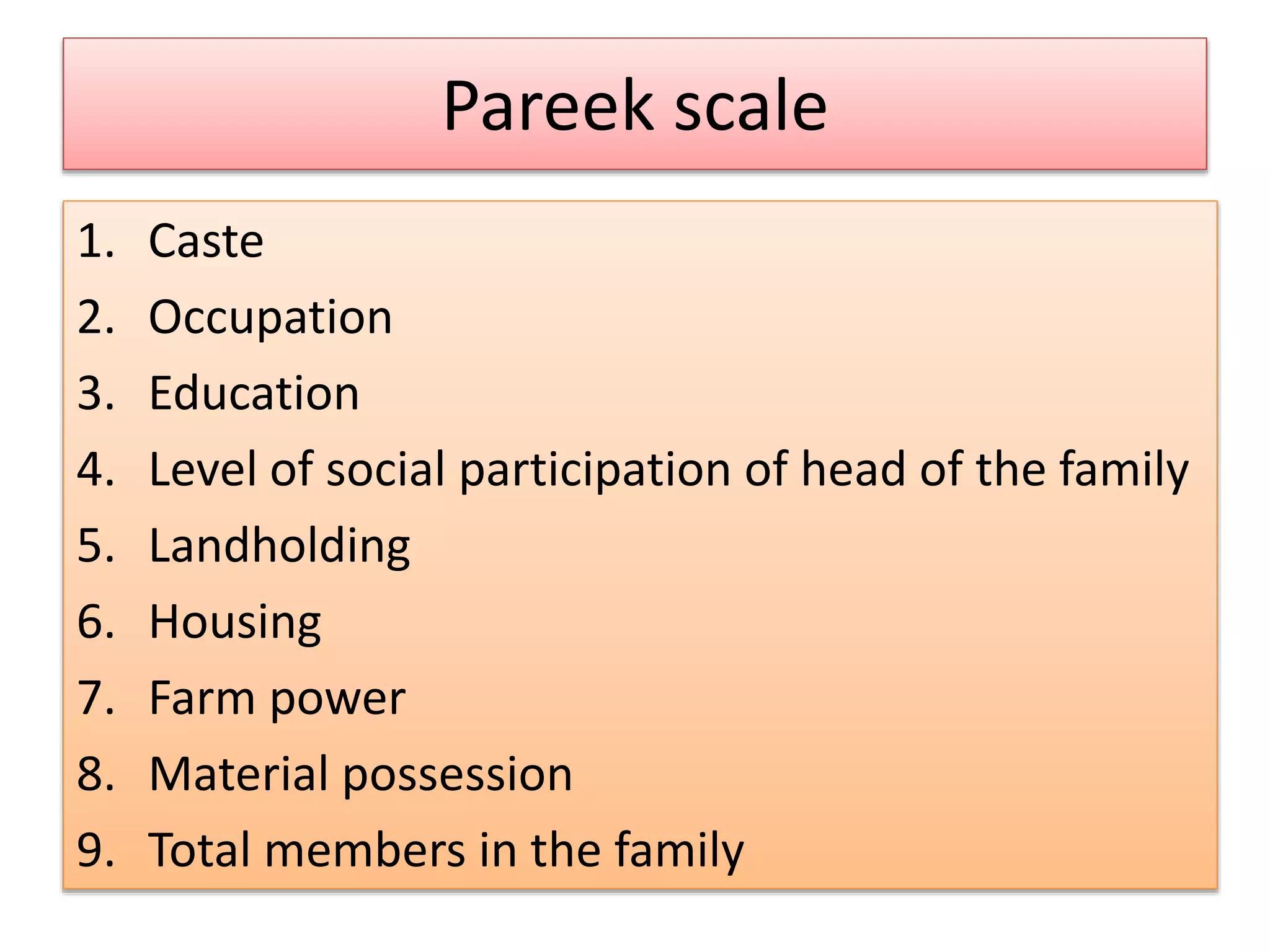
Pareek scale
1. Caste
2. Occupation
3. Education
4. Level of social participation of head of the family
5. Landholding
6. Housing
7. Farm power
8. Material possession
9. Total members in the family
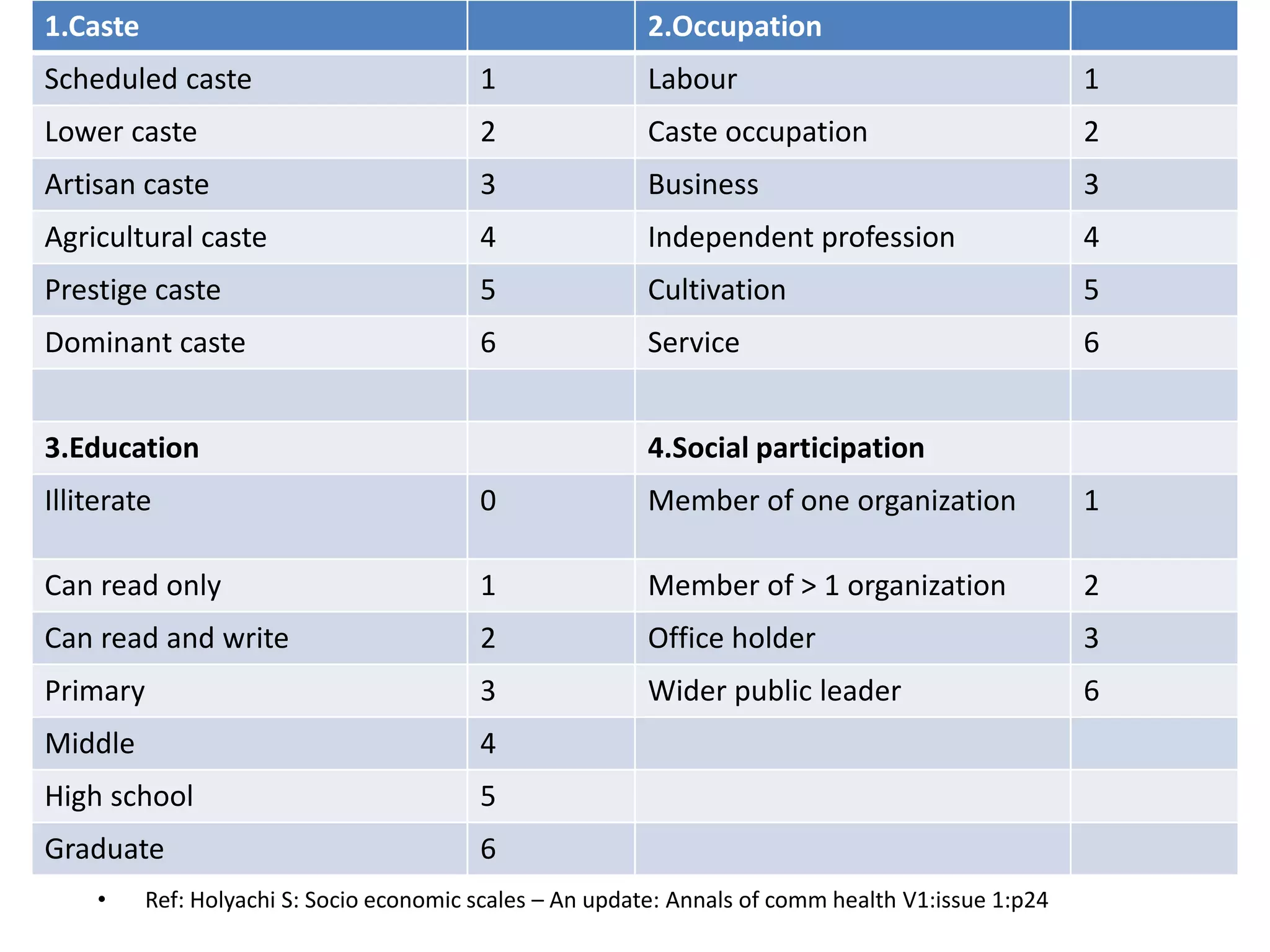
1.Caste 2.Occupation
Scheduled caste 1 Labour 1
Lower caste 2 Caste occupation 2
Artisan caste 3 Business 3
Agricultural caste 4 Independent profession 4
Prestige caste 5 Cultivation 5
Dominant caste 6 Service 6
3.Education 4.Social participation
Illiterate 0 Member of one organization 1
Can read only 1 Member of > 1 organization 2
Can read and write 2 Office holder 3
Primary 3 Wider public leader 6
Middle 4
High school 5
Graduate 6
• Ref: Holyachi S: Socio economic scales – An update: Annals of comm health V1:issue 1:p24
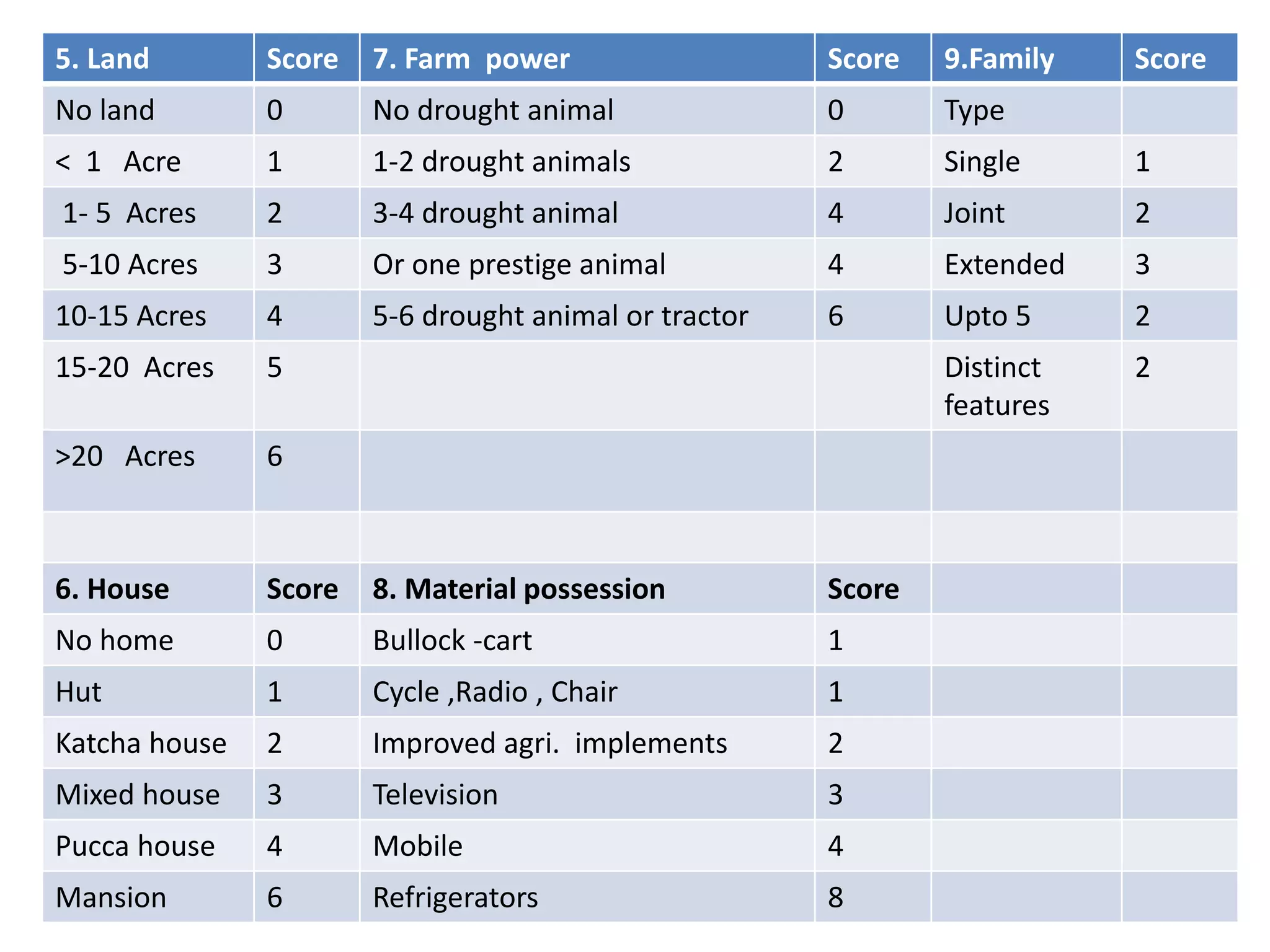
5. Land Score 7. Farm power Score 9.Family Score
No land 0 No drought animal 0 Type
< 1 Acre 1 1-2 drought animals 2 Single 1
1- 5 Acres 2 3-4 drought animal 4 Joint 2
5-10 Acres 3 Or one prestige animal 4 Extended 3
10-15 Acres 4 5-6 drought animal or tractor 6 Upto 5 2
15-20 Acres 5 Distinct
features
2
>20 Acres 6
6. House Score 8. Material possession Score
No home 0 Bullock -cart 1
Hut 1 Cycle ,Radio , Chair 1
Katcha house 2 Improved agri. implements 2
Mixed house 3 Television 3
Pucca house 4 Mobile 4
Mansion 6 Refrigerators 8
Scoring
• After filling the information ,and scoring the
individual items, the total score is summed up.
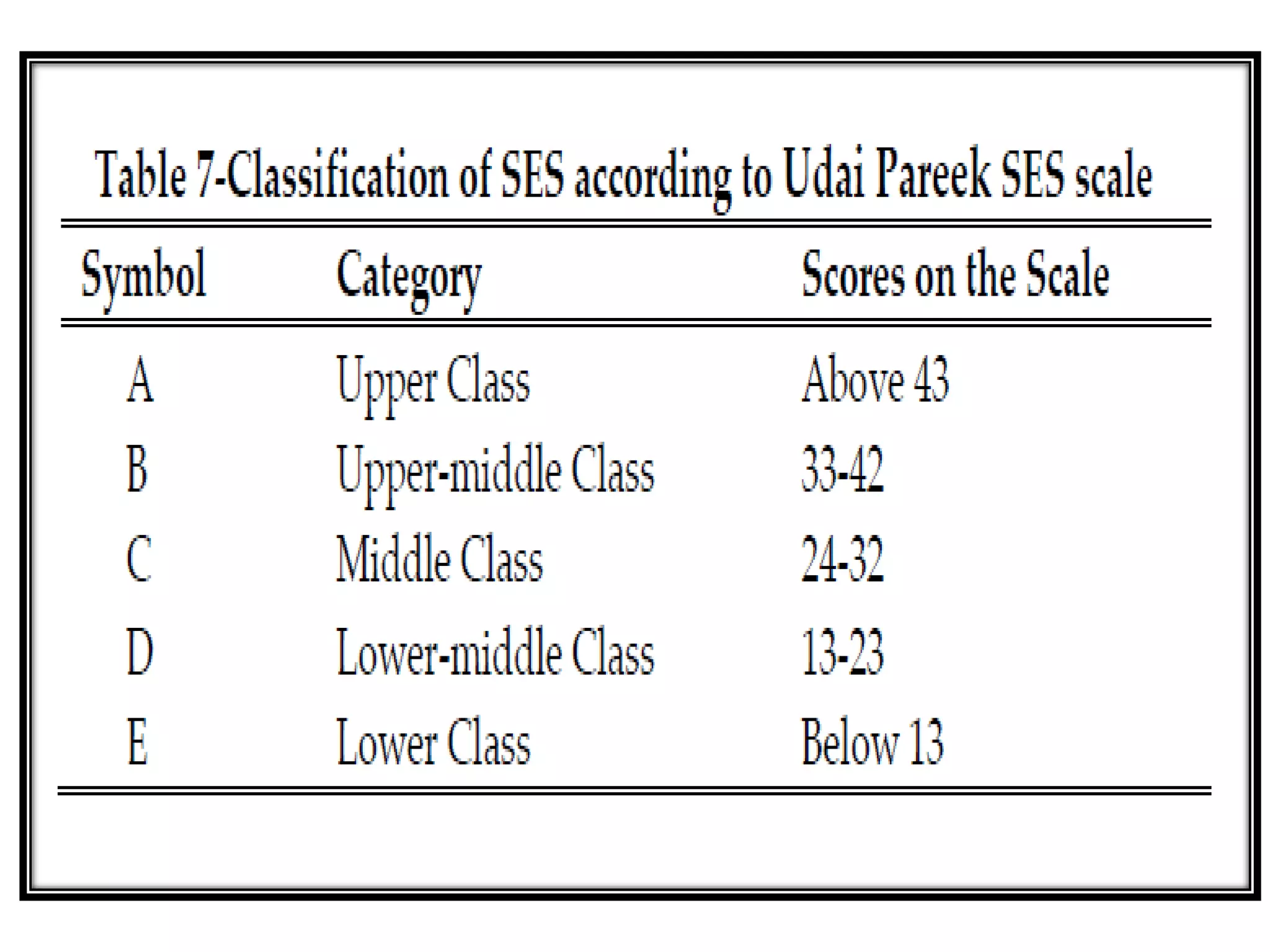
• With the help of the key provided in the
manual, total score is interpreteding terms of
the class.
Limitations
• This scale does not emphasize the income
aspect and can only be used for rural subjects
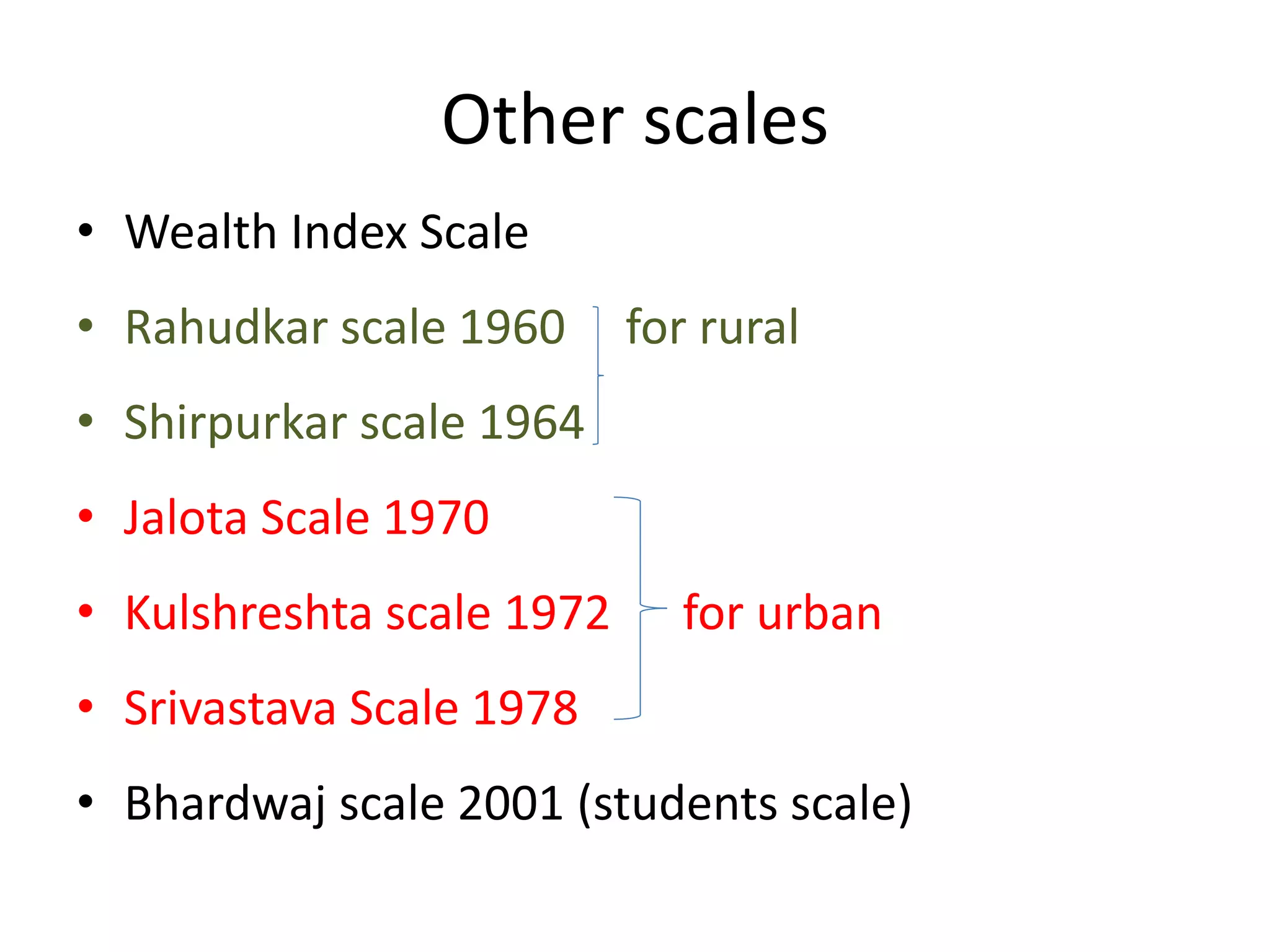
• Wealth Index Scale
• Rahudkar scale 1960 for rural
• Shirpurkar scale 1964
• Jalota Scale 1970
• Kulshreshta scale 1972 for urban
• Srivastava Scale 1978
• Bhardwaj scale 2001 (students scale)
Other scales
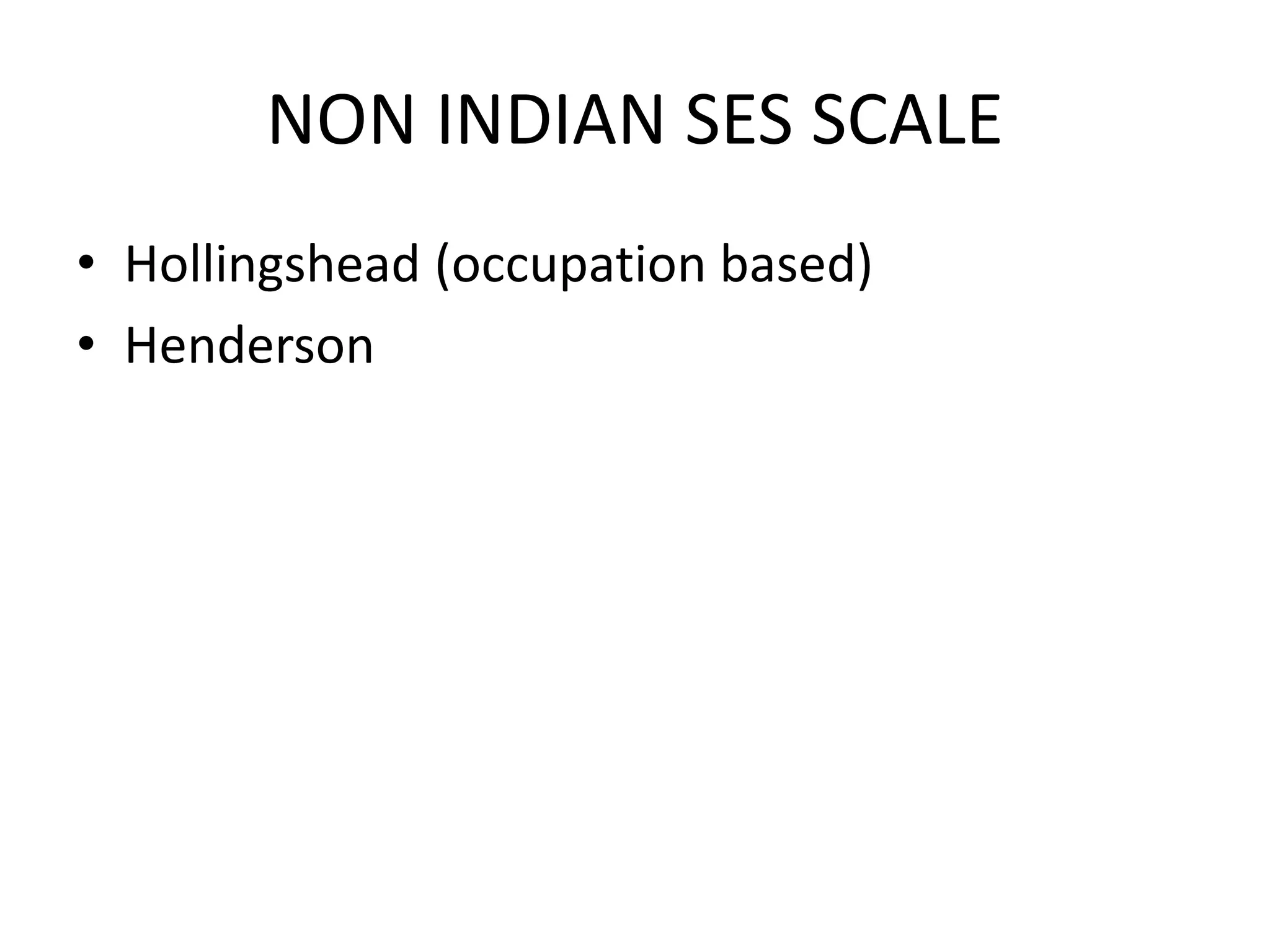
NON INDIAN SES SCALE
• Hollingshead (occupation based)
• Henderson
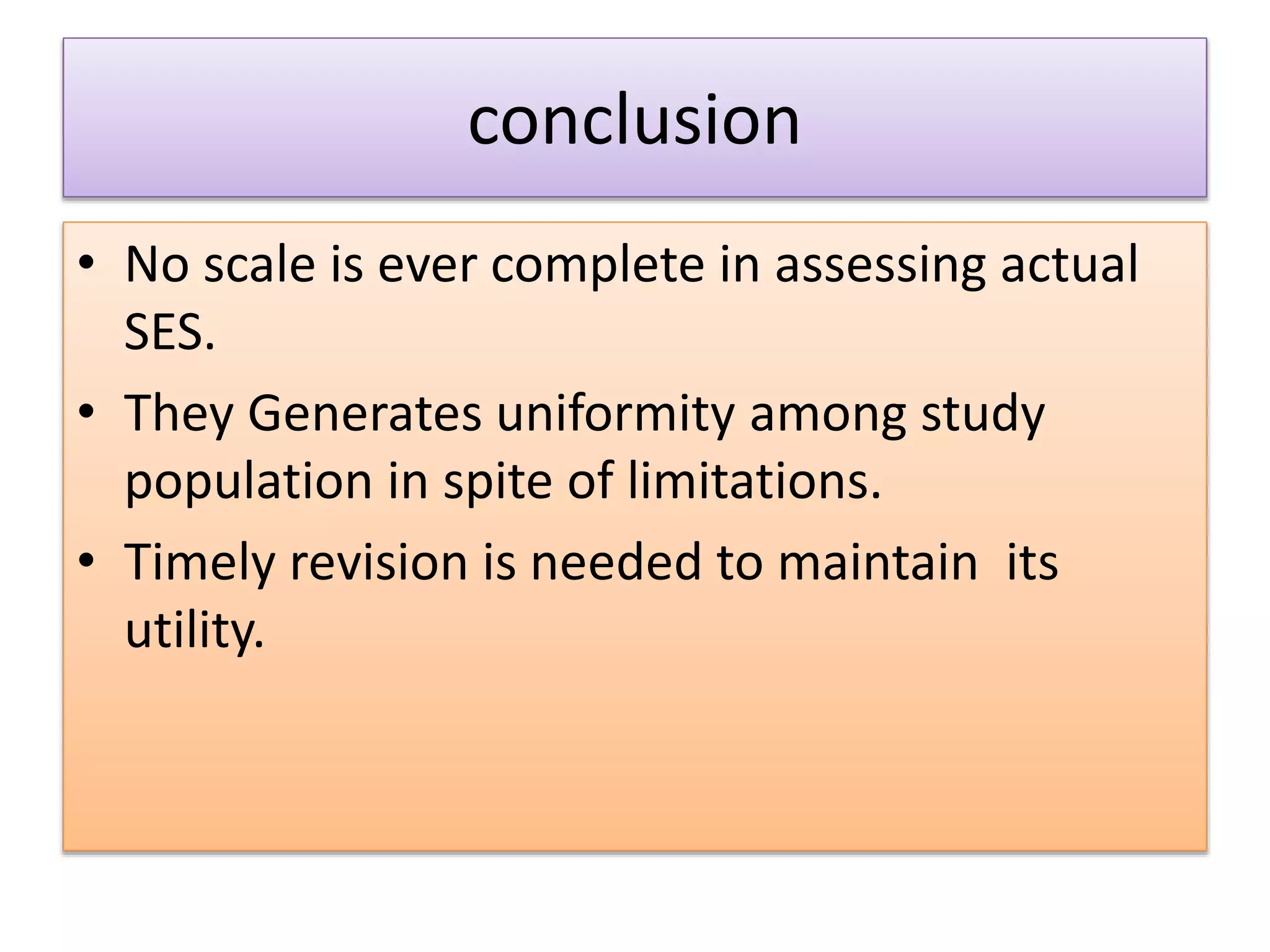
conclusion
• No scale is ever complete in assessing actual
SES.
• They Generates uniformity among study
population in spite of limitations.
• Timely revision is needed to maintain its
utility.
Thank you

Socio economic status scales

  • 1.
    DR VISHAL BATHMA[MBBS, MBA(HA), MD] COMMUNITY MEDICINE Socio-Economic Status Scale 2020 CPI 338 as on Aug-2020 base 2016=100
  • 2.
    Introduction • Socioeconomic status(SES) is an important determinant of health • SES influences accessibility, affordability, acceptability, and actual utilization of available health facilities.
  • 3.
    SES- Scales •Kuppuswamy scale •BGPrasad Scale •Pareek scale
  • 4.
    Kuppuswamy scale • Devisedby Kuppuswamy in 1976 • Important tool in hospital and community based research in India – Education of head of family, – Occupation of head of the family – Income per month from all sources • This scale classifies the study populations into high, middle, and low SES • Yields a score of 3-29
  • 6.
    Why revision ? •Rupee does not retain the same value each year • If it is not revised it will lose its utility. • Revision is linked to the All India Average Consumer Price Index for Industrial Workers (CPI-IW). • Presently the base year has been changed from 1982, 2001 to current base year 2016
  • 7.
    CPI(IW) • A consumerprice index (CPI) measures changes in the price level of a market basket of consumer goods and services purchased by households • CPI(IW) means Consumer Price Index for Industrial Workers. • It will be some number between 300 to 400.For example, the CPI(IW) for 2020 January was 330.
  • 8.
    Updated income 2020 2020(Aug)CPI 338 1976 >52129 >2000 26065- 52128 1000-1999 19549-26064 750-999 13032-19548 500-749 7819-13031 300-499 2633-7818 101-299 <2632 <100 CPI 338 as on Aug-2020 base 2016=100
  • 9.
    Limitations of Kuppuswamy’sscale • No consideration is given to size of the family • There is an overemphasis on income rather than educational and occupational factors. • Can be used for urban only.
  • 10.
    BG Prasad Scale •Rural community • Based on per capita monthly income of the family. • Simple to calculate
  • 11.
    Modified BG PrasadScale Social Class Per capita monthly income BG Prasad 1961 Modified BG Prasad 2020 Upper Class >100 >7533 Upper Middle Class 50-99 3766-7532 Middle Class 30-49 2260-3765 Lower Middle Class 15-29 1130-2259 Lower Class <15 <1129 CPI 338 as on Aug-2020 base 2016=100
  • 12.
    By Udai Pareekand G. Trivedi (1964) • Udai Pareek and G. Trivedi (1964) attempts to examine the socio-economic status for the rural population only • This scale consists of a manual and one information blank • This scale has nine factors which assess the socioeconomic status of the individual
  • 13.
    Pareek scale 1. Caste 2.Occupation 3. Education 4. Level of social participation of head of the family 5. Landholding 6. Housing 7. Farm power 8. Material possession 9. Total members in the family
  • 14.
    1.Caste 2.Occupation Scheduled caste1 Labour 1 Lower caste 2 Caste occupation 2 Artisan caste 3 Business 3 Agricultural caste 4 Independent profession 4 Prestige caste 5 Cultivation 5 Dominant caste 6 Service 6 3.Education 4.Social participation Illiterate 0 Member of one organization 1 Can read only 1 Member of > 1 organization 2 Can read and write 2 Office holder 3 Primary 3 Wider public leader 6 Middle 4 High school 5 Graduate 6 • Ref: Holyachi S: Socio economic scales – An update: Annals of comm health V1:issue 1:p24
  • 15.
    5. Land Score7. Farm power Score 9.Family Score No land 0 No drought animal 0 Type < 1 Acre 1 1-2 drought animals 2 Single 1 1- 5 Acres 2 3-4 drought animal 4 Joint 2 5-10 Acres 3 Or one prestige animal 4 Extended 3 10-15 Acres 4 5-6 drought animal or tractor 6 Upto 5 2 15-20 Acres 5 Distinct features 2 >20 Acres 6 6. House Score 8. Material possession Score No home 0 Bullock -cart 1 Hut 1 Cycle ,Radio , Chair 1 Katcha house 2 Improved agri. implements 2 Mixed house 3 Television 3 Pucca house 4 Mobile 4 Mansion 6 Refrigerators 8
  • 16.
    Scoring • After fillingthe information ,and scoring the individual items, the total score is summed up. • With the help of the key provided in the manual, total score is interpreteding terms of the class.
  • 17.
    Limitations • This scaledoes not emphasize the income aspect and can only be used for rural subjects
  • 20.
    • Wealth IndexScale • Rahudkar scale 1960 for rural • Shirpurkar scale 1964 • Jalota Scale 1970 • Kulshreshta scale 1972 for urban • Srivastava Scale 1978 • Bhardwaj scale 2001 (students scale) Other scales
  • 21.
    NON INDIAN SESSCALE • Hollingshead (occupation based) • Henderson
  • 22.
    conclusion • No scaleis ever complete in assessing actual SES. • They Generates uniformity among study population in spite of limitations. • Timely revision is needed to maintain its utility.
  • 23.