Principles of Communicable
Diseases Epidemiology
Objectives
• Definition of epidemiology
• Definition of communicable diseases
• Importance of studying communicable diseases
epidemiology
• Terminology
• Dynamics of disease transmission (chain of
infection):
– Human reservoir or source
– Modes of transmission
– Susceptible host
Definition of Epidemiology
Epidemiology is the study of the distribution
and determinants of health-related states
and events in populations, and the
application of this study to control health
problems (Last, 1983).
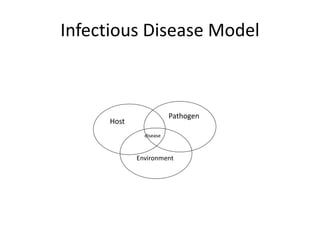
Infectious Disease Model
Host
Pathogen
Environment
disease
Definition of communicable diseases
• A communicable disease is an illness due to a
specific infectious (biological) agent or its toxic
products capable of being directly or indirectly
transmitted from man to man, from animal to
man, from animal to animal, or from the
environment (through air, water, food, etc..) to
man.
Importance of Studying Communicable Diseases
Epidemiology
• Changes of the pattern of infectious diseases
• Discovery of new infections
• The possibility that some chronic diseases
have an infective origin.
Terminology and Definitions
• Infection
• Contamination
• Infestation
• Contagious disease
• Incidence and prevalence of
infectious diseases
• Epidemic
• Endemic
• Pandemic
• Eradication
• Elimination
• Host
• Vector (source)
• Reservoir
• Incubation period
• Latent period
Infection
• Infection is the entry and development or
multiplication of an infectious agent in the body of
man or animals. An infection does not always cause
illness.
contamination
• The presence of an infectious agent on a body
surface, on or in clothes, beddings, toys,
surgical instruments or dressings, or other
articles or substances including water and
food
Infestation
• It is the lodgment, development and
reproduction of arthropods on the surface of
the body or in the clothing, e.g. lice, itch mite.
This term could be also used to describe the
invasion of the gut by parasitic worms, e.g.
ascariasis.
Contagious disease
• A contagious disease is the one that is
transmitted through contact. Examples
include scabies, trachoma, STD and leprosy.
Host
• A person or an animal that affords subsistence
or lodgement to an infectious agent under
natural conditions. Types include: an obligate
host, definitive (primary) host, intermediate
host and a transport host.
Vector of infection
• An insect or any living carrier that transports
an infectious agent from an infected individual
or its wastes to a susceptible individual or its
food or immediate surroundings. Both
biological and mechanical transmissions are
encountered.
Reservoir
• Any person, animal, arthropod, plant, soil, or
substance, or a combination of these, in which
an infectious agent normally lives and
multiplies, on which it depends primarily for
survival, and where it reproduces itself in such
a manner that it can be transmitted to a
susceptible host. It is the natural habitat of
the infectious agent.
Incidence and prevalence of infectious
diseases
Epidemic
• “The unusual occurrence in a community of
disease, specific health related behavior, or
other health related events clearly in excess of
expected occurrence”
• (epi= upon; demos= people)
• Epidemics can occur upon endemic states too.
Endemic
• It refers to the constant presence of a disease
or infectious agent within a given geographic
area or population group. It is the usual or
expected frequency of disease within a
population.
• (En = in; demos = people)
Eradication and Elimination
• Termination of all transmission of infection by the
extermination of the infectious agent through surveillance
and containment. Eradication is an absolute process, an “all or
none” phenomenon, restricted to termination of infection
from the whole world.
• The term elimination is sometimes used to describe
eradication of a disease from a large geographic region.
Disease which are amenable to elimination in the meantime
are polio, measles and diphtheria.
Incubation and Latent periods
• Incubation period: time from exposure to
development of disease. In other words, the time
interval between invasion by an infectious agent and
the appearance of the first sign or symptom of the
disease in question.
• Latent period: the period between exposure and the
onset of infectiousness (this may be shorter or longer
than the incubation period).
CD- Modes of transmission
• Direct
• Blood-borne or sexual – HIV, Hepatitis B,C
• Inhalation – Tuberculosis, influenza, anthrax
• Food-borne – E.coli, Salmonella,
• Contaminated water- Cholera, rotavirus, Hepatitis A
• Indirect
• Vector-borne- malaria, onchocerciasis, trypanosomiasis
• Formites
• Zoonotic diseases – animal handling and feeding practices
(Mad cow disease, Avian Influenza)
Importance of Communicable Diseases
• Significant burden of disease especially in low
and middle income countries
• Social impact
• Economic impact
• Potential for rapid spread
• Human security concerns
• Intentional use
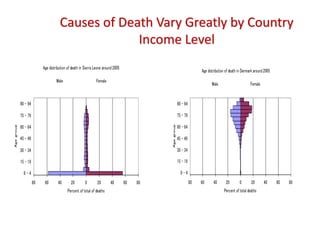
Communicable Diseases account for a
significant global disease burden
• In 2005, CDs accounted for about 30% of the
global BoD and 60% of the BoD in Africa.
• CDs typically affect LIC and MICs
disproportionately.
• Account for 40% of the disease burden in low and
middle income countries
• Most communicable diseases are preventable
or treatable.
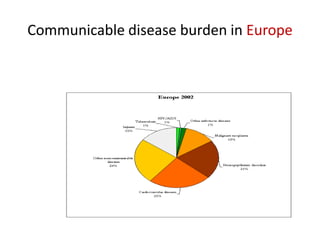
Communicable disease burden in Europe
Causes of Death Vary Greatly by Country
Income Level
Age distribution of death in Denmark around 2005
Male Female
80 60 40 20 0 20 40 60 80
0 - 4
15 - 19
30 - 34
45 - 49
60 - 64
75 - 79
90 - 94
Agegroup
Percent of total deaths
Age distribution of death in Sierra Leone around 2005
Male Female
80 60 40 20 0 20 40 60 80
0 - 4
15 - 19
30 - 34
45 - 49
60 - 64
75 - 79
90 - 94
Agegroup
Percent of total of deaths
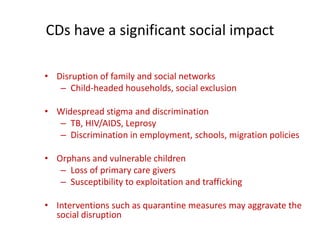
CDs have a significant social impact
• Disruption of family and social networks
– Child-headed households, social exclusion
• Widespread stigma and discrimination
– TB, HIV/AIDS, Leprosy
– Discrimination in employment, schools, migration policies
• Orphans and vulnerable children
– Loss of primary care givers
– Susceptibility to exploitation and trafficking
• Interventions such as quarantine measures may aggravate the
social disruption
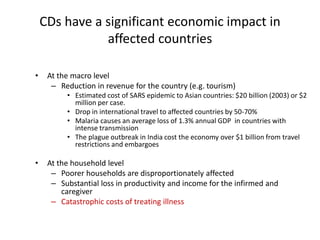
CDs have a significant economic impact in
affected countries
• At the macro level
– Reduction in revenue for the country (e.g. tourism)
• Estimated cost of SARS epidemic to Asian countries: $20 billion (2003) or $2
million per case.
• Drop in international travel to affected countries by 50-70%
• Malaria causes an average loss of 1.3% annual GDP in countries with
intense transmission
• The plague outbreak in India cost the economy over $1 billion from travel
restrictions and embargoes
• At the household level
– Poorer households are disproportionately affected
– Substantial loss in productivity and income for the infirmed and
caregiver
– Catastrophic costs of treating illness
International boundaries are disappearing
• Borders are not very effective at stopping
communicable diseases.
• With increasing globalization
• interdependence of countries – more trade and human/animal
interactions
• The rise in international traffic and commerce makes
challenges even more daunting
• Other global issues affect or are affected by
communicable diseases.
• climate change
• migration
• Change in biodiversity
Human Security concerns
• Potential magnitude and rapid spread of
outbreaks/pandemics. e.g. SARS outbreak
– No country or region can contain a full blown outbreak of
Avian influenza
• Bioterrorism and intentional outbreaks
– Anthrax, Small pox
• New and re-emerging diseases
– Ebola, TB (MDR-TB and XDR-TB), HPAI, Rift valley fever.
Select Communicable Diseases
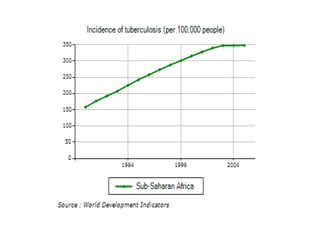
Tuberculosis
• 2 billion people infected with microbes that cause TB.
– Not everyone develops active disease
– A person is infected every second globally
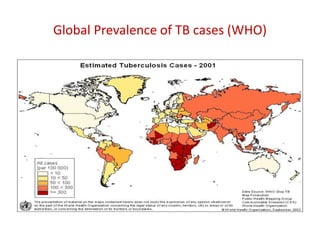
• 22 countries account for 80% of TB cases.
– >50% cases in Asia, 28% in Africa (which also has the
highest per capita prevalence)
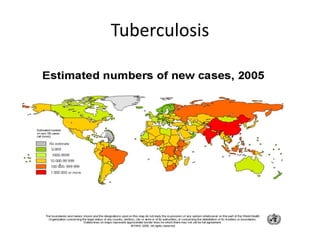
• In 2005, there were 8.8 million new TB cases; 1.6 million
deaths from TB (about 4400 a day)
• Highly stigmatizing disease
Tuberculosis and HIV
• A third of those living with HIV are co-infected with TB
– About 200,000 people with HIV die annually from TB.
– Most common opportunistic infection in Africa
– 70% of TB patients are co-infected with HIV in some countries in Africa
• Impact of HIV on TB
– TB is harder to diagnose in HIV-positive people.
– TB progresses faster in HIV-infected people.
– TB in HIV-positive people is almost certain to be fatal if undiagnosed
or left untreated.
– TB occurs earlier in the course of HIV infection than many other
opportunistic infections.
Global Prevalence of TB cases (WHO)
Tuberculosis
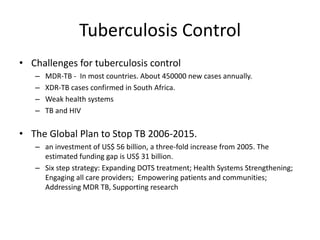
Tuberculosis Control
• Challenges for tuberculosis control
– MDR-TB - In most countries. About 450000 new cases annually.
– XDR-TB cases confirmed in South Africa.
– Weak health systems
– TB and HIV
• The Global Plan to Stop TB 2006-2015.
– an investment of US$ 56 billion, a three-fold increase from 2005. The
estimated funding gap is US$ 31 billion.
– Six step strategy: Expanding DOTS treatment; Health Systems Strengthening;
Engaging all care providers; Empowering patients and communities;
Addressing MDR TB, Supporting research
HIV/AIDS
• In 2005, 38.6 million people worldwide were living
with HIV, of which 24.7 million (two-thirds) lived in
SSA
– 4.1 million people worldwide became newly infected
– 2.8 million people lost their lives to AIDS
• New infections occur predominantly among the 15-
24 age group.
• Previously unknown about 25 years ago. Has affected
over 60 million people so far.
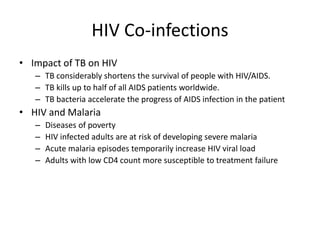
HIV Co-infections
• Impact of TB on HIV
– TB considerably shortens the survival of people with HIV/AIDS.
– TB kills up to half of all AIDS patients worldwide.
– TB bacteria accelerate the progress of AIDS infection in the patient
• HIV and Malaria
– Diseases of poverty
– HIV infected adults are at risk of developing severe malaria
– Acute malaria episodes temporarily increase HIV viral load
– Adults with low CD4 count more susceptible to treatment failure
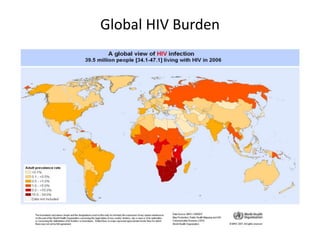
Global HIV Burden
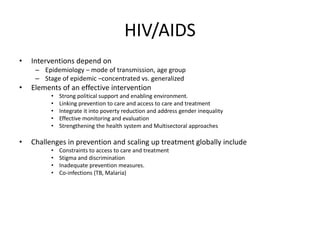
HIV/AIDS
• Interventions depend on
– Epidemiology – mode of transmission, age group
– Stage of epidemic –concentrated vs. generalized
• Elements of an effective intervention
• Strong political support and enabling environment.
• Linking prevention to care and access to care and treatment
• Integrate it into poverty reduction and address gender inequality
• Effective monitoring and evaluation
• Strengthening the health system and Multisectoral approaches
• Challenges in prevention and scaling up treatment globally include
• Constraints to access to care and treatment
• Stigma and discrimination
• Inadequate prevention measures.
• Co-infections (TB, Malaria)
Avian Influenza
• Seasonal influenza causes severe illness in 3-5
million people and 250000 – 500000 deaths
yearly
• 1st H5N1 avian influenza case in Hong Kong in
1997.
• By October 2007 – 331 human cases, 202
deaths.
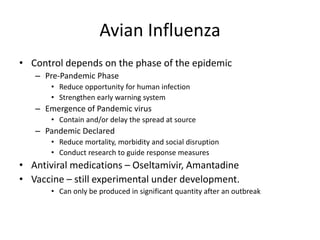
Avian Influenza
• Control depends on the phase of the epidemic
– Pre-Pandemic Phase
• Reduce opportunity for human infection
• Strengthen early warning system
– Emergence of Pandemic virus
• Contain and/or delay the spread at source
– Pandemic Declared
• Reduce mortality, morbidity and social disruption
• Conduct research to guide response measures
• Antiviral medications – Oseltamivir, Amantadine
• Vaccine – still experimental under development.
• Can only be produced in significant quantity after an outbreak
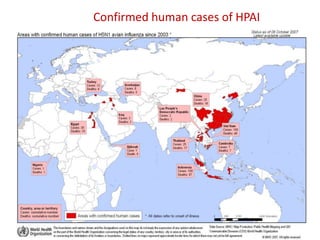
Confirmed human cases of HPAI

L2 epi studies on com dx in hk

  • 1.
  • 2.
    Objectives • Definition ofepidemiology • Definition of communicable diseases • Importance of studying communicable diseases epidemiology • Terminology • Dynamics of disease transmission (chain of infection): – Human reservoir or source – Modes of transmission – Susceptible host
  • 3.
    Definition of Epidemiology Epidemiologyis the study of the distribution and determinants of health-related states and events in populations, and the application of this study to control health problems (Last, 1983).
  • 4.
  • 5.
    Definition of communicablediseases • A communicable disease is an illness due to a specific infectious (biological) agent or its toxic products capable of being directly or indirectly transmitted from man to man, from animal to man, from animal to animal, or from the environment (through air, water, food, etc..) to man.
  • 6.
    Importance of StudyingCommunicable Diseases Epidemiology • Changes of the pattern of infectious diseases • Discovery of new infections • The possibility that some chronic diseases have an infective origin.
  • 7.
    Terminology and Definitions •Infection • Contamination • Infestation • Contagious disease • Incidence and prevalence of infectious diseases • Epidemic • Endemic • Pandemic • Eradication • Elimination • Host • Vector (source) • Reservoir • Incubation period • Latent period
  • 8.
    Infection • Infection isthe entry and development or multiplication of an infectious agent in the body of man or animals. An infection does not always cause illness.
  • 9.
    contamination • The presenceof an infectious agent on a body surface, on or in clothes, beddings, toys, surgical instruments or dressings, or other articles or substances including water and food
  • 10.
    Infestation • It isthe lodgment, development and reproduction of arthropods on the surface of the body or in the clothing, e.g. lice, itch mite. This term could be also used to describe the invasion of the gut by parasitic worms, e.g. ascariasis.
  • 11.
    Contagious disease • Acontagious disease is the one that is transmitted through contact. Examples include scabies, trachoma, STD and leprosy.
  • 12.
    Host • A personor an animal that affords subsistence or lodgement to an infectious agent under natural conditions. Types include: an obligate host, definitive (primary) host, intermediate host and a transport host.
  • 13.
    Vector of infection •An insect or any living carrier that transports an infectious agent from an infected individual or its wastes to a susceptible individual or its food or immediate surroundings. Both biological and mechanical transmissions are encountered.
  • 14.
    Reservoir • Any person,animal, arthropod, plant, soil, or substance, or a combination of these, in which an infectious agent normally lives and multiplies, on which it depends primarily for survival, and where it reproduces itself in such a manner that it can be transmitted to a susceptible host. It is the natural habitat of the infectious agent.
  • 15.
    Incidence and prevalenceof infectious diseases
  • 16.
    Epidemic • “The unusualoccurrence in a community of disease, specific health related behavior, or other health related events clearly in excess of expected occurrence” • (epi= upon; demos= people) • Epidemics can occur upon endemic states too.
  • 17.
    Endemic • It refersto the constant presence of a disease or infectious agent within a given geographic area or population group. It is the usual or expected frequency of disease within a population. • (En = in; demos = people)
  • 18.
    Eradication and Elimination •Termination of all transmission of infection by the extermination of the infectious agent through surveillance and containment. Eradication is an absolute process, an “all or none” phenomenon, restricted to termination of infection from the whole world. • The term elimination is sometimes used to describe eradication of a disease from a large geographic region. Disease which are amenable to elimination in the meantime are polio, measles and diphtheria.
  • 19.
    Incubation and Latentperiods • Incubation period: time from exposure to development of disease. In other words, the time interval between invasion by an infectious agent and the appearance of the first sign or symptom of the disease in question. • Latent period: the period between exposure and the onset of infectiousness (this may be shorter or longer than the incubation period).
  • 20.
    CD- Modes oftransmission • Direct • Blood-borne or sexual – HIV, Hepatitis B,C • Inhalation – Tuberculosis, influenza, anthrax • Food-borne – E.coli, Salmonella, • Contaminated water- Cholera, rotavirus, Hepatitis A • Indirect • Vector-borne- malaria, onchocerciasis, trypanosomiasis • Formites • Zoonotic diseases – animal handling and feeding practices (Mad cow disease, Avian Influenza)
  • 21.
    Importance of CommunicableDiseases • Significant burden of disease especially in low and middle income countries • Social impact • Economic impact • Potential for rapid spread • Human security concerns • Intentional use
  • 22.
    Communicable Diseases accountfor a significant global disease burden • In 2005, CDs accounted for about 30% of the global BoD and 60% of the BoD in Africa. • CDs typically affect LIC and MICs disproportionately. • Account for 40% of the disease burden in low and middle income countries • Most communicable diseases are preventable or treatable.
  • 23.
  • 24.
    Causes of DeathVary Greatly by Country Income Level Age distribution of death in Denmark around 2005 Male Female 80 60 40 20 0 20 40 60 80 0 - 4 15 - 19 30 - 34 45 - 49 60 - 64 75 - 79 90 - 94 Agegroup Percent of total deaths Age distribution of death in Sierra Leone around 2005 Male Female 80 60 40 20 0 20 40 60 80 0 - 4 15 - 19 30 - 34 45 - 49 60 - 64 75 - 79 90 - 94 Agegroup Percent of total of deaths
  • 25.
    CDs have asignificant social impact • Disruption of family and social networks – Child-headed households, social exclusion • Widespread stigma and discrimination – TB, HIV/AIDS, Leprosy – Discrimination in employment, schools, migration policies • Orphans and vulnerable children – Loss of primary care givers – Susceptibility to exploitation and trafficking • Interventions such as quarantine measures may aggravate the social disruption
  • 26.
    CDs have asignificant economic impact in affected countries • At the macro level – Reduction in revenue for the country (e.g. tourism) • Estimated cost of SARS epidemic to Asian countries: $20 billion (2003) or $2 million per case. • Drop in international travel to affected countries by 50-70% • Malaria causes an average loss of 1.3% annual GDP in countries with intense transmission • The plague outbreak in India cost the economy over $1 billion from travel restrictions and embargoes • At the household level – Poorer households are disproportionately affected – Substantial loss in productivity and income for the infirmed and caregiver – Catastrophic costs of treating illness
  • 27.
    International boundaries aredisappearing • Borders are not very effective at stopping communicable diseases. • With increasing globalization • interdependence of countries – more trade and human/animal interactions • The rise in international traffic and commerce makes challenges even more daunting • Other global issues affect or are affected by communicable diseases. • climate change • migration • Change in biodiversity
  • 28.
    Human Security concerns •Potential magnitude and rapid spread of outbreaks/pandemics. e.g. SARS outbreak – No country or region can contain a full blown outbreak of Avian influenza • Bioterrorism and intentional outbreaks – Anthrax, Small pox • New and re-emerging diseases – Ebola, TB (MDR-TB and XDR-TB), HPAI, Rift valley fever.
  • 29.
  • 30.
    Tuberculosis • 2 billionpeople infected with microbes that cause TB. – Not everyone develops active disease – A person is infected every second globally • 22 countries account for 80% of TB cases. – >50% cases in Asia, 28% in Africa (which also has the highest per capita prevalence) • In 2005, there were 8.8 million new TB cases; 1.6 million deaths from TB (about 4400 a day) • Highly stigmatizing disease
  • 31.
    Tuberculosis and HIV •A third of those living with HIV are co-infected with TB – About 200,000 people with HIV die annually from TB. – Most common opportunistic infection in Africa – 70% of TB patients are co-infected with HIV in some countries in Africa • Impact of HIV on TB – TB is harder to diagnose in HIV-positive people. – TB progresses faster in HIV-infected people. – TB in HIV-positive people is almost certain to be fatal if undiagnosed or left untreated. – TB occurs earlier in the course of HIV infection than many other opportunistic infections.
  • 32.
    Global Prevalence ofTB cases (WHO)
  • 33.
  • 35.
    Tuberculosis Control • Challengesfor tuberculosis control – MDR-TB - In most countries. About 450000 new cases annually. – XDR-TB cases confirmed in South Africa. – Weak health systems – TB and HIV • The Global Plan to Stop TB 2006-2015. – an investment of US$ 56 billion, a three-fold increase from 2005. The estimated funding gap is US$ 31 billion. – Six step strategy: Expanding DOTS treatment; Health Systems Strengthening; Engaging all care providers; Empowering patients and communities; Addressing MDR TB, Supporting research
  • 36.
    HIV/AIDS • In 2005,38.6 million people worldwide were living with HIV, of which 24.7 million (two-thirds) lived in SSA – 4.1 million people worldwide became newly infected – 2.8 million people lost their lives to AIDS • New infections occur predominantly among the 15- 24 age group. • Previously unknown about 25 years ago. Has affected over 60 million people so far.
  • 37.
    HIV Co-infections • Impactof TB on HIV – TB considerably shortens the survival of people with HIV/AIDS. – TB kills up to half of all AIDS patients worldwide. – TB bacteria accelerate the progress of AIDS infection in the patient • HIV and Malaria – Diseases of poverty – HIV infected adults are at risk of developing severe malaria – Acute malaria episodes temporarily increase HIV viral load – Adults with low CD4 count more susceptible to treatment failure
  • 38.
  • 39.
    HIV/AIDS • Interventions dependon – Epidemiology – mode of transmission, age group – Stage of epidemic –concentrated vs. generalized • Elements of an effective intervention • Strong political support and enabling environment. • Linking prevention to care and access to care and treatment • Integrate it into poverty reduction and address gender inequality • Effective monitoring and evaluation • Strengthening the health system and Multisectoral approaches • Challenges in prevention and scaling up treatment globally include • Constraints to access to care and treatment • Stigma and discrimination • Inadequate prevention measures. • Co-infections (TB, Malaria)
  • 40.
    Avian Influenza • Seasonalinfluenza causes severe illness in 3-5 million people and 250000 – 500000 deaths yearly • 1st H5N1 avian influenza case in Hong Kong in 1997. • By October 2007 – 331 human cases, 202 deaths.
  • 41.
    Avian Influenza • Controldepends on the phase of the epidemic – Pre-Pandemic Phase • Reduce opportunity for human infection • Strengthen early warning system – Emergence of Pandemic virus • Contain and/or delay the spread at source – Pandemic Declared • Reduce mortality, morbidity and social disruption • Conduct research to guide response measures • Antiviral medications – Oseltamivir, Amantadine • Vaccine – still experimental under development. • Can only be produced in significant quantity after an outbreak
  • 42.