CENSUS AND NATIONAL FAMILY
WELFARE SURVEY
PRESENTED BY- NISHA
YADAV
MSC NURSING 1ST YEAR
NINE, PGIMER
CHANDIGARH
OUTLINE
 Demography
 Sources of population data
 Census
 Introduction and objectives
 Features of census
 Methods of census
 History of census in India
 Census 2011
 National Family Health Survey
 Introduction and objectives
 NFHS-1
 NFHS-2
 NFHS-3
CONT….…
 NFHS-4
 NFHS-5
 Sample Registration System (SRS)
 Introduction
 objectives
 Structure of SRS
 District Level Household Survey (DLHS)
 Introduction
 Objectives
 DLHS-1
 DLHS-2
 DLHS-3
LEARNING OBJECTIVES
After completion of class, students will be able to-
 Define demography
 Describe sources of population data
 Define census, enumerate features of census, describe different methods of census
 Describe history of census in India and explain census 2011
 Define National Family Health Survey (NFHS), describe NFHS objectives, NFHS rounds
and explain NFHS-1, NFHS-2, NFHS-3, NFHS-4 and NFHS-5.
 Define Sample Registration System (SRS), explain objectives of SRS & Structure of
SRS.
 Define DLHS (DLHS), describe objectives of DLHS, explain DLHS-1, DLHS-2, DLHS-3
in detail.
DEMOGRAPHY
 Demography is the science of population. It is the statistical study of
population.
 The word 'Demography' is derived from the two Greek words 'Demos' and
'Graphy’ .
 The word Demos means people and graphy mean to write or to study.
 The word 'Demography' was first used by Achille Guillard in 1855 AD in his
book "Elements of human statistics or comparative demography". He is
known as the father of Demography.
SOURCES OF POPULATION DATA
 Primary Sources
 Census
 Vital registration system
 Administrative records
 Sample surveys
 Population register
CENSUS
"A population census is a total process of collecting, compiling,
evaluating, analysing and publishing demographic, economic and
social data pertaining at a specified time to all persons in the
country or in a well delimited territory of the country".
Census simply means the counting of people of a certain area at a
certain time. It is the main source of demographic data. It is
conducted by the government
FEATURES OF CENSUS
 Each individual is enumerated separately; the characteristics of
each person within the household are recorded separately.
 The census covers a precisely defined territory and includes every
person present or residing within its scope.
 Each person and each type of building and living quarters is
enumerated with respect to a well-defined point of time.
 The census is taken at regular defined intervals, usually every 10
years.
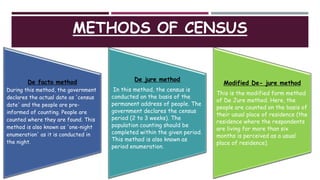
METHODS OF CENSUS
De facto method
During this method, the government
declares the actual date as 'census
date' and the people are pre-
informed of counting. People are
counted where they are found. This
method is also known as 'one-night
enumeration' as it is conducted in
the night.
De jure method
In this method, the census is
conducted on the basis of the
permanent address of people. The
government declares the census
period (2 to 3 weeks). The
population counting should be
completed within the given period.
This method is also known as
period enumeration.
Modified De- jure method
This is the modified form method
of De Jure method. Here, the
people are counted on the basis of
their usual place of residence (the
residence where the respondents
are living for more than six
months is perceived as a usual
place of residence).
OBJECTIVE
 It helps government in forming health related plans,
Annual Plans and various welfare schemes for the benefit
of the common man.
FUNDAMENTAL PURPOSE OF CENSUS
 Provide the facts essential to government for policy-
making, planning and administration.
 Decision-making that facilitates the development of socio-
economic policies -enhance the welfare of the population.
 Provides important data for the analysis and appraisal of
the changing patterns of rural/urban movement and
concentration
 Aids in the decision-making processes of the private sector.
HISTORY OF CENSUS
 Indian census has a rich tradition & enjoys the reputation of
being one of the best in the world. 
 The first census in India was conducted in year 1872.
 In 1881 a census was taken for entire country simultaneously.
Since then census has been conducted every ten year without a
break
CONT…
 The census of 1881 which was undertaken on 17th February, 1881 by
W.C. Plowden, Census Commissioner of India was a great step towards a
modern synchronous census.
 In this census, emphasis was laid not only on complete coverage but also
on classification of demographic, economic and social characteristics.
 The second census was conducted from 26 Feb 1891 almost on the
pattern of 1881 census.
 The question on religion, caste, literacy, occupation etc were further
modified.
CONT…
 The third continuous census was started on 1st march 1901. In this
census, the main change was that the provision for house number was
made in the schedule. Other changes were caste of only Hindus and Jains
were recorded. In pace of foreign language, a new question ‘no or does
not know- English’ was included.
 The census of 1911 was commenced on 18 march 1911. In this census,
the main change in the question was that in place of age the question
asked was ‘age completed last birthday’
 The census of 1921- the sect of Christian which was asked in 1911 was
dropped and information on caste, tribe or race was collected from all
irrespective of their religion
CONT…
 The 6th general census of India commenced on Feb. 26, 1931
 The 7th census of 1941- started under adverse condition of war
 1951 census- 1st census of independent India.
 The next census started on 10 Feb 1961 and ended on sunrise of 1st
march. Two schedules were included in this
o Household schedule for each household
o Individual slip for each individual
 The 11th census 1971- was conducted at different time as compared to
previous censuses to avoid clash with mid-term parliamentary election
includes two phases- house listing and actual enumeration
CONT…
 1981- this census was divided into two parts-
o Part 1 included two new question were added.
o Part 2 included reason for migration
 1991- the scope of house list was enlarged and for the first time a
question regarding type of fuel used for cooking was included, toilet
facilities for rural areas also included.
 2001- the census of 2001 was the first census of 21st century. It was
conducted in 2 phases. During 1st phase, the house listing operations were
conducted and 2nd phase included population enumeration.
CENSUS 2011
 Census 2011 was conducted in two phases: House listing and
Population Enumeration.
 House listing phase began on 1st April 2010.
 It involved collection of information about all building.
 The second population enumeration phase was conducted
between 9 to 28 February 2011.
 Census 2011 marks the first-time biometric information was
collected
 The Indian population increased to 1.21 billion with a decadal
growth of 17.64%.
 Adult literacy rate increased to 74.04% with a decadal growth
of 9.21%.
 The national census survey covered all the 28 states of the
country and 7 union territories including 640 districts, 497
cities, 5676 tehsils and over 6 lakhs villages.
 A total of 2.7 million officials visited households in 7,933
towns and 6 lakhs villages.
 The cost of the exercise was approx. 2200 crore
 Census data was collected in 16 languages and training manual
was prepared in 18 languages.
 The House listing schedule contained 35 questions such as:
• Building number
• Census house number
• Condition of the census house
• Total number of persons in the household
• Name of the head of household
• Ownership status of the house
CONT.…
• Waste water outlet connection
• Bathing facility within the premises
• Availability of kitchen
• Fuel used for cooking
• Availing Banking services, etc.
 The Population enumeration schedule contained 30 questions such as:
• Name of the person
• Relationship to head
• Current marital status
• Age at marriage
• Literacy status
• Status of attendance (Education)
• Highest educational level attained
• Trade or service
• Place of last residence
• Reason for migration, etc.
 The National Population Register household schedule contained 9
questions:
• Name of the person and resident status
• Name of the person as should appear in the population register
• Relationship to head
• Gender
• Date of birth
• Marital status
• Educational qualification
• Occupation/Activity
• Names of father, mother and spouse.
POPULATION
• The population of India on 1 March 2011 was 1,210,193,422. 
India added 181.5 million to its population since 2001.
• India with 2.4% of the world's surface area accounts for
17.5% of its population. Uttar Pradesh is the most populous
state with roughly 200 million people.
• A little over 5 out of 10 Indians live in the six states i.e. Uttar
Pradesh, Maharashtra, Bihar, West Bengal, Andhra Pradesh
and Madhya Pradesh.
LITERACY
• Any one above age 7 who can read and write in any language
with an ability to understand was considered a literate
• Effective literacy rate increased to a total of 74.04% with
82.14% of the males and 65.46% of the females being literate.
• Kerala is the highly literate state with literacy rate of 93.91%
and Bihar is less literate with literacy rate of 63.82%.
• Provisional data from the census was released on 31 March
2011 (and was updated on 20 May 2013)
 Population total-1,210,569,573
 Males-623,121,843
 Female- 587,447,730
 Literacy total-72.99%
 Males-80.89%
 Females-64.64%
 Density of population- 382 persons/sq.km
 Sex ratio per 1000 males, 943 females
 Child sex ratio (0-6 age group) per 1000 males, 919 females
• Positive indications are observed in the achievement in female
literacy
• The total literacy rate in the country raised from 64.83% to
74.04%.
• 15.54 Million households i.e. 6.3% of total population in India have
computers/laptops in their homes with 7.6 Million households having
internet connection
• 14.50 million broadband subscribers as per the Telephone
regulatory Authority of India (TRAI).
• Worrying picture emerges from the decline of the child sex
ratio.
• The Population of India raised from 1028.74 billion to 1210.19
billion
NATIONAL FAMILY HEALTH SURVEY
(NFHS)
 The National Family Health Survey (NFHS) is a large-scale,
multi-round survey conducted in a representative sample of
households throughout India.
 All National Family Health Surveys have been conducted under
the stewardship of the Ministry of Health and Family Welfare,
Government of India, with the International Institute for
Population Sciences, Mumbai, serving as the nodal agency.
NATIONAL FAMILY HEALTH SURVEY
OBJECTIVES
The Objective of conducting the NFHS is to collect information on the
following-
 Fertility
 Maternal and Child Health
 Reproductive Health
 Nutrition
 Anaemia
 Infant and Child Mortality
 Family Planning
NATIONAL FAMILY HEALTH SURVEY
ROUNDS
Total five rounds of survey have been conducted to date. The
below information gives details on the round and the year it was
conducted.
 First Round of NFHS conducted in 1992-93
 Second Round of NFHS conducted in 1998-99
 Third Round of NFHS conducted in 2005-06
 Fourth Round of NFHS conducted in 2015-16
 Fifth Round of NFHS conducted in 2018-19
FIRST NATIONAL FAMILY HEALTH
SURVEY (NFHS-1)
 The First National Family Health Survey (NFHS-1) was conducted
in 1992-93. The survey collected extensive information on
population, health, and nutrition, with an emphasis on women and
young children.
 Eighteen Population Research Centres (PRCs), located in
universities and institutes of national repute, assisted IIPS in all
stages of conducting NFHS-1. All the state-level and national-
level reports for the survey have already been published (48
reports in all).
SECOND NATIONAL FAMILY HEALTH
SURVEY (NFHS-2)
 The Second National Family Health Survey (NFHS-2) was
conducted in 1998-99 in all 26 states of India with added
features on the quality of health and family planning services,
domestic violence, reproductive health, anaemia, the nutrition
of women, and the status of women.
THIRD NATIONAL FAMILY HEALTH
SURVEY (NFHS-3)
 The Third National Family Health Survey (NFHS-3) was carried
out in 2005-2006. Eighteen Research Organizations including five
Population Research Centres carried out the survey in 29 states of
India.
 The funding for NFHS-3 is provided by USAID, DFID, the Bill and
Melinda Gates Foundation, UNICEF, UNFPA, and MOHFW, GOI.
ORC Macro, USA, is providing technical assistance for NFHS-3,
and the National AIDS Control Organization (NACO) and the
National AIDS Research Institute (NARI) are providing technical
assistance for the HIV component.
FOURTH NATIONAL FAMILY HEALTH
SURVEY (NFHS-4)
 The Fourth National Family Health Survey (NFHS-4) was carried out in 2014-2015.
NFHS-4 funding was provided by the Government of India, the United States Agency
for International Development (USAID), the Department for International Development
(DFID), the Bill and Melinda Gates Foundation, UNICEF, the United Nations Population
Fund (UNFPA), and the MacArthur Foundation.
 Technical assistance for the HIV component of the survey was provided by the National
AIDS Control Organization and the National AIDS Research Institute.
 NFHS-4 is the first of the NFHS series that collects data in each of India’s 29 States
and all 7 Union Territories. Also, NFHS-4, for the first time, will provide estimates of
most indicators at the district level for all 640 districts of the country included in the
2011 Census. In NFHS-4, women aged 15-49 years and men aged 15-54 years are
interviewed.
THE SALIENT FINDINGS ARE AS
FOLLOWS
 Fewer children are dying in infancy and early childhood
 Better care for women during pregnancy and childbirth
contributes to reduction of maternal deaths and improved
child
 Overall, women in the First Phase States/Union Territories
are having fewer children.
CONT…
 Full immunization coverage among children age 12-23 months
varies widely in the First Phase States/Union Territories
 Married women are less likely to be using modern family
planning in eight of the First Phase States/Union Territories
 Fewer children under five years of age are now found to be
stunted, showing intake of improved nutrition
CONT…
 Over two-thirds of households in every State/Union Territory
have access to an improved source of drinking water, and more
than 90% of households have access to an improved source of
drinking water in nine of the 15 States/Union Territories -
 Lack of HIV awareness in Indian adults
 Tobacco use among men has fallen from 50 per cent in 2005-
06 to 47 per cent in 2015.
WHAT IS NFHS 5?
National Family Health Survey 5 is the recent round of the survey carried
on by MoH & FW to bring out reliable data on emerging health and family
welfare issues. The coordinating and implementing agencies that are helping
the ministry to bring out this NFHS round are:
 International Institute for Population Sciences, Mumbai
 A group of survey organizations and Population Research Centres
 ICF International is providing technical assistance for the NFHS 5
while the United States Agency for International Development is
providing financial assistance.
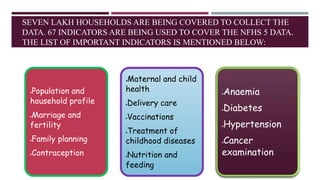
SEVEN LAKH HOUSEHOLDS ARE BEING COVERED TO COLLECT THE
DATA. 67 INDICATORS ARE BEING USED TO COVER THE NFHS 5 DATA.
THE LIST OF IMPORTANT INDICATORS IS MENTIONED BELOW:
Population and
household profile
Marriage and
fertility
Family planning
Contraception
Maternal and child
health
Delivery care
Vaccinations
Treatment of
childhood diseases
Nutrition and
feeding
Anaemia
Diabetes
Hypertension
Cancer
examination
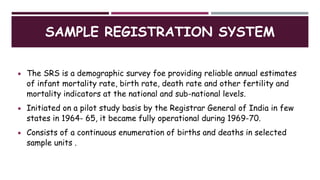
SAMPLE REGISTRATION SYSTEM
 The SRS is a demographic survey foe providing reliable annual estimates
of infant mortality rate, birth rate, death rate and other fertility and
mortality indicators at the national and sub-national levels.
 Initiated on a pilot study basis by the Registrar General of India in few
states in 1964- 65, it became fully operational during 1969-70.
 Consists of a continuous enumeration of births and deaths in selected
sample units .
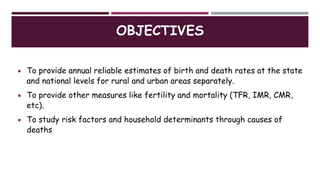
OBJECTIVES
 To provide annual reliable estimates of birth and death rates at the state
and national levels for rural and urban areas separately.
 To provide other measures like fertility and mortality (TFR, IMR, CMR,
etc).
 To study risk factors and household determinants through causes of
deaths
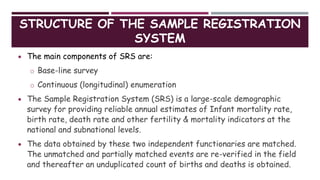
STRUCTURE OF THE SAMPLE REGISTRATION
SYSTEM
 The main components of SRS are:
o Base-line survey
o Continuous (longitudinal) enumeration
 The Sample Registration System (SRS) is a large-scale demographic
survey for providing reliable annual estimates of Infant mortality rate,
birth rate, death rate and other fertility & mortality indicators at the
national and subnational levels.
 The data obtained by these two independent functionaries are matched.
The unmatched and partially matched events are re-verified in the field
and thereafter an unduplicated count of births and deaths is obtained.
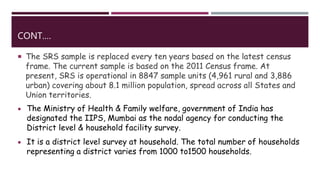
CONT.…
 The SRS sample is replaced every ten years based on the latest census
frame. The current sample is based on the 2011 Census frame. At
present, SRS is operational in 8847 sample units (4,961 rural and 3,886
urban) covering about 8.1 million population, spread across all States and
Union territories.
 The Ministry of Health & Family welfare, government of India has
designated the IIPS, Mumbai as the nodal agency for conducting the
District level & household facility survey.
 It is a district level survey at household. The total number of households
representing a district varies from 1000 to1500 households.
HIGHLIGHTS OF THE DATA
Birth and Death rates
 According to data released in 2018, death and infant mortality rate are at 6.2 and 32 respectively.
 Madhya Pradesh has highest IMR (48) and Nagaland has least (4).
 Chhattisgarh (8) has highest death rate while Delhi (3.3) has least.
 Bihar (26.2) continues to remain on top in terms of birth rate and Andaman & Nicobar (11.2) at
bottom.
DISTRICT LEVEL HOUSEHOLD SURVEY (DLHS)
 The district being the basic nucleus of planning and implementation, and
for decentralize approach
 GoI has been interested in generating district level data on utilization of
the services provided by government health facilities
 To assess people’s perceptions on quality of services. Therefore, it was
decided to undertake the DLHS under the RCH programme in the
country.
DLHS-1
 For administrative convenience, India was divided into 15 regions, and 12 reputed
regional agencies in India including 5 Population Research Centres were selected to
carry out the data collection.
 The district level household survey covered a representative sample of about 1000
households in each district, and all the married women age 15-44 in a household were
interviewed.
 This is the first time that such a large sample survey included men as respondent to
elicit information on their RTI, STI, HIV/AIDS, and their views on family planning were
also sought.
CONT….
 The contents of this report are based on a Tabulation Plan prepared by the nodal agency
as per the recommendation of the Technical Advisory Committee. We hope the report
would provide useful information that could be used in the district planning and for
evaluation of the RCH programme.
 The database generated by the household survey can help Government of India and the
State Governments to identify districts that need special attention in terms of
infrastructure strengthening and social development
DLHS-2
 In Round II, the survey was completed during 2002-04 in 593 districts as per the 2001
Census.
 In addition to the information that was collected in Round I, in Round II some new
dimensions were added such as testing of cooking salt to assess the consumption of salt
fortified with iodine, testing of blood of children (ages below 72 months), adolescents
and pregnant women to assess the level of anaemia and measuring weight of children to
assess the nutritional status.
 The survey was conducted by various Regional Agencies (RAs) and co-ordinated by the
International Institute for Population Sciences (IIPS), Mumbai.
 The district level household survey covered a representative sample of about 1,000
households in each district, and all the married women age 15-44 in the sample
household were interviewed.
DLHS-3
 The District Level Household and Facility Survey (DLHS-3) is a
nationwide survey covering 601 districts from 34 states and union
territories of India.
 This is the third round of the district level household survey which was
conducted during December 2007 to December 2008. The survey was
funded by the Union Ministry of Health and Family Welfare, United
Nations Population Fund (UNFPA) and United Nations Children’s Fund
(UNICEF).
OBJECTIVES OF DLHS-3
The main focus and objectives of DLHS-3 is to provide RCH indicators at the district level
covering the following aspects:
• Coverage of antenatal care and immunization services
• Proportion of institutional/safe deliveries
• JSY beneficiaries
• Contraceptive prevalence rates
• ASHA’s involvement
• Unmet need for family planning
• Awareness about RTI/STI and HIV/AIDS
• Family life education among unmarried adolescent girl
DLHS-3 OBJECTIVES
 The main objectives of the health facility survey are to assess the facilities having
critical inputs as per the norms, and to know the extent of utilization of facilities at
various levels. The health facility survey has been conducted as a companion survey of
the household survey in DLHS-3.
 There were separate questionnaires for each category of health facility, including
questions on infrastructure, human resources, supply of drugs and instruments, and
performance. According to this survey, the average population covered by a Sub-Centre
is 8,372 and for PHC, it is 49,193. About 91percent of the Sub-Centres have ANM in
position and in 58 percent of the cases, ANM is residing in Sub-Centre quarter.
FEATURES OF DLHS-3
 DLHS-3 interviewed ever-married women (aged 15-49). In DLHS-3, along with ever-
married women, unmarried women (aged 15-24) are also included as respondents.
 DLHS-3 adopted a multi-stage stratified probability proportion to size sampling design.
The International Institute for Population Sciences (IIPS) was designated as the nodal
agency for carrying out the survey.
 The data was collected from 7,20,320 households from 34 states and union territories
of India (excluding Nagaland).
 From these households, 6,43,944 ever married women aged 15-49 years and 1,66,260
unmarried women aged 15-24 years were interviewed
 DLHS-3 also collected information regarding facilities available at the Sub-Centre,
Primary Health Centre (PHC), Community Health Centre (CHC) and District Hospital.
CONCLUSION
 Census simply means the counting of people of a certain area at a certain time. It is the main
source of demographic data. There are mainly three methods of conducting census- de jure
method, de facto method and modified de jure method. The main objective of conducting census is
to help in formulating policy making, health related schemes, and programmes, etc.
 The National Family Health Survey (NFHS) is a large-scale, multi-round survey conducted in a
representative sample of households throughout India. The main objectives of NFHS is to collect
information related to fertility, MCH, etc.
 Sample Registration System is the registration of births and deaths is an important source for
demographic data for socio-economic development and population control in developing countries
e.g. India. After independence registration of births and deaths were started on voluntarily basis
but – under-registration – incomplete coverage resulted to no uniformity in statistical returns.
 The district being the basic nucleus of planning and implementation, and for decentralize
approach. The main objectives of the health facility survey are to assess the facilities having
critical inputs as per the norms, and to know the extent of utilization of facilities at various
levels.
REFERENCES
 https://censusindia.gov.in/vital_statistics/srs/sample_registration_system.aspx
 http://rchiips.org/nfhs/
 https://censusindia.gov.in/
 http://rchiips.org/
THANKYOU

Census, NFHS, SRS, DLHS

  • 1.
    CENSUS AND NATIONALFAMILY WELFARE SURVEY PRESENTED BY- NISHA YADAV MSC NURSING 1ST YEAR NINE, PGIMER CHANDIGARH
  • 2.
    OUTLINE  Demography  Sourcesof population data  Census  Introduction and objectives  Features of census  Methods of census  History of census in India  Census 2011  National Family Health Survey  Introduction and objectives  NFHS-1  NFHS-2  NFHS-3
  • 3.
    CONT….…  NFHS-4  NFHS-5 Sample Registration System (SRS)  Introduction  objectives  Structure of SRS  District Level Household Survey (DLHS)  Introduction  Objectives  DLHS-1  DLHS-2  DLHS-3
  • 4.
    LEARNING OBJECTIVES After completionof class, students will be able to-  Define demography  Describe sources of population data  Define census, enumerate features of census, describe different methods of census  Describe history of census in India and explain census 2011  Define National Family Health Survey (NFHS), describe NFHS objectives, NFHS rounds and explain NFHS-1, NFHS-2, NFHS-3, NFHS-4 and NFHS-5.  Define Sample Registration System (SRS), explain objectives of SRS & Structure of SRS.  Define DLHS (DLHS), describe objectives of DLHS, explain DLHS-1, DLHS-2, DLHS-3 in detail.
  • 5.
    DEMOGRAPHY  Demography isthe science of population. It is the statistical study of population.  The word 'Demography' is derived from the two Greek words 'Demos' and 'Graphy’ .  The word Demos means people and graphy mean to write or to study.  The word 'Demography' was first used by Achille Guillard in 1855 AD in his book "Elements of human statistics or comparative demography". He is known as the father of Demography.
  • 6.
    SOURCES OF POPULATIONDATA  Primary Sources  Census  Vital registration system  Administrative records  Sample surveys  Population register
  • 7.
    CENSUS "A population censusis a total process of collecting, compiling, evaluating, analysing and publishing demographic, economic and social data pertaining at a specified time to all persons in the country or in a well delimited territory of the country". Census simply means the counting of people of a certain area at a certain time. It is the main source of demographic data. It is conducted by the government
  • 8.
    FEATURES OF CENSUS Each individual is enumerated separately; the characteristics of each person within the household are recorded separately.  The census covers a precisely defined territory and includes every person present or residing within its scope.  Each person and each type of building and living quarters is enumerated with respect to a well-defined point of time.  The census is taken at regular defined intervals, usually every 10 years.
  • 9.
    METHODS OF CENSUS Defacto method During this method, the government declares the actual date as 'census date' and the people are pre- informed of counting. People are counted where they are found. This method is also known as 'one-night enumeration' as it is conducted in the night. De jure method In this method, the census is conducted on the basis of the permanent address of people. The government declares the census period (2 to 3 weeks). The population counting should be completed within the given period. This method is also known as period enumeration. Modified De- jure method This is the modified form method of De Jure method. Here, the people are counted on the basis of their usual place of residence (the residence where the respondents are living for more than six months is perceived as a usual place of residence).
  • 10.
    OBJECTIVE  It helpsgovernment in forming health related plans, Annual Plans and various welfare schemes for the benefit of the common man.
  • 11.
    FUNDAMENTAL PURPOSE OFCENSUS  Provide the facts essential to government for policy- making, planning and administration.  Decision-making that facilitates the development of socio- economic policies -enhance the welfare of the population.  Provides important data for the analysis and appraisal of the changing patterns of rural/urban movement and concentration  Aids in the decision-making processes of the private sector.
  • 12.
    HISTORY OF CENSUS Indian census has a rich tradition & enjoys the reputation of being one of the best in the world.   The first census in India was conducted in year 1872.  In 1881 a census was taken for entire country simultaneously. Since then census has been conducted every ten year without a break
  • 13.
    CONT…  The censusof 1881 which was undertaken on 17th February, 1881 by W.C. Plowden, Census Commissioner of India was a great step towards a modern synchronous census.  In this census, emphasis was laid not only on complete coverage but also on classification of demographic, economic and social characteristics.  The second census was conducted from 26 Feb 1891 almost on the pattern of 1881 census.  The question on religion, caste, literacy, occupation etc were further modified.
  • 14.
    CONT…  The thirdcontinuous census was started on 1st march 1901. In this census, the main change was that the provision for house number was made in the schedule. Other changes were caste of only Hindus and Jains were recorded. In pace of foreign language, a new question ‘no or does not know- English’ was included.  The census of 1911 was commenced on 18 march 1911. In this census, the main change in the question was that in place of age the question asked was ‘age completed last birthday’  The census of 1921- the sect of Christian which was asked in 1911 was dropped and information on caste, tribe or race was collected from all irrespective of their religion
  • 15.
    CONT…  The 6thgeneral census of India commenced on Feb. 26, 1931  The 7th census of 1941- started under adverse condition of war  1951 census- 1st census of independent India.  The next census started on 10 Feb 1961 and ended on sunrise of 1st march. Two schedules were included in this o Household schedule for each household o Individual slip for each individual  The 11th census 1971- was conducted at different time as compared to previous censuses to avoid clash with mid-term parliamentary election includes two phases- house listing and actual enumeration
  • 16.
    CONT…  1981- thiscensus was divided into two parts- o Part 1 included two new question were added. o Part 2 included reason for migration  1991- the scope of house list was enlarged and for the first time a question regarding type of fuel used for cooking was included, toilet facilities for rural areas also included.  2001- the census of 2001 was the first census of 21st century. It was conducted in 2 phases. During 1st phase, the house listing operations were conducted and 2nd phase included population enumeration.
  • 17.
    CENSUS 2011  Census2011 was conducted in two phases: House listing and Population Enumeration.  House listing phase began on 1st April 2010.  It involved collection of information about all building.  The second population enumeration phase was conducted between 9 to 28 February 2011.  Census 2011 marks the first-time biometric information was collected
  • 18.
     The Indianpopulation increased to 1.21 billion with a decadal growth of 17.64%.  Adult literacy rate increased to 74.04% with a decadal growth of 9.21%.  The national census survey covered all the 28 states of the country and 7 union territories including 640 districts, 497 cities, 5676 tehsils and over 6 lakhs villages.
  • 19.
     A totalof 2.7 million officials visited households in 7,933 towns and 6 lakhs villages.  The cost of the exercise was approx. 2200 crore  Census data was collected in 16 languages and training manual was prepared in 18 languages.
  • 20.
     The Houselisting schedule contained 35 questions such as: • Building number • Census house number • Condition of the census house • Total number of persons in the household • Name of the head of household • Ownership status of the house
  • 21.
    CONT.… • Waste wateroutlet connection • Bathing facility within the premises • Availability of kitchen • Fuel used for cooking • Availing Banking services, etc.
  • 22.
     The Populationenumeration schedule contained 30 questions such as: • Name of the person • Relationship to head • Current marital status • Age at marriage • Literacy status • Status of attendance (Education) • Highest educational level attained • Trade or service • Place of last residence • Reason for migration, etc.
  • 23.
     The NationalPopulation Register household schedule contained 9 questions: • Name of the person and resident status • Name of the person as should appear in the population register • Relationship to head • Gender • Date of birth • Marital status • Educational qualification • Occupation/Activity • Names of father, mother and spouse.
  • 24.
    POPULATION • The populationof India on 1 March 2011 was 1,210,193,422.  India added 181.5 million to its population since 2001. • India with 2.4% of the world's surface area accounts for 17.5% of its population. Uttar Pradesh is the most populous state with roughly 200 million people. • A little over 5 out of 10 Indians live in the six states i.e. Uttar Pradesh, Maharashtra, Bihar, West Bengal, Andhra Pradesh and Madhya Pradesh.
  • 25.
    LITERACY • Any oneabove age 7 who can read and write in any language with an ability to understand was considered a literate • Effective literacy rate increased to a total of 74.04% with 82.14% of the males and 65.46% of the females being literate. • Kerala is the highly literate state with literacy rate of 93.91% and Bihar is less literate with literacy rate of 63.82%. • Provisional data from the census was released on 31 March 2011 (and was updated on 20 May 2013)
  • 26.
     Population total-1,210,569,573 Males-623,121,843  Female- 587,447,730  Literacy total-72.99%  Males-80.89%  Females-64.64%  Density of population- 382 persons/sq.km  Sex ratio per 1000 males, 943 females  Child sex ratio (0-6 age group) per 1000 males, 919 females
  • 27.
    • Positive indicationsare observed in the achievement in female literacy • The total literacy rate in the country raised from 64.83% to 74.04%. • 15.54 Million households i.e. 6.3% of total population in India have computers/laptops in their homes with 7.6 Million households having internet connection
  • 28.
    • 14.50 millionbroadband subscribers as per the Telephone regulatory Authority of India (TRAI). • Worrying picture emerges from the decline of the child sex ratio. • The Population of India raised from 1028.74 billion to 1210.19 billion
  • 29.
    NATIONAL FAMILY HEALTHSURVEY (NFHS)  The National Family Health Survey (NFHS) is a large-scale, multi-round survey conducted in a representative sample of households throughout India.  All National Family Health Surveys have been conducted under the stewardship of the Ministry of Health and Family Welfare, Government of India, with the International Institute for Population Sciences, Mumbai, serving as the nodal agency.
  • 30.
    NATIONAL FAMILY HEALTHSURVEY OBJECTIVES The Objective of conducting the NFHS is to collect information on the following-  Fertility  Maternal and Child Health  Reproductive Health  Nutrition  Anaemia  Infant and Child Mortality  Family Planning
  • 31.
    NATIONAL FAMILY HEALTHSURVEY ROUNDS Total five rounds of survey have been conducted to date. The below information gives details on the round and the year it was conducted.  First Round of NFHS conducted in 1992-93  Second Round of NFHS conducted in 1998-99  Third Round of NFHS conducted in 2005-06  Fourth Round of NFHS conducted in 2015-16  Fifth Round of NFHS conducted in 2018-19
  • 32.
    FIRST NATIONAL FAMILYHEALTH SURVEY (NFHS-1)  The First National Family Health Survey (NFHS-1) was conducted in 1992-93. The survey collected extensive information on population, health, and nutrition, with an emphasis on women and young children.  Eighteen Population Research Centres (PRCs), located in universities and institutes of national repute, assisted IIPS in all stages of conducting NFHS-1. All the state-level and national- level reports for the survey have already been published (48 reports in all).
  • 33.
    SECOND NATIONAL FAMILYHEALTH SURVEY (NFHS-2)  The Second National Family Health Survey (NFHS-2) was conducted in 1998-99 in all 26 states of India with added features on the quality of health and family planning services, domestic violence, reproductive health, anaemia, the nutrition of women, and the status of women.
  • 34.
    THIRD NATIONAL FAMILYHEALTH SURVEY (NFHS-3)  The Third National Family Health Survey (NFHS-3) was carried out in 2005-2006. Eighteen Research Organizations including five Population Research Centres carried out the survey in 29 states of India.  The funding for NFHS-3 is provided by USAID, DFID, the Bill and Melinda Gates Foundation, UNICEF, UNFPA, and MOHFW, GOI. ORC Macro, USA, is providing technical assistance for NFHS-3, and the National AIDS Control Organization (NACO) and the National AIDS Research Institute (NARI) are providing technical assistance for the HIV component.
  • 35.
    FOURTH NATIONAL FAMILYHEALTH SURVEY (NFHS-4)  The Fourth National Family Health Survey (NFHS-4) was carried out in 2014-2015. NFHS-4 funding was provided by the Government of India, the United States Agency for International Development (USAID), the Department for International Development (DFID), the Bill and Melinda Gates Foundation, UNICEF, the United Nations Population Fund (UNFPA), and the MacArthur Foundation.  Technical assistance for the HIV component of the survey was provided by the National AIDS Control Organization and the National AIDS Research Institute.  NFHS-4 is the first of the NFHS series that collects data in each of India’s 29 States and all 7 Union Territories. Also, NFHS-4, for the first time, will provide estimates of most indicators at the district level for all 640 districts of the country included in the 2011 Census. In NFHS-4, women aged 15-49 years and men aged 15-54 years are interviewed.
  • 36.
    THE SALIENT FINDINGSARE AS FOLLOWS  Fewer children are dying in infancy and early childhood  Better care for women during pregnancy and childbirth contributes to reduction of maternal deaths and improved child  Overall, women in the First Phase States/Union Territories are having fewer children.
  • 37.
    CONT…  Full immunizationcoverage among children age 12-23 months varies widely in the First Phase States/Union Territories  Married women are less likely to be using modern family planning in eight of the First Phase States/Union Territories  Fewer children under five years of age are now found to be stunted, showing intake of improved nutrition
  • 38.
    CONT…  Over two-thirdsof households in every State/Union Territory have access to an improved source of drinking water, and more than 90% of households have access to an improved source of drinking water in nine of the 15 States/Union Territories -  Lack of HIV awareness in Indian adults  Tobacco use among men has fallen from 50 per cent in 2005- 06 to 47 per cent in 2015.
  • 39.
    WHAT IS NFHS5? National Family Health Survey 5 is the recent round of the survey carried on by MoH & FW to bring out reliable data on emerging health and family welfare issues. The coordinating and implementing agencies that are helping the ministry to bring out this NFHS round are:  International Institute for Population Sciences, Mumbai  A group of survey organizations and Population Research Centres  ICF International is providing technical assistance for the NFHS 5 while the United States Agency for International Development is providing financial assistance.
  • 40.
    SEVEN LAKH HOUSEHOLDSARE BEING COVERED TO COLLECT THE DATA. 67 INDICATORS ARE BEING USED TO COVER THE NFHS 5 DATA. THE LIST OF IMPORTANT INDICATORS IS MENTIONED BELOW: Population and household profile Marriage and fertility Family planning Contraception Maternal and child health Delivery care Vaccinations Treatment of childhood diseases Nutrition and feeding Anaemia Diabetes Hypertension Cancer examination
  • 41.
    SAMPLE REGISTRATION SYSTEM The SRS is a demographic survey foe providing reliable annual estimates of infant mortality rate, birth rate, death rate and other fertility and mortality indicators at the national and sub-national levels.  Initiated on a pilot study basis by the Registrar General of India in few states in 1964- 65, it became fully operational during 1969-70.  Consists of a continuous enumeration of births and deaths in selected sample units .
  • 42.
    OBJECTIVES  To provideannual reliable estimates of birth and death rates at the state and national levels for rural and urban areas separately.  To provide other measures like fertility and mortality (TFR, IMR, CMR, etc).  To study risk factors and household determinants through causes of deaths
  • 43.
    STRUCTURE OF THESAMPLE REGISTRATION SYSTEM  The main components of SRS are: o Base-line survey o Continuous (longitudinal) enumeration  The Sample Registration System (SRS) is a large-scale demographic survey for providing reliable annual estimates of Infant mortality rate, birth rate, death rate and other fertility & mortality indicators at the national and subnational levels.  The data obtained by these two independent functionaries are matched. The unmatched and partially matched events are re-verified in the field and thereafter an unduplicated count of births and deaths is obtained.
  • 44.
    CONT.…  The SRSsample is replaced every ten years based on the latest census frame. The current sample is based on the 2011 Census frame. At present, SRS is operational in 8847 sample units (4,961 rural and 3,886 urban) covering about 8.1 million population, spread across all States and Union territories.  The Ministry of Health & Family welfare, government of India has designated the IIPS, Mumbai as the nodal agency for conducting the District level & household facility survey.  It is a district level survey at household. The total number of households representing a district varies from 1000 to1500 households.
  • 45.
    HIGHLIGHTS OF THEDATA Birth and Death rates  According to data released in 2018, death and infant mortality rate are at 6.2 and 32 respectively.  Madhya Pradesh has highest IMR (48) and Nagaland has least (4).  Chhattisgarh (8) has highest death rate while Delhi (3.3) has least.  Bihar (26.2) continues to remain on top in terms of birth rate and Andaman & Nicobar (11.2) at bottom.
  • 46.
    DISTRICT LEVEL HOUSEHOLDSURVEY (DLHS)  The district being the basic nucleus of planning and implementation, and for decentralize approach  GoI has been interested in generating district level data on utilization of the services provided by government health facilities  To assess people’s perceptions on quality of services. Therefore, it was decided to undertake the DLHS under the RCH programme in the country.
  • 47.
    DLHS-1  For administrativeconvenience, India was divided into 15 regions, and 12 reputed regional agencies in India including 5 Population Research Centres were selected to carry out the data collection.  The district level household survey covered a representative sample of about 1000 households in each district, and all the married women age 15-44 in a household were interviewed.  This is the first time that such a large sample survey included men as respondent to elicit information on their RTI, STI, HIV/AIDS, and their views on family planning were also sought.
  • 48.
    CONT….  The contentsof this report are based on a Tabulation Plan prepared by the nodal agency as per the recommendation of the Technical Advisory Committee. We hope the report would provide useful information that could be used in the district planning and for evaluation of the RCH programme.  The database generated by the household survey can help Government of India and the State Governments to identify districts that need special attention in terms of infrastructure strengthening and social development
  • 49.
    DLHS-2  In RoundII, the survey was completed during 2002-04 in 593 districts as per the 2001 Census.  In addition to the information that was collected in Round I, in Round II some new dimensions were added such as testing of cooking salt to assess the consumption of salt fortified with iodine, testing of blood of children (ages below 72 months), adolescents and pregnant women to assess the level of anaemia and measuring weight of children to assess the nutritional status.  The survey was conducted by various Regional Agencies (RAs) and co-ordinated by the International Institute for Population Sciences (IIPS), Mumbai.  The district level household survey covered a representative sample of about 1,000 households in each district, and all the married women age 15-44 in the sample household were interviewed.
  • 50.
    DLHS-3  The DistrictLevel Household and Facility Survey (DLHS-3) is a nationwide survey covering 601 districts from 34 states and union territories of India.  This is the third round of the district level household survey which was conducted during December 2007 to December 2008. The survey was funded by the Union Ministry of Health and Family Welfare, United Nations Population Fund (UNFPA) and United Nations Children’s Fund (UNICEF).
  • 51.
    OBJECTIVES OF DLHS-3 Themain focus and objectives of DLHS-3 is to provide RCH indicators at the district level covering the following aspects: • Coverage of antenatal care and immunization services • Proportion of institutional/safe deliveries • JSY beneficiaries • Contraceptive prevalence rates • ASHA’s involvement • Unmet need for family planning • Awareness about RTI/STI and HIV/AIDS • Family life education among unmarried adolescent girl
  • 52.
    DLHS-3 OBJECTIVES  Themain objectives of the health facility survey are to assess the facilities having critical inputs as per the norms, and to know the extent of utilization of facilities at various levels. The health facility survey has been conducted as a companion survey of the household survey in DLHS-3.  There were separate questionnaires for each category of health facility, including questions on infrastructure, human resources, supply of drugs and instruments, and performance. According to this survey, the average population covered by a Sub-Centre is 8,372 and for PHC, it is 49,193. About 91percent of the Sub-Centres have ANM in position and in 58 percent of the cases, ANM is residing in Sub-Centre quarter.
  • 53.
    FEATURES OF DLHS-3 DLHS-3 interviewed ever-married women (aged 15-49). In DLHS-3, along with ever- married women, unmarried women (aged 15-24) are also included as respondents.  DLHS-3 adopted a multi-stage stratified probability proportion to size sampling design. The International Institute for Population Sciences (IIPS) was designated as the nodal agency for carrying out the survey.  The data was collected from 7,20,320 households from 34 states and union territories of India (excluding Nagaland).  From these households, 6,43,944 ever married women aged 15-49 years and 1,66,260 unmarried women aged 15-24 years were interviewed  DLHS-3 also collected information regarding facilities available at the Sub-Centre, Primary Health Centre (PHC), Community Health Centre (CHC) and District Hospital.
  • 54.
    CONCLUSION  Census simplymeans the counting of people of a certain area at a certain time. It is the main source of demographic data. There are mainly three methods of conducting census- de jure method, de facto method and modified de jure method. The main objective of conducting census is to help in formulating policy making, health related schemes, and programmes, etc.  The National Family Health Survey (NFHS) is a large-scale, multi-round survey conducted in a representative sample of households throughout India. The main objectives of NFHS is to collect information related to fertility, MCH, etc.  Sample Registration System is the registration of births and deaths is an important source for demographic data for socio-economic development and population control in developing countries e.g. India. After independence registration of births and deaths were started on voluntarily basis but – under-registration – incomplete coverage resulted to no uniformity in statistical returns.  The district being the basic nucleus of planning and implementation, and for decentralize approach. The main objectives of the health facility survey are to assess the facilities having critical inputs as per the norms, and to know the extent of utilization of facilities at various levels.
  • 55.
  • 56.