How Does Infection Occur?
CA Standards Know and understand medical terminology to interpret, transcribe, and communicate information and observations necessary for workers in the health care industry. (Health Sciences and Medical Technology Standard 2.5)  Understand the importance and requirements of using sterile techniques in a laboratory. (Health Sciences and Medical Technology Standard A4.4)  Students know the role of the skin in providing nonspecific defenses against infection. (Science Grades 9-12, Biology/Life Sciences Standard 10a)  Students know the role of antibodies in the body’s response to in fection. (Science Grades 9-12, Biology/Life Sciences Standard 10b)  Students know how vaccination protects an individual from infectious diseases. (Science Grades 9-12, Biology/Life Sciences Standard 10c)  Students know there are important differences between bacteria and viruses with respect to their requirements for growth and replication, the body’s primary defenses against bacterial and viral infections, and effective treatments of these infections. (Science Grades 9-12, Biology/Life Sciences Standard 10d)  Students determine the domain of independent variables and the range of dependent variables defined by a graph, a set of ordered pairs, or a symbolic expression. (Algebra I Standard 17.0)
Learning Objectives Students will: Observe and compare microorganisms found on fomites Identify different types of pathogens, types of diseases, and types of body defenses Simulate the spread of an infection throughout a population Determine factors that affect the rate of spread of a disease
How Does Infection Occur? Microorganisms  are small, living organisms not visible to the naked eye. Pathogens  are microorganisms that cause disease.
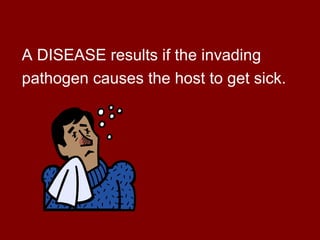
A DISEASE results if the invading  pathogen causes the host to get sick.
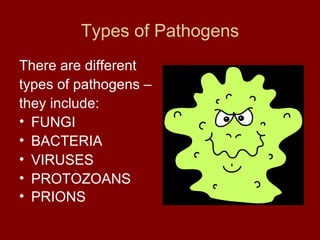
Types of Pathogens There are different types of pathogens – they include: FUNGI BACTERIA VIRUSES PROTOZOANS PRIONS
Bacteria
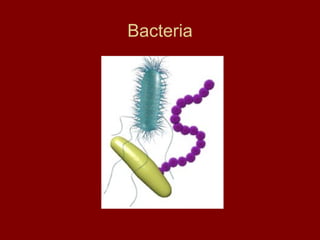
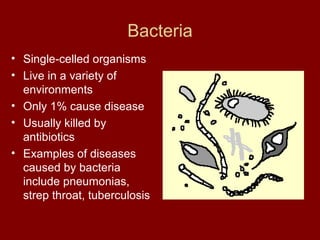
Bacteria Single-celled organisms Live in a variety of environments Only 1% cause disease  Usually killed by antibiotics  Examples of diseases caused by bacteria include pneumonias, strep throat, tuberculosis
Viruses
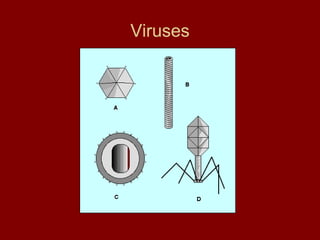
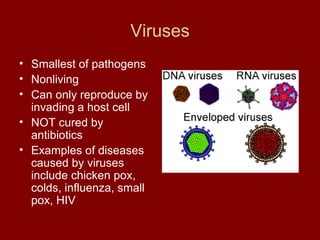
Viruses Smallest of pathogens Nonliving Can only reproduce by invading a host cell NOT cured by antibiotics Examples of diseases caused by viruses include chicken pox, colds, influenza, small pox, HIV
Types of Disease Endogenous = the disease begins WITHIN the body  Examples: Metabolic disorders Birth defects Tumors
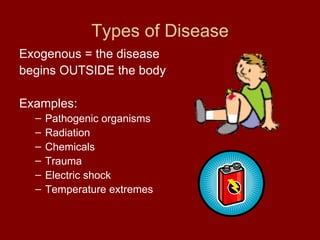
Types of Disease Exogenous = the disease begins OUTSIDE the body Examples: Pathogenic organisms Radiation Chemicals Trauma  Electric shock Temperature extremes
Types of Disease Nosocomial = diseases acquired by an individual in a health care facility Usually present in the facility and transmitted by health care workers to the patient
Types of Disease Opportunistic = disease that occurs when the body’s defenses are weak
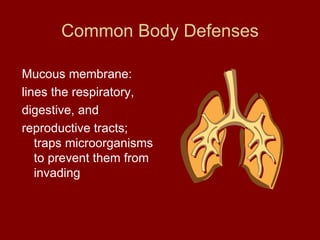
Common Body Defenses Mucous membrane: lines the respiratory, digestive, and reproductive tracts; traps microorganisms to prevent them from invading
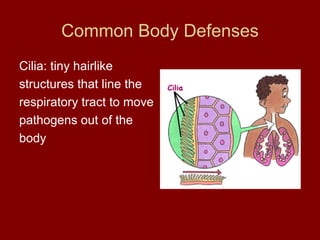
Common Body Defenses Cilia: tiny hairlike structures that line the respiratory tract to move pathogens out of the body
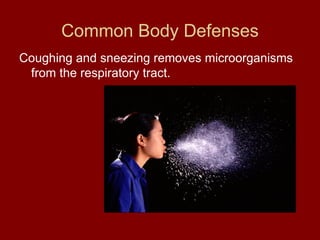
Common Body Defenses Coughing and sneezing removes microorganisms from the respiratory tract.
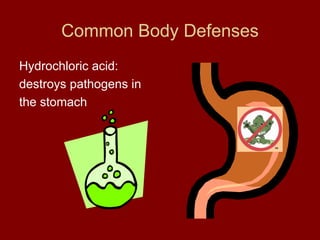
Common Body Defenses Hydrochloric acid: destroys pathogens in the stomach
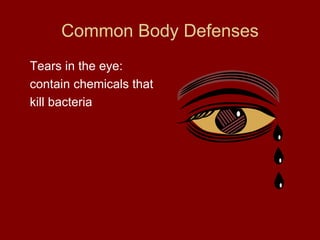
Common Body Defenses Tears in the eye: contain chemicals that kill bacteria
Common Body Defenses Fever: kills pathogens by heat
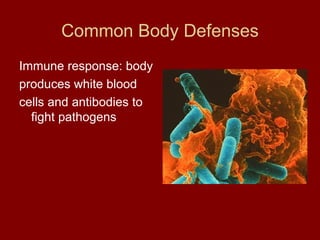
Common Body Defenses Immune response: body produces white blood cells and antibodies to fight pathogens

How Does Infection Occur?

  • 1.
  • 2.
    CA Standards Knowand understand medical terminology to interpret, transcribe, and communicate information and observations necessary for workers in the health care industry. (Health Sciences and Medical Technology Standard 2.5)  Understand the importance and requirements of using sterile techniques in a laboratory. (Health Sciences and Medical Technology Standard A4.4)  Students know the role of the skin in providing nonspecific defenses against infection. (Science Grades 9-12, Biology/Life Sciences Standard 10a)  Students know the role of antibodies in the body’s response to in fection. (Science Grades 9-12, Biology/Life Sciences Standard 10b)  Students know how vaccination protects an individual from infectious diseases. (Science Grades 9-12, Biology/Life Sciences Standard 10c)  Students know there are important differences between bacteria and viruses with respect to their requirements for growth and replication, the body’s primary defenses against bacterial and viral infections, and effective treatments of these infections. (Science Grades 9-12, Biology/Life Sciences Standard 10d)  Students determine the domain of independent variables and the range of dependent variables defined by a graph, a set of ordered pairs, or a symbolic expression. (Algebra I Standard 17.0)
  • 3.
    Learning Objectives Studentswill: Observe and compare microorganisms found on fomites Identify different types of pathogens, types of diseases, and types of body defenses Simulate the spread of an infection throughout a population Determine factors that affect the rate of spread of a disease
  • 4.
    How Does InfectionOccur? Microorganisms are small, living organisms not visible to the naked eye. Pathogens are microorganisms that cause disease.
  • 5.
    A DISEASE resultsif the invading pathogen causes the host to get sick.
  • 6.
    Types of PathogensThere are different types of pathogens – they include: FUNGI BACTERIA VIRUSES PROTOZOANS PRIONS
  • 7.
  • 8.
    Bacteria Single-celled organismsLive in a variety of environments Only 1% cause disease Usually killed by antibiotics Examples of diseases caused by bacteria include pneumonias, strep throat, tuberculosis
  • 9.
  • 10.
    Viruses Smallest ofpathogens Nonliving Can only reproduce by invading a host cell NOT cured by antibiotics Examples of diseases caused by viruses include chicken pox, colds, influenza, small pox, HIV
  • 11.
    Types of DiseaseEndogenous = the disease begins WITHIN the body Examples: Metabolic disorders Birth defects Tumors
  • 12.
    Types of DiseaseExogenous = the disease begins OUTSIDE the body Examples: Pathogenic organisms Radiation Chemicals Trauma Electric shock Temperature extremes
  • 13.
    Types of DiseaseNosocomial = diseases acquired by an individual in a health care facility Usually present in the facility and transmitted by health care workers to the patient
  • 14.
    Types of DiseaseOpportunistic = disease that occurs when the body’s defenses are weak
  • 15.
    Common Body DefensesMucous membrane: lines the respiratory, digestive, and reproductive tracts; traps microorganisms to prevent them from invading
  • 16.
    Common Body DefensesCilia: tiny hairlike structures that line the respiratory tract to move pathogens out of the body
  • 17.
    Common Body DefensesCoughing and sneezing removes microorganisms from the respiratory tract.
  • 18.
    Common Body DefensesHydrochloric acid: destroys pathogens in the stomach
  • 19.
    Common Body DefensesTears in the eye: contain chemicals that kill bacteria
  • 20.
    Common Body DefensesFever: kills pathogens by heat
  • 21.
    Common Body DefensesImmune response: body produces white blood cells and antibodies to fight pathogens