1
LATHA.M
2017601306
NANOSCIENCE &TECHNOLOGY
 Developed by James alwine, David Kemp and George Stark
– 1977.
 Detects the presence of specific mRNA in total RNA extract.
 Can determine whether the gene is transcribed or not.
 RNA is more susceptible to degradation than DNA.
2
Concept:
 To study the gene expression by detection of RNA by
molecular biology using Northern blotting.
 Reannealing nucleic acids to identify sequence of interest.
 Separates RNA in an agarose gel, then detects specific bands
using probe and hybridization.
 Hybridization takes advantage of the ability of a single
stranded DNA or RNA molecule to find its complement, even in
the presence of large amounts of unrelated DNA.
 Allows detection of specific bands (RNA molecules) that have
complementary sequence to the probe.
 Size bands and quantify abundance of molecule.
3
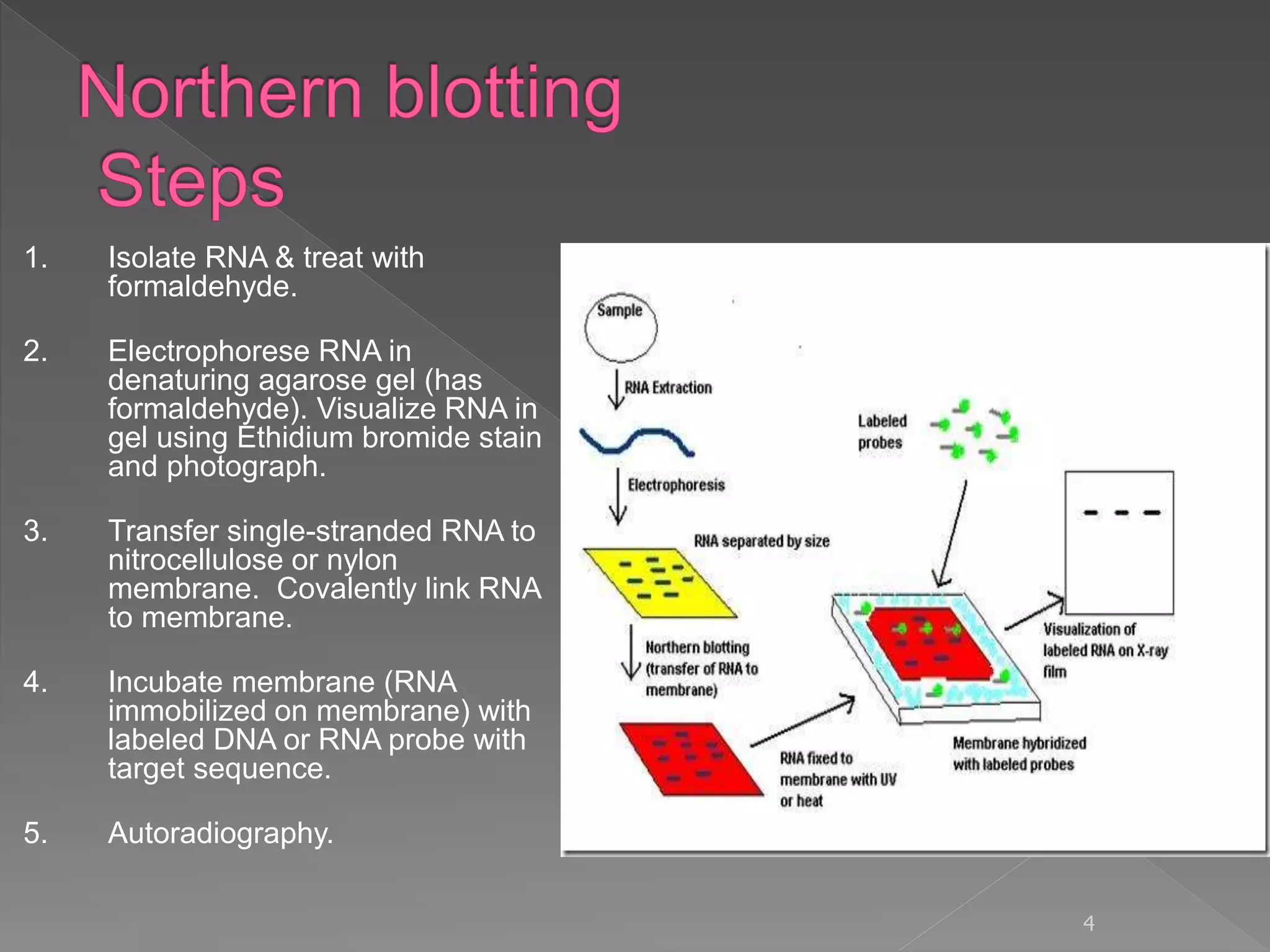
1. Isolate RNA & treat with
formaldehyde.
2. Electrophorese RNA in
denaturing agarose gel (has
formaldehyde). Visualize RNA in
gel using Ethidium bromide stain
and photograph.
3. Transfer single-stranded RNA to
nitrocellulose or nylon
membrane. Covalently link RNA
to membrane.
4. Incubate membrane (RNA
immobilized on membrane) with
labeled DNA or RNA probe with
target sequence.
5. Autoradiography.
4
5
Isolate RNA:
-To detect rare mRNA, isolate the poly A+ mRNA.
-RNA is both biologically and chemically more labile than
DNA. Thus eliminate RNases.
6
Electrophoresis:
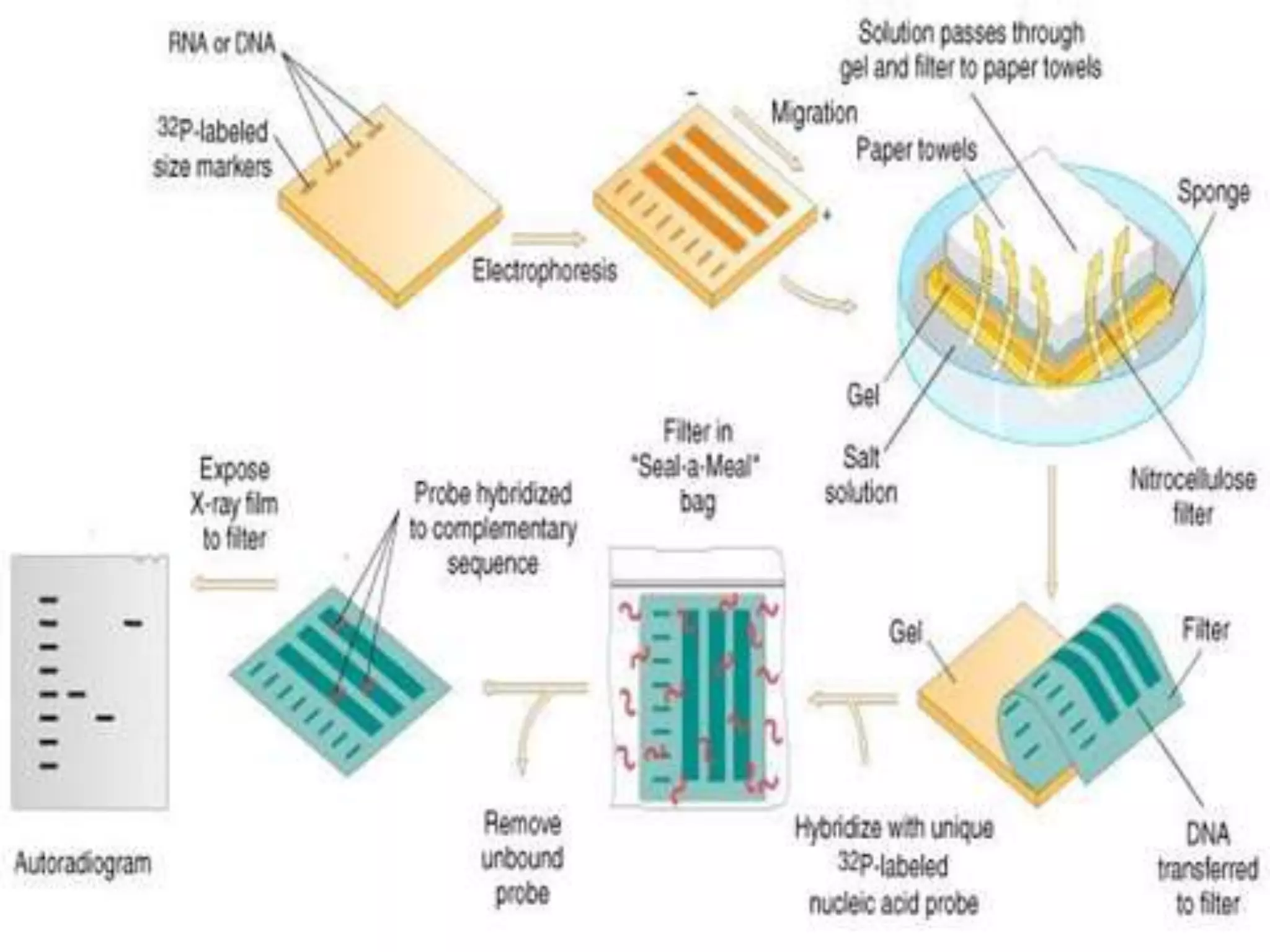
-Performed in formaldehyde agarose gel to prevent RNA from
folding on itself.
-Stain with EtBr to visualize the RNA bands.
Step 2
Transfer single-stranded RNA to
nitrocellulose or nylon membrane:
Traditionally, a nitrocellulose membrane is used, although
nylon or a positively charged nylon membrane may be used.
Nitrocellulose typically has a binding capacity of about
100µg/cm, while nylon has a binding capacity of about 500
µg/cm. Many scientists feel nylon is better since it binds more
and is less fragile.
Covalently link RNA to membrane:
UV cross linking is more effective in binding RNA to the
membrane than baking at 80C.
7
Prehybridize before hybridization:
Blocks non-specific sites to prevent the single-stranded
probe from binding just anywhere on the membrane.
Incubate membrane with labeled DNA or
RNA probe with target sequence:
Probe could be 32P, biotin/streptavidin or a bioluminescent
probe.
Autoradiography:
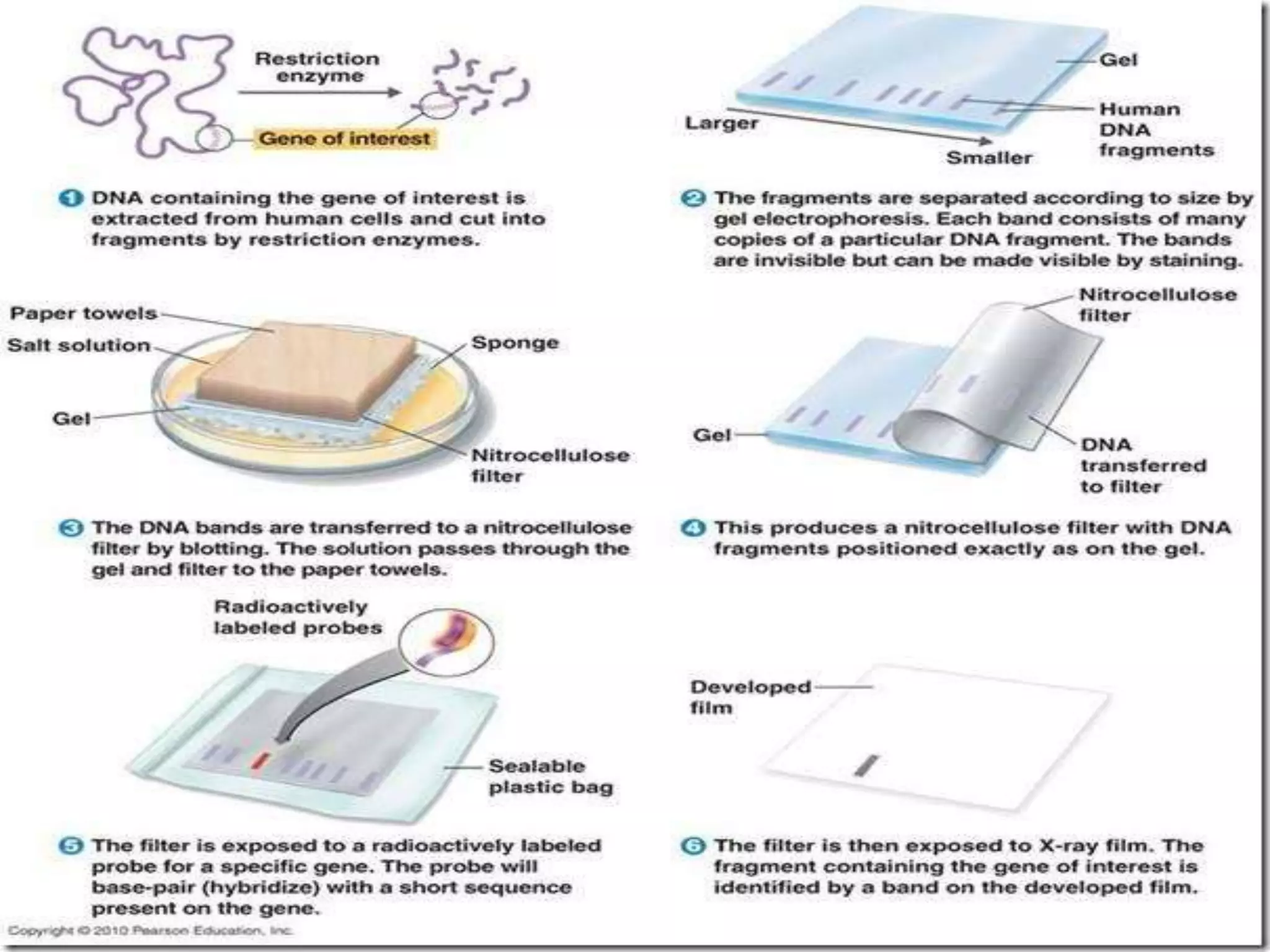
Place membrane over X-ray film.
X-ray film darkens where the fragments are complementary
to the radioactive probes. 8
9
10
11
 Northern blots are particularly useful for determining the
conditions under which specific genes are being expressed,
including which tissues in a complex organism express
which of its genes at the mRNA level.
 Detection of specific mRNA in a sample.
 Used in screening of recombinants by detecting the mRNA
produced by the transgene.
 In disease diagnosis.
 In gene expression studies.
 RNA splicing studies.
12
 The strength of this method is its simplicity.
 Specificity is relatively high.
 The quality and quantity of RNA can be measured on the
gel prior to blotting.
 mRNA transcript size can be detected.
Disadvantages :
 Time consuming procedure.
 RNA samples can be degraded by RNases.
 Use of radio active probes.
13
 https://en.wikipedia.org/wiki/Northern_blot
 www.biologyexams4u.com/2014/01/northern-blotting-
principle-summary-of.html
 https://en.wikibooks.org/wiki/Structural_Biochemistry/D
NA...techniques/Northern_Blot
 https://www.biotecharticles.com/...products.../Technique-
of-Northern-Blotting-382.ht...
 https://www.youtube.com/watch?v=KfHZFyADnNg
14
15