Mrs. Jagtap P.N.
HOD of Pharmacology
PDEA′S SGRS college of
Pharmacy, Saswad
Ms. Sayali S. Chavan &
Mr. Pranesh P. Memane
1ST Year M. Pharmacy
PDEA′S SGRS college of
Pharmacy,Saswad
 Gene therapy is a novel method of treatment of disease.
Genes or short oligonucleotide sequence is used as
therapeutic molecule instead of conventional drug
compound in the gene therapy.
 It is widely used to treat defective genes that contribute in
the developement of disease.
 It is used to treat hereditary or acquired genetic defects.
 A single gene or more foreign genes are introduced in the
organism in this technique.
 In gene therapy, DNA encoding a therapeutic protein is
packed within a “vector”, which transports the DNA
inside cell within the body.
 Advantage of gene therapy is the DNA inserted is
expressed by the cell machinery & the disease is treated
with minimal toxicity
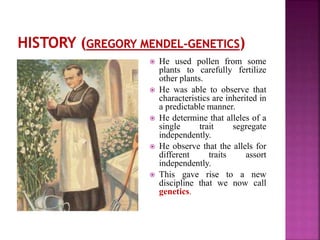
 He used pollen from some
plants to carefully fertilize
other plants.
 He was able to observe that
characteristics are inherited in
a predictable manner.
 He determine that alleles of a
single trait segregate
independently.
 He observe that the allels for
different traits assort
independently.
 This gave rise to a new
discipline that we now call
genetics.
 How to deliver genes to specific cell and tissues and
whole animals?
 How much and how long the introduced gene will be
expressed.
 The site and dose of gene delivery.
 Any toxic effects.
 Is there any adverse immunological consequences of
both vehicle and gene?
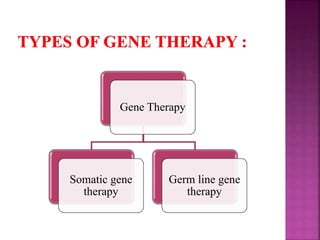
Gene Therapy
Somatic gene
therapy
Germ line gene
therapy
 The technique of somatic gene therapy involves
inserting a normal gene into the appropriate cell of
an individual affected with a genetic disease,
thereby permanently correcting the disorder.
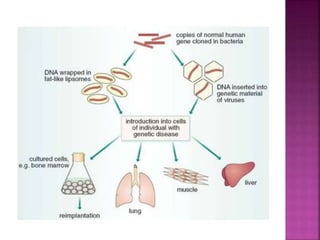
 Following figure outlines the simplest method of
getting genes into the person′s cells either viruses
or liposomes.
 Somatic cell therapy is viewed as a more conservative,
safer approach because it affects only the targeted cells
in the patients, & is not passed on to future
generations. In other words, the therapeutic effect ends
with the individual who receives the therapy.
 However, this types of therapy presents unique
problems of its own. Often the effects of somatic cell
therapy are short-lived. Because the cells of most
tissues ultimately die and are replaced by new cells.
Transporting the gene to the target cell or tissue is also
problematic.
 Regardless of these difficulties, however somatic cell
gene therapy is appropriate and acceptable for many
disorders, including cystic fibrosis, muscular
dystrophy, cancer & certain infectious disease, life-
threatening disorders.
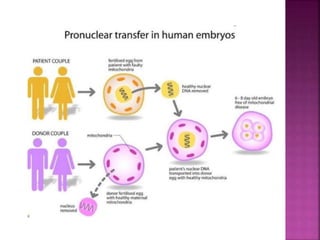
 In this type, the functional genes, which are to be
integrated in the genomes, are inserted in the germ
cells, i.e., sperm or eggs.
 Targeting of germ cells makes the therapy
heritable.
 Gene therapy using the germ line cells results in
permanent changes that are passed down to
subsequent generations. If done early in
embryologic development, such as during pre-
implantation, diagnosis & in-vitro fertilization.
 The gene transfer could also occur in all cells of
the developing embryo.
 The appeal of germ line gene therapy is its
potential for offering a permanent therapeutic
effect for all who inherit the target gene.
 Successful germ line therapies introduce the
possibilities of eliminating some diseases from a
particular family, & ultimately from the
population, forever.
 The genetic change propagated by germ line gene
therapy may actually be deleterious & harmful,
with the potential for unforeseen effects on future
generation.
DIFFERENCE
SOMATIC THERAPY GERM LINE THERAPY
1.Gens are introduced into somatic cell. 1.Genes are introduced into germ line
cells & will get distributed in both
germ cells and somatic cells.
2. Changes are confirmed to the
recipient.
2. Changes will be passed to the future
generations.
3. Genes are tissue specific in most
instances although not location specific
in many.
3. High frequency of insertional
mutations are observed in these
process and cause teratogenic
consequences.
4. Technical expertise for somatic cells
manipulations in-vitro introduction of
gene of interest & replanting somatic
cells in body to make them functional
is developed.
4. There are still many technical
difficulties in introduction of gene into
germ cells.
5. No ethical issues attached. 5. Ethical problems to be answered &
precludes its use.
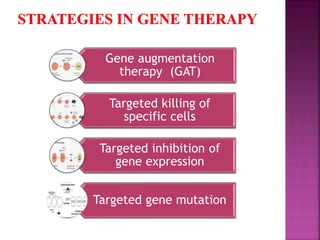
Gene augmentation
therapy (GAT)
Targeted killing of
specific cells
Targeted inhibition of
gene expression
Targeted gene mutation
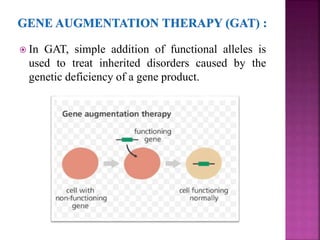
 In GAT, simple addition of functional alleles is
used to treat inherited disorders caused by the
genetic deficiency of a gene product.
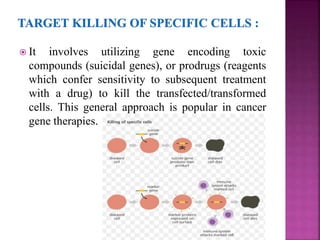
 It involves utilizing gene encoding toxic
compounds (suicidal genes), or prodrugs (reagents
which confer sensitivity to subsequent treatment
with a drug) to kill the transfected/transformed
cells. This general approach is popular in cancer
gene therapies.
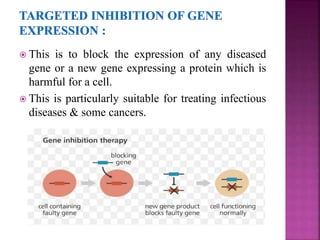
 This is to block the expression of any diseased
gene or a new gene expressing a protein which is
harmful for a cell.
 This is particularly suitable for treating infectious
diseases & some cancers.
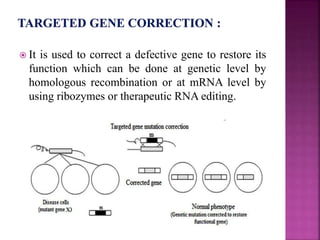
 It is used to correct a defective gene to restore its
function which can be done at genetic level by
homologous recombination or at mRNA level by
using ribozymes or therapeutic RNA editing.
 Classical gene
therapy
1. Produce a product
that the patient lacks.
2. Produce toxins so
that diseased gene is
killed.
3. Activates cells of the
immune system so as
to help in killing of
diseased cells.
 Non-classical gene
therapy
1. It involves the
expression of gene
associated with the
pathogenesis or to
correct a genetic
defect and restore
the normal gene
expression.
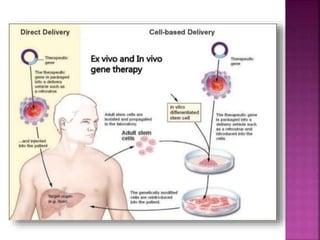
 There are mainly two methods of for the transfer
of gene in gene therapy:
1.Transfer of genes into patient cells outside the
body (ex-vivo gene therapy).
2.Transfer of gene directly to cells inside the body
(in-vivo).
 In this mode of gene therapy genes are transferred to
the cells grow in culture, transformed cells are selected
multiply and then introduced in to the patients.
 This cells are sourced initially from the patients to be
treated and grown in culture before being reintroduced
into the same individual.
 This approach can be apply to the tissues like
hematopoietic cells and skin cells which can be
removed from the body, genetically corrected out side
the body & reintroduced into the patient body where
they become engrafted & survive for a long period of
time.
 In vivo method of gene transfer of cloned genes
directly into the tissue of patient.
 This is done in case of tissues whose individual
cells cannot be cultured in vitro in sufficient
numbers where re-implantation of the cultured
cells in the patient is not efficient.
 Liposomes & certain viral vectors are employed
for this purpose because of lack of any other mode
of cellection.
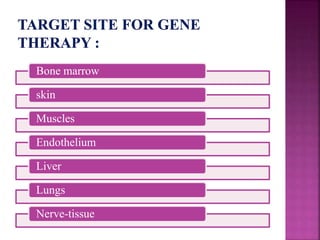
Bone marrow
skin
Muscles
Endothelium
Liver
Lungs
Nerve-tissue
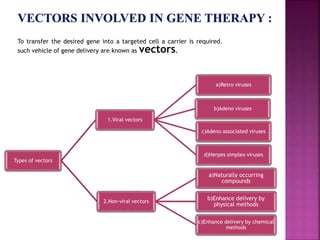
To transfer the desired gene into a targeted cell a carrier is required.
such vehicle of gene delivery are known as vectors.
Types of vectors
1.Viral vectors
a)Retro viruses
b)Adeno viruses
c)Adeno associated viruses
d)Herpes simplex viruses
2.Non-viral vectors
a)Naturally occurring
compounds
b)Enhance delivery by
physical methods
c)Enhance delivery by chemical
methods
Viral vectors are mostly derivatives of viruses that
infects animals.
 Viruses have evolved a way of encapsulating and
delivering their genes to human cells to remove
disease-causing genes and insert therapeutic ones.
 Virus bind to their hosts and introduce their
genetic material into the host cell.
1) Free replicating viruses- that multiply within
the cell, but do not integrated into the genome of
the host.
2) Integrating viruses- that can integrates into the
host genome. They enters the cell, copy their
RNA genome into DNA.
a)Retrovirus vector system
 They uses the enzyme reverse transcriptase to
convert the RNA into DNA which is integrated
into genome further enters the host cell.
 It have the ability to infect a wide variety of cell
type with high efficiency.
 The AAV genome comprises of inverted terminal
repeats (ITR) as both of the DNA stand and open
reading frames.(ORFs).
 This type of viruses is being uses, because it is non
pathogenic and do not build an immune response.
 AVV vectors are used to deliver genes to the brain,
this is possible because AAV viruses can infect
non-dividing cells such as neurons.
 Herpes viruses includes herpes simplex viruses
that rarely can cause encephalitis and infect the
non dividing cells so it have the ability to
transduce neurons. Its advantage is being able to
infect non dividing cells that help in treating
neurological disorders.
They′re very good at targeting and
entering cells.
Some target specific types of cells.
They can be modified so that they
can′t replicate and destroy cells.
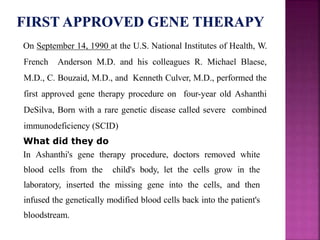
 Physical methods-
1. Electroporation
2. Microinjection
3. Gene gun or a biollistic particle delivery system
4. Magnetofection
 Chemical methods-
1. DNA transfer by calcium phosphate method
2. Liposome medicated transfer
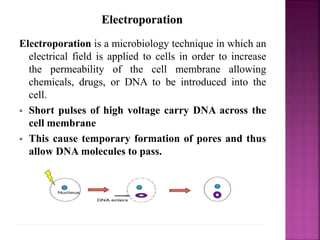
Electroporation is a microbiology technique in which an
electrical field is applied to cells in order to increase
the permeability of the cell membrane allowing
chemicals, drugs, or DNA to be introduced into the
cell.
 Short pulses of high voltage carry DNA across the
cell membrane
 This cause temporary formation of pores and thus
allow DNA molecules to pass.
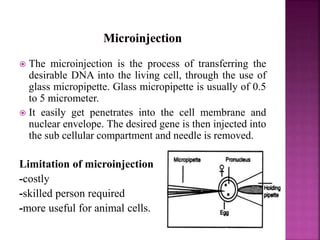
 The microinjection is the process of transferring the
desirable DNA into the living cell, through the use of
glass micropipette. Glass micropipette is usually of 0.5
to 5 micrometer.
 It easily get penetrates into the cell membrane and
nuclear envelope. The desired gene is then injected into
the sub cellular compartment and needle is removed.
Limitation of microinjection
-costly
-skilled person required
-more useful for animal cells.
1. Biollistics or particle bombardment also known as
gene gun technique is a physical method that uses
accelerated micro projectiles to deliver DNA or a
other molecule into intact tissue and cells.
2. The gene gun is a device that literally fit DNA into
target cells.
3. The DNA to be transformed into the cell which are
coated onto microscopic beads made of either gold or
tungsten.
4. The coated beads are then attached to the end of
plastic bullets and loaded into the firing chamber of
the gene gun.
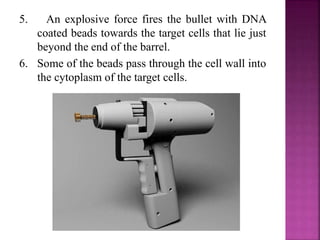
5. An explosive force fires the bullet with DNA
coated beads towards the target cells that lie just
beyond the end of the barrel.
6. Some of the beads pass through the cell wall into
the cytoplasm of the target cells.
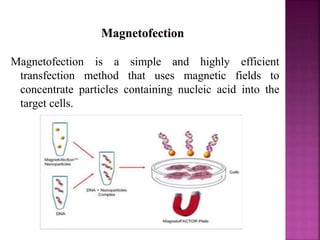
Magnetofection is a simple and highly efficient
transfection method that uses magnetic fields to
concentrate particles containing nucleic acid into the
target cells.
1.DNA transfer by calcium phosphate method-
 The process of transfection involves the mixture of
isolate DNA with solution of calcium chloride and
potassium phosphate.
 Cell are then incubated with precipitated DNA either
in solution or in tissue culture dish.
 A fraction of cells will take up the calcium
phosphate DNA precipitate by endocytosis.
2. Liposome medicated transfer-
 Liposome are spheres of lipids which can be used to
transport molecules into cells.
 These are artificial vesicles that can act as delivery agent
for exogenous materials including trans genes.
 Promote transport after fusing with the cell membrane.
 Cationic lipids are those having a positive charge are used
for the transfer of nucleic acid.
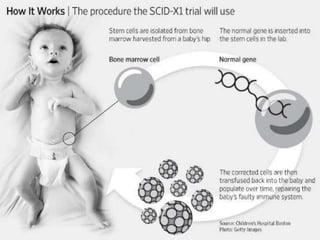
On September 14, 1990 at the U.S. National Institutes of Health, W.
French Anderson M.D. and his colleagues R. Michael Blaese,
M.D., C. Bouzaid, M.D., and Kenneth Culver, M.D., performed the
first approved gene therapy procedure on four-year old Ashanthi
DeSilva, Born with a rare genetic disease called severe combined
immunodeficiency (SCID)
What did they do
In Ashanthi's gene therapy procedure, doctors removed white
blood cells from the child's body, let the cells grow in the
laboratory, inserted the missing gene into the cells, and then
infused the genetically modified blood cells back into the patient's
bloodstream.
As of early 2007, she was still in good health,
and she was attending college. Some would state
that the study is of great importance despite its
indefinite results, if only because it
demonstrated that gene therapy could be
practically attempted without adverse
consequences
Novel techniques to “mend broken hearts” using gene therapy and stem
cells represent a major new frontier in the treatment of heart disease
It was achieved by the researchers at Gladstone Institute of Cardiovascular Disease
in
California
 They were able to re-programme scar-forming cells into heart muscle cells, some of
which were capable of transmitting the kind of electrical signals that make the heart
beat
They performed on a live mice, transforming scar-forming cells, called fibroblasts
into beating heart muscle cells
 They injected three genes (cocktail of genes) into the heart of live mice that had
been damaged by heart attack, fibroblasts could be turned into working heart cells.
Researchers said that the “cocktail of genes” used to regenerate cells could one day
be replaced with “small drug-like molecules” that would offer safer and easier
delivery
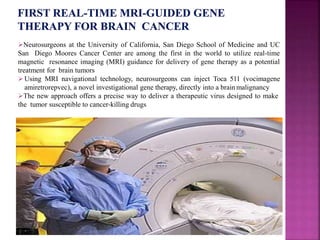
Neurosurgeons at the University of California, San Diego School of Medicine and UC
San Diego Moores Cancer Center are among the first in the world to utilize real-time
magnetic resonance imaging (MRI) guidance for delivery of gene therapy as a potential
treatment for brain tumors
 Using MRI navigational technology, neurosurgeons can inject Toca 511 (vocimagene
amiretrorepvec), a novel investigational gene therapy, directly into a brain malignancy
The new approach offers a precise way to deliver a therapeutic virus designed to make
the tumor susceptible to cancer-killing drugs
.
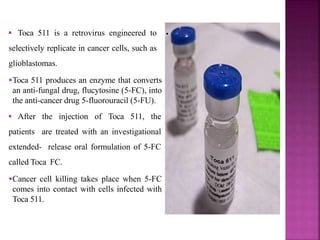
 Toca 511 is a retrovirus engineered to
selectively replicate in cancer cells, such as
glioblastomas.
Toca 511 produces an enzyme that converts
an anti-fungal drug, flucytosine (5-FC), into
the anti-cancer drug 5-fluorouracil (5-FU).
 After the injection of Toca 511, the
patients are treated with an investigational
extended- release oral formulation of 5-FC
called Toca FC.
Cancer cell killing takes place when 5-FC
comes into contact with cells infected with
Toca 511.
.
 Carol Kruse, a professor of neurosurgery and member of the Jonsson Cancer
Center and the UCLA Brain Research Institute led the research on breastcancer
 Breast cancer is the most common form of cancer in women, and metastasis is a
major cause of health deterioration and death from the disease
Cellular therapy and gene therapy were used together to treat breast cancer
 Cellular therapy is a type of immunotherapy that uses T cells, the foot soldiers
of the immune system, that have been sensitized in the laboratory to kill breast
cancer cells.
These sensitized T cells are injected into the parts of the brain to which cancer
has spread.
 The research shows that the T cells can move through tissue and recognize
and directly kill the tumor cells
Scientists from The University of Manchester have used stem
cellgene therapy to treat a fatal genetic brain disease
 It was used to treat Sanfilippo – a fatal inherited condition
which causes progressive dementia in children
Sanfilippo, is currently untreatable mucopolysaccharide (MPS)disease
 It is caused by the lack of SGSH enzyme in the body which helps to
breakdown and recycle long chain sugars, such as heparan sulphate(HS)
Children with the condition build up and store excess HS throughout
their body from birth which affects their brain and results in progressive
dementia and hyperactivity, followed by losing the ability to walk and
swallow
 Researchers have developed a stem cell gene therapy which
overproduces the SGSH enzyme specifically in bone marrow white
blood cells to increase SGSH enzyme from bone marrow transplants,
and to target it to the cellsthat traffic into the brain
 It was seen that mice treated by this method produce five times the
normal SGSH enzyme levels in the bone marrow and and 11 per cent of
normal levels in the brain
 The enzyme is taken up by affected brain cells and is enough to
correct brain HS storage and neuro inflammation to near normal
levels and completely corrects the hyperactive behaviour in mice
with Sanfilippo
 Mucopolysaccharidosis Type IIIA (MPSIIIA) is a metabolic disorder in
which the body is missing an enzyme that is required to break down long
chains of sugars known as glycosaminoglycans
 The glycosaminoglycans collect in the body and cause damage,
particularly inthe brain if not broken
Fàtima Bosch and colleagues at Universitat Autònoma de Barcelona in
Spain developed a form of gene therapy to replace the enzyme that is
missing in MPSIIIA
 They injected the replacement gene into the cerebrospinal fluid that
surrounds the brain and spinal cord
 This study demonstrates that gene therapy can be delivered to the brain
through the cerebrospinal fluid and suggests that this approach could
potentially be used as a therapy for MPSIIIA
Gene therapy
Gene therapy

Gene therapy

  • 1.
    Mrs. Jagtap P.N. HODof Pharmacology PDEA′S SGRS college of Pharmacy, Saswad Ms. Sayali S. Chavan & Mr. Pranesh P. Memane 1ST Year M. Pharmacy PDEA′S SGRS college of Pharmacy,Saswad
  • 2.
     Gene therapyis a novel method of treatment of disease. Genes or short oligonucleotide sequence is used as therapeutic molecule instead of conventional drug compound in the gene therapy.  It is widely used to treat defective genes that contribute in the developement of disease.  It is used to treat hereditary or acquired genetic defects.  A single gene or more foreign genes are introduced in the organism in this technique.  In gene therapy, DNA encoding a therapeutic protein is packed within a “vector”, which transports the DNA inside cell within the body.  Advantage of gene therapy is the DNA inserted is expressed by the cell machinery & the disease is treated with minimal toxicity
  • 3.
     He usedpollen from some plants to carefully fertilize other plants.  He was able to observe that characteristics are inherited in a predictable manner.  He determine that alleles of a single trait segregate independently.  He observe that the allels for different traits assort independently.  This gave rise to a new discipline that we now call genetics.
  • 4.
     How todeliver genes to specific cell and tissues and whole animals?  How much and how long the introduced gene will be expressed.  The site and dose of gene delivery.  Any toxic effects.  Is there any adverse immunological consequences of both vehicle and gene?
  • 5.
  • 6.
     The techniqueof somatic gene therapy involves inserting a normal gene into the appropriate cell of an individual affected with a genetic disease, thereby permanently correcting the disorder.  Following figure outlines the simplest method of getting genes into the person′s cells either viruses or liposomes.
  • 8.
     Somatic celltherapy is viewed as a more conservative, safer approach because it affects only the targeted cells in the patients, & is not passed on to future generations. In other words, the therapeutic effect ends with the individual who receives the therapy.  However, this types of therapy presents unique problems of its own. Often the effects of somatic cell therapy are short-lived. Because the cells of most tissues ultimately die and are replaced by new cells. Transporting the gene to the target cell or tissue is also problematic.  Regardless of these difficulties, however somatic cell gene therapy is appropriate and acceptable for many disorders, including cystic fibrosis, muscular dystrophy, cancer & certain infectious disease, life- threatening disorders.
  • 9.
     In thistype, the functional genes, which are to be integrated in the genomes, are inserted in the germ cells, i.e., sperm or eggs.  Targeting of germ cells makes the therapy heritable.  Gene therapy using the germ line cells results in permanent changes that are passed down to subsequent generations. If done early in embryologic development, such as during pre- implantation, diagnosis & in-vitro fertilization.  The gene transfer could also occur in all cells of the developing embryo.
  • 11.
     The appealof germ line gene therapy is its potential for offering a permanent therapeutic effect for all who inherit the target gene.  Successful germ line therapies introduce the possibilities of eliminating some diseases from a particular family, & ultimately from the population, forever.  The genetic change propagated by germ line gene therapy may actually be deleterious & harmful, with the potential for unforeseen effects on future generation.
  • 12.
    DIFFERENCE SOMATIC THERAPY GERMLINE THERAPY 1.Gens are introduced into somatic cell. 1.Genes are introduced into germ line cells & will get distributed in both germ cells and somatic cells. 2. Changes are confirmed to the recipient. 2. Changes will be passed to the future generations. 3. Genes are tissue specific in most instances although not location specific in many. 3. High frequency of insertional mutations are observed in these process and cause teratogenic consequences. 4. Technical expertise for somatic cells manipulations in-vitro introduction of gene of interest & replanting somatic cells in body to make them functional is developed. 4. There are still many technical difficulties in introduction of gene into germ cells. 5. No ethical issues attached. 5. Ethical problems to be answered & precludes its use.
  • 13.
    Gene augmentation therapy (GAT) Targetedkilling of specific cells Targeted inhibition of gene expression Targeted gene mutation
  • 14.
     In GAT,simple addition of functional alleles is used to treat inherited disorders caused by the genetic deficiency of a gene product.
  • 15.
     It involvesutilizing gene encoding toxic compounds (suicidal genes), or prodrugs (reagents which confer sensitivity to subsequent treatment with a drug) to kill the transfected/transformed cells. This general approach is popular in cancer gene therapies.
  • 16.
     This isto block the expression of any diseased gene or a new gene expressing a protein which is harmful for a cell.  This is particularly suitable for treating infectious diseases & some cancers.
  • 17.
     It isused to correct a defective gene to restore its function which can be done at genetic level by homologous recombination or at mRNA level by using ribozymes or therapeutic RNA editing.
  • 18.
     Classical gene therapy 1.Produce a product that the patient lacks. 2. Produce toxins so that diseased gene is killed. 3. Activates cells of the immune system so as to help in killing of diseased cells.  Non-classical gene therapy 1. It involves the expression of gene associated with the pathogenesis or to correct a genetic defect and restore the normal gene expression.
  • 19.
     There aremainly two methods of for the transfer of gene in gene therapy: 1.Transfer of genes into patient cells outside the body (ex-vivo gene therapy). 2.Transfer of gene directly to cells inside the body (in-vivo).
  • 20.
     In thismode of gene therapy genes are transferred to the cells grow in culture, transformed cells are selected multiply and then introduced in to the patients.  This cells are sourced initially from the patients to be treated and grown in culture before being reintroduced into the same individual.  This approach can be apply to the tissues like hematopoietic cells and skin cells which can be removed from the body, genetically corrected out side the body & reintroduced into the patient body where they become engrafted & survive for a long period of time.
  • 21.
     In vivomethod of gene transfer of cloned genes directly into the tissue of patient.  This is done in case of tissues whose individual cells cannot be cultured in vitro in sufficient numbers where re-implantation of the cultured cells in the patient is not efficient.  Liposomes & certain viral vectors are employed for this purpose because of lack of any other mode of cellection.
  • 23.
  • 24.
    To transfer thedesired gene into a targeted cell a carrier is required. such vehicle of gene delivery are known as vectors. Types of vectors 1.Viral vectors a)Retro viruses b)Adeno viruses c)Adeno associated viruses d)Herpes simplex viruses 2.Non-viral vectors a)Naturally occurring compounds b)Enhance delivery by physical methods c)Enhance delivery by chemical methods
  • 25.
    Viral vectors aremostly derivatives of viruses that infects animals.  Viruses have evolved a way of encapsulating and delivering their genes to human cells to remove disease-causing genes and insert therapeutic ones.  Virus bind to their hosts and introduce their genetic material into the host cell. 1) Free replicating viruses- that multiply within the cell, but do not integrated into the genome of the host. 2) Integrating viruses- that can integrates into the host genome. They enters the cell, copy their RNA genome into DNA.
  • 26.
    a)Retrovirus vector system They uses the enzyme reverse transcriptase to convert the RNA into DNA which is integrated into genome further enters the host cell.  It have the ability to infect a wide variety of cell type with high efficiency.
  • 27.
     The AAVgenome comprises of inverted terminal repeats (ITR) as both of the DNA stand and open reading frames.(ORFs).  This type of viruses is being uses, because it is non pathogenic and do not build an immune response.  AVV vectors are used to deliver genes to the brain, this is possible because AAV viruses can infect non-dividing cells such as neurons.
  • 28.
     Herpes virusesincludes herpes simplex viruses that rarely can cause encephalitis and infect the non dividing cells so it have the ability to transduce neurons. Its advantage is being able to infect non dividing cells that help in treating neurological disorders.
  • 29.
    They′re very goodat targeting and entering cells. Some target specific types of cells. They can be modified so that they can′t replicate and destroy cells.
  • 30.
     Physical methods- 1.Electroporation 2. Microinjection 3. Gene gun or a biollistic particle delivery system 4. Magnetofection  Chemical methods- 1. DNA transfer by calcium phosphate method 2. Liposome medicated transfer
  • 31.
    Electroporation is amicrobiology technique in which an electrical field is applied to cells in order to increase the permeability of the cell membrane allowing chemicals, drugs, or DNA to be introduced into the cell.  Short pulses of high voltage carry DNA across the cell membrane  This cause temporary formation of pores and thus allow DNA molecules to pass.
  • 32.
     The microinjectionis the process of transferring the desirable DNA into the living cell, through the use of glass micropipette. Glass micropipette is usually of 0.5 to 5 micrometer.  It easily get penetrates into the cell membrane and nuclear envelope. The desired gene is then injected into the sub cellular compartment and needle is removed. Limitation of microinjection -costly -skilled person required -more useful for animal cells.
  • 33.
    1. Biollistics orparticle bombardment also known as gene gun technique is a physical method that uses accelerated micro projectiles to deliver DNA or a other molecule into intact tissue and cells. 2. The gene gun is a device that literally fit DNA into target cells. 3. The DNA to be transformed into the cell which are coated onto microscopic beads made of either gold or tungsten. 4. The coated beads are then attached to the end of plastic bullets and loaded into the firing chamber of the gene gun.
  • 34.
    5. An explosiveforce fires the bullet with DNA coated beads towards the target cells that lie just beyond the end of the barrel. 6. Some of the beads pass through the cell wall into the cytoplasm of the target cells.
  • 35.
    Magnetofection is asimple and highly efficient transfection method that uses magnetic fields to concentrate particles containing nucleic acid into the target cells.
  • 36.
    1.DNA transfer bycalcium phosphate method-  The process of transfection involves the mixture of isolate DNA with solution of calcium chloride and potassium phosphate.  Cell are then incubated with precipitated DNA either in solution or in tissue culture dish.  A fraction of cells will take up the calcium phosphate DNA precipitate by endocytosis.
  • 37.
    2. Liposome medicatedtransfer-  Liposome are spheres of lipids which can be used to transport molecules into cells.  These are artificial vesicles that can act as delivery agent for exogenous materials including trans genes.  Promote transport after fusing with the cell membrane.  Cationic lipids are those having a positive charge are used for the transfer of nucleic acid.
  • 38.
    On September 14,1990 at the U.S. National Institutes of Health, W. French Anderson M.D. and his colleagues R. Michael Blaese, M.D., C. Bouzaid, M.D., and Kenneth Culver, M.D., performed the first approved gene therapy procedure on four-year old Ashanthi DeSilva, Born with a rare genetic disease called severe combined immunodeficiency (SCID) What did they do In Ashanthi's gene therapy procedure, doctors removed white blood cells from the child's body, let the cells grow in the laboratory, inserted the missing gene into the cells, and then infused the genetically modified blood cells back into the patient's bloodstream.
  • 40.
    As of early2007, she was still in good health, and she was attending college. Some would state that the study is of great importance despite its indefinite results, if only because it demonstrated that gene therapy could be practically attempted without adverse consequences
  • 41.
    Novel techniques to“mend broken hearts” using gene therapy and stem cells represent a major new frontier in the treatment of heart disease It was achieved by the researchers at Gladstone Institute of Cardiovascular Disease in California  They were able to re-programme scar-forming cells into heart muscle cells, some of which were capable of transmitting the kind of electrical signals that make the heart beat They performed on a live mice, transforming scar-forming cells, called fibroblasts into beating heart muscle cells  They injected three genes (cocktail of genes) into the heart of live mice that had been damaged by heart attack, fibroblasts could be turned into working heart cells. Researchers said that the “cocktail of genes” used to regenerate cells could one day be replaced with “small drug-like molecules” that would offer safer and easier delivery
  • 42.
    Neurosurgeons at theUniversity of California, San Diego School of Medicine and UC San Diego Moores Cancer Center are among the first in the world to utilize real-time magnetic resonance imaging (MRI) guidance for delivery of gene therapy as a potential treatment for brain tumors  Using MRI navigational technology, neurosurgeons can inject Toca 511 (vocimagene amiretrorepvec), a novel investigational gene therapy, directly into a brain malignancy The new approach offers a precise way to deliver a therapeutic virus designed to make the tumor susceptible to cancer-killing drugs .
  • 43.
     Toca 511is a retrovirus engineered to selectively replicate in cancer cells, such as glioblastomas. Toca 511 produces an enzyme that converts an anti-fungal drug, flucytosine (5-FC), into the anti-cancer drug 5-fluorouracil (5-FU).  After the injection of Toca 511, the patients are treated with an investigational extended- release oral formulation of 5-FC called Toca FC. Cancer cell killing takes place when 5-FC comes into contact with cells infected with Toca 511. .
  • 44.
     Carol Kruse,a professor of neurosurgery and member of the Jonsson Cancer Center and the UCLA Brain Research Institute led the research on breastcancer  Breast cancer is the most common form of cancer in women, and metastasis is a major cause of health deterioration and death from the disease Cellular therapy and gene therapy were used together to treat breast cancer  Cellular therapy is a type of immunotherapy that uses T cells, the foot soldiers of the immune system, that have been sensitized in the laboratory to kill breast cancer cells. These sensitized T cells are injected into the parts of the brain to which cancer has spread.  The research shows that the T cells can move through tissue and recognize and directly kill the tumor cells
  • 45.
    Scientists from TheUniversity of Manchester have used stem cellgene therapy to treat a fatal genetic brain disease  It was used to treat Sanfilippo – a fatal inherited condition which causes progressive dementia in children Sanfilippo, is currently untreatable mucopolysaccharide (MPS)disease  It is caused by the lack of SGSH enzyme in the body which helps to breakdown and recycle long chain sugars, such as heparan sulphate(HS) Children with the condition build up and store excess HS throughout their body from birth which affects their brain and results in progressive dementia and hyperactivity, followed by losing the ability to walk and swallow
  • 46.
     Researchers havedeveloped a stem cell gene therapy which overproduces the SGSH enzyme specifically in bone marrow white blood cells to increase SGSH enzyme from bone marrow transplants, and to target it to the cellsthat traffic into the brain  It was seen that mice treated by this method produce five times the normal SGSH enzyme levels in the bone marrow and and 11 per cent of normal levels in the brain  The enzyme is taken up by affected brain cells and is enough to correct brain HS storage and neuro inflammation to near normal levels and completely corrects the hyperactive behaviour in mice with Sanfilippo
  • 47.
     Mucopolysaccharidosis TypeIIIA (MPSIIIA) is a metabolic disorder in which the body is missing an enzyme that is required to break down long chains of sugars known as glycosaminoglycans  The glycosaminoglycans collect in the body and cause damage, particularly inthe brain if not broken Fàtima Bosch and colleagues at Universitat Autònoma de Barcelona in Spain developed a form of gene therapy to replace the enzyme that is missing in MPSIIIA  They injected the replacement gene into the cerebrospinal fluid that surrounds the brain and spinal cord  This study demonstrates that gene therapy can be delivered to the brain through the cerebrospinal fluid and suggests that this approach could potentially be used as a therapy for MPSIIIA