Potential target diseases
gene therapy
POTENTIAL TARGET DISEASES FOR GENE
THERAPY
Presented by:
BAISHALI PURKAYASTHA
Sem: M.Pharm 2nd sem
Roll no: 180520011002
CONTENTS
• Introduction
• Steps in gene therapy
• Techniques
• Approach of gene modification
• Transfer of gene into cells
• Gene therapy in disease prevention
• Application
INTRODUCTION
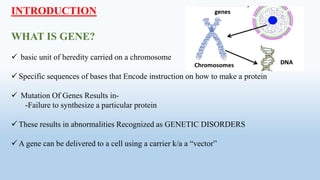
WHAT IS GENE?
 basic unit of heredity carried on a chromosome
 Specific sequences of bases that Encode instruction on how to make a protein
 Mutation Of Genes Results in-
-Failure to synthesize a particular protein
 These results in abnormalities Recognized as GENETIC DISORDERS
 A gene can be delivered to a cell using a carrier k/a a “vector”
CONCEPT OF GENE THERAPY
 an experimental treatment that involves introducing genetic
material into a person’s cells to fight or prevent disease.
 used to correct a deficient phenotype so that sufficient amounts
of a normal gene product are synthesized to improve a genetic
disorder
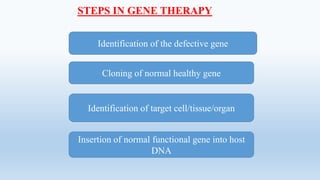
STEPS IN GENE THERAPY
Identification of the defective gene
Cloning of normal healthy gene
Identification of target cell/tissue/organ
Insertion of normal functional gene into host
DNA
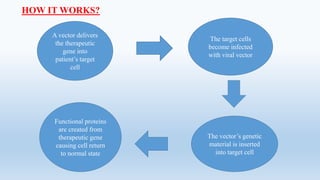
HOW IT WORKS?
A vector delivers
the therapeutic
gene into
patient’s target
cell
The target cells
become infected
with viral vector
The vector’s genetic
material is inserted
into target cell
Functional proteins
are created from
therapeutic gene
causing cell return
to normal state
TYPES OF GENE THERAPY
Somatic gene therapy
Germline gene therapy
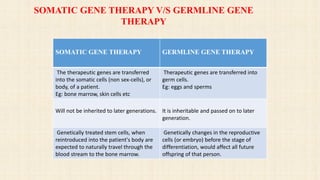
SOMATIC GENE THERAPY GERMLINE GENE THERAPY
The therapeutic genes are transferred
into the somatic cells (non sex-cells), or
body, of a patient.
Eg: bone marrow, skin cells etc
Therapeutic genes are transferred into
germ cells.
Eg: eggs and sperms
Will not be inherited to later generations. It is inheritable and passed on to later
generation.
Genetically treated stem cells, when
reintroduced into the patient's body are
expected to naturally travel through the
blood stream to the bone marrow.
Genetically changes in the reproductive
cells (or embryo) before the stage of
differentiation, would affect all future
offspring of that person.
SOMATIC GENE THERAPY V/S GERMLINE GENE
THERAPY
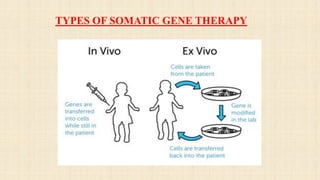
TYPES OF SOMATIC GENE THERAPY
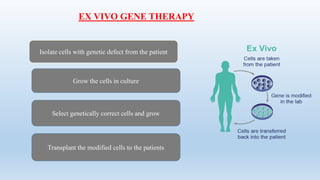
EX VIVO GENE THERAPY
Isolate cells with genetic defect from the patient
Grow the cells in culture
Select genetically correct cells and grow
Transplant the modified cells to the patients
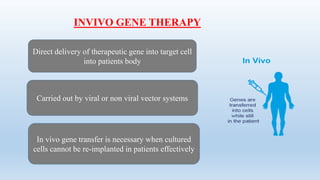
INVIVO GENE THERAPY
Direct delivery of therapeutic gene into target cell
into patients body
Carried out by viral or non viral vector systems
In vivo gene transfer is necessary when cultured
cells cannot be re-implanted in patients effectively
VECTORS IN GENE THERAPY
• To transfer the desired gene into a target cell, a carrier is required.
• Such vehicles of gene delivery are known as vectors.
2 main classes
a)Viral vectors
b)Non viral vectors
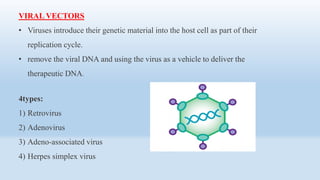
VIRAL VECTORS
• Viruses introduce their genetic material into the host cell as part of their
replication cycle.
• remove the viral DNA and using the virus as a vehicle to deliver the
therapeutic DNA.
4types:
1) Retrovirus
2) Adenovirus
3) Adeno-associated virus
4) Herpes simplex virus
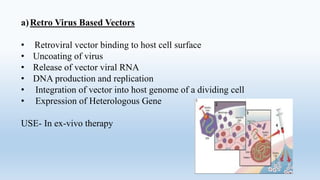
a)Retro Virus Based Vectors
• Retroviral vector binding to host cell surface
• Uncoating of virus
• Release of vector viral RNA
• DNA production and replication
• Integration of vector into host genome of a dividing cell
• Expression of Heterologous Gene
USE- In ex-vivo therapy
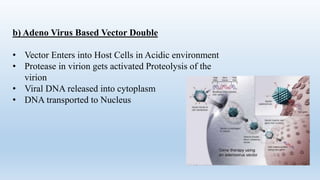
b) Adeno Virus Based Vector Double
• Vector Enters into Host Cells in Acidic environment
• Protease in virion gets activated Proteolysis of the
virion
• Viral DNA released into cytoplasm
• DNA transported to Nucleus
c) ADENO ASSOCIATED VIRUS VECTOR
• It is a human virus that can integrate into chromosome 19.
• It is a single stranded, non pathogenic small DNA virus.
• AAV enters host cell, becomes double stranded and gets integrated
into chromosome.
d) HERPEX SIMPLEX VIRUS VECTOR
• Viruses which have natural tendency to infect a particular type of
cell.
• They infect and persist in nervous cells
NON VIRAL VECTOR SYSTEM
1) PURE DNA CONSTRUCT
• Direct introduction of pure DNA construct into target tissue.
• Efficiency of DNA uptake by cells and expression rather low.
• Consequently, large quantities of DNA have to be injected periodically
2) DNA MOLECULAR CONJUGATES
• Commonly used synthetic conjugate is poly- L- lysine bound to
specific target cell receptor.
• Therapeutic DNA is then made to combine with the conjugate to
form a complex.
• avoids lysosomal breakdown of DNA.
3) LIPOPLEXES
• Lipid DNA complexes
• DNA construct surrounded by artificial lipid layer. Most of it gets
degraded by lysosomes.
4) HUMAN ARTIFICIAL CHROMOSOME
• Can carry a large DNA i.e., with one or more therapeutic genes
APPROACHES IN GENE THERAPY
a) Gene modification
i) Gene replacement
ii) Gene correction
iii)Gene augmentation
b) Gene transfer
i) Physical
ii) Chemical
iii) Biological
c) Gene transfer in specific cell line
i) Somatic gene therapy
ii) Germ line gene therapy
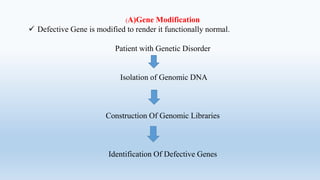
(A)Gene Modification
 Defective Gene is modified to render it functionally normal.
Patient with Genetic Disorder
Isolation of Genomic DNA
Construction Of Genomic Libraries
Identification Of Defective Genes
1) Gene Replacement
 Removal of a Mutant Gene sequence from the Host Genome and its
replacement with a normal Functional Gene.
 Used for Disorder marked by deficiency of ENZYME/PROTEIN.
(2) Gene Correction
 Involves only defective portion of a mutant gene which is altered to
provide the Functional Gene, without precisely changing the gene back to
its natural form
(3) Gene Augmentation
 Expression of mutant gene in defective gene is modified by introducing a normal
genetic sequence into Host Genome without altering the defective one.
(B) Gene Transfer Method
(1)Non-Viral Gene Transfer
(2) Viral Mediated Gene Transfer
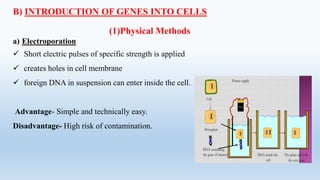
B) INTRODUCTION OF GENES INTO CELLS
(1)Physical Methods
a) Electroporation
 Short electric pulses of specific strength is applied
 creates holes in cell membrane
 foreign DNA in suspension can enter inside the cell.
Advantage- Simple and technically easy.
Disadvantage- High risk of contamination.
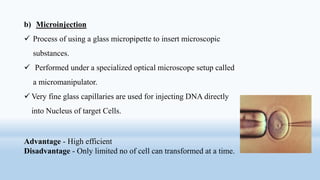
b) Microinjection
 Process of using a glass micropipette to insert microscopic
substances.
 Performed under a specialized optical microscope setup called
a micromanipulator.
 Very fine glass capillaries are used for injecting DNA directly
into Nucleus of target Cells.
Advantage - High efficient
Disadvantage - Only limited no of cell can transformed at a time.
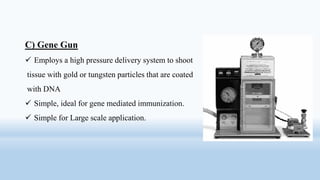
C) Gene Gun
 Employs a high pressure delivery system to shoot
tissue with gold or tungsten particles that are coated
with DNA
 Simple, ideal for gene mediated immunization.
 Simple for Large scale application.
(2) Chemical Method
a)Naked DNA Injection
 DNA is introduce into cell by using chemicals
 EX- CaCl2 + DNA Solution + PBS(PO4 buffer Saline) Ca(PO4)2
DNA gets entrapped with ppt Cells take up DNA
b)Liposome Mediated Transfer
 Foreign DNA is incorporated into Liposomes by sonication of a
lipid sol and DNA in Ether.
 deliver a variety of molecules including DNA into the cells.
Advantage- Protection of DNA from Nuclease, non toxic nature.
3) BIOLOGICAL METHOD (VIRAL METHOD)
a)Viral mediated transfer
b)Non-viral mediated transfer
TARGET CELLS OF GENE THERAPY
 THE HEMOPOIETIC CELLS
Most consistent target for gene therapy.
Has strong potential
 THE HEPATOCYTES
Attractive target for gene therapy.
Liver plays a vital role in most metabolic process.
 MUSCLE CELLS
Strong potential
Use as an efficient target organ for correlation of intrinsic muscle and
non- muscle diseases.
GENE THERAPY USED TO TREAT TYPE I DIABETES
 First, the gene was cloned under the L-type Pyruvate Kinase (LPK) promoter, which
regulates the expression of SIA in response to glucose levels.
 The LPK-SIA gene was then attached to a recombinant adeno-associated virus and
integrated into the host chromosomal DNA.
 After insertion of the rAV -LPK-SIAA , the rats displayed a drop in glucose levels that
reached a range of normoglycaemia within one week of treatment.
 The rates remained in this range for more than eight months.
 In addition to eight months of controlled glucose levels, there were no visible side affects
from the gene therapy. While the results did not show permanent remission, the control of
glucose levels from the insertion of the SIA gene was promising.
GENE THERAPY FOR CANCER TREATMENT:
Oncogene Inactivation:
• Done by using antisense therapy.
• Reduces the expression of antigenic proteins responsible for
malignancies
Cell- Targeted Suicide:
• Herpes Simplex Virus-1 Thymidine Kinase(HSV-1 - TK) is given in
combination with Gancyclovir causes Over production of Thymidine
Kinase
• HSV-1 – TK helps in phosphorylation of Gancyclovir
GENE THERAPY REDUCES PARKINSON’S DISEASE
SYMPTOMS
it significantly improved the weakness of the symptoms such as tremors, motor skill
problems
the subthalamic nucleus should be introduced with gene that produce GABA—an inhibitory
chemical—then they could potentially quiet that brain region and alleviate tremors.
Done with local anesthesia, used a harmless, inactive virus [AAV-2 GAD]
 Deliver the GAD gene into patient’s subthalamic nucleus.
The gene instructs cells to begin making GABA neurotransmitters to re-establish the normal
chemical balance that becomes dysfunctional as the disease progresses.
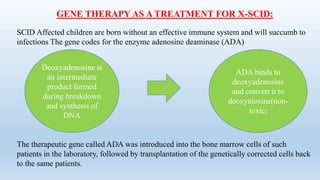
GENE THERAPY AS A TREATMENT FOR X-SCID:
SCID Affected children are born without an effective immune system and will succumb to
infections The gene codes for the enzyme adenosine deaminase (ADA)
The therapeutic gene called ADA was introduced into the bone marrow cells of such
patients in the laboratory, followed by transplantation of the genetically corrected cells back
to the same patients.
Deoxyadenosine is
an intermediate
product formed
during breakdown
and synthesis of
DNA
ADA binds to
deoxyadenosine
and convert it to
deoxyniosine(non-
toxic)
GENE THERAPY FOR CYSTIC FIBROSIS
• In patients with cystic fibrosis, a protein called cystic fibrosis transmembrane
regulator (CFTR) is absent due to a gene defect.
• In the absence of CFTR chloride ions concentrate within the cells and it draws water
from surrounding.
• This leads to the accumulation of sticky mucous in respiratory tract and lungs.
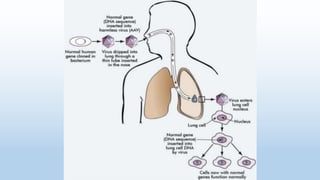
• Treated by in vivo replacement of defective gene by adenovirus vector.
APPLICATION OF GENE THERAPY
1) Synthesis Of Therapeutic Protein
Coagulation Factor:
• Hemophilia A & B causes due to congenital deficiency of the Factor
8 & 9.
• Gene responsible for synthesis of Factor 9 with vector is transduce in
Skeletal muscle
• Vector: Adeno- associated virus
2)Peptide Hormone (Growth Hormone)
• AAV vector encoding gene
• Injected IM in Skeletal Muscle
• Give long term regulated expression of Human GH
3)Preparation of DNA VACCINE:
• Gene + Vector Incubated
• Transcription and Translation
• Produces Antigen protein
• Stimulate the T-helper and T-lymphocytes
• Produce Antibody
4) In Treatment Of Cancer: Breast and Ovarian Cancer by
Oncogene Inactivation
5)In Treatment Of Immunodeficiency Disorders
6) Recent advancement showed that gene therapy can cure
blindness
CONCLUSION
Theoretically, gene therapy is the permanent solution for genetic diseases. But it
has several complexities. At its current stage, it is not accessible to most people
due to its huge cost. A breakthrough may come anytime and a day may come
when almost every disease will have a gene therapy .Gene therapy have the
potential to revolutionize the practice of medicine.
REFERENCES:
1)S.P. Vyas and R.K.Khar , Controlled drug delivery-concepts and
advances, New Delhi, First edition 2002
2)https://www.slideshare.net/damarisb/gene-therapy
3) http://japi.org/february_2013/06_ra_human_gene_therapy_a.pdf
POTENTIAL TARGET DISEASES FOR GENE THERAPY

POTENTIAL TARGET DISEASES FOR GENE THERAPY

  • 1.
    Potential target diseases genetherapy POTENTIAL TARGET DISEASES FOR GENE THERAPY Presented by: BAISHALI PURKAYASTHA Sem: M.Pharm 2nd sem Roll no: 180520011002
  • 2.
    CONTENTS • Introduction • Stepsin gene therapy • Techniques • Approach of gene modification • Transfer of gene into cells • Gene therapy in disease prevention • Application
  • 3.
    INTRODUCTION WHAT IS GENE? basic unit of heredity carried on a chromosome  Specific sequences of bases that Encode instruction on how to make a protein  Mutation Of Genes Results in- -Failure to synthesize a particular protein  These results in abnormalities Recognized as GENETIC DISORDERS  A gene can be delivered to a cell using a carrier k/a a “vector”
  • 4.
    CONCEPT OF GENETHERAPY  an experimental treatment that involves introducing genetic material into a person’s cells to fight or prevent disease.  used to correct a deficient phenotype so that sufficient amounts of a normal gene product are synthesized to improve a genetic disorder
  • 5.
    STEPS IN GENETHERAPY Identification of the defective gene Cloning of normal healthy gene Identification of target cell/tissue/organ Insertion of normal functional gene into host DNA
  • 6.
    HOW IT WORKS? Avector delivers the therapeutic gene into patient’s target cell The target cells become infected with viral vector The vector’s genetic material is inserted into target cell Functional proteins are created from therapeutic gene causing cell return to normal state
  • 7.
    TYPES OF GENETHERAPY Somatic gene therapy Germline gene therapy
  • 8.
    SOMATIC GENE THERAPYGERMLINE GENE THERAPY The therapeutic genes are transferred into the somatic cells (non sex-cells), or body, of a patient. Eg: bone marrow, skin cells etc Therapeutic genes are transferred into germ cells. Eg: eggs and sperms Will not be inherited to later generations. It is inheritable and passed on to later generation. Genetically treated stem cells, when reintroduced into the patient's body are expected to naturally travel through the blood stream to the bone marrow. Genetically changes in the reproductive cells (or embryo) before the stage of differentiation, would affect all future offspring of that person. SOMATIC GENE THERAPY V/S GERMLINE GENE THERAPY
  • 9.
    TYPES OF SOMATICGENE THERAPY
  • 10.
    EX VIVO GENETHERAPY Isolate cells with genetic defect from the patient Grow the cells in culture Select genetically correct cells and grow Transplant the modified cells to the patients
  • 11.
    INVIVO GENE THERAPY Directdelivery of therapeutic gene into target cell into patients body Carried out by viral or non viral vector systems In vivo gene transfer is necessary when cultured cells cannot be re-implanted in patients effectively
  • 12.
    VECTORS IN GENETHERAPY • To transfer the desired gene into a target cell, a carrier is required. • Such vehicles of gene delivery are known as vectors. 2 main classes a)Viral vectors b)Non viral vectors
  • 13.
    VIRAL VECTORS • Virusesintroduce their genetic material into the host cell as part of their replication cycle. • remove the viral DNA and using the virus as a vehicle to deliver the therapeutic DNA. 4types: 1) Retrovirus 2) Adenovirus 3) Adeno-associated virus 4) Herpes simplex virus
  • 14.
    a)Retro Virus BasedVectors • Retroviral vector binding to host cell surface • Uncoating of virus • Release of vector viral RNA • DNA production and replication • Integration of vector into host genome of a dividing cell • Expression of Heterologous Gene USE- In ex-vivo therapy
  • 15.
    b) Adeno VirusBased Vector Double • Vector Enters into Host Cells in Acidic environment • Protease in virion gets activated Proteolysis of the virion • Viral DNA released into cytoplasm • DNA transported to Nucleus
  • 16.
    c) ADENO ASSOCIATEDVIRUS VECTOR • It is a human virus that can integrate into chromosome 19. • It is a single stranded, non pathogenic small DNA virus. • AAV enters host cell, becomes double stranded and gets integrated into chromosome. d) HERPEX SIMPLEX VIRUS VECTOR • Viruses which have natural tendency to infect a particular type of cell. • They infect and persist in nervous cells
  • 17.
    NON VIRAL VECTORSYSTEM 1) PURE DNA CONSTRUCT • Direct introduction of pure DNA construct into target tissue. • Efficiency of DNA uptake by cells and expression rather low. • Consequently, large quantities of DNA have to be injected periodically
  • 18.
    2) DNA MOLECULARCONJUGATES • Commonly used synthetic conjugate is poly- L- lysine bound to specific target cell receptor. • Therapeutic DNA is then made to combine with the conjugate to form a complex. • avoids lysosomal breakdown of DNA.
  • 19.
    3) LIPOPLEXES • LipidDNA complexes • DNA construct surrounded by artificial lipid layer. Most of it gets degraded by lysosomes. 4) HUMAN ARTIFICIAL CHROMOSOME • Can carry a large DNA i.e., with one or more therapeutic genes
  • 20.
    APPROACHES IN GENETHERAPY a) Gene modification i) Gene replacement ii) Gene correction iii)Gene augmentation b) Gene transfer i) Physical ii) Chemical iii) Biological c) Gene transfer in specific cell line i) Somatic gene therapy ii) Germ line gene therapy
  • 21.
    (A)Gene Modification  DefectiveGene is modified to render it functionally normal. Patient with Genetic Disorder Isolation of Genomic DNA Construction Of Genomic Libraries Identification Of Defective Genes
  • 22.
    1) Gene Replacement Removal of a Mutant Gene sequence from the Host Genome and its replacement with a normal Functional Gene.  Used for Disorder marked by deficiency of ENZYME/PROTEIN. (2) Gene Correction  Involves only defective portion of a mutant gene which is altered to provide the Functional Gene, without precisely changing the gene back to its natural form
  • 23.
    (3) Gene Augmentation Expression of mutant gene in defective gene is modified by introducing a normal genetic sequence into Host Genome without altering the defective one. (B) Gene Transfer Method (1)Non-Viral Gene Transfer (2) Viral Mediated Gene Transfer
  • 24.
    B) INTRODUCTION OFGENES INTO CELLS (1)Physical Methods a) Electroporation  Short electric pulses of specific strength is applied  creates holes in cell membrane  foreign DNA in suspension can enter inside the cell. Advantage- Simple and technically easy. Disadvantage- High risk of contamination.
  • 25.
    b) Microinjection  Processof using a glass micropipette to insert microscopic substances.  Performed under a specialized optical microscope setup called a micromanipulator.  Very fine glass capillaries are used for injecting DNA directly into Nucleus of target Cells. Advantage - High efficient Disadvantage - Only limited no of cell can transformed at a time.
  • 26.
    C) Gene Gun Employs a high pressure delivery system to shoot tissue with gold or tungsten particles that are coated with DNA  Simple, ideal for gene mediated immunization.  Simple for Large scale application.
  • 27.
    (2) Chemical Method a)NakedDNA Injection  DNA is introduce into cell by using chemicals  EX- CaCl2 + DNA Solution + PBS(PO4 buffer Saline) Ca(PO4)2 DNA gets entrapped with ppt Cells take up DNA
  • 28.
    b)Liposome Mediated Transfer Foreign DNA is incorporated into Liposomes by sonication of a lipid sol and DNA in Ether.  deliver a variety of molecules including DNA into the cells. Advantage- Protection of DNA from Nuclease, non toxic nature.
  • 29.
    3) BIOLOGICAL METHOD(VIRAL METHOD) a)Viral mediated transfer b)Non-viral mediated transfer
  • 30.
    TARGET CELLS OFGENE THERAPY  THE HEMOPOIETIC CELLS Most consistent target for gene therapy. Has strong potential  THE HEPATOCYTES Attractive target for gene therapy. Liver plays a vital role in most metabolic process.  MUSCLE CELLS Strong potential Use as an efficient target organ for correlation of intrinsic muscle and non- muscle diseases.
  • 31.
    GENE THERAPY USEDTO TREAT TYPE I DIABETES  First, the gene was cloned under the L-type Pyruvate Kinase (LPK) promoter, which regulates the expression of SIA in response to glucose levels.  The LPK-SIA gene was then attached to a recombinant adeno-associated virus and integrated into the host chromosomal DNA.  After insertion of the rAV -LPK-SIAA , the rats displayed a drop in glucose levels that reached a range of normoglycaemia within one week of treatment.  The rates remained in this range for more than eight months.  In addition to eight months of controlled glucose levels, there were no visible side affects from the gene therapy. While the results did not show permanent remission, the control of glucose levels from the insertion of the SIA gene was promising.
  • 32.
    GENE THERAPY FORCANCER TREATMENT: Oncogene Inactivation: • Done by using antisense therapy. • Reduces the expression of antigenic proteins responsible for malignancies Cell- Targeted Suicide: • Herpes Simplex Virus-1 Thymidine Kinase(HSV-1 - TK) is given in combination with Gancyclovir causes Over production of Thymidine Kinase • HSV-1 – TK helps in phosphorylation of Gancyclovir
  • 33.
    GENE THERAPY REDUCESPARKINSON’S DISEASE SYMPTOMS it significantly improved the weakness of the symptoms such as tremors, motor skill problems the subthalamic nucleus should be introduced with gene that produce GABA—an inhibitory chemical—then they could potentially quiet that brain region and alleviate tremors. Done with local anesthesia, used a harmless, inactive virus [AAV-2 GAD]  Deliver the GAD gene into patient’s subthalamic nucleus. The gene instructs cells to begin making GABA neurotransmitters to re-establish the normal chemical balance that becomes dysfunctional as the disease progresses.
  • 34.
    GENE THERAPY ASA TREATMENT FOR X-SCID: SCID Affected children are born without an effective immune system and will succumb to infections The gene codes for the enzyme adenosine deaminase (ADA) The therapeutic gene called ADA was introduced into the bone marrow cells of such patients in the laboratory, followed by transplantation of the genetically corrected cells back to the same patients. Deoxyadenosine is an intermediate product formed during breakdown and synthesis of DNA ADA binds to deoxyadenosine and convert it to deoxyniosine(non- toxic)
  • 35.
    GENE THERAPY FORCYSTIC FIBROSIS • In patients with cystic fibrosis, a protein called cystic fibrosis transmembrane regulator (CFTR) is absent due to a gene defect. • In the absence of CFTR chloride ions concentrate within the cells and it draws water from surrounding. • This leads to the accumulation of sticky mucous in respiratory tract and lungs. • Treated by in vivo replacement of defective gene by adenovirus vector.
  • 37.
    APPLICATION OF GENETHERAPY 1) Synthesis Of Therapeutic Protein Coagulation Factor: • Hemophilia A & B causes due to congenital deficiency of the Factor 8 & 9. • Gene responsible for synthesis of Factor 9 with vector is transduce in Skeletal muscle • Vector: Adeno- associated virus
  • 38.
    2)Peptide Hormone (GrowthHormone) • AAV vector encoding gene • Injected IM in Skeletal Muscle • Give long term regulated expression of Human GH 3)Preparation of DNA VACCINE: • Gene + Vector Incubated • Transcription and Translation • Produces Antigen protein • Stimulate the T-helper and T-lymphocytes • Produce Antibody
  • 39.
    4) In TreatmentOf Cancer: Breast and Ovarian Cancer by Oncogene Inactivation 5)In Treatment Of Immunodeficiency Disorders 6) Recent advancement showed that gene therapy can cure blindness
  • 40.
    CONCLUSION Theoretically, gene therapyis the permanent solution for genetic diseases. But it has several complexities. At its current stage, it is not accessible to most people due to its huge cost. A breakthrough may come anytime and a day may come when almost every disease will have a gene therapy .Gene therapy have the potential to revolutionize the practice of medicine.
  • 41.
    REFERENCES: 1)S.P. Vyas andR.K.Khar , Controlled drug delivery-concepts and advances, New Delhi, First edition 2002 2)https://www.slideshare.net/damarisb/gene-therapy 3) http://japi.org/february_2013/06_ra_human_gene_therapy_a.pdf