Submitted By:
Mohd Muzahid
M.Pharma(Pharmacology
1st
year)
Submitted To:
INTEGRAL
UNIVERSITY
Lucknow 104/10/2018
2
 Gene therapy is an experimental technique for
correcting defective gene that are responsible for
disease development.
 The most common form of gene therapy involves
inserting a normal gene to replace an abnormal
gene.
 The first approved gene therapy experiment
occurred on september 14,1990 in US, when
Ashanti DeSilva was treated for ADA-SCID.
3
 Other approaches used:
• Replacing a muted gene that causes disease with a
healthy copy of the gene.
• Introducing a new gene into the body to help fight a
disease.
4
• Researchers are studying gene therapy for a number of
diseases, such as
 Severe combined immuno-deficiencies(SCID)
 Hemophilia
 Perkinson’s disease
 Cancer
 HIV
5
6
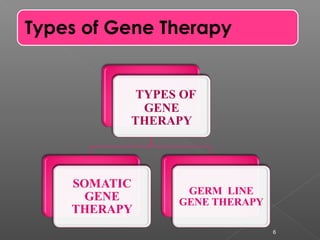
Types of Gene Therapy
 Therapeutic genes transferred into
the somatic cells.
 E.g.. Introduction of gene into bone
marrow cells, blood cells, skin cells
etc.
 Will not be inherited later
generation.
 At present all researches directed to correct
genetic defects in somatic cells.
7
Somatic Gene Therapy
Therapeutic genes transferred into the germ cells.
E.g.. Gene introduced into eggs and sperms.
It is heritable and passed on to later generations.
For safety, ethical and technical reason, it is not being
attempted at present.
8
Germ Line Gene Therapy
9
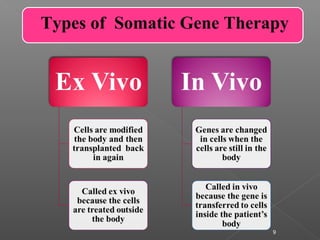
Types of Somatic Gene Therapy
10
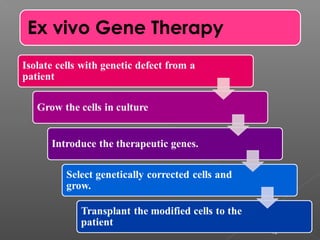
Ex vivo Gene Therapy
11
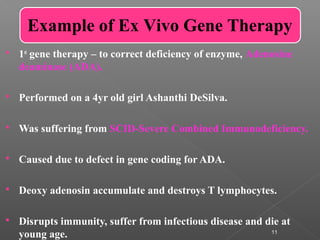
 1st
gene therapy – to correct deficiency of enzyme, Adenosine
deaminase (ADA).
 Performed on a 4yr old girl Ashanthi DeSilva.
 Was suffering from SCID-Severe Combined Immunodeficiency.
 Caused due to defect in gene coding for ADA.
 Deoxy adenosin accumulate and destroys T lymphocytes.
 Disrupts immunity, suffer from infectious disease and die at
young age.
Example of Ex Vivo Gene Therapy
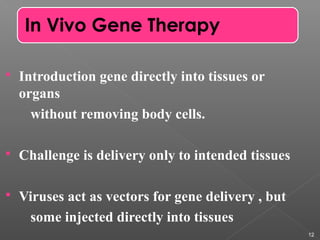
 Introduction gene directly into tissues or
organs
without removing body cells.
 Challenge is delivery only to intended tissues
 Viruses act as vectors for gene delivery , but
some injected directly into tissues
12
In Vivo Gene Therapy
13
Example of In Vivo Gene Therapy
 In patients with cystic fibrosis, a protein called cystic
fibrosis transmembrane regulator (CFTR) is absent due
to a gene defect.
 In the absence of CFTR chloride ions concentrate within
the cells and it draws water from surrounding .
 This leads to the accumulation of sticky mucous in
respiratory tract and lungs.
 Treated by in vivo replacement of defective gene by
adenovirus vector.
To transfer the desired gene into a target cell, a
carrier is required. Such vehicles of gene delivery are
known as vectors.
Two main classes
 Viral vectors
 Non viral vectors
14
Vector In Gene Therapy
15
 Viruses introduce their genetic material into the host
cell as part of their replication cycle.
 Remove the viral DNA and using the virus as a vehicle
to deliver the therapeutic DNA.
 The viruses used are altered to make them safe,
although some risks still exist with gene therapy.
 A number of viruses have been used for human
gene therapy, including:
 Retrovirus
 Adenovirus
 Adeno-associate virus
 Harpes simplex virus
16
Type of Viral Vectors
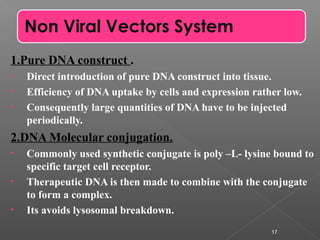
1.Pure DNA construct .
• Direct introduction of pure DNA construct into tissue.
• Efficiency of DNA uptake by cells and expression rather low.
• Consequently large quantities of DNA have to be injected
periodically.
2.DNA Molecular conjugation.
• Commonly used synthetic conjugate is poly –L- lysine bound to
specific target cell receptor.
• Therapeutic DNA is then made to combine with the conjugate
to form a complex.
• Its avoids lysosomal breakdown.
17
Non Viral Vectors System
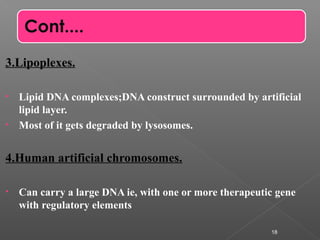
3.Lipoplexes.
• Lipid DNA complexes;DNA construct surrounded by artificial
lipid layer.
• Most of it gets degraded by lysosomes.
4.Human artificial chromosomes.
• Can carry a large DNA ie, with one or more therapeutic gene
with regulatory elements
18
Cont....
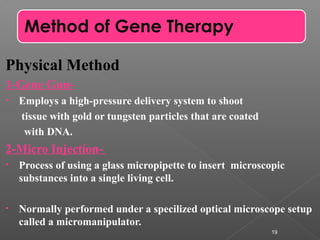
Physical Method
1-Gene Gun-
• Employs a high-pressure delivery system to shoot
tissue with gold or tungsten particles that are coated
with DNA.
2-Micro Injection-
• Process of using a glass micropipette to insert microscopic
substances into a single living cell.
• Normally performed under a specilized optical microscope setup
called a micromanipulator.
19
Method of Gene Therapy
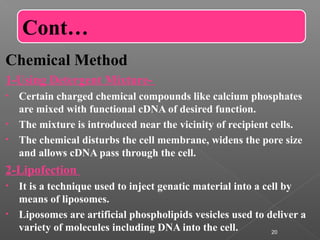
Chemical Method
1-Using Detergent Mixture-
• Certain charged chemical compounds like calcium phosphates
are mixed with functional cDNA of desired function.
• The mixture is introduced near the vicinity of recipient cells.
• The chemical disturbs the cell membrane, widens the pore size
and allows cDNA pass through the cell.
2-Lipofection
• It is a technique used to inject genatic material into a cell by
means of liposomes.
• Liposomes are artificial phospholipids vesicles used to deliver a
variety of molecules including DNA into the cell. 20
Cont…
List of Advantages of Gene Therapy:
It has the ability to replace defective cells.
It is a possible cure for heart disease, AIDS and cancer.
 It can help eradicate diseases from the future
generations.
List of Disadvantages of Gene Therapy
It can damage the gene pool.
It would modify human capabilities.
It has the potential to give rise in other disorders
21
Advantages & Disadvantages of gene therapy
• Genetic disorder (deficiency ): OTC
• Cancer
- Genetic predisposition
- Mutation in oncogene or tumor supperssor gene.
• Autoimmunity Disease: Rheumatoid arthritis
- Delivery of counteracting gene
• Diseases involves several gene and the
environmental intract:Diabetes
22
Application of Gene Therapy
 Dubey R.C,A Textbook of biotechnology, 1st
edition (2004), S
Chand and company , New Delhi.
 Gupta P.K Elements of biotechnology,1st
edition (2001)
,Rastogi Publications, Meerut.
 Satyanarayna U,Biotechnology ,1st
edition ,book and allied (P)
Ltd, Kolkata.
23
24

Gene therapy

  • 1.
  • 2.
  • 3.
     Gene therapyis an experimental technique for correcting defective gene that are responsible for disease development.  The most common form of gene therapy involves inserting a normal gene to replace an abnormal gene.  The first approved gene therapy experiment occurred on september 14,1990 in US, when Ashanti DeSilva was treated for ADA-SCID. 3
  • 4.
     Other approachesused: • Replacing a muted gene that causes disease with a healthy copy of the gene. • Introducing a new gene into the body to help fight a disease. 4
  • 5.
    • Researchers arestudying gene therapy for a number of diseases, such as  Severe combined immuno-deficiencies(SCID)  Hemophilia  Perkinson’s disease  Cancer  HIV 5
  • 6.
  • 7.
     Therapeutic genestransferred into the somatic cells.  E.g.. Introduction of gene into bone marrow cells, blood cells, skin cells etc.  Will not be inherited later generation.  At present all researches directed to correct genetic defects in somatic cells. 7 Somatic Gene Therapy
  • 8.
    Therapeutic genes transferredinto the germ cells. E.g.. Gene introduced into eggs and sperms. It is heritable and passed on to later generations. For safety, ethical and technical reason, it is not being attempted at present. 8 Germ Line Gene Therapy
  • 9.
    9 Types of SomaticGene Therapy
  • 10.
  • 11.
    11  1st gene therapy– to correct deficiency of enzyme, Adenosine deaminase (ADA).  Performed on a 4yr old girl Ashanthi DeSilva.  Was suffering from SCID-Severe Combined Immunodeficiency.  Caused due to defect in gene coding for ADA.  Deoxy adenosin accumulate and destroys T lymphocytes.  Disrupts immunity, suffer from infectious disease and die at young age. Example of Ex Vivo Gene Therapy
  • 12.
     Introduction genedirectly into tissues or organs without removing body cells.  Challenge is delivery only to intended tissues  Viruses act as vectors for gene delivery , but some injected directly into tissues 12 In Vivo Gene Therapy
  • 13.
    13 Example of InVivo Gene Therapy  In patients with cystic fibrosis, a protein called cystic fibrosis transmembrane regulator (CFTR) is absent due to a gene defect.  In the absence of CFTR chloride ions concentrate within the cells and it draws water from surrounding .  This leads to the accumulation of sticky mucous in respiratory tract and lungs.  Treated by in vivo replacement of defective gene by adenovirus vector.
  • 14.
    To transfer thedesired gene into a target cell, a carrier is required. Such vehicles of gene delivery are known as vectors. Two main classes  Viral vectors  Non viral vectors 14 Vector In Gene Therapy
  • 15.
    15  Viruses introducetheir genetic material into the host cell as part of their replication cycle.  Remove the viral DNA and using the virus as a vehicle to deliver the therapeutic DNA.  The viruses used are altered to make them safe, although some risks still exist with gene therapy.
  • 16.
     A numberof viruses have been used for human gene therapy, including:  Retrovirus  Adenovirus  Adeno-associate virus  Harpes simplex virus 16 Type of Viral Vectors
  • 17.
    1.Pure DNA construct. • Direct introduction of pure DNA construct into tissue. • Efficiency of DNA uptake by cells and expression rather low. • Consequently large quantities of DNA have to be injected periodically. 2.DNA Molecular conjugation. • Commonly used synthetic conjugate is poly –L- lysine bound to specific target cell receptor. • Therapeutic DNA is then made to combine with the conjugate to form a complex. • Its avoids lysosomal breakdown. 17 Non Viral Vectors System
  • 18.
    3.Lipoplexes. • Lipid DNAcomplexes;DNA construct surrounded by artificial lipid layer. • Most of it gets degraded by lysosomes. 4.Human artificial chromosomes. • Can carry a large DNA ie, with one or more therapeutic gene with regulatory elements 18 Cont....
  • 19.
    Physical Method 1-Gene Gun- •Employs a high-pressure delivery system to shoot tissue with gold or tungsten particles that are coated with DNA. 2-Micro Injection- • Process of using a glass micropipette to insert microscopic substances into a single living cell. • Normally performed under a specilized optical microscope setup called a micromanipulator. 19 Method of Gene Therapy
  • 20.
    Chemical Method 1-Using DetergentMixture- • Certain charged chemical compounds like calcium phosphates are mixed with functional cDNA of desired function. • The mixture is introduced near the vicinity of recipient cells. • The chemical disturbs the cell membrane, widens the pore size and allows cDNA pass through the cell. 2-Lipofection • It is a technique used to inject genatic material into a cell by means of liposomes. • Liposomes are artificial phospholipids vesicles used to deliver a variety of molecules including DNA into the cell. 20 Cont…
  • 21.
    List of Advantagesof Gene Therapy: It has the ability to replace defective cells. It is a possible cure for heart disease, AIDS and cancer.  It can help eradicate diseases from the future generations. List of Disadvantages of Gene Therapy It can damage the gene pool. It would modify human capabilities. It has the potential to give rise in other disorders 21 Advantages & Disadvantages of gene therapy
  • 22.
    • Genetic disorder(deficiency ): OTC • Cancer - Genetic predisposition - Mutation in oncogene or tumor supperssor gene. • Autoimmunity Disease: Rheumatoid arthritis - Delivery of counteracting gene • Diseases involves several gene and the environmental intract:Diabetes 22 Application of Gene Therapy
  • 23.
     Dubey R.C,ATextbook of biotechnology, 1st edition (2004), S Chand and company , New Delhi.  Gupta P.K Elements of biotechnology,1st edition (2001) ,Rastogi Publications, Meerut.  Satyanarayna U,Biotechnology ,1st edition ,book and allied (P) Ltd, Kolkata. 23
  • 24.