PRESENTED BY :
SREYA. S
M. Pharmacy
I. Semester
Academic year:2019-2021
DEPARTMENT OF
PHARMACOLOGY
GENE THERAPY
 Gene therapy is the introduction of genes into existing cells to
prevent or cure a wide range of diseases.
 It is a technique for correcting defective genes responsible for
disease development.
 The first approved gene therapy experiment occurred on
September 14, 1990 in US, when Ashanti DeSilva was treated
for ADA-SCID
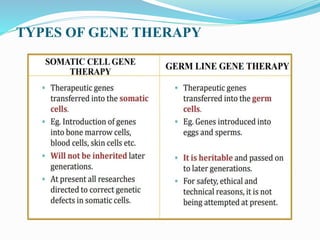
TYPES OF GENE THERAPY
APPROACHES IN GENE THERAPY
 In vivo gene therapy :-
direct delivery of genes into the cells of a
particular tissue in the body.
 Ex vivo gene therapy :-
transfer of genes to cultured cells and reinsertion.
Ex vivo gene transfer
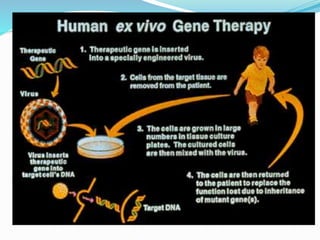
- Few defective cells removed from patient and grown in the
laboratory.
The cells are exposed to the virus that is carrying the desired
gene. The virus enters the cells and inserts the desired gene into
the cell's DNA.
The cells grow in the laboratory and then returned to the
patient by injection into a vein.
EXAMPLE:
 1 st gene therapy – to correct deficiency of enzyme, Adenosine
deaminase (ADA).
 Performed on a 4yr old girl Ashanthi DeSilva
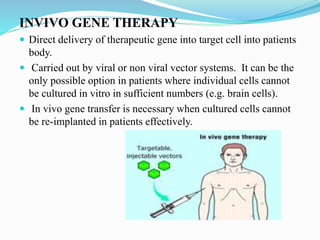
INVIVO GENE THERAPY
 Direct delivery of therapeutic gene into target cell into patients
body.
 Carried out by viral or non viral vector systems. It can be the
only possible option in patients where individual cells cannot
be cultured in vitro in sufficient numbers (e.g. brain cells).
 In vivo gene transfer is necessary when cultured cells cannot
be re-implanted in patients effectively.
EXAMPLES
 In patients with cystic fibrosis, a protein called cystic
fibrosis transmembrane regulator (CFTR) is absent due to
a gene defect. In the absence of CFTR chloride ions
concentrate within the cells and it draws water from
surrounding. This leads to the accumulation of sticky
mucous in respiratory tract and lungs. Treated by in vivo
replacement of defective gene by adenovirus vector.
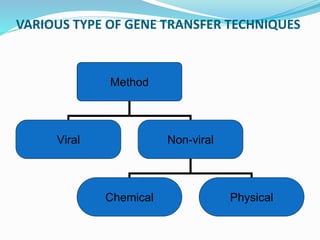
VARIOUS TYPE OF GENE TRANSFER TECHNIQUES
Method
Viral Non-viral
Chemical Physical
Why viruses
 High concentration of virus allowing many cells to be infected
or transduced
 Convenience and reproducibility of production
 Ability to transduce dividing and non-dividing cells
 Ability to integrate into a site-specific location in the host
chromosome, or to be successfully maintained as stable
episome
 Ability to target the desired type of cell
VIRAL VECTORS
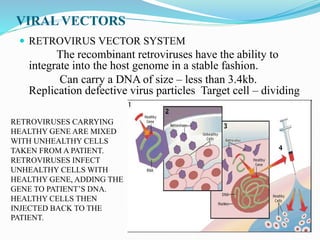
 RETROVIRUS VECTOR SYSTEM
The recombinant retroviruses have the ability to
integrate into the host genome in a stable fashion.
Can carry a DNA of size – less than 3.4kb.
Replication defective virus particles Target cell – dividing
RETROVIRUSES CARRYING
HEALTHY GENE ARE MIXED
WITH UNHEALTHY CELLS
TAKEN FROM A PATIENT.
RETROVIRUSES INFECT
UNHEALTHY CELLS WITH
HEALTHY GENE, ADDING THE
GENE TO PATIENT’S DNA.
HEALTHY CELLS THEN
INJECTED BACK TO THE
PATIENT.
Disadvantages of retroviruses
 Can only invade cells that devide often, therefore blood cells,
skin cells and many other tissues can not be invaded by this
vector.
 Do not insert their genetic material in any specific places, but
in the middle of an important gene. The important gene could
become defective, stop functioning and could do more harm
than good……. (insertional mutagenesis)
e.g. leukemia in 10 patients
 Immune rejection
ADENO VIRUS VECTOR SYSTEM
• Adeno virus with a DNA genome – good vectors. Target-
non dividing human cell. Eg. Common cold adenovirus
• Genetic material in the form of DNA (common pathogen)
• When these viruses infect a host, they introduce their DNA
molecule into the host but not incorporated into the host
genetic material.
• These extra genes are not replicated, so when the host
undergo cell division, the descendants of the cell will not
have the extra gene.
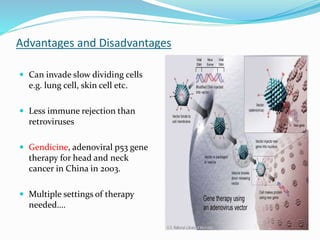
Advantages and Disadvantages
 Can invade slow dividing cells
e.g. lung cell, skin cell etc.
 Less immune rejection than
retroviruses
 Gendicine, adenoviral p53 gene
therapy for head and neck
cancer in China in 2003.
 Multiple settings of therapy
needed….
ADENO ASSOCIATED VIRUS VECTOR
It is a human virus that can integrate into chromosome 19.
It is a single stranded, non pathogenic small DNA virus. AAV
enters host cell, becomes double stranded and gets integrated
into chromosome
HERPEX SIMPLEX VIRUS VECTOR
Viruses which have natural tendency to infect a
particular type of cell. They infect and persist in nervous cells.
NON VIRAL VECTORS
PURE DNA CONSTRUCT
Direct introduction of pure DNA construct into target
tissue . Efficiency of DNA uptake by cells and expression
rather low. Consequently, large quantities of DNA have to
be injected periodically.
LIPOPLEXES
Lipid DNA complexes; DNA construct surrounded by
artificial lipid layer. Most of it gets degraded by
lysosomes
HUMAN ARTIFICIAL CHROMOSOME
Can carry a large DNA ie, with one or more therapeutic
genes with regulatory elements
Mechanism of viral gene delivery
 viruses genetically altered to carry normal human DNA
 Target cell such as the patient’s liver or lung cells are infected
with the viral vector.
 The viral vector then unload its genetic material containing the
therapeutic human gene into the target cell.
 The generation of a functional protein product from therapeutic
gene restores the target cell to a normal state.
METHODS OF GENE DELIVERY
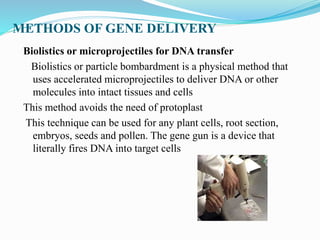
Biolistics or microprojectiles for DNA transfer
Biolistics or particle bombardment is a physical method that
uses accelerated microprojectiles to deliver DNA or other
molecules into intact tissues and cells
This method avoids the need of protoplast
This technique can be used for any plant cells, root section,
embryos, seeds and pollen. The gene gun is a device that
literally fires DNA into target cells
Advantages
 Requirement of protoplast can be avoided.
 Walled intact cells can be penetrated.
 Manipulation of genome of subcellular organelles can be
achieved.
Limitations
Integration is random.
Requirement of equipments.
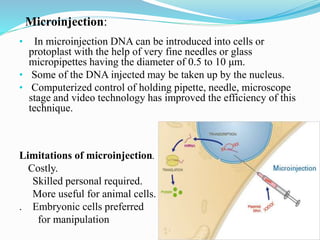
Microinjection:
• In microinjection DNA can be introduced into cells or
protoplast with the help of very fine needles or glass
micropipettes having the diameter of 0.5 to 10 μm.
• Some of the DNA injected may be taken up by the nucleus.
• Computerized control of holding pipette, needle, microscope
stage and video technology has improved the efficiency of this
technique.
Limitations of microinjection.
Costly.
Skilled personal required.
More useful for animal cells.
. Embryonic cells preferred
for manipulation
Advantages
 Frequency of stable integration of DNA is far better as
compare to other methods.
 Method is effective in transforming primary cells as well
as cells in established cultures.
 The DNA injected in this process is subjected to less
extensive modifications
 Mere precise integration of recombinant gene in limited
copy number can be obtained
ELECTROPORATION
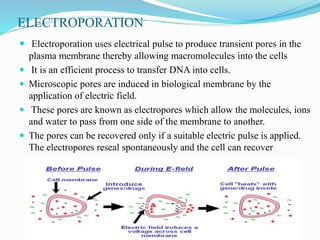
 Electroporation uses electrical pulse to produce transient pores in the
plasma membrane thereby allowing macromolecules into the cells
 It is an efficient process to transfer DNA into cells.
 Microscopic pores are induced in biological membrane by the
application of electric field.
 These pores are known as electropores which allow the molecules, ions
and water to pass from one side of the membrane to another.
 The pores can be recovered only if a suitable electric pulse is applied.
The electropores reseal spontaneously and the cell can recover
Advantages of electroporation.
 Method is fast.
 Less costly.
 Applied for a number of cell types.
 Simultaneously a large number of cell can be treated.
 High percentage of stable transformants can be produced.
CHEMICAL METHODS
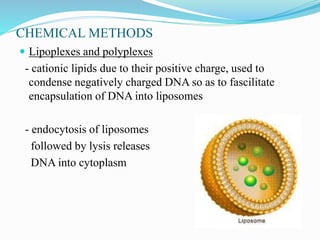
 Lipoplexes and polyplexes
- cationic lipids due to their positive charge, used to
condense negatively charged DNA so as to fascilitate
encapsulation of DNA into liposomes
- endocytosis of liposomes
followed by lysis releases
DNA into cytoplasm
USING DETERGENT MIXTURES
Certain charged chemical compounds like Calcium phosphates
are mixed with functional cDNA of desired function. The
mixture is introduced near the vicinity of recipient cells.
The chemicals disturbs the cell membrane, widens the pore
size and allows cDNA to pass through the cell.
LIPOFECTION
It is a technique used to inject genetic materials into a cell by
means of liposomes. Liposomes are artificial phospholipid
vesicles used to deliver a variety of molecules including DNA
into the cells
Applications of Gene Therapy
Severe combined immunodeficiency disease (SCID)
 Growth hormone deficiency: by implanting cultured myoblasts
transfected with GH gene.
 Familial hypercholesterolemia: by introducing LDL receptor
gene into hepatocytes.
 Lesch-Nyhan syndrome: by introducing HPRT gene.
Parkinsonism
It has significantly improved the weakness of the symptoms such
as tremors, motor skill problems, and rigidity
Done with local anesthesia, used a harmless, inactive virus [AAV-
2 ]
 Cardiovascular disease
Recent human clinical trials have shown that injection of
naked DNA encoding vascular endothelial growth factor
promotes collateral vessel development in patients with critical
limb ischemia or chronic myocardial ischemia.
Gene transfer in liver
Hepatic gene therapy is a good approach for the treatment
of metabolic defects or serum protein deficiencies.
Osteoarthritis
Osteoarthritis is a bone disease that affects over 43
million Americans, Gene transfer to the synovial linings of
affected joints is a promising strategy for achieving sustained,
therapeutic, intraarticular concentrations of antiarthritic gene
products.
 Stroke, head injury, multiple sclerosis: by delivering nerve
growth factor gene.
 Duchenne muscular dystrophy: by administering muscle
dystropin gene
 Sickle cell anaemia: by introducing beta/ delta sickle cell
inhibitor hybrid gene.
 Haemophilia: by introducing factor VIII gene.
 DM - 1: by introducing insulin-1 gene into liver.
 HIV infection: by injecting fibroblasts expressing HIV
envelope glycoprotein gene to augment immunity against
HIV.
Cancer:
• By genetic introduction of an enzyme (viral thymidine
kinase) into tumour cells followed by a prodrug that is
converted to the toxic metabolite, tumour cells are
selectively killed.
• By inserting TNFa, IL-2 and other cytokine genes into tumour
cells to increase their immune recognition and destruction by
tumour infiltrating lymphocytes.
• By introducing promoter 'antisense' gene or 'suppressor' gene
which negatively regulate tumour growth.
• By introducing multidrug resistance MDR-1 gene into bone
marrow cells and render them less susceptible to destruction by
myelosuppressant drugs, toxicity of many anticancer drugs can
be overcome.
RECENT ADVANCES
 Genes get into brain using liposomes coated in polymer call
polyethylene glycol.
 Potential for treating Parkinson’s disease.
 RNA interference or gene silencing to treat Huntington’s
disease.
 siRNA used to degrade RNA of particular sequence.
 Abnormal protein won’t be produced.
 Create tiny liposomes that can carry therapeutic DNA through
pores of nuclear membrane.
 Sickle cell successfully treated in mice.
REFERENCES
• Dubey R.C, A textbook of biotechnology, 1st
edition(2004), S Chand and company, New Delhi
• Gupta P.K, Elements of Biotechnology, 1st
edition(2001), Rastogi Publications, Meerut.
• Satyanarayana U, Biotechnology, 1st edition, Book and
allied (P) Ltd, Kolkata.
• http://www.medindia.net/articles/genetherapy_treat
ment.htm
• http://en.wikipedia.org/wiki/Gene_therapy
THANK YOU

Gene therapy

  • 1.
    PRESENTED BY : SREYA.S M. Pharmacy I. Semester Academic year:2019-2021 DEPARTMENT OF PHARMACOLOGY
  • 2.
    GENE THERAPY  Genetherapy is the introduction of genes into existing cells to prevent or cure a wide range of diseases.  It is a technique for correcting defective genes responsible for disease development.  The first approved gene therapy experiment occurred on September 14, 1990 in US, when Ashanti DeSilva was treated for ADA-SCID
  • 3.
  • 4.
    APPROACHES IN GENETHERAPY  In vivo gene therapy :- direct delivery of genes into the cells of a particular tissue in the body.  Ex vivo gene therapy :- transfer of genes to cultured cells and reinsertion.
  • 5.
    Ex vivo genetransfer - Few defective cells removed from patient and grown in the laboratory. The cells are exposed to the virus that is carrying the desired gene. The virus enters the cells and inserts the desired gene into the cell's DNA. The cells grow in the laboratory and then returned to the patient by injection into a vein. EXAMPLE:  1 st gene therapy – to correct deficiency of enzyme, Adenosine deaminase (ADA).  Performed on a 4yr old girl Ashanthi DeSilva
  • 7.
    INVIVO GENE THERAPY Direct delivery of therapeutic gene into target cell into patients body.  Carried out by viral or non viral vector systems. It can be the only possible option in patients where individual cells cannot be cultured in vitro in sufficient numbers (e.g. brain cells).  In vivo gene transfer is necessary when cultured cells cannot be re-implanted in patients effectively.
  • 8.
    EXAMPLES  In patientswith cystic fibrosis, a protein called cystic fibrosis transmembrane regulator (CFTR) is absent due to a gene defect. In the absence of CFTR chloride ions concentrate within the cells and it draws water from surrounding. This leads to the accumulation of sticky mucous in respiratory tract and lungs. Treated by in vivo replacement of defective gene by adenovirus vector.
  • 9.
    VARIOUS TYPE OFGENE TRANSFER TECHNIQUES Method Viral Non-viral Chemical Physical
  • 10.
    Why viruses  Highconcentration of virus allowing many cells to be infected or transduced  Convenience and reproducibility of production  Ability to transduce dividing and non-dividing cells  Ability to integrate into a site-specific location in the host chromosome, or to be successfully maintained as stable episome  Ability to target the desired type of cell
  • 11.
    VIRAL VECTORS  RETROVIRUSVECTOR SYSTEM The recombinant retroviruses have the ability to integrate into the host genome in a stable fashion. Can carry a DNA of size – less than 3.4kb. Replication defective virus particles Target cell – dividing RETROVIRUSES CARRYING HEALTHY GENE ARE MIXED WITH UNHEALTHY CELLS TAKEN FROM A PATIENT. RETROVIRUSES INFECT UNHEALTHY CELLS WITH HEALTHY GENE, ADDING THE GENE TO PATIENT’S DNA. HEALTHY CELLS THEN INJECTED BACK TO THE PATIENT.
  • 12.
    Disadvantages of retroviruses Can only invade cells that devide often, therefore blood cells, skin cells and many other tissues can not be invaded by this vector.  Do not insert their genetic material in any specific places, but in the middle of an important gene. The important gene could become defective, stop functioning and could do more harm than good……. (insertional mutagenesis) e.g. leukemia in 10 patients  Immune rejection
  • 13.
    ADENO VIRUS VECTORSYSTEM • Adeno virus with a DNA genome – good vectors. Target- non dividing human cell. Eg. Common cold adenovirus • Genetic material in the form of DNA (common pathogen) • When these viruses infect a host, they introduce their DNA molecule into the host but not incorporated into the host genetic material. • These extra genes are not replicated, so when the host undergo cell division, the descendants of the cell will not have the extra gene.
  • 14.
    Advantages and Disadvantages Can invade slow dividing cells e.g. lung cell, skin cell etc.  Less immune rejection than retroviruses  Gendicine, adenoviral p53 gene therapy for head and neck cancer in China in 2003.  Multiple settings of therapy needed….
  • 15.
    ADENO ASSOCIATED VIRUSVECTOR It is a human virus that can integrate into chromosome 19. It is a single stranded, non pathogenic small DNA virus. AAV enters host cell, becomes double stranded and gets integrated into chromosome HERPEX SIMPLEX VIRUS VECTOR Viruses which have natural tendency to infect a particular type of cell. They infect and persist in nervous cells.
  • 16.
    NON VIRAL VECTORS PUREDNA CONSTRUCT Direct introduction of pure DNA construct into target tissue . Efficiency of DNA uptake by cells and expression rather low. Consequently, large quantities of DNA have to be injected periodically. LIPOPLEXES Lipid DNA complexes; DNA construct surrounded by artificial lipid layer. Most of it gets degraded by lysosomes HUMAN ARTIFICIAL CHROMOSOME Can carry a large DNA ie, with one or more therapeutic genes with regulatory elements
  • 17.
    Mechanism of viralgene delivery  viruses genetically altered to carry normal human DNA  Target cell such as the patient’s liver or lung cells are infected with the viral vector.  The viral vector then unload its genetic material containing the therapeutic human gene into the target cell.  The generation of a functional protein product from therapeutic gene restores the target cell to a normal state.
  • 18.
    METHODS OF GENEDELIVERY Biolistics or microprojectiles for DNA transfer Biolistics or particle bombardment is a physical method that uses accelerated microprojectiles to deliver DNA or other molecules into intact tissues and cells This method avoids the need of protoplast This technique can be used for any plant cells, root section, embryos, seeds and pollen. The gene gun is a device that literally fires DNA into target cells
  • 19.
    Advantages  Requirement ofprotoplast can be avoided.  Walled intact cells can be penetrated.  Manipulation of genome of subcellular organelles can be achieved. Limitations Integration is random. Requirement of equipments.
  • 20.
    Microinjection: • In microinjectionDNA can be introduced into cells or protoplast with the help of very fine needles or glass micropipettes having the diameter of 0.5 to 10 μm. • Some of the DNA injected may be taken up by the nucleus. • Computerized control of holding pipette, needle, microscope stage and video technology has improved the efficiency of this technique. Limitations of microinjection. Costly. Skilled personal required. More useful for animal cells. . Embryonic cells preferred for manipulation
  • 21.
    Advantages  Frequency ofstable integration of DNA is far better as compare to other methods.  Method is effective in transforming primary cells as well as cells in established cultures.  The DNA injected in this process is subjected to less extensive modifications  Mere precise integration of recombinant gene in limited copy number can be obtained
  • 22.
    ELECTROPORATION  Electroporation useselectrical pulse to produce transient pores in the plasma membrane thereby allowing macromolecules into the cells  It is an efficient process to transfer DNA into cells.  Microscopic pores are induced in biological membrane by the application of electric field.  These pores are known as electropores which allow the molecules, ions and water to pass from one side of the membrane to another.  The pores can be recovered only if a suitable electric pulse is applied. The electropores reseal spontaneously and the cell can recover
  • 23.
    Advantages of electroporation. Method is fast.  Less costly.  Applied for a number of cell types.  Simultaneously a large number of cell can be treated.  High percentage of stable transformants can be produced.
  • 24.
    CHEMICAL METHODS  Lipoplexesand polyplexes - cationic lipids due to their positive charge, used to condense negatively charged DNA so as to fascilitate encapsulation of DNA into liposomes - endocytosis of liposomes followed by lysis releases DNA into cytoplasm
  • 25.
    USING DETERGENT MIXTURES Certaincharged chemical compounds like Calcium phosphates are mixed with functional cDNA of desired function. The mixture is introduced near the vicinity of recipient cells. The chemicals disturbs the cell membrane, widens the pore size and allows cDNA to pass through the cell. LIPOFECTION It is a technique used to inject genetic materials into a cell by means of liposomes. Liposomes are artificial phospholipid vesicles used to deliver a variety of molecules including DNA into the cells
  • 26.
    Applications of GeneTherapy Severe combined immunodeficiency disease (SCID)  Growth hormone deficiency: by implanting cultured myoblasts transfected with GH gene.  Familial hypercholesterolemia: by introducing LDL receptor gene into hepatocytes.  Lesch-Nyhan syndrome: by introducing HPRT gene. Parkinsonism It has significantly improved the weakness of the symptoms such as tremors, motor skill problems, and rigidity Done with local anesthesia, used a harmless, inactive virus [AAV- 2 ]
  • 27.
     Cardiovascular disease Recenthuman clinical trials have shown that injection of naked DNA encoding vascular endothelial growth factor promotes collateral vessel development in patients with critical limb ischemia or chronic myocardial ischemia. Gene transfer in liver Hepatic gene therapy is a good approach for the treatment of metabolic defects or serum protein deficiencies. Osteoarthritis Osteoarthritis is a bone disease that affects over 43 million Americans, Gene transfer to the synovial linings of affected joints is a promising strategy for achieving sustained, therapeutic, intraarticular concentrations of antiarthritic gene products.
  • 28.
     Stroke, headinjury, multiple sclerosis: by delivering nerve growth factor gene.  Duchenne muscular dystrophy: by administering muscle dystropin gene  Sickle cell anaemia: by introducing beta/ delta sickle cell inhibitor hybrid gene.  Haemophilia: by introducing factor VIII gene.  DM - 1: by introducing insulin-1 gene into liver.  HIV infection: by injecting fibroblasts expressing HIV envelope glycoprotein gene to augment immunity against HIV.
  • 29.
    Cancer: • By geneticintroduction of an enzyme (viral thymidine kinase) into tumour cells followed by a prodrug that is converted to the toxic metabolite, tumour cells are selectively killed. • By inserting TNFa, IL-2 and other cytokine genes into tumour cells to increase their immune recognition and destruction by tumour infiltrating lymphocytes. • By introducing promoter 'antisense' gene or 'suppressor' gene which negatively regulate tumour growth. • By introducing multidrug resistance MDR-1 gene into bone marrow cells and render them less susceptible to destruction by myelosuppressant drugs, toxicity of many anticancer drugs can be overcome.
  • 30.
    RECENT ADVANCES  Genesget into brain using liposomes coated in polymer call polyethylene glycol.  Potential for treating Parkinson’s disease.  RNA interference or gene silencing to treat Huntington’s disease.  siRNA used to degrade RNA of particular sequence.  Abnormal protein won’t be produced.  Create tiny liposomes that can carry therapeutic DNA through pores of nuclear membrane.  Sickle cell successfully treated in mice.
  • 31.
    REFERENCES • Dubey R.C,A textbook of biotechnology, 1st edition(2004), S Chand and company, New Delhi • Gupta P.K, Elements of Biotechnology, 1st edition(2001), Rastogi Publications, Meerut. • Satyanarayana U, Biotechnology, 1st edition, Book and allied (P) Ltd, Kolkata. • http://www.medindia.net/articles/genetherapy_treat ment.htm • http://en.wikipedia.org/wiki/Gene_therapy
  • 32.