GENETICS
PRESENTATION
SRISHTI
BSc. Hons. Biochemistry
Department Of Chemistry & Biochemistry
School Of Basic Sciences & Research
Sharda University
MUTATION
“Change in the nucleotide sequence of the DNA”
“Due to the replication errors, exposure to
mutagens and viral infections changes or
alterations occur in a DNA sequence which causes
genetic abnormalities, known as mutation.”
Types Of Mutations
1. Chromosomal Mutations
2. Genetic Mutations
GENE MUTATION
‘Mutation or series of mutations occur in the
polynucleotide sequence of a gene that
changes the function of it is referred to as
gene mutations’
Point Mutation– Change in the single base
of the DNA. It’s often known as single
nucleotide polymorphism.
Type Of Gene Mutations
• INSERTION
• DELETION
• INVERSION
• SUBSTITUTION
• DUPLICATION
• SILENCE MUTATION
• MISSENSE MUTATION
• NONSENSE MUTATION
• FRAMESHIFT MUTATION
1. Insertion– insertion or addition of a
base into the gene sequence. Often known as
addition mutation.
2. Deletion– When a base or some bases
deleted from the gene sequence.
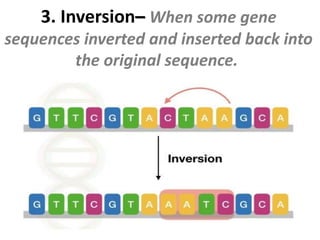
3. Inversion– When some gene
sequences inverted and inserted back into
the original sequence.
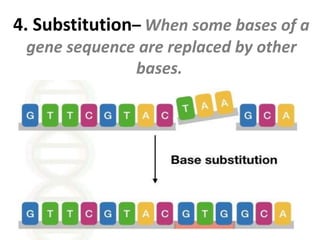
4. Substitution– When some bases of a
gene sequence are replaced by other
bases.
5. Duplication– when some bases or
a base duplicated in a gene
sequence.
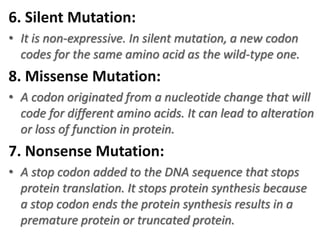
6. Silent Mutation:
• It is non-expressive. In silent mutation, a new codon
codes for the same amino acid as the wild-type one.
8. Missense Mutation:
• A codon originated from a nucleotide change that will
code for different amino acids. It can lead to alteration
or loss of function in protein.
7. Nonsense Mutation:
• A stop codon added to the DNA sequence that stops
protein translation. It stops protein synthesis because
a stop codon ends the protein synthesis results in a
premature protein or truncated protein.
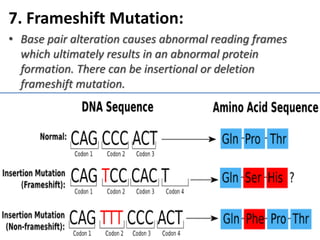
7. Frameshift Mutation:
• Base pair alteration causes abnormal reading frames
which ultimately results in an abnormal protein
formation. There can be insertional or deletion
frameshift mutation.
Gene Mutation
Gene Mutation
Gene Mutation

Gene Mutation

  • 1.
    GENETICS PRESENTATION SRISHTI BSc. Hons. Biochemistry DepartmentOf Chemistry & Biochemistry School Of Basic Sciences & Research Sharda University
  • 2.
    MUTATION “Change in thenucleotide sequence of the DNA” “Due to the replication errors, exposure to mutagens and viral infections changes or alterations occur in a DNA sequence which causes genetic abnormalities, known as mutation.” Types Of Mutations 1. Chromosomal Mutations 2. Genetic Mutations
  • 3.
    GENE MUTATION ‘Mutation orseries of mutations occur in the polynucleotide sequence of a gene that changes the function of it is referred to as gene mutations’ Point Mutation– Change in the single base of the DNA. It’s often known as single nucleotide polymorphism.
  • 4.
    Type Of GeneMutations • INSERTION • DELETION • INVERSION • SUBSTITUTION • DUPLICATION • SILENCE MUTATION • MISSENSE MUTATION • NONSENSE MUTATION • FRAMESHIFT MUTATION
  • 5.
    1. Insertion– insertionor addition of a base into the gene sequence. Often known as addition mutation.
  • 6.
    2. Deletion– Whena base or some bases deleted from the gene sequence.
  • 7.
    3. Inversion– Whensome gene sequences inverted and inserted back into the original sequence.
  • 8.
    4. Substitution– Whensome bases of a gene sequence are replaced by other bases.
  • 9.
    5. Duplication– whensome bases or a base duplicated in a gene sequence.
  • 10.
    6. Silent Mutation: •It is non-expressive. In silent mutation, a new codon codes for the same amino acid as the wild-type one. 8. Missense Mutation: • A codon originated from a nucleotide change that will code for different amino acids. It can lead to alteration or loss of function in protein. 7. Nonsense Mutation: • A stop codon added to the DNA sequence that stops protein translation. It stops protein synthesis because a stop codon ends the protein synthesis results in a premature protein or truncated protein.
  • 12.
    7. Frameshift Mutation: •Base pair alteration causes abnormal reading frames which ultimately results in an abnormal protein formation. There can be insertional or deletion frameshift mutation.