Genetics: Mutation and their Types
A Biodiction (A Unit of Dr. Divya Sharma)
Genetics / Mutation and their Types Page 1
Mutation and its types
A mutation is a change or alteration happens in a DNA, gene or chromosome due to intrinsic or
extrinsic factors such as an error in replication or exposure to UV light, respectively.
 Any change in the DNA sequence of an organism is a mutation.
 Mutations are the source of the altered versions of genes that provide the raw material for
evolution.
 The mutation is an important biological process in nature. It can be helpful or harmful. For
instance, the mutation creates variations in nature by providing new alleles in nature and
hence helps in evolution.
 The word Mutation was similar to the French word “Mutacioun” which literally means
“Process of changing.”
 Although the “mutation” world was originally derived from the Latin word “Mutate”. The
meaning of this is “to change”.
 Most mutations have no effect on the organism, especially among the eukaryotes, because a
large portion of the DNA is not in genes and thus does not affect the organism’s phenotype.
 Of the mutations that do affect the phenotype, the most common effect of mutations is
lethality, because most genes are necessary for life.
 Only a small percentage of mutations causes a visible but non-lethal change in the
phenotype.
Mutation is a process that produces a gene or chromosome that differs from the wild
type. The mutation may result due to changes either on the gene or the chromosome itself.
Thus, broadly mutation maybe:
1. Somatic mutation, if mutations happens to occur in somatic cells, the mutatnt characteristically
generation
2. Germ line mutation, if mutation occurs in germ line of sexually reproducing organisms, may
be transmitted by the gametes, to next generation, such mutations.
3. Gene mutation, where the allele of a gene changes.
4. Chromosome mutation, where segments of chromosomes, whole chromosomes, orentire sets
of chromosomes change.
History
 The term “mutation” was coined by Hugo De Vries in 1890.
 However, before him, Seth Wright, an English farmer noticed mutation first time in his
unusual short-lege male lambs during 1791. He fails to define the process.
 After the findings of Hugo de Vries, the mechanism of mutation was studied by Morgan in
1910.
 In 1927, H. J. Muller performed experiments of artificial mutagenesis. Using the X-rays he
had introduced mutation in Drosophila. For that, he was awarded Nobel Prize in 1946.
Genetics: Mutation and their Types
A Biodiction (A Unit of Dr. Divya Sharma)
Genetics / Mutation and their Types Page 2
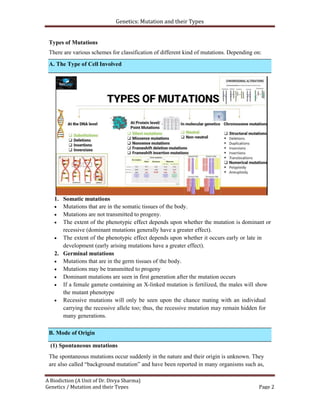
A. The Type of Cell Involved
Types of Mutations
There are various schemes for classification of different kind of mutations. Depending on:
1. Somatic mutations
 Mutations that are in the somatic tissues of the body.
 Mutations are not transmitted to progeny.
 The extent of the phenotypic effect depends upon whether the mutation is dominant or
recessive (dominant mutations generally have a greater effect).
 The extent of the phenotypic effect depends upon whether it occurs early or late in
development (early arising mutations have a greater effect).
2. Germinal mutations
 Mutations that are in the germ tissues of the body.
 Mutations may be transmitted to progeny
 Dominant mutations are seen in first generation after the mutation occurs
 If a female gamete containing an X-linked mutation is fertilized, the males will show
the mutant phenotype
 Recessive mutations will only be seen upon the chance mating with an individual
carrying the recessive allele too; thus, the recessive mutation may remain hidden for
many generations.
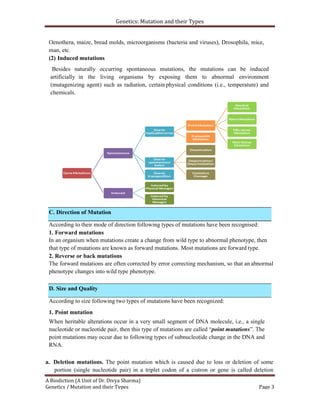
(1) Spontaneous mutations
The spontaneous mutations occur suddenly in the nature and their origin is unknown. They
are also called “background mutation” and have been reported in many organisms such as,
B. Mode of Origin
Genetics: Mutation and their Types
A Biodiction (A Unit of Dr. Divya Sharma)
Genetics / Mutation and their Types Page 3
Oenothera, maize, bread molds, microorganisms (bacteria and viruses), Drosophila, mice,
man, etc.
(2) Induced mutations
Besides naturally occurring spontaneous mutations, the mutations can be induced
artificially in the living organisms by exposing them to abnormal environment
(mutagenizing agent) such as radiation, certainphysical conditions (i.e., temperature) and
chemicals.
According to their mode of direction following types of mutations have been recognised:
1. Forward mutations
In an organism when mutations create a change from wild type to abnormal phenotype, then
that type of mutations are known as forward mutations. Most mutations are forward type.
2. Reverse or back mutations
The forward mutations are often corrected by error correcting mechanism, so that an abnormal
phenotype changes into wild type phenotype.
According to size following two types of mutations have been recognized:
1. Point mutation
When heritable alterations occur in a very small segment of DNA molecule, i.e., a single
nucleotide or nucleotide pair, then this type of mutations are called “point mutations”. The
point mutations may occur due to following types of subnucleotide change in the DNA and
RNA.
a. Deletion mutations. The point mutation which is caused due to loss or deletion of some
portion (single nucleotide pair) in a triplet codon of a cistron or gene is called deletion
D. Size and Quality
C. Direction of Mutation
Genetics: Mutation and their Types
A Biodiction (A Unit of Dr. Divya Sharma)
Genetics / Mutation and their Types Page 4
mutation.
 Deletions are mutations in which a section of DNA is lost, or deleted. The number of base
pairs deleted can again range from one to thousands!
 Insertions and Deletion mutations are often together dubbed as INDELS.
Example of Deletion Mutation: 22q11.2 deletion syndrome is caused by the deletion of some
bases of chromosome 22. This disease is characterized by cleft palate, heart defects,
autoimmune disorders etc.
b. Insertion or addition mutation. The point mutations which occur due to addition of one or
more extra nucleotides to a gene or cistron are called insertion mutations.
 Insertions are mutations in which extra base pairs are inserted into a new place in the DNA.
The number of base pairs inserted can range from one to thousands!
Example of Insertion Mutation: Huntington's disease and the fragile X syndrome are examples
of insertion mutation wherein trinucleotide repeats are inserted into the DNA sequence leading
to these diseases.
c. Substitution mutation: A point mutation in which a nucleotide of a triplet is replaced by
another nucleotide, is called Substitution mutation.
 A substitution is a mutation in which there is an exchange between two bases (i.e. a change
in a single "chemical letter" such as switching a T to a C). Such a substitution could change
a codon to one that encodes a different amino acid and cause a change in the protein
produced. Sometimes substitutions may not effects the protein structure, such mutations are
called silent mutations and sometimes they may change an amino-acid-coding codon to a
single "stop" codon and cause an incomplete protein. This can seriously affect the protein
structure which may completely change the organism.
Example of Substitution Mutation: Sickle Cell Anemia is caused by substitution mutation,
where in codon (GAG mutates to --> GTG) and leads to (Glu --> Val) change.
Genetics: Mutation and their Types
A Biodiction (A Unit of Dr. Divya Sharma)
Genetics / Mutation and their Types Page 5
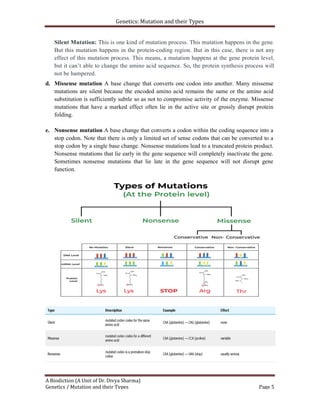
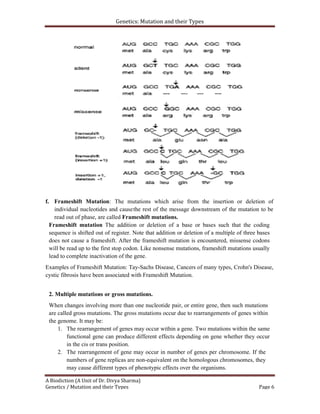
Silent Mutation: This is one kind of mutation process. This mutation happens in the gene.
But this mutation happens in the protein-coding region. But in this case, there is not any
effect of this mutation process. This means, a mutation happens at the gene protein level,
but it can’t able to change the amino acid sequence. So, the protein synthesis process will
not be hampered.
d. Missense mutation A base change that converts one codon into another. Many missense
mutations are silent because the encoded amino acid remains the same or the amino acid
substitution is sufficiently subtle so as not to compromise activity of the enzyme. Missense
mutations that have a marked effect often lie in the active site or grossly disrupt protein
folding.
e. Nonsense mutation A base change that converts a codon within the coding sequence into a
stop codon. Note that there is only a limited set of sense codons that can be converted to a
stop codon by a single base change. Nonsense mutations lead to a truncated protein product.
Nonsense mutations that lie early in the gene sequence will completely inactivate the gene.
Sometimes nonsense mutations that lie late in the gene sequence will not disrupt gene
function.
Genetics: Mutation and their Types
A Biodiction (A Unit of Dr. Divya Sharma)
Genetics / Mutation and their Types Page 6
f. Frameshift Mutation: The mutations which arise from the insertion or deletion of
individual nucleotides and causethe rest of the message downstream of the mutation to be
read out of phase, are called Frameshift mutations.
Frameshift mutation The addition or deletion of a base or bases such that the coding
sequence is shifted out of register. Note that addition or deletion of a multiple of three bases
does not cause a frameshift. After the frameshift mutation is encountered, missense codons
will be read up to the first stop codon. Like nonsense mutations, frameshift mutations usually
lead to complete inactivation of the gene.
Examples of Frameshift Mutation: Tay-Sachs Disease, Cancers of many types, Crohn's Disease,
cystic fibrosis have been associated with Frameshift Mutation.
2. Multiple mutations or gross mutations.
When changes involving more than one nucleotide pair, or entire gene, then such mutations
are called gross mutations. The gross mutations occur due to rearrangements of genes within
the genome. It may be:
1. The rearrangement of genes may occur within a gene. Two mutations within the same
functional gene can produce different effects depending on gene whether they occur
in the cis or trans position.
2. The rearrangement of gene may occur in number of genes per chromosome. If the
numbers of gene replicas are non-equivalent on the homologous chromosomes, they
may cause different types of phenotypic effects over the organisms.
Genetics: Mutation and their Types
A Biodiction (A Unit of Dr. Divya Sharma)
Genetics / Mutation and their Types Page 7
E. Phenotypic Effects
3. Due to movement of a gene locus new type of phenotypes may be created, especially
when the gene is relocated near heterochromatin. The movement of gene loci may
take place due to following method:
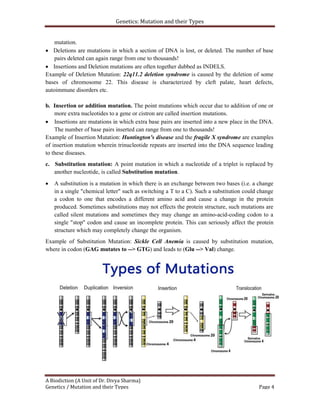
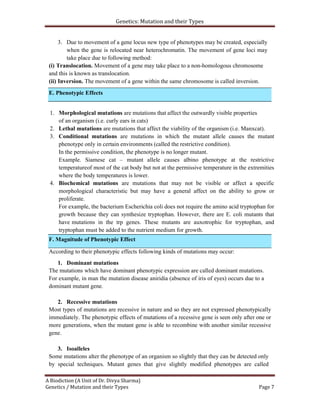
(i) Translocation. Movement of a gene may take place to a non-homologous chromosome
and this is known as translocation.
(ii) Inversion. The movement of a gene within the same chromosome is called inversion.
1. Morphological mutations are mutations that affect the outwardly visible properties
of an organism (i.e. curly ears in cats)
2. Lethal mutations are mutations that affect the viability of the organism (i.e. Manxcat).
3. Conditional mutations are mutations in which the mutant allele causes the mutant
phenotype only in certain environments (called the restrictive condition).
In the permissive condition, the phenotype is no longer mutant.
Example. Siamese cat – mutant allele causes albino phenotype at the restrictive
temperatureof most of the cat body but not at the permissive temperature in the extremities
where the body temperatures is lower.
4. Biochemical mutations are mutations that may not be visible or affect a specific
morphological characteristic but may have a general affect on the ability to grow or
proliferate.
For example, the bacterium Escherichia coli does not require the amino acid tryptophan for
growth because they can synthesize tryptophan. However, there are E. coli mutants that
have mutations in the trp genes. These mutants are auxotrophic for tryptophan, and
tryptophan must be added to the nutrient medium for growth.
According to their phenotypic effects following kinds of mutations may occur:
1. Dominant mutations
The mutations which have dominant phenotypic expression are called dominant mutations.
For example, in man the mutation disease aniridia (absence of iris of eyes) occurs due to a
dominant mutant gene.
2. Recessive mutations
Most types of mutations are recessive in nature and so they are not expressed phenotypically
immediately. The phenotypic effects of mutations of a recessive gene is seen only after one or
more generations, when the mutant gene is able to recombine with another similar recessive
gene.
3. Isoalleles
Some mutations alter the phenotype of an organism so slightly that they can be detected only
by special techniques. Mutant genes that give slightly modified phenotypes are called
F. Magnitude of Phenotypic Effect
Genetics: Mutation and their Types
A Biodiction (A Unit of Dr. Divya Sharma)
Genetics / Mutation and their Types Page 8
I. Chromosomal Mutation and Types
isoalleles. They produce identical phenotypes in homozygous or heterozygous combinations.
1. Loss of function mutation
Loss of function mutation is also called inactivating mutations, result in the gene product
having less or no function (being partially or wholly inactivated).
2. Gain of function mutations
The gain of function mutations also called activating mutations, change the gene product such
that its effect gets stronger (enhanced activation) or even is superseded by a different and
abnormal function.
According to the types of chromosomes, the mutations may be of following two kinds:
1. Autosomal mutations. This type of mutation occurs in autosomal chromosomes.
2. Sex chromosomal mutations. This type of mutation occurs in sex chromosomes.
 The changes in the genome involving chromosome parts, whole chromosomes, or
whole chromosome sets are called chromosome aberrations or chromosome
mutations.
 Chromosome mutations have proved to be of great significance in applied biology—
agriculture (including horticulture), animal husbandry and medicine.
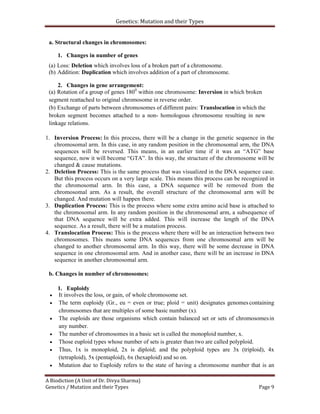
Chromosome mutations are inherited once they occur and are of the following types:
H. Type of Chromosome Involved
G. Loss of Function or Gain of Function
Genetics: Mutation and their Types
A Biodiction (A Unit of Dr. Divya Sharma)
Genetics / Mutation and their Types Page 9
a. Structural changes in chromosomes:
1. Changes in number of genes
(a) Loss: Deletion which involves loss of a broken part of a chromosome.
(b) Addition: Duplication which involves addition of a part of chromosome.
2. Changes in gene arrangement:
(a) Rotation of a group of genes 1800
within one chromosome: Inversion in which broken
segment reattached to original chromosome in reverse order.
(b) Exchange of parts between chromosomes of different pairs: Translocation in which the
broken segment becomes attached to a non- homologous chromosome resulting in new
linkage relations.
1. Inversion Process: In this process, there will be a change in the genetic sequence in the
chromosomal arm. In this case, in any random position in the chromosomal arm, the DNA
sequences will be reversed. This means, in an earlier time if it was an “ATG” base
sequence, now it will become “GTA”. In this way, the structure of the chromosome will be
changed & cause mutations.
2. Deletion Process: This is the same process that was visualized in the DNA sequence case.
But this process occurs on a very large scale. This means this process can be recognized in
the chromosomal arm. In this case, a DNA sequence will be removed from the
chromosomal arm. As a result, the overall structure of the chromosomal arm will be
changed. And mutation will happen there.
3. Duplication Process: This is the process where some extra amino acid base is attached to
the chromosomal arm. In any random position in the chromosomal arm, a subsequence of
that DNA sequence will be extra added. This will increase the length of the DNA
sequence. As a result, there will be a mutation process.
4. Translocation Process: This is the process where there will be an interaction between two
chromosomes. This means some DNA sequences from one chromosomal arm will be
changed to another chromosomal arm. In this way, there will be some decrease in DNA
sequence in one chromosomal arm. And in another case, there will be an increase in DNA
sequence in another chromosomal arm.
b. Changes in number of chromosomes:
1. Euploidy
 It involves the loss, or gain, of whole chromosome set.
 The term euploidy (Gr., eu = even or true; ploid = unit) designates genomes containing
chromosomes that are multiples of some basic number (x).
 The euploids are those organisms which contain balanced set or sets of chromosomesin
any number.
 The number of chromosomes in a basic set is called the monoploid number, x.
 Those euploid types whose number of sets is greater than two are called polyploid.
 Thus, 1x is monoploid, 2x is diploid; and the polyploid types are 3x (triploid), 4x
(tetraploid), 5x (pentaploid), 6x (hexaploid) and so on.
 Mutation due to Euploidy refers to the state of having a chromosome number that is an
Genetics: Mutation and their Types
A Biodiction (A Unit of Dr. Divya Sharma)
Genetics / Mutation and their Types Page 10
exact multiple of a basic chromosome set. This means the number of chromosomesets is
increased in euploidy.
Polyploidy
Addition of one or more sets of chromosomes.
They may be further:
(a) Autopolyploidy. The autopolyploidy involves polyploidy, in which the same basic set of
chromosomes are multiplied.
(b) Allopolyploidy. The polyploidy results due the doubling of chromosome number in a F1
hybrid which is derived from two distinctly different species. The resultant species is called
an allopolyploid.
2. Aneuploidy
 It involves the loss, or gain, of a part of the chromosome set.
 It refers to a condition in which one or a few chromosomes are added or deleted fromthe
normal chromosome number. Hence, the number of chromosomes in aneuploidy can be
greater or smaller than the number of chromosomes in the wild type.
 Various types of aneuploidy can be identified as: nullisomy, monosomy, and trisomy.
1. Nullisomy (2n-2) is the loss of both chromosomes of the homologous pair. Thisconditions
may be lethal in most organisms.
2. Monosomy (2n-1) is the loss of a single chromosome of the homologous pair.
3. Trisomy is the gain of an extra chromosome (2n+1). Klinefelter syndrome
(44+XXY/XYY) and Down syndrome are examples of trisomy.
Some of the important characteristics of mutations are briefly presented below:
i. Nature of Change:
Mutations are more or less permanent and heritable changes in the phenotype of an
individual. Such changes occur due to alteration in number, kind or sequence of
nucleotides of genetic material, i.e., DNA in most of the cases.
ii. Frequency:
Spontaneous mutations occur at a very low frequency. However, the mutation rate can be
enhanced many fold by the use of physical and chemical mutagens. The frequency of
mutation for a gene is calculated as follows:
Frequency of gene mutation = M / M + N
where, M = number of individuals expressing mutation for a gene, and
N = number of normal individuals in a population.
iii. Mutation Rate:
Mutation rate varies from gene to gene. Some genes exhibit high mutation rate than
others. Such genes are known as mutable genes, e.g., white eye in Drosophila. In some
Genetics: Mutation and their Types
A Biodiction (A Unit of Dr. Divya Sharma)
Genetics / Mutation and their Types Page 11
genomes, some genes enhance the natural mutation rate of other genes. Such genes are
termed as mutator genes.
The example of mutator gene is dotted gene in maize. In some cases, some genes
decrease the frequency of spontaneous mutations of other genes in the same genome,
which are referred to as anti-mutator genes. Such gene has been reported in bacteria and
bacteriophages.
iv. Direction of Change:
Mutations usually occur from dominant to recessive allele or wild type to mutant allele.
However, reverse mutations are also known, e.g., notch wing and bar eye in Drosophila.
v. Effects:
Mutations are generally harmful to the organism. In other words, most of the mutations
have deleterious effects. Only about 0.1% of the induced mutations are useful in crop
improvement. In majority of cases, mutant alleles have pleiotropic effects. Mutations
give rise to multiple alleles of a gene.
vi. Site of Mutation:
Muton which is a sub-division of gene is the site of mutation. An average gene contains
500 to 1000 mutational sites. Within a gene some sites are highly mutable than others.
These are generally referred to as hot spots. Mutations may occur in any tissue of an
organism, i.e., somatic or gametic.
vii. Type of Event:
Mutations are random events. They may occur in any gene (nuclear or cytoplasmic), in
any cell (somatic or reproductive) and at any stage of development of an individual.
viii. Recurrence:
The same type of mutation may occur repeatedly or again and again in different
individuals of the same population. Thus, mutations are of recurrent nature.
Genetics: Mutation and their Types
A Biodiction (A Unit of Dr. Divya Sharma)
Genetics / Mutation and their Types Page 12
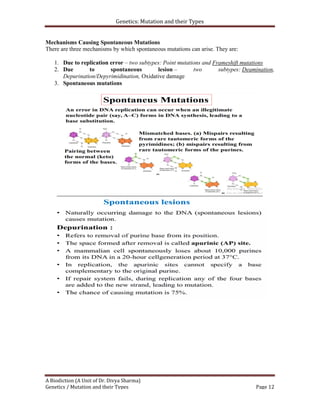
Mechanisms Causing Spontaneous Mutations
There are three mechanisms by which spontaneous mutations can arise. They are:
1. Due to replication error – two subtypes: Point mutations and Frameshift mutations
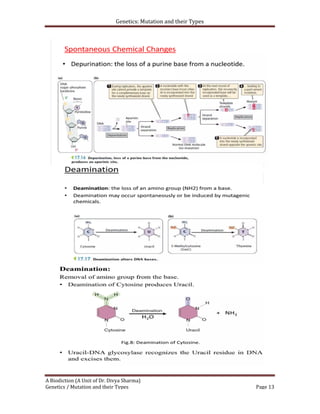
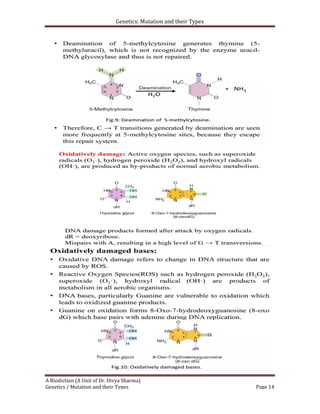
2. Due to spontaneous lesion – two subtypes: Deamination,
Depurination/Depyrimidination, Oxidative damage
3. Spontaneous mutations
Genetics: Mutation and their Types
A Biodiction (A Unit of Dr. Divya Sharma)
Genetics / Mutation and their Types Page 13
Genetics: Mutation and their Types
A Biodiction (A Unit of Dr. Divya Sharma)
Genetics / Mutation and their Types Page 14
Genetics: Mutation and their Types
A Biodiction (A Unit of Dr. Divya Sharma)
Genetics / Mutation and their Types Page 15
INDUCED MUTATION
Agents of Mutations:
Mutagens:
Mutagens refer to physical or chemical agents which greatly enhance the frequency of
mutations. Various radiations and chemicals are used as mutagens. Radiations come under
physical mutagens.
A brief description of various physical and chemical mutagens is presented below:
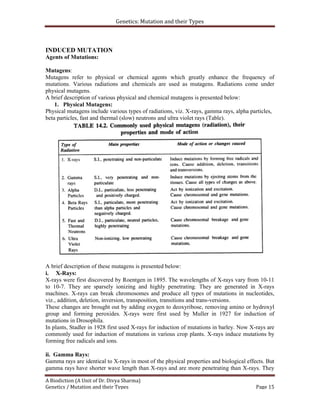
1. Physical Mutagens:
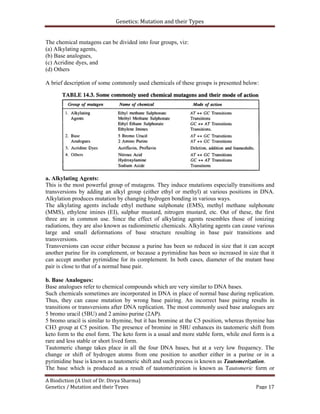
Physical mutagens include various types of radiations, viz. X-rays, gamma rays, alpha particles,
beta particles, fast and thermal (slow) neutrons and ultra violet rays (Table).
A brief description of these mutagens is presented below:
i. X-Rays:
X-rays were first discovered by Roentgen in 1895. The wavelengths of X-rays vary from 10-11
to 10-7. They are sparsely ionizing and highly penetrating. They are generated in X-rays
machines. X-rays can break chromosomes and produce all types of mutations in nucleotides,
viz., addition, deletion, inversion, transposition, transitions and trans-versions.
These changes are brought out by adding oxygen to deoxyribose, removing amino or hydroxyl
group and forming peroxides. X-rays were first used by Muller in 1927 for induction of
mutations in Drosophila.
In plants, Stadler in 1928 first used X-rays for induction of mutations in barley. Now X-rays are
commonly used for induction of mutations in various crop plants. X-rays induce mutations by
forming free radicals and ions.
ii. Gamma Rays:
Gamma rays are identical to X-rays in most of the physical properties and biological effects. But
gamma rays have shorter wave length than X-rays and are more penetrating than X-rays. They
Genetics: Mutation and their Types
A Biodiction (A Unit of Dr. Divya Sharma)
Genetics / Mutation and their Types Page 16
are generated from radioactive decay of some elements like 14C, 60C, radium etc.
Of these, cobalt 60 is commonly used for the production of Gamma rays. Gamma rays cause
chromosomal and gene mutations like X-rays by ejecting electrons from the atoms of tissues
through which they pass. Now a days, gamma rays are also widely used for induction of
mutations in various crop plants.
iii. Alpha Particles:
Alpha rays are composed of alpha particles. They are made of two protons and two neutrons and
thus have double positive charge. They are densely ionizing, but lesser penetrating than beta
rays and neutrons. Alpha particles are emitted by the isotopes of heavier elements.
They have positive charge and hence they are slowed down by negative charge of tissues
resulting in low penetrating power. Alpha particles lead to both ionization and excitation
resulting in chromosomal mutations.
iv. Beta Particles:
Beta rays are composed of beta particles. They are sparsely ionizing but more penetrating than
alpha rays. Beta particles are generated from radioactive decay of heavier elements such as 3H,
32P, 35S etc. They are negatively charged, therefore, their action is reduced by positive charge
of tissues. Beta particles also act by way of ionization and excitation like alpha particles and
result in both chromosomal and gene mutations.
v. Fast and Thermal Neutrons:
These are densely ionizing and highly penetrating particles. Since they are electrically neutral
particles, their action is not slowed down by charged (negative or positive) particles of tissues.
They are generated from radioactive decay of heavier elements in atomic reactors or cyclotrons.
Because of high velocity, these particles are called as fast neutrons.
Their velocity can be reduced by the use of graphite or heavy water to produce slow neutrons or
thermal neutrons. Fast and thermal neutrons result in both chromosomal breakage and gene
mutation. Since they are heavy particles, they move in straight line. Fast and thermal neutrons
are effectively used for induction of mutations especially in asexually reproducing crop species.
vi. Ultraviolet Rays:
UV rays are non-ionizing radiations, which are produced from mercury vapour lamps or tubes.
They are also present in solar radiation. UV rays can penetrate one or two cell layers. Because of
low penetrating capacity, they are commonly used for radiation of micro-organisms like bacteria
and viruses.
In higher organisms, their use is generally limited to irradiation of pollen in plants and eggs in
Drosophila UV rays can also break chromosomes. They have two main chemical effects on
pyrimidine’s.
The first effect is the addition of a water molecule which weakens the H bonding with its purine
complement and permits localized separation of DNA strands. The second effect is to join
pyrimidines to make a pyrimidine dimer.
This dimerization can produce TT, CC, UU and mixed pyrimidine dimers like CT. Dimerization
interferes with DNA and RNA synthesis. Inter-strand dimers cross link nucleic acid chains,
inhibiting strand separation and distribution.
Chemical Mutagens:
There is a long list of chemicals which are used as mutagens. Detailed treatment of such
chemicals is beyond the scope of this discussion.
Genetics: Mutation and their Types
A Biodiction (A Unit of Dr. Divya Sharma)
Genetics / Mutation and their Types Page 17
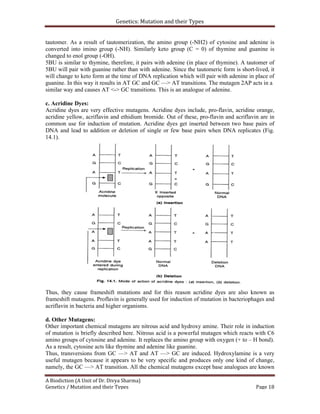
The chemical mutagens can be divided into four groups, viz:
(a) Alkylating agents,
(b) Base analogues,
(c) Acridine dyes, and
(d) Others
A brief description of some commonly used chemicals of these groups is presented below:
a. Alkylating Agents:
This is the most powerful group of mutagens. They induce mutations especially transitions and
transversions by adding an alkyl group (either ethyl or methyl) at various positions in DNA.
Alkylation produces mutation by changing hydrogen bonding in various ways.
The alkylating agents include ethyl methane sulphonate (EMS), methyl methane sulphonate
(MMS), ethylene imines (EI), sulphur mustard, nitrogen mustard, etc. Out of these, the first
three are in common use. Since the effect of alkylating agents resembles those of ionizing
radiations, they are also known as radiomimetic chemicals. Alkylating agents can cause various
large and small deformations of base structure resulting in base pair transitions and
transversions.
Transversions can occur either because a purine has been so reduced in size that it can accept
another purine for its complement, or because a pyrimidine has been so increased in size that it
can accept another pyrimidine for its complement. In both cases, diameter of the mutant base
pair is close to that of a normal base pair.
b. Base Analogues:
Base analogues refer to chemical compounds which are very similar to DNA bases.
Such chemicals sometimes are incorporated in DNA in place of normal base during replication.
Thus, they can cause mutation by wrong base pairing. An incorrect base pairing results in
transitions or transversions after DNA replication. The most commonly used base analogues are
5 bromo uracil (5BU) and 2 amino purine (2AP).
5 bromo uracil is similar to thymine, but it has bromine at the C5 position, whereas thymine has
CH3 group at C5 position. The presence of bromine in 5BU enhances its tautomeric shift from
keto form to the enol form. The keto form is a usual and more stable form, while enol form is a
rare and less stable or short lived form.
Tautomeric change takes place in all the four DNA bases, but at a very low frequency. The
change or shift of hydrogen atoms from one position to another either in a purine or in a
pyrimidine base is known as tautomeric shift and such process is known as Tautomerization.
The base which is produced as a result of tautomerization is known as Tautomeric form or
Genetics: Mutation and their Types
A Biodiction (A Unit of Dr. Divya Sharma)
Genetics / Mutation and their Types Page 18
tautomer. As a result of tautomerization, the amino group (-NH2) of cytosine and adenine is
converted into imino group (-NH). Similarly keto group (C = 0) of thymine and guanine is
changed to enol group (-OH).
5BU is similar to thymine, therefore, it pairs with adenine (in place of thymine). A tautomer of
5BU will pair with guanine rather than with adenine. Since the tautomeric form is short-lived, it
will change to keto form at the time of DNA replication which will pair with adenine in place of
guanine. In this way it results in AT GC and GC —> AT transitions. The mutagen 2AP acts in a
similar way and causes AT <-> GC transitions. This is an analogue of adenine.
c. Acridine Dyes:
Acridine dyes are very effective mutagens. Acridine dyes include, pro-flavin, acridine orange,
acridine yellow, acriflavin and ethidium bromide. Out of these, pro-flavin and acriflavin are in
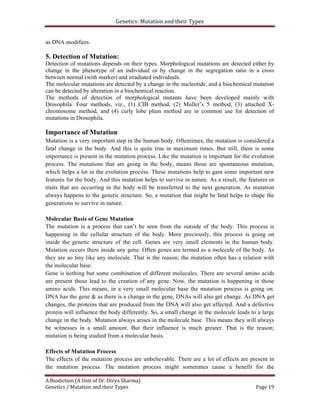
common use for induction of mutation. Acridine dyes get inserted between two base pairs of
DNA and lead to addition or deletion of single or few base pairs when DNA replicates (Fig.
14.1).
Thus, they cause frameshift mutations and for this reason acridine dyes are also known as
frameshift mutagens. Proflavin is generally used for induction of mutation in bacteriophages and
acriflavin in bacteria and higher organisms.
d. Other Mutagens:
Other important chemical mutagens are nitrous acid and hydroxy amine. Their role in induction
of mutation is briefly described here. Nitrous acid is a powerful mutagen which reacts with C6
amino groups of cytosine and adenine. It replaces the amino group with oxygen (+ to – H bond).
As a result, cytosine acts like thymine and adenine like guanine.
Thus, transversions from GC —> AT and AT —> GC are induced. Hydroxylamine is a very
useful mutagen because it appears to be very specific and produces only one kind of change,
namely, the GC —> AT transition. All the chemical mutagens except base analogues are known
Genetics: Mutation and their Types
A Biodiction (A Unit of Dr. Divya Sharma)
Genetics / Mutation and their Types Page 19
as DNA modifiers.
5. Detection of Mutation:
Detection of mutations depends on their types. Morphological mutations are detected either by
change in the phenotype of an individual or by change in the segregation ratio in a cross
between normal (with marker) and irradiated individuals.
The molecular mutations are detected by a change in the nucleotide, and a biochemical mutation
can be detected by alteration in a biochemical reaction.
The methods of detection of morphological mutants have been developed mainly with
Drosophila. Four methods, viz., (1) CIB method, (2) Muller’s 5 method, (3) attached X-
chromosome method, and (4) curly lobe plum method are in common use for detection of
mutations in Drosophila.
Importance of Mutation
Mutation is a very important step in the human body. Oftentimes, the mutation is considered a
fatal change in the body. And this is quite true in maximum times. But still, there is some
importance is present in the mutation process. Like the mutation is important for the evolution
process. The mutations that are going in the body, means those are spontaneous mutation,
which helps a lot in the evolution process. These mutations help to gain some important new
features for the body. And this mutation helps to survive in nature. As a result, the features or
traits that are occurring in the body will be transferred to the next generation. As mutation
always happens to the genetic structure. So, a mutation that might be fatal helps to shape the
generations to survive in nature.
Molecular Basis of Gene Mutation
The mutation is a process that can’t be seen from the outside of the body. This process is
happening in the cellular structure of the body. More preciously, this process is going on
inside the genetic structure of the cell. Genes are very small elements in the human body.
Mutation occurs there inside any gene. Often genes are termed as a molecule of the body. As
they are so tiny like any molecule. That is the reason; the mutation often has a relation with
the molecular base.
Gene is nothing but some combination of different molecules. There are several amino acids
are present those lead to the creation of any gene. Now, the mutation is happening in those
amino acids. This means, in a very small molecular base the mutation process is going on.
DNA has the gene & as there is a change in the gene, DNAs will also get change. As DNA get
changes, the proteins that are produced from the DNA will also get affected. And a defective
protein will influence the body differently. So, a small change in the molecule leads to a large
change in the body. Mutation always arises in the molecule base. This means they will always
be witnesses in a small amount. But their influence is much greater. That is the reason;
mutation is being studied from a molecular basis.
Effects of Mutation Process
The effects of the mutation process are unbelievable. There are a lot of effects are present in
the mutation process. The mutation process might sometimes cause a benefit for the
Genetics: Mutation and their Types
A Biodiction (A Unit of Dr. Divya Sharma)
Genetics / Mutation and their Types Page 20
organization. Or sometimes it causes problems for the organisms. So, depending upon their
effect on the human body, the mutation process can be divided into two categories. One will
be the beneficiary effect and another will be the fatal effect.
1. Beneficiary Effect Of Mutation: The most beneficiary effect of a mutation can be
visualized in the evolution process. Evolution is the result of the mutation process. The
spontaneous mutation that is happening to the body every day has a prominent role in the
evolution process. This is the beneficiary effect of the mutation as it helps to survive with
nature. And without the evolution process, one can’t develop & acquire more traits.
2. Fatal Effect Of Mutation: Fatal effect of the mutation is unstoppable. Some severe
diseases occur due to the mutation in abnormal processes. Cancer is a disease that is
occurred due to abnormal mutation processes & changes in the genetic structure. Some
changes occur to the reproductive cells only. So, they are hereditary changes. This means
those changes can be inherited by the next generation. If those changes rise to any disease,
then the next generations will face the disease. So, all of these are the fatal effects of the
mutation on the human body.
Point mutations are genetic mutations that can have beneficial effects on humans, such as:
 Protection from disease: Mutations can protect humans from developing atherosclerosis, a
dangerous buildup of fatty material in blood vessels. Mutations in red blood cell genes can also
provide up to 40% better protection against a severe form of malaria.
 Improved tasting ability: Variants in tasting genes can give humans increased tasting ability.
 Adaptation to environmental changes: Changes in how cells work can improve the proteins
that cells produce and allow them to adapt to environmental changes.
Point mutations are genetic mutations that occur when a single nucleotide base is changed,
inserted, or deleted from an organism's DNA or RNA sequence. The consequences of a point
mutation can range from no effect to deleterious effects, depending on the specifics of the
mutation.
Mutations are the raw materials of evolution. A mutation that allows an organism to feed, grow,
or reproduce more effectively can cause the mutant allele to become more abundant over time

Mutation and their Types # Spontaneous Mutation# Induced Mutation

  • 1.
    Genetics: Mutation andtheir Types A Biodiction (A Unit of Dr. Divya Sharma) Genetics / Mutation and their Types Page 1 Mutation and its types A mutation is a change or alteration happens in a DNA, gene or chromosome due to intrinsic or extrinsic factors such as an error in replication or exposure to UV light, respectively.  Any change in the DNA sequence of an organism is a mutation.  Mutations are the source of the altered versions of genes that provide the raw material for evolution.  The mutation is an important biological process in nature. It can be helpful or harmful. For instance, the mutation creates variations in nature by providing new alleles in nature and hence helps in evolution.  The word Mutation was similar to the French word “Mutacioun” which literally means “Process of changing.”  Although the “mutation” world was originally derived from the Latin word “Mutate”. The meaning of this is “to change”.  Most mutations have no effect on the organism, especially among the eukaryotes, because a large portion of the DNA is not in genes and thus does not affect the organism’s phenotype.  Of the mutations that do affect the phenotype, the most common effect of mutations is lethality, because most genes are necessary for life.  Only a small percentage of mutations causes a visible but non-lethal change in the phenotype. Mutation is a process that produces a gene or chromosome that differs from the wild type. The mutation may result due to changes either on the gene or the chromosome itself. Thus, broadly mutation maybe: 1. Somatic mutation, if mutations happens to occur in somatic cells, the mutatnt characteristically generation 2. Germ line mutation, if mutation occurs in germ line of sexually reproducing organisms, may be transmitted by the gametes, to next generation, such mutations. 3. Gene mutation, where the allele of a gene changes. 4. Chromosome mutation, where segments of chromosomes, whole chromosomes, orentire sets of chromosomes change. History  The term “mutation” was coined by Hugo De Vries in 1890.  However, before him, Seth Wright, an English farmer noticed mutation first time in his unusual short-lege male lambs during 1791. He fails to define the process.  After the findings of Hugo de Vries, the mechanism of mutation was studied by Morgan in 1910.  In 1927, H. J. Muller performed experiments of artificial mutagenesis. Using the X-rays he had introduced mutation in Drosophila. For that, he was awarded Nobel Prize in 1946.
  • 2.
    Genetics: Mutation andtheir Types A Biodiction (A Unit of Dr. Divya Sharma) Genetics / Mutation and their Types Page 2 A. The Type of Cell Involved Types of Mutations There are various schemes for classification of different kind of mutations. Depending on: 1. Somatic mutations  Mutations that are in the somatic tissues of the body.  Mutations are not transmitted to progeny.  The extent of the phenotypic effect depends upon whether the mutation is dominant or recessive (dominant mutations generally have a greater effect).  The extent of the phenotypic effect depends upon whether it occurs early or late in development (early arising mutations have a greater effect). 2. Germinal mutations  Mutations that are in the germ tissues of the body.  Mutations may be transmitted to progeny  Dominant mutations are seen in first generation after the mutation occurs  If a female gamete containing an X-linked mutation is fertilized, the males will show the mutant phenotype  Recessive mutations will only be seen upon the chance mating with an individual carrying the recessive allele too; thus, the recessive mutation may remain hidden for many generations. (1) Spontaneous mutations The spontaneous mutations occur suddenly in the nature and their origin is unknown. They are also called “background mutation” and have been reported in many organisms such as, B. Mode of Origin
  • 3.
    Genetics: Mutation andtheir Types A Biodiction (A Unit of Dr. Divya Sharma) Genetics / Mutation and their Types Page 3 Oenothera, maize, bread molds, microorganisms (bacteria and viruses), Drosophila, mice, man, etc. (2) Induced mutations Besides naturally occurring spontaneous mutations, the mutations can be induced artificially in the living organisms by exposing them to abnormal environment (mutagenizing agent) such as radiation, certainphysical conditions (i.e., temperature) and chemicals. According to their mode of direction following types of mutations have been recognised: 1. Forward mutations In an organism when mutations create a change from wild type to abnormal phenotype, then that type of mutations are known as forward mutations. Most mutations are forward type. 2. Reverse or back mutations The forward mutations are often corrected by error correcting mechanism, so that an abnormal phenotype changes into wild type phenotype. According to size following two types of mutations have been recognized: 1. Point mutation When heritable alterations occur in a very small segment of DNA molecule, i.e., a single nucleotide or nucleotide pair, then this type of mutations are called “point mutations”. The point mutations may occur due to following types of subnucleotide change in the DNA and RNA. a. Deletion mutations. The point mutation which is caused due to loss or deletion of some portion (single nucleotide pair) in a triplet codon of a cistron or gene is called deletion D. Size and Quality C. Direction of Mutation
  • 4.
    Genetics: Mutation andtheir Types A Biodiction (A Unit of Dr. Divya Sharma) Genetics / Mutation and their Types Page 4 mutation.  Deletions are mutations in which a section of DNA is lost, or deleted. The number of base pairs deleted can again range from one to thousands!  Insertions and Deletion mutations are often together dubbed as INDELS. Example of Deletion Mutation: 22q11.2 deletion syndrome is caused by the deletion of some bases of chromosome 22. This disease is characterized by cleft palate, heart defects, autoimmune disorders etc. b. Insertion or addition mutation. The point mutations which occur due to addition of one or more extra nucleotides to a gene or cistron are called insertion mutations.  Insertions are mutations in which extra base pairs are inserted into a new place in the DNA. The number of base pairs inserted can range from one to thousands! Example of Insertion Mutation: Huntington's disease and the fragile X syndrome are examples of insertion mutation wherein trinucleotide repeats are inserted into the DNA sequence leading to these diseases. c. Substitution mutation: A point mutation in which a nucleotide of a triplet is replaced by another nucleotide, is called Substitution mutation.  A substitution is a mutation in which there is an exchange between two bases (i.e. a change in a single "chemical letter" such as switching a T to a C). Such a substitution could change a codon to one that encodes a different amino acid and cause a change in the protein produced. Sometimes substitutions may not effects the protein structure, such mutations are called silent mutations and sometimes they may change an amino-acid-coding codon to a single "stop" codon and cause an incomplete protein. This can seriously affect the protein structure which may completely change the organism. Example of Substitution Mutation: Sickle Cell Anemia is caused by substitution mutation, where in codon (GAG mutates to --> GTG) and leads to (Glu --> Val) change.
  • 5.
    Genetics: Mutation andtheir Types A Biodiction (A Unit of Dr. Divya Sharma) Genetics / Mutation and their Types Page 5 Silent Mutation: This is one kind of mutation process. This mutation happens in the gene. But this mutation happens in the protein-coding region. But in this case, there is not any effect of this mutation process. This means, a mutation happens at the gene protein level, but it can’t able to change the amino acid sequence. So, the protein synthesis process will not be hampered. d. Missense mutation A base change that converts one codon into another. Many missense mutations are silent because the encoded amino acid remains the same or the amino acid substitution is sufficiently subtle so as not to compromise activity of the enzyme. Missense mutations that have a marked effect often lie in the active site or grossly disrupt protein folding. e. Nonsense mutation A base change that converts a codon within the coding sequence into a stop codon. Note that there is only a limited set of sense codons that can be converted to a stop codon by a single base change. Nonsense mutations lead to a truncated protein product. Nonsense mutations that lie early in the gene sequence will completely inactivate the gene. Sometimes nonsense mutations that lie late in the gene sequence will not disrupt gene function.
  • 6.
    Genetics: Mutation andtheir Types A Biodiction (A Unit of Dr. Divya Sharma) Genetics / Mutation and their Types Page 6 f. Frameshift Mutation: The mutations which arise from the insertion or deletion of individual nucleotides and causethe rest of the message downstream of the mutation to be read out of phase, are called Frameshift mutations. Frameshift mutation The addition or deletion of a base or bases such that the coding sequence is shifted out of register. Note that addition or deletion of a multiple of three bases does not cause a frameshift. After the frameshift mutation is encountered, missense codons will be read up to the first stop codon. Like nonsense mutations, frameshift mutations usually lead to complete inactivation of the gene. Examples of Frameshift Mutation: Tay-Sachs Disease, Cancers of many types, Crohn's Disease, cystic fibrosis have been associated with Frameshift Mutation. 2. Multiple mutations or gross mutations. When changes involving more than one nucleotide pair, or entire gene, then such mutations are called gross mutations. The gross mutations occur due to rearrangements of genes within the genome. It may be: 1. The rearrangement of genes may occur within a gene. Two mutations within the same functional gene can produce different effects depending on gene whether they occur in the cis or trans position. 2. The rearrangement of gene may occur in number of genes per chromosome. If the numbers of gene replicas are non-equivalent on the homologous chromosomes, they may cause different types of phenotypic effects over the organisms.
  • 7.
    Genetics: Mutation andtheir Types A Biodiction (A Unit of Dr. Divya Sharma) Genetics / Mutation and their Types Page 7 E. Phenotypic Effects 3. Due to movement of a gene locus new type of phenotypes may be created, especially when the gene is relocated near heterochromatin. The movement of gene loci may take place due to following method: (i) Translocation. Movement of a gene may take place to a non-homologous chromosome and this is known as translocation. (ii) Inversion. The movement of a gene within the same chromosome is called inversion. 1. Morphological mutations are mutations that affect the outwardly visible properties of an organism (i.e. curly ears in cats) 2. Lethal mutations are mutations that affect the viability of the organism (i.e. Manxcat). 3. Conditional mutations are mutations in which the mutant allele causes the mutant phenotype only in certain environments (called the restrictive condition). In the permissive condition, the phenotype is no longer mutant. Example. Siamese cat – mutant allele causes albino phenotype at the restrictive temperatureof most of the cat body but not at the permissive temperature in the extremities where the body temperatures is lower. 4. Biochemical mutations are mutations that may not be visible or affect a specific morphological characteristic but may have a general affect on the ability to grow or proliferate. For example, the bacterium Escherichia coli does not require the amino acid tryptophan for growth because they can synthesize tryptophan. However, there are E. coli mutants that have mutations in the trp genes. These mutants are auxotrophic for tryptophan, and tryptophan must be added to the nutrient medium for growth. According to their phenotypic effects following kinds of mutations may occur: 1. Dominant mutations The mutations which have dominant phenotypic expression are called dominant mutations. For example, in man the mutation disease aniridia (absence of iris of eyes) occurs due to a dominant mutant gene. 2. Recessive mutations Most types of mutations are recessive in nature and so they are not expressed phenotypically immediately. The phenotypic effects of mutations of a recessive gene is seen only after one or more generations, when the mutant gene is able to recombine with another similar recessive gene. 3. Isoalleles Some mutations alter the phenotype of an organism so slightly that they can be detected only by special techniques. Mutant genes that give slightly modified phenotypes are called F. Magnitude of Phenotypic Effect
  • 8.
    Genetics: Mutation andtheir Types A Biodiction (A Unit of Dr. Divya Sharma) Genetics / Mutation and their Types Page 8 I. Chromosomal Mutation and Types isoalleles. They produce identical phenotypes in homozygous or heterozygous combinations. 1. Loss of function mutation Loss of function mutation is also called inactivating mutations, result in the gene product having less or no function (being partially or wholly inactivated). 2. Gain of function mutations The gain of function mutations also called activating mutations, change the gene product such that its effect gets stronger (enhanced activation) or even is superseded by a different and abnormal function. According to the types of chromosomes, the mutations may be of following two kinds: 1. Autosomal mutations. This type of mutation occurs in autosomal chromosomes. 2. Sex chromosomal mutations. This type of mutation occurs in sex chromosomes.  The changes in the genome involving chromosome parts, whole chromosomes, or whole chromosome sets are called chromosome aberrations or chromosome mutations.  Chromosome mutations have proved to be of great significance in applied biology— agriculture (including horticulture), animal husbandry and medicine. Chromosome mutations are inherited once they occur and are of the following types: H. Type of Chromosome Involved G. Loss of Function or Gain of Function
  • 9.
    Genetics: Mutation andtheir Types A Biodiction (A Unit of Dr. Divya Sharma) Genetics / Mutation and their Types Page 9 a. Structural changes in chromosomes: 1. Changes in number of genes (a) Loss: Deletion which involves loss of a broken part of a chromosome. (b) Addition: Duplication which involves addition of a part of chromosome. 2. Changes in gene arrangement: (a) Rotation of a group of genes 1800 within one chromosome: Inversion in which broken segment reattached to original chromosome in reverse order. (b) Exchange of parts between chromosomes of different pairs: Translocation in which the broken segment becomes attached to a non- homologous chromosome resulting in new linkage relations. 1. Inversion Process: In this process, there will be a change in the genetic sequence in the chromosomal arm. In this case, in any random position in the chromosomal arm, the DNA sequences will be reversed. This means, in an earlier time if it was an “ATG” base sequence, now it will become “GTA”. In this way, the structure of the chromosome will be changed & cause mutations. 2. Deletion Process: This is the same process that was visualized in the DNA sequence case. But this process occurs on a very large scale. This means this process can be recognized in the chromosomal arm. In this case, a DNA sequence will be removed from the chromosomal arm. As a result, the overall structure of the chromosomal arm will be changed. And mutation will happen there. 3. Duplication Process: This is the process where some extra amino acid base is attached to the chromosomal arm. In any random position in the chromosomal arm, a subsequence of that DNA sequence will be extra added. This will increase the length of the DNA sequence. As a result, there will be a mutation process. 4. Translocation Process: This is the process where there will be an interaction between two chromosomes. This means some DNA sequences from one chromosomal arm will be changed to another chromosomal arm. In this way, there will be some decrease in DNA sequence in one chromosomal arm. And in another case, there will be an increase in DNA sequence in another chromosomal arm. b. Changes in number of chromosomes: 1. Euploidy  It involves the loss, or gain, of whole chromosome set.  The term euploidy (Gr., eu = even or true; ploid = unit) designates genomes containing chromosomes that are multiples of some basic number (x).  The euploids are those organisms which contain balanced set or sets of chromosomesin any number.  The number of chromosomes in a basic set is called the monoploid number, x.  Those euploid types whose number of sets is greater than two are called polyploid.  Thus, 1x is monoploid, 2x is diploid; and the polyploid types are 3x (triploid), 4x (tetraploid), 5x (pentaploid), 6x (hexaploid) and so on.  Mutation due to Euploidy refers to the state of having a chromosome number that is an
  • 10.
    Genetics: Mutation andtheir Types A Biodiction (A Unit of Dr. Divya Sharma) Genetics / Mutation and their Types Page 10 exact multiple of a basic chromosome set. This means the number of chromosomesets is increased in euploidy. Polyploidy Addition of one or more sets of chromosomes. They may be further: (a) Autopolyploidy. The autopolyploidy involves polyploidy, in which the same basic set of chromosomes are multiplied. (b) Allopolyploidy. The polyploidy results due the doubling of chromosome number in a F1 hybrid which is derived from two distinctly different species. The resultant species is called an allopolyploid. 2. Aneuploidy  It involves the loss, or gain, of a part of the chromosome set.  It refers to a condition in which one or a few chromosomes are added or deleted fromthe normal chromosome number. Hence, the number of chromosomes in aneuploidy can be greater or smaller than the number of chromosomes in the wild type.  Various types of aneuploidy can be identified as: nullisomy, monosomy, and trisomy. 1. Nullisomy (2n-2) is the loss of both chromosomes of the homologous pair. Thisconditions may be lethal in most organisms. 2. Monosomy (2n-1) is the loss of a single chromosome of the homologous pair. 3. Trisomy is the gain of an extra chromosome (2n+1). Klinefelter syndrome (44+XXY/XYY) and Down syndrome are examples of trisomy. Some of the important characteristics of mutations are briefly presented below: i. Nature of Change: Mutations are more or less permanent and heritable changes in the phenotype of an individual. Such changes occur due to alteration in number, kind or sequence of nucleotides of genetic material, i.e., DNA in most of the cases. ii. Frequency: Spontaneous mutations occur at a very low frequency. However, the mutation rate can be enhanced many fold by the use of physical and chemical mutagens. The frequency of mutation for a gene is calculated as follows: Frequency of gene mutation = M / M + N where, M = number of individuals expressing mutation for a gene, and N = number of normal individuals in a population. iii. Mutation Rate: Mutation rate varies from gene to gene. Some genes exhibit high mutation rate than others. Such genes are known as mutable genes, e.g., white eye in Drosophila. In some
  • 11.
    Genetics: Mutation andtheir Types A Biodiction (A Unit of Dr. Divya Sharma) Genetics / Mutation and their Types Page 11 genomes, some genes enhance the natural mutation rate of other genes. Such genes are termed as mutator genes. The example of mutator gene is dotted gene in maize. In some cases, some genes decrease the frequency of spontaneous mutations of other genes in the same genome, which are referred to as anti-mutator genes. Such gene has been reported in bacteria and bacteriophages. iv. Direction of Change: Mutations usually occur from dominant to recessive allele or wild type to mutant allele. However, reverse mutations are also known, e.g., notch wing and bar eye in Drosophila. v. Effects: Mutations are generally harmful to the organism. In other words, most of the mutations have deleterious effects. Only about 0.1% of the induced mutations are useful in crop improvement. In majority of cases, mutant alleles have pleiotropic effects. Mutations give rise to multiple alleles of a gene. vi. Site of Mutation: Muton which is a sub-division of gene is the site of mutation. An average gene contains 500 to 1000 mutational sites. Within a gene some sites are highly mutable than others. These are generally referred to as hot spots. Mutations may occur in any tissue of an organism, i.e., somatic or gametic. vii. Type of Event: Mutations are random events. They may occur in any gene (nuclear or cytoplasmic), in any cell (somatic or reproductive) and at any stage of development of an individual. viii. Recurrence: The same type of mutation may occur repeatedly or again and again in different individuals of the same population. Thus, mutations are of recurrent nature.
  • 12.
    Genetics: Mutation andtheir Types A Biodiction (A Unit of Dr. Divya Sharma) Genetics / Mutation and their Types Page 12 Mechanisms Causing Spontaneous Mutations There are three mechanisms by which spontaneous mutations can arise. They are: 1. Due to replication error – two subtypes: Point mutations and Frameshift mutations 2. Due to spontaneous lesion – two subtypes: Deamination, Depurination/Depyrimidination, Oxidative damage 3. Spontaneous mutations
  • 13.
    Genetics: Mutation andtheir Types A Biodiction (A Unit of Dr. Divya Sharma) Genetics / Mutation and their Types Page 13
  • 14.
    Genetics: Mutation andtheir Types A Biodiction (A Unit of Dr. Divya Sharma) Genetics / Mutation and their Types Page 14
  • 15.
    Genetics: Mutation andtheir Types A Biodiction (A Unit of Dr. Divya Sharma) Genetics / Mutation and their Types Page 15 INDUCED MUTATION Agents of Mutations: Mutagens: Mutagens refer to physical or chemical agents which greatly enhance the frequency of mutations. Various radiations and chemicals are used as mutagens. Radiations come under physical mutagens. A brief description of various physical and chemical mutagens is presented below: 1. Physical Mutagens: Physical mutagens include various types of radiations, viz. X-rays, gamma rays, alpha particles, beta particles, fast and thermal (slow) neutrons and ultra violet rays (Table). A brief description of these mutagens is presented below: i. X-Rays: X-rays were first discovered by Roentgen in 1895. The wavelengths of X-rays vary from 10-11 to 10-7. They are sparsely ionizing and highly penetrating. They are generated in X-rays machines. X-rays can break chromosomes and produce all types of mutations in nucleotides, viz., addition, deletion, inversion, transposition, transitions and trans-versions. These changes are brought out by adding oxygen to deoxyribose, removing amino or hydroxyl group and forming peroxides. X-rays were first used by Muller in 1927 for induction of mutations in Drosophila. In plants, Stadler in 1928 first used X-rays for induction of mutations in barley. Now X-rays are commonly used for induction of mutations in various crop plants. X-rays induce mutations by forming free radicals and ions. ii. Gamma Rays: Gamma rays are identical to X-rays in most of the physical properties and biological effects. But gamma rays have shorter wave length than X-rays and are more penetrating than X-rays. They
  • 16.
    Genetics: Mutation andtheir Types A Biodiction (A Unit of Dr. Divya Sharma) Genetics / Mutation and their Types Page 16 are generated from radioactive decay of some elements like 14C, 60C, radium etc. Of these, cobalt 60 is commonly used for the production of Gamma rays. Gamma rays cause chromosomal and gene mutations like X-rays by ejecting electrons from the atoms of tissues through which they pass. Now a days, gamma rays are also widely used for induction of mutations in various crop plants. iii. Alpha Particles: Alpha rays are composed of alpha particles. They are made of two protons and two neutrons and thus have double positive charge. They are densely ionizing, but lesser penetrating than beta rays and neutrons. Alpha particles are emitted by the isotopes of heavier elements. They have positive charge and hence they are slowed down by negative charge of tissues resulting in low penetrating power. Alpha particles lead to both ionization and excitation resulting in chromosomal mutations. iv. Beta Particles: Beta rays are composed of beta particles. They are sparsely ionizing but more penetrating than alpha rays. Beta particles are generated from radioactive decay of heavier elements such as 3H, 32P, 35S etc. They are negatively charged, therefore, their action is reduced by positive charge of tissues. Beta particles also act by way of ionization and excitation like alpha particles and result in both chromosomal and gene mutations. v. Fast and Thermal Neutrons: These are densely ionizing and highly penetrating particles. Since they are electrically neutral particles, their action is not slowed down by charged (negative or positive) particles of tissues. They are generated from radioactive decay of heavier elements in atomic reactors or cyclotrons. Because of high velocity, these particles are called as fast neutrons. Their velocity can be reduced by the use of graphite or heavy water to produce slow neutrons or thermal neutrons. Fast and thermal neutrons result in both chromosomal breakage and gene mutation. Since they are heavy particles, they move in straight line. Fast and thermal neutrons are effectively used for induction of mutations especially in asexually reproducing crop species. vi. Ultraviolet Rays: UV rays are non-ionizing radiations, which are produced from mercury vapour lamps or tubes. They are also present in solar radiation. UV rays can penetrate one or two cell layers. Because of low penetrating capacity, they are commonly used for radiation of micro-organisms like bacteria and viruses. In higher organisms, their use is generally limited to irradiation of pollen in plants and eggs in Drosophila UV rays can also break chromosomes. They have two main chemical effects on pyrimidine’s. The first effect is the addition of a water molecule which weakens the H bonding with its purine complement and permits localized separation of DNA strands. The second effect is to join pyrimidines to make a pyrimidine dimer. This dimerization can produce TT, CC, UU and mixed pyrimidine dimers like CT. Dimerization interferes with DNA and RNA synthesis. Inter-strand dimers cross link nucleic acid chains, inhibiting strand separation and distribution. Chemical Mutagens: There is a long list of chemicals which are used as mutagens. Detailed treatment of such chemicals is beyond the scope of this discussion.
  • 17.
    Genetics: Mutation andtheir Types A Biodiction (A Unit of Dr. Divya Sharma) Genetics / Mutation and their Types Page 17 The chemical mutagens can be divided into four groups, viz: (a) Alkylating agents, (b) Base analogues, (c) Acridine dyes, and (d) Others A brief description of some commonly used chemicals of these groups is presented below: a. Alkylating Agents: This is the most powerful group of mutagens. They induce mutations especially transitions and transversions by adding an alkyl group (either ethyl or methyl) at various positions in DNA. Alkylation produces mutation by changing hydrogen bonding in various ways. The alkylating agents include ethyl methane sulphonate (EMS), methyl methane sulphonate (MMS), ethylene imines (EI), sulphur mustard, nitrogen mustard, etc. Out of these, the first three are in common use. Since the effect of alkylating agents resembles those of ionizing radiations, they are also known as radiomimetic chemicals. Alkylating agents can cause various large and small deformations of base structure resulting in base pair transitions and transversions. Transversions can occur either because a purine has been so reduced in size that it can accept another purine for its complement, or because a pyrimidine has been so increased in size that it can accept another pyrimidine for its complement. In both cases, diameter of the mutant base pair is close to that of a normal base pair. b. Base Analogues: Base analogues refer to chemical compounds which are very similar to DNA bases. Such chemicals sometimes are incorporated in DNA in place of normal base during replication. Thus, they can cause mutation by wrong base pairing. An incorrect base pairing results in transitions or transversions after DNA replication. The most commonly used base analogues are 5 bromo uracil (5BU) and 2 amino purine (2AP). 5 bromo uracil is similar to thymine, but it has bromine at the C5 position, whereas thymine has CH3 group at C5 position. The presence of bromine in 5BU enhances its tautomeric shift from keto form to the enol form. The keto form is a usual and more stable form, while enol form is a rare and less stable or short lived form. Tautomeric change takes place in all the four DNA bases, but at a very low frequency. The change or shift of hydrogen atoms from one position to another either in a purine or in a pyrimidine base is known as tautomeric shift and such process is known as Tautomerization. The base which is produced as a result of tautomerization is known as Tautomeric form or
  • 18.
    Genetics: Mutation andtheir Types A Biodiction (A Unit of Dr. Divya Sharma) Genetics / Mutation and their Types Page 18 tautomer. As a result of tautomerization, the amino group (-NH2) of cytosine and adenine is converted into imino group (-NH). Similarly keto group (C = 0) of thymine and guanine is changed to enol group (-OH). 5BU is similar to thymine, therefore, it pairs with adenine (in place of thymine). A tautomer of 5BU will pair with guanine rather than with adenine. Since the tautomeric form is short-lived, it will change to keto form at the time of DNA replication which will pair with adenine in place of guanine. In this way it results in AT GC and GC —> AT transitions. The mutagen 2AP acts in a similar way and causes AT <-> GC transitions. This is an analogue of adenine. c. Acridine Dyes: Acridine dyes are very effective mutagens. Acridine dyes include, pro-flavin, acridine orange, acridine yellow, acriflavin and ethidium bromide. Out of these, pro-flavin and acriflavin are in common use for induction of mutation. Acridine dyes get inserted between two base pairs of DNA and lead to addition or deletion of single or few base pairs when DNA replicates (Fig. 14.1). Thus, they cause frameshift mutations and for this reason acridine dyes are also known as frameshift mutagens. Proflavin is generally used for induction of mutation in bacteriophages and acriflavin in bacteria and higher organisms. d. Other Mutagens: Other important chemical mutagens are nitrous acid and hydroxy amine. Their role in induction of mutation is briefly described here. Nitrous acid is a powerful mutagen which reacts with C6 amino groups of cytosine and adenine. It replaces the amino group with oxygen (+ to – H bond). As a result, cytosine acts like thymine and adenine like guanine. Thus, transversions from GC —> AT and AT —> GC are induced. Hydroxylamine is a very useful mutagen because it appears to be very specific and produces only one kind of change, namely, the GC —> AT transition. All the chemical mutagens except base analogues are known
  • 19.
    Genetics: Mutation andtheir Types A Biodiction (A Unit of Dr. Divya Sharma) Genetics / Mutation and their Types Page 19 as DNA modifiers. 5. Detection of Mutation: Detection of mutations depends on their types. Morphological mutations are detected either by change in the phenotype of an individual or by change in the segregation ratio in a cross between normal (with marker) and irradiated individuals. The molecular mutations are detected by a change in the nucleotide, and a biochemical mutation can be detected by alteration in a biochemical reaction. The methods of detection of morphological mutants have been developed mainly with Drosophila. Four methods, viz., (1) CIB method, (2) Muller’s 5 method, (3) attached X- chromosome method, and (4) curly lobe plum method are in common use for detection of mutations in Drosophila. Importance of Mutation Mutation is a very important step in the human body. Oftentimes, the mutation is considered a fatal change in the body. And this is quite true in maximum times. But still, there is some importance is present in the mutation process. Like the mutation is important for the evolution process. The mutations that are going in the body, means those are spontaneous mutation, which helps a lot in the evolution process. These mutations help to gain some important new features for the body. And this mutation helps to survive in nature. As a result, the features or traits that are occurring in the body will be transferred to the next generation. As mutation always happens to the genetic structure. So, a mutation that might be fatal helps to shape the generations to survive in nature. Molecular Basis of Gene Mutation The mutation is a process that can’t be seen from the outside of the body. This process is happening in the cellular structure of the body. More preciously, this process is going on inside the genetic structure of the cell. Genes are very small elements in the human body. Mutation occurs there inside any gene. Often genes are termed as a molecule of the body. As they are so tiny like any molecule. That is the reason; the mutation often has a relation with the molecular base. Gene is nothing but some combination of different molecules. There are several amino acids are present those lead to the creation of any gene. Now, the mutation is happening in those amino acids. This means, in a very small molecular base the mutation process is going on. DNA has the gene & as there is a change in the gene, DNAs will also get change. As DNA get changes, the proteins that are produced from the DNA will also get affected. And a defective protein will influence the body differently. So, a small change in the molecule leads to a large change in the body. Mutation always arises in the molecule base. This means they will always be witnesses in a small amount. But their influence is much greater. That is the reason; mutation is being studied from a molecular basis. Effects of Mutation Process The effects of the mutation process are unbelievable. There are a lot of effects are present in the mutation process. The mutation process might sometimes cause a benefit for the
  • 20.
    Genetics: Mutation andtheir Types A Biodiction (A Unit of Dr. Divya Sharma) Genetics / Mutation and their Types Page 20 organization. Or sometimes it causes problems for the organisms. So, depending upon their effect on the human body, the mutation process can be divided into two categories. One will be the beneficiary effect and another will be the fatal effect. 1. Beneficiary Effect Of Mutation: The most beneficiary effect of a mutation can be visualized in the evolution process. Evolution is the result of the mutation process. The spontaneous mutation that is happening to the body every day has a prominent role in the evolution process. This is the beneficiary effect of the mutation as it helps to survive with nature. And without the evolution process, one can’t develop & acquire more traits. 2. Fatal Effect Of Mutation: Fatal effect of the mutation is unstoppable. Some severe diseases occur due to the mutation in abnormal processes. Cancer is a disease that is occurred due to abnormal mutation processes & changes in the genetic structure. Some changes occur to the reproductive cells only. So, they are hereditary changes. This means those changes can be inherited by the next generation. If those changes rise to any disease, then the next generations will face the disease. So, all of these are the fatal effects of the mutation on the human body. Point mutations are genetic mutations that can have beneficial effects on humans, such as:  Protection from disease: Mutations can protect humans from developing atherosclerosis, a dangerous buildup of fatty material in blood vessels. Mutations in red blood cell genes can also provide up to 40% better protection against a severe form of malaria.  Improved tasting ability: Variants in tasting genes can give humans increased tasting ability.  Adaptation to environmental changes: Changes in how cells work can improve the proteins that cells produce and allow them to adapt to environmental changes. Point mutations are genetic mutations that occur when a single nucleotide base is changed, inserted, or deleted from an organism's DNA or RNA sequence. The consequences of a point mutation can range from no effect to deleterious effects, depending on the specifics of the mutation. Mutations are the raw materials of evolution. A mutation that allows an organism to feed, grow, or reproduce more effectively can cause the mutant allele to become more abundant over time