Aromatic
Rearrangements
1
Fries rearrangement
1. Intra molecular Friedal –Craft Acylation
2. Rearrangement of phenolic ester by heating it
with Friedal –Craft catalyst.
3. The reaction is catalyzed by Brønsted or Lewis
acids such as HF, AlCl3, BF3, TiCl4 or SnCl4. The
acids are used in excess of the stoichiometric
amount, especially the Lewis acids, since they
form complexes with both the starting
materials and products.
2
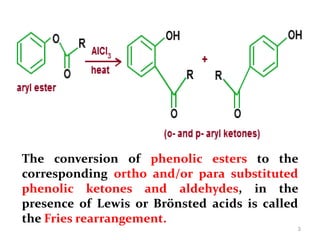
The conversion of phenolic esters to the
corresponding ortho and/or para substituted
phenolic ketones and aldehydes, in the
presence of Lewis or Brönsted acids is called
the Fries rearrangement.
3
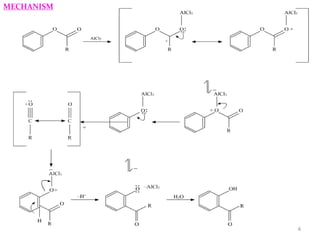
MECHANISM
4
The Fries rearrangement has the following general features:
1. usually it is carried out by heating the phenolic ester to high temperatures (80-
180 °C) in the presence of at least one
equivalent of Lewis acid or Brönsted acid (e.g., HF, HClO4)
2. Lewis acids that catalyze the Friedel-Crafts acylation are all active but recently
solid acid catalysts (e.g., zeolites, mesoporous molecular sieves) and metal
triflates have also been used
3. The rearrangement is general for a wide range of structural variation in both
the acid and phenol component of phenolic
Esters
4. yields are the highest when there are electron-donating substituents on the
phenol, while electronwithdrawing
substituents result in very low yields or no reaction;
5
5. with polyalkylated phenols alkyl migration is often observed under the reaction
conditions
6. the selectivity of the rearrangement to give ortho or
para- substituted products largely depends on the reaction conditions
(temperature, type, and amount of catalyst,
solvent polarity, etc.)
7. at high temperatures without any solvent the ortho-acylated product dominates (
TEMP > 370 OC while low temperatures favor the formation of the para-acylated
product
8. with increasing solvent polarity the ratio of the para-acylated product increases.
6
There are two main variants of the Fries
rearrangement:
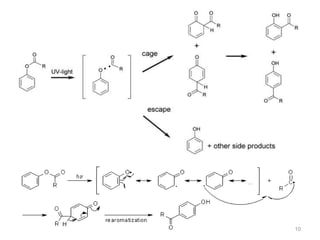
A. Upon irradiation with light phenolic esters
undergo the same transformation, which is
known as the photo-Fries rearrangement.
B. An anionic ortho-Fries rearrangement takes
place when ortho-lithiated O-aryl carbamates
undergo a facile intramolecular [1,3]-acyl
migration to give substituted salicylamides at
room temperature.
7
photo-Fries rearrangement
1.The photo-initiated rearrangement of phenyl or aryl
esters is generally known as the photo-Fries
rearrangement or photo-Fries reaction and usually carried
out in an aprotic solvent.
2.The mechanistic features of this rearrangement can be
compared with the normal Fries rearrangement catalyzed
by Lewis acid.
3.The study finds that regioselectivity can be further
enhanced when the photo-Fries rearrangement is carried
out in presence of zeolite. Besides phenyl and aryl esters,
several other kinds of compounds can also undergo the
hemolytic cleavage from photo-irradiation.
8
4.This reaction is not useful in actual organic
synthesis because of its different by-products.
5. In the normal course of reaction when the
reaction is irradiated under nirtogen atmosphere
with UV light, the acyl group migrates from
phenolic oxygen to the C atom at o- and p-
positions to form 0- and p- substituted products.
6. Its predominantaly an intra molecular free
radical process hence both the o- and p- products
are obtained.
9
10
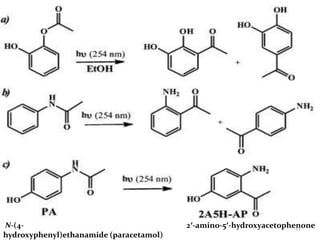
2′-amino-5′-hydroxyacetophenoneN-(4-
hydroxyphenyl)ethanamide (paracetamol)
11
Reimer- tiemann reaction
( fromylation )
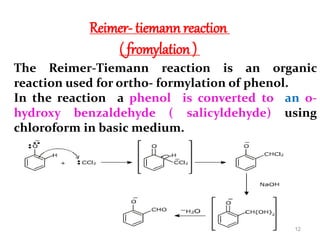
The Reimer-Tiemann reaction is an organic
reaction used for ortho- formylation of phenol.
In the reaction a phenol is converted to an o-
hydroxy benzaldehyde ( salicyldehyde) using
chloroform in basic medium.
12
MECHANISM
13
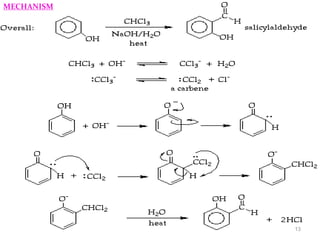
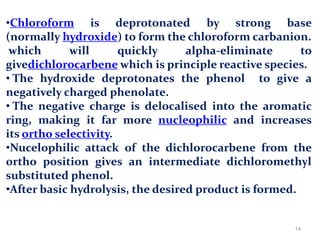
•Chloroform is deprotonated by strong base
(normally hydroxide) to form the chloroform carbanion.
which will quickly alpha-eliminate to
givedichlorocarbene which is principle reactive species.
• The hydroxide deprotonates the phenol to give a
negatively charged phenolate.
• The negative charge is delocalised into the aromatic
ring, making it far more nucleophilic and increases
its ortho selectivity.
•Nucelophilic attack of the dichlorocarbene from the
ortho position gives an intermediate dichloromethyl
substituted phenol.
•After basic hydrolysis, the desired product is formed.
14
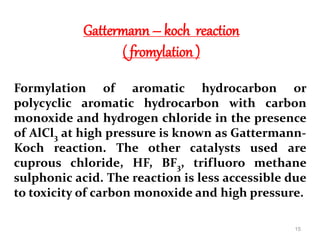
Gattermann – koch reaction
( fromylation )
Formylation of aromatic hydrocarbon or
polycyclic aromatic hydrocarbon with carbon
monoxide and hydrogen chloride in the presence
of AlCl3 at high pressure is known as Gattermann-
Koch reaction. The other catalysts used are
cuprous chloride, HF, BF3, trifluoro methane
sulphonic acid. The reaction is less accessible due
to toxicity of carbon monoxide and high pressure.
15
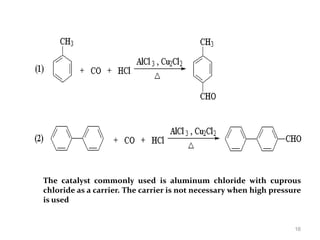
The catalyst commonly used is aluminum chloride with cuprous
chloride as a carrier. The carrier is not necessary when high pressure
is used
16
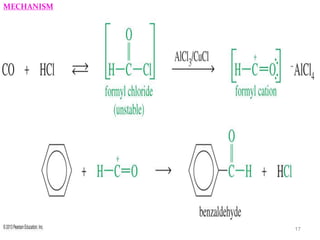
MECHANISM
17
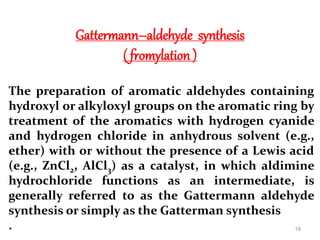
Gattermann–aldehyde synthesis
( fromylation )
The preparation of aromatic aldehydes containing
hydroxyl or alkyloxyl groups on the aromatic ring by
treatment of the aromatics with hydrogen cyanide
and hydrogen chloride in anhydrous solvent (e.g.,
ether) with or without the presence of a Lewis acid
(e.g., ZnCl2, AlCl3) as a catalyst, in which aldimine
hydrochloride functions as an intermediate, is
generally referred to as the Gattermann aldehyde
synthesis or simply as the Gatterman synthesis
. 18
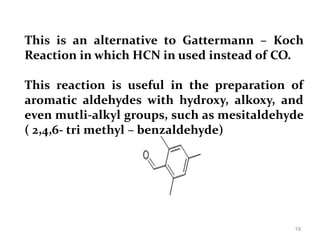
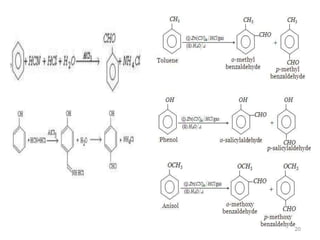
This is an alternative to Gattermann – Koch
Reaction in which HCN in used instead of CO.
This reaction is useful in the preparation of
aromatic aldehydes with hydroxy, alkoxy, and
even mutli-alkyl groups, such as mesitaldehyde
( 2,4,6- tri methyl – benzaldehyde)
19
20
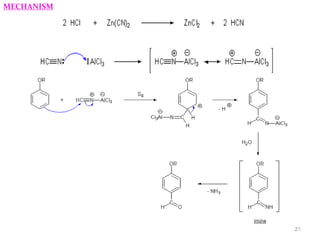
MECHANISM
21
Velsmeier – haack reaction
( fromylation )
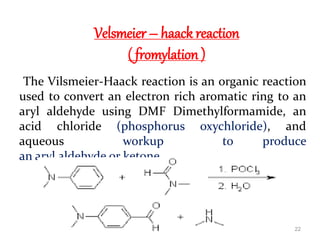
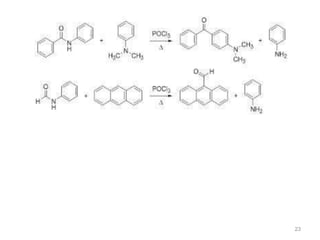
The Vilsmeier-Haack reaction is an organic reaction
used to convert an electron rich aromatic ring to an
aryl aldehyde using DMF Dimethylformamide, an
acid chloride (phosphorus oxychloride), and
aqueous workup to produce
an aryl aldehyde or ketone.
22
23
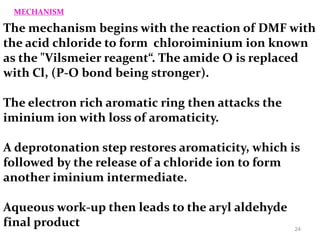
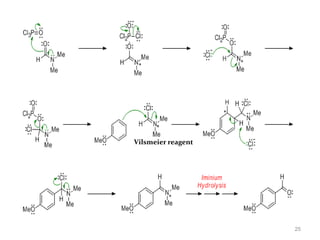
The mechanism begins with the reaction of DMF with
the acid chloride to form chloroiminium ion known
as the "Vilsmeier reagent“. The amide O is replaced
with Cl, (P-O bond being stronger).
The electron rich aromatic ring then attacks the
iminium ion with loss of aromaticity.
A deprotonation step restores aromaticity, which is
followed by the release of a chloride ion to form
another iminium intermediate.
Aqueous work-up then leads to the aryl aldehyde
final product
MECHANISM
24
Vilsmeier reagent
25
……..CONTINUED

Aromatic rearrangements

  • 1.
  • 2.
    Fries rearrangement 1. Intramolecular Friedal –Craft Acylation 2. Rearrangement of phenolic ester by heating it with Friedal –Craft catalyst. 3. The reaction is catalyzed by Brønsted or Lewis acids such as HF, AlCl3, BF3, TiCl4 or SnCl4. The acids are used in excess of the stoichiometric amount, especially the Lewis acids, since they form complexes with both the starting materials and products. 2
  • 3.
    The conversion ofphenolic esters to the corresponding ortho and/or para substituted phenolic ketones and aldehydes, in the presence of Lewis or Brönsted acids is called the Fries rearrangement. 3
  • 4.
  • 5.
    The Fries rearrangementhas the following general features: 1. usually it is carried out by heating the phenolic ester to high temperatures (80- 180 °C) in the presence of at least one equivalent of Lewis acid or Brönsted acid (e.g., HF, HClO4) 2. Lewis acids that catalyze the Friedel-Crafts acylation are all active but recently solid acid catalysts (e.g., zeolites, mesoporous molecular sieves) and metal triflates have also been used 3. The rearrangement is general for a wide range of structural variation in both the acid and phenol component of phenolic Esters 4. yields are the highest when there are electron-donating substituents on the phenol, while electronwithdrawing substituents result in very low yields or no reaction; 5
  • 6.
    5. with polyalkylatedphenols alkyl migration is often observed under the reaction conditions 6. the selectivity of the rearrangement to give ortho or para- substituted products largely depends on the reaction conditions (temperature, type, and amount of catalyst, solvent polarity, etc.) 7. at high temperatures without any solvent the ortho-acylated product dominates ( TEMP > 370 OC while low temperatures favor the formation of the para-acylated product 8. with increasing solvent polarity the ratio of the para-acylated product increases. 6
  • 7.
    There are twomain variants of the Fries rearrangement: A. Upon irradiation with light phenolic esters undergo the same transformation, which is known as the photo-Fries rearrangement. B. An anionic ortho-Fries rearrangement takes place when ortho-lithiated O-aryl carbamates undergo a facile intramolecular [1,3]-acyl migration to give substituted salicylamides at room temperature. 7
  • 8.
    photo-Fries rearrangement 1.The photo-initiatedrearrangement of phenyl or aryl esters is generally known as the photo-Fries rearrangement or photo-Fries reaction and usually carried out in an aprotic solvent. 2.The mechanistic features of this rearrangement can be compared with the normal Fries rearrangement catalyzed by Lewis acid. 3.The study finds that regioselectivity can be further enhanced when the photo-Fries rearrangement is carried out in presence of zeolite. Besides phenyl and aryl esters, several other kinds of compounds can also undergo the hemolytic cleavage from photo-irradiation. 8
  • 9.
    4.This reaction isnot useful in actual organic synthesis because of its different by-products. 5. In the normal course of reaction when the reaction is irradiated under nirtogen atmosphere with UV light, the acyl group migrates from phenolic oxygen to the C atom at o- and p- positions to form 0- and p- substituted products. 6. Its predominantaly an intra molecular free radical process hence both the o- and p- products are obtained. 9
  • 10.
  • 11.
  • 12.
    Reimer- tiemann reaction (fromylation ) The Reimer-Tiemann reaction is an organic reaction used for ortho- formylation of phenol. In the reaction a phenol is converted to an o- hydroxy benzaldehyde ( salicyldehyde) using chloroform in basic medium. 12
  • 13.
  • 14.
    •Chloroform is deprotonatedby strong base (normally hydroxide) to form the chloroform carbanion. which will quickly alpha-eliminate to givedichlorocarbene which is principle reactive species. • The hydroxide deprotonates the phenol to give a negatively charged phenolate. • The negative charge is delocalised into the aromatic ring, making it far more nucleophilic and increases its ortho selectivity. •Nucelophilic attack of the dichlorocarbene from the ortho position gives an intermediate dichloromethyl substituted phenol. •After basic hydrolysis, the desired product is formed. 14
  • 15.
    Gattermann – kochreaction ( fromylation ) Formylation of aromatic hydrocarbon or polycyclic aromatic hydrocarbon with carbon monoxide and hydrogen chloride in the presence of AlCl3 at high pressure is known as Gattermann- Koch reaction. The other catalysts used are cuprous chloride, HF, BF3, trifluoro methane sulphonic acid. The reaction is less accessible due to toxicity of carbon monoxide and high pressure. 15
  • 16.
    The catalyst commonlyused is aluminum chloride with cuprous chloride as a carrier. The carrier is not necessary when high pressure is used 16
  • 17.
  • 18.
    Gattermann–aldehyde synthesis ( fromylation) The preparation of aromatic aldehydes containing hydroxyl or alkyloxyl groups on the aromatic ring by treatment of the aromatics with hydrogen cyanide and hydrogen chloride in anhydrous solvent (e.g., ether) with or without the presence of a Lewis acid (e.g., ZnCl2, AlCl3) as a catalyst, in which aldimine hydrochloride functions as an intermediate, is generally referred to as the Gattermann aldehyde synthesis or simply as the Gatterman synthesis . 18
  • 19.
    This is analternative to Gattermann – Koch Reaction in which HCN in used instead of CO. This reaction is useful in the preparation of aromatic aldehydes with hydroxy, alkoxy, and even mutli-alkyl groups, such as mesitaldehyde ( 2,4,6- tri methyl – benzaldehyde) 19
  • 20.
  • 21.
  • 22.
    Velsmeier – haackreaction ( fromylation ) The Vilsmeier-Haack reaction is an organic reaction used to convert an electron rich aromatic ring to an aryl aldehyde using DMF Dimethylformamide, an acid chloride (phosphorus oxychloride), and aqueous workup to produce an aryl aldehyde or ketone. 22
  • 23.
  • 24.
    The mechanism beginswith the reaction of DMF with the acid chloride to form chloroiminium ion known as the "Vilsmeier reagent“. The amide O is replaced with Cl, (P-O bond being stronger). The electron rich aromatic ring then attacks the iminium ion with loss of aromaticity. A deprotonation step restores aromaticity, which is followed by the release of a chloride ion to form another iminium intermediate. Aqueous work-up then leads to the aryl aldehyde final product MECHANISM 24
  • 25.
  • 26.

Editor's Notes

  • #7 AT higer temperature the product with is having more ∆G value( in negative) will be more stable..so ortho porduct is formed. (thermodynamically more stable product) At lower temp Para product is favored as it is kinetically stable. More polar solvent is attracted to oxygen of easter group attached to benzene ring making the reaction at o – postion difficult ….so the reaction is more at p- postion increasing the product.
  • #8 Facile: easily achieved ignoring the complexities
  • #9 Aprotic solvents may have hydrogens on them somewhere, but they lack O-H or N-H bonds, and therefore cannot hydrogen bond with themselves which serves as the sourceof H + TOLUENE, BENZENE, PHENOL ACETONE, CCl 4 etc ethyl acetate . A regioselective reaction is one in which one direction of bond making or breaking occurs preferentially over all other possible directions