





The prolonged recession before the world war 2nd
& the devastation caused by the world war 2nd led
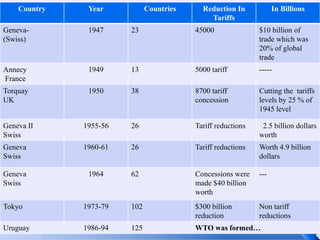
to the BRETTON WOODS conference resulting in the
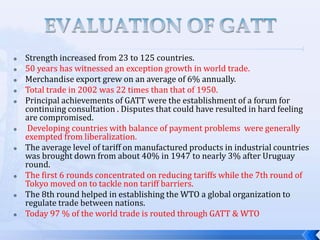
formation IMF , IBRD & ITO.
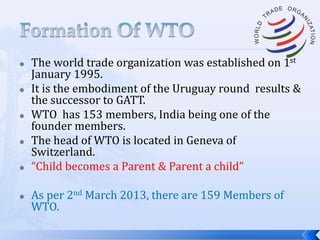
The IMF, IBRD and ITO, were formed in 1945 but
USA didn’t ratify ITO.

23 countries met in Geneva in 1947 & signed a
agreement on tariff & international trade.(GATT)






Set of multilateral trade agreements aimed
at the abolition of quotas and the reduction
of tariffs among member countries.
Signed on October 30, 1947, by 23 countries
in Geneva (to take effect on January 1, 1948)
It Consists of 8 Rounds – Rounds of trade
negotiations


Non discrimination
Prohibition of quantitative restrictions



Consultations.



To raise the standard of living.
2. To ensure full employment and a large and
steadily growing volume of real income and
effective demand.
3. To develop the full use of the resource of the
world
4. To expand production and international trade.
1.
Country

Year

Countries

Reduction In
Tariffs

In Billions

Geneva(Swiss)

1947

23

45000

$10 billion of
trade which was
20% of global
trade

Annecy
France

1949

13

5000 tariff

-----

Torquay
UK

1950

38

8700 tariff
concession

Cutting the tariffs
levels by 25 % of
1945 level

Geneva II
Swiss

1955-56

26

Tariff reductions

2.5 billion dollars
worth

Geneva
Swiss

1960-61

26

Tariff reductions

Worth 4.9 billion
dollars

Geneva
Swiss

1964

62

Concessions were
made $40 billion
worth

---

Tokyo

1973-79

102

$300 billion
reduction

Non tariff
reductions

Uruguay

1986-94

125

WTO was formed…
















Strength increased from 23 to 125 countries.
50 years has witnessed an exception growth in world trade.
Merchandise export grew on an average of 6% annually.
Total trade in 2002 was 22 times than that of 1950.
Principal achievements of GATT were the establishment of a forum for
continuing consultation . Disputes that could have resulted in hard feeling
are compromised.
Developing countries with balance of payment problems were generally
exempted from liberalization.
The average level of tariff on manufactured products in industrial countries
was brought down from about 40% in 1947 to nearly 3% after Uruguay
round.
The first 6 rounds concentrated on reducing tariffs while the 7th round of
Tokyo moved on to tackle non tariff barriers.
The 8th round helped in establishing the WTO a global organization to
regulate trade between nations.
Today 97 % of the world trade is routed through GATT & WTO












The world trade organization was established on 1st
January 1995.
It is the embodiment of the Uruguay round results &
the successor to GATT.
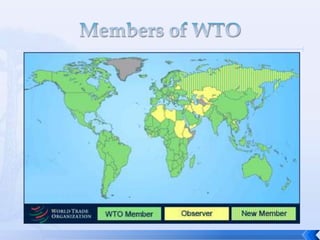
WTO has 153 members, India being one of the
founder members.
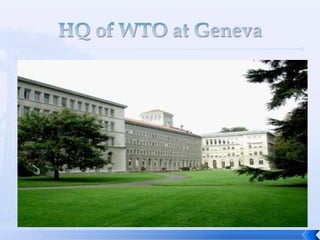
The head of WTO is located in Geneva of
Switzerland.
“Child becomes a Parent & Parent a child”
As per 2nd March 2013, there are 159 Members of
WTO.




“WTO is an International body designed to play the
role of a watchdog in spheres of trade in Goods,
services foreign investments, IPR etc.”
WTO is the only international organization dealing
with the global rules of trade between nations. Its
main function is to ensure that trade flows as
smoothly, predictably and freely as possible.











Administering WTO trade agreements
Forum for trade negotiations
Handling trade disputes
It acts as a watch dog of international trade
Monitoring national trade policies
Technical assistance and training for developing
countries
Cooperation with other international organizations
Providing technical assistance and training for
developing countries.









GATT
GATS
TRIP’S
TRIM’S
Disputes settlement mechanism
Antidumping measures
Agreement on agriculture




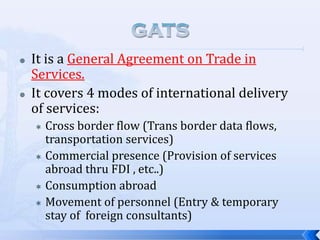
It is a General Agreement on Trade in
Services.
It covers 4 modes of international delivery
of services:
Cross border flow (Trans border data flows,
transportation services)
 Commercial presence (Provision of services
abroad thru FDI , etc..)
 Consumption abroad
 Movement of personnel (Entry & temporary
stay of foreign consultants)

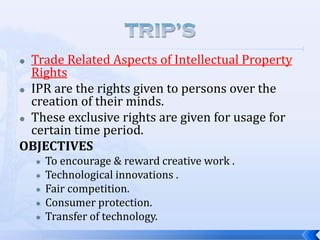
Trade Related Aspects of Intellectual Property
Rights
 IPR are the rights given to persons over the
creation of their minds.
 These exclusive rights are given for usage for
certain time period.
OBJECTIVES









To encourage & reward creative work .
Technological innovations .
Fair competition.
Consumer protection.
Transfer of technology.
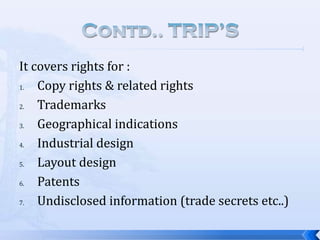
It covers rights for :
1.
Copy rights & related rights
2.
Trademarks
3.
Geographical indications
4.
Industrial design
5.
Layout design
6.
Patents
7.
Undisclosed information (trade secrets etc..)



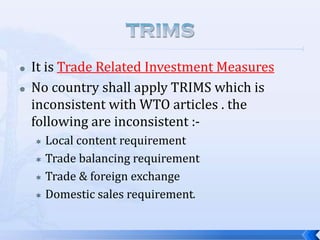
It is Trade Related Investment Measures
No country shall apply TRIMS which is
inconsistent with WTO articles . the
following are inconsistent :Local content requirement
 Trade balancing requirement
 Trade & foreign exchange
 Domestic sales requirement.







It has a fixed dead line in settlement of
disputes .
The first ruling does not extend beyond 1
year.
The appeal is generally disposed off before
60 days.








Meaning- It means selling the product at below the
on going market price or at the price below the cost
of production.
Anti-Dumping laws is applicable if the margin of
dumping is more than 2% of the export price or the
volume of dumped products is more than 3% of the
product.
Anti-Dumping duty shall not exceed the margin of
dumping .
Anti-Dumping action may be suspended or
terminated if the exporter agrees to remove the
dumping or the injurious effect of it.
Agreement on Agriculture
 There are 3 principal commitments..
1.
Market Access :- no import restrictions & limitations
2.
Domestic support :- Elimination of govt support to
domestic company’s.
3.
Export subsidies :- phase out support given to exporters ..
Other important aspects are:a)
Tariffication :- means removal of tariff quotas.
b)
Tariff binding :- means fixing the max rate of import
duty, above which a country does not raise the duty
unilaterally.

I.

II.

III.

IV.

V.

GATT is an agreement.
It was designed with an
attempt to establish
International Trade
Organizations
It was applied on a
provisional bases
GATT covered only
goods.
Disputes settlement
mechanism slow & at
times in conclusive.

I.

II.

III.

IV.

V.

WTO is an organization.
It is establishes to serve
its own purpose.

Its activity are full and
permanent.
It covers goods, services,
IPR.
Dispute settlement
system is fast






IMF – International Monetary Fund
IBRD – International Bank of
Reconstruction and Development
ITO – International Trade Organization
IPR – Intellectual Property Rights




www.wto.org
www.wikipedia.org
International Business- 2e- P Subba Rao.
GATT AND WTO
GATT AND WTO

GATT AND WTO

  • 2.
       The prolonged recessionbefore the world war 2nd & the devastation caused by the world war 2nd led to the BRETTON WOODS conference resulting in the formation IMF , IBRD & ITO. The IMF, IBRD and ITO, were formed in 1945 but USA didn’t ratify ITO. 23 countries met in Geneva in 1947 & signed a agreement on tariff & international trade.(GATT)
  • 3.
       Set of multilateraltrade agreements aimed at the abolition of quotas and the reduction of tariffs among member countries. Signed on October 30, 1947, by 23 countries in Geneva (to take effect on January 1, 1948) It Consists of 8 Rounds – Rounds of trade negotiations
  • 4.
     Non discrimination Prohibition ofquantitative restrictions  Consultations.  To raise the standard of living. 2. To ensure full employment and a large and steadily growing volume of real income and effective demand. 3. To develop the full use of the resource of the world 4. To expand production and international trade. 1.
  • 5.
    Country Year Countries Reduction In Tariffs In Billions Geneva(Swiss) 1947 23 45000 $10billion of trade which was 20% of global trade Annecy France 1949 13 5000 tariff ----- Torquay UK 1950 38 8700 tariff concession Cutting the tariffs levels by 25 % of 1945 level Geneva II Swiss 1955-56 26 Tariff reductions 2.5 billion dollars worth Geneva Swiss 1960-61 26 Tariff reductions Worth 4.9 billion dollars Geneva Swiss 1964 62 Concessions were made $40 billion worth --- Tokyo 1973-79 102 $300 billion reduction Non tariff reductions Uruguay 1986-94 125 WTO was formed…
  • 6.
              Strength increased from23 to 125 countries. 50 years has witnessed an exception growth in world trade. Merchandise export grew on an average of 6% annually. Total trade in 2002 was 22 times than that of 1950. Principal achievements of GATT were the establishment of a forum for continuing consultation . Disputes that could have resulted in hard feeling are compromised. Developing countries with balance of payment problems were generally exempted from liberalization. The average level of tariff on manufactured products in industrial countries was brought down from about 40% in 1947 to nearly 3% after Uruguay round. The first 6 rounds concentrated on reducing tariffs while the 7th round of Tokyo moved on to tackle non tariff barriers. The 8th round helped in establishing the WTO a global organization to regulate trade between nations. Today 97 % of the world trade is routed through GATT & WTO
  • 7.
          The world tradeorganization was established on 1st January 1995. It is the embodiment of the Uruguay round results & the successor to GATT. WTO has 153 members, India being one of the founder members. The head of WTO is located in Geneva of Switzerland. “Child becomes a Parent & Parent a child” As per 2nd March 2013, there are 159 Members of WTO.
  • 9.
      “WTO is anInternational body designed to play the role of a watchdog in spheres of trade in Goods, services foreign investments, IPR etc.” WTO is the only international organization dealing with the global rules of trade between nations. Its main function is to ensure that trade flows as smoothly, predictably and freely as possible.
  • 11.
            Administering WTO tradeagreements Forum for trade negotiations Handling trade disputes It acts as a watch dog of international trade Monitoring national trade policies Technical assistance and training for developing countries Cooperation with other international organizations Providing technical assistance and training for developing countries.
  • 12.
  • 13.
      It is aGeneral Agreement on Trade in Services. It covers 4 modes of international delivery of services: Cross border flow (Trans border data flows, transportation services)  Commercial presence (Provision of services abroad thru FDI , etc..)  Consumption abroad  Movement of personnel (Entry & temporary stay of foreign consultants) 
  • 14.
    Trade Related Aspectsof Intellectual Property Rights  IPR are the rights given to persons over the creation of their minds.  These exclusive rights are given for usage for certain time period. OBJECTIVES       To encourage & reward creative work . Technological innovations . Fair competition. Consumer protection. Transfer of technology.
  • 15.
    It covers rightsfor : 1. Copy rights & related rights 2. Trademarks 3. Geographical indications 4. Industrial design 5. Layout design 6. Patents 7. Undisclosed information (trade secrets etc..)
  • 16.
      It is TradeRelated Investment Measures No country shall apply TRIMS which is inconsistent with WTO articles . the following are inconsistent :Local content requirement  Trade balancing requirement  Trade & foreign exchange  Domestic sales requirement. 
  • 17.
       It has afixed dead line in settlement of disputes . The first ruling does not extend beyond 1 year. The appeal is generally disposed off before 60 days.
  • 18.
        Meaning- It meansselling the product at below the on going market price or at the price below the cost of production. Anti-Dumping laws is applicable if the margin of dumping is more than 2% of the export price or the volume of dumped products is more than 3% of the product. Anti-Dumping duty shall not exceed the margin of dumping . Anti-Dumping action may be suspended or terminated if the exporter agrees to remove the dumping or the injurious effect of it.
  • 19.
    Agreement on Agriculture There are 3 principal commitments.. 1. Market Access :- no import restrictions & limitations 2. Domestic support :- Elimination of govt support to domestic company’s. 3. Export subsidies :- phase out support given to exporters .. Other important aspects are:a) Tariffication :- means removal of tariff quotas. b) Tariff binding :- means fixing the max rate of import duty, above which a country does not raise the duty unilaterally. 
  • 20.
    I. II. III. IV. V. GATT is anagreement. It was designed with an attempt to establish International Trade Organizations It was applied on a provisional bases GATT covered only goods. Disputes settlement mechanism slow & at times in conclusive. I. II. III. IV. V. WTO is an organization. It is establishes to serve its own purpose. Its activity are full and permanent. It covers goods, services, IPR. Dispute settlement system is fast
  • 21.
        IMF – InternationalMonetary Fund IBRD – International Bank of Reconstruction and Development ITO – International Trade Organization IPR – Intellectual Property Rights
  • 22.