1 
FUNCTIONS OF WORLD TRADE ORGANISATION 
 The WTO shall facilitate the implementation, administration and operation,and further the 
objectives of this agreement and of the Multilateral Trade Agreements and shall also provide 
the framework for the implementation, administration and operation of the Plurilateral Trade 
Agreements. 
 The WTO shall provide the forum for negotiations among its members concerning their 
multilateral trade relations in matters dealt with under the agreements of GATT. The WTO may 
also provide a forum for further negotiations among its Members concerning their Multilateral 
trade relations, and a framework for the implementation of the results of such negotiations, as 
may be decided by the Ministerial Conference. 
 The WTO shall administer the understanding on Rules and Procedures Governing the Settlement 
of Disputes. 
 The WTO shall administer the Trade Policy Review Mechanism (TPRM). 
 The WTO shall co-operate as appropriate, with the International Monetary Fund (IMF) and the 
International Bank for Reconstruction and Development (IBRD) and its affiliated agencies to 
achieve greater coherence in global economic policy-making. 
STRUCTURE OF WORLD TRADE ORGANISATION 
The Ministerial Conference: 
 There shall be a Ministerial Conference composed of representatives of all the Members, which 
shall meet atleast once every two years. It shall carry out the functions of the WTO and take 
actions necessary to this effect. 
 It shall have the authority to take decisions on all matters under any of the Multilateral Trade 
Agreements, if so requested by a Member, in accordance with the specific requirements for 
decision- making in this Agreement of WTO and in the relevant Multilateral Trade Agreements. 
The General Council: 
 There shall be a General Council composed of representatives of all the Members, which shall 
meet as appropriate. In the intervals between meetings of the Ministerial Conference, its 
functions shall be conducted by the General Council. The General Council shall also carry out the 
functions assigned to it by this agreement. 
The Dispute settlement Body: 
 The General Council shall convene as appropriate to discharge the responsibilities of the Dispute 
Settlement Body provided for in the Dispute Settlement Understanding. The Dispute Settlement
2 
Body may have its own chairman and shall establish such rules of procedure as it deems 
necessary for the fulfilment of those responsibilities. 
The Trade Policy Review Body: 
 The General Council shall convene as appropriate to discharge the responsibilities of the Trade 
Policy Review Body provided for in the TPRM. The Trade Policy Review Body may have its own 
chairman and shall establish such rules of procedure as it deems necessary for the fulfilment of 
those responsibilities. 
The Council for Trade in Goods, The Council for Trade in services and The Council for Trade-Related 
Aspects of Intellectual Property Rights (Council for TRIPS): 
 They shall operate under the general guidance of the General Council. These Councils shall carry 
out the functions assigned to them by their respective agreements and by the General Council. 
 They shall establish their respective rules of procedure subject to the approval of the General 
Council. Membership in these Councils shall be open to representatives of all Members. These 
Councils shall meet as necessary to carry out their functions 
Subsidiary Bodies: 
 The Council for Trade in Goods, the Council for Trade in Services and the Council for TRIPS shall 
establish subsidiary bodies as required. These subsidiary bodies shall establish their respective 
rules of procedure subject to the approval of their respective Councils. 
The committee on Trade and Development, The Committee on Balance of Payments Restrictions 
and The Committee on Budget, Finance and Administration: 
 The Ministerial Conference shall establish these Committees which shall carry out the functions 
assigned to them by the Agreement and by the Multilateral Trade Agreements, and any 
additional functions assigned to them by the General Council, and may establish such additional 
Committees with such functions as it may deem appropriate. 
 As part of its functions, the Committee on Trade and Development shall periodically review the 
special provisions in the Multilateral trade Agreements in favour of the Least-developed country 
Members and report to the General Council for appropriate action. Membership to these 
Committees shall be open to representatives of all Members. 
Bodies provided for under the Plurilateral Trade Agreements: 
 They shall carry out the functions assigned to them under those agreements and shall operate 
within the institutional framework of the WTO. These bodies shall keep the General Council 
informed of their activities on a regular basis.
3 
STATUS OF THE WORLD TRADE ORGANISATION 
 The WTO shall have legal personality, and shall be accorded by each of its Members such legal 
capacity as may be necessary for the exercise of its functions. 
 The WTO shall be accorded by each of its Members such privileges and immunities as are 
necessary for the exercise of its functions. 
 The officials of the WTO and the representatives of the Members shall similarly be accorded by 
each of its Members such privileges and immunities as are necessary for the independent 
exercise of their functions in connection with the WTO. 
 The privileges and immunities to be accorded by a Member to the WTO its officials, and the 
representatives of its Members shall be similar to the privileges and immunities stipulated in 
the Convention on the Privileges and Immunities of the Specialised Agencies, approved by the 
General Assembly of the United Nations on 21 November,1947. 
 The WTO may conclude a headquarters agreement. 
DISPUTE SETTELMENT IN WORLD 
TRADE ORGANISATION 
 A dispute arises when a member government believes another member government is violating 
an agreement or a commitment that it has made in the WTO. 
 The Dispute Settlement Body (DSB) of the World Trade Organisation (WTO) makes decisions on 
trade disputes between governments that are adjudicated by the Organization. 
 Other then the dispute settelment body ,WTO contains independent and quasi -judicial 
institutions that are the Panels, the Appellate Body and Arbitrators 
Dispute Settlement Body (DSB) –(article 2 of the DSU) 
 Comprises a chairman (head of the permanent mission of one of the Member countries 
appointed by consensus among the Members of WTO) and representatives of all WTO Members 
(government representatives, usually diplomats who belong to ministries of trade or foreign 
affairs).
4 
 In their capacity as government officials, the representatives receive instructions from their 
governments on the positions they must adopt and the statements they must make within the 
DSB, hence the latter is considered a political body. 
 The DSB is responsible for the application of the DSU, in other words it oversees the entire 
dispute settlement procedure. It has the authority to set up panels, adopt panel and Appellate 
Body reports, monitor the application of recommendations and authorize retaliatory measures 
when a Member fails to comply with rulings. 
 The DSB usually meets once a month, and the Director-General may convene extraordinary 
meetings at the request of Members. The staff of the WTO Secretariat provide administrative 
support to the DSB. 
 As a general rule, the DSB makes decisions by consensus. However, when the DSB sets up 
panels, adopts reports or authorizes retaliation, the decision is automatically considered to be 
adopted, unless there is a consensus to the contrary (a negative consensus). 
Director-General and Secretariat of WTO: 
The Director-General of WTO participates in the Dispute Settlement Body (DSB) in the following ways: 
 The Director-General may, acting in an ex officio capacity, offer good offices, conciliation or 
mediation with the view to assisting Members to settle a dispute (article 5.6 of the 
Understanding on Rules and Procedures Governing the Settlement of Disputes (DSU)), especially 
in cases involving a less developed country. 
 If there is no agreement on the panelists, at the request of either party, the Director-General, in 
consultation with the Chairman of the DSB and the Chairman of the relevant Council or 
Committee, shall convene DSB meetings and determine the composition of the panel (article 
8.7). 
 The Director-General appoints an Arbitrator to determine a reasonable period of time if the 
parties are unable to agree on a period of time or the appointment of an Arbi trator (article 21.3 
c). 
 The Director-General shall examine proposed retaliatory measures in cases of non-implementation 
(article 22.6). 
 Within the Dispute Settlement Body (DSB), the Secretariat can act in the following ways (article 
27). 
 Reports to the Director-General; provides assistance in respect of dispute settlement to 
Members at their request; organizes special training courses and provides additional legal 
advice and assistance to developing country Members; provides assistance to parties in the
5 
formation of panels; and helps established panels and provides administrative support to the 
DSB. 
Panels - articles 6, 7 and 8 of the DSU: 
 Panels are quasi-judicial bodies responsible for settling differences between Members in the 
first instance. 
 They comprise three, and in exceptional cases five, experts specially selected for each case 
(there is no permanent panel, but rather a different one is set up for each case). WTO Members 
regularly put forward names to be included in the list kept by the Secretariat. 
 People appointed to a panel provide their services independently, in an individual capacity, and 
not as a representative of any government or organization. 
Appellate Body - article 17 of the DSU: 
 Unlike the panels, the Appellate Body is a standing body made up of seven members appointed 
by the DSB by consensus and for a period of four years, with a maximum of two terms. 
 The Appellate Body examines the legal aspects of panel reports (rather than studying evidence 
or facts), and represents the second and final instance of the legal process. 
Arbitrators - article 25 of the DSU: 
 Arbitration is an alternative means of dispute settlement to panels and the Appellate Body. 
 Arbitrators can thus be called on to resolve certain issues at various stages of the dispute 
settlement process (when there is no agreement on determining the reasonable period of time 
or on the level of retaliation). Arbitral awards are not subject to appeal and may be enforced by 
the DSB. 
Experts - article 13 and appendix 4 of the DSU: 
 Panels may seek the opinions of experts in dealing with technical or scientific issues, such as 
when the case relates to the Agreement on the Application of Sanitary and Phytosanitary 
Measures, Agreement on Technical Barriers to Trade, or the Agreement on Subsidies and 
Countervailing Measures. 
 Groups of experts act under the authority of the panel, and provide the latter with their 
opinion. These groups carry out a purely consultative role.
6 
 The final decision on legal issues and fact-finding, based on expert opinion, remains with the 
panel. 
DISPUTE SETTELMENT PROCEDURE 
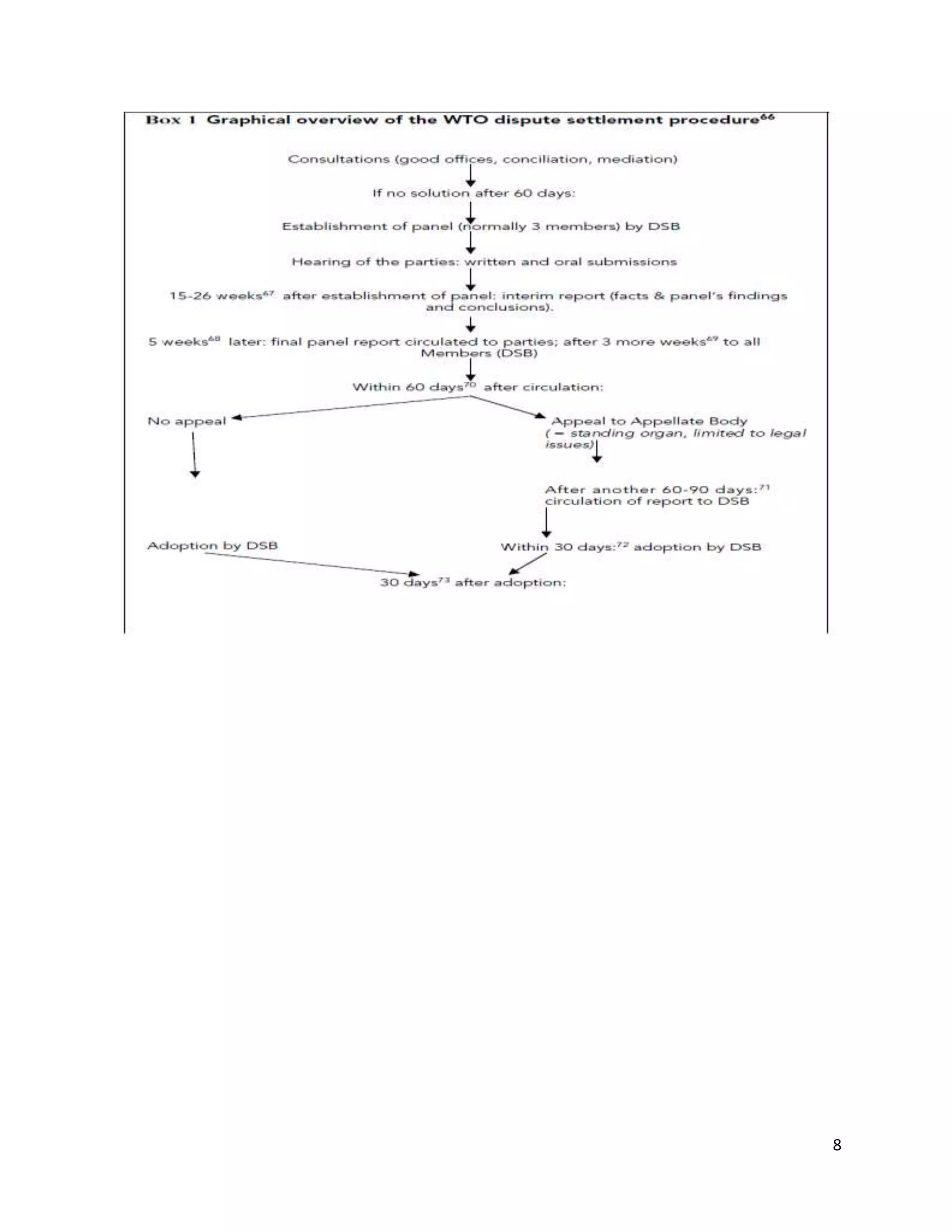
Main stages involved are: 
 CONSULTATIONS 
 PANEL 
 APPEAL 
 ADOPTION 
 IMPLEMENTATION 
Pre-litigation stage 
 Consultations: A filing of a “Request for Consultations” is the official beginning of the dispute 
within WTO and brings the Understanding on Rules and Procedures Governing the Settlement of 
Disputes (DSU) into play. 
 Consultations provide parties with the opportunity to debate the issue and find a satisfactory 
solution without resorting to litigation. The party complained against must reply to the request 
within 10 days after the date of its receipt and shall enter into consultations in good faith within 
a period of no more than 30 days after the date of receipt of the request. 
 If the Member does not comply with this time frame, then the Member that requested the 
holding of consultations may proceed directly to the litigation stage and request the 
establishment of a panel. If the consultations fail to settle a dispute within 60 days after the date 
of receipt of the request for consultations, the complaining party may request the establishment 
of a panel (article 4.7). 
 However, governments are in permanent contact, and agreement may be reached at any stage 
of the process (article 4). Along with good offices, conciliation and mediation, 
 consultations are the main non-judicial or diplomatic instrument in the WTO dispute settlement 
system 
Litigation stage
 1st stage (panel): If the consultations fail to settle a dispute, the complaining party may request 
7 
establishment of a panel by the Dispute Settlement Body (DSB). The panel must be established 
within 45 days of the request. 
 Once established, the panel must produce a report for the DSB within six to nine months. 
 This report must include an objective assessment of the facts of the case and an examination of 
the measures in dispute, using the relevant provisions of the appropriate legal instruments. 
 2nd stage (optional recourse to the Appellate Body): The Appellate Body examines the legal 
aspects of the challenge and may uphold, modify or reverse the legal findings and conclusions of 
the panel (article 17.13). 
 According to the Understanding on Rules and Procedures Governing the Settlement of Disputes 
(DSU) 
 parties may adopt three positions in relation to reports: 
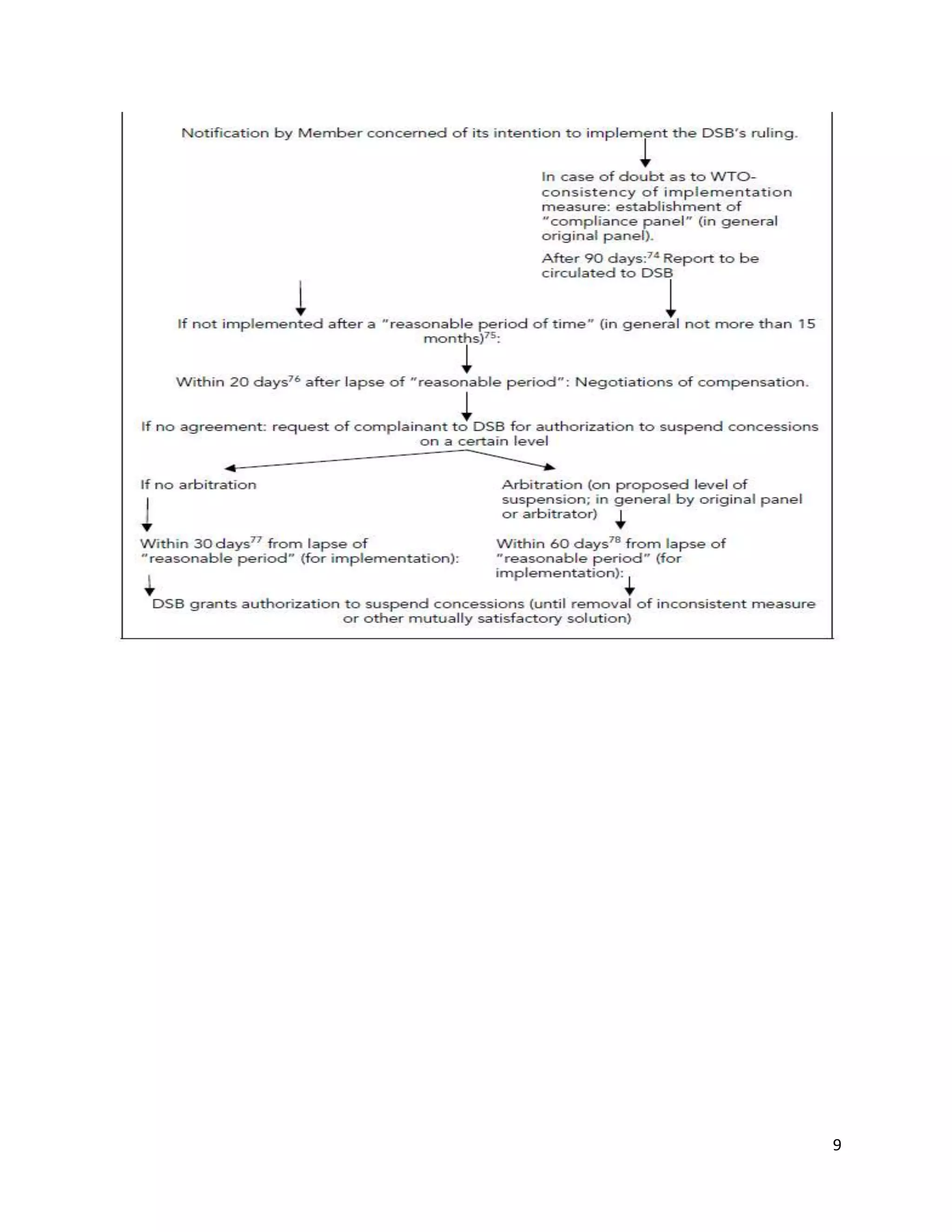
 Implementation: it is insisted that the party failing to fulfil its obligations comply with the 
recommendations of the panel or Appellate Body. When it is impossible to do so immediately, 
the DSB may establish a reasonable period of time for implementation. 
 Payment of compensation: when the offending party exceeds the reasonable period of time 
without implementing the recommendations or determinations, the complainant may ask for 
compensation. The offending party may also offer compensation. 
 Retaliatory measures: when the offending party fails to comply with recommendations and 
refuses to offer compensation, the affected party may request DSB authorization to introduce 
retaliatory measures against the offending country. 
 In principle, these measures must be applicable in the same sectors in which the panel has 
established the existence of an offence. 
 Only if this were considered impossible could the application of retaliatory measures in other 
sectors of the same agreement be authorized.
8
9
10 
IMPACT ON GLOBALISTION 
 GLOBALISATION 
 The term Globalisation is defined as integration of economies and societies through cross 
country flows of information, ideas, technologies, goods, services, capital, finance, people. 
 In short terms globalization refers to increasing global connectivity, integration and 
interdependence in the economic, social, technological, cultural, political, and ecological 
spheres. 
 At present the term globalisation used in limited sense of 
economic integration leaving all cultural , Social , political 
dimensions. 
 The economic integration occurs through three channels: 
a. Trades in goods and services 
b. Movement of capital 
c. Flow of finance by influencing market integration effciency and industrial organisation. 
• TRADE IN GOODS AND SERVICES: 
 International trade ensures allocating different resources and that has to be consistent. 
 We all know from economic point of view that restrictive trade barriers on emerging economies 
which impedes growth 
 Emerging economies can reap the benefits of international trade if only all the resources are 
utilized in full potential 
 This is where the importance of reducing the tariff and non-tariff barriers crop up. 
 MOVEMENT OF CAPITAL: 
 The production base of a developing economy gets enhanced 
 due to capital flows across countries 
 The mobility of capital only enabled savings for the entire 
 globe and exhibited high investment potential.
 A country's economic growth doesn't, however, get barred by domestic savings. Foreign capital 
11 
inflow play an important role in the development of an economy 
 Developing countries would definitely prefer foreign direct 
 investment because portfolio investment doesn't have a direct 
 impact on the productive capacity expansion. 
FINANCIAL FLOW: 
 The growth in capital and mobility of the foreign exchange 
 markets enabled better transfer of resources cross borders and 
 by large the global foreign exchange markets improved. 
 It is mandatory to go in for the expansion of foreign exchange 
 markets and thus facilitate international transfer of capital. 
 Impact of Globalisation on Manufacturing Industry: 
• Manufacturing companies, both domestic and global, are expanding their Indian 
production capacities and establishing new plants. 
• Indian companies are also becoming global, with manufactured goods exports growing in 
excess of 20 percent annually in recent years. 
• The growth of manufacturing has resulted in India emerging as one of the fastest growing 
markets for automation systems, enterprise solutions and integration service providers. 
Impact of Globalisation on Employment 
 An analysis of the impact of globalization on 
employment in India will bring out a number of factors . 
They are: 
a. Market liberalisation policies and employment: 
 The wake of globalisation which leads to intiation of open market policies. 
 There was significant rise in the customer base and it slowly gave rise to the consumer 
market where the market changes were dependant on the demand supply chain. 
b. Growth of new segments in the market :
 In the recent years, a number of industry segments such as information technology, agro 
12 
products, personal and beauty care, health care and other sectors have come into the 
market. 
 Experts say that the introduction of a wide range of sectors have led to the favorable 
growth of the economy in the country. 
c. Improvement in standard of living: 
 The favorable economic growth has led to the development of infrastructure, health care 
facilities and services, per capita income and other factors which have really led to the 
high growth rate. 
India Tasks and Challenges 
 India seeks to protect its food and livelihood security by having sufficient flexibility for domestic 
policy measures. 
 Protect domestic products from surge in imports 
 Substantial reduction in expert subsidies and domestic support to agriculture in developed 
countries for greater market access 
 Negotiation on trade in services are crucial to India. 
 India should not be seen as a spoiler in negotiations 
 India should give constructive leadership to protect the interests of developing and least 
developed countries 
 India vigorously pursue liberalization of trade in services 
 CHALLENGES: 
 The government will have to find a way of addressing anomalous situation of allowing 
import of some products which are reserved for production in the small scale sector. 
 India has to work creatively and make developments in leading edge technologies being 
developed all over the world. 
 India should bring about universal literacy 
 India needs a very elaborate national science policy which should address area of health.
13 
 India should reach the international standards in the quality of both industrial and 
agricultural products 
 India should properly plan and utilise its cheap and abundant human and natural 
resources. 
 India should open up its economy to foreign investment without the detriment of native 
investment 
& 
INDIA TASKS AND CHALLENGES

Functions of world trade organisation

  • 1.
    1 FUNCTIONS OFWORLD TRADE ORGANISATION  The WTO shall facilitate the implementation, administration and operation,and further the objectives of this agreement and of the Multilateral Trade Agreements and shall also provide the framework for the implementation, administration and operation of the Plurilateral Trade Agreements.  The WTO shall provide the forum for negotiations among its members concerning their multilateral trade relations in matters dealt with under the agreements of GATT. The WTO may also provide a forum for further negotiations among its Members concerning their Multilateral trade relations, and a framework for the implementation of the results of such negotiations, as may be decided by the Ministerial Conference.  The WTO shall administer the understanding on Rules and Procedures Governing the Settlement of Disputes.  The WTO shall administer the Trade Policy Review Mechanism (TPRM).  The WTO shall co-operate as appropriate, with the International Monetary Fund (IMF) and the International Bank for Reconstruction and Development (IBRD) and its affiliated agencies to achieve greater coherence in global economic policy-making. STRUCTURE OF WORLD TRADE ORGANISATION The Ministerial Conference:  There shall be a Ministerial Conference composed of representatives of all the Members, which shall meet atleast once every two years. It shall carry out the functions of the WTO and take actions necessary to this effect.  It shall have the authority to take decisions on all matters under any of the Multilateral Trade Agreements, if so requested by a Member, in accordance with the specific requirements for decision- making in this Agreement of WTO and in the relevant Multilateral Trade Agreements. The General Council:  There shall be a General Council composed of representatives of all the Members, which shall meet as appropriate. In the intervals between meetings of the Ministerial Conference, its functions shall be conducted by the General Council. The General Council shall also carry out the functions assigned to it by this agreement. The Dispute settlement Body:  The General Council shall convene as appropriate to discharge the responsibilities of the Dispute Settlement Body provided for in the Dispute Settlement Understanding. The Dispute Settlement
  • 2.
    2 Body mayhave its own chairman and shall establish such rules of procedure as it deems necessary for the fulfilment of those responsibilities. The Trade Policy Review Body:  The General Council shall convene as appropriate to discharge the responsibilities of the Trade Policy Review Body provided for in the TPRM. The Trade Policy Review Body may have its own chairman and shall establish such rules of procedure as it deems necessary for the fulfilment of those responsibilities. The Council for Trade in Goods, The Council for Trade in services and The Council for Trade-Related Aspects of Intellectual Property Rights (Council for TRIPS):  They shall operate under the general guidance of the General Council. These Councils shall carry out the functions assigned to them by their respective agreements and by the General Council.  They shall establish their respective rules of procedure subject to the approval of the General Council. Membership in these Councils shall be open to representatives of all Members. These Councils shall meet as necessary to carry out their functions Subsidiary Bodies:  The Council for Trade in Goods, the Council for Trade in Services and the Council for TRIPS shall establish subsidiary bodies as required. These subsidiary bodies shall establish their respective rules of procedure subject to the approval of their respective Councils. The committee on Trade and Development, The Committee on Balance of Payments Restrictions and The Committee on Budget, Finance and Administration:  The Ministerial Conference shall establish these Committees which shall carry out the functions assigned to them by the Agreement and by the Multilateral Trade Agreements, and any additional functions assigned to them by the General Council, and may establish such additional Committees with such functions as it may deem appropriate.  As part of its functions, the Committee on Trade and Development shall periodically review the special provisions in the Multilateral trade Agreements in favour of the Least-developed country Members and report to the General Council for appropriate action. Membership to these Committees shall be open to representatives of all Members. Bodies provided for under the Plurilateral Trade Agreements:  They shall carry out the functions assigned to them under those agreements and shall operate within the institutional framework of the WTO. These bodies shall keep the General Council informed of their activities on a regular basis.
  • 3.
    3 STATUS OFTHE WORLD TRADE ORGANISATION  The WTO shall have legal personality, and shall be accorded by each of its Members such legal capacity as may be necessary for the exercise of its functions.  The WTO shall be accorded by each of its Members such privileges and immunities as are necessary for the exercise of its functions.  The officials of the WTO and the representatives of the Members shall similarly be accorded by each of its Members such privileges and immunities as are necessary for the independent exercise of their functions in connection with the WTO.  The privileges and immunities to be accorded by a Member to the WTO its officials, and the representatives of its Members shall be similar to the privileges and immunities stipulated in the Convention on the Privileges and Immunities of the Specialised Agencies, approved by the General Assembly of the United Nations on 21 November,1947.  The WTO may conclude a headquarters agreement. DISPUTE SETTELMENT IN WORLD TRADE ORGANISATION  A dispute arises when a member government believes another member government is violating an agreement or a commitment that it has made in the WTO.  The Dispute Settlement Body (DSB) of the World Trade Organisation (WTO) makes decisions on trade disputes between governments that are adjudicated by the Organization.  Other then the dispute settelment body ,WTO contains independent and quasi -judicial institutions that are the Panels, the Appellate Body and Arbitrators Dispute Settlement Body (DSB) –(article 2 of the DSU)  Comprises a chairman (head of the permanent mission of one of the Member countries appointed by consensus among the Members of WTO) and representatives of all WTO Members (government representatives, usually diplomats who belong to ministries of trade or foreign affairs).
  • 4.
    4  Intheir capacity as government officials, the representatives receive instructions from their governments on the positions they must adopt and the statements they must make within the DSB, hence the latter is considered a political body.  The DSB is responsible for the application of the DSU, in other words it oversees the entire dispute settlement procedure. It has the authority to set up panels, adopt panel and Appellate Body reports, monitor the application of recommendations and authorize retaliatory measures when a Member fails to comply with rulings.  The DSB usually meets once a month, and the Director-General may convene extraordinary meetings at the request of Members. The staff of the WTO Secretariat provide administrative support to the DSB.  As a general rule, the DSB makes decisions by consensus. However, when the DSB sets up panels, adopts reports or authorizes retaliation, the decision is automatically considered to be adopted, unless there is a consensus to the contrary (a negative consensus). Director-General and Secretariat of WTO: The Director-General of WTO participates in the Dispute Settlement Body (DSB) in the following ways:  The Director-General may, acting in an ex officio capacity, offer good offices, conciliation or mediation with the view to assisting Members to settle a dispute (article 5.6 of the Understanding on Rules and Procedures Governing the Settlement of Disputes (DSU)), especially in cases involving a less developed country.  If there is no agreement on the panelists, at the request of either party, the Director-General, in consultation with the Chairman of the DSB and the Chairman of the relevant Council or Committee, shall convene DSB meetings and determine the composition of the panel (article 8.7).  The Director-General appoints an Arbitrator to determine a reasonable period of time if the parties are unable to agree on a period of time or the appointment of an Arbi trator (article 21.3 c).  The Director-General shall examine proposed retaliatory measures in cases of non-implementation (article 22.6).  Within the Dispute Settlement Body (DSB), the Secretariat can act in the following ways (article 27).  Reports to the Director-General; provides assistance in respect of dispute settlement to Members at their request; organizes special training courses and provides additional legal advice and assistance to developing country Members; provides assistance to parties in the
  • 5.
    5 formation ofpanels; and helps established panels and provides administrative support to the DSB. Panels - articles 6, 7 and 8 of the DSU:  Panels are quasi-judicial bodies responsible for settling differences between Members in the first instance.  They comprise three, and in exceptional cases five, experts specially selected for each case (there is no permanent panel, but rather a different one is set up for each case). WTO Members regularly put forward names to be included in the list kept by the Secretariat.  People appointed to a panel provide their services independently, in an individual capacity, and not as a representative of any government or organization. Appellate Body - article 17 of the DSU:  Unlike the panels, the Appellate Body is a standing body made up of seven members appointed by the DSB by consensus and for a period of four years, with a maximum of two terms.  The Appellate Body examines the legal aspects of panel reports (rather than studying evidence or facts), and represents the second and final instance of the legal process. Arbitrators - article 25 of the DSU:  Arbitration is an alternative means of dispute settlement to panels and the Appellate Body.  Arbitrators can thus be called on to resolve certain issues at various stages of the dispute settlement process (when there is no agreement on determining the reasonable period of time or on the level of retaliation). Arbitral awards are not subject to appeal and may be enforced by the DSB. Experts - article 13 and appendix 4 of the DSU:  Panels may seek the opinions of experts in dealing with technical or scientific issues, such as when the case relates to the Agreement on the Application of Sanitary and Phytosanitary Measures, Agreement on Technical Barriers to Trade, or the Agreement on Subsidies and Countervailing Measures.  Groups of experts act under the authority of the panel, and provide the latter with their opinion. These groups carry out a purely consultative role.
  • 6.
    6  Thefinal decision on legal issues and fact-finding, based on expert opinion, remains with the panel. DISPUTE SETTELMENT PROCEDURE Main stages involved are:  CONSULTATIONS  PANEL  APPEAL  ADOPTION  IMPLEMENTATION Pre-litigation stage  Consultations: A filing of a “Request for Consultations” is the official beginning of the dispute within WTO and brings the Understanding on Rules and Procedures Governing the Settlement of Disputes (DSU) into play.  Consultations provide parties with the opportunity to debate the issue and find a satisfactory solution without resorting to litigation. The party complained against must reply to the request within 10 days after the date of its receipt and shall enter into consultations in good faith within a period of no more than 30 days after the date of receipt of the request.  If the Member does not comply with this time frame, then the Member that requested the holding of consultations may proceed directly to the litigation stage and request the establishment of a panel. If the consultations fail to settle a dispute within 60 days after the date of receipt of the request for consultations, the complaining party may request the establishment of a panel (article 4.7).  However, governments are in permanent contact, and agreement may be reached at any stage of the process (article 4). Along with good offices, conciliation and mediation,  consultations are the main non-judicial or diplomatic instrument in the WTO dispute settlement system Litigation stage
  • 7.
     1st stage(panel): If the consultations fail to settle a dispute, the complaining party may request 7 establishment of a panel by the Dispute Settlement Body (DSB). The panel must be established within 45 days of the request.  Once established, the panel must produce a report for the DSB within six to nine months.  This report must include an objective assessment of the facts of the case and an examination of the measures in dispute, using the relevant provisions of the appropriate legal instruments.  2nd stage (optional recourse to the Appellate Body): The Appellate Body examines the legal aspects of the challenge and may uphold, modify or reverse the legal findings and conclusions of the panel (article 17.13).  According to the Understanding on Rules and Procedures Governing the Settlement of Disputes (DSU)  parties may adopt three positions in relation to reports:  Implementation: it is insisted that the party failing to fulfil its obligations comply with the recommendations of the panel or Appellate Body. When it is impossible to do so immediately, the DSB may establish a reasonable period of time for implementation.  Payment of compensation: when the offending party exceeds the reasonable period of time without implementing the recommendations or determinations, the complainant may ask for compensation. The offending party may also offer compensation.  Retaliatory measures: when the offending party fails to comply with recommendations and refuses to offer compensation, the affected party may request DSB authorization to introduce retaliatory measures against the offending country.  In principle, these measures must be applicable in the same sectors in which the panel has established the existence of an offence.  Only if this were considered impossible could the application of retaliatory measures in other sectors of the same agreement be authorized.
  • 8.
  • 9.
  • 10.
    10 IMPACT ONGLOBALISTION  GLOBALISATION  The term Globalisation is defined as integration of economies and societies through cross country flows of information, ideas, technologies, goods, services, capital, finance, people.  In short terms globalization refers to increasing global connectivity, integration and interdependence in the economic, social, technological, cultural, political, and ecological spheres.  At present the term globalisation used in limited sense of economic integration leaving all cultural , Social , political dimensions.  The economic integration occurs through three channels: a. Trades in goods and services b. Movement of capital c. Flow of finance by influencing market integration effciency and industrial organisation. • TRADE IN GOODS AND SERVICES:  International trade ensures allocating different resources and that has to be consistent.  We all know from economic point of view that restrictive trade barriers on emerging economies which impedes growth  Emerging economies can reap the benefits of international trade if only all the resources are utilized in full potential  This is where the importance of reducing the tariff and non-tariff barriers crop up.  MOVEMENT OF CAPITAL:  The production base of a developing economy gets enhanced  due to capital flows across countries  The mobility of capital only enabled savings for the entire  globe and exhibited high investment potential.
  • 11.
     A country'seconomic growth doesn't, however, get barred by domestic savings. Foreign capital 11 inflow play an important role in the development of an economy  Developing countries would definitely prefer foreign direct  investment because portfolio investment doesn't have a direct  impact on the productive capacity expansion. FINANCIAL FLOW:  The growth in capital and mobility of the foreign exchange  markets enabled better transfer of resources cross borders and  by large the global foreign exchange markets improved.  It is mandatory to go in for the expansion of foreign exchange  markets and thus facilitate international transfer of capital.  Impact of Globalisation on Manufacturing Industry: • Manufacturing companies, both domestic and global, are expanding their Indian production capacities and establishing new plants. • Indian companies are also becoming global, with manufactured goods exports growing in excess of 20 percent annually in recent years. • The growth of manufacturing has resulted in India emerging as one of the fastest growing markets for automation systems, enterprise solutions and integration service providers. Impact of Globalisation on Employment  An analysis of the impact of globalization on employment in India will bring out a number of factors . They are: a. Market liberalisation policies and employment:  The wake of globalisation which leads to intiation of open market policies.  There was significant rise in the customer base and it slowly gave rise to the consumer market where the market changes were dependant on the demand supply chain. b. Growth of new segments in the market :
  • 12.
     In therecent years, a number of industry segments such as information technology, agro 12 products, personal and beauty care, health care and other sectors have come into the market.  Experts say that the introduction of a wide range of sectors have led to the favorable growth of the economy in the country. c. Improvement in standard of living:  The favorable economic growth has led to the development of infrastructure, health care facilities and services, per capita income and other factors which have really led to the high growth rate. India Tasks and Challenges  India seeks to protect its food and livelihood security by having sufficient flexibility for domestic policy measures.  Protect domestic products from surge in imports  Substantial reduction in expert subsidies and domestic support to agriculture in developed countries for greater market access  Negotiation on trade in services are crucial to India.  India should not be seen as a spoiler in negotiations  India should give constructive leadership to protect the interests of developing and least developed countries  India vigorously pursue liberalization of trade in services  CHALLENGES:  The government will have to find a way of addressing anomalous situation of allowing import of some products which are reserved for production in the small scale sector.  India has to work creatively and make developments in leading edge technologies being developed all over the world.  India should bring about universal literacy  India needs a very elaborate national science policy which should address area of health.
  • 13.
    13  Indiashould reach the international standards in the quality of both industrial and agricultural products  India should properly plan and utilise its cheap and abundant human and natural resources.  India should open up its economy to foreign investment without the detriment of native investment & INDIA TASKS AND CHALLENGES