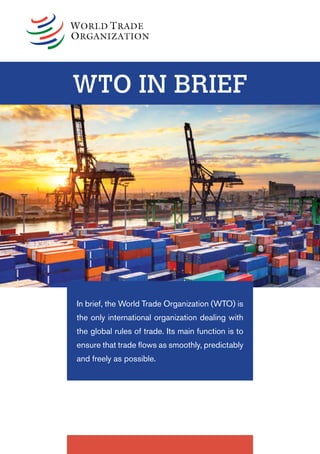
In brief, the World Trade Organization (WTO) is
the only international organization dealing with
the global rules of trade. Its main function is to
ensure that trade flows as smoothly, predictably
and freely as possible.
WTO IN BRIEF
WTO IN BRIEF
2 WTO IN BRIEF
WWW.WTO.ORG
Global trade rules
Global rules of trade provide
assurance and stability.
Consumers and producers know
they can enjoy secure supplies
and greater choice of the
finished products, components,
raw materials and services they
use. Producers and exporters
know foreign markets will remain
open to them.
This leads to a more prosperous,
peaceful and accountable
economic world. Decisions in
the WTO are typically taken
by consensus among all
members and they are ratified
by members’ parliaments. Trade
frictions are channelled into
the WTO’s dispute settlement
process, where the focus is on
interpreting agreements and
commitments and how to ensure
that members’ trade policies
conform with them. That way, the
risk of disputes spilling over into
3 WTO IN BRIEF
WWW.WTO.ORG
WWW.WTO.ORG
political or military conflict
is reduced.
By lowering trade barriers
through negotiations
among member
governments, the WTO’s
system also breaks down
other barriers between
peoples and trading
economies.
At the heart of the
system – known as
the multilateral trading
system – are the WTO’s
agreements, negotiated
and signed by a large
majority of the world’s
trading economies, and
ratified in their parliaments.
These agreements are
the legal foundations for
global trade. Essentially,
they are contracts,
guaranteeing WTO
members important trade
rights. They also bind
governments to keep their
trade policies transparent
and predictable which is
to everybody’s benefit.
By lowering trade
barriers through
negotiations
among member
governments, the
WTO’s system also
breaks down other
barriers between
peoples and
trading economies.
The agreements provide
a stable and transparent
framework to help
producers of goods and
services, exporters and
importers conduct their
business.
The goal is to improve the
welfare of the peoples of
the WTO’s members.
WTO IN BRIEF
4 WTO IN BRIEF
WWW.WTO.ORG
Trade negotiations
The World Trade Organization
came into being in 1995. One of
the youngest of the international
organizations, the WTO is
the successor to the General
Agreement on Tariffs and Trade
(GATT) established in the wake of
the Second World War.
So while the WTO is relatively
young, the multilateral trading
system that was originally set up
under the GATT is over 70 years
old.
The past 70 years have seen
an exceptional growth in world
trade. Merchandise exports
have grown on average by 6%
annually. This growth in trade
has been a powerful engine for
overall economic expansion and
on average trade has grown by
1.5 times more than the global
economy each year. Total exports
in 2019 were 250 times the level
of 1948. The GATT and the WTO
have helped to create a strong
and prosperous trading system
contributing to unprecedented
growth.
The system was developed
through a series of trade
negotiations, or rounds, held
under the GATT. The first rounds
dealt mainly with tariff reductions
but later negotiations included
other areas such as anti-dumping
and non-tariff measures. The
1986-94 round – the Uruguay
Round – led to the WTO’s
creation.
The negotiations did not
end there. In 1997, an
agreement was reached on
telecommunications services,
with 69 governments agreeing
to wide-ranging liberalization
measures that went beyond
those agreed in the Uruguay
Round.
In the same year, 40 governments
successfully concluded
negotiations for tariff-free trade in
information technology products,
and 70 members concluded a
financial services deal covering
more than 95% of trade in
banking, insurance, securities and
financial information.
In 2000, new talks started on
agriculture and services. These
were incorporated into a broader
work programme, the Doha
Development Agenda, launched
at the fourth WTO Ministerial
Conference in Doha, Qatar, in
November 2001.
The past
70 years
have seen an
exceptional
growth in
world trade.
Merchandise
exports have
grown on
average by
6% annually.
5 WTO IN BRIEF
WWW.WTO.ORG
WWW.WTO.ORG
The new work programme
included negotiations
and other work on non-
agricultural tariffs, trade
and the environment, WTO
rules on anti-dumping and
subsidies, trade facilitation,
transparency in government
procurement, intellectual
property and a range of
issues raised by developing
economies as difficulties
they face in implementing
WTO agreements.
Negotiations on these
and other topics have
resulted in major updates
to the WTO rulebook in
recent years. A revised
Government Procurement
Agreement – adopted
at the WTO’s 8th
Ministerial Conference
in 2011 – expanded the
coverage of the original
agreement by an estimated
US$ 100 billion a year.
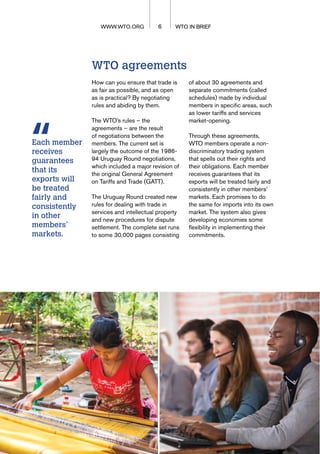
At the 9th Ministerial
Conference in Bali in 2013,
WTO members struck
the Agreement on Trade
Facilitation, which aims
to reduce border delays
by slashing red tape.
When fully implemented,
this Agreement – the first
multilateral accord reached
at the WTO – will cut
trade costs by more than
14% and will lift global
exports by as much as
US$ 1 trillion per year.
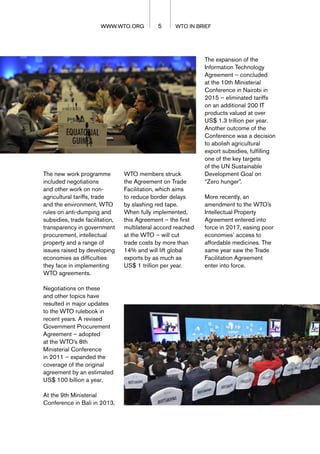
The expansion of the
Information Technology
Agreement – concluded
at the 10th Ministerial
Conference in Nairobi in
2015 – eliminated tariffs
on an additional 200 IT
products valued at over
US$ 1.3 trillion per year.
Another outcome of the
Conference was a decision
to abolish agricultural
export subsidies, fulfilling
one of the key targets
of the UN Sustainable
Development Goal on
“Zero hunger”.
More recently, an
amendment to the WTO’s
Intellectual Property
Agreement entered into
force in 2017, easing poor
economies’ access to
affordable medicines. The
same year saw the Trade
Facilitation Agreement
enter into force.
WTO agreements
How can you ensure that trade is
as fair as possible, and as open
as is practical? By negotiating
rules and abiding by them.
The WTO’s rules – the
agreements – are the result
of negotiations between the
members. The current set is
largely the outcome of the 1986-
94 Uruguay Round negotiations,
which included a major revision of
the original General Agreement
on Tariffs and Trade (GATT).
The Uruguay Round created new
rules for dealing with trade in
services and intellectual property
and new procedures for dispute
settlement. The complete set runs
to some 30,000 pages consisting
of about 30 agreements and
separate commitments (called
schedules) made by individual
members in specific areas, such
as lower tariffs and services
market-opening.
Through these agreements,
WTO members operate a non-
discriminatory trading system
that spells out their rights and
their obligations. Each member
receives guarantees that its
exports will be treated fairly and
consistently in other members’
markets. Each promises to do
the same for imports into its own
market. The system also gives
developing economies some
flexibility in implementing their
commitments.
WTO IN BRIEF
6 WTO IN BRIEF
WWW.WTO.ORG
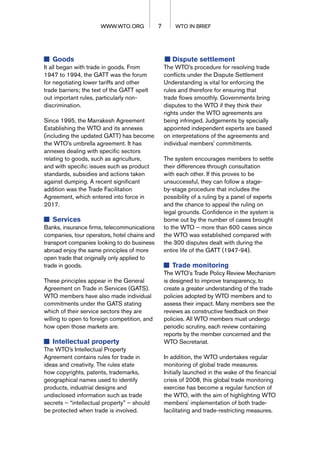
Each member
receives
guarantees
that its
exports will
be treated
fairly and
consistently
in other
members’
markets.
Goods
It all began with trade in goods. From
1947 to 1994, the GATT was the forum
for negotiating lower tariffs and other
trade barriers; the text of the GATT spelt
out important rules, particularly non-
discrimination.
Since 1995, the Marrakesh Agreement
Establishing the WTO and its annexes
(including the updated GATT) has become
the WTO’s umbrella agreement. It has
annexes dealing with specific sectors
relating to goods, such as agriculture,
and with specific issues such as product
standards, subsidies and actions taken
against dumping. A recent significant
addition was the Trade Facilitation
Agreement, which entered into force in
2017.
Services
Banks, insurance firms, telecommunications
companies, tour operators, hotel chains and
transport companies looking to do business
abroad enjoy the same principles of more
open trade that originally only applied to
trade in goods.
These principles appear in the General
Agreement on Trade in Services (GATS).
WTO members have also made individual
commitments under the GATS stating
which of their service sectors they are
willing to open to foreign competition, and
how open those markets are.
Intellectual property
The WTO’s Intellectual Property
Agreement contains rules for trade in
ideas and creativity. The rules state
how copyrights, patents, trademarks,
geographical names used to identify
products, industrial designs and
undisclosed information such as trade
secrets – “intellectual property” – should
be protected when trade is involved.
Dispute settlement
The WTO’s procedure for resolving trade
conflicts under the Dispute Settlement
Understanding is vital for enforcing the
rules and therefore for ensuring that
trade flows smoothly. Governments bring
disputes to the WTO if they think their
rights under the WTO agreements are
being infringed. Judgements by specially
appointed independent experts are based
on interpretations of the agreements and
individual members' commitments.
The system encourages members to settle
their differences through consultation
with each other. If this proves to be
unsuccessful, they can follow a stage-
by-stage procedure that includes the
possibility of a ruling by a panel of experts
and the chance to appeal the ruling on
legal grounds. Confidence in the system is
borne out by the number of cases brought
to the WTO – more than 600 cases since
the WTO was established compared with
the 300 disputes dealt with during the
entire life of the GATT (1947-94).
Trade monitoring
The WTO's Trade Policy Review Mechanism
is designed to improve transparency, to
create a greater understanding of the trade
policies adopted by WTO members and to
assess their impact. Many members see the
reviews as constructive feedback on their
policies. All WTO members must undergo
periodic scrutiny, each review containing
reports by the member concerned and the
WTO Secretariat.
In addition, the WTO undertakes regular
monitoring of global trade measures.
Initially launched in the wake of the financial
crisis of 2008, this global trade monitoring
exercise has become a regular function of
the WTO, with the aim of highlighting WTO
members' implementation of both trade-
facilitating and trade-restricting measures.
7 WTO IN BRIEF
WWW.WTO.ORG
WWW.WTO.ORG
Building trade capacity in
developing economies
Over three-quarters of WTO
members are developing or
least-developed economies.
All WTO agreements contain
special provisions for them,
including longer time periods
to implement commitments,
measures to increase their trading
opportunities and support to
help them build the infrastructure
needed to participate in world
trade.
A WTO Committee on Trade
and Development looks at
developing economies’ special
needs. Its responsibility
includes implementation of the
WTO agreements, technical
cooperation and the increased
participation of developing
economies in the global trading
system.
The Aid for Trade initiative,
launched by WTO members
in 2005, is designed to help
developing economies build
trade capacity, enhance their
infrastructure and improve their
ability to benefit from trade-
opening opportunities. So far,
over US$ 400 billion has been
disbursed to support Aid for
Trade projects. A Global Review
of the initiative is held every two
years at the WTO’s headquarters.
The Enhanced Integrated
Framework (EIF) is the only
multilateral partnership dedicated
exclusively to assisting least
developed countries (LDCs) in
their use of trade as an engine for
growth, sustainable development
and poverty reduction. The EIF
partnership of 51 countries,
8 WTO IN BRIEF
WWW.WTO.ORG
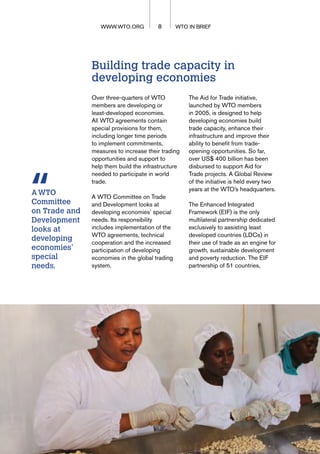
AWTO
Committee
on Trade and
Development
looks at
developing
economies’
special
needs.
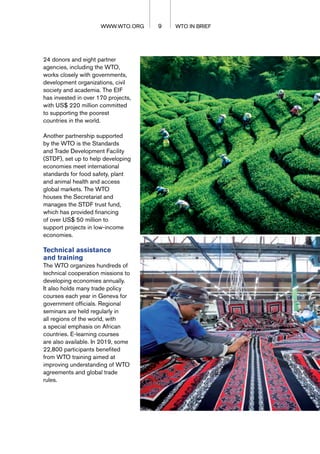
24 donors and eight partner
agencies, including the WTO,
works closely with governments,
development organizations, civil
society and academia. The EIF
has invested in over 170 projects,
with US$ 220 million committed
to supporting the poorest
countries in the world.
Another partnership supported
by the WTO is the Standards
and Trade Development Facility
(STDF), set up to help developing
economies meet international
standards for food safety, plant
and animal health and access
global markets. The WTO
houses the Secretariat and
manages the STDF trust fund,
which has provided financing
of over US$ 50 million to
support projects in low-income
economies.
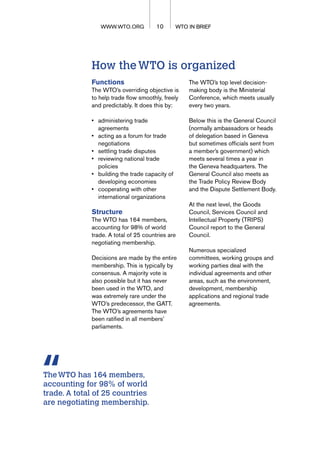
Technical assistance
and training
The WTO organizes hundreds of
technical cooperation missions to
developing economies annually.
It also holds many trade policy
courses each year in Geneva for
government officials. Regional
seminars are held regularly in
all regions of the world, with
a special emphasis on African
countries. E-learning courses
are also available. In 2019, some
22,800 participants benefited
from WTO training aimed at
improving understanding of WTO
agreements and global trade
rules.
9 WTO IN BRIEF
WWW.WTO.ORG
How theWTO is organized
Functions
The WTO’s overriding objective is
to help trade flow smoothly, freely
and predictably. It does this by:
• administering trade
agreements
• acting as a forum for trade
negotiations
• settling trade disputes
• reviewing national trade
policies
• building the trade capacity of
developing economies
• cooperating with other
international organizations
Structure
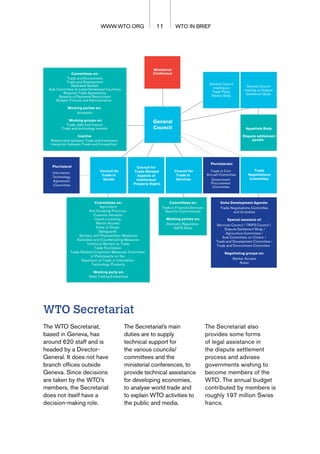
The WTO has 164 members,
accounting for 98% of world
trade. A total of 25 countries are
negotiating membership.
Decisions are made by the entire
membership. This is typically by
consensus. A majority vote is
also possible but it has never
been used in the WTO, and
was extremely rare under the
WTO’s predecessor, the GATT.
The WTO’s agreements have
been ratified in all members’
parliaments.
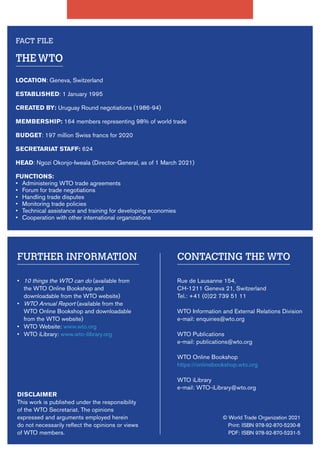
The WTO’s top level decision-
making body is the Ministerial
Conference, which meets usually
every two years.
Below this is the General Council
(normally ambassadors or heads
of delegation based in Geneva
but sometimes officials sent from
a member’s government) which
meets several times a year in
the Geneva headquarters. The
General Council also meets as
the Trade Policy Review Body
and the Dispute Settlement Body.
At the next level, the Goods
Council, Services Council and
Intellectual Property (TRIPS)
Council report to the General
Council.
Numerous specialized
committees, working groups and
working parties deal with the
individual agreements and other
areas, such as the environment,
development, membership
applications and regional trade
agreements.
WTO IN BRIEF
10 WTO IN BRIEF
WWW.WTO.ORG
TheWTO has 164 members,
accounting for 98% of world
trade. A total of 25 countries
are negotiating membership.
WTO Secretariat
The WTO Secretariat,
based in Geneva, has
around 620 staff and is
headed by a Director-
General. It does not have
branch offices outside
Geneva. Since decisions
are taken by the WTO’s
members, the Secretariat
does not itself have a
decision-making role.
The Secretariat’s main
duties are to supply
technical support for
the various councils/
committees and the
ministerial conferences, to
provide technical assistance
for developing economies,
to analyse world trade and
to explain WTO activities to
the public and media.
The Secretariat also
provides some forms
of legal assistance in
the dispute settlement
process and advises
governments wishing to
become members of the
WTO. The annual budget
contributed by members is
roughly 197 million Swiss
francs.
:
Council for
Trade in
Goods
Council for
Trade-Related
Aspects of
Intellectual
Property Rights
Council for
Trade in
Services
Trade
Negotiations
Committee
Plurilateral
Information
Technology
Agreement
Committee
Plurilaterals:
Trade in Civil
Aircraft Committee
Government
Procurement
Committee
Doha Development Agenda:
Trade Negotiations Committee
and its bodies
Special sessions of:
Services Council / TRIPS Council /
Dispute Settlement Body /
Agriculture Committee /
Sub-Committee on Cotton /
Trade and Development Committee /
Trade and Environment Committee
Negotiating groups on:
Market Access
Rules
Committees on:
Trade in Financial Services
Specific Commitments
Working parties on:
Domestic Regulation
GATS Rules
Committees on:
Agriculture
Anti-Dumping Practices
Customs Valuation
Import Licensing
Market Access
Rules of Origin
Safeguards
Sanitary and Phytosanitary Measures
Subsidies and Countervailing Measures
Technical Barriers to Trade
Trade Facilitation
Trade-Related Investment Measures Committee
of Participants on the
Expansion of Trade in Information
Technology Products
Working party on:
State Trading Enterprises
Ministerial
Conference
General Council
meeting as
Trade Policy
Review Body
Working groups on:
Trade, debt and finance
Trade and technology transfer
Inactive
Relationship between Trade and Investment
Interaction between Trade and Competition
Trade and Environment
Trade and Development
Dedicated Session
Sub-Committee on Least-Developed Countries
Regional Trade Agreements
Balance of Payments Restrictions
Budget, Finance and Administration
Committees on:
Working parties on:
Accession
General
Council Appellate Body
Dispute settlement
panels
General Council
meeting as Dispute
Settlement Body
Reporting to General Council (or a subsidiary)
Reporting to Dispute Settlement Body
Trade Negociations Committee reports to General Council
Plurilateral committees inform the General Council or Goods Council of their activities, althogh these agreements are not signed by all WTO Members
11 WTO IN BRIEF
WWW.WTO.ORG
© World Trade Organization 2021
Print: ISBN 978-92-870-5230-8
PDF: ISBN 978-92-870-5231-5
CONTACTING THE WTO
Rue de Lausanne 154,
CH-1211 Geneva 21, Switzerland
Tel.: +41 (0)22 739 51 11
WTO Information and External Relations Division
e-mail: enquiries@wto.org
WTO Publications
e-mail: publications@wto.org
WTO Online Bookshop
https://onlinebookshop.wto.org
WTO iLibrary
e-mail: WTO-iLibrary@wto.org
FURTHER INFORMATION
• 10 things the WTO can do (available from
the WTO Online Bookshop and
downloadable from the WTO website)
• WTO Annual Report (available from the
WTO Online Bookshop and downloadable
from the WTO website)
• WTO Website: www.wto.org
• WTO iLibrary: www.wto-ilibrary.org
DISCLAIMER
This work is published under the responsibility
of the WTO Secretariat. The opinions
expressed and arguments employed herein
do not necessarily reflect the opinions or views
of WTO members.
THEWTO
LOCATION: Geneva, Switzerland
ESTABLISHED: 1 January 1995
CREATED BY: Uruguay Round negotiations (1986-94)
MEMBERSHIP: 164 members representing 98% of world trade
BUDGET: 197 million Swiss francs for 2020
SECRETARIAT STAFF: 624
HEAD: Ngozi Okonjo-Iweala (Director-General, as of 1 March 2021)
FUNCTIONS:
• Administering WTO trade agreements
• Forum for trade negotiations
• Handling trade disputes
• Monitoring trade policies
• Technical assistance and training for developing economies
• Cooperation with other international organizations
FACT FILE

inbr_e.pdf

  • 1.
    In brief, theWorld Trade Organization (WTO) is the only international organization dealing with the global rules of trade. Its main function is to ensure that trade flows as smoothly, predictably and freely as possible. WTO IN BRIEF
  • 2.
    WTO IN BRIEF 2WTO IN BRIEF WWW.WTO.ORG Global trade rules Global rules of trade provide assurance and stability. Consumers and producers know they can enjoy secure supplies and greater choice of the finished products, components, raw materials and services they use. Producers and exporters know foreign markets will remain open to them. This leads to a more prosperous, peaceful and accountable economic world. Decisions in the WTO are typically taken by consensus among all members and they are ratified by members’ parliaments. Trade frictions are channelled into the WTO’s dispute settlement process, where the focus is on interpreting agreements and commitments and how to ensure that members’ trade policies conform with them. That way, the risk of disputes spilling over into
  • 3.
    3 WTO INBRIEF WWW.WTO.ORG WWW.WTO.ORG political or military conflict is reduced. By lowering trade barriers through negotiations among member governments, the WTO’s system also breaks down other barriers between peoples and trading economies. At the heart of the system – known as the multilateral trading system – are the WTO’s agreements, negotiated and signed by a large majority of the world’s trading economies, and ratified in their parliaments. These agreements are the legal foundations for global trade. Essentially, they are contracts, guaranteeing WTO members important trade rights. They also bind governments to keep their trade policies transparent and predictable which is to everybody’s benefit. By lowering trade barriers through negotiations among member governments, the WTO’s system also breaks down other barriers between peoples and trading economies. The agreements provide a stable and transparent framework to help producers of goods and services, exporters and importers conduct their business. The goal is to improve the welfare of the peoples of the WTO’s members.
  • 4.
    WTO IN BRIEF 4WTO IN BRIEF WWW.WTO.ORG Trade negotiations The World Trade Organization came into being in 1995. One of the youngest of the international organizations, the WTO is the successor to the General Agreement on Tariffs and Trade (GATT) established in the wake of the Second World War. So while the WTO is relatively young, the multilateral trading system that was originally set up under the GATT is over 70 years old. The past 70 years have seen an exceptional growth in world trade. Merchandise exports have grown on average by 6% annually. This growth in trade has been a powerful engine for overall economic expansion and on average trade has grown by 1.5 times more than the global economy each year. Total exports in 2019 were 250 times the level of 1948. The GATT and the WTO have helped to create a strong and prosperous trading system contributing to unprecedented growth. The system was developed through a series of trade negotiations, or rounds, held under the GATT. The first rounds dealt mainly with tariff reductions but later negotiations included other areas such as anti-dumping and non-tariff measures. The 1986-94 round – the Uruguay Round – led to the WTO’s creation. The negotiations did not end there. In 1997, an agreement was reached on telecommunications services, with 69 governments agreeing to wide-ranging liberalization measures that went beyond those agreed in the Uruguay Round. In the same year, 40 governments successfully concluded negotiations for tariff-free trade in information technology products, and 70 members concluded a financial services deal covering more than 95% of trade in banking, insurance, securities and financial information. In 2000, new talks started on agriculture and services. These were incorporated into a broader work programme, the Doha Development Agenda, launched at the fourth WTO Ministerial Conference in Doha, Qatar, in November 2001. The past 70 years have seen an exceptional growth in world trade. Merchandise exports have grown on average by 6% annually.
  • 5.
    5 WTO INBRIEF WWW.WTO.ORG WWW.WTO.ORG The new work programme included negotiations and other work on non- agricultural tariffs, trade and the environment, WTO rules on anti-dumping and subsidies, trade facilitation, transparency in government procurement, intellectual property and a range of issues raised by developing economies as difficulties they face in implementing WTO agreements. Negotiations on these and other topics have resulted in major updates to the WTO rulebook in recent years. A revised Government Procurement Agreement – adopted at the WTO’s 8th Ministerial Conference in 2011 – expanded the coverage of the original agreement by an estimated US$ 100 billion a year. At the 9th Ministerial Conference in Bali in 2013, WTO members struck the Agreement on Trade Facilitation, which aims to reduce border delays by slashing red tape. When fully implemented, this Agreement – the first multilateral accord reached at the WTO – will cut trade costs by more than 14% and will lift global exports by as much as US$ 1 trillion per year. The expansion of the Information Technology Agreement – concluded at the 10th Ministerial Conference in Nairobi in 2015 – eliminated tariffs on an additional 200 IT products valued at over US$ 1.3 trillion per year. Another outcome of the Conference was a decision to abolish agricultural export subsidies, fulfilling one of the key targets of the UN Sustainable Development Goal on “Zero hunger”. More recently, an amendment to the WTO’s Intellectual Property Agreement entered into force in 2017, easing poor economies’ access to affordable medicines. The same year saw the Trade Facilitation Agreement enter into force.
  • 6.
    WTO agreements How canyou ensure that trade is as fair as possible, and as open as is practical? By negotiating rules and abiding by them. The WTO’s rules – the agreements – are the result of negotiations between the members. The current set is largely the outcome of the 1986- 94 Uruguay Round negotiations, which included a major revision of the original General Agreement on Tariffs and Trade (GATT). The Uruguay Round created new rules for dealing with trade in services and intellectual property and new procedures for dispute settlement. The complete set runs to some 30,000 pages consisting of about 30 agreements and separate commitments (called schedules) made by individual members in specific areas, such as lower tariffs and services market-opening. Through these agreements, WTO members operate a non- discriminatory trading system that spells out their rights and their obligations. Each member receives guarantees that its exports will be treated fairly and consistently in other members’ markets. Each promises to do the same for imports into its own market. The system also gives developing economies some flexibility in implementing their commitments. WTO IN BRIEF 6 WTO IN BRIEF WWW.WTO.ORG Each member receives guarantees that its exports will be treated fairly and consistently in other members’ markets.
  • 7.
    Goods It all beganwith trade in goods. From 1947 to 1994, the GATT was the forum for negotiating lower tariffs and other trade barriers; the text of the GATT spelt out important rules, particularly non- discrimination. Since 1995, the Marrakesh Agreement Establishing the WTO and its annexes (including the updated GATT) has become the WTO’s umbrella agreement. It has annexes dealing with specific sectors relating to goods, such as agriculture, and with specific issues such as product standards, subsidies and actions taken against dumping. A recent significant addition was the Trade Facilitation Agreement, which entered into force in 2017. Services Banks, insurance firms, telecommunications companies, tour operators, hotel chains and transport companies looking to do business abroad enjoy the same principles of more open trade that originally only applied to trade in goods. These principles appear in the General Agreement on Trade in Services (GATS). WTO members have also made individual commitments under the GATS stating which of their service sectors they are willing to open to foreign competition, and how open those markets are. Intellectual property The WTO’s Intellectual Property Agreement contains rules for trade in ideas and creativity. The rules state how copyrights, patents, trademarks, geographical names used to identify products, industrial designs and undisclosed information such as trade secrets – “intellectual property” – should be protected when trade is involved. Dispute settlement The WTO’s procedure for resolving trade conflicts under the Dispute Settlement Understanding is vital for enforcing the rules and therefore for ensuring that trade flows smoothly. Governments bring disputes to the WTO if they think their rights under the WTO agreements are being infringed. Judgements by specially appointed independent experts are based on interpretations of the agreements and individual members' commitments. The system encourages members to settle their differences through consultation with each other. If this proves to be unsuccessful, they can follow a stage- by-stage procedure that includes the possibility of a ruling by a panel of experts and the chance to appeal the ruling on legal grounds. Confidence in the system is borne out by the number of cases brought to the WTO – more than 600 cases since the WTO was established compared with the 300 disputes dealt with during the entire life of the GATT (1947-94). Trade monitoring The WTO's Trade Policy Review Mechanism is designed to improve transparency, to create a greater understanding of the trade policies adopted by WTO members and to assess their impact. Many members see the reviews as constructive feedback on their policies. All WTO members must undergo periodic scrutiny, each review containing reports by the member concerned and the WTO Secretariat. In addition, the WTO undertakes regular monitoring of global trade measures. Initially launched in the wake of the financial crisis of 2008, this global trade monitoring exercise has become a regular function of the WTO, with the aim of highlighting WTO members' implementation of both trade- facilitating and trade-restricting measures. 7 WTO IN BRIEF WWW.WTO.ORG WWW.WTO.ORG
  • 8.
    Building trade capacityin developing economies Over three-quarters of WTO members are developing or least-developed economies. All WTO agreements contain special provisions for them, including longer time periods to implement commitments, measures to increase their trading opportunities and support to help them build the infrastructure needed to participate in world trade. A WTO Committee on Trade and Development looks at developing economies’ special needs. Its responsibility includes implementation of the WTO agreements, technical cooperation and the increased participation of developing economies in the global trading system. The Aid for Trade initiative, launched by WTO members in 2005, is designed to help developing economies build trade capacity, enhance their infrastructure and improve their ability to benefit from trade- opening opportunities. So far, over US$ 400 billion has been disbursed to support Aid for Trade projects. A Global Review of the initiative is held every two years at the WTO’s headquarters. The Enhanced Integrated Framework (EIF) is the only multilateral partnership dedicated exclusively to assisting least developed countries (LDCs) in their use of trade as an engine for growth, sustainable development and poverty reduction. The EIF partnership of 51 countries, 8 WTO IN BRIEF WWW.WTO.ORG AWTO Committee on Trade and Development looks at developing economies’ special needs.
  • 9.
    24 donors andeight partner agencies, including the WTO, works closely with governments, development organizations, civil society and academia. The EIF has invested in over 170 projects, with US$ 220 million committed to supporting the poorest countries in the world. Another partnership supported by the WTO is the Standards and Trade Development Facility (STDF), set up to help developing economies meet international standards for food safety, plant and animal health and access global markets. The WTO houses the Secretariat and manages the STDF trust fund, which has provided financing of over US$ 50 million to support projects in low-income economies. Technical assistance and training The WTO organizes hundreds of technical cooperation missions to developing economies annually. It also holds many trade policy courses each year in Geneva for government officials. Regional seminars are held regularly in all regions of the world, with a special emphasis on African countries. E-learning courses are also available. In 2019, some 22,800 participants benefited from WTO training aimed at improving understanding of WTO agreements and global trade rules. 9 WTO IN BRIEF WWW.WTO.ORG
  • 10.
    How theWTO isorganized Functions The WTO’s overriding objective is to help trade flow smoothly, freely and predictably. It does this by: • administering trade agreements • acting as a forum for trade negotiations • settling trade disputes • reviewing national trade policies • building the trade capacity of developing economies • cooperating with other international organizations Structure The WTO has 164 members, accounting for 98% of world trade. A total of 25 countries are negotiating membership. Decisions are made by the entire membership. This is typically by consensus. A majority vote is also possible but it has never been used in the WTO, and was extremely rare under the WTO’s predecessor, the GATT. The WTO’s agreements have been ratified in all members’ parliaments. The WTO’s top level decision- making body is the Ministerial Conference, which meets usually every two years. Below this is the General Council (normally ambassadors or heads of delegation based in Geneva but sometimes officials sent from a member’s government) which meets several times a year in the Geneva headquarters. The General Council also meets as the Trade Policy Review Body and the Dispute Settlement Body. At the next level, the Goods Council, Services Council and Intellectual Property (TRIPS) Council report to the General Council. Numerous specialized committees, working groups and working parties deal with the individual agreements and other areas, such as the environment, development, membership applications and regional trade agreements. WTO IN BRIEF 10 WTO IN BRIEF WWW.WTO.ORG TheWTO has 164 members, accounting for 98% of world trade. A total of 25 countries are negotiating membership.
  • 11.
    WTO Secretariat The WTOSecretariat, based in Geneva, has around 620 staff and is headed by a Director- General. It does not have branch offices outside Geneva. Since decisions are taken by the WTO’s members, the Secretariat does not itself have a decision-making role. The Secretariat’s main duties are to supply technical support for the various councils/ committees and the ministerial conferences, to provide technical assistance for developing economies, to analyse world trade and to explain WTO activities to the public and media. The Secretariat also provides some forms of legal assistance in the dispute settlement process and advises governments wishing to become members of the WTO. The annual budget contributed by members is roughly 197 million Swiss francs. : Council for Trade in Goods Council for Trade-Related Aspects of Intellectual Property Rights Council for Trade in Services Trade Negotiations Committee Plurilateral Information Technology Agreement Committee Plurilaterals: Trade in Civil Aircraft Committee Government Procurement Committee Doha Development Agenda: Trade Negotiations Committee and its bodies Special sessions of: Services Council / TRIPS Council / Dispute Settlement Body / Agriculture Committee / Sub-Committee on Cotton / Trade and Development Committee / Trade and Environment Committee Negotiating groups on: Market Access Rules Committees on: Trade in Financial Services Specific Commitments Working parties on: Domestic Regulation GATS Rules Committees on: Agriculture Anti-Dumping Practices Customs Valuation Import Licensing Market Access Rules of Origin Safeguards Sanitary and Phytosanitary Measures Subsidies and Countervailing Measures Technical Barriers to Trade Trade Facilitation Trade-Related Investment Measures Committee of Participants on the Expansion of Trade in Information Technology Products Working party on: State Trading Enterprises Ministerial Conference General Council meeting as Trade Policy Review Body Working groups on: Trade, debt and finance Trade and technology transfer Inactive Relationship between Trade and Investment Interaction between Trade and Competition Trade and Environment Trade and Development Dedicated Session Sub-Committee on Least-Developed Countries Regional Trade Agreements Balance of Payments Restrictions Budget, Finance and Administration Committees on: Working parties on: Accession General Council Appellate Body Dispute settlement panels General Council meeting as Dispute Settlement Body Reporting to General Council (or a subsidiary) Reporting to Dispute Settlement Body Trade Negociations Committee reports to General Council Plurilateral committees inform the General Council or Goods Council of their activities, althogh these agreements are not signed by all WTO Members 11 WTO IN BRIEF WWW.WTO.ORG
  • 12.
    © World TradeOrganization 2021 Print: ISBN 978-92-870-5230-8 PDF: ISBN 978-92-870-5231-5 CONTACTING THE WTO Rue de Lausanne 154, CH-1211 Geneva 21, Switzerland Tel.: +41 (0)22 739 51 11 WTO Information and External Relations Division e-mail: enquiries@wto.org WTO Publications e-mail: publications@wto.org WTO Online Bookshop https://onlinebookshop.wto.org WTO iLibrary e-mail: WTO-iLibrary@wto.org FURTHER INFORMATION • 10 things the WTO can do (available from the WTO Online Bookshop and downloadable from the WTO website) • WTO Annual Report (available from the WTO Online Bookshop and downloadable from the WTO website) • WTO Website: www.wto.org • WTO iLibrary: www.wto-ilibrary.org DISCLAIMER This work is published under the responsibility of the WTO Secretariat. The opinions expressed and arguments employed herein do not necessarily reflect the opinions or views of WTO members. THEWTO LOCATION: Geneva, Switzerland ESTABLISHED: 1 January 1995 CREATED BY: Uruguay Round negotiations (1986-94) MEMBERSHIP: 164 members representing 98% of world trade BUDGET: 197 million Swiss francs for 2020 SECRETARIAT STAFF: 624 HEAD: Ngozi Okonjo-Iweala (Director-General, as of 1 March 2021) FUNCTIONS: • Administering WTO trade agreements • Forum for trade negotiations • Handling trade disputes • Monitoring trade policies • Technical assistance and training for developing economies • Cooperation with other international organizations FACT FILE