Presented by- 
Suditi Bhagat 
Arpit Mittal 
Naman Jain
Introduction Of 
GATT(1948 - 1994) 
 
 Set of multilateral trade agreements 
To provide an international forum - expansion of 
world trade 
 That encouraged free trade between member states 
 By regulating and reducing tariffs on traded goods 
 Providing a common mechanism for resolving trade 
disputes eliminating discrimination
Back ground 
 
 1930 Depression in international trade. 
 Restrictions- safe guard their interest 
 Oct 30 1947,23 countries at Geneva signed an 
agreement-GATT 
 Post World War II, the victory nations sought to 
create institutions - eliminate the causes of war. 
 To resolve/prevent war through the United Nations 
 To eliminate the economic causes of war by 
establishing three international economic 
institutions.
Objectives of GATT 
 
 To provide equal opportunities to all countries in 
terms of trade in international market 
 Increase effective demand for real income growth 
goods 
 Minimize tariffs and other restrictions on trade 
 Provide amicable solutions to dispute related to 
international trade 
 Ensure better living standard 
 To strengthen and clarify rules for agricultural trade
Fundamental Principles 
of GATT 
 
 Non Discrimination 
 Prohibition of Quantitative Restrictions 
 Concept of consultation aims to avoid damage to trading 
interests of contracting parties. 
 GATT provides frame work within which the negotiations 
can be held for reduction of tariff another barrier to trade and 
structure for embodying results of such negotiations.
FUNCTIONS OF GATT 
 Matters related to the tariff and related matters granted to any of 
 
the trading partner. 
 Ensures that any tariff reduction or any other trade concession is 
extended to all GATT parties. 
National treatment: 
 GATT members must give imported goods treatment equal to that 
of domestic goods. 
 No restrictions on charges like rates may be applied to imported 
goods unless equally treated. 
Protection through tariff: 
 Prohibits quantitative restrictions / Quotas. 
 Contracting parties are expected to provide protection by means of 
tariffs which are transparent and subject to negotiations in the 
GATT. 
Dispute Settlement: 
 Procedures from Uruguay round negotiations provides more 
automatic and effective resolution of disputes between member 
nations.
INTRODUCTION OF 
 
Established: 1st January 1995 with its origin in Bretton Woods 
Conference post World War II . 
Motive:- Formed for economic stability, peace and for 
reconstruction 
Created By: Uruguay Round negotiations (1986-1994) 
Headquarter: Geneva, Switzerland 
Membership: 160 member states (26th June 2014) 
Secretariat Staff: 640 
WTO
WORLD TRADE 
ORGANIZATION 
 
 Organization that intends to supervise 
and liberalize international trade 
 Only global international organization dealing with the 
rules of trade between nations 
 WTO deals with agreements, negotiated and signed by 
the bulk of world’s trading nations and ratified in their 
parliaments. 
 The goal is to help producers of goods and services, 
exporters and importers conduct their business.
WTO MEMBERS 
 The WTO is composed of 160 countries which represents 95% 
 
of world trade. 
 Of these, 123 were signed during the Uruguay round 
 WTO members do not have to be full-sovereign nation 
members. Instead, they must be a custom territory with full 
autonomy in their external relations. 
 Over 3/4th of WTO members are developing or least 
developed countries. 
 There are 24 countries that are not members known as 
Observers. These countries are currently negotiating 
membership. 
 The biggest of these non-members is Russia, however they are 
in the process of accession. 
 YEMEN became the newest member on 26 June, 2014
FORMATION OF WTO 
 The GATT (1948) multilateral instrument governing 
international trade managed to operate for almost half a 
century as a semi institutionalized multilateral treaty regime 
on a provisional basis. 
 Seven rounds of negotiations occurred under the GATT 
 The Tokyo round during the 70’s - tackle trade barriers that 
do not take the form of tariffs and to improve the system but 
the agreements were not accepted by all the member nations 
of GATT. 
 These agreements and policies were amended in URUGUAY 
ROUND leading to acceptance by the member nations and 
formation of WTO. 
 This final act concluding the Uruguay round and officially 
establishing the WTO regime was signed in 1994 at 
Marrakesh, Morroco and hence known as Marrakesh 
Agreement.
Areas of Uruguay 
 
 Tariffs and Non-tariff measures 
 Tropical product 
 Textile product 
 National resource based products 
 Textile & clothing 
 Agriculture 
 GATT –articles 
 Safeguards 
 Multilateral trade agreements & arrangement 
 Subsidies 
 Dispute settlement 
 Trade related aspects of intellectual property rights 
(TRIPs) 
Round
Functions of WTO 
 
 Administering WTO trade agreements 
 Forum for trade negotiations 
 Handling trade disputes 
 Monitoring National Trade policies 
 Technical assistance and training for developing 
countries 
 Cooperation with other international organizations.
Principles of WTO 
1. Non-Discrimination. 
2. Reciprocity. 
3. Binding and enforceable commitments. 
The tariff commitments 
4. Transparency. 
5. Safety valves.
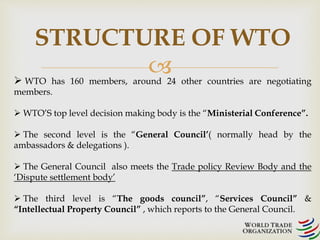
STRUCTURE OF WTO 
 
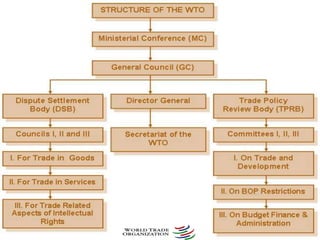
 WTO has 160 members, around 24 other countries are negotiating 
members. 
 WTO’S top level decision making body is the “Ministerial Conference”. 
 The second level is the “General Council’( normally head by the 
ambassadors & delegations ). 
 The General Council also meets the Trade policy Review Body and the 
‘Dispute settlement body’ 
 The third level is “The goods council”, “Services Council” & 
“Intellectual Property Council” , which reports to the General Council.
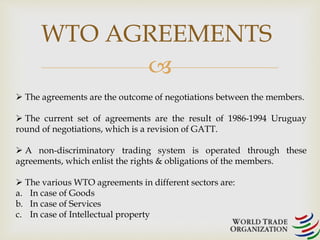
WTO AGREEMENTS 
 
 The agreements are the outcome of negotiations between the members. 
 The current set of agreements are the result of 1986-1994 Uruguay 
round of negotiations, which is a revision of GATT. 
 A non-discriminatory trading system is operated through these 
agreements, which enlist the rights & obligations of the members. 
 The various WTO agreements in different sectors are: 
a. In case of Goods 
b. In case of Services 
c. In case of Intellectual property
THE WTO AND INDIA 
 
 After Marrakesh Agreement, India joined WTO since 
inception in 1995. 
 Developing countries like India availed greater trade 
opportunities and also challenged a certain policies of 
developed countries. 
 For India, exposure to volatile international market 
would affect not only domestic prices but also incomes 
of poor. 
 Aim to participate in WTO rule based system with 
greater stability, transparency and predictability in 
governance of international trade.
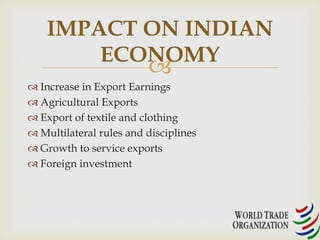
IMPACT ON INDIAN 
ECONOMY 
 
 Increase in Export Earnings 
 Agricultural Exports 
 Export of textile and clothing 
 Multilateral rules and disciplines 
 Growth to service exports 
 Foreign investment


Wto and gatt

  • 1.
    Presented by- SuditiBhagat Arpit Mittal Naman Jain
  • 2.
    Introduction Of GATT(1948- 1994)   Set of multilateral trade agreements To provide an international forum - expansion of world trade  That encouraged free trade between member states  By regulating and reducing tariffs on traded goods  Providing a common mechanism for resolving trade disputes eliminating discrimination
  • 3.
    Back ground   1930 Depression in international trade.  Restrictions- safe guard their interest  Oct 30 1947,23 countries at Geneva signed an agreement-GATT  Post World War II, the victory nations sought to create institutions - eliminate the causes of war.  To resolve/prevent war through the United Nations  To eliminate the economic causes of war by establishing three international economic institutions.
  • 4.
    Objectives of GATT   To provide equal opportunities to all countries in terms of trade in international market  Increase effective demand for real income growth goods  Minimize tariffs and other restrictions on trade  Provide amicable solutions to dispute related to international trade  Ensure better living standard  To strengthen and clarify rules for agricultural trade
  • 5.
    Fundamental Principles ofGATT   Non Discrimination  Prohibition of Quantitative Restrictions  Concept of consultation aims to avoid damage to trading interests of contracting parties.  GATT provides frame work within which the negotiations can be held for reduction of tariff another barrier to trade and structure for embodying results of such negotiations.
  • 6.
    FUNCTIONS OF GATT  Matters related to the tariff and related matters granted to any of  the trading partner.  Ensures that any tariff reduction or any other trade concession is extended to all GATT parties. National treatment:  GATT members must give imported goods treatment equal to that of domestic goods.  No restrictions on charges like rates may be applied to imported goods unless equally treated. Protection through tariff:  Prohibits quantitative restrictions / Quotas.  Contracting parties are expected to provide protection by means of tariffs which are transparent and subject to negotiations in the GATT. Dispute Settlement:  Procedures from Uruguay round negotiations provides more automatic and effective resolution of disputes between member nations.
  • 7.
    INTRODUCTION OF  Established: 1st January 1995 with its origin in Bretton Woods Conference post World War II . Motive:- Formed for economic stability, peace and for reconstruction Created By: Uruguay Round negotiations (1986-1994) Headquarter: Geneva, Switzerland Membership: 160 member states (26th June 2014) Secretariat Staff: 640 WTO
  • 8.
    WORLD TRADE ORGANIZATION   Organization that intends to supervise and liberalize international trade  Only global international organization dealing with the rules of trade between nations  WTO deals with agreements, negotiated and signed by the bulk of world’s trading nations and ratified in their parliaments.  The goal is to help producers of goods and services, exporters and importers conduct their business.
  • 9.
    WTO MEMBERS The WTO is composed of 160 countries which represents 95%  of world trade.  Of these, 123 were signed during the Uruguay round  WTO members do not have to be full-sovereign nation members. Instead, they must be a custom territory with full autonomy in their external relations.  Over 3/4th of WTO members are developing or least developed countries.  There are 24 countries that are not members known as Observers. These countries are currently negotiating membership.  The biggest of these non-members is Russia, however they are in the process of accession.  YEMEN became the newest member on 26 June, 2014
  • 10.
    FORMATION OF WTO  The GATT (1948) multilateral instrument governing international trade managed to operate for almost half a century as a semi institutionalized multilateral treaty regime on a provisional basis.  Seven rounds of negotiations occurred under the GATT  The Tokyo round during the 70’s - tackle trade barriers that do not take the form of tariffs and to improve the system but the agreements were not accepted by all the member nations of GATT.  These agreements and policies were amended in URUGUAY ROUND leading to acceptance by the member nations and formation of WTO.  This final act concluding the Uruguay round and officially establishing the WTO regime was signed in 1994 at Marrakesh, Morroco and hence known as Marrakesh Agreement.
  • 11.
    Areas of Uruguay   Tariffs and Non-tariff measures  Tropical product  Textile product  National resource based products  Textile & clothing  Agriculture  GATT –articles  Safeguards  Multilateral trade agreements & arrangement  Subsidies  Dispute settlement  Trade related aspects of intellectual property rights (TRIPs) Round
  • 12.
    Functions of WTO   Administering WTO trade agreements  Forum for trade negotiations  Handling trade disputes  Monitoring National Trade policies  Technical assistance and training for developing countries  Cooperation with other international organizations.
  • 13.
    Principles of WTO 1. Non-Discrimination. 2. Reciprocity. 3. Binding and enforceable commitments. The tariff commitments 4. Transparency. 5. Safety valves.
  • 14.
    STRUCTURE OF WTO   WTO has 160 members, around 24 other countries are negotiating members.  WTO’S top level decision making body is the “Ministerial Conference”.  The second level is the “General Council’( normally head by the ambassadors & delegations ).  The General Council also meets the Trade policy Review Body and the ‘Dispute settlement body’  The third level is “The goods council”, “Services Council” & “Intellectual Property Council” , which reports to the General Council.
  • 16.
    WTO AGREEMENTS   The agreements are the outcome of negotiations between the members.  The current set of agreements are the result of 1986-1994 Uruguay round of negotiations, which is a revision of GATT.  A non-discriminatory trading system is operated through these agreements, which enlist the rights & obligations of the members.  The various WTO agreements in different sectors are: a. In case of Goods b. In case of Services c. In case of Intellectual property
  • 17.
    THE WTO ANDINDIA   After Marrakesh Agreement, India joined WTO since inception in 1995.  Developing countries like India availed greater trade opportunities and also challenged a certain policies of developed countries.  For India, exposure to volatile international market would affect not only domestic prices but also incomes of poor.  Aim to participate in WTO rule based system with greater stability, transparency and predictability in governance of international trade.
  • 18.
    IMPACT ON INDIAN ECONOMY   Increase in Export Earnings  Agricultural Exports  Export of textile and clothing  Multilateral rules and disciplines  Growth to service exports  Foreign investment
  • 19.