PRESENTED BY:
• Dharmendra Kumar Singh
• Rishi Kant Sharma
• Manish Kumar Singh
• Tapas Gorai
• Raman Kumar


 NETAJI SUBHAS INSTITUTE OF BUSINESS MANAGEMENT
                  SEPTEMBER, 2012
OBJECTIVES OF THE STUDY

• To have an understanding of WTO and the principles and
  functions of WTO
• To study the structure of WTO
• To study the role of WTO
• To study the relevance of WTO
• To study the provision of TRIPs, TRIMs of WTO
• To have a knowledge of different agreements done under
  WTO guidance
• To study role of WTO in developing countries
• To study the current issues of WTO
What is the World Trade Organization ?


              “The World Trade Organization is
‘member-driven’, with decisions taken by General
agreement among all member of governments and it
deals with the rules of trade between nations at a
global or near-global level. But there is more to it
than that.”
They deal with: agriculture, textiles and clothing,
banking, telecommunications, government purchases,
industrial standards and product safety, food
sanitation regulations, intellectual property, and much
more.

  The WTO agreements are lengthy and complex
because they are legal texts covering a wide range of
activities.
WTO: The Beginnings/ History
• The World Trade Organization (WTO) came into
  being on January 1st 1995. It was the outcome of the
  lengthy (1986-1994) Uruguay round of GATT
  negotiations. The WTO was essentially an extension
  of GATT.
• It extended GATT in two major ways. First GATT
  became only one of the three major trade agreements
  that went into the WTO (the other two being the
  General Agreement on Trade in Services (GATS) and
  the agreements on Trade Related Aspects of
  Intellectual Property Rights (TRIPS)).
CONTI...

• Second the WTO was put on a much sounder
  institutional footing than GATT. With GATT the
  support services that helped maintain the agreement
  had come into being in an ad hoc manner as the need
  arose. The WTO by contrast is a fully fledged
  institution (GATT also was, at least formally, only an
  agreement between contracting parties and had no
  independent existence of its own while the WTO is a
  corporate body recognized under international law).
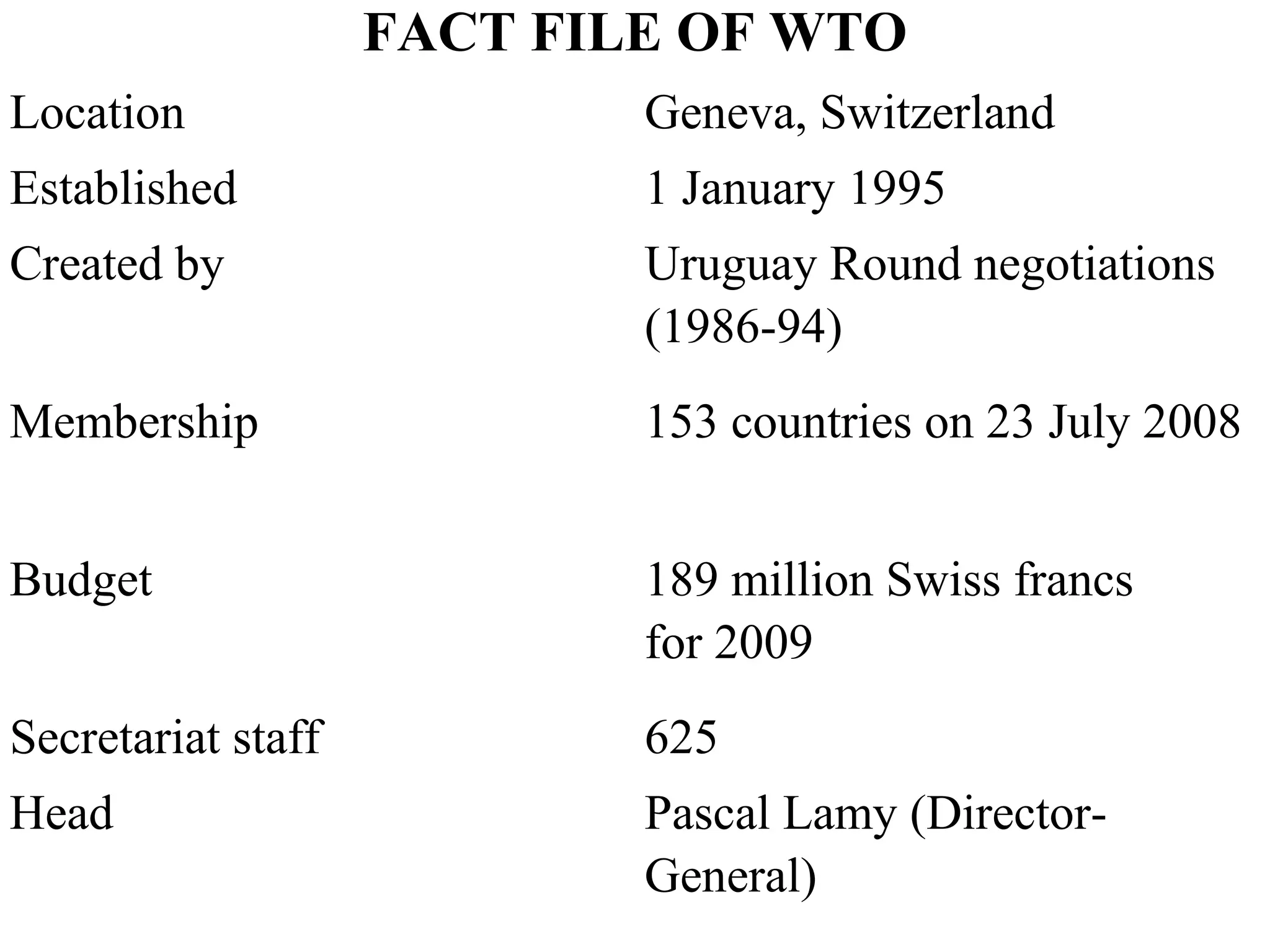
FACT FILE OF WTO
Location                    Geneva, Switzerland
Established                 1 January 1995
Created by                  Uruguay Round negotiations
                            (1986-94)
Membership                  153 countries on 23 July 2008


Budget                      189 million Swiss francs
                            for 2009
Secretariat staff           625
Head                        Pascal Lamy (Director-
                            General)
Current WTO members

• 153 members
• Observers(31)
Why WTO?
• To     arrange     the     implementation,
  administration     and     operations    of
  multilateral (involving three or more
  participants) and Plurilateral trade
  agreements (power which shared between
  different countries)
• To arrange the forum for deliberations for
  the member nations in regard to their
  multilateral trade relations in issues deal
  with under the agreements
CONTI...
• To     provide      a    framework     for
  implementing of the results arising out of
  the deliberations (long and care full
  agreements/consideration) which taken
  place at ministerial conference level

• To manage the created understanding on
  rules and procedure governing the
  settlement of disputes
CONTI...
• To manage effectively and efficiency the
  trade policy review mechanism (TRIM)

• To create more together relationship with
  all nations in respect of global economic
  policy-making, it would cooperate with
  the IMF and the world bank & its
  affiliated Organisations.
FUNCTIONS OF WTO

•   Administering WTO trade agreements
•  Forum for trade negotiations
• Handling trade disputes
• Monitoring national trade policies
• Technical assistance and training for developing
  countries
• Cooperation with other international organizations
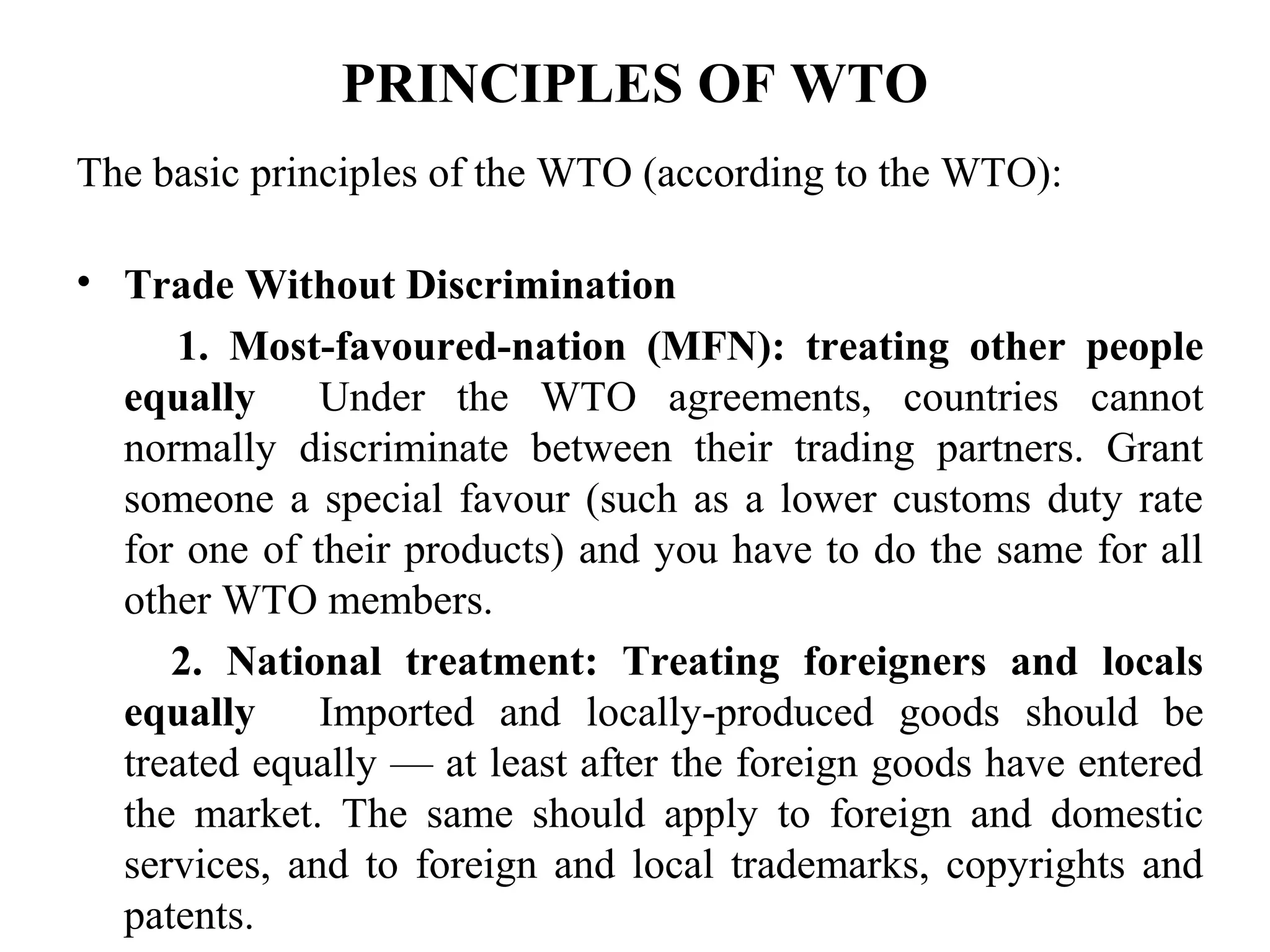
PRINCIPLES OF WTO
The basic principles of the WTO (according to the WTO):

• Trade Without Discrimination
     1. Most-favoured-nation (MFN): treating other people
  equally     Under the WTO agreements, countries cannot
  normally discriminate between their trading partners. Grant
  someone a special favour (such as a lower customs duty rate
  for one of their products) and you have to do the same for all
  other WTO members.
     2. National treatment: Treating foreigners and locals
  equally     Imported and locally-produced goods should be
  treated equally — at least after the foreign goods have entered
  the market. The same should apply to foreign and domestic
  services, and to foreign and local trademarks, copyrights and
  patents.
CONTI...
• Freer trade: gradually, through negotiation
   Lowering trade barriers is one of the most obvious means of
  encouraging trade. The barriers concerned include customs
  duties (or tariffs) and measures such as import bans or quotas
  that restrict quantities selectively
• Predictability: through binding and transparency
    Sometimes, promising not to raise a trade barrier can be as
  important as lowering one, because the promise gives
  businesses a clearer view of their future opportunities. With
  stability and predictability, investment is encouraged, jobs are
  created and consumers can fully enjoy the benefits of
  competition — choice and lower prices. The multilateral
  trading system is an attempt by governments to make the
  business environment stable and predictable.
CONTI...
• Promoting fair competition
  The WTO is sometimes described as a “free trade” institution,
  but that is not entirely accurate. The system does allow tariffs
  and, in limited circumstances, other forms of protection. More
  accurately, it is a system of rules dedicated to open, fair and
  undistorted competition.
• Encouraging development and economic reform.
    The WTO system contributes to development. On the other
  hand, developing countries need flexibility in the time they
  take to implement the system’s agreements. And the
  agreements themselves inherit the earlier provisions of GATT
  that allow for special assistance and trade concessions for
  developing countries.
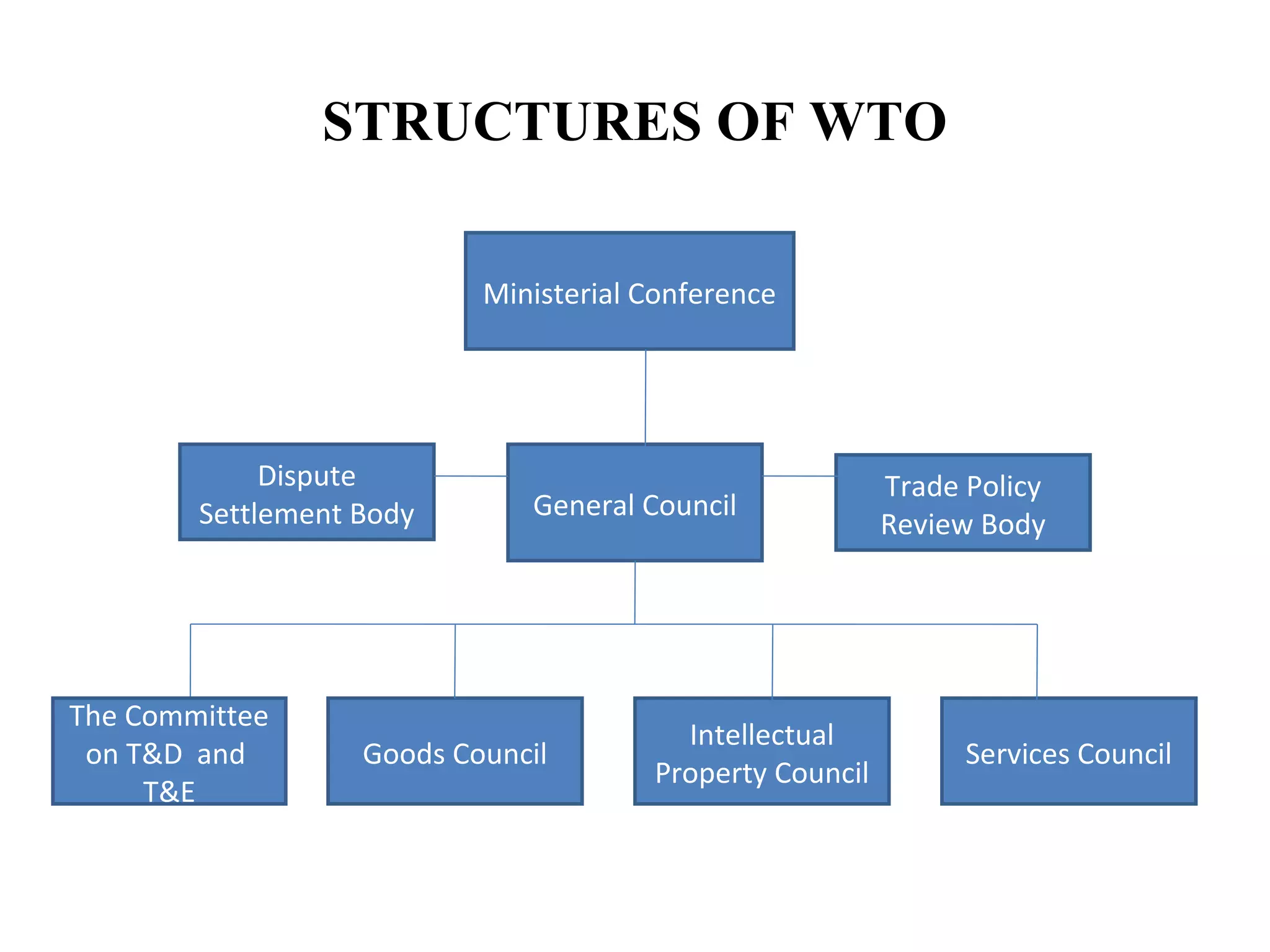
STRUCTURES OF WTO

                           Ministerial Conference


             Dispute                                      Trade Policy
        Settlement Body       General Council
                                                          Review Body


The Committee
                                         Intellectual
 on T&D and        Goods Council                                Services Council
                                       Property Council
     T&E
ROLE OF WTO
• The main goal of WTO is to help the trading industry to
  become smooth, fair, free and predictable. It was organized to
  become the administrator of multilateral trade and business
  agreements between its member nations. It supports all
  occurring negotiations for latest agreements for trade. WTO
  also tries to resolve trade disputes between member nations.
• Multi-lateral agreements are always made between several
  countries in the past. Because of this, such agreements become
  very difficult to negotiate but are so powerful and influential
  once all the parties agree and sign the multi-lateral agreement.
  WTO acts as the administrator. If there are unfair trade
  practices or dumping and there is complain filed, the staff of
  WTO are expected to investigate and check if there are
  violations based on the multi-lateral agreements.
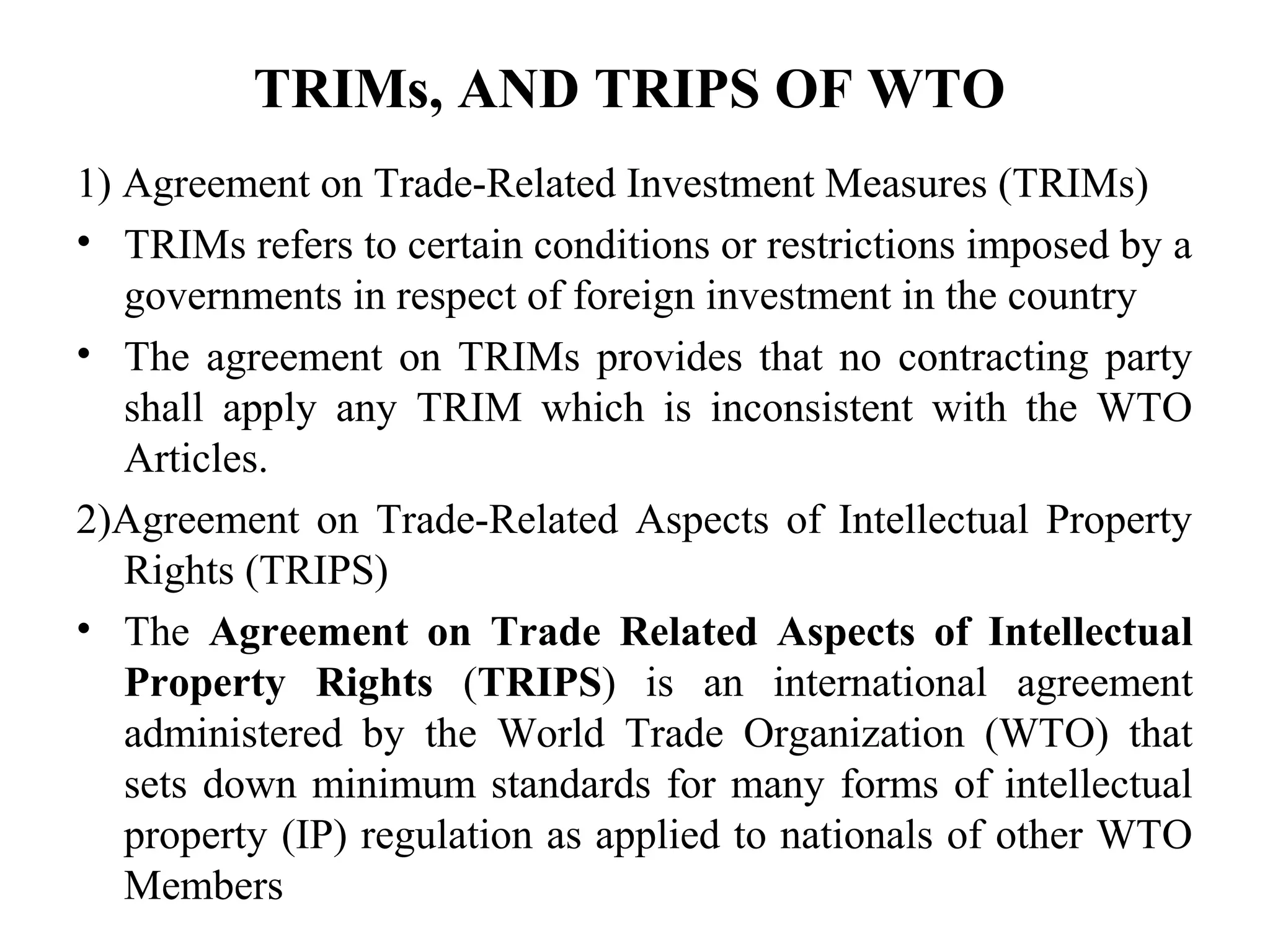
TRIMs, AND TRIPS OF WTO
1) Agreement on Trade-Related Investment Measures (TRIMs)
• TRIMs refers to certain conditions or restrictions imposed by a
   governments in respect of foreign investment in the country
• The agreement on TRIMs provides that no contracting party
   shall apply any TRIM which is inconsistent with the WTO
   Articles.
2)Agreement on Trade-Related Aspects of Intellectual Property
   Rights (TRIPS)
• The Agreement on Trade Related Aspects of Intellectual
   Property Rights (TRIPS) is an international agreement
   administered by the World Trade Organization (WTO) that
   sets down minimum standards for many forms of intellectual
   property (IP) regulation as applied to nationals of other WTO
   Members
CONTI...
• It was negotiated at the end of the Uruguay Round of the
  General Agreement on Tariffs and Trade (GATT) in 1994.
• TRIPS contains requirements that nations' laws must meet for
  copyright rights, including the rights of performers, producers
  of sound recordings and broadcasting organizations;
  geographical indications, including appellations of origin;
  industrial designs; integrated circuit layout-designs; patents;
  monopolies for the developers of new plant varieties;
  trademarks; trade dress; and undisclosed or confidential
  information.
• specifies enforcement procedures, remedies, and dispute
  resolution procedures.
THE RELEVANCE OF WTO
• The system helps promote peace.
• The system allows disputes to be handled constructively.
• A system based on rules rather than power makes life
  easier for all.
• Freer trade cuts the cost of living.
• It gives consumers more choice and a broader range of
  qualities to choose from.
• Trade raises incomes.
• Trade stimulates economic growth and that can be good
  news for employment
• The basic principles make the system economically more
  efficient, and they cut costs.
THE AGREEMENTS

• The WTO is ‘rules-based’; its rules are negotiated
  agreements

• Overview: a navigational guide

• Plurilateral agreement

• Further changes on the horizon, the Doha Agenda
CONTI...
• Some of the agreements of WTO:
  -Tariffs: more bindings and closer to zero

  -The Agriculture Agreement: new rules and
  commitments

  -Textiles: back in the mainstream

  -Intellectual property: protection and enforcement
CONTI...
The agreement covers five broad issues:
• How basic principles of the trading system and other
  international intellectual property agreements should
  be applied

• How to give adequate protection to intellectual
  property rights

• How countries should enforce those rights adequately
  in their own territories
CONTI...

• How to settle disputes on intellectual property
  between members of the WTO

• Special transitional arrangements during the period
  when the new system is being introduced
Developing Countries
How the WTO deals with the special needs of an
  increasingly important group
• In the agreements: more time, better terms
• Legal assistance: a Secretariat service
• Least-developed countries: special focus
• Committees
-Trade and Development Committee
CONTI...

-Sub-committee on Least-Developed Countries
-The Doha agenda committees
• WTO technical cooperation
• Participation in the system: opportunities and
  concerns
• Erosion of preferences
• The ability to adapt: the supply-side
Recent Issues
• Trade to expand by 9.5% in 2010 after a dismal 2009, WTO
  reports
• Why was the trade decline so large?
• Trade prospects for 2010
• Lamy calls for addressing macro-economic imbalances
  through cooperation
• 32 WTO members take anti-dumping actions during first
  half of 2010
• Transparency     mechanism       for     preferential trade
  arrangements set for approval
• Market access for LDCs
• Trade agreements between developing countries
• Overseeing national trade policies: the TPRM
• Trade policy reviews: ensuring transparency
CONCLUSION
• It is the place where the member country comes and talks
  together and shares their grievance in order to resolve their
  problem related to International trade.

• The countries make their decisions through various councils
  and committees, whose membership consists of all WTO
  members.

• The system helps promote peace, by handling Dispute of
  member countries. It provides free trade which cuts the costs
  of living and provides more choice of products and qualities
  and stimulates economic growth.
• The WTO agreements cover goods, services and intellectual
  property. They spell out the principles of liberalization, and
  the permitted exceptions. They include individual countries’
  commitments to lower customs tariffs and other trade barriers,
  and to open and keep open services markets. They set
  procedures for settling disputes. They prescribe special
  treatment for developing countries. They require governments
  to make their trade policies transparent
• WTO deals with the special needs of developing countries as
  two thirds of the WTO members are developing countries and
  they play an increasingly important and active role in the
  WTO because of their numbers, because they are becoming
  more important in the global economy, and because they
  increasingly look to trade as a vital tool in their development
  efforts.
THANK YOU

Wto ppt

  • 1.
    PRESENTED BY: • DharmendraKumar Singh • Rishi Kant Sharma • Manish Kumar Singh • Tapas Gorai • Raman Kumar NETAJI SUBHAS INSTITUTE OF BUSINESS MANAGEMENT SEPTEMBER, 2012
  • 2.
    OBJECTIVES OF THESTUDY • To have an understanding of WTO and the principles and functions of WTO • To study the structure of WTO • To study the role of WTO • To study the relevance of WTO • To study the provision of TRIPs, TRIMs of WTO • To have a knowledge of different agreements done under WTO guidance • To study role of WTO in developing countries • To study the current issues of WTO
  • 3.
    What is theWorld Trade Organization ? “The World Trade Organization is ‘member-driven’, with decisions taken by General agreement among all member of governments and it deals with the rules of trade between nations at a global or near-global level. But there is more to it than that.”
  • 4.
    They deal with:agriculture, textiles and clothing, banking, telecommunications, government purchases, industrial standards and product safety, food sanitation regulations, intellectual property, and much more. The WTO agreements are lengthy and complex because they are legal texts covering a wide range of activities.
  • 5.
    WTO: The Beginnings/History • The World Trade Organization (WTO) came into being on January 1st 1995. It was the outcome of the lengthy (1986-1994) Uruguay round of GATT negotiations. The WTO was essentially an extension of GATT. • It extended GATT in two major ways. First GATT became only one of the three major trade agreements that went into the WTO (the other two being the General Agreement on Trade in Services (GATS) and the agreements on Trade Related Aspects of Intellectual Property Rights (TRIPS)).
  • 6.
    CONTI... • Second theWTO was put on a much sounder institutional footing than GATT. With GATT the support services that helped maintain the agreement had come into being in an ad hoc manner as the need arose. The WTO by contrast is a fully fledged institution (GATT also was, at least formally, only an agreement between contracting parties and had no independent existence of its own while the WTO is a corporate body recognized under international law).
  • 7.
    FACT FILE OFWTO Location Geneva, Switzerland Established 1 January 1995 Created by Uruguay Round negotiations (1986-94) Membership 153 countries on 23 July 2008 Budget 189 million Swiss francs for 2009 Secretariat staff 625 Head Pascal Lamy (Director- General)
  • 8.
    Current WTO members •153 members • Observers(31)
  • 9.
    Why WTO? • To arrange the implementation, administration and operations of multilateral (involving three or more participants) and Plurilateral trade agreements (power which shared between different countries) • To arrange the forum for deliberations for the member nations in regard to their multilateral trade relations in issues deal with under the agreements
  • 10.
    CONTI... • To provide a framework for implementing of the results arising out of the deliberations (long and care full agreements/consideration) which taken place at ministerial conference level • To manage the created understanding on rules and procedure governing the settlement of disputes
  • 11.
    CONTI... • To manageeffectively and efficiency the trade policy review mechanism (TRIM) • To create more together relationship with all nations in respect of global economic policy-making, it would cooperate with the IMF and the world bank & its affiliated Organisations.
  • 12.
    FUNCTIONS OF WTO • Administering WTO trade agreements • Forum for trade negotiations • Handling trade disputes • Monitoring national trade policies • Technical assistance and training for developing countries • Cooperation with other international organizations
  • 13.
    PRINCIPLES OF WTO Thebasic principles of the WTO (according to the WTO): • Trade Without Discrimination 1. Most-favoured-nation (MFN): treating other people equally Under the WTO agreements, countries cannot normally discriminate between their trading partners. Grant someone a special favour (such as a lower customs duty rate for one of their products) and you have to do the same for all other WTO members. 2. National treatment: Treating foreigners and locals equally Imported and locally-produced goods should be treated equally — at least after the foreign goods have entered the market. The same should apply to foreign and domestic services, and to foreign and local trademarks, copyrights and patents.
  • 14.
    CONTI... • Freer trade:gradually, through negotiation Lowering trade barriers is one of the most obvious means of encouraging trade. The barriers concerned include customs duties (or tariffs) and measures such as import bans or quotas that restrict quantities selectively • Predictability: through binding and transparency Sometimes, promising not to raise a trade barrier can be as important as lowering one, because the promise gives businesses a clearer view of their future opportunities. With stability and predictability, investment is encouraged, jobs are created and consumers can fully enjoy the benefits of competition — choice and lower prices. The multilateral trading system is an attempt by governments to make the business environment stable and predictable.
  • 15.
    CONTI... • Promoting faircompetition The WTO is sometimes described as a “free trade” institution, but that is not entirely accurate. The system does allow tariffs and, in limited circumstances, other forms of protection. More accurately, it is a system of rules dedicated to open, fair and undistorted competition. • Encouraging development and economic reform. The WTO system contributes to development. On the other hand, developing countries need flexibility in the time they take to implement the system’s agreements. And the agreements themselves inherit the earlier provisions of GATT that allow for special assistance and trade concessions for developing countries.
  • 16.
    STRUCTURES OF WTO Ministerial Conference Dispute Trade Policy Settlement Body General Council Review Body The Committee Intellectual on T&D and Goods Council Services Council Property Council T&E
  • 17.
    ROLE OF WTO •The main goal of WTO is to help the trading industry to become smooth, fair, free and predictable. It was organized to become the administrator of multilateral trade and business agreements between its member nations. It supports all occurring negotiations for latest agreements for trade. WTO also tries to resolve trade disputes between member nations. • Multi-lateral agreements are always made between several countries in the past. Because of this, such agreements become very difficult to negotiate but are so powerful and influential once all the parties agree and sign the multi-lateral agreement. WTO acts as the administrator. If there are unfair trade practices or dumping and there is complain filed, the staff of WTO are expected to investigate and check if there are violations based on the multi-lateral agreements.
  • 18.
    TRIMs, AND TRIPSOF WTO 1) Agreement on Trade-Related Investment Measures (TRIMs) • TRIMs refers to certain conditions or restrictions imposed by a governments in respect of foreign investment in the country • The agreement on TRIMs provides that no contracting party shall apply any TRIM which is inconsistent with the WTO Articles. 2)Agreement on Trade-Related Aspects of Intellectual Property Rights (TRIPS) • The Agreement on Trade Related Aspects of Intellectual Property Rights (TRIPS) is an international agreement administered by the World Trade Organization (WTO) that sets down minimum standards for many forms of intellectual property (IP) regulation as applied to nationals of other WTO Members
  • 19.
    CONTI... • It wasnegotiated at the end of the Uruguay Round of the General Agreement on Tariffs and Trade (GATT) in 1994. • TRIPS contains requirements that nations' laws must meet for copyright rights, including the rights of performers, producers of sound recordings and broadcasting organizations; geographical indications, including appellations of origin; industrial designs; integrated circuit layout-designs; patents; monopolies for the developers of new plant varieties; trademarks; trade dress; and undisclosed or confidential information. • specifies enforcement procedures, remedies, and dispute resolution procedures.
  • 20.
    THE RELEVANCE OFWTO • The system helps promote peace. • The system allows disputes to be handled constructively. • A system based on rules rather than power makes life easier for all. • Freer trade cuts the cost of living. • It gives consumers more choice and a broader range of qualities to choose from. • Trade raises incomes. • Trade stimulates economic growth and that can be good news for employment • The basic principles make the system economically more efficient, and they cut costs.
  • 21.
    THE AGREEMENTS • TheWTO is ‘rules-based’; its rules are negotiated agreements • Overview: a navigational guide • Plurilateral agreement • Further changes on the horizon, the Doha Agenda
  • 22.
    CONTI... • Some ofthe agreements of WTO: -Tariffs: more bindings and closer to zero -The Agriculture Agreement: new rules and commitments -Textiles: back in the mainstream -Intellectual property: protection and enforcement
  • 23.
    CONTI... The agreement coversfive broad issues: • How basic principles of the trading system and other international intellectual property agreements should be applied • How to give adequate protection to intellectual property rights • How countries should enforce those rights adequately in their own territories
  • 24.
    CONTI... • How tosettle disputes on intellectual property between members of the WTO • Special transitional arrangements during the period when the new system is being introduced
  • 25.
    Developing Countries How theWTO deals with the special needs of an increasingly important group • In the agreements: more time, better terms • Legal assistance: a Secretariat service • Least-developed countries: special focus • Committees -Trade and Development Committee
  • 26.
    CONTI... -Sub-committee on Least-DevelopedCountries -The Doha agenda committees • WTO technical cooperation • Participation in the system: opportunities and concerns • Erosion of preferences • The ability to adapt: the supply-side
  • 27.
    Recent Issues • Tradeto expand by 9.5% in 2010 after a dismal 2009, WTO reports • Why was the trade decline so large? • Trade prospects for 2010 • Lamy calls for addressing macro-economic imbalances through cooperation • 32 WTO members take anti-dumping actions during first half of 2010 • Transparency mechanism for preferential trade arrangements set for approval • Market access for LDCs • Trade agreements between developing countries • Overseeing national trade policies: the TPRM • Trade policy reviews: ensuring transparency
  • 28.
    CONCLUSION • It isthe place where the member country comes and talks together and shares their grievance in order to resolve their problem related to International trade. • The countries make their decisions through various councils and committees, whose membership consists of all WTO members. • The system helps promote peace, by handling Dispute of member countries. It provides free trade which cuts the costs of living and provides more choice of products and qualities and stimulates economic growth.
  • 29.
    • The WTOagreements cover goods, services and intellectual property. They spell out the principles of liberalization, and the permitted exceptions. They include individual countries’ commitments to lower customs tariffs and other trade barriers, and to open and keep open services markets. They set procedures for settling disputes. They prescribe special treatment for developing countries. They require governments to make their trade policies transparent • WTO deals with the special needs of developing countries as two thirds of the WTO members are developing countries and they play an increasingly important and active role in the WTO because of their numbers, because they are becoming more important in the global economy, and because they increasingly look to trade as a vital tool in their development efforts.
  • 30.