WORLD TRADE ORGANISATIO (WTO)
Department of Pharmacy (Pharmaceutics) | Sagar Savale
Mr. Sagar Kishor Savale
[Department of Pharmaceutics]
avengersagar16@gmail.com
2015-2016
7/9/2016Sagar Savale
1
CONTENTS
 INTRODUCTION
 HISTORY
 OBJECTIVES
 FUNCTION
 ABOUT WTO…
 ADVANTAGES
 REFERENCES
7/9/2016Sagar Savale
2
INTRODUCTION
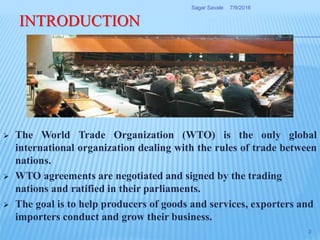
 The World Trade Organization (WTO) is the only global
international organization dealing with the rules of trade between
nations.
 WTO agreements are negotiated and signed by the trading
nations and ratified in their parliaments.
 The goal is to help producers of goods and services, exporters and
importers conduct and grow their business.
7/9/2016Sagar Savale
3
Objective of World Trade Organization
(WTO)
* To ensure the conduct the international trade on non-discrimination
basis.
* To raise standard of living and income, ensuring full employment
* To expand production and trade
* Protecting environment
* Ensuring better share for developing countries.
Function of World Trade Organization
(WTO)
* Administering World Trade Organization (WTO) trade
agreement
* Forum the trade negotiation
* Handling trade disputes
* Monitoring national trade policy
* Technical assistance and training for developing countries
* Co-operation with other international organization (like help
from World Bank and IMF).
7/9/2016Sagar Savale
4
HISTORY
 Period between the First and Second World
Wars:
 – 1920s: Attempt to organize world trade on a
liberal basis.
 – at the beginning of the 1930s, the monetary
system broke down
 – Reciprocal Trade Agreements and trade
restrictions were introduced
7/9/2016Sagar Savale
5
Period following the Second World War (WW II):
1– Memories of the pre-war period: economic reason as major cause from
World War-II
• High damages from WW I
• High inflation rate
• High unemployment rate
2– Victorious countries (US, Britain) were determined to learn from mistakes:
• Economic success
• Strong trade relation
• Economic interdependency
7/9/2016Sagar Savale
6
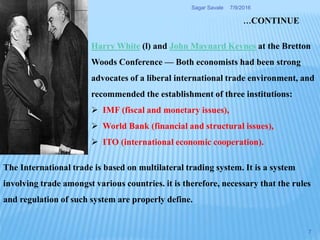
Harry White (l) and John Maynard Keynes at the Bretton
Woods Conference — Both economists had been strong
advocates of a liberal international trade environment, and
recommended the establishment of three institutions:
 IMF (fiscal and monetary issues),
 World Bank (financial and structural issues),
 ITO (international economic cooperation).
The International trade is based on multilateral trading system. It is a system
involving trade amongst various countries. it is therefore, necessary that the rules
and regulation of such system are properly define.
…CONTINUE
7/9/2016Sagar Savale
7
In the year 1947, an attempt was made by 23 countries in the world to
define the basic norms for conduct of international trade. The trade
negotiation amongst these 23 countries in multilateral treaty called
general agreement On Traffic and Trade (GATT) in the year 1948.
The GATT was established to secure the conduct of international
trade based on the principles of non-discrimination, transparency and
liberalization.
7/9/2016Sagar Savale
8
Foundation of the GATT
The GATT was signed by its 23 founding members on 30 October 1947
and entered into force on 1 January 1948
23 Founding member countries of the GATT:
United States, Canada, Cuba, Brazil, Chile,
Australia, New Zealand, China, India,
Myanmar, SriLanka, Pakistan, Syria, Lebanon,
 South Africa, Zimbabwe, United Kingdom,
France, Belgium, Luxembourg, Netherlands, Norway,
Czechoslovakia
GATT was introduce as a stepping stone towards the
establishment of the ITO and embodied many principles of the proposed ITO.
7/9/2016Sagar Savale
9
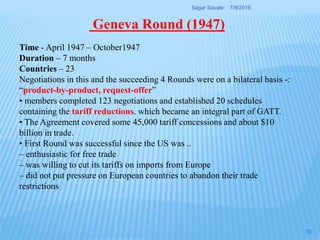
Time - April 1947 – October1947
Duration – 7 months
Countries – 23
Negotiations in this and the succeeding 4 Rounds were on a bilateral basis -:
“product-by-product, request-offer”
• members completed 123 negotiations and established 20 schedules
containing the tariff reductions. which became an integral part of GATT.
• The Agreement covered some 45,000 tariff concessions and about $10
billion in trade.
• First Round was successful since the US was ..
– enthusiastic for free trade
– was willing to cut its tariffs on imports from Europe
– did not put pressure on European countries to abandon their trade
restrictions
Geneva Round (1947)
7/9/2016Sagar Savale
10
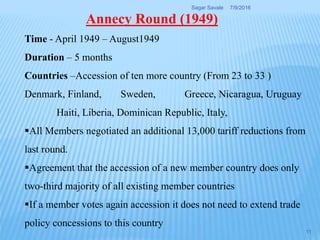
Time - April 1949 – August1949
Duration – 5 months
Countries –Accession of ten more country (From 23 to 33 )
Denmark, Finland, Sweden, Greece, Nicaragua, Uruguay
Haiti, Liberia, Dominican Republic, Italy,
All Members negotiated an additional 13,000 tariff reductions from
last round.
Agreement that the accession of a new member country does only
two-third majority of all existing member countries
If a member votes again accession it does not need to extend trade
policy concessions to this country
Annecy Round (1949)
7/9/2016Sagar Savale
11
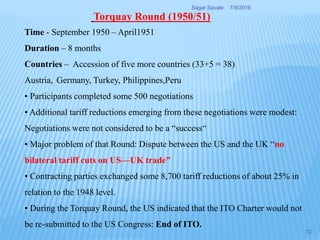
Time - September 1950 – April1951
Duration – 8 months
Countries – Accession of five more countries (33+5 = 38)
Austria, Germany, Turkey, Philippines,Peru
• Participants completed some 500 negotiations
• Additional tariff reductions emerging from these negotiations were modest:
Negotiations were not considered to be a “success“
• Major problem of that Round: Dispute between the US and the UK “no
bilateral tariff cuts on US—UK trade”
• Contracting parties exchanged some 8,700 tariff reductions of about 25% in
relation to the 1948 level.
• During the Torquay Round, the US indicated that the ITO Charter would not
be re-submitted to the US Congress: End of ITO.
Torquay Round (1950/51)
7/9/2016Sagar Savale
12
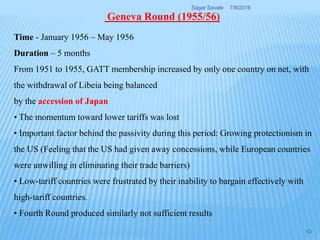
Time - January 1956 – May 1956
Duration – 5 months
From 1951 to 1955, GATT membership increased by only one country on net, with
the withdrawal of Libeia being balanced
by the accession of Japan
• The momentum toward lower tariffs was lost
• Important factor behind the passivity during this period: Growing protectionism in
the US (Feeling that the US had given away concessions, while European countries
were unwilling in eliminating their trade barriers)
• Low-tariff countries were frustrated by their inability to bargain effectively with
high-tariff countries.
• Fourth Round produced similarly not sufficient results
Geneva Round (1955/56)
7/9/2016Sagar Savale
13
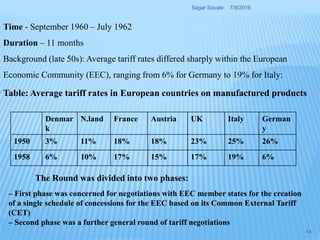
Time - September 1960 – July 1962
Duration – 11 months
Background (late 50s): Average tariff rates differed sharply within the European
Economic Community (EEC), ranging from 6% for Germany to 19% for Italy:
Table: Average tariff rates in European countries on manufactured products
Denmar
k
N.land France Austria UK Italy German
y
1950 3% 11% 18% 18% 23% 25% 26%
1958 6% 10% 17% 15% 17% 19% 6%
– First phase was concerned for negotiations with EEC member states for the creation
of a single schedule of concessions for the EEC based on its Common External Tariff
(CET)
– Second phase was a further general round of tariff negotiations
The Round was divided into two phases:
7/9/2016Sagar Savale
14
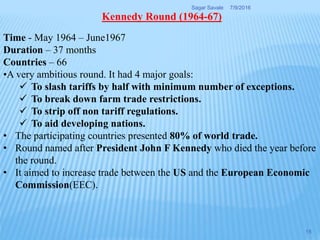
Time - May 1964 – June1967
Duration – 37 months
Countries – 66
•A very ambitious round. It had 4 major goals:
 To slash tariffs by half with minimum number of exceptions.
 To break down farm trade restrictions.
 To strip off non tariff regulations.
 To aid developing nations.
• The participating countries presented 80% of world trade.
• Round named after President John F Kennedy who died the year before
the round.
• It aimed to increase trade between the US and the European Economic
Commission(EEC).
Kennedy Round (1964-67)
7/9/2016Sagar Savale
15
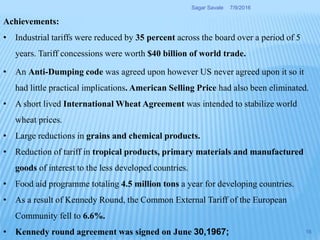
Achievements:
• Industrial tariffs were reduced by 35 percent across the board over a period of 5
years. Tariff concessions were worth $40 billion of world trade.
• An Anti-Dumping code was agreed upon however US never agreed upon it so it
had little practical implications. American Selling Price had also been eliminated.
• A short lived International Wheat Agreement was intended to stabilize world
wheat prices.
• Large reductions in grains and chemical products.
• Reduction of tariff in tropical products, primary materials and manufactured
goods of interest to the less developed countries.
• Food aid programme totaling 4.5 million tons a year for developing countries.
• As a result of Kennedy Round, the Common External Tariff of the European
Community fell to 6.6%.
• Kennedy round agreement was signed on June 30,1967;
7/9/2016Sagar Savale
16
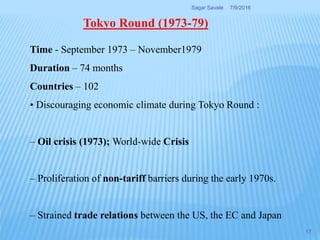
Time - September 1973 – November1979
Duration – 74 months
Countries – 102
• Discouraging economic climate during Tokyo Round :
– Oil crisis (1973); World-wide Crisis
– Proliferation of non-tariff barriers during the early 1970s.
– Strained trade relations between the US, the EC and Japan
Tokyo Round (1973-79)
7/9/2016Sagar Savale
17
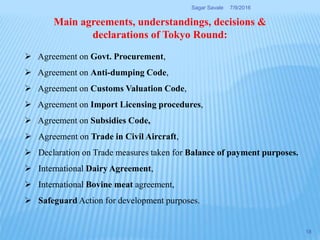
 Agreement on Govt. Procurement,
 Agreement on Anti-dumping Code,
 Agreement on Customs Valuation Code,
 Agreement on Import Licensing procedures,
 Agreement on Subsidies Code,
 Agreement on Trade in Civil Aircraft,
 Declaration on Trade measures taken for Balance of payment purposes.
 International Dairy Agreement,
 International Bovine meat agreement,
 Safeguard Action for development purposes.
Main agreements, understandings, decisions &
declarations of Tokyo Round:
7/9/2016Sagar Savale
18
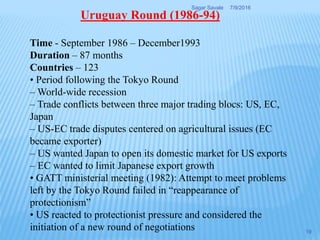
Time - September 1986 – December1993
Duration – 87 months
Countries – 123
• Period following the Tokyo Round
– World-wide recession
– Trade conflicts between three major trading blocs: US, EC,
Japan
– US-EC trade disputes centered on agricultural issues (EC
became exporter)
– US wanted Japan to open its domestic market for US exports
– EC wanted to limit Japanese export growth
• GATT ministerial meeting (1982): Attempt to meet problems
left by the Tokyo Round failed in “reappearance of
protectionism”
• US reacted to protectionist pressure and considered the
initiation of a new round of negotiations
Uruguay Round (1986-94)
7/9/2016Sagar Savale
19
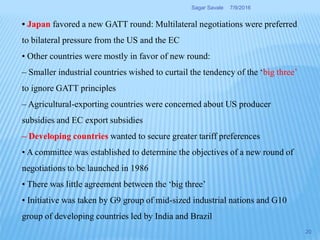
• Japan favored a new GATT round: Multilateral negotiations were preferred
to bilateral pressure from the US and the EC
• Other countries were mostly in favor of new round:
– Smaller industrial countries wished to curtail the tendency of the ‘big three’
to ignore GATT principles
– Agricultural-exporting countries were concerned about US producer
subsidies and EC export subsidies
– Developing countries wanted to secure greater tariff preferences
• A committee was established to determine the objectives of a new round of
negotiations to be launched in 1986
• There was little agreement between the ‘big three’
• Initiative was taken by G9 group of mid-sized industrial nations and G10
group of developing countries led by India and Brazil
7/9/2016Sagar Savale
20
Formation January 1, 1995
Headquarters Centre William Rappard, Geneva,
Switzerland
Membership 157 member states
Official languages English, French, Spanish[1]
Director-General Pascal Lamy
Budget 196 million Swiss francs (approx. 209
million USD) in 2011.
Staff 629
Website wto.org
ABOUT WTO
7/9/2016Sagar Savale
21
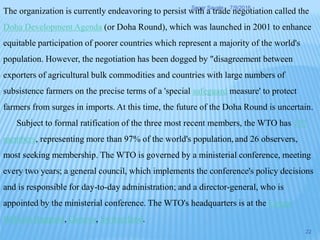
The organization is currently endeavoring to persist with a trade negotiation called the
Doha Development Agenda (or Doha Round), which was launched in 2001 to enhance
equitable participation of poorer countries which represent a majority of the world's
population. However, the negotiation has been dogged by "disagreement between
exporters of agricultural bulk commodities and countries with large numbers of
subsistence farmers on the precise terms of a 'special safeguard measure' to protect
farmers from surges in imports. At this time, the future of the Doha Round is uncertain.
Subject to formal ratification of the three most recent members, the WTO has 157
members, representing more than 97% of the world's population, and 26 observers,
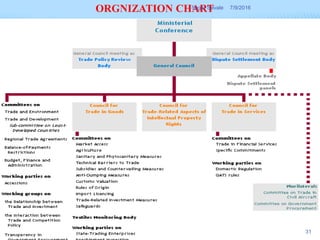
most seeking membership. The WTO is governed by a ministerial conference, meeting
every two years; a general council, which implements the conference's policy decisions
and is responsible for day-to-day administration; and a director-general, who is
appointed by the ministerial conference. The WTO's headquarters is at the Centre
William Rappard, Geneva, Switzerland.
7/9/2016Sagar Savale
22
The Doha Development Round started in 2001 and continues today.
The WTO launched the current round of negotiations, the Doha Development
Agenda (DDA) or Doha Round, at the fourth ministerial conference in Doha,
Qatar in November 2001. The Doha round was to be an ambitious effort to make
globalization more inclusive and help the world's poor, particularly by slashing
barriers and subsidies in farming. The initial agenda comprised both further trade
liberalization and new rule-making, underpinned by commitments to strengthen
substantial assistance to developing countries.
The negotiations have been highly contentious and agreement has not been
reached, despite the intense negotiations at several ministerial conferences and at
other sessions. Disagreements still continue over several key areas including
agriculture subsidies.
Doha Round 7/9/2016Sagar Savale
23
WTO AGREEMENTS
The WTO’s rules – the agreements – are the result of negotiations between the
members.
The current set were the outcome of the 1986-94 Uruguay Round negotiations which
included a major revision of the original General Agreement on Tariffs and Trade
(GATT).
GATT is now the WTO’s principal rule-book for trade in goods. The Uruguay Round
also
created new rules for dealing with trade in services, relevant aspects of intellectual
property, dispute settlement, and trade policy reviews. The complete set runs to some
30,000 pages consisting of about 30 agreements and separate commitments (called
schedules) made by individual members in specific areas such as lower customs duty
rates and services market-opening.
7/9/2016Sagar Savale
24
Through these agreements, WTO members operate
a non-discriminatory trading system that spells out
their rights and their obligations.
Each country receives guarantees that its exports
will be treated fairly & consistently in other
countries’markets.
Each promises to do the same for imports into its
own market.
The system also gives developing countries some
flexibility in implementing their commitments.
7/9/2016Sagar Savale
25
GOODS
It all began with trade in goods. From 1947 to 1994, GATT was the forum
for negotiating lower customs duty rates and other trade barriers; the text
of the General Agreement spelt out important rules, particularly non-
discrimination.
Since 1995, the updated GATT has become the WTO’s umbrella agreement
for trade in goods. It has annexes dealing with specific sectors such as
agriculture and textiles, and with specific issues such as state trading,
product standards, subsidies and actions taken against dumping.
7/9/2016Sagar Savale
26
SERVICES
Banks, insurance firms, telecommunications companies, tour
operators, hotel chains and transport companies looking to do business
abroad can now enjoy the same principles of freer and fairer trade that
originally only applied to trade in goods.
These principles appear in the new General Agreement on Trade in
Services (GATS). WTO members have also made individual
commitments under GATS stating which of their services sectors they
are willing to open to foreign competition, and how open those
markets are.
7/9/2016Sagar Savale
27
INTELLECTUAL PROPERTY
The WTO’s Intellectual Property Agreement amounts to rules for trade and
investment in ideas and creativity. The rules state how copyrights, patents,
trademarks, geographical names used to identify products, industrial designs,
integrated circuit layout-designs and undisclosed information such as trade
secrets – “intellectual property” – should be protected when trade is involved.
7/9/2016Sagar Savale
28
DISPUTE SETTLEMENT
The WTO’s procedure for resolving trade quarrels under the Dispute Settlement
Understanding is vital for enforcing the rules and therefore for ensuring that trade
flows smoothly. Countries bring disputes to the WTO if they think their rights under
the agreements are being infringed. Judgements by specially-appointed independent
experts are based on interpretations of the agreements and individual countries’
commitments.
The system encourages countries to settle their differences through consultation.
Failing that, they can follow a carefully mapped out, stage-by-stage procedure that
includes the possibility of a ruling by a panel of experts, and the chance to appeal the
ruling on legal grounds. Confidence in the system is borne out by the number of cases
brought to the WTO – more than 300 cases in ten years compared to the 300 disputes
dealt with during the
entire life of GATT (1947-94).
7/9/2016Sagar Savale
29
TRADE POLICY REVIEW
The Trade Policy Review Mechanism’s purpose is to improve transparency,
to create a greater understanding of the policies that countries are adopting,
and to assess their impact. Many members also see the reviews as
constructive feedback on their policies.
All WTO members must undergo periodic scrutiny, each review containing
reports by the country concerned and the WTO Secretariat.
7/9/2016Sagar Savale
30
ORGNIZATION CHART 7/9/2016Sagar Savale
31
Helps promote peace within nations: Peace is partly an outcome
of two of the most fundamental principle of the trading system;
helping trade flow smoothly and providing countries with a
constructive and fair outlet for dealing with disputes over trade issues.
Peace creates international confidence and cooperation that the WTO
creates and reinforces.
Disputes are handled constructively: As trade expands in volume,
in the numbers of products traded and in the number of countries and
company trading, there is a greater chance that disputes will arise.
WTO helps resolve these disputes peacefully and constructively. If
this could be left to the member states, the dispute may lead to serious
conflict, but lot of trade tension is reduced by organizations such as
WTO.
ADVANTAGES OF WTO
It provides more choice of products and qualities: It gives
consumer more choice and a broader range of qualities to choose
from.
7/9/2016Sagar Savale
32
•Rules make life easier for all: WTO system is based on rules rather
than power and this makes life easier for all trading nations. WTO
reduces some inequalities giving smaller countries more voice, and at the
same time freeing the major powers from the complexity of having to
negotiate trade agreements with each of the member states.
•Free trade cuts the cost of living: Protectionism is expensive, it raises
prices, WTO lowers trade barriers through negotiation and applies the
principle of non-discrimination. The result is reduced costs of production
(because imports used in production are cheaper) and reduced prices of
finished goods and services, and ultimately a lower cost of living.
7/9/2016Sagar Savale
33
CONTACTING THE WTO
Rue de Lausanne 154, CH-1211 Geneva 21,
Switzerland
Tel.: +41 (0)22 739 51 11Fax: +41 (0)22 731 42 06
WTO Information and External Relations Division
Tel.: +41 (0)22 739 50 07 / 51 90 Fax: +41 (0)22 739
54 58
e-mail: enquiries@wto.org
WTO Publications
Tel.: +41 (0)22 739 52 08 / 739 53 08 +41 (0)22 739
57 92
e-mail: publications@wto.org
7/9/2016Sagar Savale
34

WTO

  • 1.
    WORLD TRADE ORGANISATIO(WTO) Department of Pharmacy (Pharmaceutics) | Sagar Savale Mr. Sagar Kishor Savale [Department of Pharmaceutics] avengersagar16@gmail.com 2015-2016 7/9/2016Sagar Savale 1
  • 2.
    CONTENTS  INTRODUCTION  HISTORY OBJECTIVES  FUNCTION  ABOUT WTO…  ADVANTAGES  REFERENCES 7/9/2016Sagar Savale 2
  • 3.
    INTRODUCTION  The WorldTrade Organization (WTO) is the only global international organization dealing with the rules of trade between nations.  WTO agreements are negotiated and signed by the trading nations and ratified in their parliaments.  The goal is to help producers of goods and services, exporters and importers conduct and grow their business. 7/9/2016Sagar Savale 3
  • 4.
    Objective of WorldTrade Organization (WTO) * To ensure the conduct the international trade on non-discrimination basis. * To raise standard of living and income, ensuring full employment * To expand production and trade * Protecting environment * Ensuring better share for developing countries. Function of World Trade Organization (WTO) * Administering World Trade Organization (WTO) trade agreement * Forum the trade negotiation * Handling trade disputes * Monitoring national trade policy * Technical assistance and training for developing countries * Co-operation with other international organization (like help from World Bank and IMF). 7/9/2016Sagar Savale 4
  • 5.
    HISTORY  Period betweenthe First and Second World Wars:  – 1920s: Attempt to organize world trade on a liberal basis.  – at the beginning of the 1930s, the monetary system broke down  – Reciprocal Trade Agreements and trade restrictions were introduced 7/9/2016Sagar Savale 5
  • 6.
    Period following theSecond World War (WW II): 1– Memories of the pre-war period: economic reason as major cause from World War-II • High damages from WW I • High inflation rate • High unemployment rate 2– Victorious countries (US, Britain) were determined to learn from mistakes: • Economic success • Strong trade relation • Economic interdependency 7/9/2016Sagar Savale 6
  • 7.
    Harry White (l)and John Maynard Keynes at the Bretton Woods Conference — Both economists had been strong advocates of a liberal international trade environment, and recommended the establishment of three institutions:  IMF (fiscal and monetary issues),  World Bank (financial and structural issues),  ITO (international economic cooperation). The International trade is based on multilateral trading system. It is a system involving trade amongst various countries. it is therefore, necessary that the rules and regulation of such system are properly define. …CONTINUE 7/9/2016Sagar Savale 7
  • 8.
    In the year1947, an attempt was made by 23 countries in the world to define the basic norms for conduct of international trade. The trade negotiation amongst these 23 countries in multilateral treaty called general agreement On Traffic and Trade (GATT) in the year 1948. The GATT was established to secure the conduct of international trade based on the principles of non-discrimination, transparency and liberalization. 7/9/2016Sagar Savale 8
  • 9.
    Foundation of theGATT The GATT was signed by its 23 founding members on 30 October 1947 and entered into force on 1 January 1948 23 Founding member countries of the GATT: United States, Canada, Cuba, Brazil, Chile, Australia, New Zealand, China, India, Myanmar, SriLanka, Pakistan, Syria, Lebanon,  South Africa, Zimbabwe, United Kingdom, France, Belgium, Luxembourg, Netherlands, Norway, Czechoslovakia GATT was introduce as a stepping stone towards the establishment of the ITO and embodied many principles of the proposed ITO. 7/9/2016Sagar Savale 9
  • 10.
    Time - April1947 – October1947 Duration – 7 months Countries – 23 Negotiations in this and the succeeding 4 Rounds were on a bilateral basis -: “product-by-product, request-offer” • members completed 123 negotiations and established 20 schedules containing the tariff reductions. which became an integral part of GATT. • The Agreement covered some 45,000 tariff concessions and about $10 billion in trade. • First Round was successful since the US was .. – enthusiastic for free trade – was willing to cut its tariffs on imports from Europe – did not put pressure on European countries to abandon their trade restrictions Geneva Round (1947) 7/9/2016Sagar Savale 10
  • 11.
    Time - April1949 – August1949 Duration – 5 months Countries –Accession of ten more country (From 23 to 33 ) Denmark, Finland, Sweden, Greece, Nicaragua, Uruguay Haiti, Liberia, Dominican Republic, Italy, All Members negotiated an additional 13,000 tariff reductions from last round. Agreement that the accession of a new member country does only two-third majority of all existing member countries If a member votes again accession it does not need to extend trade policy concessions to this country Annecy Round (1949) 7/9/2016Sagar Savale 11
  • 12.
    Time - September1950 – April1951 Duration – 8 months Countries – Accession of five more countries (33+5 = 38) Austria, Germany, Turkey, Philippines,Peru • Participants completed some 500 negotiations • Additional tariff reductions emerging from these negotiations were modest: Negotiations were not considered to be a “success“ • Major problem of that Round: Dispute between the US and the UK “no bilateral tariff cuts on US—UK trade” • Contracting parties exchanged some 8,700 tariff reductions of about 25% in relation to the 1948 level. • During the Torquay Round, the US indicated that the ITO Charter would not be re-submitted to the US Congress: End of ITO. Torquay Round (1950/51) 7/9/2016Sagar Savale 12
  • 13.
    Time - January1956 – May 1956 Duration – 5 months From 1951 to 1955, GATT membership increased by only one country on net, with the withdrawal of Libeia being balanced by the accession of Japan • The momentum toward lower tariffs was lost • Important factor behind the passivity during this period: Growing protectionism in the US (Feeling that the US had given away concessions, while European countries were unwilling in eliminating their trade barriers) • Low-tariff countries were frustrated by their inability to bargain effectively with high-tariff countries. • Fourth Round produced similarly not sufficient results Geneva Round (1955/56) 7/9/2016Sagar Savale 13
  • 14.
    Time - September1960 – July 1962 Duration – 11 months Background (late 50s): Average tariff rates differed sharply within the European Economic Community (EEC), ranging from 6% for Germany to 19% for Italy: Table: Average tariff rates in European countries on manufactured products Denmar k N.land France Austria UK Italy German y 1950 3% 11% 18% 18% 23% 25% 26% 1958 6% 10% 17% 15% 17% 19% 6% – First phase was concerned for negotiations with EEC member states for the creation of a single schedule of concessions for the EEC based on its Common External Tariff (CET) – Second phase was a further general round of tariff negotiations The Round was divided into two phases: 7/9/2016Sagar Savale 14
  • 15.
    Time - May1964 – June1967 Duration – 37 months Countries – 66 •A very ambitious round. It had 4 major goals:  To slash tariffs by half with minimum number of exceptions.  To break down farm trade restrictions.  To strip off non tariff regulations.  To aid developing nations. • The participating countries presented 80% of world trade. • Round named after President John F Kennedy who died the year before the round. • It aimed to increase trade between the US and the European Economic Commission(EEC). Kennedy Round (1964-67) 7/9/2016Sagar Savale 15
  • 16.
    Achievements: • Industrial tariffswere reduced by 35 percent across the board over a period of 5 years. Tariff concessions were worth $40 billion of world trade. • An Anti-Dumping code was agreed upon however US never agreed upon it so it had little practical implications. American Selling Price had also been eliminated. • A short lived International Wheat Agreement was intended to stabilize world wheat prices. • Large reductions in grains and chemical products. • Reduction of tariff in tropical products, primary materials and manufactured goods of interest to the less developed countries. • Food aid programme totaling 4.5 million tons a year for developing countries. • As a result of Kennedy Round, the Common External Tariff of the European Community fell to 6.6%. • Kennedy round agreement was signed on June 30,1967; 7/9/2016Sagar Savale 16
  • 17.
    Time - September1973 – November1979 Duration – 74 months Countries – 102 • Discouraging economic climate during Tokyo Round : – Oil crisis (1973); World-wide Crisis – Proliferation of non-tariff barriers during the early 1970s. – Strained trade relations between the US, the EC and Japan Tokyo Round (1973-79) 7/9/2016Sagar Savale 17
  • 18.
     Agreement onGovt. Procurement,  Agreement on Anti-dumping Code,  Agreement on Customs Valuation Code,  Agreement on Import Licensing procedures,  Agreement on Subsidies Code,  Agreement on Trade in Civil Aircraft,  Declaration on Trade measures taken for Balance of payment purposes.  International Dairy Agreement,  International Bovine meat agreement,  Safeguard Action for development purposes. Main agreements, understandings, decisions & declarations of Tokyo Round: 7/9/2016Sagar Savale 18
  • 19.
    Time - September1986 – December1993 Duration – 87 months Countries – 123 • Period following the Tokyo Round – World-wide recession – Trade conflicts between three major trading blocs: US, EC, Japan – US-EC trade disputes centered on agricultural issues (EC became exporter) – US wanted Japan to open its domestic market for US exports – EC wanted to limit Japanese export growth • GATT ministerial meeting (1982): Attempt to meet problems left by the Tokyo Round failed in “reappearance of protectionism” • US reacted to protectionist pressure and considered the initiation of a new round of negotiations Uruguay Round (1986-94) 7/9/2016Sagar Savale 19
  • 20.
    • Japan favoreda new GATT round: Multilateral negotiations were preferred to bilateral pressure from the US and the EC • Other countries were mostly in favor of new round: – Smaller industrial countries wished to curtail the tendency of the ‘big three’ to ignore GATT principles – Agricultural-exporting countries were concerned about US producer subsidies and EC export subsidies – Developing countries wanted to secure greater tariff preferences • A committee was established to determine the objectives of a new round of negotiations to be launched in 1986 • There was little agreement between the ‘big three’ • Initiative was taken by G9 group of mid-sized industrial nations and G10 group of developing countries led by India and Brazil 7/9/2016Sagar Savale 20
  • 21.
    Formation January 1,1995 Headquarters Centre William Rappard, Geneva, Switzerland Membership 157 member states Official languages English, French, Spanish[1] Director-General Pascal Lamy Budget 196 million Swiss francs (approx. 209 million USD) in 2011. Staff 629 Website wto.org ABOUT WTO 7/9/2016Sagar Savale 21
  • 22.
    The organization iscurrently endeavoring to persist with a trade negotiation called the Doha Development Agenda (or Doha Round), which was launched in 2001 to enhance equitable participation of poorer countries which represent a majority of the world's population. However, the negotiation has been dogged by "disagreement between exporters of agricultural bulk commodities and countries with large numbers of subsistence farmers on the precise terms of a 'special safeguard measure' to protect farmers from surges in imports. At this time, the future of the Doha Round is uncertain. Subject to formal ratification of the three most recent members, the WTO has 157 members, representing more than 97% of the world's population, and 26 observers, most seeking membership. The WTO is governed by a ministerial conference, meeting every two years; a general council, which implements the conference's policy decisions and is responsible for day-to-day administration; and a director-general, who is appointed by the ministerial conference. The WTO's headquarters is at the Centre William Rappard, Geneva, Switzerland. 7/9/2016Sagar Savale 22
  • 23.
    The Doha DevelopmentRound started in 2001 and continues today. The WTO launched the current round of negotiations, the Doha Development Agenda (DDA) or Doha Round, at the fourth ministerial conference in Doha, Qatar in November 2001. The Doha round was to be an ambitious effort to make globalization more inclusive and help the world's poor, particularly by slashing barriers and subsidies in farming. The initial agenda comprised both further trade liberalization and new rule-making, underpinned by commitments to strengthen substantial assistance to developing countries. The negotiations have been highly contentious and agreement has not been reached, despite the intense negotiations at several ministerial conferences and at other sessions. Disagreements still continue over several key areas including agriculture subsidies. Doha Round 7/9/2016Sagar Savale 23
  • 24.
    WTO AGREEMENTS The WTO’srules – the agreements – are the result of negotiations between the members. The current set were the outcome of the 1986-94 Uruguay Round negotiations which included a major revision of the original General Agreement on Tariffs and Trade (GATT). GATT is now the WTO’s principal rule-book for trade in goods. The Uruguay Round also created new rules for dealing with trade in services, relevant aspects of intellectual property, dispute settlement, and trade policy reviews. The complete set runs to some 30,000 pages consisting of about 30 agreements and separate commitments (called schedules) made by individual members in specific areas such as lower customs duty rates and services market-opening. 7/9/2016Sagar Savale 24
  • 25.
    Through these agreements,WTO members operate a non-discriminatory trading system that spells out their rights and their obligations. Each country receives guarantees that its exports will be treated fairly & consistently in other countries’markets. Each promises to do the same for imports into its own market. The system also gives developing countries some flexibility in implementing their commitments. 7/9/2016Sagar Savale 25
  • 26.
    GOODS It all beganwith trade in goods. From 1947 to 1994, GATT was the forum for negotiating lower customs duty rates and other trade barriers; the text of the General Agreement spelt out important rules, particularly non- discrimination. Since 1995, the updated GATT has become the WTO’s umbrella agreement for trade in goods. It has annexes dealing with specific sectors such as agriculture and textiles, and with specific issues such as state trading, product standards, subsidies and actions taken against dumping. 7/9/2016Sagar Savale 26
  • 27.
    SERVICES Banks, insurance firms,telecommunications companies, tour operators, hotel chains and transport companies looking to do business abroad can now enjoy the same principles of freer and fairer trade that originally only applied to trade in goods. These principles appear in the new General Agreement on Trade in Services (GATS). WTO members have also made individual commitments under GATS stating which of their services sectors they are willing to open to foreign competition, and how open those markets are. 7/9/2016Sagar Savale 27
  • 28.
    INTELLECTUAL PROPERTY The WTO’sIntellectual Property Agreement amounts to rules for trade and investment in ideas and creativity. The rules state how copyrights, patents, trademarks, geographical names used to identify products, industrial designs, integrated circuit layout-designs and undisclosed information such as trade secrets – “intellectual property” – should be protected when trade is involved. 7/9/2016Sagar Savale 28
  • 29.
    DISPUTE SETTLEMENT The WTO’sprocedure for resolving trade quarrels under the Dispute Settlement Understanding is vital for enforcing the rules and therefore for ensuring that trade flows smoothly. Countries bring disputes to the WTO if they think their rights under the agreements are being infringed. Judgements by specially-appointed independent experts are based on interpretations of the agreements and individual countries’ commitments. The system encourages countries to settle their differences through consultation. Failing that, they can follow a carefully mapped out, stage-by-stage procedure that includes the possibility of a ruling by a panel of experts, and the chance to appeal the ruling on legal grounds. Confidence in the system is borne out by the number of cases brought to the WTO – more than 300 cases in ten years compared to the 300 disputes dealt with during the entire life of GATT (1947-94). 7/9/2016Sagar Savale 29
  • 30.
    TRADE POLICY REVIEW TheTrade Policy Review Mechanism’s purpose is to improve transparency, to create a greater understanding of the policies that countries are adopting, and to assess their impact. Many members also see the reviews as constructive feedback on their policies. All WTO members must undergo periodic scrutiny, each review containing reports by the country concerned and the WTO Secretariat. 7/9/2016Sagar Savale 30
  • 31.
  • 32.
    Helps promote peacewithin nations: Peace is partly an outcome of two of the most fundamental principle of the trading system; helping trade flow smoothly and providing countries with a constructive and fair outlet for dealing with disputes over trade issues. Peace creates international confidence and cooperation that the WTO creates and reinforces. Disputes are handled constructively: As trade expands in volume, in the numbers of products traded and in the number of countries and company trading, there is a greater chance that disputes will arise. WTO helps resolve these disputes peacefully and constructively. If this could be left to the member states, the dispute may lead to serious conflict, but lot of trade tension is reduced by organizations such as WTO. ADVANTAGES OF WTO It provides more choice of products and qualities: It gives consumer more choice and a broader range of qualities to choose from. 7/9/2016Sagar Savale 32
  • 33.
    •Rules make lifeeasier for all: WTO system is based on rules rather than power and this makes life easier for all trading nations. WTO reduces some inequalities giving smaller countries more voice, and at the same time freeing the major powers from the complexity of having to negotiate trade agreements with each of the member states. •Free trade cuts the cost of living: Protectionism is expensive, it raises prices, WTO lowers trade barriers through negotiation and applies the principle of non-discrimination. The result is reduced costs of production (because imports used in production are cheaper) and reduced prices of finished goods and services, and ultimately a lower cost of living. 7/9/2016Sagar Savale 33
  • 34.
    CONTACTING THE WTO Ruede Lausanne 154, CH-1211 Geneva 21, Switzerland Tel.: +41 (0)22 739 51 11Fax: +41 (0)22 731 42 06 WTO Information and External Relations Division Tel.: +41 (0)22 739 50 07 / 51 90 Fax: +41 (0)22 739 54 58 e-mail: enquiries@wto.org WTO Publications Tel.: +41 (0)22 739 52 08 / 739 53 08 +41 (0)22 739 57 92 e-mail: publications@wto.org 7/9/2016Sagar Savale 34