Performance Task
jerry.pallo@deped.gov.ph
Objectives
 State and illustrate
gas laws through
group role play/
drawing/
news casting/
singing/
dancing
 Demonstrate an
understanding of
how gases behave
based on Kinetic
Molecular Theory
(KMT) of Gases
jerry.pallo@deped.gov.ph
Introduction
 Air is all around us.
 Like breathing, many other human
activities involve gases.
 Such as: air is pumped into a bicycle
or automobile tire
 Medical field – respirator, syringe
jerry.pallo@deped.gov.ph
Gas Laws ???
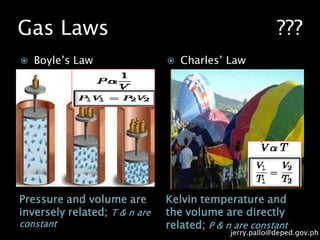
Pressure and volume are
inversely related; T & n are
constant
Kelvin temperature and
the volume are directly
related; P & n are constant
 Boyle’s Law  Charles’ Law
jerry.pallo@deped.gov.ph
Gas Laws
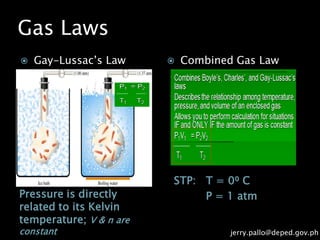
Pressure is directly
related to its Kelvin
temperature; V & n are
constant
STP: T = 0⁰ C
P = 1 atm
 Gay-Lussac’s Law  Combined Gas Law
jerry.pallo@deped.gov.ph
Gas Laws
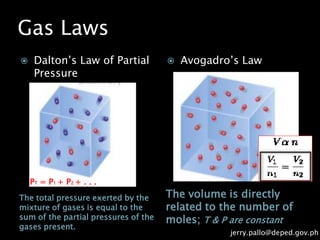
The total pressure exerted by the
mixture of gases is equal to the
sum of the partial pressures of the
gases present.
The volume is directly
related to the number of
moles; T & P are constant
 Dalton’s Law of Partial
Pressure
 Avogadro’s Law
PT = P1 + P2 + . . .
jerry.pallo@deped.gov.ph
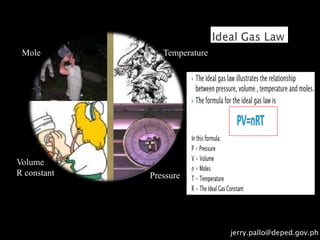
Mole
Pressure
Temperature
Volume
R constant
jerry.pallo@deped.gov.ph
Derivation of Gas Equations from
IDEAL GAS EQUATION
jerry.pallo@deped.gov.ph
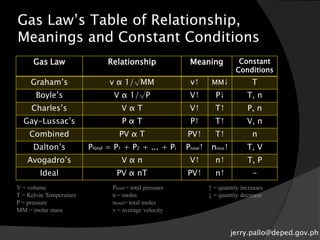
Gas Law’s Table of Relationship,
Meanings and Constant Conditions
Gas Law Relationship Meaning Constant
Conditions
Graham’s v α 1/√MM v↑ MM↓ T
Boyle’s V α 1/√P V↑ P↓ T, n
Charles’s V α T V↑ T↑ P, n
Gay-Lussac’s P α T P↑ T↑ V, n
Combined PV α T PV↑ T↑ n
Dalton’s Ptotal = P1 + P2 + ... + Pi Ptotal↑ ntotal↑ T, V
Avogadro’s V α n V↑ n↑ T, P
Ideal PV α nT PV↑ n↑ -
V = volume Ptotal = total pressure ↑ = quantity increases
T = Kelvin Temperature n = moles ↓ = quantity decrease
P = pressure ntotal= total moles
MM = molar mass v = average velocity
jerry.pallo@deped.gov.ph
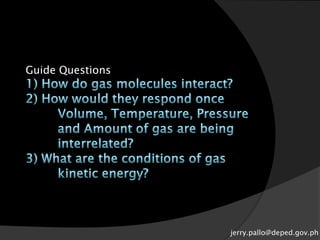
Guide Questions
jerry.pallo@deped.gov.ph
Performance Task
Criteria
 Relevance to the assigned topic –
50%
 Presentation and illustration –
35%
 Execution, participation and
organization –
15%
jerry.pallo@deped.gov.ph
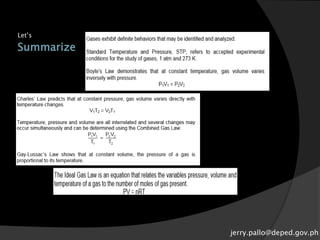
Summarize
Let’s
jerry.pallo@deped.gov.ph
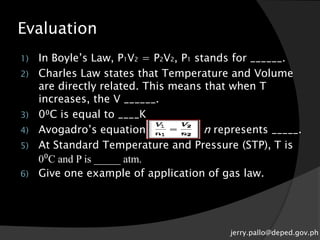
Evaluation
1) In Boyle’s Law, P1V2 = P2V2, P1 stands for ______.
2) Charles Law states that Temperature and Volume
are directly related. This means that when T
increases, the V ______.
3) 0⁰C is equal to ____K
4) Avogadro’s equation n represents _____.
5) At Standard Temperature and Pressure (STP), T is
0⁰C and P is _____ atm.
6) Give one example of application of gas law.
jerry.pallo@deped.gov.ph
Application of Gas Laws
jerry.pallo@deped.gov.ph
CHEMICAL REACTION
jerry.pallo@deped.gov.ph

Application gas laws pt

  • 1.
  • 2.
    Objectives  State andillustrate gas laws through group role play/ drawing/ news casting/ singing/ dancing  Demonstrate an understanding of how gases behave based on Kinetic Molecular Theory (KMT) of Gases jerry.pallo@deped.gov.ph
  • 3.
    Introduction  Air isall around us.  Like breathing, many other human activities involve gases.  Such as: air is pumped into a bicycle or automobile tire  Medical field – respirator, syringe jerry.pallo@deped.gov.ph
  • 4.
    Gas Laws ??? Pressureand volume are inversely related; T & n are constant Kelvin temperature and the volume are directly related; P & n are constant  Boyle’s Law  Charles’ Law jerry.pallo@deped.gov.ph
  • 5.
    Gas Laws Pressure isdirectly related to its Kelvin temperature; V & n are constant STP: T = 0⁰ C P = 1 atm  Gay-Lussac’s Law  Combined Gas Law jerry.pallo@deped.gov.ph
  • 6.
    Gas Laws The totalpressure exerted by the mixture of gases is equal to the sum of the partial pressures of the gases present. The volume is directly related to the number of moles; T & P are constant  Dalton’s Law of Partial Pressure  Avogadro’s Law PT = P1 + P2 + . . . jerry.pallo@deped.gov.ph
  • 7.
  • 8.
    Derivation of GasEquations from IDEAL GAS EQUATION jerry.pallo@deped.gov.ph
  • 9.
    Gas Law’s Tableof Relationship, Meanings and Constant Conditions Gas Law Relationship Meaning Constant Conditions Graham’s v α 1/√MM v↑ MM↓ T Boyle’s V α 1/√P V↑ P↓ T, n Charles’s V α T V↑ T↑ P, n Gay-Lussac’s P α T P↑ T↑ V, n Combined PV α T PV↑ T↑ n Dalton’s Ptotal = P1 + P2 + ... + Pi Ptotal↑ ntotal↑ T, V Avogadro’s V α n V↑ n↑ T, P Ideal PV α nT PV↑ n↑ - V = volume Ptotal = total pressure ↑ = quantity increases T = Kelvin Temperature n = moles ↓ = quantity decrease P = pressure ntotal= total moles MM = molar mass v = average velocity jerry.pallo@deped.gov.ph
  • 10.
  • 11.
    Performance Task Criteria  Relevanceto the assigned topic – 50%  Presentation and illustration – 35%  Execution, participation and organization – 15% jerry.pallo@deped.gov.ph
  • 12.
  • 13.
    Evaluation 1) In Boyle’sLaw, P1V2 = P2V2, P1 stands for ______. 2) Charles Law states that Temperature and Volume are directly related. This means that when T increases, the V ______. 3) 0⁰C is equal to ____K 4) Avogadro’s equation n represents _____. 5) At Standard Temperature and Pressure (STP), T is 0⁰C and P is _____ atm. 6) Give one example of application of gas law. jerry.pallo@deped.gov.ph
  • 14.
    Application of GasLaws jerry.pallo@deped.gov.ph
  • 15.