Dalton's Law The Law of Partial Pressures
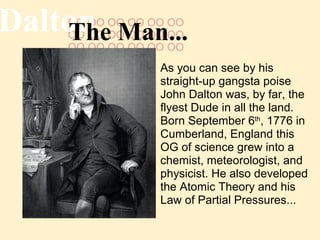
OO OO OO OO OO OO OO OO OO OO OO OO OO OO OO OO OO OO OO  Dalton The Man... As you can see by his straight-up gangsta poise John Dalton was, by far, the flyest Dude in all the land. Born September 6 th , 1776 in Cumberland, England this OG of science grew into a chemist, meteorologist, and physicist. He also developed the Atomic Theory and his Law of Partial Pressures...
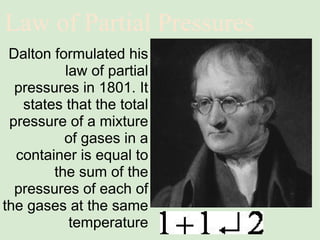
Law of Partial Pressures Dalton formulated his law of partial pressures in 1801. It states that the total pressure of a mixture of gases in a container is equal to the sum of the pressures of each of the gases at the same temperature
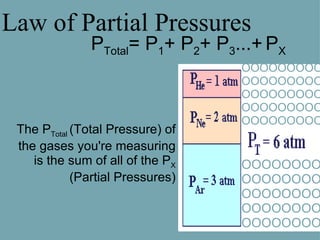
Law of Partial Pressures P Total = P 1 + P 2 + P 3 ...+   P X The P Total  (Total Pressure) of the gases you're measuring is the sum of all of the P X  (Partial Pressures) OOOOOOOOOOOOOOOOOO OOOOOOOOOOOOOOOOOO OOOOOOOOOOOOOOOOOO OOOOOOOOOOOOOOOOOO OOOOOOOOOOOOOOOOOO OOOOOOOOOOOOOOOO OOOOOOOOOOOOOOOO OOOOOOOOOOOOOOOO OOOOOOOOOOOOOOOO OOOOOOOO OOOOOOOOO OOOOOOOOOOOOOOOOOO
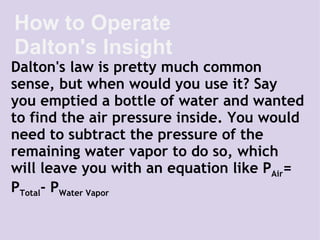
Dalton's law is pretty much common sense, but when would you use it? Say you emptied a bottle of water and wanted to find the air pressure inside. You would need to subtract the pressure of the remaining water vapor to do so, which will leave you with an equation like P Air = P Total - P Water Vapor How to Operate Dalton's Insight
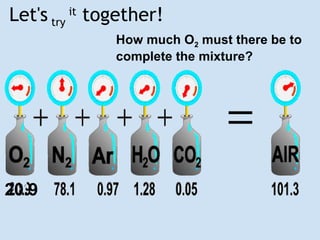
    Let's  try  it  together! OO OO 20.9 How much O 2  must there be to            complete the mixture?
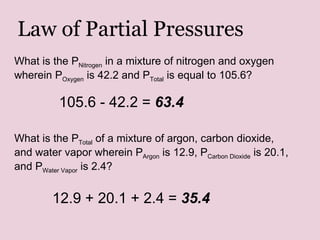
Law of Partial Pressures What is the P Nitrogen  in a mixture of nitrogen and oxygen wherein P Oxygen  is 42.2 and P Total  is equal to 105.6?         What is the P Total  of a mixture of argon, carbon dioxide, and water vapor wherein P Argon  is 12.9, P Carbon Dioxide  is 20.1, and P Water Vapor  is 2.4? 105.6 - 42.2 =  63.4 12.9 + 20.1 + 2.4 =  35.4
Works Cited http://library.thinkquest.org/12596/dalton.html   http://www.chm.davidson.edu/vce/gaslaws/daltonslaw.html    

Dalton's Law of Partial Pressures

  • 1.
    Dalton's Law TheLaw of Partial Pressures
  • 2.
    OO OO OOOO OO OO OO OO OO OO OO OO OO OO OO OO OO OO OO Dalton The Man... As you can see by his straight-up gangsta poise John Dalton was, by far, the flyest Dude in all the land. Born September 6 th , 1776 in Cumberland, England this OG of science grew into a chemist, meteorologist, and physicist. He also developed the Atomic Theory and his Law of Partial Pressures...
  • 3.
    Law of PartialPressures Dalton formulated his law of partial pressures in 1801. It states that the total pressure of a mixture of gases in a container is equal to the sum of the pressures of each of the gases at the same temperature
  • 4.
    Law of PartialPressures P Total = P 1 + P 2 + P 3 ...+   P X The P Total (Total Pressure) of the gases you're measuring is the sum of all of the P X (Partial Pressures) OOOOOOOOOOOOOOOOOO OOOOOOOOOOOOOOOOOO OOOOOOOOOOOOOOOOOO OOOOOOOOOOOOOOOOOO OOOOOOOOOOOOOOOOOO OOOOOOOOOOOOOOOO OOOOOOOOOOOOOOOO OOOOOOOOOOOOOOOO OOOOOOOOOOOOOOOO OOOOOOOO OOOOOOOOO OOOOOOOOOOOOOOOOOO
  • 5.
    Dalton's law ispretty much common sense, but when would you use it? Say you emptied a bottle of water and wanted to find the air pressure inside. You would need to subtract the pressure of the remaining water vapor to do so, which will leave you with an equation like P Air = P Total - P Water Vapor How to Operate Dalton's Insight
  • 6.
       Let's try it together! OO OO 20.9 How much O 2 must there be to            complete the mixture?
  • 7.
    Law of PartialPressures What is the P Nitrogen in a mixture of nitrogen and oxygen wherein P Oxygen is 42.2 and P Total is equal to 105.6?         What is the P Total of a mixture of argon, carbon dioxide, and water vapor wherein P Argon is 12.9, P Carbon Dioxide is 20.1, and P Water Vapor is 2.4? 105.6 - 42.2 = 63.4 12.9 + 20.1 + 2.4 = 35.4
  • 8.
    Works Cited http://library.thinkquest.org/12596/dalton.html  http://www.chm.davidson.edu/vce/gaslaws/daltonslaw.html