



Grade 10: Fourth Quarter
 Module 1: Behavior of
Gases
 Boyle’s Law
 Charles’ Law
 Gay-Lussac’s Law
 Combined Gas Laws
 Module 2: Chemical
Reactions
 Chemical change
 Chemical equation
 Types of chemical reactions
 Law of conservation of mass
 Factors affecting reaction
rate
 Module 3: Biomolecules
 Carbohydrates
 Lipid
 Proteins
 Nucleic acids
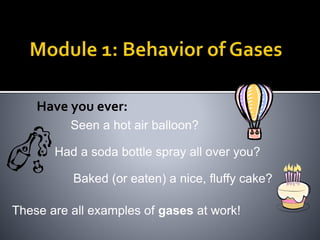
Have you ever:
Seen a hot air balloon?
Had a soda bottle spray all over you?
Baked (or eaten) a nice, fluffy cake?
These are all examples of gases at work!
 Gases have different properties.
 Indefinite shape and size
 Fit the shape and size of their containers.
 Far from one another
 Highly compressible
 Able to flow
 Have mass, volume, temperature, and
pressure.
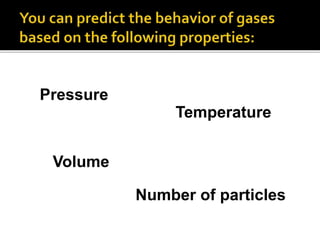
Pressure
Volume
Number of particles
Temperature
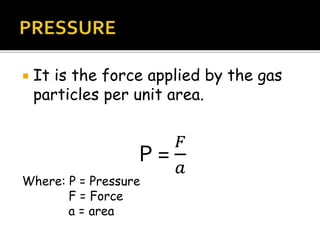
 It is the force applied by the gas
particles per unit area.
P =
𝐹
𝑎
Where: P = Pressure
F = Force
a = area
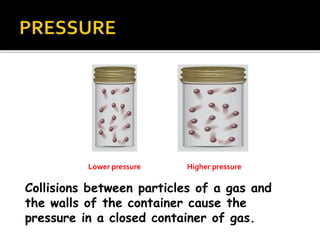
Lower pressure Higher pressure
Collisions between particles of a gas and
the walls of the container cause the
pressure in a closed container of gas.
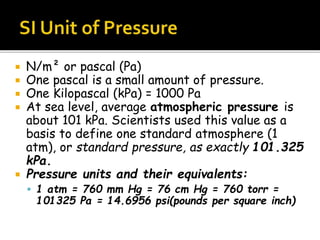
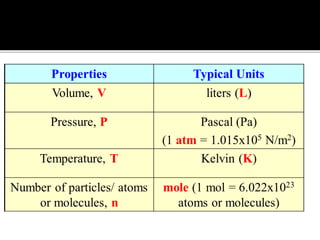
 N/m² or pascal (Pa)
 One pascal is a small amount of pressure.
 One Kilopascal (kPa) = 1000 Pa
 At sea level, average atmospheric pressure is
about 101 kPa. Scientists used this value as a
basis to define one standard atmosphere (1
atm), or standard pressure, as exactly 101.325
kPa.
 Pressure units and their equivalents:
 1 atm = 760 mm Hg = 76 cm Hg = 760 torr =
101325 Pa = 14.6956 psi(pounds per square inch)
 Factors that affect the
pressure of an enclosed gas are:
 Its temperature
 Its volume
 The number of its particles
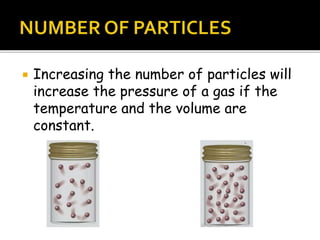
 Increasing the number of particles will
increase the pressure of a gas if the
temperature and the volume are
constant.
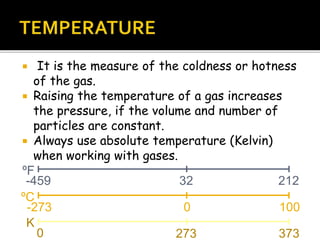
 It is the measure of the coldness or hotness
of the gas.
 Raising the temperature of a gas increases
the pressure, if the volume and number of
particles are constant.
 Always use absolute temperature (Kelvin)
when working with gases.
ºF
ºC
K
-459 32 212
-273 0 100
0 273 373
 It is the amount of space occupied by the
gases.
 It is the three-dimensional space inside
the container holding the gas.
 Reducing the volume of a gas increases its
pressure if the temperature of the gas
and the number of particles are constant.
 The SI unit for volume is the cubic meter,
m3. A more common and convenient unit is
the liter, L.
The observable properties of the gases are explained by the different gas
laws.
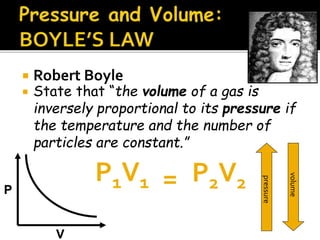
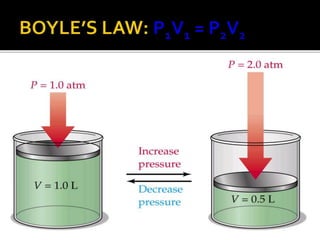
 Robert Boyle
 State that “the volume of a gas is
inversely proportional to its pressure if
the temperature and the number of
particles are constant.”
P
V
P1V1 = P2V2
pressure
volume
 A balloon contains 30.0 L of helium
gas at 103 kPa. What is the volume
of the helium when the balloon
rises to an altitude where the
pressure is only 25.0 kPa. (assume
that the Temperature remains
constant)
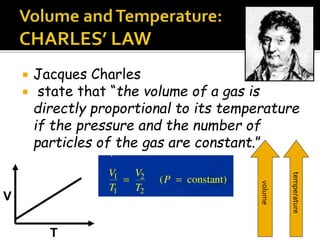
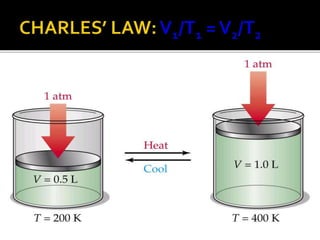
 Jacques Charles
 state that “the volume of a gas is
directly proportional to its temperature
if the pressure and the number of
particles of the gas are constant.”
volume
temperature
V
T
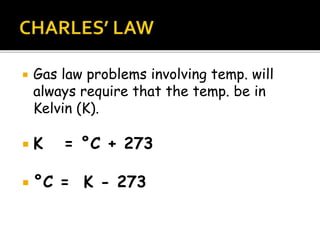
 Gas law problems involving temp. will
always require that the temp. be in
Kelvin (K).
 K = °C + 273
 °C = K - 273
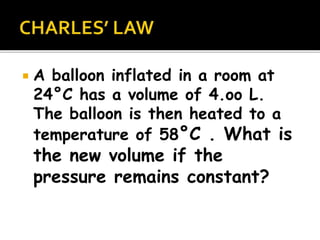
 A balloon inflated in a room at
24°C has a volume of 4.oo L.
The balloon is then heated to a
temperature of 58°C . What is
the new volume if the
pressure remains constant?
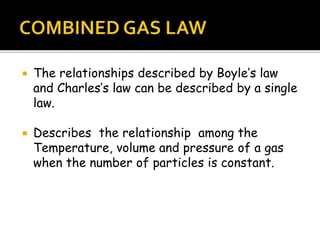
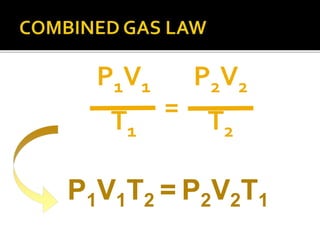
 The relationships described by Boyle’s law
and Charles’s law can be described by a single
law.
 Describes the relationship among the
Temperature, volume and pressure of a gas
when the number of particles is constant.
P1V1
T1
=
P2V2
T2
P1V1T2 = P2V2T1
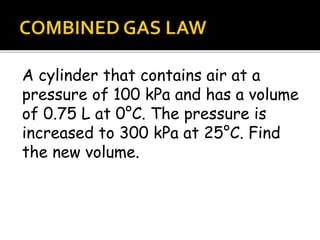
A cylinder that contains air at a
pressure of 100 kPa and has a volume
of 0.75 L at 0°C. The pressure is
increased to 300 kPa at 25°C. Find
the new volume.
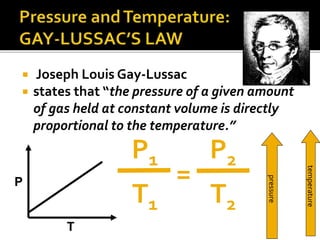
 Joseph Louis Gay-Lussac
 states that “the pressure of a given amount
of gas held at constant volume is directly
proportional to the temperature.”
P
T
P1
T1
=
P2
T2
pressure
temperature
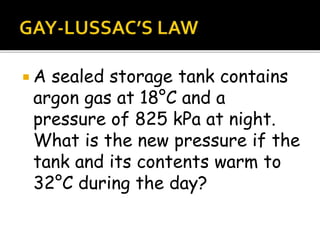
 A sealed storage tank contains
argon gas at 18°C and a
pressure of 825 kPa at night.
What is the new pressure if the
tank and its contents warm to
32°C during the day?
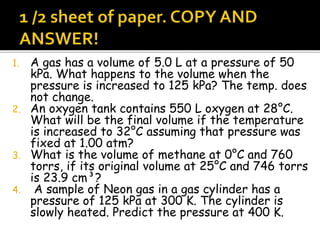
Solve the following problems.
1. A gas has a volume of 5.0 L at a pressure of 50
kPa. What happens to the volume when the
pressure is increased to 125 kPa? The temp. does
not change.
2. An oxygen tank contains 550 L oxygen at 28°C.
What will be the final volume if the temperature
is increased to 32°C assuming that pressure was
fixed at 1.00 atm?
3. What is the volume of methane at 0°C and 760
torrs, if its original volume at 25°C and 746 torrs
is 23.9 cm³?
4. A sample of Neon gas in a gas cylinder has a
pressure of 125 kPa at 300 K. The cylinder is
slowly heated. Predict the pressure at 400 K.
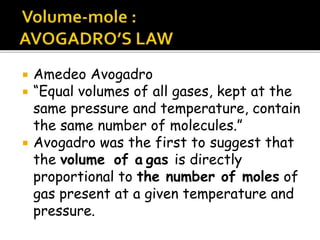
 Amedeo Avogadro
 “Equal volumes of all gases, kept at the
same pressure and temperature, contain
the same number of molecules.”
 Avogadro was the first to suggest that
the volume of a gas is directly
proportional to the number of moles of
gas present at a given temperature and
pressure.
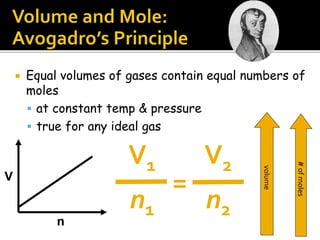
 Equal volumes of gases contain equal numbers of
moles
 at constant temp & pressure
 true for any ideal gas
V
n
V1
n1
=
V2
n2
volume
#ofmoles
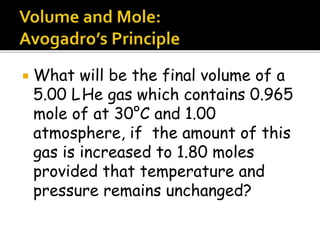
 What will be the final volume of a
5.00 LHe gas which contains 0.965
mole of at 30°C and 1.00
atmosphere, if the amount of this
gas is increased to 1.80 moles
provided that temperature and
pressure remains unchanged?
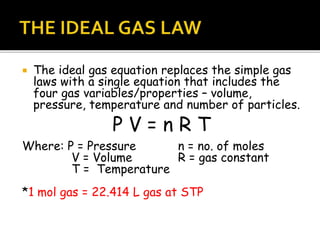
 The ideal gas equation replaces the simple gas
laws with a single equation that includes the
four gas variables/properties – volume,
pressure, temperature and number of particles.
P V = n R T
Where: P = Pressure n = no. of moles
V = Volume R = gas constant
T = Temperature
*1 mol gas = 22.414 L gas at STP
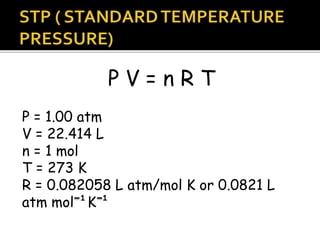
P V = n R T
P = 1.00 atm
V = 22.414 L
n = 1 mol
T = 273 K
R = 0.082058 L atm/mol K or 0.0821 L
atm mol ¹K ¹
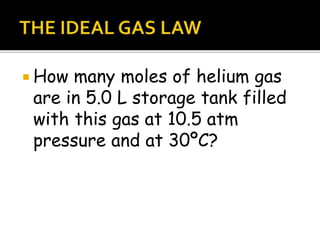
 How many moles of helium gas
are in 5.0 L storage tank filled
with this gas at 10.5 atm
pressure and at 30ºC?
1. Imagine that a gas is inside a cylinder with a
movable piston. If the volume of a gas is 2.0
L when the pressure is 760 torrs; what is the
volume of the gas if the pressure is halved?

Unit 4: Behavior of Gases

  • 1.
  • 2.
     Module 1:Behavior of Gases  Boyle’s Law  Charles’ Law  Gay-Lussac’s Law  Combined Gas Laws  Module 2: Chemical Reactions  Chemical change  Chemical equation  Types of chemical reactions  Law of conservation of mass  Factors affecting reaction rate  Module 3: Biomolecules  Carbohydrates  Lipid  Proteins  Nucleic acids
  • 3.
    Have you ever: Seena hot air balloon? Had a soda bottle spray all over you? Baked (or eaten) a nice, fluffy cake? These are all examples of gases at work!
  • 4.
     Gases havedifferent properties.  Indefinite shape and size  Fit the shape and size of their containers.  Far from one another  Highly compressible  Able to flow  Have mass, volume, temperature, and pressure.
  • 5.
  • 6.
     It isthe force applied by the gas particles per unit area. P = 𝐹 𝑎 Where: P = Pressure F = Force a = area
  • 7.
    Lower pressure Higherpressure Collisions between particles of a gas and the walls of the container cause the pressure in a closed container of gas.
  • 8.
     N/m² orpascal (Pa)  One pascal is a small amount of pressure.  One Kilopascal (kPa) = 1000 Pa  At sea level, average atmospheric pressure is about 101 kPa. Scientists used this value as a basis to define one standard atmosphere (1 atm), or standard pressure, as exactly 101.325 kPa.  Pressure units and their equivalents:  1 atm = 760 mm Hg = 76 cm Hg = 760 torr = 101325 Pa = 14.6956 psi(pounds per square inch)
  • 9.
     Factors thataffect the pressure of an enclosed gas are:  Its temperature  Its volume  The number of its particles
  • 10.
     Increasing thenumber of particles will increase the pressure of a gas if the temperature and the volume are constant.
  • 11.
     It isthe measure of the coldness or hotness of the gas.  Raising the temperature of a gas increases the pressure, if the volume and number of particles are constant.  Always use absolute temperature (Kelvin) when working with gases. ºF ºC K -459 32 212 -273 0 100 0 273 373
  • 12.
     It isthe amount of space occupied by the gases.  It is the three-dimensional space inside the container holding the gas.  Reducing the volume of a gas increases its pressure if the temperature of the gas and the number of particles are constant.  The SI unit for volume is the cubic meter, m3. A more common and convenient unit is the liter, L.
  • 14.
    The observable propertiesof the gases are explained by the different gas laws.
  • 15.
     Robert Boyle State that “the volume of a gas is inversely proportional to its pressure if the temperature and the number of particles are constant.” P V P1V1 = P2V2 pressure volume
  • 17.
     A ballooncontains 30.0 L of helium gas at 103 kPa. What is the volume of the helium when the balloon rises to an altitude where the pressure is only 25.0 kPa. (assume that the Temperature remains constant)
  • 18.
     Jacques Charles state that “the volume of a gas is directly proportional to its temperature if the pressure and the number of particles of the gas are constant.” volume temperature V T
  • 20.
     Gas lawproblems involving temp. will always require that the temp. be in Kelvin (K).  K = °C + 273  °C = K - 273
  • 21.
     A ballooninflated in a room at 24°C has a volume of 4.oo L. The balloon is then heated to a temperature of 58°C . What is the new volume if the pressure remains constant?
  • 22.
     The relationshipsdescribed by Boyle’s law and Charles’s law can be described by a single law.  Describes the relationship among the Temperature, volume and pressure of a gas when the number of particles is constant.
  • 23.
  • 24.
    A cylinder thatcontains air at a pressure of 100 kPa and has a volume of 0.75 L at 0°C. The pressure is increased to 300 kPa at 25°C. Find the new volume.
  • 25.
     Joseph LouisGay-Lussac  states that “the pressure of a given amount of gas held at constant volume is directly proportional to the temperature.” P T P1 T1 = P2 T2 pressure temperature
  • 26.
     A sealedstorage tank contains argon gas at 18°C and a pressure of 825 kPa at night. What is the new pressure if the tank and its contents warm to 32°C during the day?
  • 27.
  • 28.
    1. A gashas a volume of 5.0 L at a pressure of 50 kPa. What happens to the volume when the pressure is increased to 125 kPa? The temp. does not change. 2. An oxygen tank contains 550 L oxygen at 28°C. What will be the final volume if the temperature is increased to 32°C assuming that pressure was fixed at 1.00 atm? 3. What is the volume of methane at 0°C and 760 torrs, if its original volume at 25°C and 746 torrs is 23.9 cm³? 4. A sample of Neon gas in a gas cylinder has a pressure of 125 kPa at 300 K. The cylinder is slowly heated. Predict the pressure at 400 K.
  • 29.
     Amedeo Avogadro “Equal volumes of all gases, kept at the same pressure and temperature, contain the same number of molecules.”  Avogadro was the first to suggest that the volume of a gas is directly proportional to the number of moles of gas present at a given temperature and pressure.
  • 30.
     Equal volumesof gases contain equal numbers of moles  at constant temp & pressure  true for any ideal gas V n V1 n1 = V2 n2 volume #ofmoles
  • 31.
     What willbe the final volume of a 5.00 LHe gas which contains 0.965 mole of at 30°C and 1.00 atmosphere, if the amount of this gas is increased to 1.80 moles provided that temperature and pressure remains unchanged?
  • 32.
     The idealgas equation replaces the simple gas laws with a single equation that includes the four gas variables/properties – volume, pressure, temperature and number of particles. P V = n R T Where: P = Pressure n = no. of moles V = Volume R = gas constant T = Temperature *1 mol gas = 22.414 L gas at STP
  • 33.
    P V =n R T P = 1.00 atm V = 22.414 L n = 1 mol T = 273 K R = 0.082058 L atm/mol K or 0.0821 L atm mol ¹K ¹
  • 34.
     How manymoles of helium gas are in 5.0 L storage tank filled with this gas at 10.5 atm pressure and at 30ºC?
  • 37.
    1. Imagine thata gas is inside a cylinder with a movable piston. If the volume of a gas is 2.0 L when the pressure is 760 torrs; what is the volume of the gas if the pressure is halved?