GASES
PROPERTIES
OF GASES
Gases are compressible.
Gases fill any container that
they occupy.
Gases expand in the heat.
Gases do not settle in their
container.
KINETIC MOLECULAR
THEORY OF GASES
 A gas consists of very small particles. The
particles are in constant, random,
straight-line motion.
 The molecules of a gas are very far from
each other relative to their size.
 There is no interaction between molecules,
they act independently of each other.
 Molecules collide with each other and with
the walls of the container in a perfectly
elastic manner.
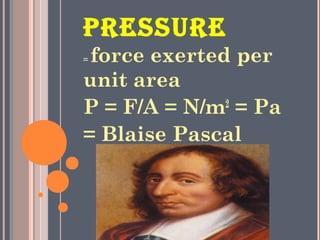
PRESSURE
= force exerted per
unit area
P = F/A = N/m2
= Pa
= Blaise Pascal
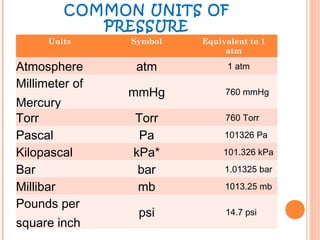
COMMON UNITS OF
PRESSURE
Units Symbol Equivalent to 1
atm
Atmosphere atm     1 atm
Millimeter of
Mercury
mmHg            760 mmHg
Torr Torr        760 Torr
Pascal Pa           101326 Pa
Kilopascal kPa*             101.326 kPa
Bar bar             1.01325 bar
Millibar mb             1013.25 mb
Pounds per
square inch
psi 14.7 psi
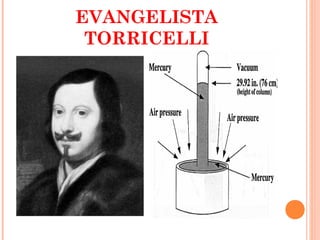
EVANGELISTA
TORRICELLI
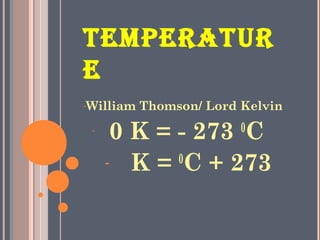
TEMPERATUR
E
-William Thomson/ Lord Kelvin
-
0 K = - 273 0
C
- K = 0
C + 273
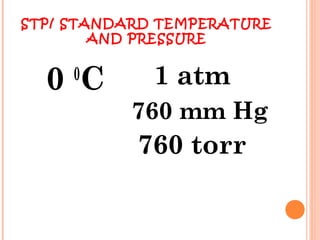
STP/ STANDARD TEMPERATURE
AND PRESSURE
0 0
C 1 atm
760 mm Hg
760 torr
GAS
LAWS
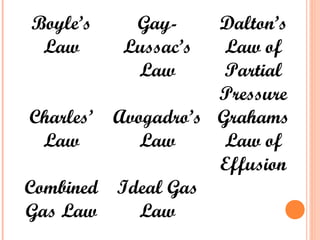
Boyle’s
Law
Gay-
Lussac’s
Law
Dalton’s
Law of
Partial
Pressure
Charles’
Law
Avogadro’s
Law
Grahams
Law of
Effusion
Combined
Gas Law
Ideal Gas
Law
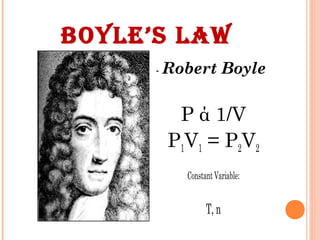
BOYLE’S LAW
- Robert Boyle
P ά 1/V
P1V1 = P2V2
Constant Variable:
T, n
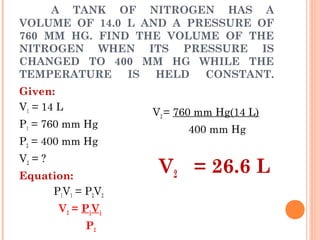
A TANK OF NITROGEN HAS A
VOLUME OF 14.0 L AND A PRESSURE OF
760 MM HG. FIND THE VOLUME OF THE
NITROGEN WHEN ITS PRESSURE IS
CHANGED TO 400 MM HG WHILE THE
TEMPERATURE IS HELD CONSTANT.
Given:
V1 = 14 L
P1 = 760 mm Hg
P2 = 400 mm Hg
V2 = ?
Equation:
P1V1 = P2V2 
V2 = P1V1
P2
V2 = 760 mm Hg(14 L)
400 mm Hg
 
V2 = 26.6 L
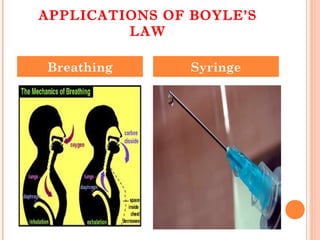
APPLICATIONS OF BOYLE’S
LAW
Breathing Syringe
APPLICATIONS OF BOYLE’S
LAW
Soda Can Scuba Diving
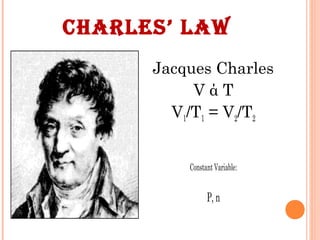
CHARLES’ LAW
Jacques Charles
V ά T
V1/T1 = V2/T2
Constant Variable:
P, n
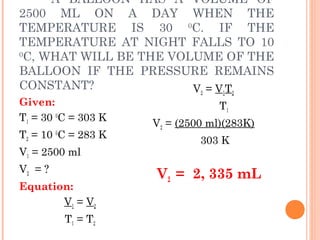
A BALLOON HAS A VOLUME OF
2500 ML ON A DAY WHEN THE
TEMPERATURE IS 30 0
C. IF THE
TEMPERATURE AT NIGHT FALLS TO 10
0
C, WHAT WILL BE THE VOLUME OF THE
BALLOON IF THE PRESSURE REMAINS
CONSTANT?
Given:
T1 = 30 0
C = 303 K
T2 = 10 0
C = 283 K
V1 = 2500 ml
V2 = ?
Equation:
V1 = V2
T1 = T2
V2 = V1T2
T1
V2 = (2500 ml)(283K)
303 K
V2 = 2, 335 mL
APPLICATIONS OF CHARLES’
LAW
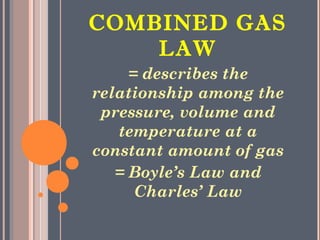
COMBINED GAS
LAW
= describes the
relationship among the
pressure, volume and
temperature at a
constant amount of gas
= Boyle’s Law and
Charles’ Law
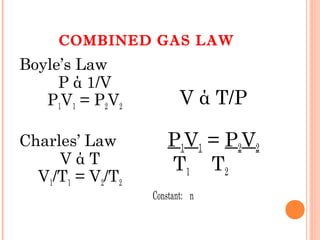
COMBINED GAS LAW
Boyle’s Law
P ά 1/V
P1V1 = P2V2
Charles’ Law
V ά T
V1/T1 = V2/T2
V ά T/P
P1V1 = P2V2
T1 T2
Constant: n
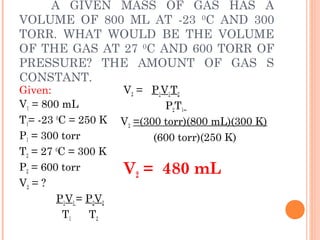
A GIVEN MASS OF GAS HAS A
VOLUME OF 800 ML AT -23 0
C AND 300
TORR. WHAT WOULD BE THE VOLUME
OF THE GAS AT 27 0
C AND 600 TORR OF
PRESSURE? THE AMOUNT OF GAS S
CONSTANT.
Given:
V1 = 800 mL
T1= -23 0
C = 250 K
P1 = 300 torr
T2 = 27 0
C = 300 K
P2 = 600 torr
V2 = ?
P1V1 = P2V2
T1 T2
 V2 = P1V1T2
P2T1
V2 =(300 torr)(800 mL)(300 K)
(600 torr)(250 K)
 
V2 = 480 mL
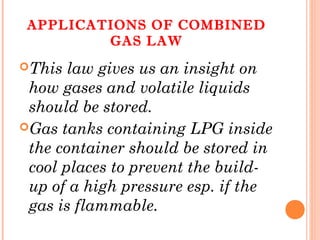
APPLICATIONS OF COMBINED
GAS LAW
This law gives us an insight on
how gases and volatile liquids
should be stored.
Gas tanks containing LPG inside
the container should be stored in
cool places to prevent the build-
up of a high pressure esp. if the
gas is flammable.
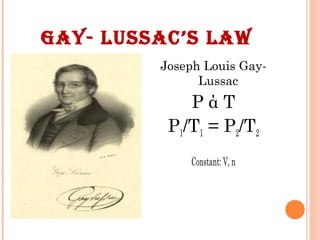
GAY- LUSSAC’S LAW
Joseph Louis Gay-
Lussac
P ά T
P1/T1 = P2/T2
Constant: V, n
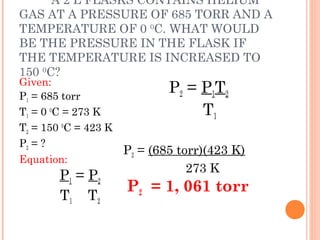
A 2 L FLASKS CONTAINS HELIUM
GAS AT A PRESSURE OF 685 TORR AND A
TEMPERATURE OF 0 0
C. WHAT WOULD
BE THE PRESSURE IN THE FLASK IF
THE TEMPERATURE IS INCREASED TO
150 0
C?
Given:
P1 = 685 torr
T1 = 0 0
C = 273 K
T2 = 150 0
C = 423 K
P2 = ?
Equation:
P1 = P2
T1 T2
 
P2 = P1T2
T1
P2 = (685 torr)(423 K)
273 K
P2 = 1, 061 torr
APPLICATIONS OF GAY-
LUSSAC’S LAW
Pressure
Cooker
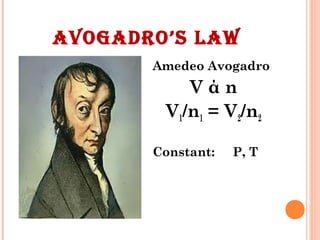
AVOGADRO’S LAW
Amedeo Avogadro
V ά n
V1/n1 = V2/n2
Constant: P, T
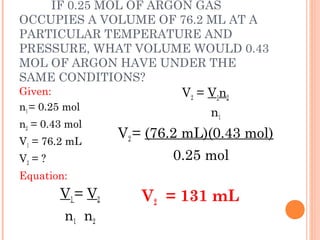
IF 0.25 MOL OF ARGON GAS
OCCUPIES A VOLUME OF 76.2 ML AT A
PARTICULAR TEMPERATURE AND
PRESSURE, WHAT VOLUME WOULD 0.43
MOL OF ARGON HAVE UNDER THE
SAME CONDITIONS?
Given:
n1 = 0.25 mol
n2 = 0.43 mol
V1 = 76.2 mL
V2 = ?
Equation:
V1 = V2
n1 n2
V2 = V1n2
n1
V2 = (76.2 mL)(0.43 mol)
0.25 mol
V2 = 131 mL
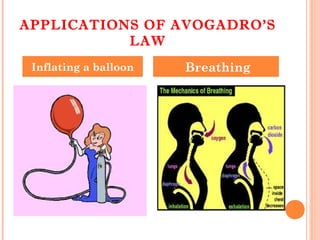
APPLICATIONS OF AVOGADRO’S
LAW
Inflating a balloon Breathing
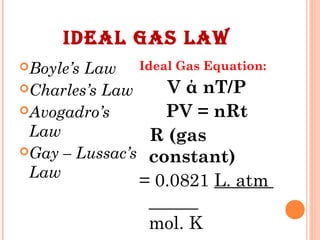
IDEAL GAS LAW
Boyle’s Law
Charles’s Law
Avogadro’s
Law
Gay – Lussac’s
Law
Ideal Gas Equation:
V ά nT/P
PV = nRt
R (gas
constant)
= 0.0821 L. atm
mol. K
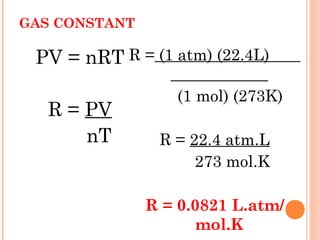
GAS CONSTANT
PV = nRT
R = PV
nT
R = (1 atm) (22.4L)
(1 mol) (273K)
R = 22.4 atm.L
273 mol.K
R = 0.0821 L.atm/
mol.K
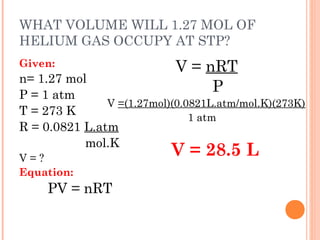
WHAT VOLUME WILL 1.27 MOL OF
HELIUM GAS OCCUPY AT STP?
Given:
n= 1.27 mol
P = 1 atm
T = 273 K
R = 0.0821 L.atm
mol.K
V = ?
Equation:
PV = nRT
 
V = nRT
P
V =(1.27mol)(0.0821L.atm/mol.K)(273K)
1 atm
V = 28.5 L
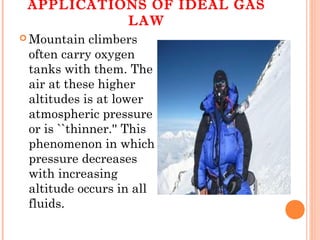
APPLICATIONS OF IDEAL GAS
LAW
 Mountain climbers
often carry oxygen
tanks with them. The
air at these higher
altitudes is at lower
atmospheric pressure
or is ``thinner.'' This
phenomenon in which
pressure decreases
with increasing
altitude occurs in all
fluids.
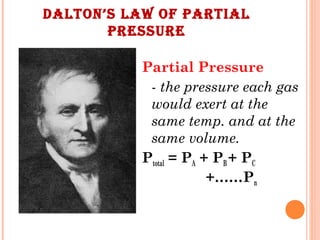
DALTON’S LAW OF PARTIAL
PRESSURE
Partial Pressure
- the pressure each gas
would exert at the
same temp. and at the
same volume.
Ptotal = PA + PB + PC
+……Pn
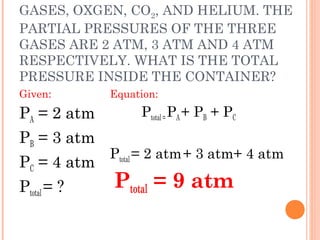
GASES, OXGEN, CO2, AND HELIUM. THE
PARTIAL PRESSURES OF THE THREE
GASES ARE 2 ATM, 3 ATM AND 4 ATM
RESPECTIVELY. WHAT IS THE TOTAL
PRESSURE INSIDE THE CONTAINER?
Given:
PA = 2 atm
PB = 3 atm
PC = 4 atm
Ptotal = ?
Equation:
Ptotal = PA + PB + PC
Ptotal = 2 atm+ 3 atm+ 4 atm
Ptotal = 9 atm
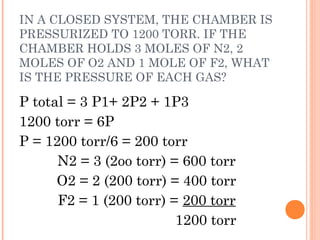
IN A CLOSED SYSTEM, THE CHAMBER IS
PRESSURIZED TO 1200 TORR. IF THE
CHAMBER HOLDS 3 MOLES OF N2, 2
MOLES OF O2 AND 1 MOLE OF F2, WHAT
IS THE PRESSURE OF EACH GAS?
P total = 3 P1+ 2P2 + 1P3
1200 torr = 6P
P = 1200 torr/6 = 200 torr
N2 = 3 (2oo torr) = 600 torr
O2 = 2 (200 torr) = 400 torr
F2 = 1 (200 torr) = 200 torr
1200 torr
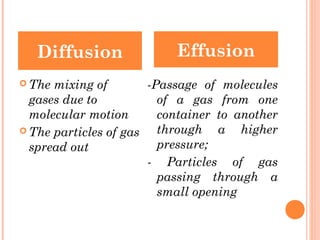
 The mixing of
gases due to
molecular motion
 The particles of gas
spread out
-Passage of molecules
of a gas from one
container to another
through a higher
pressure;
- Particles of gas
passing through a
small opening
Diffusion Effusion
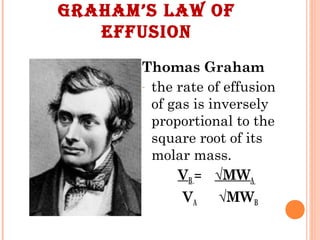
GRAHAM’S LAW OF
EFFUSION
Thomas Graham
- the rate of effusion
of gas is inversely
proportional to the
square root of its
molar mass.
VB = √MWA
VA √MWB
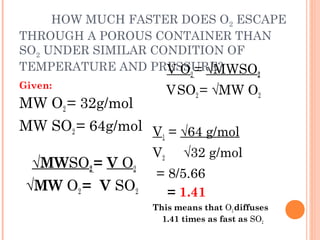
HOW MUCH FASTER DOES O2 ESCAPE
THROUGH A POROUS CONTAINER THAN
SO2 UNDER SIMILAR CONDITION OF
TEMPERATURE AND PRESSURE?
Given:
MW O2 = 32g/mol
MW SO2 = 64g/mol
√MWSO2 = V O2
√MW O2 = V SO2
 
V O2 = √MWSO2
VSO2 = √MW O2
V1 = √64 g/mol
V2 √32 g/mol
 = 8/5.66
= 1.41
This means that O2 diffuses
1.41 times as fast as SO2
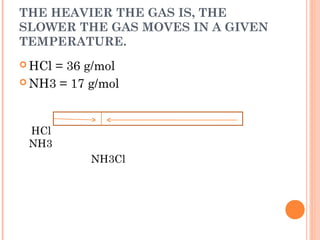
THE HEAVIER THE GAS IS, THE
SLOWER THE GAS MOVES IN A GIVEN
TEMPERATURE.
 HCl = 36 g/mol
 NH3 = 17 g/mol
HCl
NH3
NH3Cl
CONDENSED
STATES OF
MATTER
Solids and Liquids
- states in which the atoms or
molecules are fairly close
together and their behavior is
determined (at least in part)
by the attractions between
them.
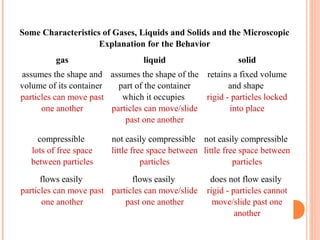
Some Characteristics of Gases, Liquids and Solids and the Microscopic
Explanation for the Behavior
gas liquid solid
assumes the shape and
volume of its container
particles can move past
one another
assumes the shape of the
part of the container
which it occupies
particles can move/slide
past one another
retains a fixed volume
and shape
rigid - particles locked
into place
compressible
lots of free space
between particles
not easily compressible
little free space between
particles
not easily compressible
little free space between
particles
flows easily
particles can move past
one another
flows easily
particles can move/slide
past one another
does not flow easily
rigid - particles cannot
move/slide past one
another
PROPERTIES OF
LIQUID
Evaporation
Vapor Pressure
Boiling Point
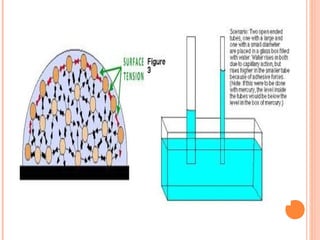
Surface Tension
Capillary Action
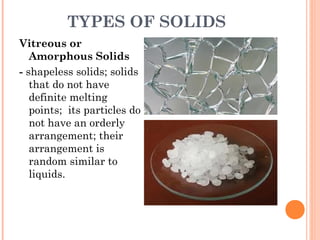
TYPES OF SOLIDS
Vitreous or
Amorphous Solids
- shapeless solids; solids
that do not have
definite melting
points; its particles do
not have an orderly
arrangement; their
arrangement is
random similar to
liquids.
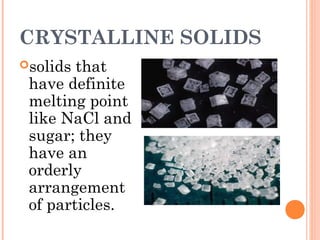
CRYSTALLINE SOLIDS
solids that
have definite
melting point
like NaCl and
sugar; they
have an
orderly
arrangement
of particles.
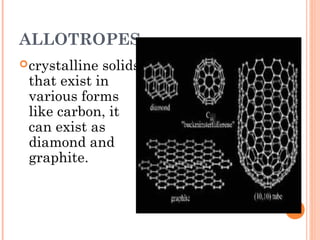
ALLOTROPES
crystalline solids
that exist in
various forms
like carbon, it
can exist as
diamond and
graphite.


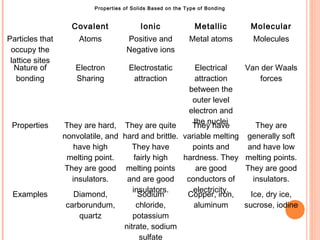
Covalent Ionic Metallic Molecular
Particles that
occupy the
lattice sites
Atoms Positive and
Negative ions
Metal atoms Molecules
Nature of
bonding
Electron
Sharing
Electrostatic
attraction
Electrical
attraction
between the
outer level
electron and
the nuclei
Van der Waals
forces
Properties They are hard,
nonvolatile, and
have high
melting point.
They are good
insulators.
They are quite
hard and brittle.
They have
fairly high
melting points
and are good
insulators.
They have
variable melting
points and
hardness. They
are good
conductors of
electricity.
They are
generally soft
and have low
melting points.
They are good
insulators.
Examples Diamond,
carborundum,
quartz
Sodium
chloride,
potassium
nitrate, sodium
sulfate
Copper, iron,
aluminum
Ice, dry ice,
sucrose, iodine
Properties of Solids Based on the Type of Bonding
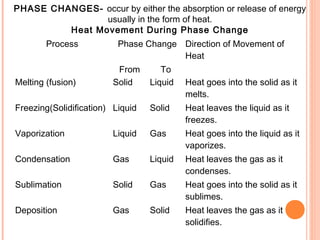
Process Phase Change Direction of Movement of
Heat
From To
Melting (fusion) Solid Liquid Heat goes into the solid as it
melts.
Freezing(Solidification) Liquid Solid Heat leaves the liquid as it
freezes.
Vaporization Liquid Gas Heat goes into the liquid as it
vaporizes.
Condensation Gas Liquid Heat leaves the gas as it
condenses.
Sublimation Solid Gas Heat goes into the solid as it
sublimes.
Deposition Gas Solid Heat leaves the gas as it
solidifies.
PHASE CHANGES- occur by either the absorption or release of energy
usually in the form of heat.
Heat Movement During Phase Change
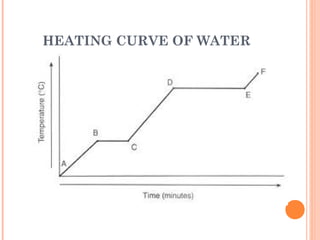
HEATING CURVE OF WATER
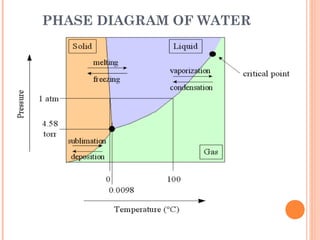
PHASE DIAGRAM OF WATER
THANK YOU
VERY
MUCH!!!
Prepared by:
Divina Michelle B. Belcina

Gases

  • 1.
  • 2.
  • 3.
    Gases are compressible. Gasesfill any container that they occupy. Gases expand in the heat. Gases do not settle in their container.
  • 4.
    KINETIC MOLECULAR THEORY OFGASES  A gas consists of very small particles. The particles are in constant, random, straight-line motion.  The molecules of a gas are very far from each other relative to their size.  There is no interaction between molecules, they act independently of each other.  Molecules collide with each other and with the walls of the container in a perfectly elastic manner.
  • 5.
    PRESSURE = force exertedper unit area P = F/A = N/m2 = Pa = Blaise Pascal
  • 6.
    COMMON UNITS OF PRESSURE UnitsSymbol Equivalent to 1 atm Atmosphere atm     1 atm Millimeter of Mercury mmHg            760 mmHg Torr Torr        760 Torr Pascal Pa           101326 Pa Kilopascal kPa*             101.326 kPa Bar bar             1.01325 bar Millibar mb             1013.25 mb Pounds per square inch psi 14.7 psi
  • 7.
  • 8.
    TEMPERATUR E -William Thomson/ LordKelvin - 0 K = - 273 0 C - K = 0 C + 273
  • 9.
    STP/ STANDARD TEMPERATURE ANDPRESSURE 0 0 C 1 atm 760 mm Hg 760 torr
  • 10.
  • 11.
  • 12.
    BOYLE’S LAW - RobertBoyle P ά 1/V P1V1 = P2V2 Constant Variable: T, n
  • 13.
    A TANK OFNITROGEN HAS A VOLUME OF 14.0 L AND A PRESSURE OF 760 MM HG. FIND THE VOLUME OF THE NITROGEN WHEN ITS PRESSURE IS CHANGED TO 400 MM HG WHILE THE TEMPERATURE IS HELD CONSTANT. Given: V1 = 14 L P1 = 760 mm Hg P2 = 400 mm Hg V2 = ? Equation: P1V1 = P2V2  V2 = P1V1 P2 V2 = 760 mm Hg(14 L) 400 mm Hg   V2 = 26.6 L
  • 14.
  • 15.
  • 16.
    CHARLES’ LAW Jacques Charles Vά T V1/T1 = V2/T2 Constant Variable: P, n
  • 17.
    A BALLOON HASA VOLUME OF 2500 ML ON A DAY WHEN THE TEMPERATURE IS 30 0 C. IF THE TEMPERATURE AT NIGHT FALLS TO 10 0 C, WHAT WILL BE THE VOLUME OF THE BALLOON IF THE PRESSURE REMAINS CONSTANT? Given: T1 = 30 0 C = 303 K T2 = 10 0 C = 283 K V1 = 2500 ml V2 = ? Equation: V1 = V2 T1 = T2 V2 = V1T2 T1 V2 = (2500 ml)(283K) 303 K V2 = 2, 335 mL
  • 18.
  • 19.
    COMBINED GAS LAW = describesthe relationship among the pressure, volume and temperature at a constant amount of gas = Boyle’s Law and Charles’ Law
  • 20.
    COMBINED GAS LAW Boyle’sLaw P ά 1/V P1V1 = P2V2 Charles’ Law V ά T V1/T1 = V2/T2 V ά T/P P1V1 = P2V2 T1 T2 Constant: n
  • 21.
    A GIVEN MASSOF GAS HAS A VOLUME OF 800 ML AT -23 0 C AND 300 TORR. WHAT WOULD BE THE VOLUME OF THE GAS AT 27 0 C AND 600 TORR OF PRESSURE? THE AMOUNT OF GAS S CONSTANT. Given: V1 = 800 mL T1= -23 0 C = 250 K P1 = 300 torr T2 = 27 0 C = 300 K P2 = 600 torr V2 = ? P1V1 = P2V2 T1 T2  V2 = P1V1T2 P2T1 V2 =(300 torr)(800 mL)(300 K) (600 torr)(250 K)   V2 = 480 mL
  • 22.
    APPLICATIONS OF COMBINED GASLAW This law gives us an insight on how gases and volatile liquids should be stored. Gas tanks containing LPG inside the container should be stored in cool places to prevent the build- up of a high pressure esp. if the gas is flammable.
  • 23.
    GAY- LUSSAC’S LAW JosephLouis Gay- Lussac P ά T P1/T1 = P2/T2 Constant: V, n
  • 24.
    A 2 LFLASKS CONTAINS HELIUM GAS AT A PRESSURE OF 685 TORR AND A TEMPERATURE OF 0 0 C. WHAT WOULD BE THE PRESSURE IN THE FLASK IF THE TEMPERATURE IS INCREASED TO 150 0 C? Given: P1 = 685 torr T1 = 0 0 C = 273 K T2 = 150 0 C = 423 K P2 = ? Equation: P1 = P2 T1 T2   P2 = P1T2 T1 P2 = (685 torr)(423 K) 273 K P2 = 1, 061 torr
  • 25.
  • 26.
    AVOGADRO’S LAW Amedeo Avogadro Vά n V1/n1 = V2/n2 Constant: P, T
  • 27.
    IF 0.25 MOLOF ARGON GAS OCCUPIES A VOLUME OF 76.2 ML AT A PARTICULAR TEMPERATURE AND PRESSURE, WHAT VOLUME WOULD 0.43 MOL OF ARGON HAVE UNDER THE SAME CONDITIONS? Given: n1 = 0.25 mol n2 = 0.43 mol V1 = 76.2 mL V2 = ? Equation: V1 = V2 n1 n2 V2 = V1n2 n1 V2 = (76.2 mL)(0.43 mol) 0.25 mol V2 = 131 mL
  • 28.
  • 29.
    IDEAL GAS LAW Boyle’sLaw Charles’s Law Avogadro’s Law Gay – Lussac’s Law Ideal Gas Equation: V ά nT/P PV = nRt R (gas constant) = 0.0821 L. atm mol. K
  • 30.
    GAS CONSTANT PV =nRT R = PV nT R = (1 atm) (22.4L) (1 mol) (273K) R = 22.4 atm.L 273 mol.K R = 0.0821 L.atm/ mol.K
  • 31.
    WHAT VOLUME WILL1.27 MOL OF HELIUM GAS OCCUPY AT STP? Given: n= 1.27 mol P = 1 atm T = 273 K R = 0.0821 L.atm mol.K V = ? Equation: PV = nRT   V = nRT P V =(1.27mol)(0.0821L.atm/mol.K)(273K) 1 atm V = 28.5 L
  • 32.
    APPLICATIONS OF IDEALGAS LAW  Mountain climbers often carry oxygen tanks with them. The air at these higher altitudes is at lower atmospheric pressure or is ``thinner.'' This phenomenon in which pressure decreases with increasing altitude occurs in all fluids.
  • 33.
    DALTON’S LAW OFPARTIAL PRESSURE Partial Pressure - the pressure each gas would exert at the same temp. and at the same volume. Ptotal = PA + PB + PC +……Pn
  • 34.
    GASES, OXGEN, CO2,AND HELIUM. THE PARTIAL PRESSURES OF THE THREE GASES ARE 2 ATM, 3 ATM AND 4 ATM RESPECTIVELY. WHAT IS THE TOTAL PRESSURE INSIDE THE CONTAINER? Given: PA = 2 atm PB = 3 atm PC = 4 atm Ptotal = ? Equation: Ptotal = PA + PB + PC Ptotal = 2 atm+ 3 atm+ 4 atm Ptotal = 9 atm
  • 35.
    IN A CLOSEDSYSTEM, THE CHAMBER IS PRESSURIZED TO 1200 TORR. IF THE CHAMBER HOLDS 3 MOLES OF N2, 2 MOLES OF O2 AND 1 MOLE OF F2, WHAT IS THE PRESSURE OF EACH GAS? P total = 3 P1+ 2P2 + 1P3 1200 torr = 6P P = 1200 torr/6 = 200 torr N2 = 3 (2oo torr) = 600 torr O2 = 2 (200 torr) = 400 torr F2 = 1 (200 torr) = 200 torr 1200 torr
  • 36.
     The mixingof gases due to molecular motion  The particles of gas spread out -Passage of molecules of a gas from one container to another through a higher pressure; - Particles of gas passing through a small opening Diffusion Effusion
  • 37.
    GRAHAM’S LAW OF EFFUSION ThomasGraham - the rate of effusion of gas is inversely proportional to the square root of its molar mass. VB = √MWA VA √MWB
  • 38.
    HOW MUCH FASTERDOES O2 ESCAPE THROUGH A POROUS CONTAINER THAN SO2 UNDER SIMILAR CONDITION OF TEMPERATURE AND PRESSURE? Given: MW O2 = 32g/mol MW SO2 = 64g/mol √MWSO2 = V O2 √MW O2 = V SO2   V O2 = √MWSO2 VSO2 = √MW O2 V1 = √64 g/mol V2 √32 g/mol  = 8/5.66 = 1.41 This means that O2 diffuses 1.41 times as fast as SO2
  • 39.
    THE HEAVIER THEGAS IS, THE SLOWER THE GAS MOVES IN A GIVEN TEMPERATURE.  HCl = 36 g/mol  NH3 = 17 g/mol HCl NH3 NH3Cl
  • 40.
    CONDENSED STATES OF MATTER Solids andLiquids - states in which the atoms or molecules are fairly close together and their behavior is determined (at least in part) by the attractions between them.
  • 41.
    Some Characteristics ofGases, Liquids and Solids and the Microscopic Explanation for the Behavior gas liquid solid assumes the shape and volume of its container particles can move past one another assumes the shape of the part of the container which it occupies particles can move/slide past one another retains a fixed volume and shape rigid - particles locked into place compressible lots of free space between particles not easily compressible little free space between particles not easily compressible little free space between particles flows easily particles can move past one another flows easily particles can move/slide past one another does not flow easily rigid - particles cannot move/slide past one another
  • 42.
    PROPERTIES OF LIQUID Evaporation Vapor Pressure BoilingPoint Surface Tension Capillary Action
  • 44.
    TYPES OF SOLIDS Vitreousor Amorphous Solids - shapeless solids; solids that do not have definite melting points; its particles do not have an orderly arrangement; their arrangement is random similar to liquids.
  • 45.
    CRYSTALLINE SOLIDS solids that havedefinite melting point like NaCl and sugar; they have an orderly arrangement of particles.
  • 46.
    ALLOTROPES crystalline solids that existin various forms like carbon, it can exist as diamond and graphite.      
  • 47.
    Covalent Ionic MetallicMolecular Particles that occupy the lattice sites Atoms Positive and Negative ions Metal atoms Molecules Nature of bonding Electron Sharing Electrostatic attraction Electrical attraction between the outer level electron and the nuclei Van der Waals forces Properties They are hard, nonvolatile, and have high melting point. They are good insulators. They are quite hard and brittle. They have fairly high melting points and are good insulators. They have variable melting points and hardness. They are good conductors of electricity. They are generally soft and have low melting points. They are good insulators. Examples Diamond, carborundum, quartz Sodium chloride, potassium nitrate, sodium sulfate Copper, iron, aluminum Ice, dry ice, sucrose, iodine Properties of Solids Based on the Type of Bonding
  • 48.
    Process Phase ChangeDirection of Movement of Heat From To Melting (fusion) Solid Liquid Heat goes into the solid as it melts. Freezing(Solidification) Liquid Solid Heat leaves the liquid as it freezes. Vaporization Liquid Gas Heat goes into the liquid as it vaporizes. Condensation Gas Liquid Heat leaves the gas as it condenses. Sublimation Solid Gas Heat goes into the solid as it sublimes. Deposition Gas Solid Heat leaves the gas as it solidifies. PHASE CHANGES- occur by either the absorption or release of energy usually in the form of heat. Heat Movement During Phase Change
  • 49.
  • 50.
  • 51.