Gases Part 1: Kinetic Molecular Theory
Kinetic Molecular Theory describes the behavior of gases in terms of particles in motion.  makes several assumptions about the  size motion, and  energy of gas particles.
Assumptions Particle size Particle motion Particle energy
Particle Size Gases consist of small particles that are separated from one another by empty space.  The volume of the particles is small compared with the volume of the empty space.
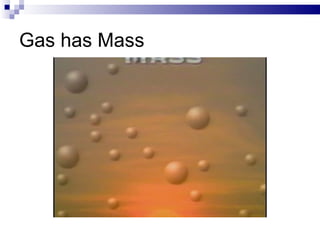
Gas has Mass
Particle motion Gas particles are in constant, random motion.  Particles move in a straight line until they collide with other particles or with the walls of their container.
Elastic Collisions Collisions between gas particles are elastic.  An  elastic collision  is one in which no kinetic energy is lost.
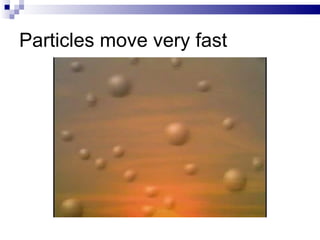
Particles move very fast
Particle energy Kinetic energy is a function of the mass and speed of a particle. In a sample of a single gas, all particles have the same mass but all particles do not have the same velocity.  Therefore, all particles do not have the same kinetic energy.
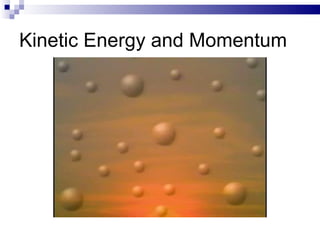
Kinetic Energy and Momentum
Properties of Gases Low density Compressible Diffuses
Low density Density – mass per unit of volume (g/cm 3 ) Density of gasses is much lower than the density of solids or liquids.
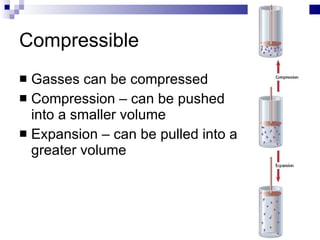
Compressible Gasses can be compressed Compression – can be pushed into a smaller volume Expansion – can be pulled into a greater volume
Diffusion the movement of one material through another. particles diffuse from an area of high concentration to one of low concentration
Temperature and Pressure Kinetic theory explains the temperature and pressure of gasses How fast the molecules of a gas are going How heavy the molecules are
Temperature Temperature  is a measure of the average kinetic energy of the particles in a sample of matter.
In other words… Temperature is related to How fast the molecules of a gas are moving How  often  the molecules hit the walls of the container
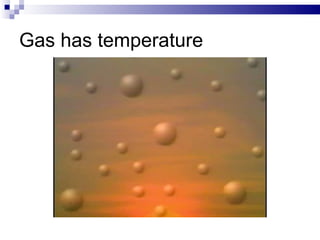
Gas has temperature
Pressure defined as force per unit area. Gas particles exert pressure when they collide with the walls of their container.
In other words… Pressure is related to How fast the molecules of a gas are moving How much the particles weigh How  hard  the molecules hit the walls of the container
Gas has pressure
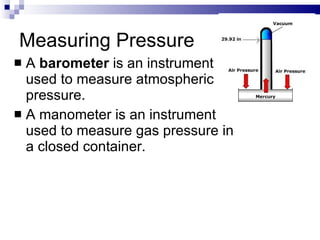
Measuring Pressure A  barometer  is an instrument used to measure atmospheric pressure. A manometer is an instrument used to measure gas pressure in a closed container.
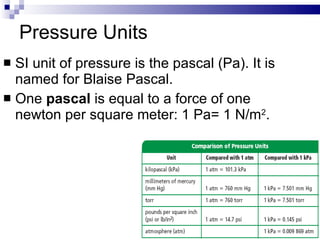
Pressure Units SI unit of pressure is the pascal (Pa). It is named for Blaise Pascal.  One  pascal  is equal to a force of one newton per square meter: 1 Pa= 1 N/m 2 .
Other Pressure Units engineers often report pressure as pounds per square inch (psi).  pressures measured by barometers and manometers can be reported in millimeters of mercury (mm Hg).
Air pressure At sea level, the average air pressure is 760 mm Hg when the temperature is 0°C. Air pressure often is reported in a unit called an atmosphere (atm). One  atmosphere  is equal to 760 mm Hg or 760 torr or 101.3 kilopascals (kPa).
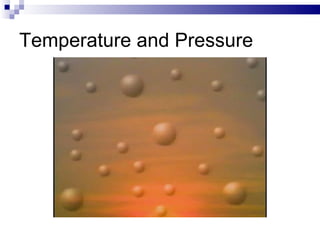
Temperature and Pressure Temperature and pressure are directly proportional As one goes up, the other goes up As one goes down, the other goes down
Temperature and Pressure
Temperature and volume
Volume and Pressure

Kinetic theory

  • 1.
    Gases Part 1:Kinetic Molecular Theory
  • 2.
    Kinetic Molecular Theorydescribes the behavior of gases in terms of particles in motion. makes several assumptions about the size motion, and energy of gas particles.
  • 3.
    Assumptions Particle sizeParticle motion Particle energy
  • 4.
    Particle Size Gasesconsist of small particles that are separated from one another by empty space. The volume of the particles is small compared with the volume of the empty space.
  • 5.
  • 6.
    Particle motion Gasparticles are in constant, random motion. Particles move in a straight line until they collide with other particles or with the walls of their container.
  • 7.
    Elastic Collisions Collisionsbetween gas particles are elastic. An elastic collision is one in which no kinetic energy is lost.
  • 8.
  • 9.
    Particle energy Kineticenergy is a function of the mass and speed of a particle. In a sample of a single gas, all particles have the same mass but all particles do not have the same velocity. Therefore, all particles do not have the same kinetic energy.
  • 10.
  • 11.
    Properties of GasesLow density Compressible Diffuses
  • 12.
    Low density Density– mass per unit of volume (g/cm 3 ) Density of gasses is much lower than the density of solids or liquids.
  • 13.
    Compressible Gasses canbe compressed Compression – can be pushed into a smaller volume Expansion – can be pulled into a greater volume
  • 14.
    Diffusion the movementof one material through another. particles diffuse from an area of high concentration to one of low concentration
  • 15.
    Temperature and PressureKinetic theory explains the temperature and pressure of gasses How fast the molecules of a gas are going How heavy the molecules are
  • 16.
    Temperature Temperature is a measure of the average kinetic energy of the particles in a sample of matter.
  • 17.
    In other words…Temperature is related to How fast the molecules of a gas are moving How often the molecules hit the walls of the container
  • 18.
  • 19.
    Pressure defined asforce per unit area. Gas particles exert pressure when they collide with the walls of their container.
  • 20.
    In other words…Pressure is related to How fast the molecules of a gas are moving How much the particles weigh How hard the molecules hit the walls of the container
  • 21.
  • 22.
    Measuring Pressure A barometer is an instrument used to measure atmospheric pressure. A manometer is an instrument used to measure gas pressure in a closed container.
  • 23.
    Pressure Units SIunit of pressure is the pascal (Pa). It is named for Blaise Pascal. One pascal is equal to a force of one newton per square meter: 1 Pa= 1 N/m 2 .
  • 24.
    Other Pressure Unitsengineers often report pressure as pounds per square inch (psi). pressures measured by barometers and manometers can be reported in millimeters of mercury (mm Hg).
  • 25.
    Air pressure Atsea level, the average air pressure is 760 mm Hg when the temperature is 0°C. Air pressure often is reported in a unit called an atmosphere (atm). One atmosphere is equal to 760 mm Hg or 760 torr or 101.3 kilopascals (kPa).
  • 26.
    Temperature and PressureTemperature and pressure are directly proportional As one goes up, the other goes up As one goes down, the other goes down
  • 27.
  • 28.
  • 29.