Today’s Lesson:
Charles’s Law & Boyle’s Law
Lesson Objective
Students will be able to describe Charles’s Gas Law and
Boyle’s Gas Law and use these laws to solve a real-life
problem relating to these concepts.
Charles’s Law
Definition
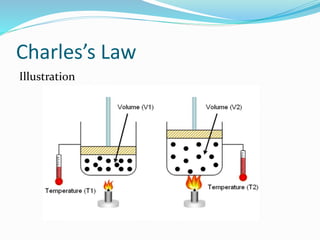
For an ideal gas at constant pressure, it’s volume is directly
proportional to its temperature.
(An ideal gas refers to a hypothetical gas whose molecules
occupy negligible space and have no interactions, and that
consequently obey the gas laws exactly.)
Charles’s Law
Illustration
Charles’s Law
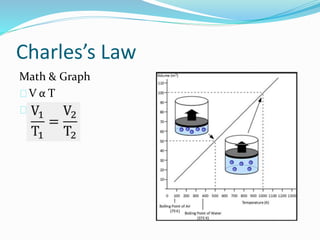
Math & Graph
V α T
Charles’s Law
Demonstration
The “Self-Inflating” Balloon
Boyle’s Law
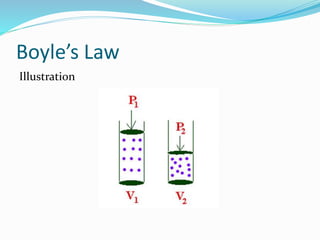
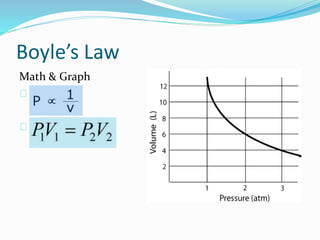
Definition
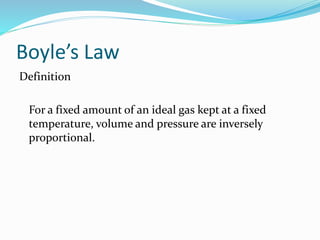
For a fixed amount of an ideal gas kept at a fixed
temperature, volume and pressure are inversely
proportional.
Boyle’s Law
Illustration
Boyle’s Law
Math & Graph
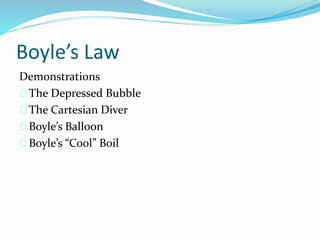
Boyle’s Law
Demonstrations
The Depressed Bubble
The Cartesian Diver
Boyle’s Balloon
Boyle’s “Cool” Boil
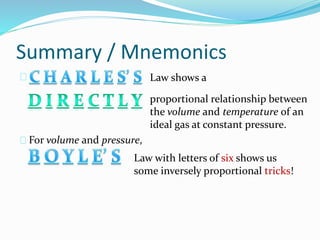
Summary / Mnemonics
Law shows a
proportional relationship between
the volume and temperature of an
ideal gas at constant pressure.
For volume and pressure,
Law with letters of six shows us
some inversely proportional tricks!
Application of Concepts
Read the “Double Flat” scenario and answer the open-
ended question that follows being sure to identify and
discuss the appropriate gas law(s) that help support
your answer.
If you do not have time to give me an answer during
this demo lesson, feel free to email me your answer
and/or comments about this lesson.
My E-mail: snobbigdet@gmail.com
Double Flat
I recently took a very long and hot bicycle trip from
Camp Hill, PA to Charlestown, SC. During my trip I
had a flat tire on my back wheel. When I changed the
flat I replaced the tube with a relatively cool (“cool” in
terms of temperature) tube from one of my bike bags
and inflated it to its maximum pressure with relatively
cool air from my bike pump. After putting the wheel
back onto my heavily loaded bike, I took-off again
immediately turning onto a dark-black, freshly-paved
road. Then, within 5 minutes, a surprising and
disappointing thing happened: THE SAME TIRE
WENT FLAT!
Open-Ended Question
Based on your understanding of Charles’s and Boyle’s
Gas Laws, why did my bicycle tire go flat a second time
so soon after it was changed?
Note: Look for clues in the scenario that connect to
one or more of the gas laws in order to identify and
discuss the appropriate gas law(s) to support your
answer.

The gas laws

  • 1.
  • 2.
    Lesson Objective Students willbe able to describe Charles’s Gas Law and Boyle’s Gas Law and use these laws to solve a real-life problem relating to these concepts.
  • 3.
    Charles’s Law Definition For anideal gas at constant pressure, it’s volume is directly proportional to its temperature. (An ideal gas refers to a hypothetical gas whose molecules occupy negligible space and have no interactions, and that consequently obey the gas laws exactly.)
  • 4.
  • 5.
  • 6.
  • 7.
    Boyle’s Law Definition For afixed amount of an ideal gas kept at a fixed temperature, volume and pressure are inversely proportional.
  • 8.
  • 9.
  • 10.
    Boyle’s Law Demonstrations The DepressedBubble The Cartesian Diver Boyle’s Balloon Boyle’s “Cool” Boil
  • 11.
    Summary / Mnemonics Lawshows a proportional relationship between the volume and temperature of an ideal gas at constant pressure. For volume and pressure, Law with letters of six shows us some inversely proportional tricks!
  • 12.
    Application of Concepts Readthe “Double Flat” scenario and answer the open- ended question that follows being sure to identify and discuss the appropriate gas law(s) that help support your answer. If you do not have time to give me an answer during this demo lesson, feel free to email me your answer and/or comments about this lesson. My E-mail: snobbigdet@gmail.com
  • 13.
    Double Flat I recentlytook a very long and hot bicycle trip from Camp Hill, PA to Charlestown, SC. During my trip I had a flat tire on my back wheel. When I changed the flat I replaced the tube with a relatively cool (“cool” in terms of temperature) tube from one of my bike bags and inflated it to its maximum pressure with relatively cool air from my bike pump. After putting the wheel back onto my heavily loaded bike, I took-off again immediately turning onto a dark-black, freshly-paved road. Then, within 5 minutes, a surprising and disappointing thing happened: THE SAME TIRE WENT FLAT!
  • 14.
    Open-Ended Question Based onyour understanding of Charles’s and Boyle’s Gas Laws, why did my bicycle tire go flat a second time so soon after it was changed? Note: Look for clues in the scenario that connect to one or more of the gas laws in order to identify and discuss the appropriate gas law(s) to support your answer.