Saturn
Orbital and Physical Properties Mass: 5.7 × 10 26  kg (97 times Earth)  Radius: 60,000 km (9.5 times Earth, .8 times Jupiter) Density: 700 kg/m 3  – less than water! Rotation: rapid and differential, enough to flatten Saturn considerably Rings: very prominent; wide but extremely thin
Saturn’s Atmosphere Saturn’s atmosphere also shows zone and band structure, but coloration is much more subdued than Jupiter’s Mostly molecular hydrogen, helium, methane, and ammonia; helium fraction is much less than on Jupiter
Saturn’s Atmosphere Similar to Jupiter’s, except  pressure  is lower Three  cloud layers Cloud layers are  thicker  than Jupiter’s; see only top layer
Saturn’s Cloud Structure
Saturn’s Atmosphere Wind patterns  on Saturn are similar to those on Jupiter, with  zonal flow :
Saturn’s Atmosphere Jupiter-style “ spots ” rare on Saturn; don’t form often and quickly dissipate if they do
A Storm on Saturn
Saturn, False Color
Saturn’s Interior and Magnetosphere Interior structure  similar to Jupiter’s:
Saturn’s Interior and Magnetosphere Like Jupiter, Saturn also  radiates  more energy than it gets from the Sun, but not because of cooling. Helium and hydrogen are not well-mixed; helium tends to condense into  droplets  and then fall Gravitational field  compresses helium and heats it up
Saturn’s Interior and Magnetosphere Saturn also has a strong  magnetic field , but only 5% as strong as Jupiter’s Creates  aurorae :
Saturn’s Spectacular Ring System Saturn has an extraordinarily large and complex  ring system , which was visible even to the first telescopes
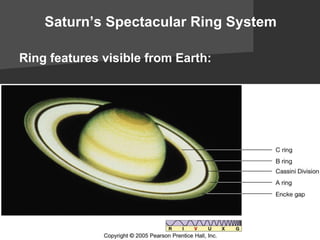
Saturn’s Spectacular Ring System Ring features  visible from Earth:
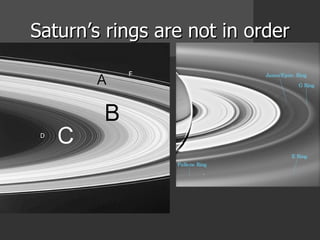
Saturn’s rings are not in order
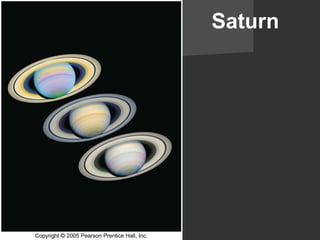
Saturn's rings change their appearance to terrestrial observers as the tilted ring plane orbits the Sun.
Saturn’s Spectacular Ring System Ring particles  range in size from fractions of a millimeter to tens of meters Composition : water ice – very similar to snowballs Why rings? Too close to planet for moon to form –  tidal forces  would tear it apart
Roche Limit
Saturn’s Spectacular Ring System Closest distance that moon could survive is called  Roche limit ; ring systems are all inside this limit
Saturn’s Spectacular Ring System Voyager  probes showed Saturn’s rings to be much more  complex  than originally thought Earth is shown on the same scale as the rings
Saturn’s Spectacular Ring System Voyager  also found radial “ spokes ” that formed and then dissipated; this probably happens frequently
Saturn’s Spectacular Ring System Cassini division  turns out not to be completely empty: It is caused by an orbital  resonance  with other ring particles and Saturn’s innermost moon
Saturn’s Spectacular Ring System Strangest  ring is outermost, F ring: It appears to have  braids  and  kinks .
Saturn’s Spectacular Ring System F ring’s oddities probably caused by two  shepherd moons , one of which can be seen here:
Saturn’s Spectacular Ring System Details of  formation  are unknown Too active to have lasted since birth of solar system Either must be continually  replenished , or are the result of a  catastrophic event
The Moons of Saturn Saturn’s many  moons  appear to be made of water ice Besides the small moons, Saturn has:  Six medium-sized moons ( Mimas ,  Enceladus ,  Tethys ,  Dione ,  Rhea , and  Iapetus ) One large moon ( Titan ) which is almost as large as Ganymede
 
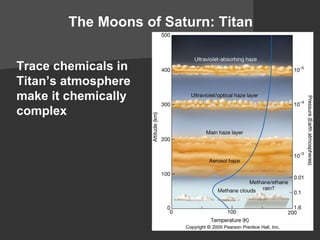
The Moons of Saturn: Titan Titan  has been known for many years to have an atmosphere  thicker  and  denser  than Earth’s; mostly nitrogen and argon Makes  surface  impossible to see; the picture at right was taken from only 4000 km away:
The Moons of Saturn: Titan Trace chemicals  in Titan’s atmosphere make it chemically complex
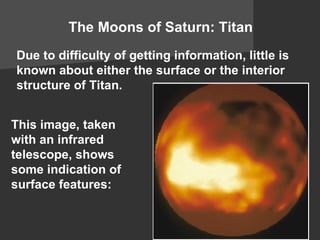
The Moons of Saturn: Titan Due to difficulty of getting information, little is known about either the  surface  or the  interior  structure of Titan. This image, taken with an  infrared  telescope, shows some indication of  surface features :
Cassini–Huygens Probe
On the surface of Titan Huygens discovered a semi-liquid surface with rocks Large bodies of liquid
Huygens to Titan
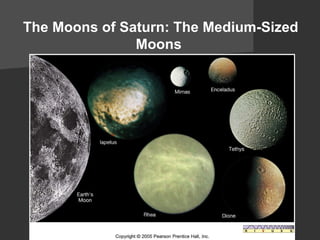
The Moons of Saturn: The Medium-Sized Moons
The Moons of Saturn: The Medium-Sized Moons Mimas ,  Enceladus ,  Tethys ,  Dione , and  Rhea  all orbit between 3 and 9 planetary radii from Saturn, and all are  tidally locked  – this means they have “ leading ” and “ trailing ” surfaces.  Iapetus  orbits 59 radii away, and is also tidally locked.
The Moons of Saturn: The Medium-Sized Moons Rhea , the largest, has a highly reflective, heavily  cratered  surface: Wispy features  are on trailing side but not leading; origin not yet understood:
The Moons of Saturn: The Medium-Sized Moons Dione  and  Tethys  are similar, having icy, heavily  cratered  surfaces:
The Moons of Saturn: The Medium-Sized Moons Mimas  is the closest moon to Saturn, and has a  crater  covering one-third of its surface, the result of an impact that must have almost destroyed the moon: That’s no moon! Oh, no. It totally is a moon.
The Moons of Saturn: The Medium-Sized Moons Enceladus  orbits close to Mimas, but is very  shiny , indicating a surface covered with ice crystals:
The Moons of Saturn: The Medium-Sized Moons Iapetus  is two-faced: its leading side is very  dark  (reflects 3% of incoming light), while its trailing side is  bright  (reflects 50% of incoming light). Cause is unknown.
Iapetus
Seeing Saturn Galileo was the first to see Saturn’s rings. He did not know what they were.
Seeing Saturn 1655 - Christiaan Huygens first to propose that Saturn is surrounded by a solid ring Huygens also discovered Titan
Seeing Saturn Giovanni Domenico Cassini was the first to observe 4 of Saturn’s moons Theorized (correctly) that Iapetus had a bright side and a dark side Discovered the Cassini Division in the rings
Exploring Saturn The Voyager missions flew by Saturn in 1980 and 1981 Cassini is currently in orbit around Saturn The Huygens probe was parachuted onto the surface of Titan in 2005
The Other Side of Saturn
Summary Saturn, like Jupiter, rotates differentially and is significantly flattened Saturn’s weather patterns are in some ways similar to Jupiter’s, but there are far fewer storms Saturn generates its own heat through the compression of “helium raindrops” Saturn has a large magnetic field and extensive magnetosphere
Summary Saturn’s most prominent feature is its rings, which are in its equatorial plane The rings have considerable gross and fine structure, with segments and gaps; their particles are icy and grain- to boulder-sized Interactions with medium and small moons determines the ring structure The rings are entirely within the Roche limit, where larger bodies would be torn apart by tidal forces
Summary Titan is the second-largest moon in the solar system Titan has an extremely thick atmosphere, and little is known about its surface or interior Medium-sized moons are rock and water ice; their terrains vary These moons are tidally locked to Saturn

Saturn

  • 1.
  • 2.
    Orbital and PhysicalProperties Mass: 5.7 × 10 26 kg (97 times Earth) Radius: 60,000 km (9.5 times Earth, .8 times Jupiter) Density: 700 kg/m 3 – less than water! Rotation: rapid and differential, enough to flatten Saturn considerably Rings: very prominent; wide but extremely thin
  • 3.
    Saturn’s Atmosphere Saturn’satmosphere also shows zone and band structure, but coloration is much more subdued than Jupiter’s Mostly molecular hydrogen, helium, methane, and ammonia; helium fraction is much less than on Jupiter
  • 4.
    Saturn’s Atmosphere Similarto Jupiter’s, except pressure is lower Three cloud layers Cloud layers are thicker than Jupiter’s; see only top layer
  • 5.
  • 6.
    Saturn’s Atmosphere Windpatterns on Saturn are similar to those on Jupiter, with zonal flow :
  • 7.
    Saturn’s Atmosphere Jupiter-style“ spots ” rare on Saturn; don’t form often and quickly dissipate if they do
  • 8.
    A Storm onSaturn
  • 9.
  • 10.
    Saturn’s Interior andMagnetosphere Interior structure similar to Jupiter’s:
  • 11.
    Saturn’s Interior andMagnetosphere Like Jupiter, Saturn also radiates more energy than it gets from the Sun, but not because of cooling. Helium and hydrogen are not well-mixed; helium tends to condense into droplets and then fall Gravitational field compresses helium and heats it up
  • 12.
    Saturn’s Interior andMagnetosphere Saturn also has a strong magnetic field , but only 5% as strong as Jupiter’s Creates aurorae :
  • 13.
    Saturn’s Spectacular RingSystem Saturn has an extraordinarily large and complex ring system , which was visible even to the first telescopes
  • 14.
    Saturn’s Spectacular RingSystem Ring features visible from Earth:
  • 15.
  • 16.
    Saturn's rings changetheir appearance to terrestrial observers as the tilted ring plane orbits the Sun.
  • 17.
    Saturn’s Spectacular RingSystem Ring particles range in size from fractions of a millimeter to tens of meters Composition : water ice – very similar to snowballs Why rings? Too close to planet for moon to form – tidal forces would tear it apart
  • 18.
  • 19.
    Saturn’s Spectacular RingSystem Closest distance that moon could survive is called Roche limit ; ring systems are all inside this limit
  • 20.
    Saturn’s Spectacular RingSystem Voyager probes showed Saturn’s rings to be much more complex than originally thought Earth is shown on the same scale as the rings
  • 21.
    Saturn’s Spectacular RingSystem Voyager also found radial “ spokes ” that formed and then dissipated; this probably happens frequently
  • 22.
    Saturn’s Spectacular RingSystem Cassini division turns out not to be completely empty: It is caused by an orbital resonance with other ring particles and Saturn’s innermost moon
  • 23.
    Saturn’s Spectacular RingSystem Strangest ring is outermost, F ring: It appears to have braids and kinks .
  • 24.
    Saturn’s Spectacular RingSystem F ring’s oddities probably caused by two shepherd moons , one of which can be seen here:
  • 25.
    Saturn’s Spectacular RingSystem Details of formation are unknown Too active to have lasted since birth of solar system Either must be continually replenished , or are the result of a catastrophic event
  • 26.
    The Moons ofSaturn Saturn’s many moons appear to be made of water ice Besides the small moons, Saturn has: Six medium-sized moons ( Mimas , Enceladus , Tethys , Dione , Rhea , and Iapetus ) One large moon ( Titan ) which is almost as large as Ganymede
  • 27.
  • 28.
    The Moons ofSaturn: Titan Titan has been known for many years to have an atmosphere thicker and denser than Earth’s; mostly nitrogen and argon Makes surface impossible to see; the picture at right was taken from only 4000 km away:
  • 29.
    The Moons ofSaturn: Titan Trace chemicals in Titan’s atmosphere make it chemically complex
  • 30.
    The Moons ofSaturn: Titan Due to difficulty of getting information, little is known about either the surface or the interior structure of Titan. This image, taken with an infrared telescope, shows some indication of surface features :
  • 31.
  • 32.
    On the surfaceof Titan Huygens discovered a semi-liquid surface with rocks Large bodies of liquid
  • 33.
  • 34.
    The Moons ofSaturn: The Medium-Sized Moons
  • 35.
    The Moons ofSaturn: The Medium-Sized Moons Mimas , Enceladus , Tethys , Dione , and Rhea all orbit between 3 and 9 planetary radii from Saturn, and all are tidally locked – this means they have “ leading ” and “ trailing ” surfaces. Iapetus orbits 59 radii away, and is also tidally locked.
  • 36.
    The Moons ofSaturn: The Medium-Sized Moons Rhea , the largest, has a highly reflective, heavily cratered surface: Wispy features are on trailing side but not leading; origin not yet understood:
  • 37.
    The Moons ofSaturn: The Medium-Sized Moons Dione and Tethys are similar, having icy, heavily cratered surfaces:
  • 38.
    The Moons ofSaturn: The Medium-Sized Moons Mimas is the closest moon to Saturn, and has a crater covering one-third of its surface, the result of an impact that must have almost destroyed the moon: That’s no moon! Oh, no. It totally is a moon.
  • 39.
    The Moons ofSaturn: The Medium-Sized Moons Enceladus orbits close to Mimas, but is very shiny , indicating a surface covered with ice crystals:
  • 40.
    The Moons ofSaturn: The Medium-Sized Moons Iapetus is two-faced: its leading side is very dark (reflects 3% of incoming light), while its trailing side is bright (reflects 50% of incoming light). Cause is unknown.
  • 41.
  • 42.
    Seeing Saturn Galileowas the first to see Saturn’s rings. He did not know what they were.
  • 43.
    Seeing Saturn 1655- Christiaan Huygens first to propose that Saturn is surrounded by a solid ring Huygens also discovered Titan
  • 44.
    Seeing Saturn GiovanniDomenico Cassini was the first to observe 4 of Saturn’s moons Theorized (correctly) that Iapetus had a bright side and a dark side Discovered the Cassini Division in the rings
  • 45.
    Exploring Saturn TheVoyager missions flew by Saturn in 1980 and 1981 Cassini is currently in orbit around Saturn The Huygens probe was parachuted onto the surface of Titan in 2005
  • 46.
    The Other Sideof Saturn
  • 47.
    Summary Saturn, likeJupiter, rotates differentially and is significantly flattened Saturn’s weather patterns are in some ways similar to Jupiter’s, but there are far fewer storms Saturn generates its own heat through the compression of “helium raindrops” Saturn has a large magnetic field and extensive magnetosphere
  • 48.
    Summary Saturn’s mostprominent feature is its rings, which are in its equatorial plane The rings have considerable gross and fine structure, with segments and gaps; their particles are icy and grain- to boulder-sized Interactions with medium and small moons determines the ring structure The rings are entirely within the Roche limit, where larger bodies would be torn apart by tidal forces
  • 49.
    Summary Titan isthe second-largest moon in the solar system Titan has an extremely thick atmosphere, and little is known about its surface or interior Medium-sized moons are rock and water ice; their terrains vary These moons are tidally locked to Saturn