Gas Laws,
Clinical Implications and
Importance in Anaesthesia
Presenter: Dr. Suresh Pradhan
Outline
• introduction
• definitions
• gas laws and clinical implications
Introduction
• origins of the Gas laws came out of experimental
work conducted during the seventeenth and
eighteenth centuries by several people
• these experiments ultimately gave us the three gas
laws
• the theoretical construct that arises from the gas
laws is the concept of an ideal gas
• this is a gas that does obey the laws completely
under all circumstances
• as the laws break down at the extremes of
temperature and pressures, there is no gas that
obeys all the laws perfectly
• in our practical day-to-day use at room
temperature they can be assumed to do so and this
simplifies our consideration of them
Definitions
 Gas
• a substance that is in its gaseous phase, but is
above its critical temperature
• Critical temperature is the temperature above
which a gas cannot be liquefied no matter how
high the pressure applied is
• a vapour in contrast is a substance in the
gaseous phase but is below its critical
temperature
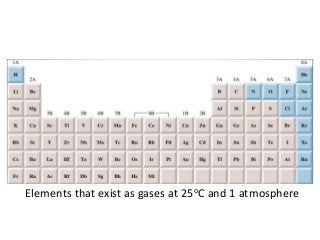
Elements that exist as gases at 25oC and 1 atmosphere
• assume the volume and shape of their containers
• most compressible state of matter
• mix evenly and completely when confined to
the same container
• much lower densities than liquids and solids
 Ideal gas
• theoretical
• negligible intermolecular forces
• collisions between atoms or molecules are
perfectly elastic
• obeys universal gas law PV= nRT at all temp &
pressures
 Real gas
• Real gases H2, N2 , O2
• exhibit properties that cannot be explained
• entirely using the ideal gas law
• behave like ideal gas at STP
• air at atmospheric pressure is a nearly ideal
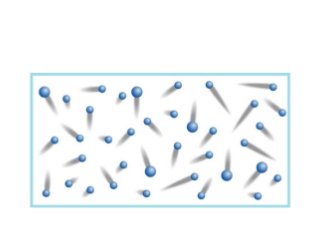
 Kinetic theory of Gases
• this model assumes that the molecules have
very small sizes relative to the distance between
them and that the molecules are in constant,
random motion related to their kinetic energy
• is given by e=½ mv2, where m is the mass of the
molecules and v is its velocity
• the molecules frequently collide with each other
and with the walls of the container holding the
gas molecules
 like all molecules, gas molecules have physical
properties of mass, velocity, momentum, and
energy
 at the macroscopic level these properties are
related to properties of density, pressure, and
temperature
 the temperature of a gas is related to the mean
kinetic energy of the gas
 the higher the temperature, the greater the
molecular motion
Pressure
• is defined as "the force per unit area acting at
right angles to the surface under consideration”
• Pressure = Force/Area
• unit of pressure is the Pascal
• pressure is the consequence of molecular
bombardment of the surface by the gas
• Kinetic energy is transferred to the surface and a
force is produced that creates the pressure
• if the volume falls, the pressure goes up because
the area for collisions fall and so more kinetic
energy transfer per unit area, and so an increase
in pressure
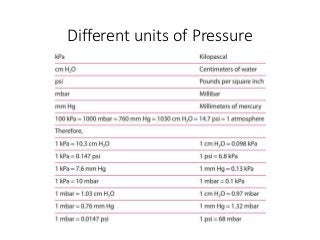
• other units of pressure
• atmospheres
• mm Hg
• cm H20
• PSI (pounds per square inch)
• dynes/cm2
Different units of Pressure
 Temperature
• is a physical quantity expressing the subjective
perceptions of hot and cold
• is a measure of the average kinetic energy in a
system
• denotes the degree of hotness or coldness of
the system
• is measured with a thermometer, historically
calibrated in various temperature scales
and units of measurement
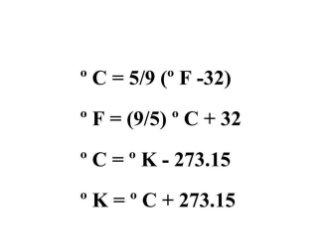
• the most commonly used scales are the Celsius
scale, denoted in °C, the Fahrenheit scale (°F),
and the Kelvin scale
• the kelvin (K) is the unit of temperature in
the International System of Units (SI), in which
temperature is one of the seven
fundamental base units
• the divisions of the Kelvin and Celsius scale are
the same but the start points differ
• 0oC is 273K, so body temperature is 310K on this
scale
• the lowest theoretical temperature is absolute
zero, at which the thermal motion of all
fundamental particles in matter reaches a
minimum
• although classically described as motionless,
particles still possess a finite zero-point
energy in the quantum mechanical description
• absolute zero is denoted as 0 K on the Kelvin
scale, −273.15 °C on the Celsius scale, and
−459.67 °F on the Fahrenheit scale
 Standard Temperature & Pressure (STP)
• IUPAC has changed the definition in 1982
• until 1982, STP was defined as a temperature of
273.15 K (0 °C, 32 °F) and an absolute
pressure of exactly 1 atm (1.01325 × 10⁵ Pa)
• Since 1982, STP is defined as a temperature of
273.15 K (0 °C, 32 °F) and an absolute pressure
of exactly 105 Pa (100 kPa, 1 bar)
 Volume
• space occupied by a substance measured in
three dimensions by cubic cm or cubic mm
• common units used to express volume include
liters, cubic meters, gallons, milliliters
GAS LAWS
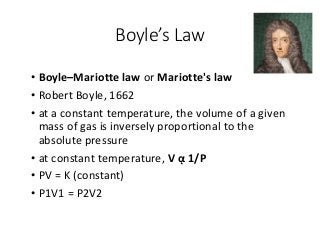
Boyle’s Law
• Boyle–Mariotte law or Mariotte's law
• Robert Boyle, 1662
• at a constant temperature, the volume of a given
mass of gas is inversely proportional to the
absolute pressure
• at constant temperature, V ᾳ 1/P
• PV = K (constant)
• P1V1 = P2V2
Clinical Implication
 Calculation of Amount of gas in a cylinder
• oxygen cylinder of volume 10 L, Pressure = 138
bars
• So how much oxygen is stored?
• P1V1=P2V2
• 138X10=1XV2
• i.e. V2=1380L
• so, if we use oxygen@3l/m, the cylinder will last
for about 460 mins
Gas Laws and
Anaesthetic Implications
…..contd……
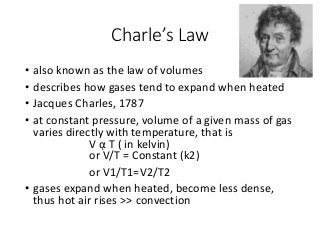
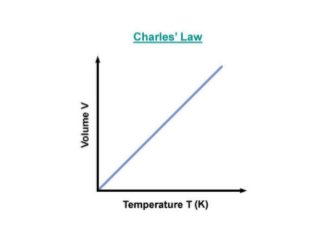
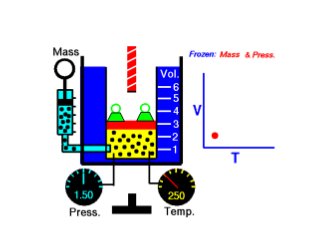
Charle’s Law
• also known as the law of volumes
• describes how gases tend to expand when heated
• Jacques Charles, 1787
• at constant pressure, volume of a given mass of gas
varies directly with temperature, that is
V ᾳ T ( in kelvin)
or V/T = Constant (k2)
or V1/T1=V2/T2
• gases expand when heated, become less dense,
thus hot air rises >> convection
Clinical Implication
• respiratory gas measurements of tidal volume &
vital capacity etc. are done at ambient temperature
while these exchanges actually take place in the
body at 37OC
• one way of heat loss from the body is that air next
to the body surface gets warmer and moves up and
thus our patient loses heat this way (esp. important
in pediatric anaesthesia)
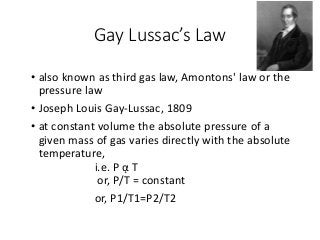
Gay Lussac’s Law
• also known as third gas law, Amontons' law or the
pressure law
• Joseph Louis Gay-Lussac, 1809
• at constant volume the absolute pressure of a
given mass of gas varies directly with the absolute
temperature,
i.e. P ᾳ T
or, P/T = constant
or, P1/T1=P2/T2
Clinical Implication
• medical gases are stored in cylinders having a
constant volume and high pressures (138 Barr in a
full oxygen / air cylinder); if these are stored at high
temperatures, pressures will rise causing explosions
• molybdenum steel can withstand pressures till 210
bars. Weakening of metal in damaged cylinders are
at a greater risk of explosion due to rise in
temperature
Combined Gas Law
• Boyle’s + Charle’s + Gay Lussac’s law
• PV/T=k
• P1V1 / T1 = P2V2 / T2
• useful for converting gas volumes collected under
one set of conditions to a new volume for a
different set of conditions
• Clinical application:
• in spirometry, measurement of volumes is done at
ambient condition of T and P; so correction should be
done by a factor of 1.07
Avogadro’s Hypothesis/Law
• an experimental gas law relating volume of a gas to
the amount of substance of gas present
• equal volumes of all gases, at same temperature
and pressure, have the same number of molecules
• can also be defined as one mole of a gas contains
6.023x10²³ (avogadro’s number) molecules and
occupies 22.4L at STP
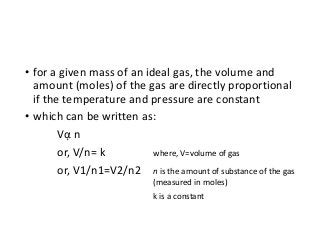
• for a given mass of an ideal gas, the volume and
amount (moles) of the gas are directly proportional
if the temperature and pressure are constant
• which can be written as:
Vᾳ n
or, V/n= k where, V=volume of gas
or, V1/n1=V2/n2 n is the amount of substance of the gas
(measured in moles)
k is a constant
Clinical Implication
Ideal Gas Law
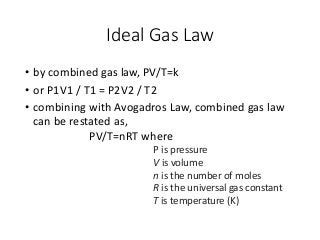
• by combined gas law, PV/T=k
• or P1V1 / T1 = P2V2 / T2
• combining with Avogadros Law, combined gas law
can be restated as,
PV/T=nRT where
P is pressure
V is volume
n is the number of moles
R is the universal gas constant
T is temperature (K)
• the equation are exact only for an ideal gas, which
neglects various intermolecular effects
• however, the ideal gas law is a good approximation
for most gases under moderate pressure and
temperature
This law has the following important consequences:
i. if temperature and pressure are kept constant,
then the volume of the gas is directly
proportional to the number of molecules of gas
ii. if the temperature and volume remain constant,
then the pressure of the gas changes is directly
proportional to the number of molecules of gas
present
iii. if the number of gas molecules and the
temperature remain constant, then the
pressure is inversely proportional to the volume
iv. if the temperature changes and the number of
gas molecules are kept constant, then either
pressure or volume (or both) will change in
direct proportion to the temperature
Clinical Implication
• this equation may be used in anaesthesia when
calculating the contents of an oxygen cylinder
- constant room temp
- fixed internal volume
- R is a constant
• Only variables are P and n so that
P ∝ n
• therefore, pressure gauge acts as a content gauge
for gases – measure of amount of O2 left in a
cylinder
BUT,
• we cannot use a nitrous oxide cylinder pressure
gauge in the same way as these cylinders contain
both vapour & liquid and so the gas laws do not
apply
Dalton’s Law of Partial Pressures
• John Dalton , 1801
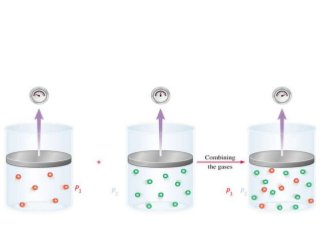
• in a mixture of gases, pressure exerted by each gas
is the same as that which it would exert if it alone
occupied the container
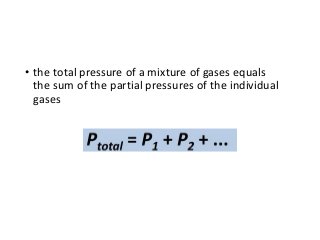
• the total pressure of a mixture of gases equals
the sum of the partial pressures of the individual
gases
Adiabatic compression or
expansion of gases
• if the state of a gas is altered without a change in
heat energy , it is said to undergo adiabatic change
• adiabatic, when applied to expansion or
compression of a gas, means that energy is not
added or removed when the changes occur.
⌐ Compression of gas – temperature rises
⌐ Expansion of gas – temperature falls
 joule thompson effect states that when a gas is
allowed to escape through a narrow opening,
there is a sudden temperature drop
Clinical Implication
• compression of gases will require added cooling
• in cyroprobe, expansion of gas in the probe – low
temperature in probe tip
• compression of air rapidly in compressor >>
↑ temp >> need of coolant
• cylinder connected to an anesthetic machine
rapidly turned on >> ↑↑ temperature in gauges &
pipelines >> fire or explosion
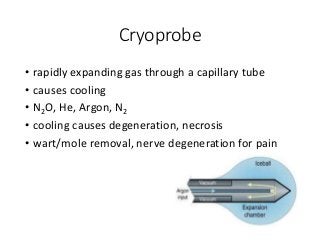
Cryoprobe
• rapidly expanding gas through a capillary tube
• causes cooling
• N2O, He, Argon, N2
• cooling causes degeneration, necrosis
• wart/mole removal, nerve degeneration for pain
• manufacture of oxygen:
• when air is cooled by external cooling and is
made to suddenly expand, it loses further
temperature as energy is spent in order to hold
the molecules together (Joule Thomson’s Effect)
• when this is repeated many times the
temperature reduces to less than -1830C and
through fractional distillation, liquid oxygen
collected in the lower part is separated from
nitrogen with a boiling point of -197oC which
collects at the top of the container
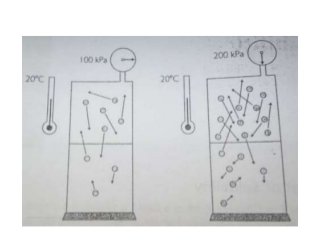
Henry’s Law
• William Henry in 1803
• Henry’s law states that for a gas-liquid interface the
amount of the gas that dissolves in the liquid is
proportional to its partial pressure
• so Henry’s law helps to predict how much gas will
be dissolved in the liquid
• at constant temperature,
Solubility of gas ᾳ Partial Pressure of gas
Graham’s Law
• states that the rate of diffusion of gases is inversely
proportional to the square root of its molecular
weight
• so the larger the molecule, the slower it diffuses
Clinical Implication
• explains the second gas effect when using nitrous
and a volatile anaesthetic in oxygen
• for example, halothane is more massive than
nitrous oxide, Graham’s law will indicate that the
nitrous will diffuse quicker and so raise the
concentration of the halothane in the alveolus.
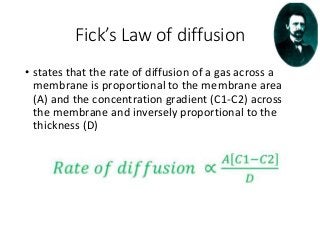
Fick’s Law of diffusion
• states that the rate of diffusion of a gas across a
membrane is proportional to the membrane area
(A) and the concentration gradient (C1-C2) across
the membrane and inversely proportional to the
thickness (D)
Clinical Implication
• anaesthetic vapour diffusing into breathing
circuits and later acting as vaporizers at the time
of discontinuation of anaesthetic agents
• N2O diffusion into cuff of ETT
• diffusion of N2O into air filled cavities
Critical temperature
• temperature above which a gas cannot be liquefied
• No matter how much pressure!
• For N2O 36.5oC, -119oC for O2
• for CO2 = 31.1oC
Critical Pressure
• minimum pressure that causes liquefaction of a gas
at its critical temperature (for CO2 pc = 73
atmospheres)
• so CO2 liquefies ↓ 73 atm at 31.1 0C
Pseudocritical temperature
• when two gases, one of high and another of low
critical temperature are mixed in a container, the
critical temperature of the gas with a high critical
temperature will decrease to a lower level (pseudo
critical temperature) and the mixture will remain
as a gas above this pseudo critical temperature
• this effect is called as Poynting effect
• is the temperature of a gas mixture at which the
gas mixture may separate out into constituents
gases
• Entonox
• N2O 50% / O2 50% = - 5.5°C for cylinders (most
likely at 117 bar)
• N2O 50% / O2 50% = - 30° C for piped gas
Thank you!!!
• venturi effect
• coanada effect

Gas laws and anaesthetic implications

  • 1.
    Gas Laws, Clinical Implicationsand Importance in Anaesthesia Presenter: Dr. Suresh Pradhan
  • 2.
    Outline • introduction • definitions •gas laws and clinical implications
  • 3.
    Introduction • origins ofthe Gas laws came out of experimental work conducted during the seventeenth and eighteenth centuries by several people • these experiments ultimately gave us the three gas laws • the theoretical construct that arises from the gas laws is the concept of an ideal gas
  • 4.
    • this isa gas that does obey the laws completely under all circumstances • as the laws break down at the extremes of temperature and pressures, there is no gas that obeys all the laws perfectly • in our practical day-to-day use at room temperature they can be assumed to do so and this simplifies our consideration of them
  • 5.
    Definitions  Gas • asubstance that is in its gaseous phase, but is above its critical temperature • Critical temperature is the temperature above which a gas cannot be liquefied no matter how high the pressure applied is • a vapour in contrast is a substance in the gaseous phase but is below its critical temperature
  • 6.
    Elements that existas gases at 25oC and 1 atmosphere
  • 7.
    • assume thevolume and shape of their containers • most compressible state of matter • mix evenly and completely when confined to the same container • much lower densities than liquids and solids
  • 8.
     Ideal gas •theoretical • negligible intermolecular forces • collisions between atoms or molecules are perfectly elastic • obeys universal gas law PV= nRT at all temp & pressures
  • 9.
     Real gas •Real gases H2, N2 , O2 • exhibit properties that cannot be explained • entirely using the ideal gas law • behave like ideal gas at STP • air at atmospheric pressure is a nearly ideal
  • 10.
     Kinetic theoryof Gases • this model assumes that the molecules have very small sizes relative to the distance between them and that the molecules are in constant, random motion related to their kinetic energy • is given by e=½ mv2, where m is the mass of the molecules and v is its velocity • the molecules frequently collide with each other and with the walls of the container holding the gas molecules
  • 12.
     like allmolecules, gas molecules have physical properties of mass, velocity, momentum, and energy  at the macroscopic level these properties are related to properties of density, pressure, and temperature  the temperature of a gas is related to the mean kinetic energy of the gas  the higher the temperature, the greater the molecular motion
  • 13.
    Pressure • is definedas "the force per unit area acting at right angles to the surface under consideration” • Pressure = Force/Area • unit of pressure is the Pascal • pressure is the consequence of molecular bombardment of the surface by the gas • Kinetic energy is transferred to the surface and a force is produced that creates the pressure
  • 14.
    • if thevolume falls, the pressure goes up because the area for collisions fall and so more kinetic energy transfer per unit area, and so an increase in pressure • other units of pressure • atmospheres • mm Hg • cm H20 • PSI (pounds per square inch) • dynes/cm2
  • 15.
  • 16.
     Temperature • isa physical quantity expressing the subjective perceptions of hot and cold • is a measure of the average kinetic energy in a system • denotes the degree of hotness or coldness of the system
  • 17.
    • is measuredwith a thermometer, historically calibrated in various temperature scales and units of measurement • the most commonly used scales are the Celsius scale, denoted in °C, the Fahrenheit scale (°F), and the Kelvin scale • the kelvin (K) is the unit of temperature in the International System of Units (SI), in which temperature is one of the seven fundamental base units
  • 18.
    • the divisionsof the Kelvin and Celsius scale are the same but the start points differ • 0oC is 273K, so body temperature is 310K on this scale • the lowest theoretical temperature is absolute zero, at which the thermal motion of all fundamental particles in matter reaches a minimum
  • 19.
    • although classicallydescribed as motionless, particles still possess a finite zero-point energy in the quantum mechanical description • absolute zero is denoted as 0 K on the Kelvin scale, −273.15 °C on the Celsius scale, and −459.67 °F on the Fahrenheit scale
  • 21.
     Standard Temperature& Pressure (STP) • IUPAC has changed the definition in 1982 • until 1982, STP was defined as a temperature of 273.15 K (0 °C, 32 °F) and an absolute pressure of exactly 1 atm (1.01325 × 10⁵ Pa) • Since 1982, STP is defined as a temperature of 273.15 K (0 °C, 32 °F) and an absolute pressure of exactly 105 Pa (100 kPa, 1 bar)
  • 22.
     Volume • spaceoccupied by a substance measured in three dimensions by cubic cm or cubic mm • common units used to express volume include liters, cubic meters, gallons, milliliters
  • 23.
  • 24.
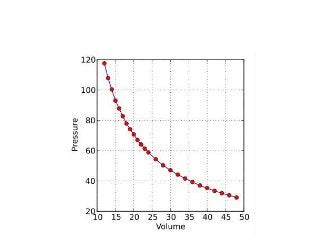
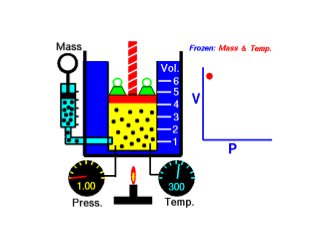
    Boyle’s Law • Boyle–Mariottelaw or Mariotte's law • Robert Boyle, 1662 • at a constant temperature, the volume of a given mass of gas is inversely proportional to the absolute pressure • at constant temperature, V ᾳ 1/P • PV = K (constant) • P1V1 = P2V2
  • 27.
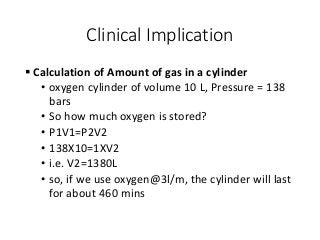
    Clinical Implication  Calculationof Amount of gas in a cylinder • oxygen cylinder of volume 10 L, Pressure = 138 bars • So how much oxygen is stored? • P1V1=P2V2 • 138X10=1XV2 • i.e. V2=1380L • so, if we use oxygen@3l/m, the cylinder will last for about 460 mins
  • 28.
    Gas Laws and AnaestheticImplications …..contd……
  • 29.
    Charle’s Law • alsoknown as the law of volumes • describes how gases tend to expand when heated • Jacques Charles, 1787 • at constant pressure, volume of a given mass of gas varies directly with temperature, that is V ᾳ T ( in kelvin) or V/T = Constant (k2) or V1/T1=V2/T2 • gases expand when heated, become less dense, thus hot air rises >> convection
  • 32.
    Clinical Implication • respiratorygas measurements of tidal volume & vital capacity etc. are done at ambient temperature while these exchanges actually take place in the body at 37OC • one way of heat loss from the body is that air next to the body surface gets warmer and moves up and thus our patient loses heat this way (esp. important in pediatric anaesthesia)
  • 33.
    Gay Lussac’s Law •also known as third gas law, Amontons' law or the pressure law • Joseph Louis Gay-Lussac, 1809 • at constant volume the absolute pressure of a given mass of gas varies directly with the absolute temperature, i.e. P ᾳ T or, P/T = constant or, P1/T1=P2/T2
  • 34.
    Clinical Implication • medicalgases are stored in cylinders having a constant volume and high pressures (138 Barr in a full oxygen / air cylinder); if these are stored at high temperatures, pressures will rise causing explosions • molybdenum steel can withstand pressures till 210 bars. Weakening of metal in damaged cylinders are at a greater risk of explosion due to rise in temperature
  • 35.
    Combined Gas Law •Boyle’s + Charle’s + Gay Lussac’s law • PV/T=k • P1V1 / T1 = P2V2 / T2 • useful for converting gas volumes collected under one set of conditions to a new volume for a different set of conditions • Clinical application: • in spirometry, measurement of volumes is done at ambient condition of T and P; so correction should be done by a factor of 1.07
  • 36.
    Avogadro’s Hypothesis/Law • anexperimental gas law relating volume of a gas to the amount of substance of gas present • equal volumes of all gases, at same temperature and pressure, have the same number of molecules • can also be defined as one mole of a gas contains 6.023x10²³ (avogadro’s number) molecules and occupies 22.4L at STP
  • 37.
    • for agiven mass of an ideal gas, the volume and amount (moles) of the gas are directly proportional if the temperature and pressure are constant • which can be written as: Vᾳ n or, V/n= k where, V=volume of gas or, V1/n1=V2/n2 n is the amount of substance of the gas (measured in moles) k is a constant
  • 38.
  • 39.
    Ideal Gas Law •by combined gas law, PV/T=k • or P1V1 / T1 = P2V2 / T2 • combining with Avogadros Law, combined gas law can be restated as, PV/T=nRT where P is pressure V is volume n is the number of moles R is the universal gas constant T is temperature (K)
  • 40.
    • the equationare exact only for an ideal gas, which neglects various intermolecular effects • however, the ideal gas law is a good approximation for most gases under moderate pressure and temperature
  • 41.
    This law hasthe following important consequences: i. if temperature and pressure are kept constant, then the volume of the gas is directly proportional to the number of molecules of gas ii. if the temperature and volume remain constant, then the pressure of the gas changes is directly proportional to the number of molecules of gas present
  • 42.
    iii. if thenumber of gas molecules and the temperature remain constant, then the pressure is inversely proportional to the volume iv. if the temperature changes and the number of gas molecules are kept constant, then either pressure or volume (or both) will change in direct proportion to the temperature
  • 43.
    Clinical Implication • thisequation may be used in anaesthesia when calculating the contents of an oxygen cylinder - constant room temp - fixed internal volume - R is a constant • Only variables are P and n so that P ∝ n • therefore, pressure gauge acts as a content gauge for gases – measure of amount of O2 left in a cylinder
  • 44.
    BUT, • we cannotuse a nitrous oxide cylinder pressure gauge in the same way as these cylinders contain both vapour & liquid and so the gas laws do not apply
  • 45.
    Dalton’s Law ofPartial Pressures • John Dalton , 1801 • in a mixture of gases, pressure exerted by each gas is the same as that which it would exert if it alone occupied the container
  • 47.
    • the totalpressure of a mixture of gases equals the sum of the partial pressures of the individual gases
  • 49.
    Adiabatic compression or expansionof gases • if the state of a gas is altered without a change in heat energy , it is said to undergo adiabatic change • adiabatic, when applied to expansion or compression of a gas, means that energy is not added or removed when the changes occur. ⌐ Compression of gas – temperature rises ⌐ Expansion of gas – temperature falls  joule thompson effect states that when a gas is allowed to escape through a narrow opening, there is a sudden temperature drop
  • 50.
    Clinical Implication • compressionof gases will require added cooling • in cyroprobe, expansion of gas in the probe – low temperature in probe tip • compression of air rapidly in compressor >> ↑ temp >> need of coolant • cylinder connected to an anesthetic machine rapidly turned on >> ↑↑ temperature in gauges & pipelines >> fire or explosion
  • 51.
    Cryoprobe • rapidly expandinggas through a capillary tube • causes cooling • N2O, He, Argon, N2 • cooling causes degeneration, necrosis • wart/mole removal, nerve degeneration for pain
  • 52.
    • manufacture ofoxygen: • when air is cooled by external cooling and is made to suddenly expand, it loses further temperature as energy is spent in order to hold the molecules together (Joule Thomson’s Effect) • when this is repeated many times the temperature reduces to less than -1830C and through fractional distillation, liquid oxygen collected in the lower part is separated from nitrogen with a boiling point of -197oC which collects at the top of the container
  • 53.
    Henry’s Law • WilliamHenry in 1803 • Henry’s law states that for a gas-liquid interface the amount of the gas that dissolves in the liquid is proportional to its partial pressure • so Henry’s law helps to predict how much gas will be dissolved in the liquid • at constant temperature, Solubility of gas ᾳ Partial Pressure of gas
  • 55.
    Graham’s Law • statesthat the rate of diffusion of gases is inversely proportional to the square root of its molecular weight • so the larger the molecule, the slower it diffuses
  • 56.
    Clinical Implication • explainsthe second gas effect when using nitrous and a volatile anaesthetic in oxygen • for example, halothane is more massive than nitrous oxide, Graham’s law will indicate that the nitrous will diffuse quicker and so raise the concentration of the halothane in the alveolus.
  • 57.
    Fick’s Law ofdiffusion • states that the rate of diffusion of a gas across a membrane is proportional to the membrane area (A) and the concentration gradient (C1-C2) across the membrane and inversely proportional to the thickness (D)
  • 58.
    Clinical Implication • anaestheticvapour diffusing into breathing circuits and later acting as vaporizers at the time of discontinuation of anaesthetic agents • N2O diffusion into cuff of ETT • diffusion of N2O into air filled cavities
  • 59.
    Critical temperature • temperatureabove which a gas cannot be liquefied • No matter how much pressure! • For N2O 36.5oC, -119oC for O2 • for CO2 = 31.1oC
  • 60.
    Critical Pressure • minimumpressure that causes liquefaction of a gas at its critical temperature (for CO2 pc = 73 atmospheres) • so CO2 liquefies ↓ 73 atm at 31.1 0C
  • 61.
    Pseudocritical temperature • whentwo gases, one of high and another of low critical temperature are mixed in a container, the critical temperature of the gas with a high critical temperature will decrease to a lower level (pseudo critical temperature) and the mixture will remain as a gas above this pseudo critical temperature • this effect is called as Poynting effect
  • 62.
    • is thetemperature of a gas mixture at which the gas mixture may separate out into constituents gases • Entonox • N2O 50% / O2 50% = - 5.5°C for cylinders (most likely at 117 bar) • N2O 50% / O2 50% = - 30° C for piped gas
  • 63.
  • 64.
    • venturi effect •coanada effect

Editor's Notes

  • #9 Where P = Pressure V = Volume n = Numbers of moles R = Universal gas constant = 8.3145 J/mol K T = Temperature
  • #10 STP = standard temperature and pressure
  • #11 note that at Absolute Zero the molecules still move a bit (“zero-point energy”); to do otherwise would be in violation of the Heisenberg uncertainty principle
  • #15 American engineers often use PSI units. Scientists often use Pascal units (SI). Clinicians use mm Hg for blood pressures and cm H2O for airway pressures and PEEP levels (and sometimes for CVP reports)
  • #16 American engineers often use PSI units. Scientists often use Pascal units (SI). Clinicians use mm Hg for blood pressures and cm H2O for airway pressures and PEEP levels (and sometimes for CVP reports)
  • #22 00C=273K IUPAC-International Union of Pure and Applied Chemistry
  • #25 The equation states that the product of pressure and volume is a constant for a given mass of confined gas as long as the temperature is constant. For comparing the same substance under two different sets of conditions, the law can be usefully expressed as P1V1=P2V2 The equation shows that, as volume increases, the pressure of the gas decreases in proportion. Similarly, as volume decreases, the pressure of the gas increases. The law was named after chemist and physicist Robert Boyle, who published the original law in 1662 boyle’s machine 1917, HEG (Henry Edmund Gaskin) Boyle
  • #26 The plot of data recorded by Robert Boyle explaining Boyle's Law.
  • #27 An animation of Boyle's Law, showing the relationship between volume and pressure when mass and temperature are held constant.
  • #32 An animation demonstrating Charles's law, namely the relationship between temperature and volume when mass and pressure are held constant.
  • #37 equal volume of gases contain equal number of molecules at standard temperature and pressure (273K and 760mm Hg)
  • #38 equal to RT/P, where R is the universal gas constant, T is the kelvin temperature, and P is the pressure. As temperature and pressure are constant, RT/P is also constant and represented as k
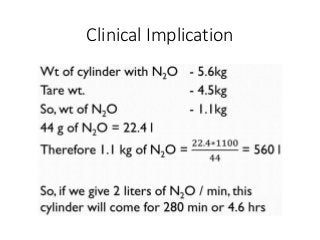
  • #39 N2O is stored in cylinder as liquid. Exists partly as liquid and partly as gas. So customary to weigh the cylinder along with its contents. From known cylinder wt. and measured wt. amount of N2O and usage is found out using Avogadro’s hypothesis
  • #40 N2O is stored in cylinder as liquid. Exists partly as liquid and partly as gas. So customary to weigh the cylinder along with its contents. From known cylinder wt. and measured wt. amount of N2O and usage is found out using Avogadro’s hypothesis
  • #41 R = Universal gas constant = 8.3145 J/mol K a value of 8.3144598 (kPa∙L)/(mol∙K)
  • #48 V and T are contant
  • #56 effect of pressure on the amount of gas dissolved in a liquid