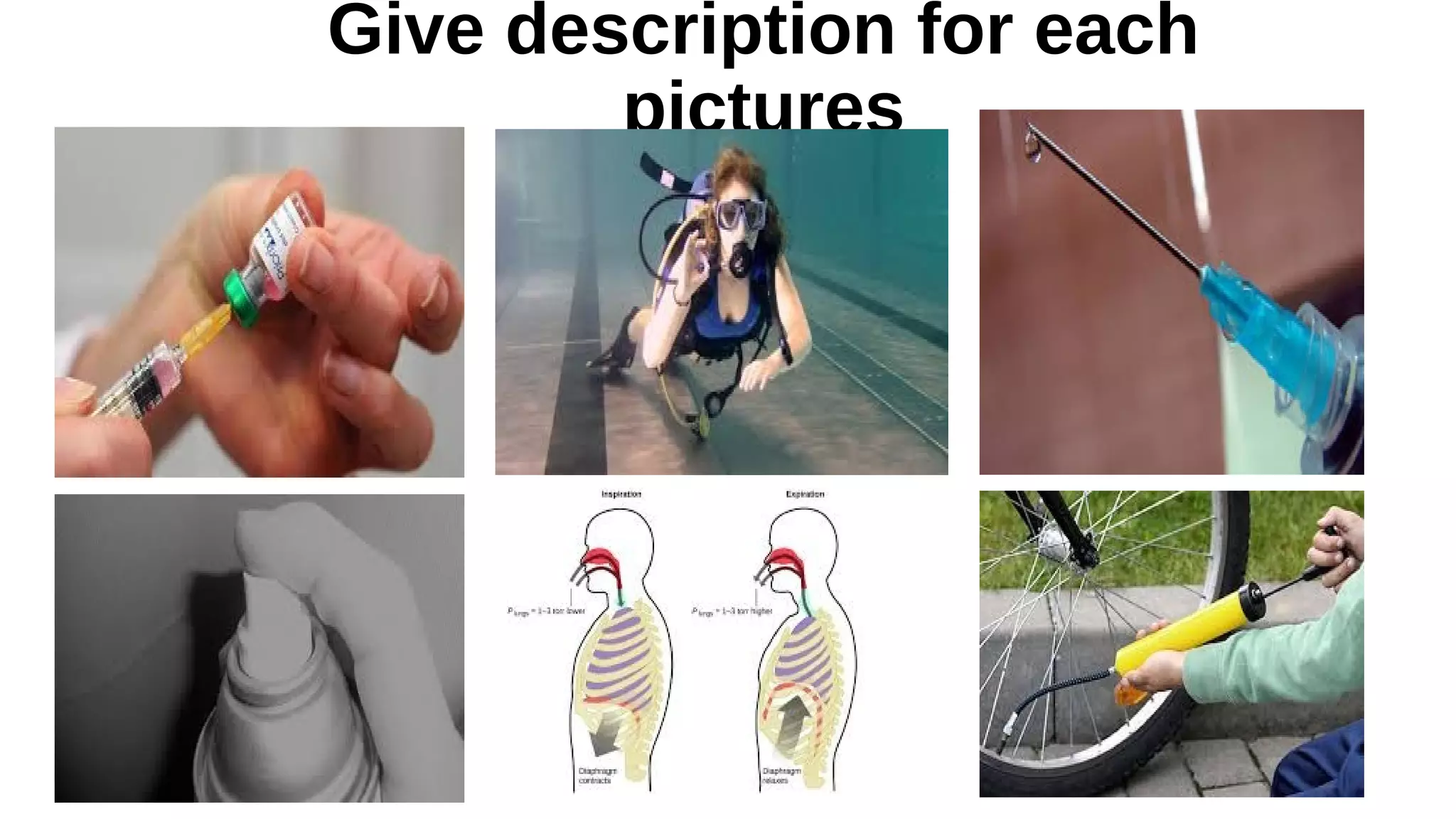


Give description for each
pictures
1
UNIT 4 Gases
Pressure and Volume (Boyle’s Law)
2
Robert Boyle -Lived 1627 –
1691
3
4
What is Boyle’s Law?
•Boyle’s Law is one of the laws in
physics that concern with the
behaviour of gases
•When a gas is under pressure it
takes up less space
•The higher the pressure, the
smaller the volume
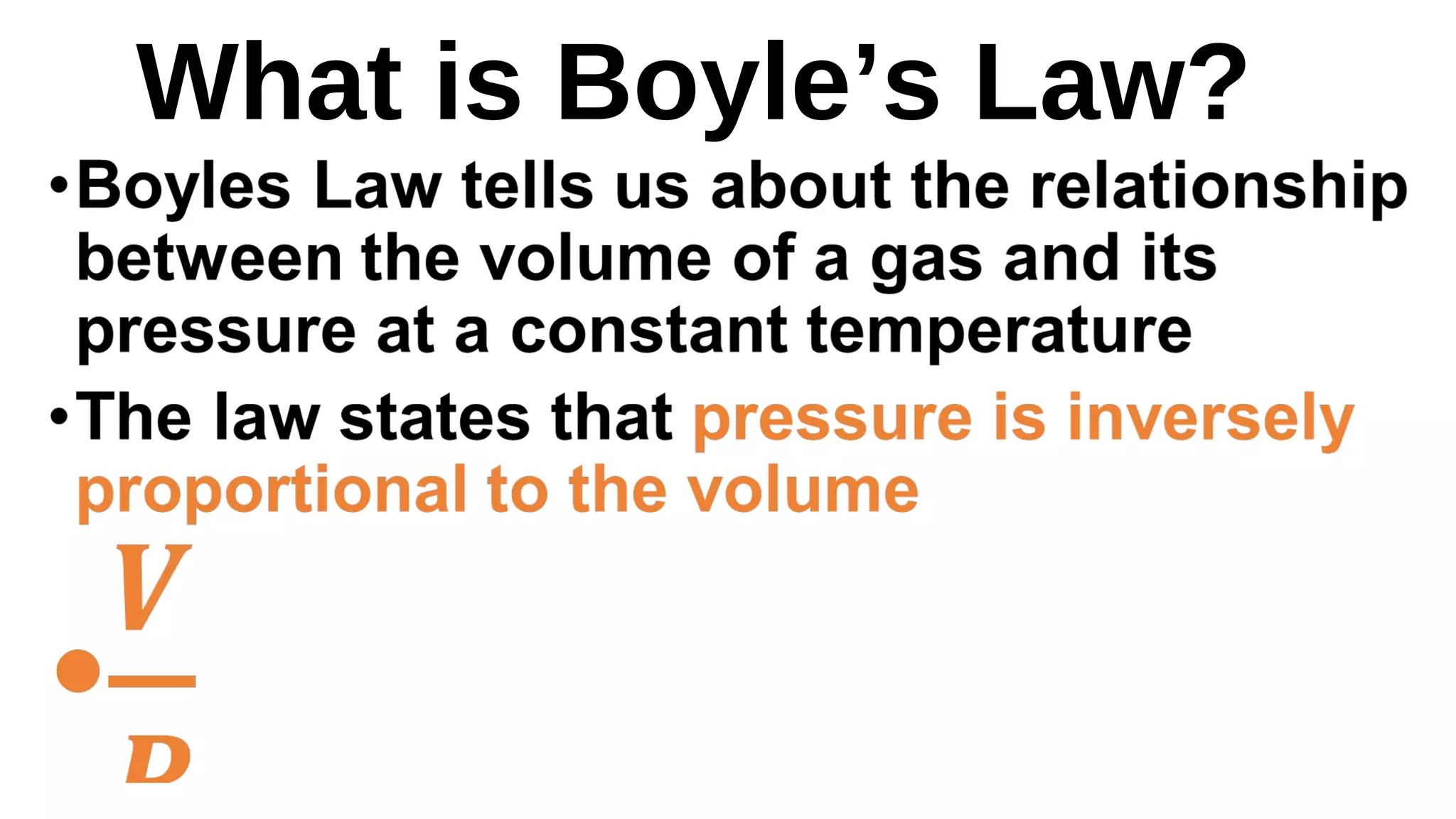
What is Boyle’s Law?
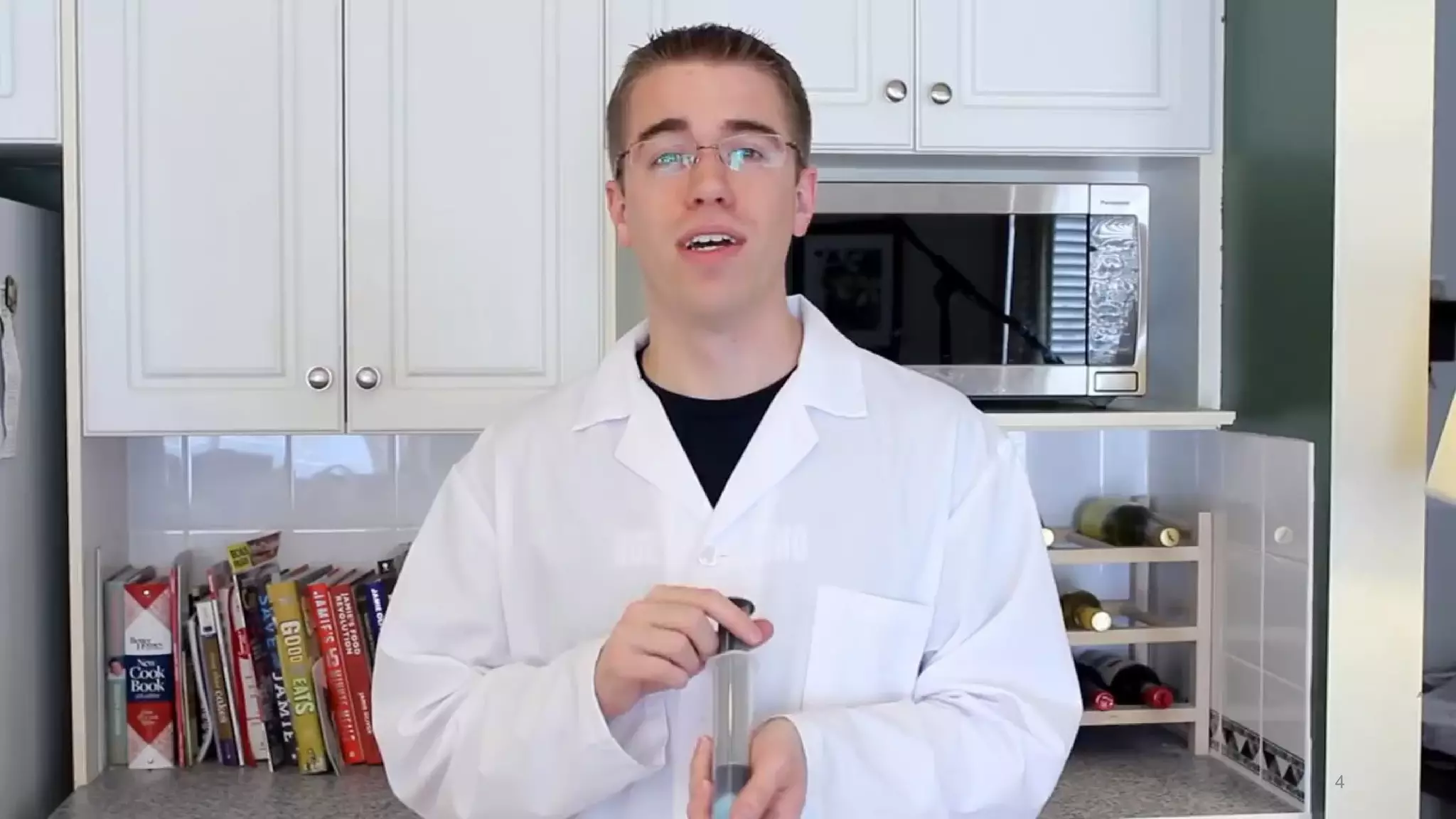
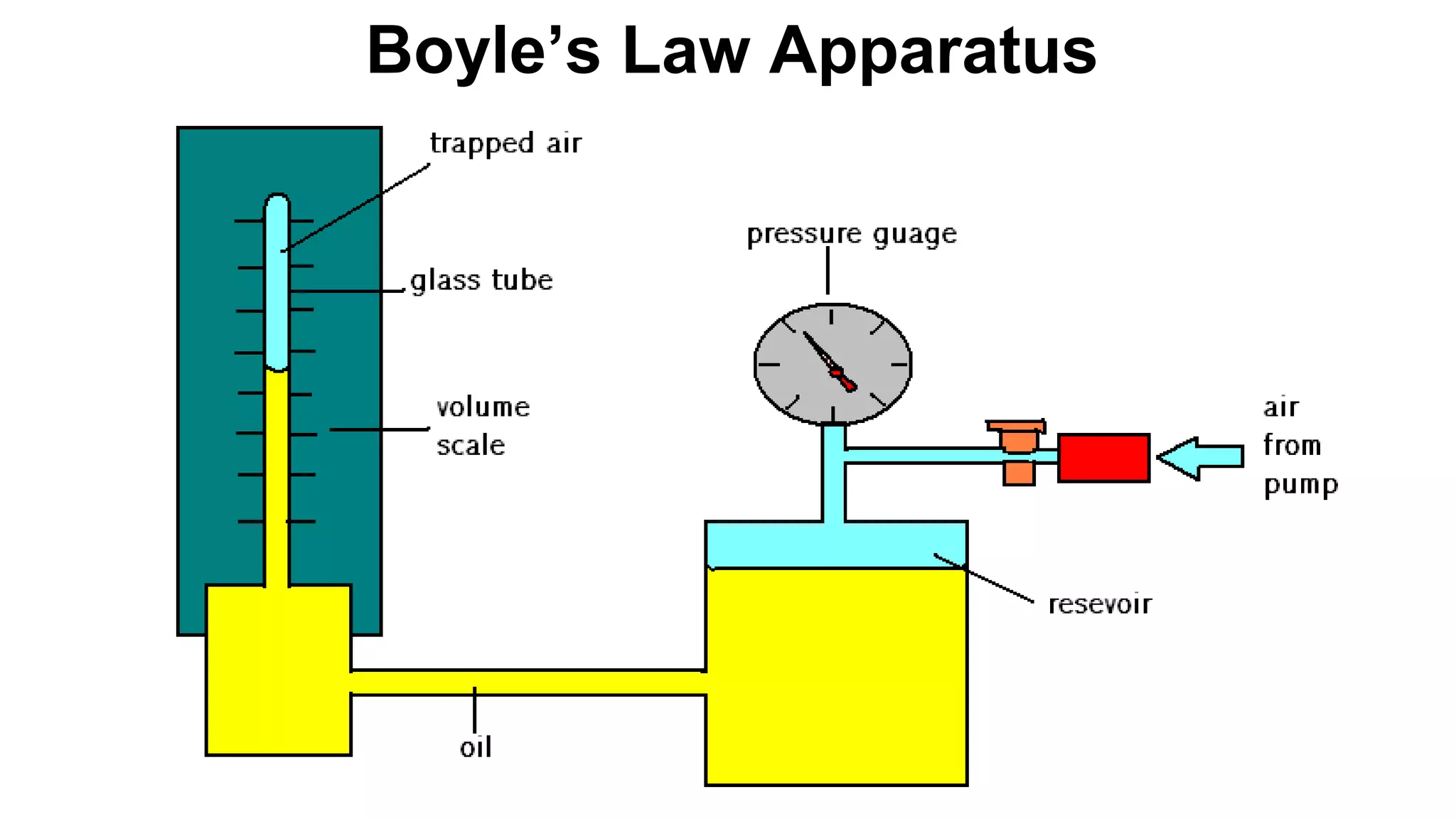
Boyle’s Law Apparatus
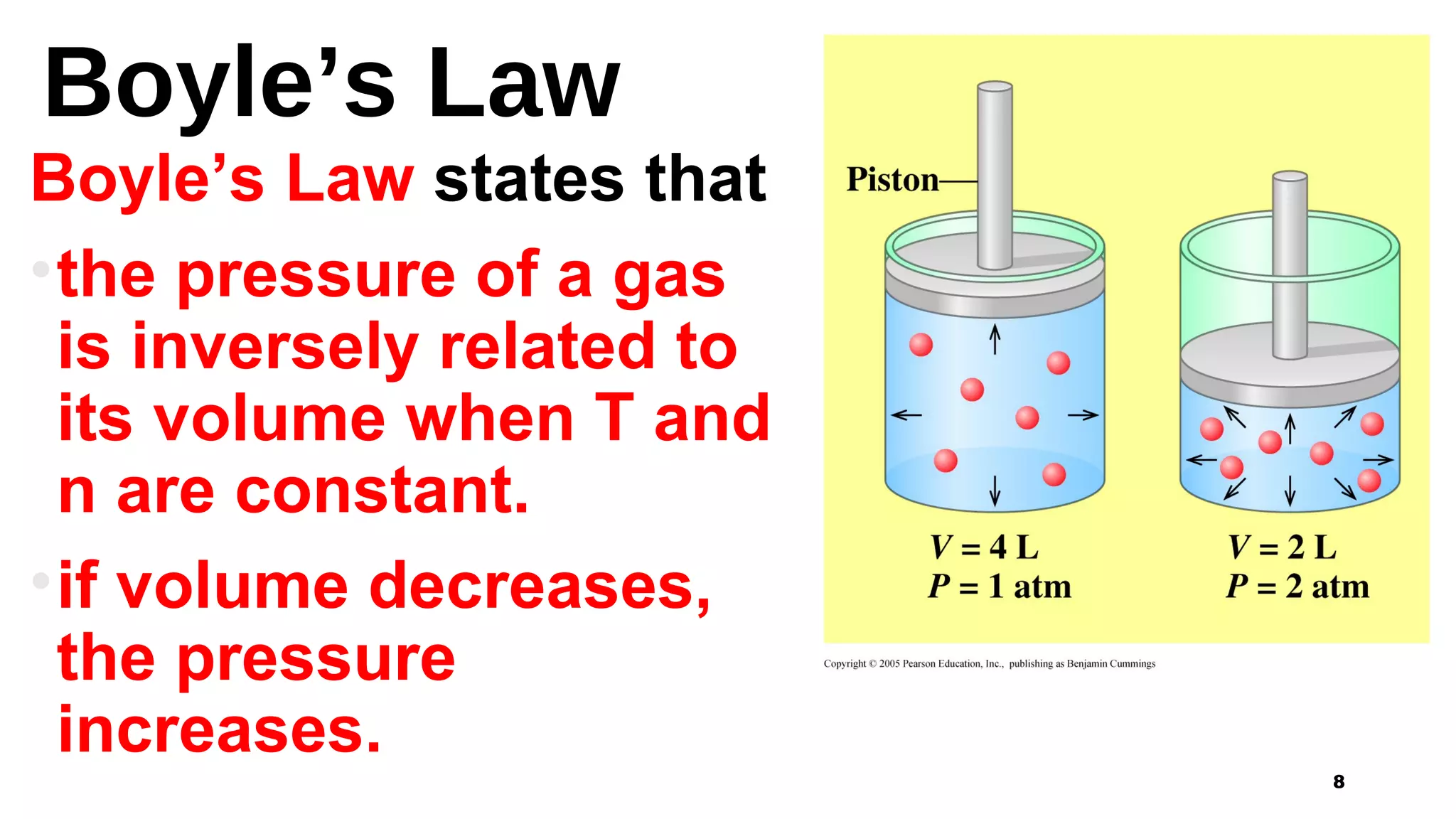
Boyle’s Law
Boyle’s Law states that
•the pressure of a gas
is inversely related to
its volume when T and
n are constant.
•if volume decreases,
the pressure
increases.
8
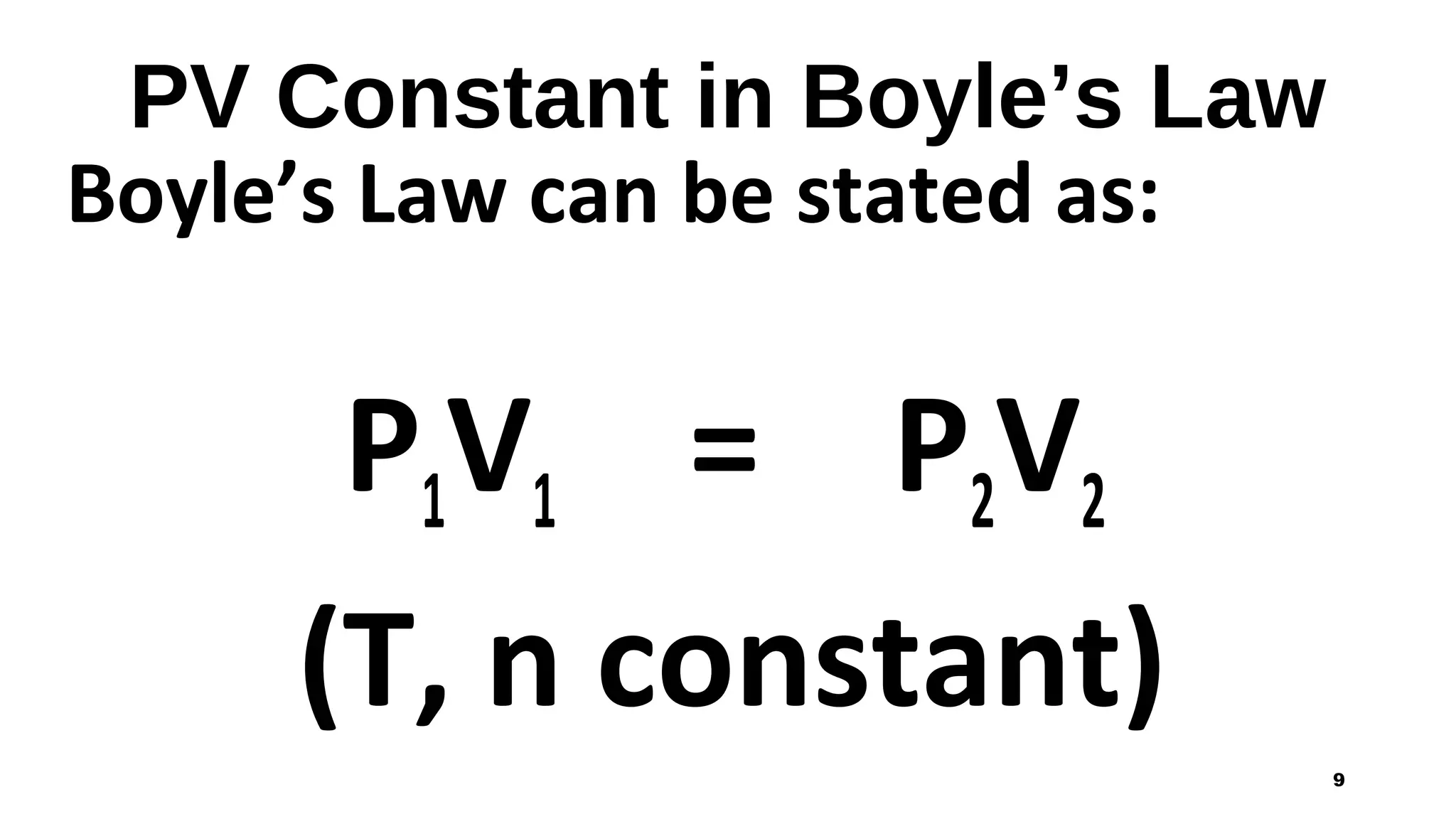
PV Constant in Boyle’s Law
Boyle’s Law can be stated as:
P1V1 = P2V2
(T, n constant)
9
10
LET’S USE LEGEND/SYMBOLS:
11
DECREASI INCREASI
12
P
R
E
S
S
U
R
E
INHALATION
V
O
L
U
M
E
OF AIR
13
V
O
L
U
M
E
OF
AIR
EXHALATION
P
R
E
S
S
U
R
E
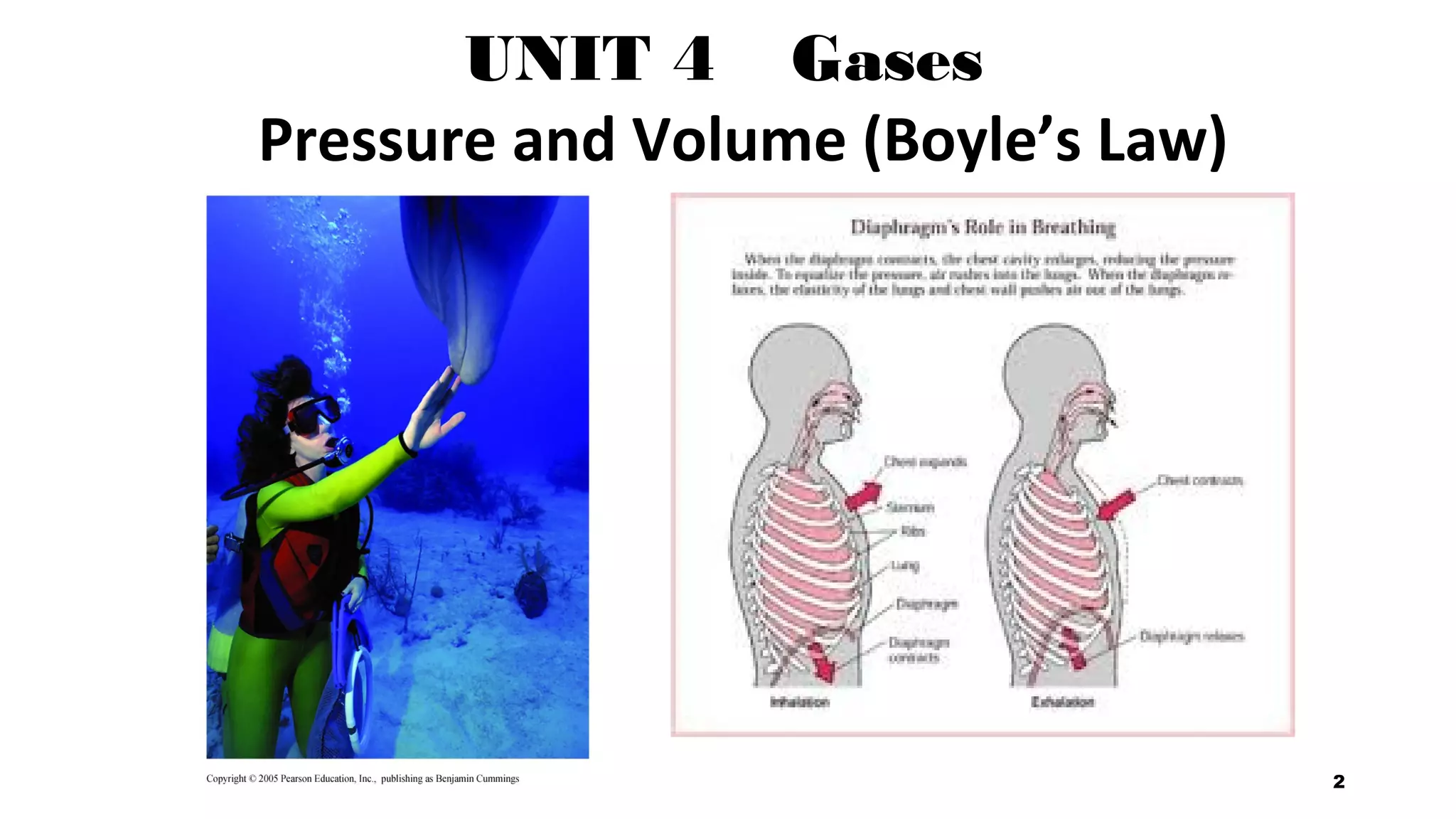
Boyles’ Law and Breathing
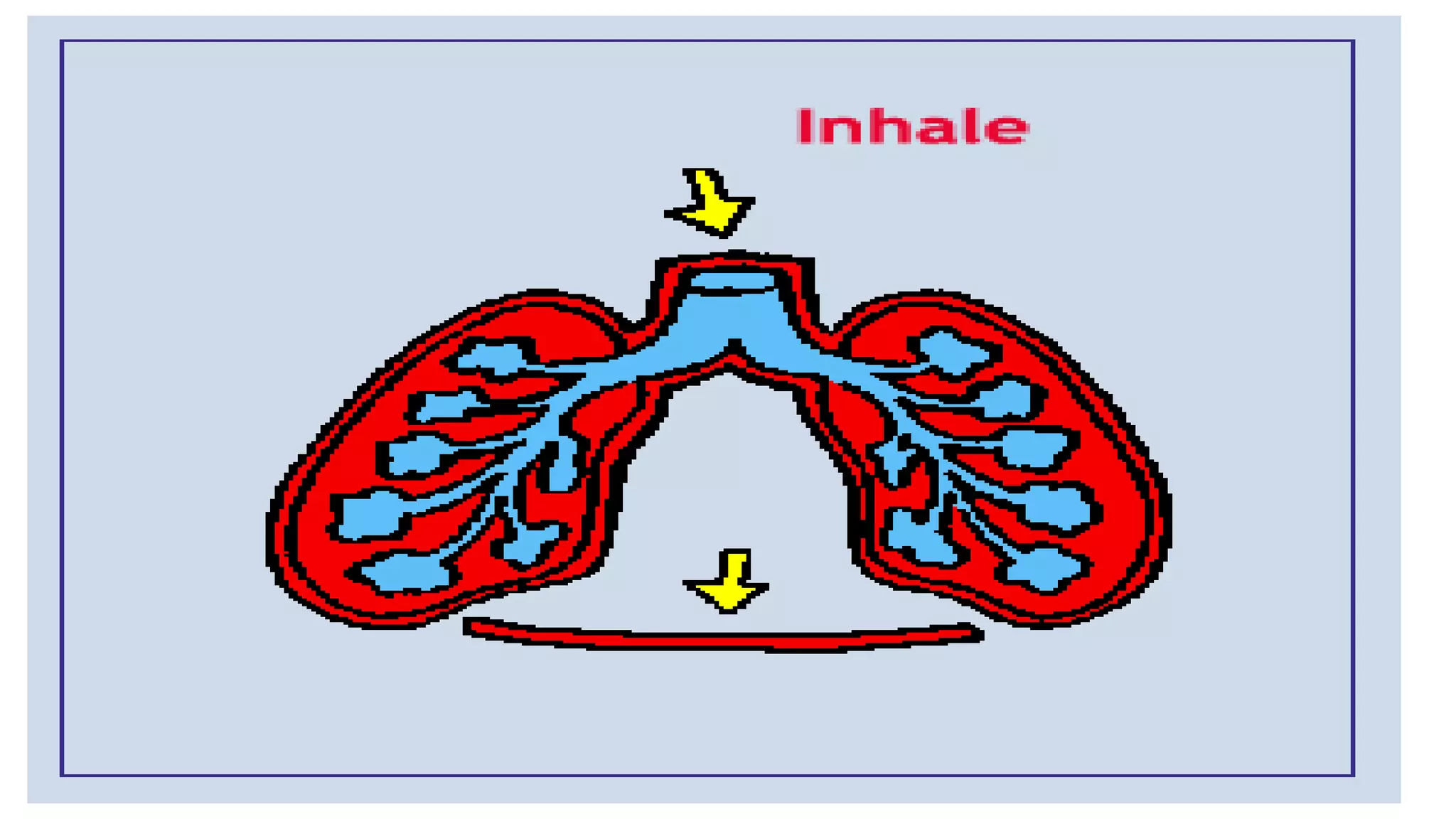
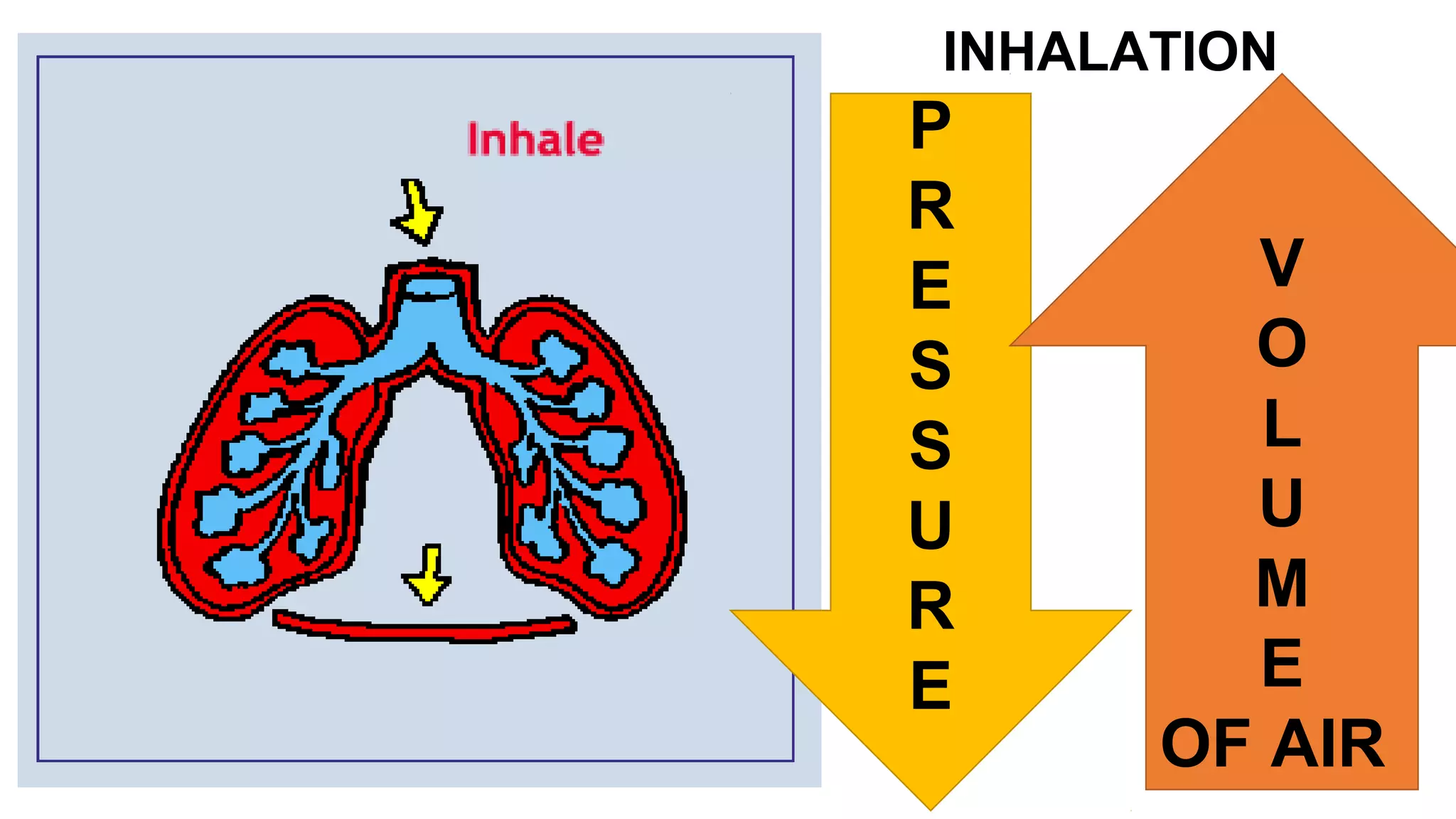
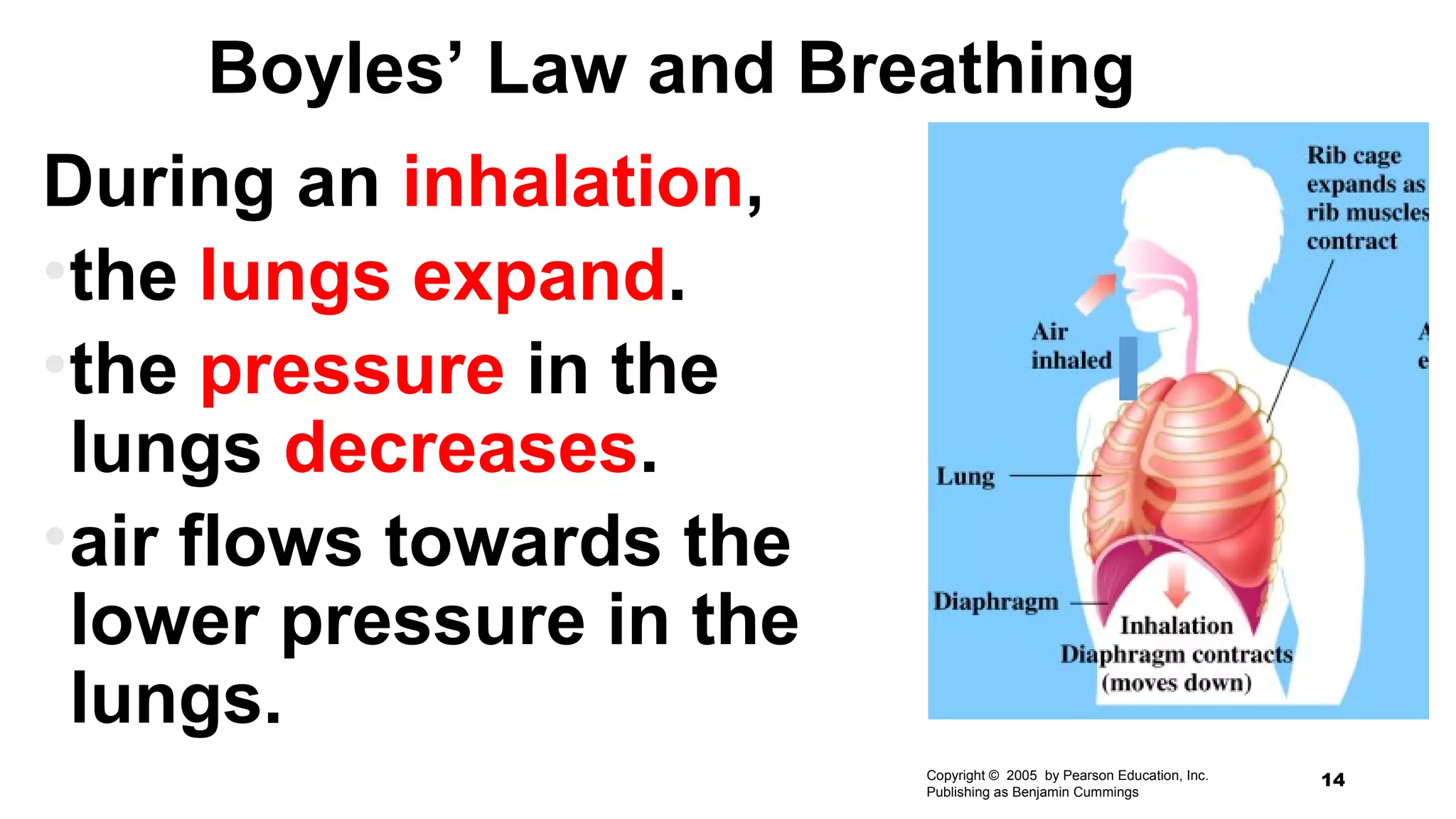
During an inhalation,
•the lungs expand.
•the pressure in the
lungs decreases.
•air flows towards the
lower pressure in the
lungs.
14Copyright © 2005 by Pearson Education, Inc.
Publishing as Benjamin Cummings
Boyles’ Law and Breathing
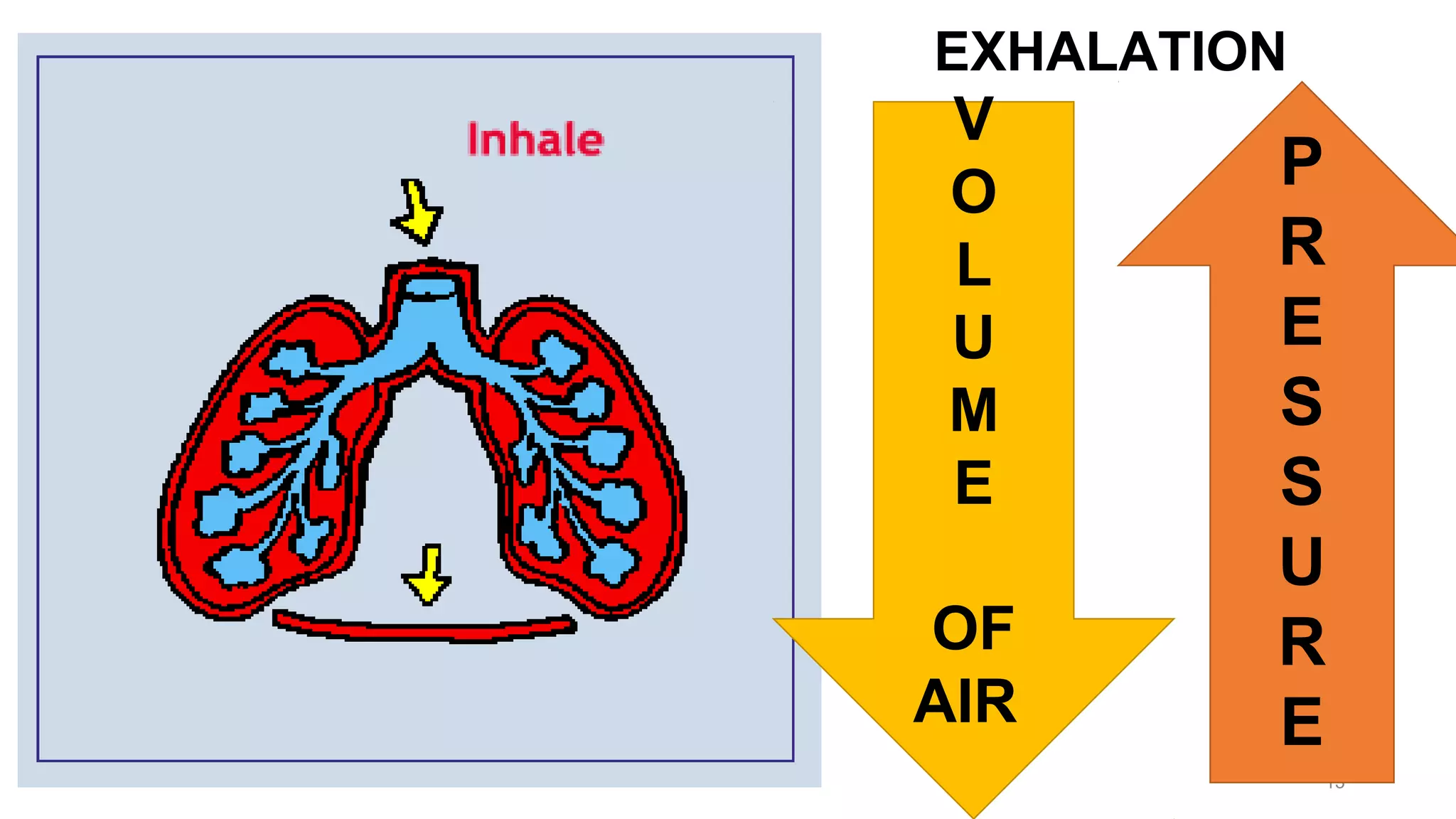
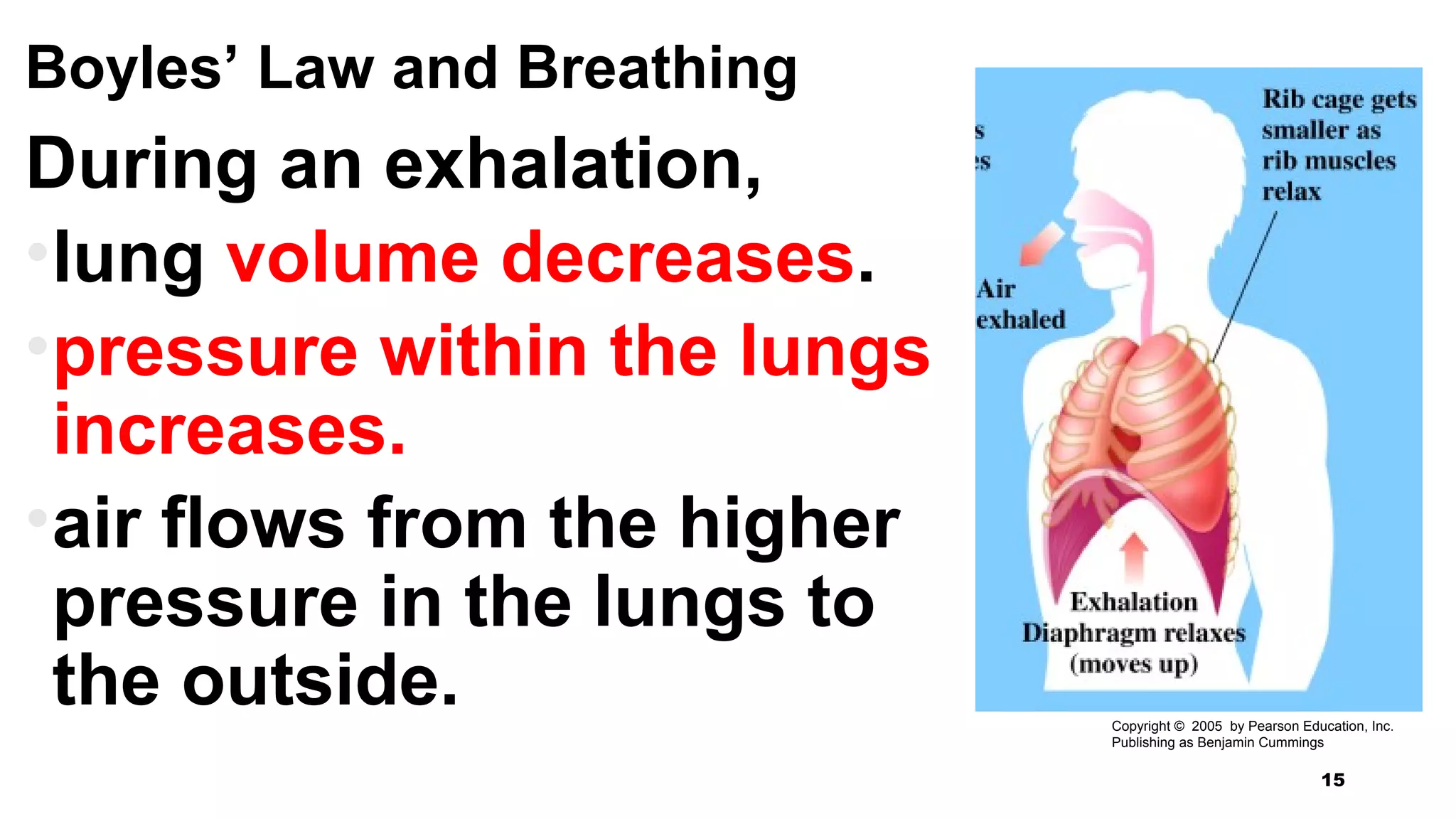
During an exhalation,
•lung volume decreases.
•pressure within the lungs
increases.
•air flows from the higher
pressure in the lungs to
the outside.
15
Copyright © 2005 by Pearson Education, Inc.
Publishing as Benjamin Cummings
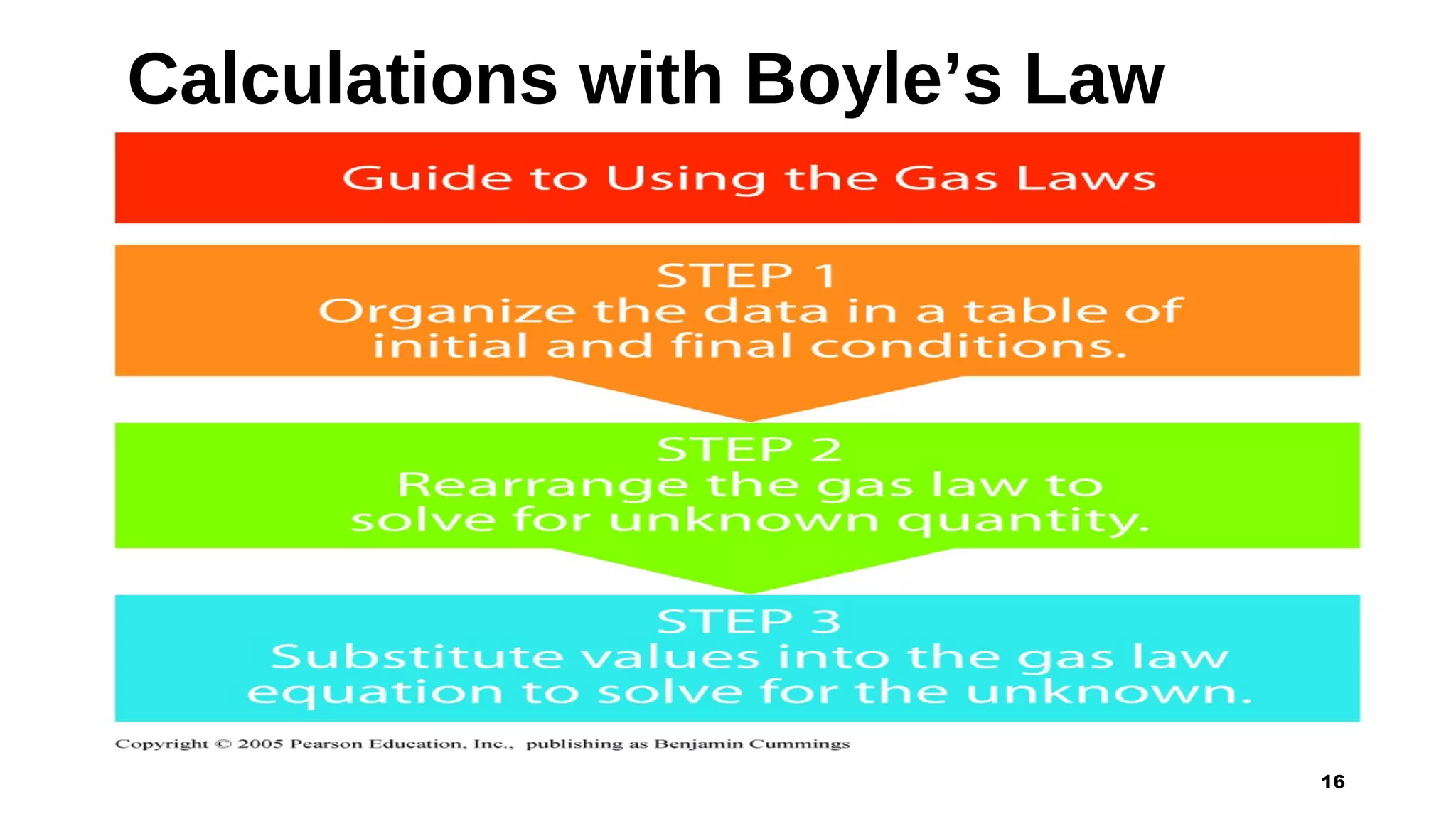
Calculations with Boyle’s Law
16
LET’S USE GRASA IN SOLVING:
•G
•R
•A
•S
•A 17
GIVEN
REQUIRE
D
ANSWER
SOLUTION
ANALYSIS
Calculation with Boyle’s Law
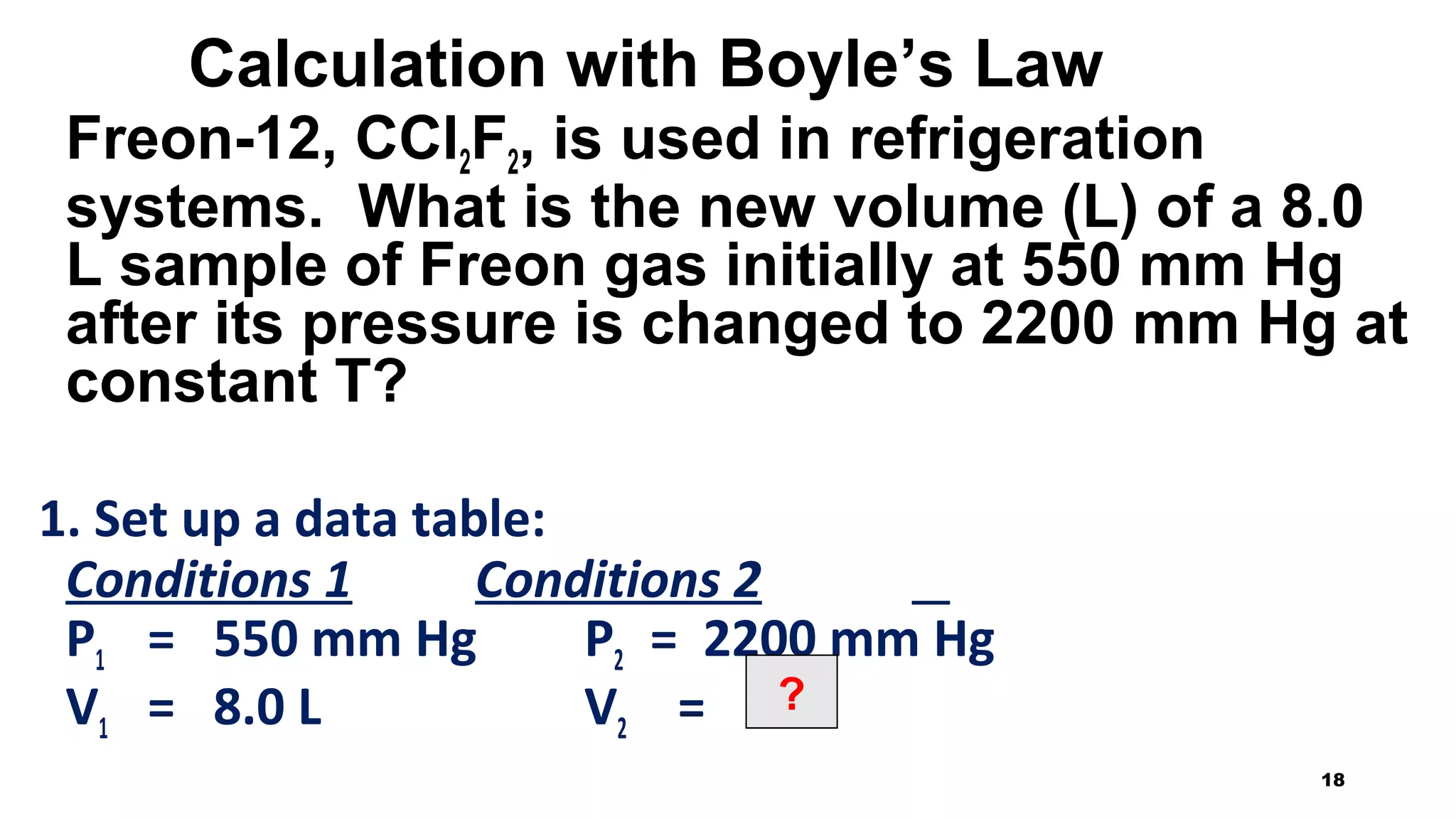
Freon-12, CCl2F2, is used in refrigeration
systems. What is the new volume (L) of a 8.0
L sample of Freon gas initially at 550 mm Hg
after its pressure is changed to 2200 mm Hg at
constant T?
1. Set up a data table:
Conditions 1 Conditions 2
P1 = 550 mm Hg P2 = 2200 mm Hg
V1 = 8.0 L V2 =
18
?
Calculation with Boyle’s Law (Continued)
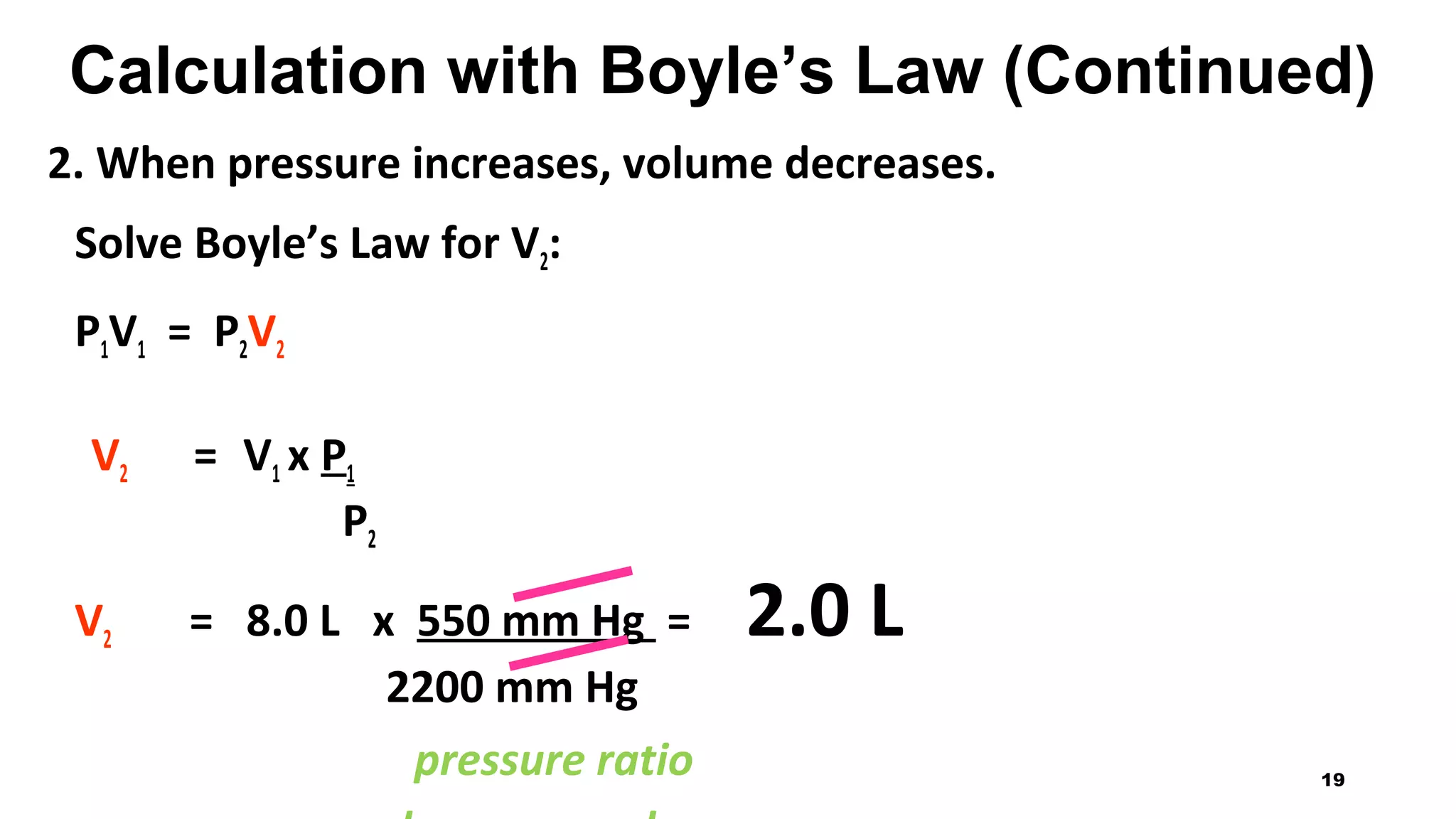
2. When pressure increases, volume decreases.
Solve Boyle’s Law for V2:
P1V1 = P2V2
V2 = V1 x P1
P2
V2 = 8.0 L x 550 mm Hg = 2.0 L
2200 mm Hg
pressure ratio 19
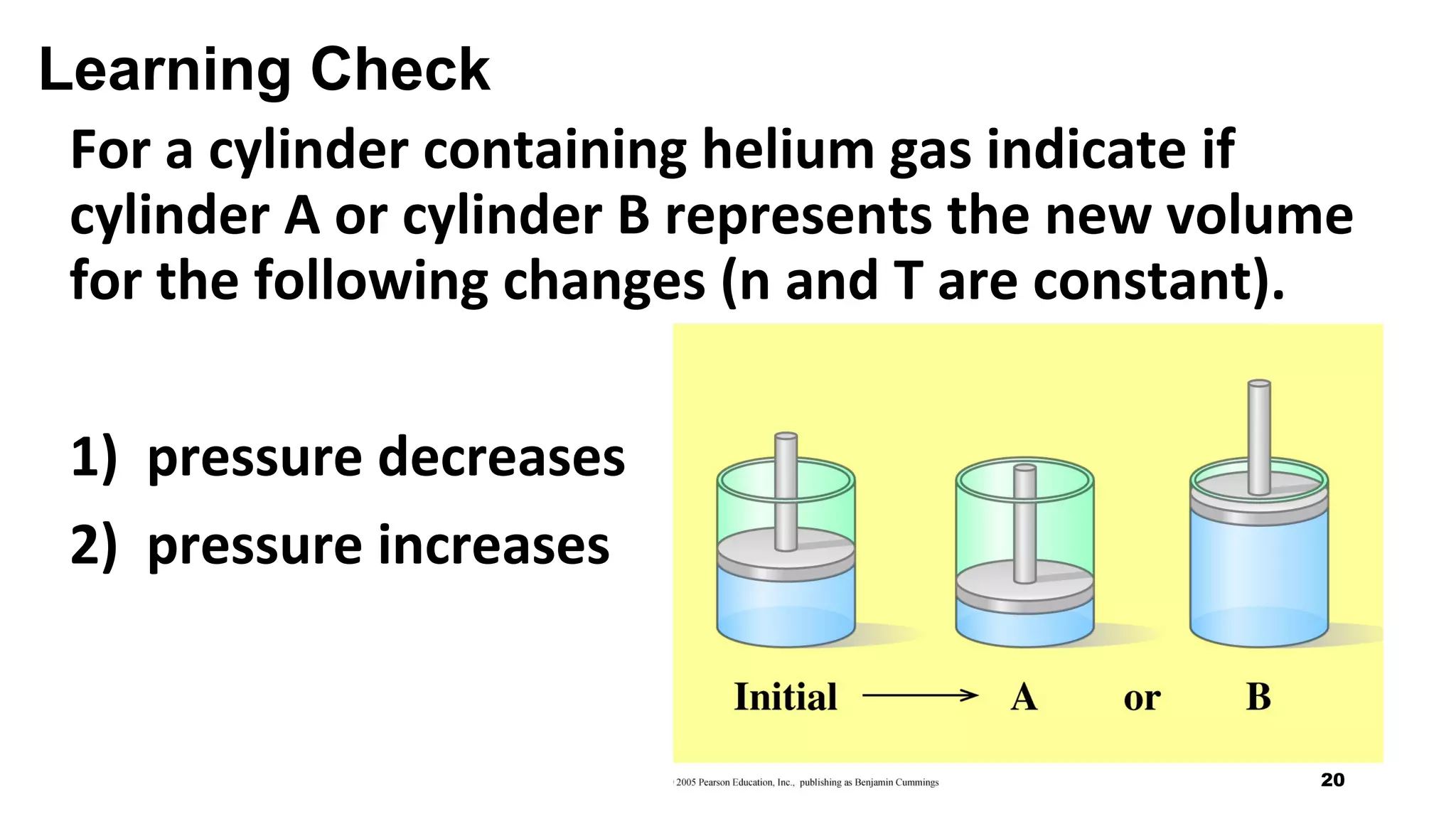
Learning Check
For a cylinder containing helium gas indicate if
cylinder A or cylinder B represents the new volume
for the following changes (n and T are constant).
1) pressure decreases
2) pressure increases
20
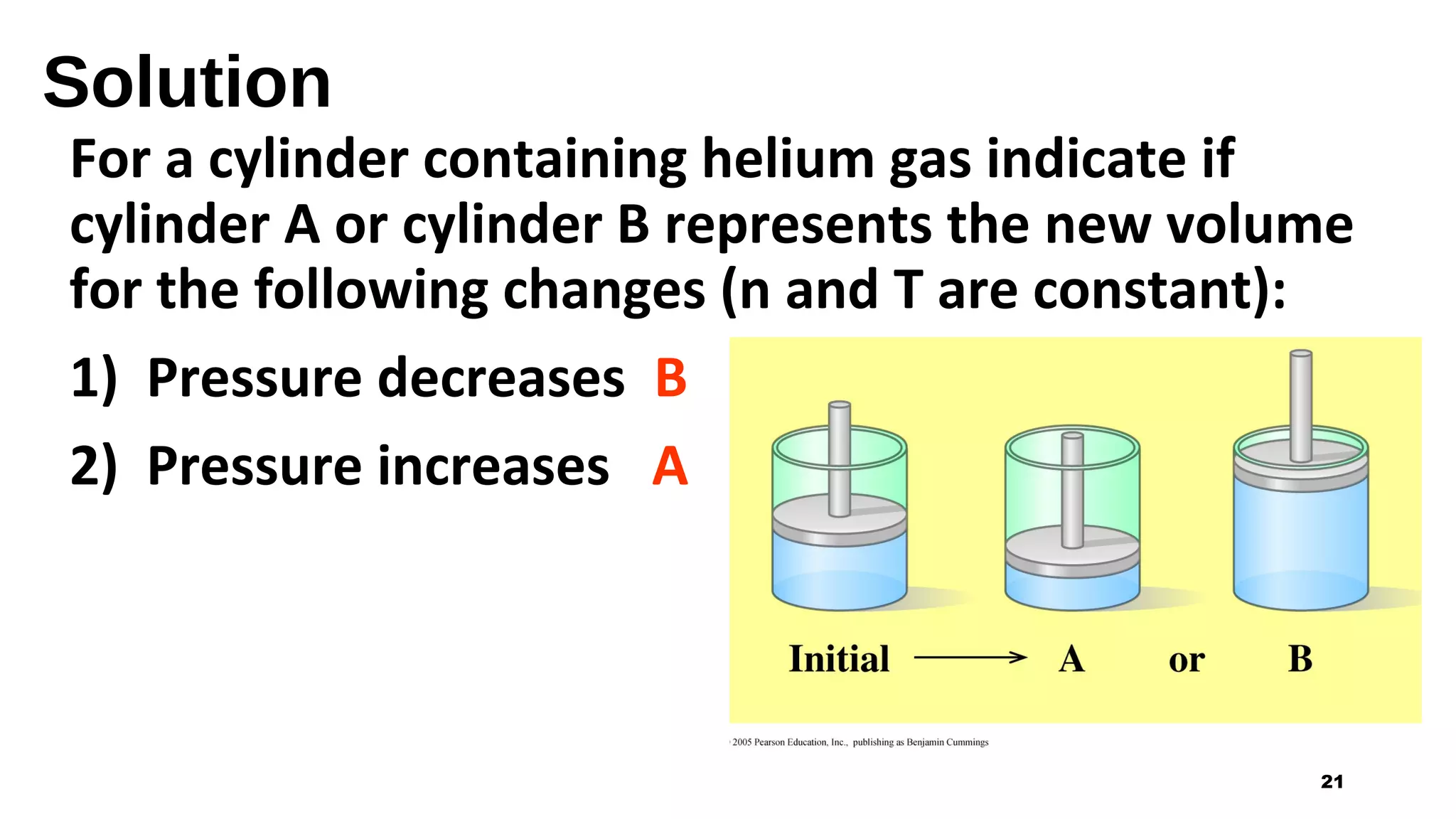
Solution
For a cylinder containing helium gas indicate if
cylinder A or cylinder B represents the new volume
for the following changes (n and T are constant):
1) Pressure decreases B
2) Pressure increases A
21
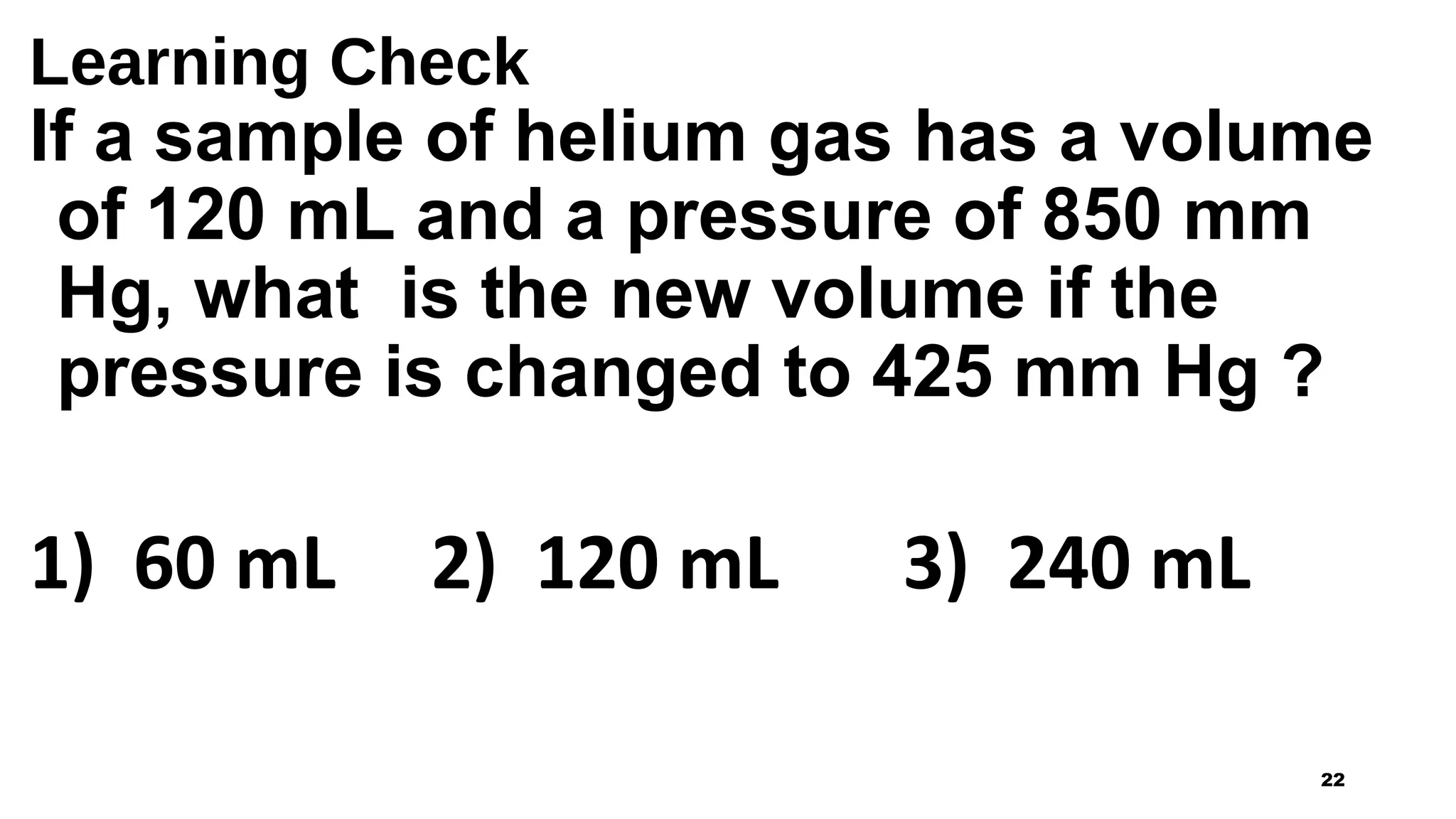
Learning Check
If a sample of helium gas has a volume
of 120 mL and a pressure of 850 mm
Hg, what is the new volume if the
pressure is changed to 425 mm Hg ?
1) 60 mL 2) 120 mL 3) 240 mL
22
Solution
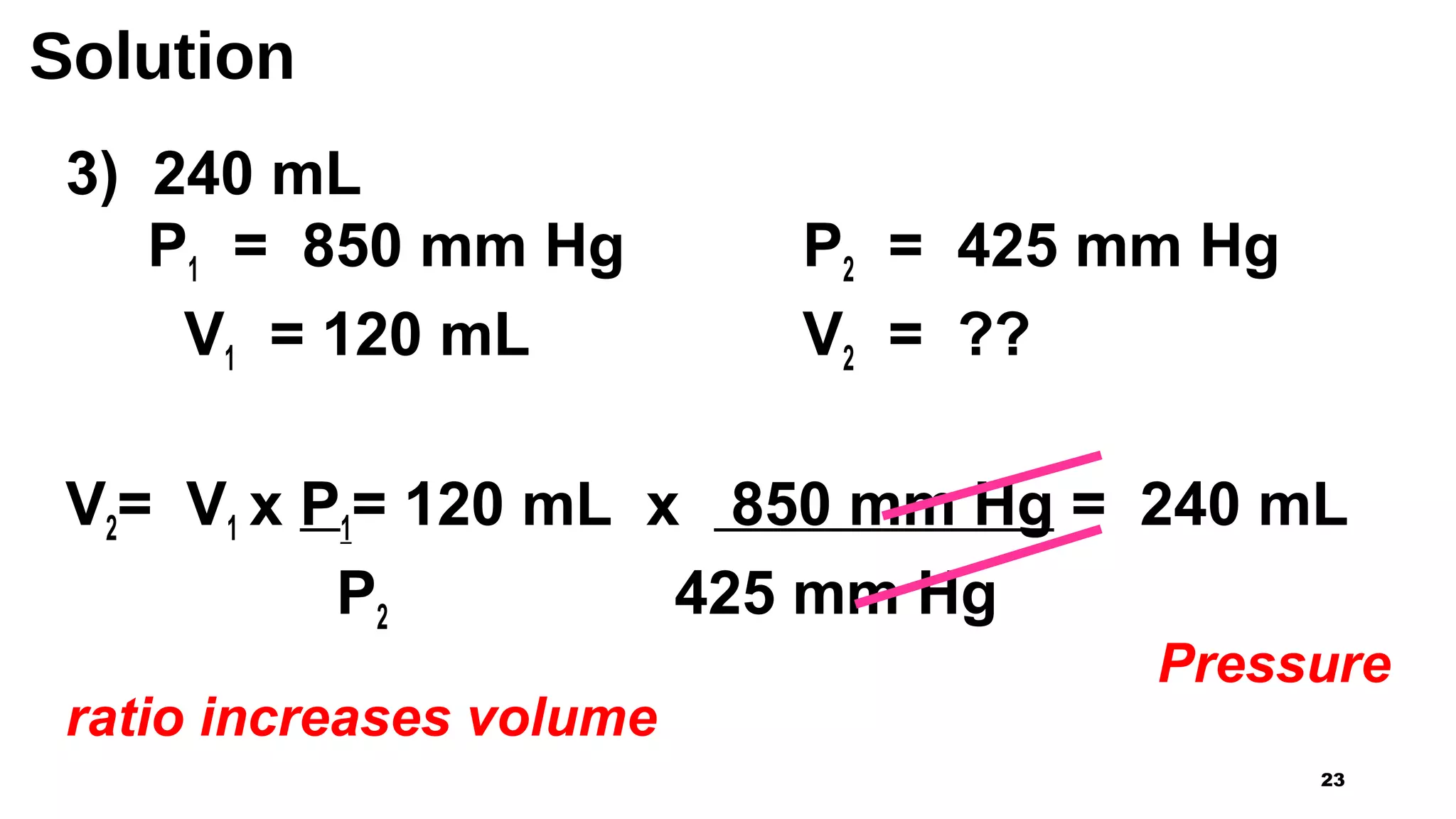
3) 240 mL
P1 = 850 mm Hg P2 = 425 mm Hg
V1 = 120 mL V2 = ??
V2= V1 x P1= 120 mL x 850 mm Hg = 240 mL
P2 425 mm Hg
Pressure
ratio increases volume
23
Learning Check
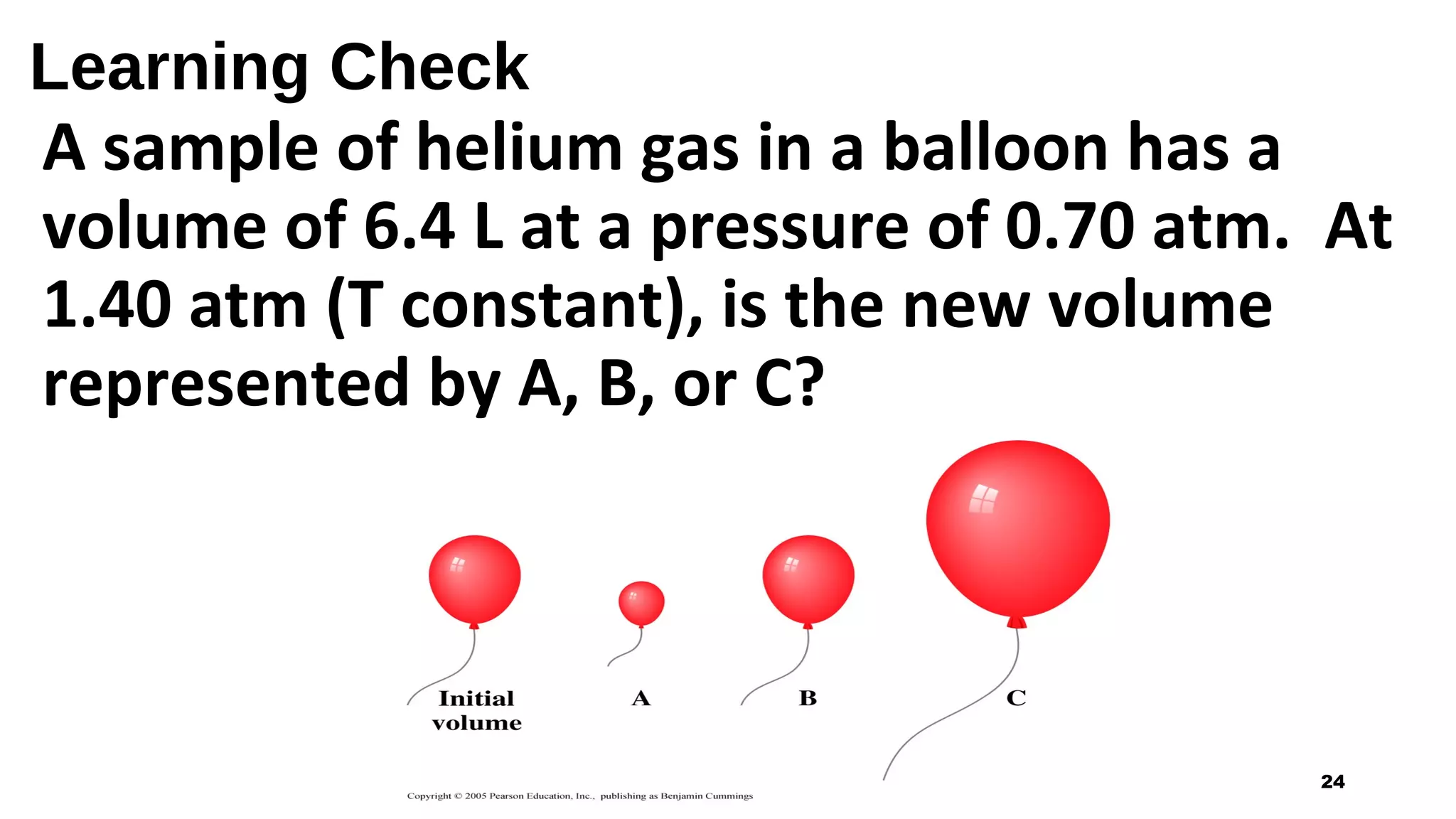
A sample of helium gas in a balloon has a
volume of 6.4 L at a pressure of 0.70 atm. At
1.40 atm (T constant), is the new volume
represented by A, B, or C?
24
Solution
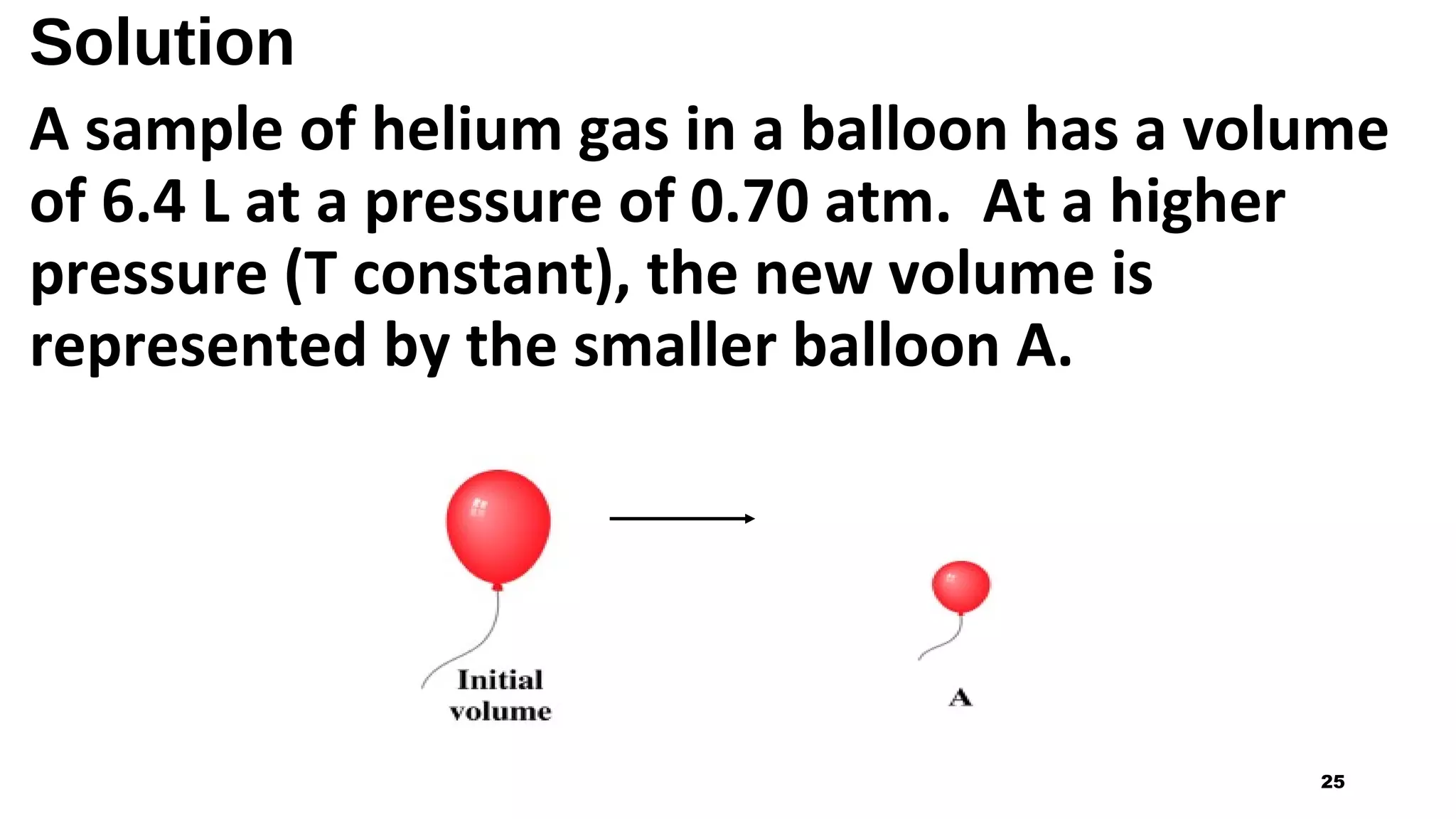
A sample of helium gas in a balloon has a volume
of 6.4 L at a pressure of 0.70 atm. At a higher
pressure (T constant), the new volume is
represented by the smaller balloon A.
25
Learning Check
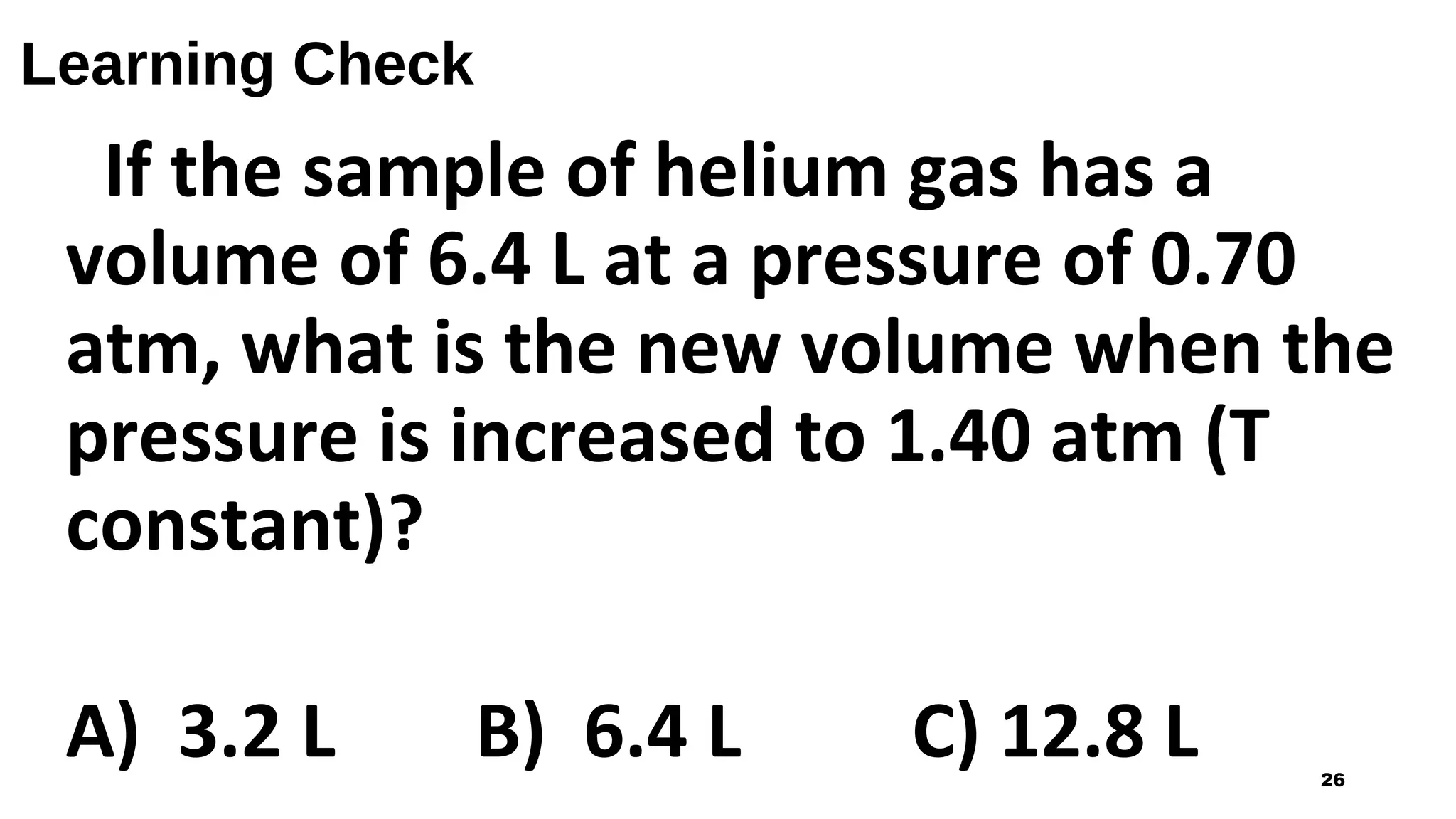
If the sample of helium gas has a
volume of 6.4 L at a pressure of 0.70
atm, what is the new volume when the
pressure is increased to 1.40 atm (T
constant)?
A) 3.2 L B) 6.4 L C) 12.8 L 26
Solution
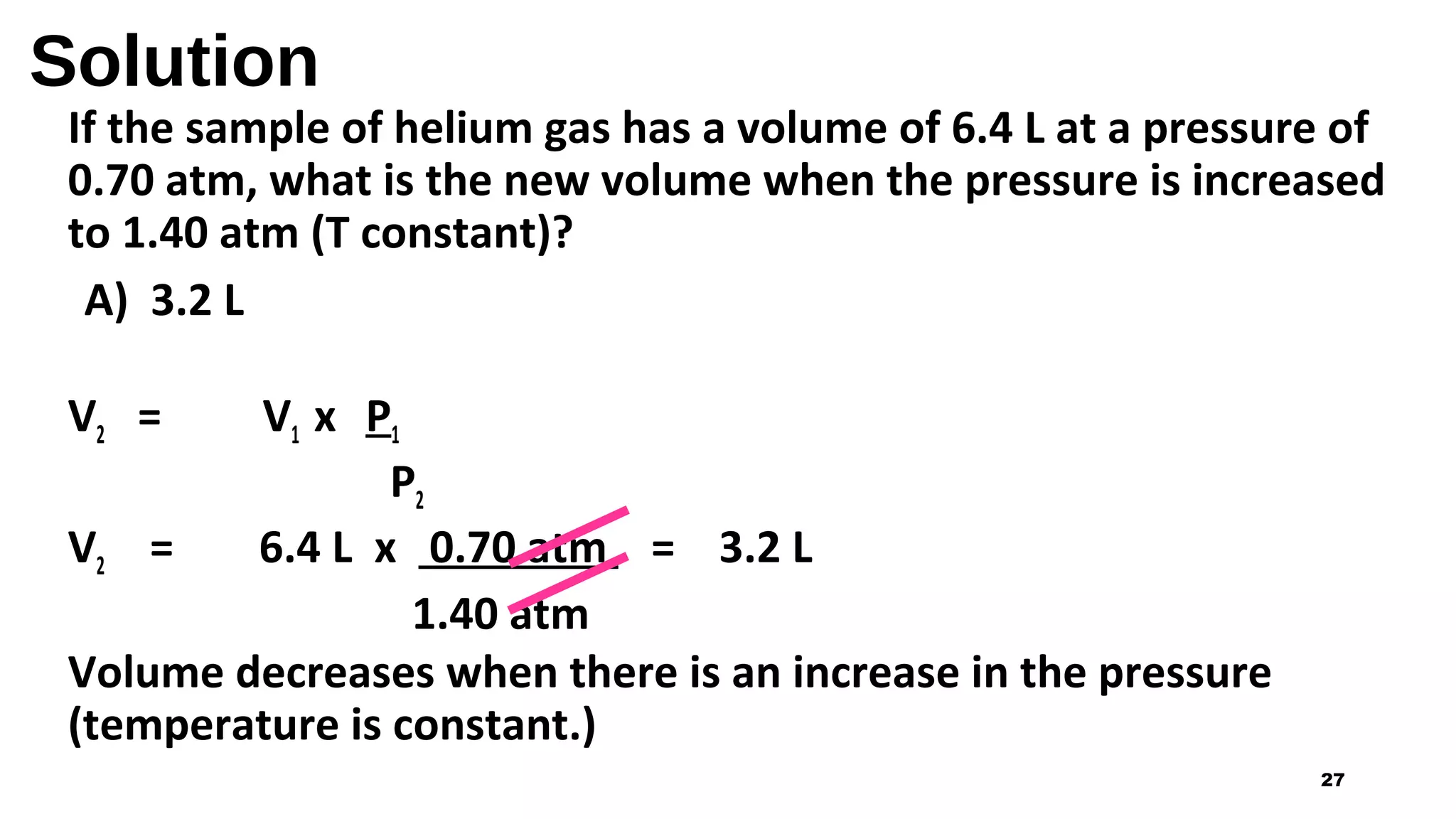
If the sample of helium gas has a volume of 6.4 L at a pressure of
0.70 atm, what is the new volume when the pressure is increased
to 1.40 atm (T constant)?
A) 3.2 L
V2 = V1 x P1
P2
V2 = 6.4 L x 0.70 atm = 3.2 L
1.40 atm
Volume decreases when there is an increase in the pressure
(temperature is constant.)
27
Learning Check
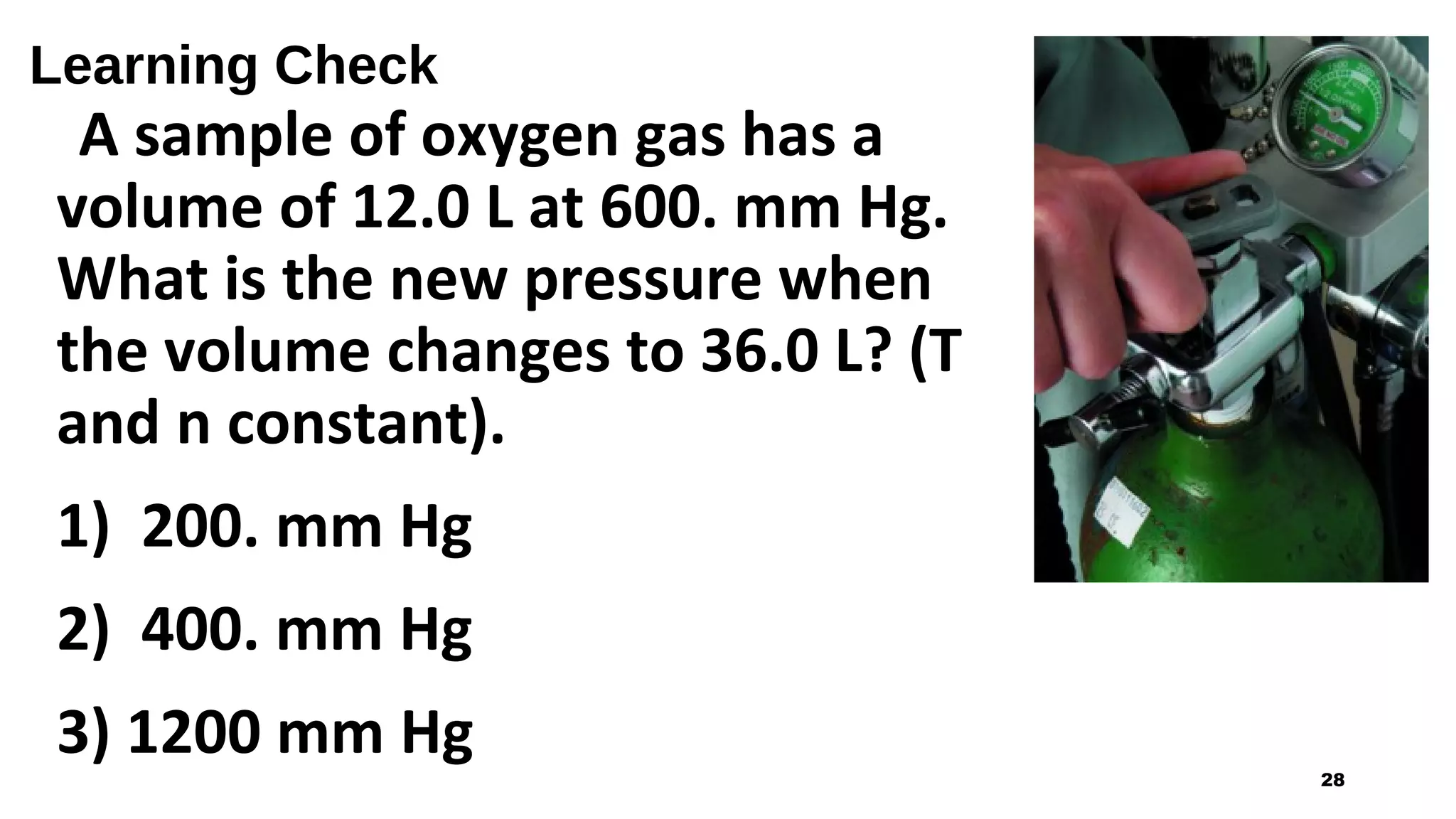
A sample of oxygen gas has a
volume of 12.0 L at 600. mm Hg.
What is the new pressure when
the volume changes to 36.0 L? (T
and n constant).
1) 200. mm Hg
2) 400. mm Hg
3) 1200 mm Hg
28
Solution
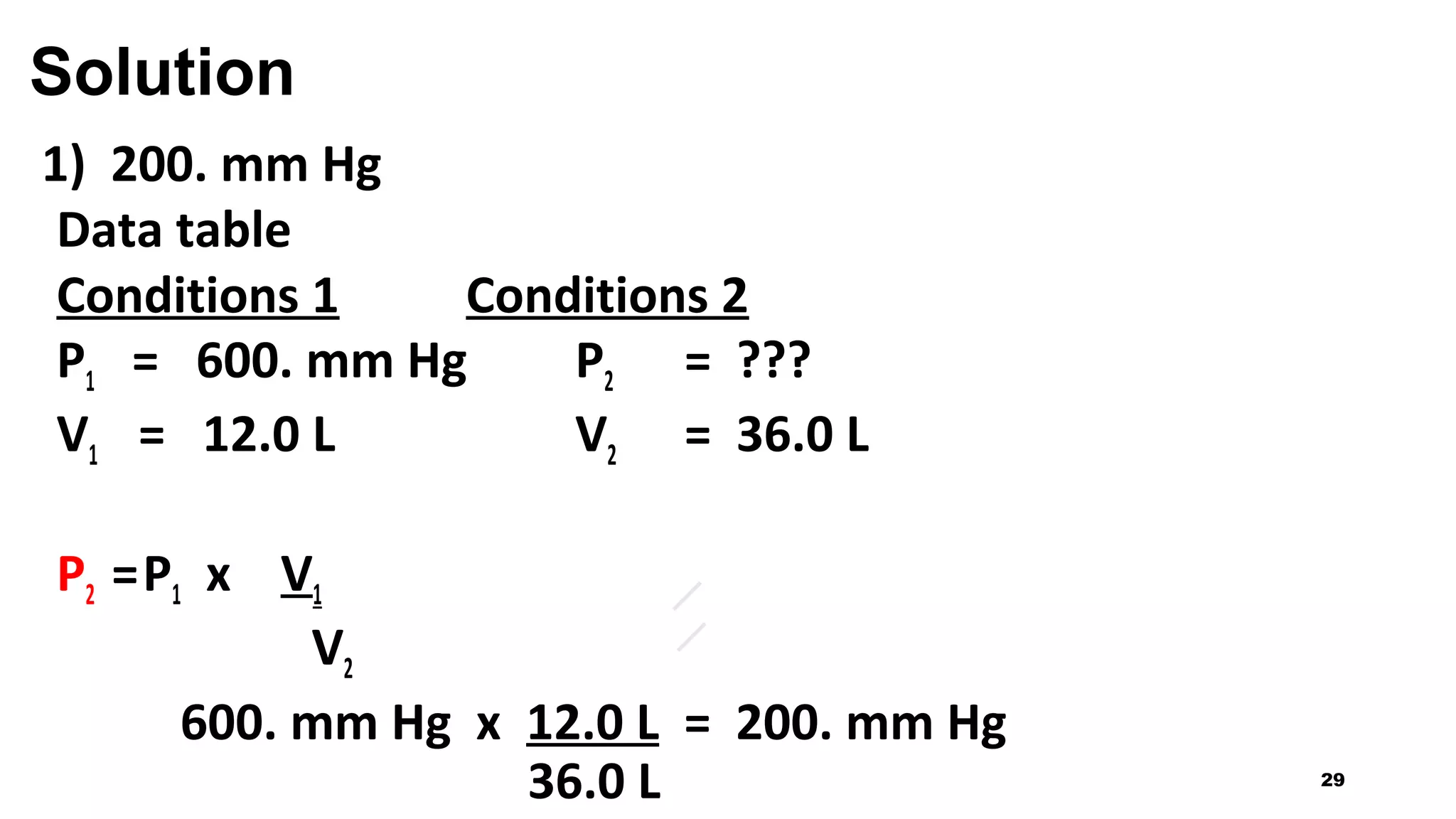
1) 200. mm Hg
Data table
Conditions 1 Conditions 2
P1 = 600. mm Hg P2 = ???
V1 = 12.0 L V2 = 36.0 L
P2 =P1 x V1
V2
600. mm Hg x 12.0 L = 200. mm Hg
36.0 L 29
LET’S DO IT!
•1. Oxygen gas inside a 1.5 L gas tank has a
pressure of 0.95 atm. Provided that the
temperature remains constant, how much
pressure is needed to reduce by ½?
•Required:?
•Pressure ₂/P₂
30
LET’S DO IT!
•1. Oxygen gas inside a 1.5 L gas tank has a pressure
of 0.95 atm. Provided that the temperature remains
constant, how much pressure is needed to reduce by
½?
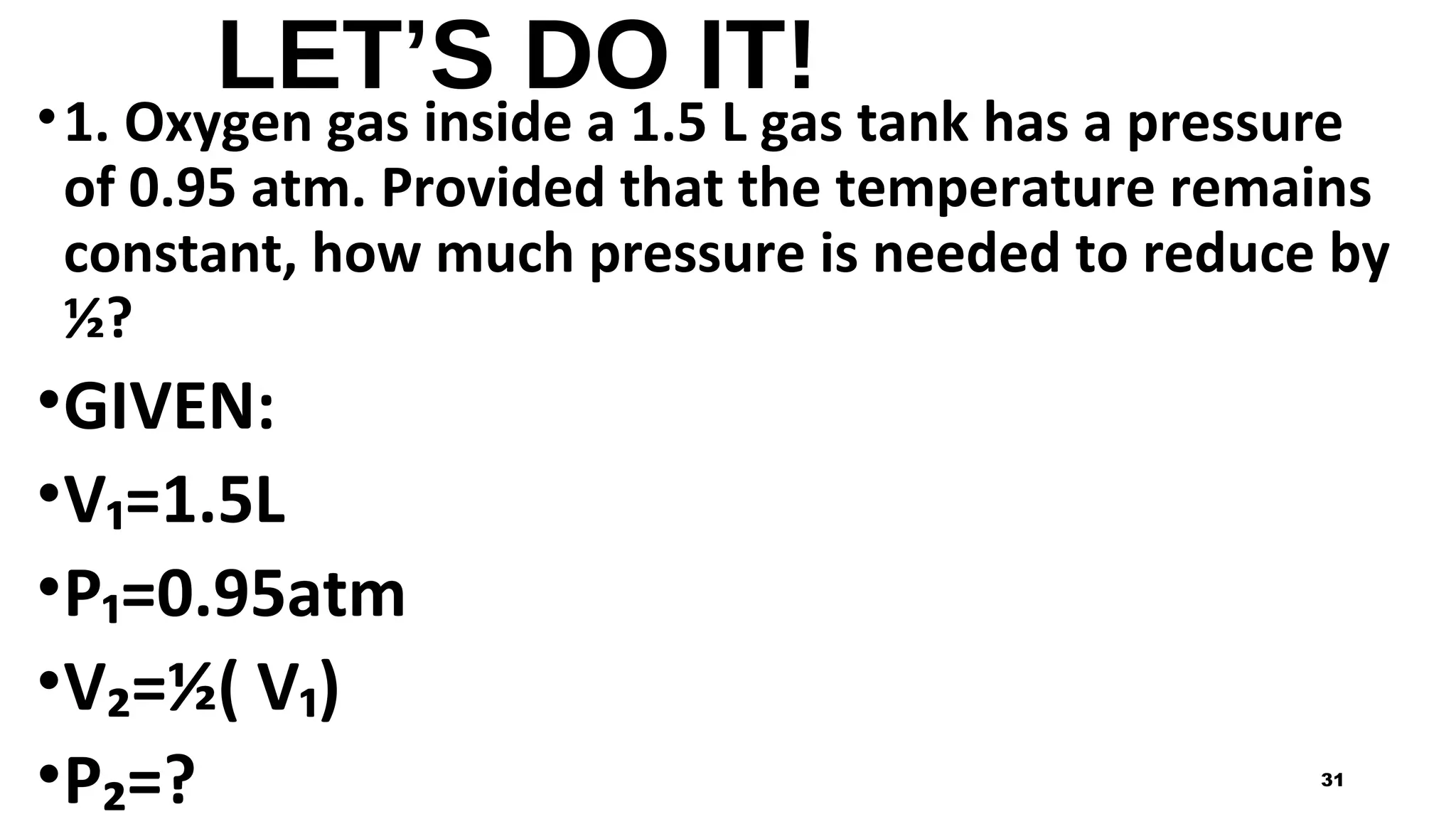
•GIVEN:
•V₁=1.5L
•P₁=0.95atm
•V₂=½( V₁)
•P₂=? 31
LET’S DO IT!
•1. Oxygen gas inside a 1.5 L gas tank has a
pressure of 0.95 atm. Provided that the
temperature remains constant, how much
pressure is needed to reduce by ½?
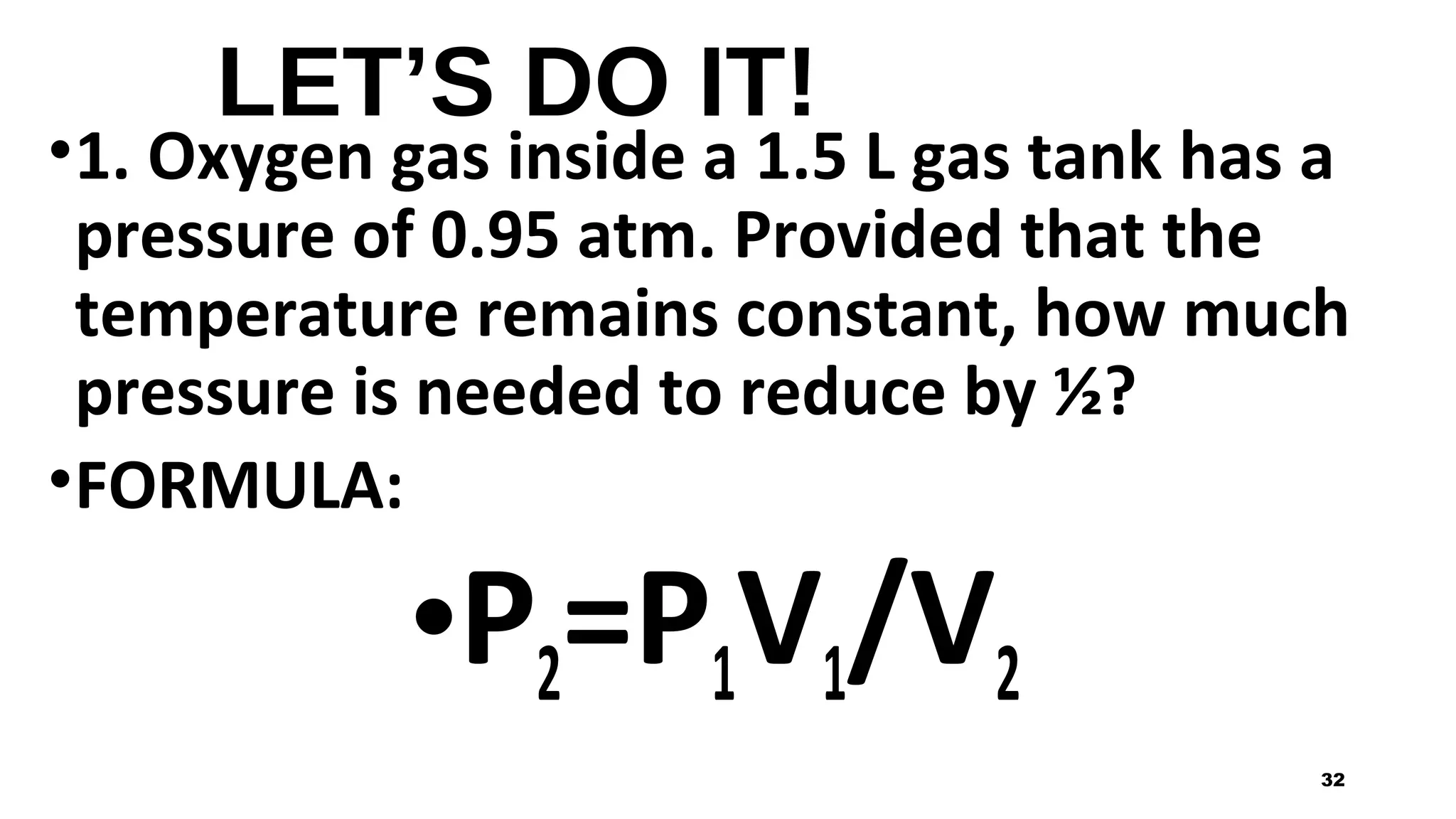
•FORMULA:
•P2=P1V1/V2
32
LET’S DO IT!
•1. Oxygen gas inside a 1.5 L gas tank has a pressure
of 0.95 atm. Provided that the temperature remains
constant, how much pressure is needed to reduce by
½?
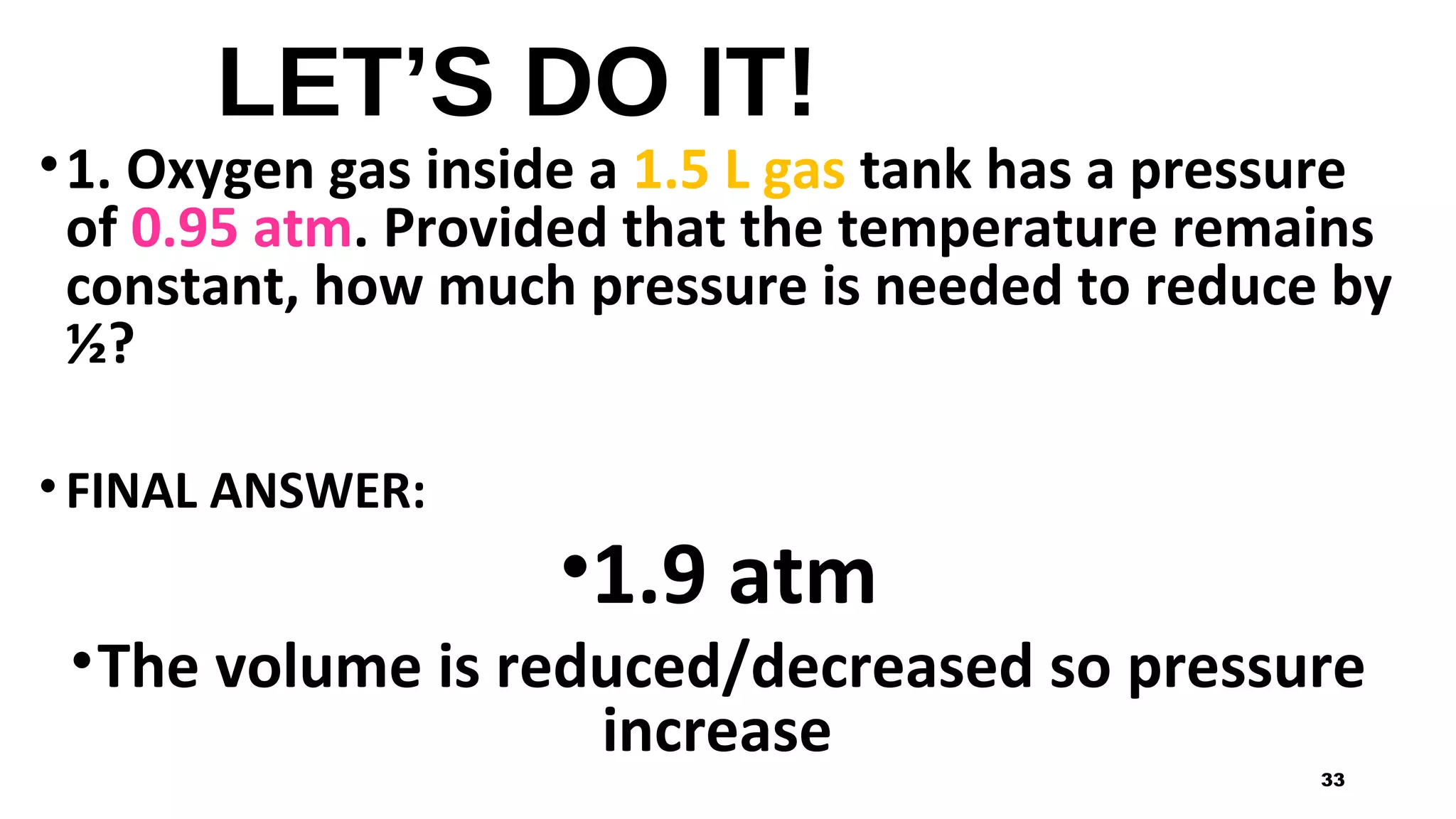
• FINAL ANSWER:
•1.9 atm
•The volume is reduced/decreased so pressure
increase
33
LET’S DO IT!
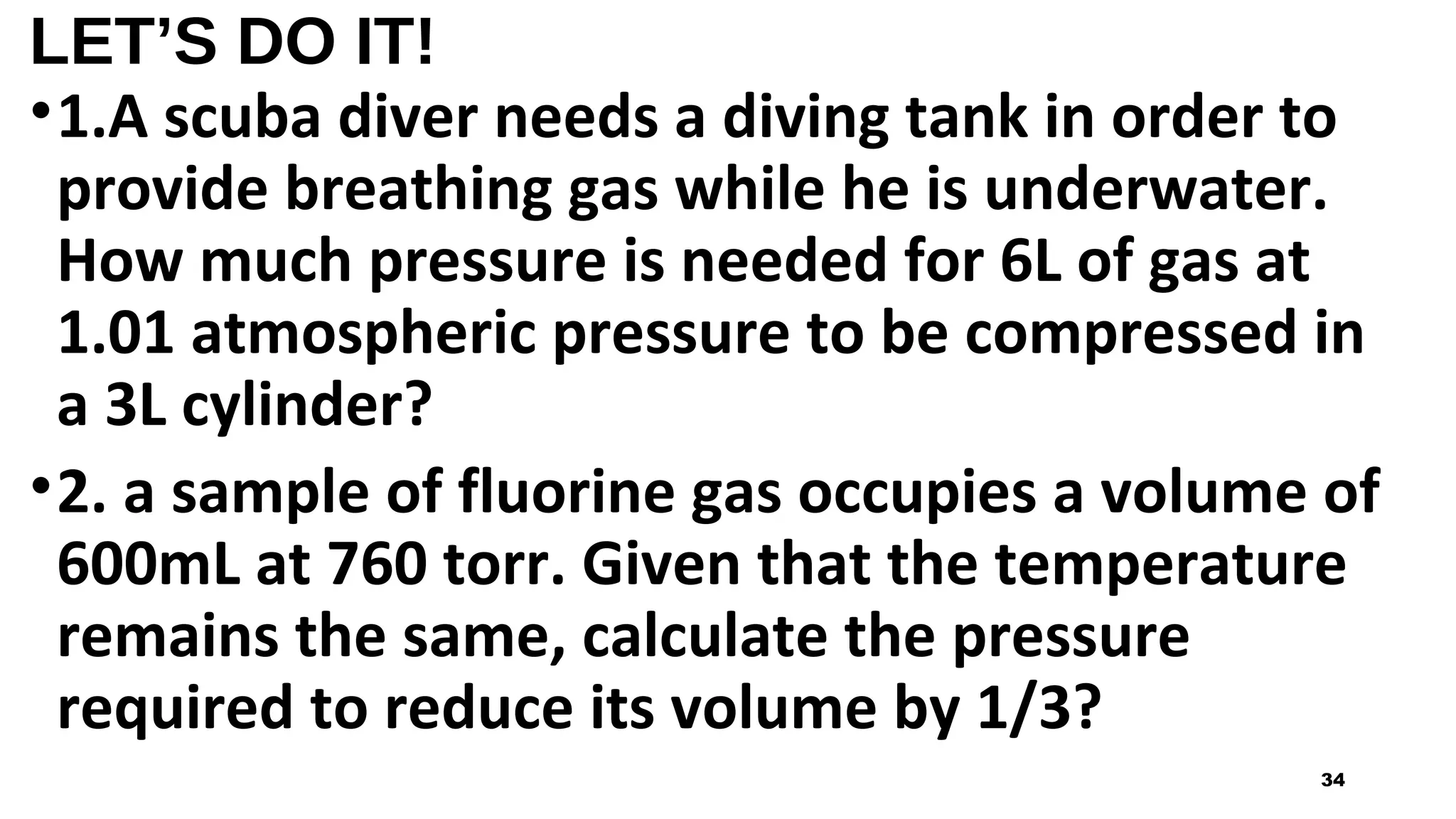
•1.A scuba diver needs a diving tank in order to
provide breathing gas while he is underwater.
How much pressure is needed for 6L of gas at
1.01 atmospheric pressure to be compressed in
a 3L cylinder?
•2. a sample of fluorine gas occupies a volume of
600mL at 760 torr. Given that the temperature
remains the same, calculate the pressure
required to reduce its volume by 1/3?
34

Lecture 3 Boyle's law

  • 1.
    Give description foreach pictures 1
  • 2.
    UNIT 4 Gases Pressureand Volume (Boyle’s Law) 2
  • 3.
    Robert Boyle -Lived1627 – 1691 3
  • 4.
  • 5.
    What is Boyle’sLaw? •Boyle’s Law is one of the laws in physics that concern with the behaviour of gases •When a gas is under pressure it takes up less space •The higher the pressure, the smaller the volume
  • 6.
  • 7.
  • 8.
    Boyle’s Law Boyle’s Lawstates that •the pressure of a gas is inversely related to its volume when T and n are constant. •if volume decreases, the pressure increases. 8
  • 9.
    PV Constant inBoyle’s Law Boyle’s Law can be stated as: P1V1 = P2V2 (T, n constant) 9
  • 10.
  • 11.
  • 12.
  • 13.
  • 14.
    Boyles’ Law andBreathing During an inhalation, •the lungs expand. •the pressure in the lungs decreases. •air flows towards the lower pressure in the lungs. 14Copyright © 2005 by Pearson Education, Inc. Publishing as Benjamin Cummings
  • 15.
    Boyles’ Law andBreathing During an exhalation, •lung volume decreases. •pressure within the lungs increases. •air flows from the higher pressure in the lungs to the outside. 15 Copyright © 2005 by Pearson Education, Inc. Publishing as Benjamin Cummings
  • 16.
  • 17.
    LET’S USE GRASAIN SOLVING: •G •R •A •S •A 17 GIVEN REQUIRE D ANSWER SOLUTION ANALYSIS
  • 18.
    Calculation with Boyle’sLaw Freon-12, CCl2F2, is used in refrigeration systems. What is the new volume (L) of a 8.0 L sample of Freon gas initially at 550 mm Hg after its pressure is changed to 2200 mm Hg at constant T? 1. Set up a data table: Conditions 1 Conditions 2 P1 = 550 mm Hg P2 = 2200 mm Hg V1 = 8.0 L V2 = 18 ?
  • 19.
    Calculation with Boyle’sLaw (Continued) 2. When pressure increases, volume decreases. Solve Boyle’s Law for V2: P1V1 = P2V2 V2 = V1 x P1 P2 V2 = 8.0 L x 550 mm Hg = 2.0 L 2200 mm Hg pressure ratio 19
  • 20.
    Learning Check For acylinder containing helium gas indicate if cylinder A or cylinder B represents the new volume for the following changes (n and T are constant). 1) pressure decreases 2) pressure increases 20
  • 21.
    Solution For a cylindercontaining helium gas indicate if cylinder A or cylinder B represents the new volume for the following changes (n and T are constant): 1) Pressure decreases B 2) Pressure increases A 21
  • 22.
    Learning Check If asample of helium gas has a volume of 120 mL and a pressure of 850 mm Hg, what is the new volume if the pressure is changed to 425 mm Hg ? 1) 60 mL 2) 120 mL 3) 240 mL 22
  • 23.
    Solution 3) 240 mL P1= 850 mm Hg P2 = 425 mm Hg V1 = 120 mL V2 = ?? V2= V1 x P1= 120 mL x 850 mm Hg = 240 mL P2 425 mm Hg Pressure ratio increases volume 23
  • 24.
    Learning Check A sampleof helium gas in a balloon has a volume of 6.4 L at a pressure of 0.70 atm. At 1.40 atm (T constant), is the new volume represented by A, B, or C? 24
  • 25.
    Solution A sample ofhelium gas in a balloon has a volume of 6.4 L at a pressure of 0.70 atm. At a higher pressure (T constant), the new volume is represented by the smaller balloon A. 25
  • 26.
    Learning Check If thesample of helium gas has a volume of 6.4 L at a pressure of 0.70 atm, what is the new volume when the pressure is increased to 1.40 atm (T constant)? A) 3.2 L B) 6.4 L C) 12.8 L 26
  • 27.
    Solution If the sampleof helium gas has a volume of 6.4 L at a pressure of 0.70 atm, what is the new volume when the pressure is increased to 1.40 atm (T constant)? A) 3.2 L V2 = V1 x P1 P2 V2 = 6.4 L x 0.70 atm = 3.2 L 1.40 atm Volume decreases when there is an increase in the pressure (temperature is constant.) 27
  • 28.
    Learning Check A sampleof oxygen gas has a volume of 12.0 L at 600. mm Hg. What is the new pressure when the volume changes to 36.0 L? (T and n constant). 1) 200. mm Hg 2) 400. mm Hg 3) 1200 mm Hg 28
  • 29.
    Solution 1) 200. mmHg Data table Conditions 1 Conditions 2 P1 = 600. mm Hg P2 = ??? V1 = 12.0 L V2 = 36.0 L P2 =P1 x V1 V2 600. mm Hg x 12.0 L = 200. mm Hg 36.0 L 29
  • 30.
    LET’S DO IT! •1.Oxygen gas inside a 1.5 L gas tank has a pressure of 0.95 atm. Provided that the temperature remains constant, how much pressure is needed to reduce by ½? •Required:? •Pressure ₂/P₂ 30
  • 31.
    LET’S DO IT! •1.Oxygen gas inside a 1.5 L gas tank has a pressure of 0.95 atm. Provided that the temperature remains constant, how much pressure is needed to reduce by ½? •GIVEN: •V₁=1.5L •P₁=0.95atm •V₂=½( V₁) •P₂=? 31
  • 32.
    LET’S DO IT! •1.Oxygen gas inside a 1.5 L gas tank has a pressure of 0.95 atm. Provided that the temperature remains constant, how much pressure is needed to reduce by ½? •FORMULA: •P2=P1V1/V2 32
  • 33.
    LET’S DO IT! •1.Oxygen gas inside a 1.5 L gas tank has a pressure of 0.95 atm. Provided that the temperature remains constant, how much pressure is needed to reduce by ½? • FINAL ANSWER: •1.9 atm •The volume is reduced/decreased so pressure increase 33
  • 34.
    LET’S DO IT! •1.Ascuba diver needs a diving tank in order to provide breathing gas while he is underwater. How much pressure is needed for 6L of gas at 1.01 atmospheric pressure to be compressed in a 3L cylinder? •2. a sample of fluorine gas occupies a volume of 600mL at 760 torr. Given that the temperature remains the same, calculate the pressure required to reduce its volume by 1/3? 34