Boyle’s Law:
An Introduction
JLBC
REVIEW:
Solve for 2 mins.
The pressure of a gas is found to
be 0.83 atm. Express this in
mmHg.
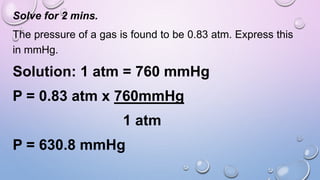
Solve for 2 mins.
The pressure of a gas is found to be 0.83 atm. Express this
in mmHg.
Solution: 1 atm = 760 mmHg
P = 0.83 atm x 760mmHg
1 atm
P = 630.8 mmHg
When we talk bout the volume of
matter, what are we referring to?
What happens when you put a
gas inside a container?
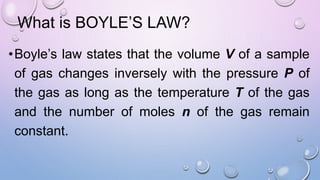
What is BOYLE’S LAW?
•Boyle’s law states that the volume V of a sample
of gas changes inversely with the pressure P of
the gas as long as the temperature T of the gas
and the number of moles n of the gas remain
constant.
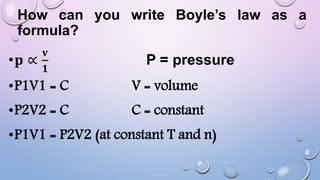
How can you write Boyle’s law as a
formula?
•𝐩 ∝
𝐯
𝟏
P = pressure
•P1V1 = C V = volume
•P2V2 = C C = constant
•P1V1 = P2V2 (at constant T and n)
Using Boyle’s Law, explain how
bubbles expand as they rise in
the air.
Application:
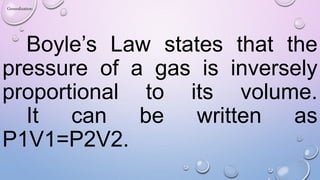
Boyle’s Law states that the
pressure of a gas is inversely
proportional to its volume.
It can be written as
P1V1=P2V2.
Generalization:
Evaluation:
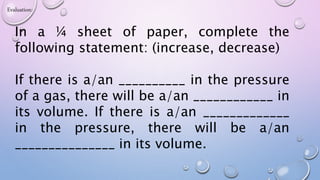
In a ¼ sheet of paper, complete the
following statement: (increase, decrease)
If there is a/an __________ in the pressure
of a gas, there will be a/an ____________ in
its volume. If there is a/an _____________
in the pressure, there will be a/an
_______________ in its volume.
Assignment:
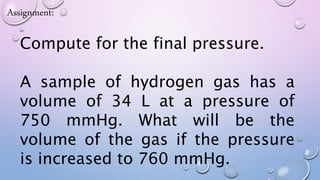
Compute for the final pressure.
A sample of hydrogen gas has a
volume of 34 L at a pressure of
750 mmHg. What will be the
volume of the gas if the pressure
is increased to 760 mmHg.

Boyles law ppt lesson

  • 1.
  • 2.
    REVIEW: Solve for 2mins. The pressure of a gas is found to be 0.83 atm. Express this in mmHg.
  • 3.
    Solve for 2mins. The pressure of a gas is found to be 0.83 atm. Express this in mmHg. Solution: 1 atm = 760 mmHg P = 0.83 atm x 760mmHg 1 atm P = 630.8 mmHg
  • 4.
    When we talkbout the volume of matter, what are we referring to? What happens when you put a gas inside a container?
  • 6.
    What is BOYLE’SLAW? •Boyle’s law states that the volume V of a sample of gas changes inversely with the pressure P of the gas as long as the temperature T of the gas and the number of moles n of the gas remain constant.
  • 7.
    How can youwrite Boyle’s law as a formula? •𝐩 ∝ 𝐯 𝟏 P = pressure •P1V1 = C V = volume •P2V2 = C C = constant •P1V1 = P2V2 (at constant T and n)
  • 8.
    Using Boyle’s Law,explain how bubbles expand as they rise in the air. Application:
  • 9.
    Boyle’s Law statesthat the pressure of a gas is inversely proportional to its volume. It can be written as P1V1=P2V2. Generalization:
  • 10.
    Evaluation: In a ¼sheet of paper, complete the following statement: (increase, decrease) If there is a/an __________ in the pressure of a gas, there will be a/an ____________ in its volume. If there is a/an _____________ in the pressure, there will be a/an _______________ in its volume.
  • 11.
    Assignment: Compute for thefinal pressure. A sample of hydrogen gas has a volume of 34 L at a pressure of 750 mmHg. What will be the volume of the gas if the pressure is increased to 760 mmHg.

Editor's Notes

  • #5 The volume of matter refers to the space it occupies. When we talk about the volume of gas, then what are we referring to? The volume of a gas is equal to the volume of its container. Why? The molecules of the gas spread out until they fill up all the space inside the container. Therefore, the volume of a gas is equal to the volume of its container. If you put oxygen in a 20-liter (L) tank, then the volume of the gas is also 20 L.
  • #7 In a simple way of saying: Boyle’s law: pressure and volume is inversely proportional. When volume goes up, pressure goes down. When pressure goes up, volume goes down.
  • #8 In a simple way of saying: Boyle’s law: pressure and volume is inversely proportional. When volume goes up, pressure goes down. When pressure goes up, volume goes down.
  • #9  Bubbles expand as they rise in the air because the atmospheric pressure is lower, the higher one goes up in the air. When the pressure is lower, the volume increases, hence the bubbles expand.