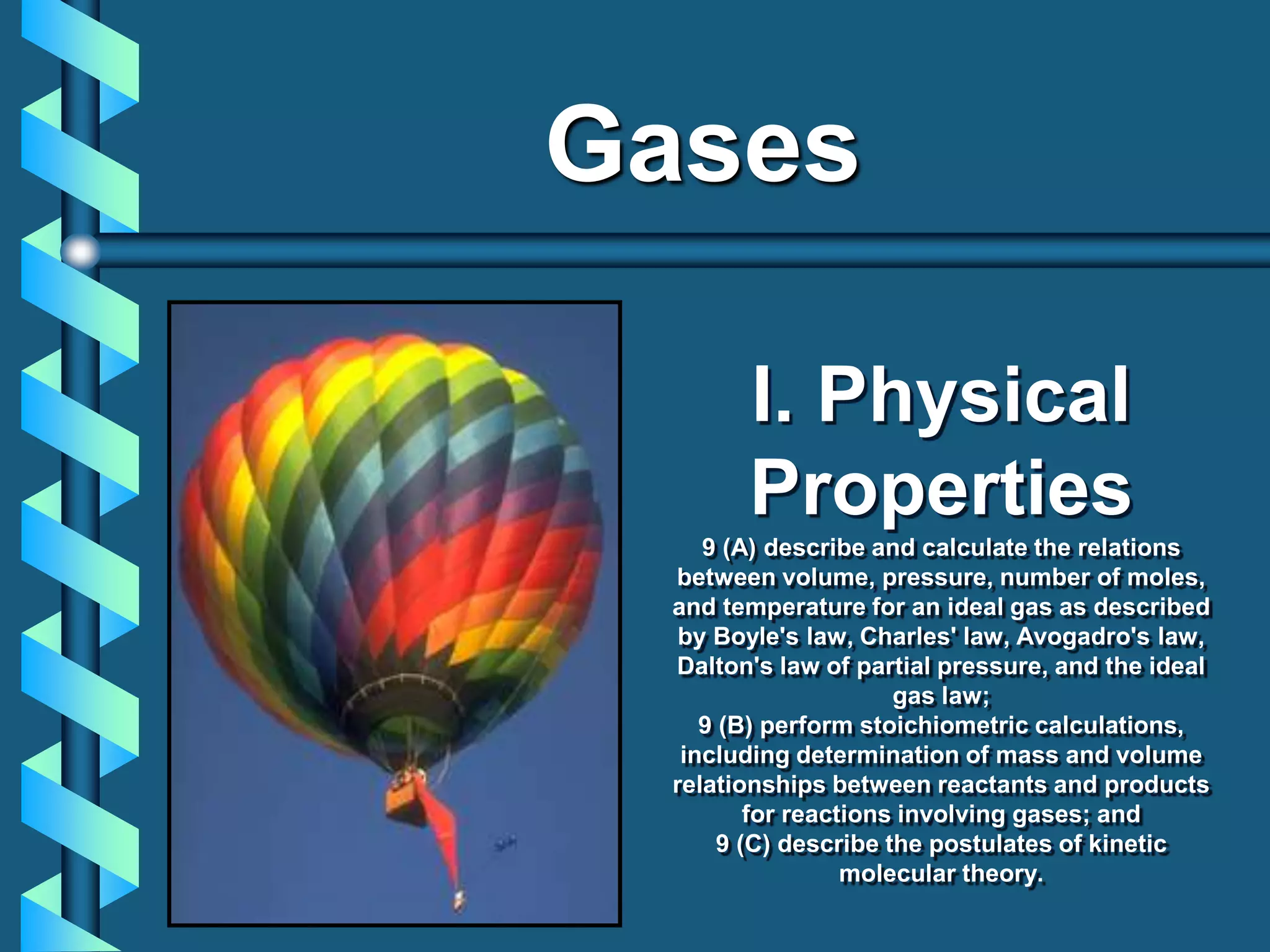
I. Physical
Properties
9 (A) describe and calculate the relations
between volume, pressure, number of moles,
and temperature for an ideal gas as described
by Boyle's law, Charles' law, Avogadro's law,
Dalton's law of partial pressure, and the ideal
gas law;
9 (B) perform stoichiometric calculations,
including determination of mass and volume
relationships between reactants and products
for reactions involving gases; and
9 (C) describe the postulates of kinetic
molecular theory.
Gases
A. Kinetic Molecular Theory
Particles in an ideal gas…
• have no volume.
• have elastic collisions.
• are in constant, random, straight-
line motion.
• don’t attract or repel each other.
• have an avg. KE directly related
to Kelvin temperature.
B. Real Gases
Particles in a REAL gas…
• have their own volume
• attract each other
Gas behavior is most ideal…
• at low pressures
• at high temperatures
• in nonpolar atoms/molecules
C. Characteristics of Gases
Gases expand to fill any container.
• random motion, no attraction
Gases are fluids (like liquids).
• no attraction
Gases have very low densities.
• no volume = lots of empty space
C. Characteristics of Gases
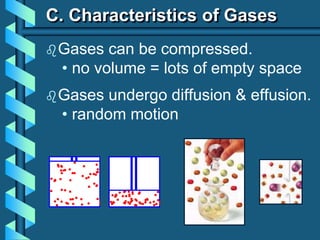
Gases can be compressed.
• no volume = lots of empty space
Gases undergo diffusion & effusion.
• random motion
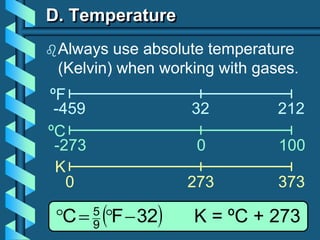
D. Temperature
ºF
ºC
K
-459 32 212
-273 0 100
0 273 373
 32FC 9
5
 K = ºC + 273
Always use absolute temperature
(Kelvin) when working with gases.
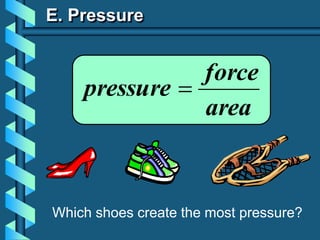
E. Pressure
area
force
pressure 
Which shoes create the most pressure?
E. Pressure
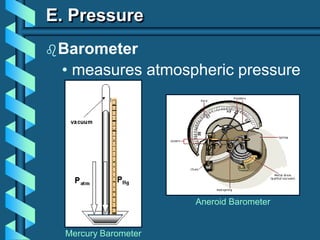
Barometer
• measures atmospheric pressure
Mercury Barometer
Aneroid Barometer
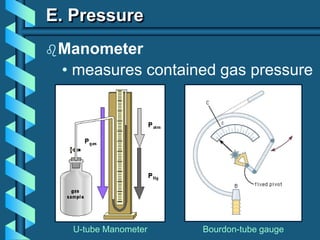
E. Pressure
Manometer
• measures contained gas pressure
U-tube Manometer Bourdon-tube gauge
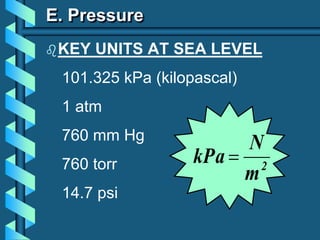
E. Pressure
2
m
N
kPa 
KEY UNITS AT SEA LEVEL
101.325 kPa (kilopascal)
1 atm
760 mm Hg
760 torr
14.7 psi
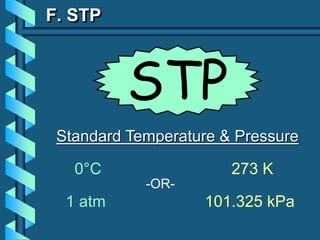
F. STP
Standard Temperature & Pressure
0°C 273 K
1 atm 101.325 kPa
-OR-
STP
II. The Gas
Laws
BOYLES
CHARLES
GAY-
LUSSAC
Ch. 12 - Gases
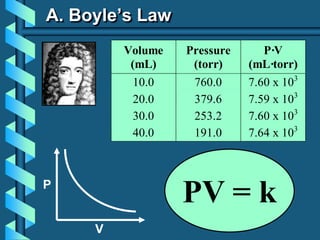
A. Boyle’s Law
P
V
PV = k
Volume
(mL)
Pressure
(torr)
P·V
(mL·torr)
10.0 760.0 7.60 x 10³
20.0 379.6 7.59 x 10³
30.0 253.2 7.60 x 10³
40.0 191.0 7.64 x 10³
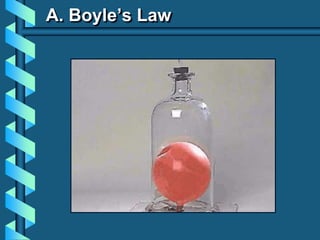
A. Boyle’s Law
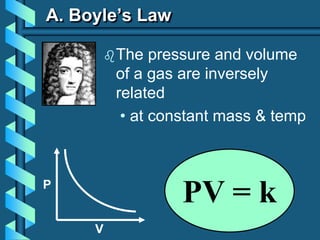
The pressure and volume
of a gas are inversely
related
• at constant mass & temp
P
V
PV = k
A. Boyle’s Law
k
T
V
V
T
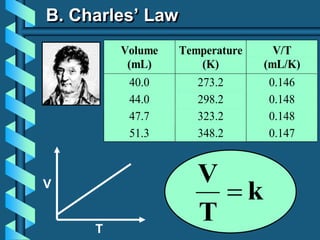
B. Charles’ Law
Volume
(mL)
Temperature
(K)
V/T
(mL/K)
40.0 273.2 0.146
44.0 298.2 0.148
47.7 323.2 0.148
51.3 348.2 0.147
k
T
V
V
T
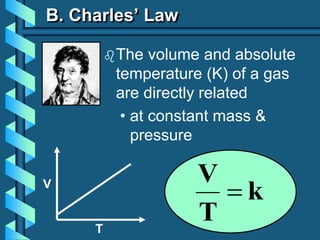
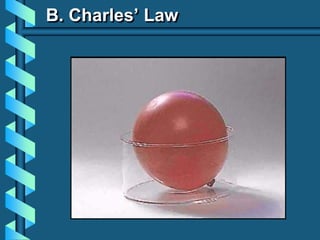
B. Charles’ Law
The volume and absolute
temperature (K) of a gas
are directly related
• at constant mass &
pressure
B. Charles’ Law
GIVEN:
V1 = 100. mL
P1 = 150. kPa
V2 = ?
P2 = 200. kPa
WORK:
P1V1T2 = P2V2T1
E. Gas Law Problems
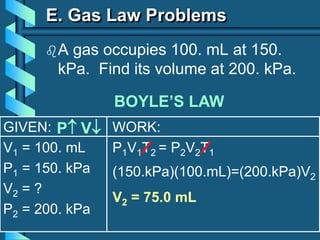
A gas occupies 100. mL at 150.
kPa. Find its volume at 200. kPa.
BOYLE’S LAW
P V
(150.kPa)(100.mL)=(200.kPa)V2
V2 = 75.0 mL
GIVEN:
V1 = 473 cm3
T1 = 36°C = 309K
V2 = ?
T2 = 94°C = 367K
WORK:
P1V1T2 = P2V2T1
E. Gas Law Problems
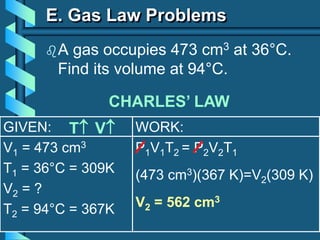
A gas occupies 473 cm3 at 36°C.
Find its volume at 94°C.
CHARLES’ LAW
T V
(473 cm3)(367 K)=V2(309 K)
V2 = 562 cm3
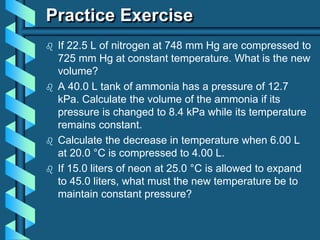
Practice Exercise
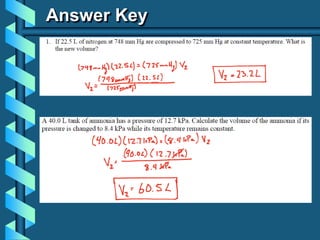
 If 22.5 L of nitrogen at 748 mm Hg are compressed to
725 mm Hg at constant temperature. What is the new
volume?
 A 40.0 L tank of ammonia has a pressure of 12.7
kPa. Calculate the volume of the ammonia if its
pressure is changed to 8.4 kPa while its temperature
remains constant.
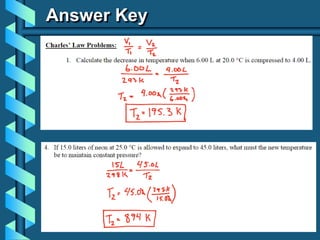
 Calculate the decrease in temperature when 6.00 L
at 20.0 °C is compressed to 4.00 L.
 If 15.0 liters of neon at 25.0 °C is allowed to expand
to 45.0 liters, what must the new temperature be to
maintain constant pressure?
Answer Key
Answer Key
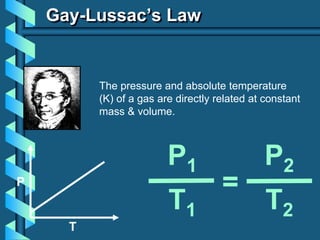
Gay-Lussac’s Law
The pressure and absolute temperature
(K) of a gas are directly related at constant
mass & volume.
P
T
P1
T1
=
P2
T2
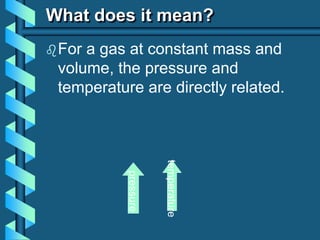
What does it mean?
For a gas at constant mass and
volume, the pressure and
temperature are directly related.
pressure
temperature
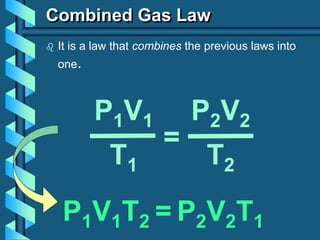
Combined Gas Law
 It is a law that combines the previous laws into
one.
P1V1
T1
=
P2V2
T2
P1V1T2 = P2V2T1
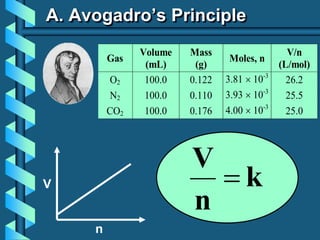
k
n
V
V
n
A. Avogadro’s Principle
Gas
Volume
(mL)
Mass
(g)
Moles, n
V/n
(L/mol)
O2 100.0 0.122 3.81  10-3
26.2
N2 100.0 0.110 3.93  10-3
25.5
CO2 100.0 0.176 4.00  10-3
25.0
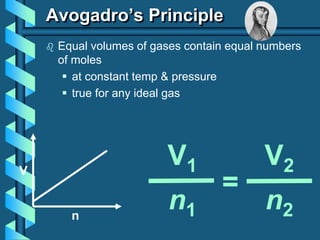
Avogadro’s Principle
 Equal volumes of gases contain equal numbers
of moles
 at constant temp & pressure
 true for any ideal gas
V
n
V1
n1
=
V2
n2
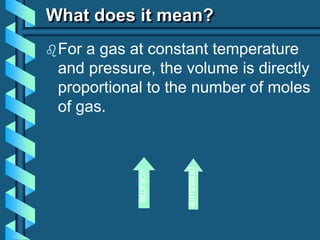
What does it mean?
For a gas at constant temperature
and pressure, the volume is directly
proportional to the number of moles
of gas.
volume
pressure
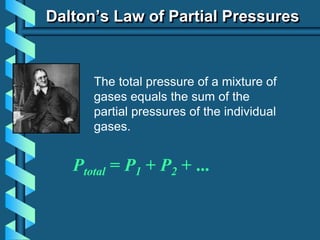
Dalton’s Law of Partial Pressures
The total pressure of a mixture of
gases equals the sum of the
partial pressures of the individual
gases.
Ptotal = P1 + P2 + ...
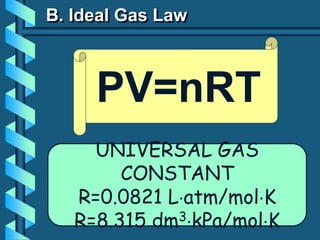
B. Ideal Gas Law
UNIVERSAL GAS
CONSTANT
R=0.0821 Latm/molK
R=8.315 dm3kPa/molK
PV=nRT
PV
T
V
n
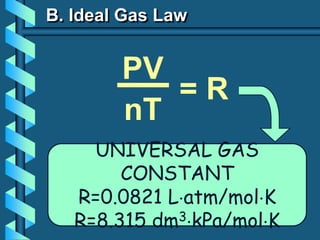
PV
nT
B. Ideal Gas Law
= k
UNIVERSAL GAS
CONSTANT
R=0.0821 Latm/molK
R=8.315 dm3kPa/molK
= R
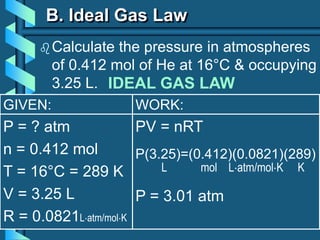
GIVEN:
P = ? atm
n = 0.412 mol
T = 16°C = 289 K
V = 3.25 L
R = 0.0821Latm/molK
WORK:
PV = nRT
P(3.25)=(0.412)(0.0821)(289)
L mol Latm/molK K
P = 3.01 atm
B. Ideal Gas Law
Calculate the pressure in atmospheres
of 0.412 mol of He at 16°C & occupying
3.25 L. IDEAL GAS LAW
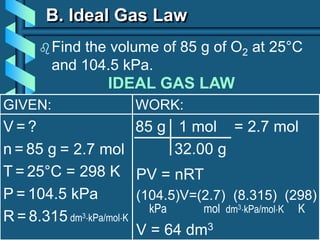
GIVEN:
V = ?
n = 85 g
T = 25°C = 298 K
P = 104.5 kPa
R = 8.315 dm3kPa/molK
B. Ideal Gas Law
Find the volume of 85 g of O2 at 25°C
and 104.5 kPa.
= 2.7 mol
WORK:
85 g 1 mol = 2.7 mol
32.00 g
PV = nRT
(104.5)V=(2.7) (8.315) (298)
kPa mol dm3kPa/molK K
V = 64 dm3
IDEAL GAS LAW
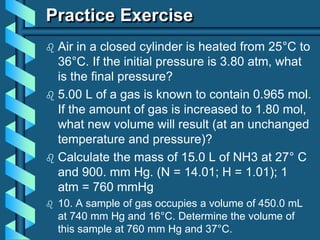
Practice Exercise
 Air in a closed cylinder is heated from 25°C to
36°C. If the initial pressure is 3.80 atm, what
is the final pressure?
 5.00 L of a gas is known to contain 0.965 mol.
If the amount of gas is increased to 1.80 mol,
what new volume will result (at an unchanged
temperature and pressure)?
 Calculate the mass of 15.0 L of NH3 at 27° C
and 900. mm Hg. (N = 14.01; H = 1.01); 1
atm = 760 mmHg
 10. A sample of gas occupies a volume of 450.0 mL
at 740 mm Hg and 16°C. Determine the volume of
this sample at 760 mm Hg and 37°C.
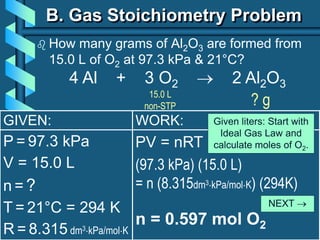
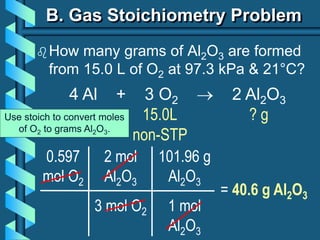
WORK:
PV = nRT
(97.3 kPa) (15.0 L)
= n (8.315dm3kPa/molK) (294K)
n = 0.597 mol O2
B. Gas Stoichiometry Problem
 How many grams of Al2O3 are formed from
15.0 L of O2 at 97.3 kPa & 21°C?
GIVEN:
P = 97.3 kPa
V = 15.0 L
n = ?
T = 21°C = 294 K
R = 8.315 dm3kPa/molK
4 Al + 3 O2  2 Al2O3
15.0 L
non-STP ? g
Given liters: Start with
Ideal Gas Law and
calculate moles of O2.
NEXT 
2 mol
Al2O3
3 mol O2
B. Gas Stoichiometry Problem
How many grams of Al2O3 are formed
from 15.0 L of O2 at 97.3 kPa & 21°C?
0.597
mol O2
= 40.6 g Al2O3
4 Al + 3 O2  2 Al2O3
101.96 g
Al2O3
1 mol
Al2O3
15.0L
non-STP
? gUse stoich to convert moles
of O2 to grams Al2O3.
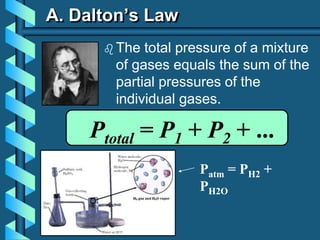
A. Dalton’s Law
 The total pressure of a mixture
of gases equals the sum of the
partial pressures of the
individual gases.
Ptotal = P1 + P2 + ...
Patm = PH2 +
PH2O
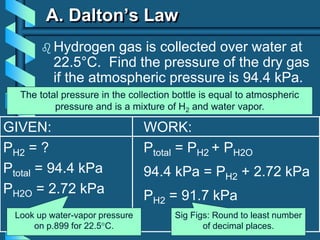
GIVEN:
PH2 = ?
Ptotal = 94.4 kPa
PH2O = 2.72 kPa
WORK:
Ptotal = PH2 + PH2O
94.4 kPa = PH2 + 2.72 kPa
PH2 = 91.7 kPa
A. Dalton’s Law
 Hydrogen gas is collected over water at
22.5°C. Find the pressure of the dry gas
if the atmospheric pressure is 94.4 kPa.
Look up water-vapor pressure
on p.899 for 22.5°C.
Sig Figs: Round to least number
of decimal places.
The total pressure in the collection bottle is equal to atmospheric
pressure and is a mixture of H2 and water vapor.
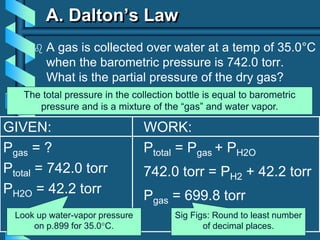
GIVEN:
Pgas = ?
Ptotal = 742.0 torr
PH2O = 42.2 torr
WORK:
Ptotal = Pgas + PH2O
742.0 torr = PH2 + 42.2 torr
Pgas = 699.8 torr
 A gas is collected over water at a temp of 35.0°C
when the barometric pressure is 742.0 torr.
What is the partial pressure of the dry gas?
DALTON’S LAW
Look up water-vapor pressure
on p.899 for 35.0°C.
Sig Figs: Round to least number
of decimal places.
A. Dalton’s Law
The total pressure in the collection bottle is equal to barometric
pressure and is a mixture of the “gas” and water vapor.

Gas Laws

  • 1.
    I. Physical Properties 9 (A)describe and calculate the relations between volume, pressure, number of moles, and temperature for an ideal gas as described by Boyle's law, Charles' law, Avogadro's law, Dalton's law of partial pressure, and the ideal gas law; 9 (B) perform stoichiometric calculations, including determination of mass and volume relationships between reactants and products for reactions involving gases; and 9 (C) describe the postulates of kinetic molecular theory. Gases
  • 2.
    A. Kinetic MolecularTheory Particles in an ideal gas… • have no volume. • have elastic collisions. • are in constant, random, straight- line motion. • don’t attract or repel each other. • have an avg. KE directly related to Kelvin temperature.
  • 3.
    B. Real Gases Particlesin a REAL gas… • have their own volume • attract each other Gas behavior is most ideal… • at low pressures • at high temperatures • in nonpolar atoms/molecules
  • 4.
    C. Characteristics ofGases Gases expand to fill any container. • random motion, no attraction Gases are fluids (like liquids). • no attraction Gases have very low densities. • no volume = lots of empty space
  • 5.
    C. Characteristics ofGases Gases can be compressed. • no volume = lots of empty space Gases undergo diffusion & effusion. • random motion
  • 6.
    D. Temperature ºF ºC K -459 32212 -273 0 100 0 273 373  32FC 9 5  K = ºC + 273 Always use absolute temperature (Kelvin) when working with gases.
  • 7.
    E. Pressure area force pressure  Whichshoes create the most pressure?
  • 8.
    E. Pressure Barometer • measuresatmospheric pressure Mercury Barometer Aneroid Barometer
  • 9.
    E. Pressure Manometer • measurescontained gas pressure U-tube Manometer Bourdon-tube gauge
  • 10.
    E. Pressure 2 m N kPa  KEYUNITS AT SEA LEVEL 101.325 kPa (kilopascal) 1 atm 760 mm Hg 760 torr 14.7 psi
  • 11.
    F. STP Standard Temperature& Pressure 0°C 273 K 1 atm 101.325 kPa -OR- STP
  • 12.
  • 13.
    A. Boyle’s Law P V PV= k Volume (mL) Pressure (torr) P·V (mL·torr) 10.0 760.0 7.60 x 10³ 20.0 379.6 7.59 x 10³ 30.0 253.2 7.60 x 10³ 40.0 191.0 7.64 x 10³
  • 14.
    A. Boyle’s Law Thepressure and volume of a gas are inversely related • at constant mass & temp P V PV = k
  • 15.
  • 16.
    k T V V T B. Charles’ Law Volume (mL) Temperature (K) V/T (mL/K) 40.0273.2 0.146 44.0 298.2 0.148 47.7 323.2 0.148 51.3 348.2 0.147
  • 17.
    k T V V T B. Charles’ Law Thevolume and absolute temperature (K) of a gas are directly related • at constant mass & pressure
  • 18.
  • 19.
    GIVEN: V1 = 100.mL P1 = 150. kPa V2 = ? P2 = 200. kPa WORK: P1V1T2 = P2V2T1 E. Gas Law Problems A gas occupies 100. mL at 150. kPa. Find its volume at 200. kPa. BOYLE’S LAW P V (150.kPa)(100.mL)=(200.kPa)V2 V2 = 75.0 mL
  • 20.
    GIVEN: V1 = 473cm3 T1 = 36°C = 309K V2 = ? T2 = 94°C = 367K WORK: P1V1T2 = P2V2T1 E. Gas Law Problems A gas occupies 473 cm3 at 36°C. Find its volume at 94°C. CHARLES’ LAW T V (473 cm3)(367 K)=V2(309 K) V2 = 562 cm3
  • 21.
    Practice Exercise  If22.5 L of nitrogen at 748 mm Hg are compressed to 725 mm Hg at constant temperature. What is the new volume?  A 40.0 L tank of ammonia has a pressure of 12.7 kPa. Calculate the volume of the ammonia if its pressure is changed to 8.4 kPa while its temperature remains constant.  Calculate the decrease in temperature when 6.00 L at 20.0 °C is compressed to 4.00 L.  If 15.0 liters of neon at 25.0 °C is allowed to expand to 45.0 liters, what must the new temperature be to maintain constant pressure?
  • 22.
  • 23.
  • 24.
    Gay-Lussac’s Law The pressureand absolute temperature (K) of a gas are directly related at constant mass & volume. P T P1 T1 = P2 T2
  • 25.
    What does itmean? For a gas at constant mass and volume, the pressure and temperature are directly related. pressure temperature
  • 26.
    Combined Gas Law It is a law that combines the previous laws into one. P1V1 T1 = P2V2 T2 P1V1T2 = P2V2T1
  • 27.
    k n V V n A. Avogadro’s Principle Gas Volume (mL) Mass (g) Moles,n V/n (L/mol) O2 100.0 0.122 3.81  10-3 26.2 N2 100.0 0.110 3.93  10-3 25.5 CO2 100.0 0.176 4.00  10-3 25.0
  • 28.
    Avogadro’s Principle  Equalvolumes of gases contain equal numbers of moles  at constant temp & pressure  true for any ideal gas V n V1 n1 = V2 n2
  • 29.
    What does itmean? For a gas at constant temperature and pressure, the volume is directly proportional to the number of moles of gas. volume pressure
  • 30.
    Dalton’s Law ofPartial Pressures The total pressure of a mixture of gases equals the sum of the partial pressures of the individual gases. Ptotal = P1 + P2 + ...
  • 31.
    B. Ideal GasLaw UNIVERSAL GAS CONSTANT R=0.0821 Latm/molK R=8.315 dm3kPa/molK PV=nRT
  • 32.
    PV T V n PV nT B. Ideal GasLaw = k UNIVERSAL GAS CONSTANT R=0.0821 Latm/molK R=8.315 dm3kPa/molK = R
  • 33.
    GIVEN: P = ?atm n = 0.412 mol T = 16°C = 289 K V = 3.25 L R = 0.0821Latm/molK WORK: PV = nRT P(3.25)=(0.412)(0.0821)(289) L mol Latm/molK K P = 3.01 atm B. Ideal Gas Law Calculate the pressure in atmospheres of 0.412 mol of He at 16°C & occupying 3.25 L. IDEAL GAS LAW
  • 34.
    GIVEN: V = ? n= 85 g T = 25°C = 298 K P = 104.5 kPa R = 8.315 dm3kPa/molK B. Ideal Gas Law Find the volume of 85 g of O2 at 25°C and 104.5 kPa. = 2.7 mol WORK: 85 g 1 mol = 2.7 mol 32.00 g PV = nRT (104.5)V=(2.7) (8.315) (298) kPa mol dm3kPa/molK K V = 64 dm3 IDEAL GAS LAW
  • 35.
    Practice Exercise  Airin a closed cylinder is heated from 25°C to 36°C. If the initial pressure is 3.80 atm, what is the final pressure?  5.00 L of a gas is known to contain 0.965 mol. If the amount of gas is increased to 1.80 mol, what new volume will result (at an unchanged temperature and pressure)?  Calculate the mass of 15.0 L of NH3 at 27° C and 900. mm Hg. (N = 14.01; H = 1.01); 1 atm = 760 mmHg  10. A sample of gas occupies a volume of 450.0 mL at 740 mm Hg and 16°C. Determine the volume of this sample at 760 mm Hg and 37°C.
  • 36.
    WORK: PV = nRT (97.3kPa) (15.0 L) = n (8.315dm3kPa/molK) (294K) n = 0.597 mol O2 B. Gas Stoichiometry Problem  How many grams of Al2O3 are formed from 15.0 L of O2 at 97.3 kPa & 21°C? GIVEN: P = 97.3 kPa V = 15.0 L n = ? T = 21°C = 294 K R = 8.315 dm3kPa/molK 4 Al + 3 O2  2 Al2O3 15.0 L non-STP ? g Given liters: Start with Ideal Gas Law and calculate moles of O2. NEXT 
  • 37.
    2 mol Al2O3 3 molO2 B. Gas Stoichiometry Problem How many grams of Al2O3 are formed from 15.0 L of O2 at 97.3 kPa & 21°C? 0.597 mol O2 = 40.6 g Al2O3 4 Al + 3 O2  2 Al2O3 101.96 g Al2O3 1 mol Al2O3 15.0L non-STP ? gUse stoich to convert moles of O2 to grams Al2O3.
  • 38.
    A. Dalton’s Law The total pressure of a mixture of gases equals the sum of the partial pressures of the individual gases. Ptotal = P1 + P2 + ... Patm = PH2 + PH2O
  • 39.
    GIVEN: PH2 = ? Ptotal= 94.4 kPa PH2O = 2.72 kPa WORK: Ptotal = PH2 + PH2O 94.4 kPa = PH2 + 2.72 kPa PH2 = 91.7 kPa A. Dalton’s Law  Hydrogen gas is collected over water at 22.5°C. Find the pressure of the dry gas if the atmospheric pressure is 94.4 kPa. Look up water-vapor pressure on p.899 for 22.5°C. Sig Figs: Round to least number of decimal places. The total pressure in the collection bottle is equal to atmospheric pressure and is a mixture of H2 and water vapor.
  • 40.
    GIVEN: Pgas = ? Ptotal= 742.0 torr PH2O = 42.2 torr WORK: Ptotal = Pgas + PH2O 742.0 torr = PH2 + 42.2 torr Pgas = 699.8 torr  A gas is collected over water at a temp of 35.0°C when the barometric pressure is 742.0 torr. What is the partial pressure of the dry gas? DALTON’S LAW Look up water-vapor pressure on p.899 for 35.0°C. Sig Figs: Round to least number of decimal places. A. Dalton’s Law The total pressure in the collection bottle is equal to barometric pressure and is a mixture of the “gas” and water vapor.