PREPARED BY: JEGAN. S.NADAR
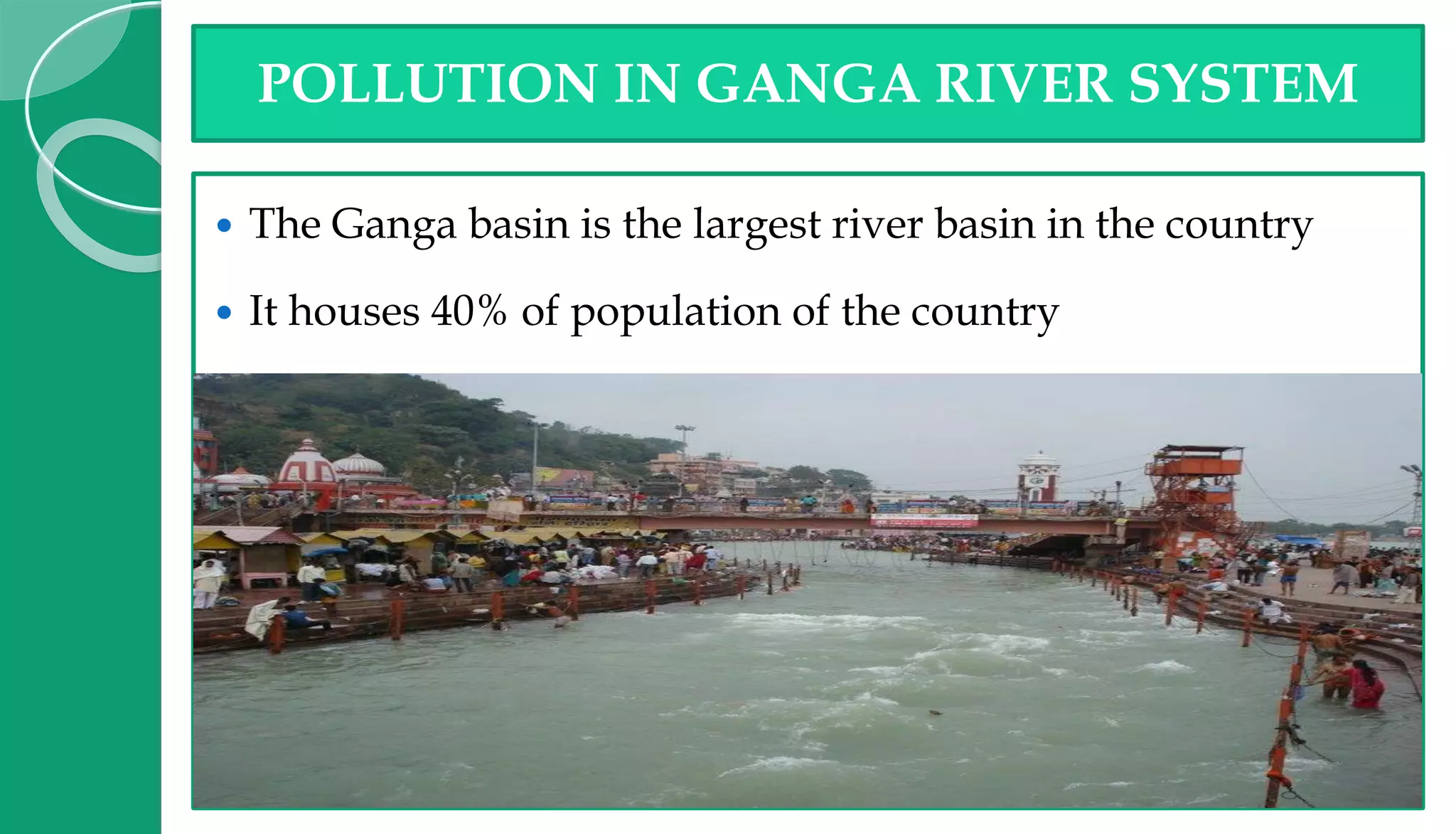
POLLUTION IN GANGA RIVER SYSTEM
 The Ganga basin is the largest river basin in the country
 It houses 40% of population of the country
 During the course of its journey Municipal sewages from
 29 class-I cities
 23 class-II cities
 48 towns
and effluents from industry are discharged into river ganga
resulting into pollution
 According to CPCB pollution control board the total waste water
generation on ganga basin is about 6445 MLD
Jegan Nadar
SOURCES OF POLLUTION
 Dosmestic waste
 Industrial effluents
 Solid garbage thrown directly into river
 Agricultural run-off containing harmful pesticide
 Half burned and unburned human bodies thrown into river
 Defecation on the banks by low income people
 Mass bathing and ritualistic practices
Jegan Nadar
Launching of GAP
 An action plan known as ganga action plan for immediate
reduction of pollution load on the Ganga was prepared by MoEF
in december 1984
 Government of India constitued Central Ganga Authority (CGA)
under chairmanship of Prime Minister in Feb 1985
 CGA has been renamed as NRCA in Sep 1995
Jegan Nadar
 The cabinet approved GAP in April 1985
 The GAP was thus launched in June 1985
Jegan Nadar
OBJECTIVES OF GAP
 The of main objectives GAP is to improve the water quality of the
ganga to acceptable standards by preventing the pollution load
reaching the river
 The restoring the river water quality to the bathing class standard
which is as follows
Dissolved oxygen NLT 5 mg/litre
Bio chemical oxygen demand (BOD) NMT 3 mg/litre
Bacterial load/coliform count NMT 10,000/ml
Faecal coliform count NMT 2500/ml
pH value 6.5-8.5
Jegan Nadar
GAP Phase-1
 The ganga action plan phase-1 was started in 1985 to improve water
quality
 GAP-1 envisaged diversion and treatment of 882 MLD out of 1340
MLD generated from 25 class-I cities.
 The main problem was to tackle pollution from municipal sewage
accounting for about 75% of river pollution
 This program also reduced pollution by creating facilities like toilet
complexus, crematoria, improvement of bathing ghats etc
Jegan Nadar
 Under GAP-1, 261 schemes were sanctioned out of which 259 were
completed. 2 schemes of sewage treatment plant (STP) were not
completed in Bihar because of litigation problems
 A sewage treatment capacity of 865 MLD has been created so far till
Oct 2000. With the completion of 2 remaining STP the total capacity
will become 882 MLD
 The NRCD has scheduled the GAP-I for completion by March 1990
but extended till march 2000 when this phase was declared closed
Jegan Nadar
GAP Phase-2
 GAP-1 did not cover the pollution load of ganga fully
 So Ganga action plan phase-II was launched in stages between 1993
and 1996
 On tributaries of ganga viz;Yamuma, Domaodar and Gomti
 In 25 class-I cities left out in phase-1
 In other polluting towns along the river
Jegan Nadar
 The states of Uttaranchal, Haryana, Delhi, Uttar Pradesh, Bihar
and West Bengal were supposed to implement the GAP-3 by
treating 1912 MLD of sewage
 But against this a treatment capacity of 780 MLD has been
created so far
Jegan Nadar
Various shortcomings in the implementation of GAP
 Monitoring Mechanism
 NRCA met only twice, in 1994 and 1997
 NRCD did not show any results/records of field visits, review
meetings, follow up action and implementation program
 Even State governments failed to implement and monitor the
committees constituted for monitoring purposes
Jegan Nadar
 Execution of Schemes
 Phase-1 of the plan was not fully complete, even after delay of
over 10years
 Even Phase-2 is also far behind its schedule. It is due to end in
Dec 2001, but only 13.7% of targeted sewage treatment capacity
has been completed so far
Jegan Nadar
 Core Schemes: STP
 Bihar and West Bengal could not obtain sanction from the
Ministry for any sewage treatment plant in the phase-2 of the
plan
 Improper operation and maintenance of assests
 Public participation
 Water quality monitoring
Jegan Nadar
Jegan Nadar
Ganga action plan: As a case study in Environmental Legislation

Ganga action plan: As a case study in Environmental Legislation

  • 1.
  • 4.
    POLLUTION IN GANGARIVER SYSTEM  The Ganga basin is the largest river basin in the country  It houses 40% of population of the country
  • 5.
     During thecourse of its journey Municipal sewages from  29 class-I cities  23 class-II cities  48 towns and effluents from industry are discharged into river ganga resulting into pollution  According to CPCB pollution control board the total waste water generation on ganga basin is about 6445 MLD Jegan Nadar
  • 6.
    SOURCES OF POLLUTION Dosmestic waste  Industrial effluents  Solid garbage thrown directly into river  Agricultural run-off containing harmful pesticide  Half burned and unburned human bodies thrown into river  Defecation on the banks by low income people  Mass bathing and ritualistic practices Jegan Nadar
  • 8.
    Launching of GAP An action plan known as ganga action plan for immediate reduction of pollution load on the Ganga was prepared by MoEF in december 1984  Government of India constitued Central Ganga Authority (CGA) under chairmanship of Prime Minister in Feb 1985  CGA has been renamed as NRCA in Sep 1995 Jegan Nadar
  • 9.
     The cabinetapproved GAP in April 1985  The GAP was thus launched in June 1985 Jegan Nadar
  • 10.
    OBJECTIVES OF GAP The of main objectives GAP is to improve the water quality of the ganga to acceptable standards by preventing the pollution load reaching the river  The restoring the river water quality to the bathing class standard which is as follows Dissolved oxygen NLT 5 mg/litre Bio chemical oxygen demand (BOD) NMT 3 mg/litre Bacterial load/coliform count NMT 10,000/ml Faecal coliform count NMT 2500/ml pH value 6.5-8.5 Jegan Nadar
  • 11.
    GAP Phase-1  Theganga action plan phase-1 was started in 1985 to improve water quality  GAP-1 envisaged diversion and treatment of 882 MLD out of 1340 MLD generated from 25 class-I cities.  The main problem was to tackle pollution from municipal sewage accounting for about 75% of river pollution  This program also reduced pollution by creating facilities like toilet complexus, crematoria, improvement of bathing ghats etc Jegan Nadar
  • 12.
     Under GAP-1,261 schemes were sanctioned out of which 259 were completed. 2 schemes of sewage treatment plant (STP) were not completed in Bihar because of litigation problems  A sewage treatment capacity of 865 MLD has been created so far till Oct 2000. With the completion of 2 remaining STP the total capacity will become 882 MLD  The NRCD has scheduled the GAP-I for completion by March 1990 but extended till march 2000 when this phase was declared closed Jegan Nadar
  • 13.
    GAP Phase-2  GAP-1did not cover the pollution load of ganga fully  So Ganga action plan phase-II was launched in stages between 1993 and 1996  On tributaries of ganga viz;Yamuma, Domaodar and Gomti  In 25 class-I cities left out in phase-1  In other polluting towns along the river Jegan Nadar
  • 14.
     The statesof Uttaranchal, Haryana, Delhi, Uttar Pradesh, Bihar and West Bengal were supposed to implement the GAP-3 by treating 1912 MLD of sewage  But against this a treatment capacity of 780 MLD has been created so far Jegan Nadar
  • 15.
    Various shortcomings inthe implementation of GAP  Monitoring Mechanism  NRCA met only twice, in 1994 and 1997  NRCD did not show any results/records of field visits, review meetings, follow up action and implementation program  Even State governments failed to implement and monitor the committees constituted for monitoring purposes Jegan Nadar
  • 16.
     Execution ofSchemes  Phase-1 of the plan was not fully complete, even after delay of over 10years  Even Phase-2 is also far behind its schedule. It is due to end in Dec 2001, but only 13.7% of targeted sewage treatment capacity has been completed so far Jegan Nadar
  • 17.
     Core Schemes:STP  Bihar and West Bengal could not obtain sanction from the Ministry for any sewage treatment plant in the phase-2 of the plan  Improper operation and maintenance of assests  Public participation  Water quality monitoring Jegan Nadar
  • 18.