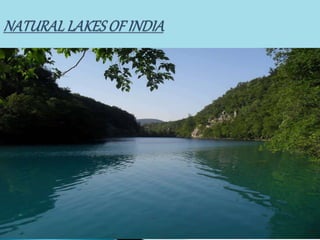
 Natural lakes are relatively large water
bodies of fresh water surrounded by land.
 For the purpose of the conservation
strategy natural lakes are defined as
standing water bodies larger than 20 acres.
 These lakes are generally found in
mountanious areas, areas with rift zone and
area with ongoing glaciation.
 Lakes and ponds are formed by remnants of
glaciers, blocked rivers, and rivers that fill
natural basins.
 Water is stagnant not flowing.
 The water in lakes, ponds and inland
wetlands is layered (stratified) according to
temperature, oxygen and life.
 The shoreline of lakes, ponds and inland
wetlands contains an abundance of life.
 They are of great economic importance as
they are good for tourism.
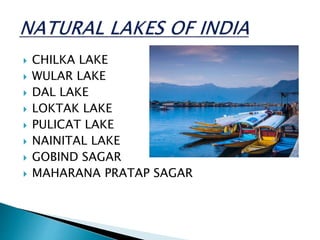
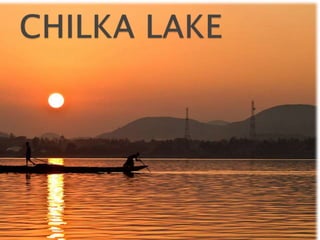
 CHILKA LAKE
 WULAR LAKE
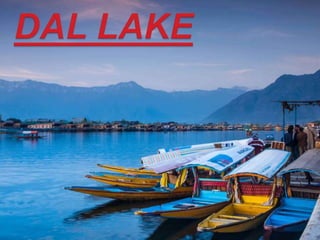
 DAL LAKE
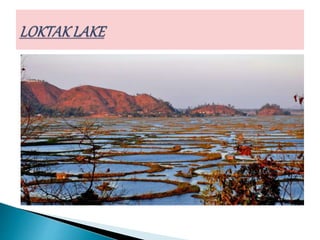
 LOKTAK LAKE
 PULICAT LAKE
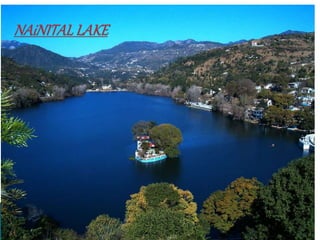
 NAINITAL LAKE
 GOBIND SAGAR
 MAHARANA PRATAP SAGAR
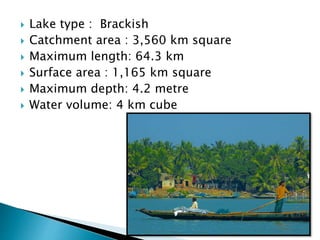
 Lake type : Brackish
 Catchment area : 3,560 km square
 Maximum length: 64.3 km
 Surface area : 1,165 km square
 Maximum depth: 4.2 metre
 Water volume: 4 km cube
 Largest wintering ground for migratory birds.
 It is spread over the Puri,kjurda, & Ganjam
district of odisa.
 Largest coastal lagoon im India & second
largest in world.
 Highly productive.
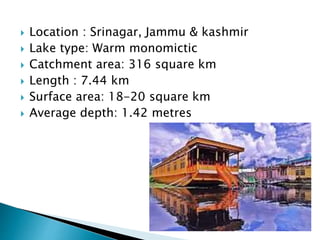
 Location : Srinagar, Jammu & kashmir
 Lake type: Warm monomictic
 Catchment area: 316 square km
 Length : 7.44 km
 Surface area: 18-20 square km
 Average depth: 1.42 metres
 Second largest in the state.
 Integral to tourism and recreation in Kashmir
and is named the "Jewel in the crown of
Kashmir"or "Srinagar's Jewel".
 The lake is also an important source for
commercial operations in fishing and water
plant harvesting.
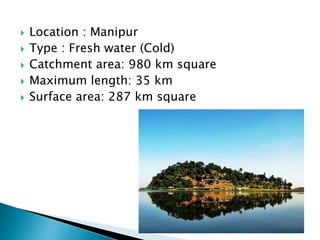
 Location : Manipur
 Type : Fresh water (Cold)
 Catchment area: 980 km square
 Maximum length: 35 km
 Surface area: 287 km square
 Loktak Lake is the largest freshwater lake in
Northeast India.
 The etymology of Loktak is Lok = "stream"
and tak = "the end“.
 It serves as a source of water for hydropower
generation, irrigation and drinking water
supply.
 Cold water fisheries is practised here.
 Icthyofauna is dominated by air breathing
fishes.
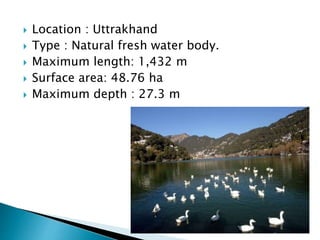
 Location : Uttrakhand
 Type : Natural fresh water body.
 Maximum length: 1,432 m
 Surface area: 48.76 ha
 Maximum depth : 27.3 m
 Nainital Lake, a natural freshwater body,
situated amidst the township
of Nainital in Uttarakhand State of India.
 Tectonic in origin, is kidney shaped or
crescent shaped and has an outfall at the
southeastern end.
 Nainital is most popular hill station of
Kumaon district. It is famous for its Naini
Lake located at the centre of the town and
several other lakes of nearby areas.
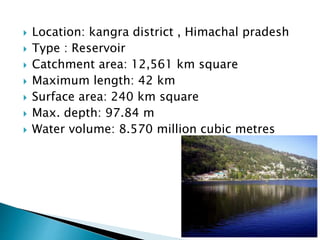
 Location: kangra district , Himachal pradesh
 Type : Reservoir
 Catchment area: 12,561 km square
 Maximum length: 42 km
 Surface area: 240 km square
 Max. depth: 97.84 m
 Water volume: 8.570 million cubic metres
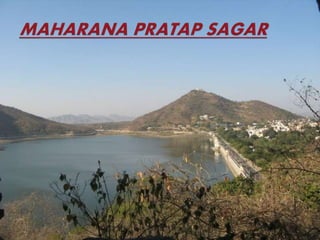
 Maharana Pratap Sagar in India also known
as Pong Reservoir or Pong Dam Lake.
 Named in the honour of Maharana Pratap
(1540–1597), the reservoir or the lake is a
well-known wildlife sanctuary and one of the
26 international wetland sites declared in
India by the Ramsar Convention.
 LAKES OF INDIA

LAKES OF INDIA

  • 3.
     Natural lakesare relatively large water bodies of fresh water surrounded by land.  For the purpose of the conservation strategy natural lakes are defined as standing water bodies larger than 20 acres.  These lakes are generally found in mountanious areas, areas with rift zone and area with ongoing glaciation.
  • 4.
     Lakes andponds are formed by remnants of glaciers, blocked rivers, and rivers that fill natural basins.  Water is stagnant not flowing.  The water in lakes, ponds and inland wetlands is layered (stratified) according to temperature, oxygen and life.  The shoreline of lakes, ponds and inland wetlands contains an abundance of life.
  • 5.
     They areof great economic importance as they are good for tourism.
  • 6.
     CHILKA LAKE WULAR LAKE  DAL LAKE  LOKTAK LAKE  PULICAT LAKE  NAINITAL LAKE  GOBIND SAGAR  MAHARANA PRATAP SAGAR
  • 8.
     Lake type: Brackish  Catchment area : 3,560 km square  Maximum length: 64.3 km  Surface area : 1,165 km square  Maximum depth: 4.2 metre  Water volume: 4 km cube
  • 9.
     Largest winteringground for migratory birds.  It is spread over the Puri,kjurda, & Ganjam district of odisa.  Largest coastal lagoon im India & second largest in world.  Highly productive.
  • 11.
     Location :Srinagar, Jammu & kashmir  Lake type: Warm monomictic  Catchment area: 316 square km  Length : 7.44 km  Surface area: 18-20 square km  Average depth: 1.42 metres
  • 12.
     Second largestin the state.  Integral to tourism and recreation in Kashmir and is named the "Jewel in the crown of Kashmir"or "Srinagar's Jewel".  The lake is also an important source for commercial operations in fishing and water plant harvesting.
  • 14.
     Location :Manipur  Type : Fresh water (Cold)  Catchment area: 980 km square  Maximum length: 35 km  Surface area: 287 km square
  • 15.
     Loktak Lakeis the largest freshwater lake in Northeast India.  The etymology of Loktak is Lok = "stream" and tak = "the end“.  It serves as a source of water for hydropower generation, irrigation and drinking water supply.  Cold water fisheries is practised here.  Icthyofauna is dominated by air breathing fishes.
  • 17.
     Location :Uttrakhand  Type : Natural fresh water body.  Maximum length: 1,432 m  Surface area: 48.76 ha  Maximum depth : 27.3 m
  • 18.
     Nainital Lake,a natural freshwater body, situated amidst the township of Nainital in Uttarakhand State of India.  Tectonic in origin, is kidney shaped or crescent shaped and has an outfall at the southeastern end.  Nainital is most popular hill station of Kumaon district. It is famous for its Naini Lake located at the centre of the town and several other lakes of nearby areas.
  • 20.
     Location: kangradistrict , Himachal pradesh  Type : Reservoir  Catchment area: 12,561 km square  Maximum length: 42 km  Surface area: 240 km square  Max. depth: 97.84 m  Water volume: 8.570 million cubic metres
  • 21.
     Maharana PratapSagar in India also known as Pong Reservoir or Pong Dam Lake.  Named in the honour of Maharana Pratap (1540–1597), the reservoir or the lake is a well-known wildlife sanctuary and one of the 26 international wetland sites declared in India by the Ramsar Convention.