Counseling Relevance
What is Counseling Direct face-to-face conversation between two people
“ A direct report which is used to help the employee to identify the reason for poor performance to  improve  and not to humiliate him or her”
Generally more formal than feedback and coaching and is required of a small percentage of employees
Subordinate-centered communication that outlines actions necessary for subordinates to achieve individual and organizational goals.
Counseling is a personal, individual, and confidential growth process during which a professional Counselor assists in defining concerns, clarifying goals and formulating plans to meet those goals.
Concept of counseling Relationship It is between 2 people where one person attempt to assists the other to organize himself better to attain the goal
Behaviour The relation between the counselor and the clients helps to openly discuss problem faced by the client
Purpose of Counseling Communicate concerns to the employee Determine the cause of the employee’s activities
Identify avenues for improvement and/or development Improve employee performance
Who Provides Employee Counseling? Depends on the organization and organizational culture Can be done using: Corporate resources (In-house) Outside resources (Out-of-house)
In-House Efforts Advantages : Internal control Familiarity with organization Better coordination of efforts Disadvantages : Confidentiality Lack of needed resources
Advantages : Sense of ownership Greater internal credibility Disadvantages : Employee reluctance to use services Limitations in staff skill and expertise
Contracting Externally  (Out-of-House) Advantages : Subject matter experts Confidentiality easier to maintain Disadvantages : Lack of on-site services Possible communications problems
Lower cost Better identification and use of resources Lack of organizational knowledge
Situations for Counseling in an Organization   When an employee violates your standards When an employee is consistently late or absent When an employee’s productivity is down
When one employee behaves in such a way that productivity of others is negatively affected When two employees have a conflict that is becoming public and it is affecting the work
When you want to compliment an individual  When you want to delegate a new task
OPEN THE SESSION Identify the purpose and establish a constructive and subordinate-centered tone. THE STAGES OF A COUNSELING SESSION
DISCUSS THE ISSUE Help the subordinate develop an  understanding of the issues and viable goals to effectively deal with them.
DEVELOP A PLAN Develop an action plan with subordinate.  The plan that evolves from the counseling process must be action-focused and facilitate both leader and subordinate attention toward resolving the identified developmental needs.
CLOSE THE SESSION Discuss the implementation, including the leader’s role in supporting the subordinate’s effort.  Gain the subordinate’s commitment to the plan.  Ensure plan is specific enough to drive behaviors needed to affect the developmental needs
Develop a Plan of Action Actions should facilitate the attainment of goals Actions should be specific enough to drive  behavior Plan may entail contacting a referral agency
Close the Session Summarize the counseling session  Discuss implementation of the plan; check for understanding and acceptance Identify leader’s responsibilities
What is follow-up and why is it necessary? Describe the assessment of the plan of action.  Why is it an integral part of the counseling  process ?
Situations which do  not  call for counseling   When you disagree with an employee’s life style  When you are upset  When you dislike the personality of an employee
Counseling Skills  Listen carefully Demonstrate empathy Do not make judgments Understand emotions/feelings behind the story of the person being counseled
Question with care Ask open ended questions  Reflect back, summarize and paraphrase so that the understanding is correct and complete
Use appropriate body language Do not show superiority or patronage
Benefits of Counseling  Helps the person being counseled to understand himself Allows the individual to help himself Assists in understand the situations more objectively
Facilitates to look at the situations with a new perspective Develops positive outlook Motivates to search for alternate solutions to problems
Helps in superior decision making Prepares the person to cope with the situation and the related stresses
Types of counseling
Directive  Counseling Directive  counseling  is  the  process  of  listening to  a  member’s  problem,  deciding  with  the   member what should be done, and then encouraging and motivating  the  person  to  do  it
Accomplishes  the  function  of  advice; but it may also reassure; give emotional release; and,  to  a  minor  extent,  clarify  thinking.
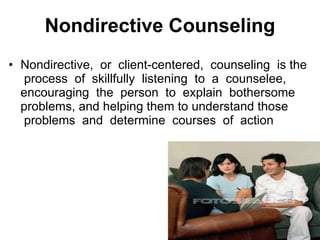
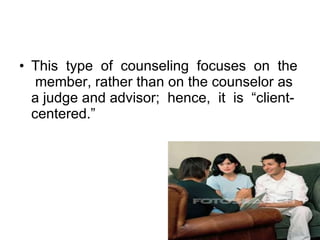
Nondirective Counseling Nondirective,  or  client-centered,  counseling  is the  process  of  skillfully  listening  to  a  counselee, encouraging  the  person  to  explain  bothersome problems, and helping them to understand those  problems  and  determine  courses  of  action
This  type  of  counseling  focuses  on  the  member, rather than on the counselor as a judge and advisor;  hence,  it  is  “client-centered.”  
PERSONAL COUNSELING All  personal  problems  should  not  be  referred to a specialist.  Examples - drug and alcohol abuse, psychological problems or behavioral  disorders,  medical  problems, limitations, personality  conflict   
Causes of Failure of Accomplishment at Work The employee does not know how - Lack of instruction or feedback. Something or someone is hindering work output - Physical or mental restrictions, time or  equipment restrictions
Attitude -  Poor attitude, employee is “burned-out” or unhappy, or does not particularly enjoy the task
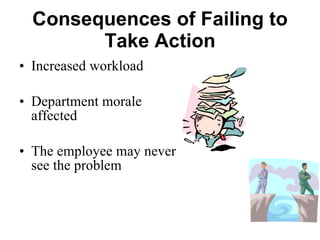
Consequences of Failing to Take Action Increased workload Department morale affected The employee may never see the problem
Problem is reinforced as acceptable
Limitations/Constraints in Counseling  Person being counselled may not have trust in his counselor (normally, his superior) or the organization  Suspicion over the level of confidentiality
Organization's constraints on using it's resources, time and efforts  Lack of skills of the counselor
 
Ambika Mehrotra Anjum Liyaquat Megha Jaiswal Parakram Hazarika Rahul Kholi Shraddha Mahani Thank You

Counselling

  • 1.
  • 2.
    What is CounselingDirect face-to-face conversation between two people
  • 3.
    “ A directreport which is used to help the employee to identify the reason for poor performance to improve and not to humiliate him or her”
  • 4.
    Generally more formalthan feedback and coaching and is required of a small percentage of employees
  • 5.
    Subordinate-centered communication thatoutlines actions necessary for subordinates to achieve individual and organizational goals.
  • 6.
    Counseling is apersonal, individual, and confidential growth process during which a professional Counselor assists in defining concerns, clarifying goals and formulating plans to meet those goals.
  • 7.
    Concept of counselingRelationship It is between 2 people where one person attempt to assists the other to organize himself better to attain the goal
  • 8.
    Behaviour The relationbetween the counselor and the clients helps to openly discuss problem faced by the client
  • 9.
    Purpose of CounselingCommunicate concerns to the employee Determine the cause of the employee’s activities
  • 10.
    Identify avenues forimprovement and/or development Improve employee performance
  • 11.
    Who Provides EmployeeCounseling? Depends on the organization and organizational culture Can be done using: Corporate resources (In-house) Outside resources (Out-of-house)
  • 12.
    In-House Efforts Advantages: Internal control Familiarity with organization Better coordination of efforts Disadvantages : Confidentiality Lack of needed resources
  • 13.
    Advantages : Senseof ownership Greater internal credibility Disadvantages : Employee reluctance to use services Limitations in staff skill and expertise
  • 14.
    Contracting Externally (Out-of-House) Advantages : Subject matter experts Confidentiality easier to maintain Disadvantages : Lack of on-site services Possible communications problems
  • 15.
    Lower cost Betteridentification and use of resources Lack of organizational knowledge
  • 16.
    Situations for Counselingin an Organization When an employee violates your standards When an employee is consistently late or absent When an employee’s productivity is down
  • 17.
    When one employeebehaves in such a way that productivity of others is negatively affected When two employees have a conflict that is becoming public and it is affecting the work
  • 18.
    When you wantto compliment an individual When you want to delegate a new task
  • 19.
    OPEN THE SESSIONIdentify the purpose and establish a constructive and subordinate-centered tone. THE STAGES OF A COUNSELING SESSION
  • 20.
    DISCUSS THE ISSUEHelp the subordinate develop an understanding of the issues and viable goals to effectively deal with them.
  • 21.
    DEVELOP A PLANDevelop an action plan with subordinate. The plan that evolves from the counseling process must be action-focused and facilitate both leader and subordinate attention toward resolving the identified developmental needs.
  • 22.
    CLOSE THE SESSIONDiscuss the implementation, including the leader’s role in supporting the subordinate’s effort. Gain the subordinate’s commitment to the plan. Ensure plan is specific enough to drive behaviors needed to affect the developmental needs
  • 23.
    Develop a Planof Action Actions should facilitate the attainment of goals Actions should be specific enough to drive behavior Plan may entail contacting a referral agency
  • 24.
    Close the SessionSummarize the counseling session Discuss implementation of the plan; check for understanding and acceptance Identify leader’s responsibilities
  • 25.
    What is follow-upand why is it necessary? Describe the assessment of the plan of action. Why is it an integral part of the counseling process ?
  • 26.
    Situations which do not call for counseling When you disagree with an employee’s life style When you are upset When you dislike the personality of an employee
  • 27.
    Counseling Skills Listen carefully Demonstrate empathy Do not make judgments Understand emotions/feelings behind the story of the person being counseled
  • 28.
    Question with careAsk open ended questions Reflect back, summarize and paraphrase so that the understanding is correct and complete
  • 29.
    Use appropriate bodylanguage Do not show superiority or patronage
  • 30.
    Benefits of Counseling Helps the person being counseled to understand himself Allows the individual to help himself Assists in understand the situations more objectively
  • 31.
    Facilitates to lookat the situations with a new perspective Develops positive outlook Motivates to search for alternate solutions to problems
  • 32.
    Helps in superiordecision making Prepares the person to cope with the situation and the related stresses
  • 33.
  • 34.
    Directive  Counseling Directive counseling  is  the  process  of  listening to  a  member’s  problem,  deciding  with  the   member what should be done, and then encouraging and motivating  the  person  to  do  it
  • 35.
    Accomplishes  the  function of  advice; but it may also reassure; give emotional release; and,  to  a  minor  extent,  clarify  thinking.
  • 36.
    Nondirective Counseling Nondirective, or  client-centered,  counseling  is the  process  of  skillfully  listening  to  a  counselee, encouraging  the  person  to  explain  bothersome problems, and helping them to understand those  problems  and  determine  courses  of  action
  • 37.
    This  type  of counseling  focuses  on  the  member, rather than on the counselor as a judge and advisor;  hence,  it  is  “client-centered.”  
  • 38.
    PERSONAL COUNSELING All personal  problems  should  not  be  referred to a specialist. Examples - drug and alcohol abuse, psychological problems or behavioral  disorders,  medical  problems, limitations, personality  conflict   
  • 39.
    Causes of Failureof Accomplishment at Work The employee does not know how - Lack of instruction or feedback. Something or someone is hindering work output - Physical or mental restrictions, time or equipment restrictions
  • 40.
    Attitude - Poor attitude, employee is “burned-out” or unhappy, or does not particularly enjoy the task
  • 41.
    Consequences of Failingto Take Action Increased workload Department morale affected The employee may never see the problem
  • 42.
    Problem is reinforcedas acceptable
  • 43.
    Limitations/Constraints in Counseling Person being counselled may not have trust in his counselor (normally, his superior) or the organization Suspicion over the level of confidentiality
  • 44.
    Organization's constraints onusing it's resources, time and efforts Lack of skills of the counselor
  • 45.
  • 46.
    Ambika Mehrotra AnjumLiyaquat Megha Jaiswal Parakram Hazarika Rahul Kholi Shraddha Mahani Thank You