EMPLOYEE
COUNSELLING
COUNSELING
COUNSELLING IS A THERAPEUTIC
PROCESS OF PROVIDING HELP AND
SUPPORT TO PEOPLE TO FACE AND
SAIL THROUGH DIFFICULT TIMES IN
LIFE.
IT HELPS PEOPLE TO SEE THINGS
FROM A DIFFERENT VIEWPOINT AND
ENCOURAGE THEM TO DRAFT THEIR
ACTION PLAN
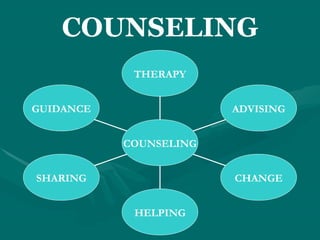
COUNSELING
            THERAPY


GUIDANCE                ADVISING


           COUNSELING


SHARING                 CHANGE


            HELPING
NEED FOR
  EMPLOYEE
COUNSELING AT
 WORKPLACE
WHEN
   Unrealistic Targets
 Excessive Workload
 Absenteeism and Late Coming
 Lack of awareness of policies &
    procedures
 Performance Issues
 Slipping Deadlines
 Career Problems
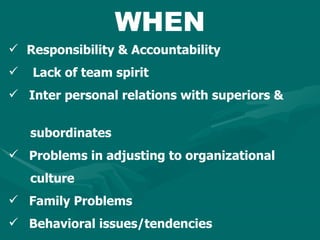
WHEN
 Responsibility & Accountability
   Lack of team spirit
 Inter personal relations with superiors &


    subordinates
 Problems in adjusting to organizational
    culture
 Family Problems
 Behavioral issues/tendencies
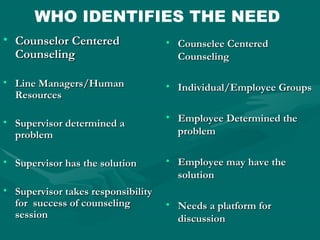
WHO IDENTIFIES THE NEED
• Counselor Centered                • Counselee Centered
  Counseling                          Counseling

• Line Managers/Human               • Individual/Employee Groups
  Resources

• Supervisor determined a           • Employee Determined the
  problem                             problem

• Supervisor has the solution       • Employee may have the
                                      solution
• Supervisor takes responsibility
  for success of counseling         • Needs a platform for
  session                             discussion
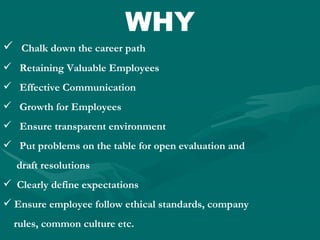
WHY
 Chalk down the career path
 Retaining Valuable Employees
 Effective Communication
 Growth for Employees
 Ensure transparent environment
 Put problems on the table for open evaluation and
  draft resolutions
 Clearly define expectations
 Ensure employee follow ethical standards, company
  rules, common culture etc.
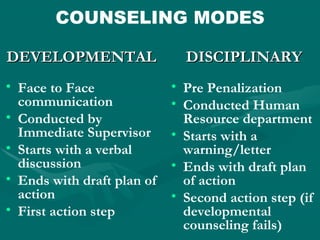
COUNSELING MODES

DEVELOPMENTAL                 DISCIPLINARY
• Face to Face              • Pre Penalization
  communication             • Conducted Human
• Conducted by                Resource department
  Immediate Supervisor      • Starts with a
• Starts with a verbal        warning/letter
  discussion                • Ends with draft plan
• Ends with draft plan of     of action
  action                    • Second action step (if
• First action step           developmental
                              counseling fails)
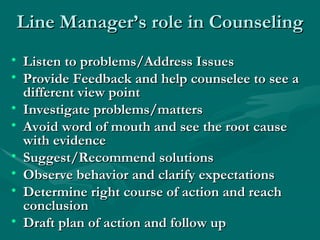
Line Manager’s role in Counseling
• Listen to problems/Address Issues
• Provide Feedback and help counselee to see a
  different view point
• Investigate problems/matters
• Avoid word of mouth and see the root cause
  with evidence
• Suggest/Recommend solutions
• Observe behavior and clarify expectations
• Determine right course of action and reach
  conclusion
• Draft plan of action and follow up
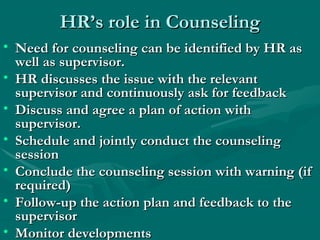
HR’s role in Counseling
• Need for counseling can be identified by HR as
  well as supervisor.
• HR discusses the issue with the relevant
  supervisor and continuously ask for feedback
• Discuss and agree a plan of action with
  supervisor.
• Schedule and jointly conduct the counseling
  session
• Conclude the counseling session with warning (if
  required)
• Follow-up the action plan and feedback to the
  supervisor
• Monitor developments
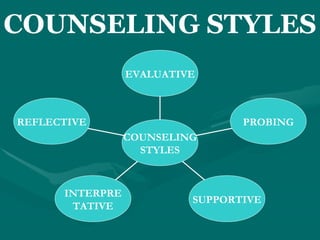
COUNSELING STYLES
                 EVALUATIVE


REFLECTIVE                       PROBING
                 COUNSELING
                   STYLES


      INTERPRE
                          SUPPORTIVE
       TATIVE
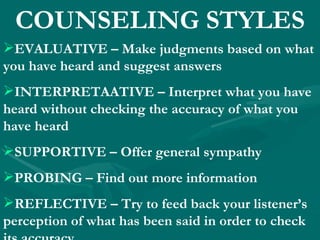
COUNSELING STYLES
EVALUATIVE – Make judgments based on what
you have heard and suggest answers
INTERPRETAATIVE – Interpret what you have
heard without checking the accuracy of what you
have heard
SUPPORTIVE – Offer general sympathy
PROBING – Find out more information
REFLECTIVE – Try to feed back your listener’s
perception of what has been said in order to check
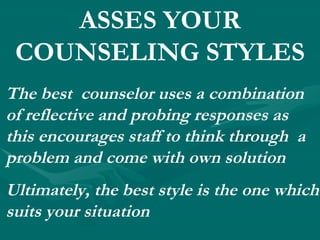
ASSES YOUR
 COUNSELING STYLES
The best counselor uses a combination
of reflective and probing responses as
this encourages staff to think through a
problem and come with own solution
Ultimately, the best style is the one which
suits your situation
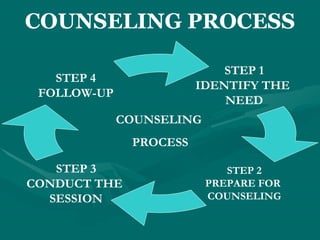
COUNSELING PROCESS

                            STEP 1
   STEP 4
                        IDENTIFY THE
 FOLLOW-UP
                            NEED
             COUNSELING
              PROCESS

   STEP 3                    STEP 2
CONDUCT THE               PREPARE FOR
  SESSION                 COUNSELING
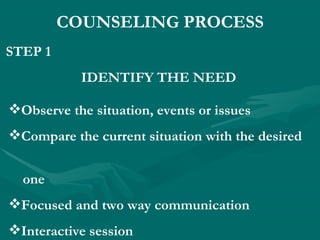
COUNSELING PROCESS
STEP 1
           IDENTIFY THE NEED

Observe the situation, events or issues
Compare the current situation with the desired


  one
Focused and two way communication
Interactive session
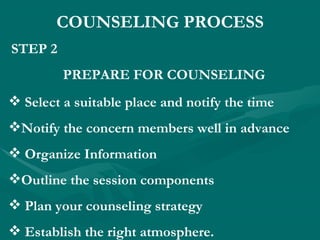
COUNSELING PROCESS
STEP 2
         PREPARE FOR COUNSELING
 Select a suitable place and notify the time
Notify the concern members well in advance
 Organize Information
Outline the session components
 Plan your counseling strategy
 Establish the right atmosphere.
COUNSELING PROCESS
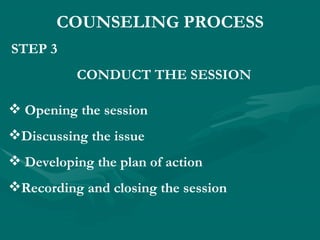
STEP 3
          CONDUCT THE SESSION

 Opening the session
Discussing the issue
 Developing the plan of action
Recording and closing the session
COUNSELING PROCESS
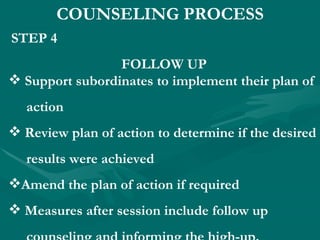
STEP 4
                 FOLLOW UP
 Support subordinates to implement their plan of
  action
 Review plan of action to determine if the desired
  results were achieved
Amend the plan of action if required
 Measures after session include follow up
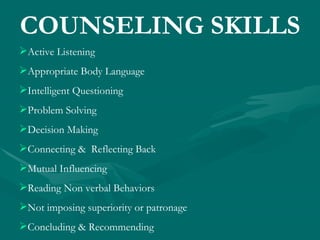
COUNSELING SKILLS
Active Listening
Appropriate Body Language
Intelligent Questioning
Problem Solving
Decision Making
Connecting & Reflecting Back
Mutual Influencing
Reading Non verbal Behaviors
Not imposing superiority or patronage
Concluding & Recommending
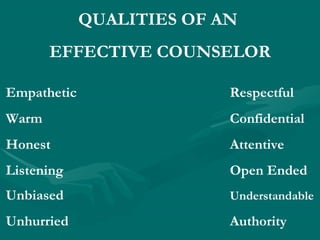
QUALITIES OF AN
       EFFECTIVE COUNSELOR

Empathetic                 Respectful
Warm                       Confidential
Honest                     Attentive
Listening                  Open Ended
Unbiased                   Understandable

Unhurried                  Authority
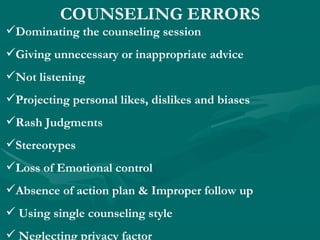
COUNSELING ERRORS
Dominating the counseling session
Giving unnecessary or inappropriate advice
Not listening
Projecting personal likes, dislikes and biases
Rash Judgments
Stereotypes
Loss of Emotional control
Absence of action plan & Improper follow up
 Using single counseling style
 Neglecting privacy factor
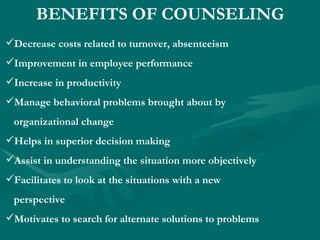
BENEFITS OF COUNSELING
Decrease costs related to turnover, absenteeism
Improvement in employee performance
Increase in productivity
Manage behavioral problems brought about by
 organizational change
Helps in superior decision making
Assist in understanding the situation more objectively
Facilitates to look at the situations with a new
 perspective
Motivates to search for alternate solutions to problems
THANK YOU