‫د‬.‫حجازى‬ ‫مصطفى‬
Cholelithiasis involves the presence of
gallstones, which are concretions that form
in the biliary tract, usually in the
gallbladder.
Choledocholithiasis refers to the presence
of 1 or more gallstones in the common bile
duct (CBD).
Treatment of gallstones depends on the
stage of disease.
Gallstone disease may be thought of as
having the following 4 stages:
Lithogenic state, in which conditions favor
gallstone formation
Asymptomatic gallstones
Symptomatic gallstones, characterized by
episodes of biliary colic
Complicated cholelithiasis
Symptoms and complications result from
effects occurring within the gallbladder or
from stones that escape the gallbladder to
lodge in the CBD.
Characteristics of biliary colic include the
following:
Sporadic and unpredictable episodes
Pain that is localized to the epigastrium or
right upper quadrant, sometimes radiating
to the right scapular tip
Pain that begins postprandially, is often
described as intense and dull, typically
lasts 1-5 hours, increases steadily over 10-
20 minutes, and then gradually wanes
Pain that is constant; not relieved by
emesis, antacids, defecation, flatus, or
positional changes; and sometimes
accompanied by diaphoresis, nausea, and
vomiting
Nonspecific symptoms (eg, indigestion,
dyspepsia, belching, or bloating)
Patients with the lithogenic state or
asymptomatic gallstones have no
abnormal findings on physical
examination.
Distinguishing uncomplicated biliary colic
from acute cholecystitis or other
complications is important.
Key findings that may be noted include the
following:
Uncomplicated biliary colic – Pain that is
poorly localized and visceral; an
essentially benign abdominal examination
without rebound or guarding; absence of
fever
Acute cholecystitis – Well-localized pain in
the right upper quadrant, usually with
rebound and guarding; positive Murphy
sign (nonspecific); frequent presence of
fever; absence of peritoneal signs;
frequent presence of tachycardia and
diaphoresis; in severe cases, absent or
hypoactive bowel sounds
The presence of fever, persistent
tachycardia, hypotension, or jaundice
necessitates a search for complications,
which may include the following:
Cholecystitis
Cholangitis
Pancreatitis
Other systemic cause
Patients with uncomplicated cholelithiasis
or simple biliary colic typically have normal
laboratory test results; laboratory studies
are generally not necessary unless
complications are suspected.
Blood tests, when indicated, may include
the following:
Complete blood count (CBC) with
differential
Liver function panel
Amylase
Lipase
Imaging modalities that may be useful
include the following:
Abdominal radiography (upright and
supine) – Used primarily to exclude other
causes of abdominal pain (eg, intestinal
obstruction)
Ultrasonography – The procedure of
choice in suspected gallbladder or biliary
disease
Endoscopic ultrasonography (EUS) – An
accurate and relatively noninvasive means
of identifying stones in the distal CBD
Laparoscopic ultrasonography –Promising
as a potential method for bile duct imaging
during laparoscopic cholecystectomy
Computed tomography (CT) – More
expensive and less sensitive than
ultrasonography for detecting gallbladder
stones, but superior for demonstrating
stones in the distal CBD
Magnetic resonance imaging (MRI) with
magnetic resonance
cholangiopancreatography (MRCP) –
Usually reserved for cases in which
choledocholithiasis is suspected
Scintigraphy – Highly accurate for the
diagnosis of cystic duct obstruction
Endoscopic retrograde
cholangiopancreatography (ERCP)
Percutaneous transhepatic
cholangiography (PTC)
The treatment of gallstones depends upon
the stage of disease, as follows:
Lithogenic state – Interventions are
currently limited to a few special
circumstances
Asymptomatic gallstones – Expectant
management
Symptomatic gallstones – Usually,
definitive surgical intervention (eg,
cholecystectomy), though medical
dissolution may be considered in some
cases
Medical treatments, used individually or in
combination, include the following:
Oral bile salt therapy (ursodeoxycholic
acid)
Contact dissolution
Extracorporeal shockwave lithotripsy
Cholecystectomy for asymptomatic
gallstones may be indicated in the
following patients:
Those with large (>2 cm) gallstones
Those who have a nonfunctional or
calcified (porcelain) gallbladder on imaging
studies and who are at high risk of
gallbladder carcinoma
Those with spinal cord injuries or sensory
neuropathies affecting the abdomen
Those with sickle cell anemia in whom the
distinction between painful crisis and
cholecystitis may be difficult
Patients with the following risk factors for
complications of gallstones may be offered
elective cholecystectomy, even if they have
asymptomatic gallstones:
Cirrhosis
Portal hypertension
Children
Transplant candidates
Diabetes with minor symptoms
Surgical interventions to be considered
include the following:
Cholecystectomy (open or laparoscopic)
Cholecystostomy
Endoscopic sphincterotomy
Oral bile acids have been used for years to
dissolve common duct stones.
The success rates, however, are variable,
ranging from 10% to 44%.
• In one randomized, double-blind,
placebo-controlled study, 28 patients with
uncomplicated, non-obstructing common
duct stones were treated with
ursodeoxycholic acid (12 mg/kg/d for up
to 2 years); the bile duct stones
disappeared in 7 of 14 patients in the
treatment group and 0 of 14 in the
placebo group.
Four patients (14%) required operative
intervention, including one from the treated
and three from the placebo groups.
Rowachol (a terpene preparation) is known
to further promote stone dissolution.

Currently, optimal patient
selection,duration of treatment, and
optimal dosing has not been determined
with these medical treatments of
choledocholithiasis.
The area in which oral bile acid therapy
may play a role is the treatment of
asymptomatic patients with small
cholesterol duct stones discovered during
laparoscopic cholecystectomy.
The composition of bile ductal stones may
be inferred if cholesterol stones were
present in the gallbladder, and small duct
stones might dissolve relatively rapidly.
Because duct exploration during
laparoscopic cholecystectomy might be
demanding technically, especially with a
small-diameter cystic and/or common bile
duct, this dissolution therapy is a
reasonable therapeutic alternative;
however, this approach needs to be
evaluated in clinical trials.
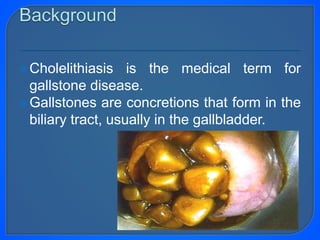
Cholelithiasis is the medical term for
gallstone disease.
Gallstones are concretions that form in the
biliary tract, usually in the gallbladder.
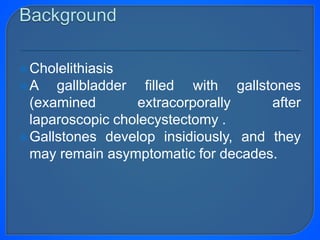
Cholelithiasis
A gallbladder filled with gallstones
(examined extracorporally after
laparoscopic cholecystectomy .
Gallstones develop insidiously, and they
may remain asymptomatic for decades.
Migration of a a gallstone into the opening
of the cystic duct may block the outflow of
bile during gallbladder contraction.
The resulting increase in gallbladder wall
tension produces a characteristic type of
pain (biliary colic).
Cystic duct obstruction, if it persists for
more than a few hours, may lead to acute
gallbladder inflammation (acute
cholecystitis).
Choledocholithiasis refers to the presence
of one or more gallstones in the common
bile duct.
Usually, this occurs when a gallstone
passes from the gallbladder into the
common bile duct .
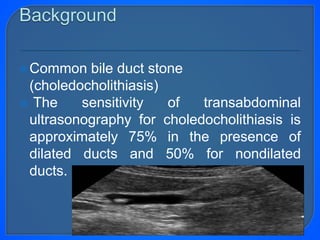
Common bile duct stone
(choledocholithiasis)
 The sensitivity of transabdominal
ultrasonography for choledocholithiasis is
approximately 75% in the presence of
dilated ducts and 50% for nondilated
ducts.
A gallstone in the common bile duct may
impact distally in the ampulla of Vater, the
point where the common bile duct and
pancreatic duct join before opening into
the duodenum.
Obstruction of bile flow by a stone at this
critical point may lead to abdominal pain
and jaundice.
Stagnant bile above an obstructing bile
duct stone often becomes infected, and
bacteria can spread rapidly back up the
ductal system into the liver to produce a
life-threatening infection called ascending
cholangitis.
Obstruction of the pancreatic duct by a
gallstone in the ampulla of Vater also can
trigger activation of pancreatic digestive
enzymes within the pancreas itself, leading
to acute pancreatitis.[1, 2]
Chronically, gallstones in the gallbladder
may cause progressive fibrosis and loss of
function of the gallbladder, a condition
known as chronic cholecystitis.
Chronic cholecystitis predisposes
to gallbladder cancer.
Ultrasonography is the initial diagnostic
procedure of choice in most cases of
suspected gallbladder or biliary tract
disease .
The treatment of gallstones depends upon
the stage of disease.
Asymptomatic gallstones may be managed
expectantly.
Once gallstones become symptomatic,
definitive surgical intervention with excision
of the gallbladder (cholecystectomy) is
usually indicated.
Cholecystectomy is among the most
frequently performed abdominal surgical
procedures .
Complications of gallstone disease may
require specialized management to relieve
obstruction and infection

Gall stone diseases hegazy

  • 1.
  • 2.
    Cholelithiasis involves thepresence of gallstones, which are concretions that form in the biliary tract, usually in the gallbladder. Choledocholithiasis refers to the presence of 1 or more gallstones in the common bile duct (CBD). Treatment of gallstones depends on the stage of disease.
  • 3.
    Gallstone disease maybe thought of as having the following 4 stages: Lithogenic state, in which conditions favor gallstone formation Asymptomatic gallstones Symptomatic gallstones, characterized by episodes of biliary colic Complicated cholelithiasis
  • 4.
    Symptoms and complicationsresult from effects occurring within the gallbladder or from stones that escape the gallbladder to lodge in the CBD.
  • 5.
    Characteristics of biliarycolic include the following: Sporadic and unpredictable episodes Pain that is localized to the epigastrium or right upper quadrant, sometimes radiating to the right scapular tip
  • 6.
    Pain that beginspostprandially, is often described as intense and dull, typically lasts 1-5 hours, increases steadily over 10- 20 minutes, and then gradually wanes Pain that is constant; not relieved by emesis, antacids, defecation, flatus, or positional changes; and sometimes accompanied by diaphoresis, nausea, and vomiting
  • 7.
    Nonspecific symptoms (eg,indigestion, dyspepsia, belching, or bloating) Patients with the lithogenic state or asymptomatic gallstones have no abnormal findings on physical examination.
  • 8.
    Distinguishing uncomplicated biliarycolic from acute cholecystitis or other complications is important. Key findings that may be noted include the following: Uncomplicated biliary colic – Pain that is poorly localized and visceral; an essentially benign abdominal examination without rebound or guarding; absence of fever
  • 9.
    Acute cholecystitis –Well-localized pain in the right upper quadrant, usually with rebound and guarding; positive Murphy sign (nonspecific); frequent presence of fever; absence of peritoneal signs; frequent presence of tachycardia and diaphoresis; in severe cases, absent or hypoactive bowel sounds
  • 10.
    The presence offever, persistent tachycardia, hypotension, or jaundice necessitates a search for complications, which may include the following: Cholecystitis Cholangitis Pancreatitis Other systemic cause
  • 11.
    Patients with uncomplicatedcholelithiasis or simple biliary colic typically have normal laboratory test results; laboratory studies are generally not necessary unless complications are suspected.
  • 12.
    Blood tests, whenindicated, may include the following: Complete blood count (CBC) with differential Liver function panel Amylase Lipase
  • 13.
    Imaging modalities thatmay be useful include the following: Abdominal radiography (upright and supine) – Used primarily to exclude other causes of abdominal pain (eg, intestinal obstruction)
  • 14.
    Ultrasonography – Theprocedure of choice in suspected gallbladder or biliary disease
  • 15.
    Endoscopic ultrasonography (EUS)– An accurate and relatively noninvasive means of identifying stones in the distal CBD Laparoscopic ultrasonography –Promising as a potential method for bile duct imaging during laparoscopic cholecystectomy
  • 16.
    Computed tomography (CT)– More expensive and less sensitive than ultrasonography for detecting gallbladder stones, but superior for demonstrating stones in the distal CBD
  • 17.
    Magnetic resonance imaging(MRI) with magnetic resonance cholangiopancreatography (MRCP) – Usually reserved for cases in which choledocholithiasis is suspected Scintigraphy – Highly accurate for the diagnosis of cystic duct obstruction
  • 18.
  • 19.
    The treatment ofgallstones depends upon the stage of disease, as follows: Lithogenic state – Interventions are currently limited to a few special circumstances Asymptomatic gallstones – Expectant management
  • 20.
    Symptomatic gallstones –Usually, definitive surgical intervention (eg, cholecystectomy), though medical dissolution may be considered in some cases
  • 21.
    Medical treatments, usedindividually or in combination, include the following: Oral bile salt therapy (ursodeoxycholic acid) Contact dissolution Extracorporeal shockwave lithotripsy
  • 22.
    Cholecystectomy for asymptomatic gallstonesmay be indicated in the following patients: Those with large (>2 cm) gallstones
  • 23.
    Those who havea nonfunctional or calcified (porcelain) gallbladder on imaging studies and who are at high risk of gallbladder carcinoma Those with spinal cord injuries or sensory neuropathies affecting the abdomen Those with sickle cell anemia in whom the distinction between painful crisis and cholecystitis may be difficult
  • 24.
    Patients with thefollowing risk factors for complications of gallstones may be offered elective cholecystectomy, even if they have asymptomatic gallstones: Cirrhosis Portal hypertension Children Transplant candidates Diabetes with minor symptoms
  • 25.
    Surgical interventions tobe considered include the following: Cholecystectomy (open or laparoscopic) Cholecystostomy Endoscopic sphincterotomy
  • 26.
    Oral bile acidshave been used for years to dissolve common duct stones. The success rates, however, are variable, ranging from 10% to 44%.
  • 27.
    • In onerandomized, double-blind, placebo-controlled study, 28 patients with uncomplicated, non-obstructing common duct stones were treated with ursodeoxycholic acid (12 mg/kg/d for up to 2 years); the bile duct stones disappeared in 7 of 14 patients in the treatment group and 0 of 14 in the placebo group.
  • 28.
    Four patients (14%)required operative intervention, including one from the treated and three from the placebo groups. Rowachol (a terpene preparation) is known to further promote stone dissolution. 
  • 29.
    Currently, optimal patient selection,durationof treatment, and optimal dosing has not been determined with these medical treatments of choledocholithiasis.
  • 30.
    The area inwhich oral bile acid therapy may play a role is the treatment of asymptomatic patients with small cholesterol duct stones discovered during laparoscopic cholecystectomy.
  • 31.
    The composition ofbile ductal stones may be inferred if cholesterol stones were present in the gallbladder, and small duct stones might dissolve relatively rapidly.
  • 32.
    Because duct explorationduring laparoscopic cholecystectomy might be demanding technically, especially with a small-diameter cystic and/or common bile duct, this dissolution therapy is a reasonable therapeutic alternative; however, this approach needs to be evaluated in clinical trials.
  • 33.
    Cholelithiasis is themedical term for gallstone disease. Gallstones are concretions that form in the biliary tract, usually in the gallbladder.
  • 34.
    Cholelithiasis A gallbladder filledwith gallstones (examined extracorporally after laparoscopic cholecystectomy . Gallstones develop insidiously, and they may remain asymptomatic for decades.
  • 35.
    Migration of aa gallstone into the opening of the cystic duct may block the outflow of bile during gallbladder contraction.
  • 36.
    The resulting increasein gallbladder wall tension produces a characteristic type of pain (biliary colic). Cystic duct obstruction, if it persists for more than a few hours, may lead to acute gallbladder inflammation (acute cholecystitis).
  • 37.
    Choledocholithiasis refers tothe presence of one or more gallstones in the common bile duct. Usually, this occurs when a gallstone passes from the gallbladder into the common bile duct .
  • 38.
    Common bile ductstone (choledocholithiasis)  The sensitivity of transabdominal ultrasonography for choledocholithiasis is approximately 75% in the presence of dilated ducts and 50% for nondilated ducts.
  • 39.
    A gallstone inthe common bile duct may impact distally in the ampulla of Vater, the point where the common bile duct and pancreatic duct join before opening into the duodenum. Obstruction of bile flow by a stone at this critical point may lead to abdominal pain and jaundice.
  • 40.
    Stagnant bile abovean obstructing bile duct stone often becomes infected, and bacteria can spread rapidly back up the ductal system into the liver to produce a life-threatening infection called ascending cholangitis.
  • 41.
    Obstruction of thepancreatic duct by a gallstone in the ampulla of Vater also can trigger activation of pancreatic digestive enzymes within the pancreas itself, leading to acute pancreatitis.[1, 2]
  • 42.
    Chronically, gallstones inthe gallbladder may cause progressive fibrosis and loss of function of the gallbladder, a condition known as chronic cholecystitis. Chronic cholecystitis predisposes to gallbladder cancer.
  • 43.
    Ultrasonography is theinitial diagnostic procedure of choice in most cases of suspected gallbladder or biliary tract disease .
  • 44.
    The treatment ofgallstones depends upon the stage of disease. Asymptomatic gallstones may be managed expectantly.
  • 45.
    Once gallstones becomesymptomatic, definitive surgical intervention with excision of the gallbladder (cholecystectomy) is usually indicated.
  • 46.
    Cholecystectomy is amongthe most frequently performed abdominal surgical procedures . Complications of gallstone disease may require specialized management to relieve obstruction and infection