Ahmed Ibrahim M.D
Prof. of Anesthesia & Intensive care
Ain Shams University
http://telemed.shams.edu.eg/moodle6
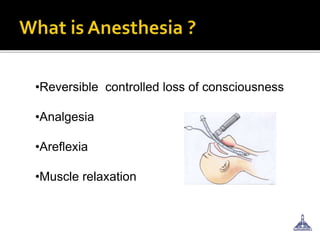
•Reversible controlled loss of consciousness
•Analgesia
•Areflexia
•Muscle relaxation
Anesthetic drugs and techniques have profound effects
on human physiology. Hence, a focused review of all major
organ systems should be completed prior to surgery.
Goals of the preoperative evaluation is to ensure that the
patient is in the best (or optimal) condition.
Patients with unstable symptoms should be postponed
for optimization prior to elective surgery.
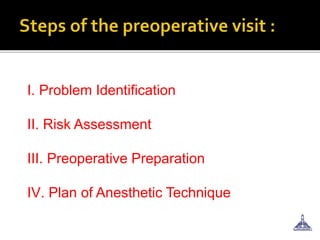
I. Problem Identification
II. Risk Assessment
III. Preoperative Preparation
IV. Plan of Anesthetic Technique
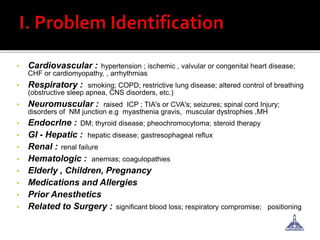
• Cardiovascular : hypertension ; ischemic , valvular or congenital heart disease;
CHF or cardiomyopathy, , arrhythmias
• Respiratory : smoking; COPD; restrictive lung disease; altered control of breathing
(obstructive sleep apnea, CNS disorders, etc.)
• Neuromuscular : raised ICP ; TIA's or CVA's; seizures; spinal cord Injury;
disorders of NM junction e.g myasthenia gravis, muscular dystrophies ,MH
• Endocrlne : DM; thyroid disease; pheochromocytoma; steroid therapy
• GI - Hepatic : hepatic disease; gastresophageal reflux
• Renal : renal failure
• Hematologic : anemias; coagulopathies
• Elderly , Children, Pregnancy
• Medications and Allergies
• Prior Anesthetics
• Related to Surgery : significant blood loss; respiratory compromise; positioning
through :
●History (including a review of the patient's chart)
●Physical examination
●laboratory investigation
General & Local examination
Should focus on evaluation of :
• Upper airway
• Respiratory system
• Cardiovascular system
• other systems’ problems identified from the history
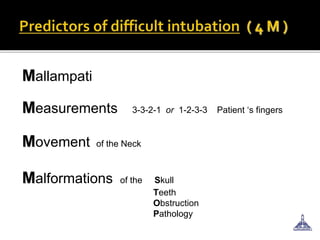
Mallampati
Measurements 3-3-2-1 or 1-2-3-3 Patient ‘s fingers
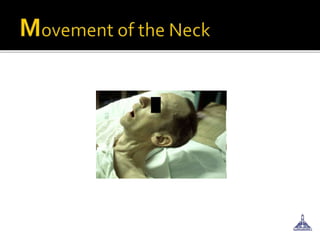
Movement of the Neck
Malformations of the Skull
Teeth
Obstruction
Pathology
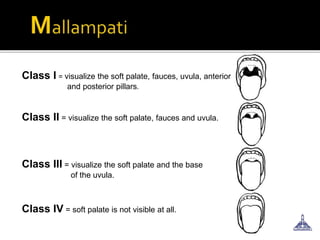
Class I = visualize the soft palate, fauces, uvula, anterior
and posterior pillars.
Class II = visualize the soft palate, fauces and uvula.
Class III = visualize the soft palate and the base
of the uvula.
Class IV = soft palate is not visible at all.
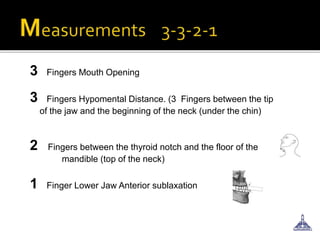
3 Fingers Mouth Opening
3 Fingers Hypomental Distance. (3 Fingers between the tip
of the jaw and the beginning of the neck (under the chin)
2 Fingers between the thyroid notch and the floor of the
mandible (top of the neck)
1 Finger Lower Jaw Anterior sublaxation
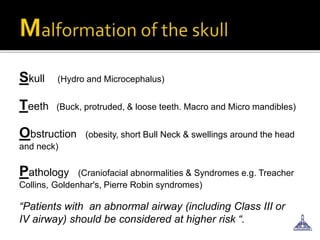
Skull (Hydro and Microcephalus)
Teeth (Buck, protruded, & loose teeth. Macro and Micro mandibles)
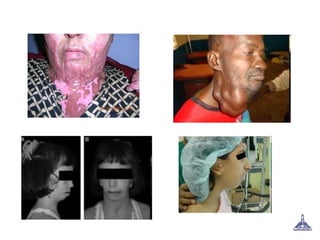
Obstruction (obesity, short Bull Neck & swellings around the head
and neck)
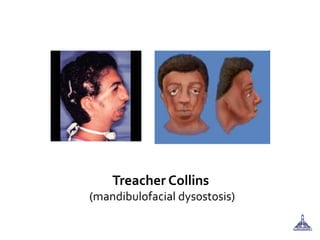
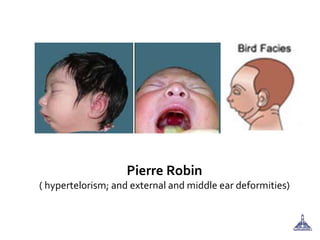
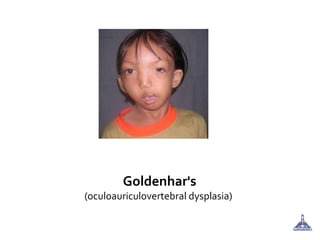
Pathology (Craniofacial abnormalities & Syndromes e.g. Treacher
Collins, Goldenhar's, Pierre Robin syndromes)
“Patients with an abnormal airway (including Class III or
IV airway) should be considered at higher risk “.
Pierre Robin
( hypertelorism; and external and middle ear deformities)
Goldenhar's
(oculoauriculovertebral dysplasia)
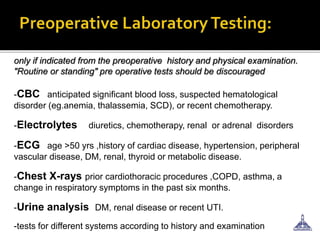
only if indicated from the preoperative history and physical examination.
"Routine or standing" pre operative tests should be discouraged
-CBC anticipated significant blood loss, suspected hematological
disorder (eg.anemia, thalassemia, SCD), or recent chemotherapy.
-Electrolytes diuretics, chemotherapy, renal or adrenal disorders
-ECG age >50 yrs ,history of cardiac disease, hypertension, peripheral
vascular disease, DM, renal, thyroid or metabolic disease.
-Chest X-rays prior cardiothoracic procedures ,COPD, asthma, a
change in respiratory symptoms in the past six months.
-Urine analysis DM, renal disease or recent UTI.
-tests for different systems according to history and examination
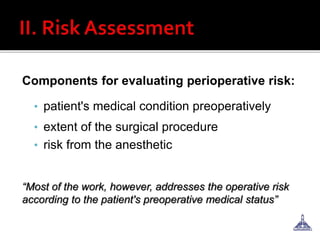
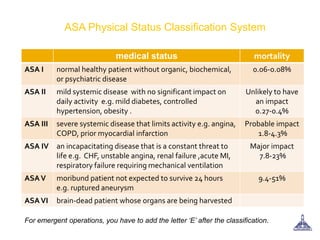
Components for evaluating perioperative risk:
• patient's medical condition preoperatively
• extent of the surgical procedure
• risk from the anesthetic
“Most of the work, however, addresses the operative risk
according to the patient's preoperative medical status”
medical status mortality
ASA I normal healthy patient without organic, biochemical,
or psychiatric disease
0.06-0.08%
ASA II mild systemic disease with no significant impact on
daily activity e.g. mild diabetes, controlled
hypertension, obesity .
Unlikely to have
an impact
0.27-0.4%
ASA III severe systemic disease that limits activity e.g. angina,
COPD, prior myocardial infarction
Probable impact
1.8-4.3%
ASA IV an incapacitating disease that is a constant threat to
life e.g. CHF, unstable angina, renal failure ,acute MI,
respiratory failure requiring mechanical ventilation
Major impact
7.8-23%
ASAV moribund patient not expected to survive 24 hours
e.g. ruptured aneurysm
9.4-51%
ASAVI brain-dead patient whose organs are being harvested
ASA Physical Status Classification System
For emergent operations, you have to add the letter ‘E’ after the classification.
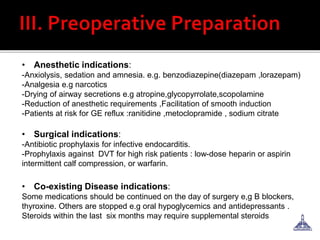
• Anesthetic indications:
-Anxiolysis, sedation and amnesia. e.g. benzodiazepine(diazepam ,lorazepam)
-Analgesia e.g narcotics
-Drying of airway secretions e.g atropine,glycopyrrolate,scopolamine
-Reduction of anesthetic requirements ,Facilitation of smooth induction
-Patients at risk for GE reflux :ranitidine ,metoclopramide , sodium citrate
• Surgical indications:
-Antibiotic prophylaxis for infective endocarditis.
-Prophylaxis against DVT for high risk patients : low-dose heparin or aspirin
intermittent calf compression, or warfarin.
• Co-existing Disease indications:
Some medications should be continued on the day of surgery e,g B blockers,
thyroxine. Others are stopped e.g oral hypoglycemics and antidepressants .
Steroids within the last six months may require supplemental steroids
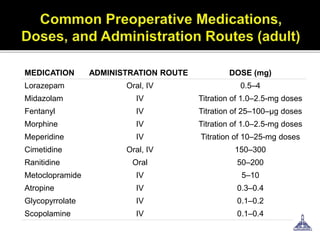
MEDICATION ADMINISTRATION ROUTE DOSE (mg)
Lorazepam Oral, IV 0.5–4
Midazolam IV Titration of 1.0–2.5-mg doses
Fentanyl IV Titration of 25–100–µg doses
Morphine IV Titration of 1.0–2.5-mg doses
Meperidine IV Titration of 10–25-mg doses
Cimetidine Oral, IV 150–300
Ranitidine Oral 50–200
Metoclopramide IV 5–10
Atropine IV 0.3–0.4
Glycopyrrolate IV 0.1–0.2
Scopolamine IV 0.1–0.4
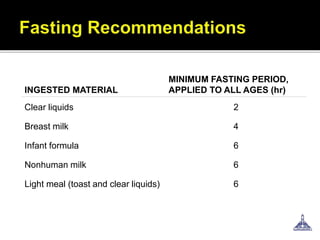
INGESTED MATERIAL
MINIMUM FASTING PERIOD,
APPLIED TO ALL AGES (hr)
Clear liquids 2
Breast milk 4
Infant formula 6
Nonhuman milk 6
Light meal (toast and clear liquids) 6
1. Is the patient's condition optimal?
2. Are there any problems which require consultation or special
tests? “Please assess and advise “
3. Is there an alternative procedure which may be more appropriate?
4. What are the plans for postoperative management of the patient?
5. What premedication if any is appropriate?
Finally, we plan our anesthetic technique :
1. Local or Regional anesthesia with 'standby‘ monitoring
with or without sedation.
2. General anesthesia; with or without intubation.
Spontaneous or controlled ventilation is used.
3. Combined regional with general anesthesia.
Preop assess prep  premed ahmed ibrahim

Preop assess prep premed ahmed ibrahim

  • 1.
    Ahmed Ibrahim M.D Prof.of Anesthesia & Intensive care Ain Shams University http://telemed.shams.edu.eg/moodle6
  • 2.
    •Reversible controlled lossof consciousness •Analgesia •Areflexia •Muscle relaxation
  • 3.
    Anesthetic drugs andtechniques have profound effects on human physiology. Hence, a focused review of all major organ systems should be completed prior to surgery. Goals of the preoperative evaluation is to ensure that the patient is in the best (or optimal) condition. Patients with unstable symptoms should be postponed for optimization prior to elective surgery.
  • 4.
    I. Problem Identification II.Risk Assessment III. Preoperative Preparation IV. Plan of Anesthetic Technique
  • 5.
    • Cardiovascular :hypertension ; ischemic , valvular or congenital heart disease; CHF or cardiomyopathy, , arrhythmias • Respiratory : smoking; COPD; restrictive lung disease; altered control of breathing (obstructive sleep apnea, CNS disorders, etc.) • Neuromuscular : raised ICP ; TIA's or CVA's; seizures; spinal cord Injury; disorders of NM junction e.g myasthenia gravis, muscular dystrophies ,MH • Endocrlne : DM; thyroid disease; pheochromocytoma; steroid therapy • GI - Hepatic : hepatic disease; gastresophageal reflux • Renal : renal failure • Hematologic : anemias; coagulopathies • Elderly , Children, Pregnancy • Medications and Allergies • Prior Anesthetics • Related to Surgery : significant blood loss; respiratory compromise; positioning
  • 6.
    through : ●History (includinga review of the patient's chart) ●Physical examination ●laboratory investigation
  • 7.
    General & Localexamination Should focus on evaluation of : • Upper airway • Respiratory system • Cardiovascular system • other systems’ problems identified from the history
  • 9.
    Mallampati Measurements 3-3-2-1 or1-2-3-3 Patient ‘s fingers Movement of the Neck Malformations of the Skull Teeth Obstruction Pathology
  • 10.
    Class I =visualize the soft palate, fauces, uvula, anterior and posterior pillars. Class II = visualize the soft palate, fauces and uvula. Class III = visualize the soft palate and the base of the uvula. Class IV = soft palate is not visible at all.
  • 11.
    3 Fingers MouthOpening 3 Fingers Hypomental Distance. (3 Fingers between the tip of the jaw and the beginning of the neck (under the chin) 2 Fingers between the thyroid notch and the floor of the mandible (top of the neck) 1 Finger Lower Jaw Anterior sublaxation
  • 13.
    Skull (Hydro andMicrocephalus) Teeth (Buck, protruded, & loose teeth. Macro and Micro mandibles) Obstruction (obesity, short Bull Neck & swellings around the head and neck) Pathology (Craniofacial abnormalities & Syndromes e.g. Treacher Collins, Goldenhar's, Pierre Robin syndromes) “Patients with an abnormal airway (including Class III or IV airway) should be considered at higher risk “.
  • 16.
    Pierre Robin ( hypertelorism;and external and middle ear deformities)
  • 17.
  • 18.
    only if indicatedfrom the preoperative history and physical examination. "Routine or standing" pre operative tests should be discouraged -CBC anticipated significant blood loss, suspected hematological disorder (eg.anemia, thalassemia, SCD), or recent chemotherapy. -Electrolytes diuretics, chemotherapy, renal or adrenal disorders -ECG age >50 yrs ,history of cardiac disease, hypertension, peripheral vascular disease, DM, renal, thyroid or metabolic disease. -Chest X-rays prior cardiothoracic procedures ,COPD, asthma, a change in respiratory symptoms in the past six months. -Urine analysis DM, renal disease or recent UTI. -tests for different systems according to history and examination
  • 19.
    Components for evaluatingperioperative risk: • patient's medical condition preoperatively • extent of the surgical procedure • risk from the anesthetic “Most of the work, however, addresses the operative risk according to the patient's preoperative medical status”
  • 20.
    medical status mortality ASAI normal healthy patient without organic, biochemical, or psychiatric disease 0.06-0.08% ASA II mild systemic disease with no significant impact on daily activity e.g. mild diabetes, controlled hypertension, obesity . Unlikely to have an impact 0.27-0.4% ASA III severe systemic disease that limits activity e.g. angina, COPD, prior myocardial infarction Probable impact 1.8-4.3% ASA IV an incapacitating disease that is a constant threat to life e.g. CHF, unstable angina, renal failure ,acute MI, respiratory failure requiring mechanical ventilation Major impact 7.8-23% ASAV moribund patient not expected to survive 24 hours e.g. ruptured aneurysm 9.4-51% ASAVI brain-dead patient whose organs are being harvested ASA Physical Status Classification System For emergent operations, you have to add the letter ‘E’ after the classification.
  • 21.
    • Anesthetic indications: -Anxiolysis,sedation and amnesia. e.g. benzodiazepine(diazepam ,lorazepam) -Analgesia e.g narcotics -Drying of airway secretions e.g atropine,glycopyrrolate,scopolamine -Reduction of anesthetic requirements ,Facilitation of smooth induction -Patients at risk for GE reflux :ranitidine ,metoclopramide , sodium citrate • Surgical indications: -Antibiotic prophylaxis for infective endocarditis. -Prophylaxis against DVT for high risk patients : low-dose heparin or aspirin intermittent calf compression, or warfarin. • Co-existing Disease indications: Some medications should be continued on the day of surgery e,g B blockers, thyroxine. Others are stopped e.g oral hypoglycemics and antidepressants . Steroids within the last six months may require supplemental steroids
  • 22.
    MEDICATION ADMINISTRATION ROUTEDOSE (mg) Lorazepam Oral, IV 0.5–4 Midazolam IV Titration of 1.0–2.5-mg doses Fentanyl IV Titration of 25–100–µg doses Morphine IV Titration of 1.0–2.5-mg doses Meperidine IV Titration of 10–25-mg doses Cimetidine Oral, IV 150–300 Ranitidine Oral 50–200 Metoclopramide IV 5–10 Atropine IV 0.3–0.4 Glycopyrrolate IV 0.1–0.2 Scopolamine IV 0.1–0.4
  • 23.
    INGESTED MATERIAL MINIMUM FASTINGPERIOD, APPLIED TO ALL AGES (hr) Clear liquids 2 Breast milk 4 Infant formula 6 Nonhuman milk 6 Light meal (toast and clear liquids) 6
  • 24.
    1. Is thepatient's condition optimal? 2. Are there any problems which require consultation or special tests? “Please assess and advise “ 3. Is there an alternative procedure which may be more appropriate? 4. What are the plans for postoperative management of the patient? 5. What premedication if any is appropriate?
  • 25.
    Finally, we planour anesthetic technique : 1. Local or Regional anesthesia with 'standby‘ monitoring with or without sedation. 2. General anesthesia; with or without intubation. Spontaneous or controlled ventilation is used. 3. Combined regional with general anesthesia.