Dr.Mostafa Hegazy
Signs and Symptoms
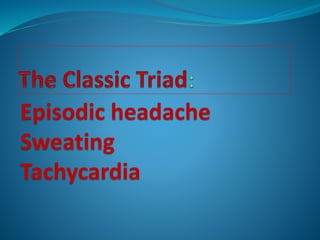
Episodic headache
Sweating
Tachycardia
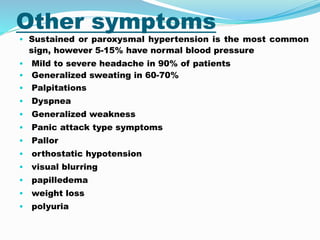
Other symptoms
• Sustained or paroxysmal hypertension is the most common
sign, however 5-15% have normal blood pressure
• Mild to severe headache in 90% of patients
• Generalized sweating in 60-70%
• Palpitations
• Dyspnea
• Generalized weakness
• Panic attack type symptoms
• Pallor
• orthostatic hypotension
• visual blurring
• papilledema
• weight loss
• polyuria
Pathophysiology
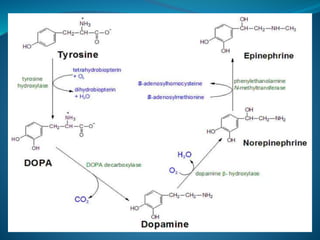
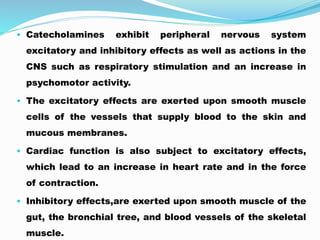
• Catecholamines exhibit peripheral nervous system
excitatory and inhibitory effects as well as actions in the
CNS such as respiratory stimulation and an increase in
psychomotor activity.
• The excitatory effects are exerted upon smooth muscle
cells of the vessels that supply blood to the skin and
mucous membranes.
• Cardiac function is also subject to excitatory effects,
which lead to an increase in heart rate and in the force
of contraction.
• Inhibitory effects,are exerted upon smooth muscle of the
gut, the bronchial tree, and blood vessels of the skeletal
muscle.
• In addition to their effects as neurotransmitters,
norepinephrine and epinephrine can influence the
rate of metabolism by modulating insulin secretion
and by increasing the rate of glycogenolysis and
fatty acid metabolism.
• Abnormalities in carbohydrate metabolism such as
insulin resistance, impaired fasting glucose, type 2
DM can occure.
When to suspect Pheochromocytoma
 Hyperadrenergic spells eg self-limited episodes of nonexertional
palpitations, diaphoresis, headache, tremor, pallor
 Resistant hypertension (<0.2% of patients with HTN have
pheochromocytoma)
 Pre-disposing familial syndrome eg MEN 2, NF1, VHL
 Family history of pheochromocytoma
 Incidentally discovered adrenal mass: 3-10% prove to be
pheochromocytomas
 Pressor response during anesthesia, surgery or angiography
 Onset of HTN < 20 years old
 Idiopathic dilated cardiomyopathy
 History of gastric stromal tumor or pulmonary chondromas (Carney
Triad)
DIAGNOSIS
 Historically: measured 24 hour urinary excretion of
catecholamines and total metanephrines
 Superior test: plasma fractionated metanephrines via liquid
chromatography with electrochemical detection or tandem mass
spectrometry
 96-100% sensitive and 85-89% specific and falls to 77% in
patients >60 years old
 Predictive value is high and normal test excludes
pheochromocytoma except in patients with early preclinical
disease and those with strictly dopamine-secreting tumors
 Tricyclic antidepressants interfere with assay most frequently
 Clonidine suppression test is confirmatory when plasma
fractionated metanephrines are positive: 0.3 mg is administered
orally, plasma catecholamines are measured before and 3 hours
after the dose. Clonidine will suppress catecholamines if excess
is due to essential hypertension, but will remain elevated in
pheochromocytoma
 Follow up with CT or MRI of abdomen and pelvis
 Consider MIBG scintgraphy where a compound resembling
norepinephrine is taken up by adrenal tissue if clinical suspicion
remains high
Medications that increase
measured catecholamine levels
 TCAs
 Levodopa
 Drugs containing adrenergic receptor agonists eg decongestants
 Amphetamines
 Buspirone and most psychoactive agents
 Prochlorperazine
 Reserpine
 Withdrawal from clonidine
 Ethanol
 acetominophen
Malignant Potential
 10% of tumors are extraadrenal, but 95% are within abdomen and
pelvis
 About 10% of all catecholamine-secreting tumors are malignant
 Histologically and biochemically identical to benign counterparts
 Local invasion or distant metastases can occur as long as 20 years
after resection
 Metastatic lesions should be resected if possible
 RFA of hepatic and bone metastases may be effective in selected
patients
 Combination chemotherapy can be considered
Treatment
 Start alpha-adrenergic blocker 7-10 days preoperatively
 Phenoxybenzamine is drug of choice: irreversible, long-acting,
non-specific alpha-adrenergic agent
 Initial dose is 10 mg b.i.d.; dose is increased by 10-20 mg in
divided doses every 2-3 days; final dose usually 20-100 mg daily
 Goal BP <120/80 seated and SBP > 90 standing
 High salt (> 5000 mg daily) recommended on 3rd day to
counteract catecholamine-induced volume contraction and
orthostasis, though caution advised in patients with CHF or CRI
 Following adequate alpha-blockade, beta blockade is initiated 2-3
days pre-operatively eg. Propranolol 10 mg q.6.h
 NEVER start beta blockade first; unopposed alpha adrenergic
stimulation can lead to further elevation in blood pressure
 Long-term treatment with selective alpha1-adrenergic
blockers such as prazosin, terazosin, doxazosin
 Calcium channel blockers are probably as effective, eg.
Nicardipine 30 mg b.i.d.
 Addition of metyrosine, a direct catecholamine synthesis
inhibitor, may improve perioperative course, though most
institutions reserve for those patients who cannot tolerate
the typical alpha + beta blockade combination. Side effects
include sedation, depression, diarrhea,anxiety, nightmares,
crystalluria and urolithiasis, galactorrhea, and
extrapyramidal signs

Pheochromocytoma hegazy

  • 1.
  • 2.
  • 3.
  • 4.
    Other symptoms • Sustainedor paroxysmal hypertension is the most common sign, however 5-15% have normal blood pressure • Mild to severe headache in 90% of patients • Generalized sweating in 60-70% • Palpitations • Dyspnea • Generalized weakness • Panic attack type symptoms • Pallor • orthostatic hypotension • visual blurring • papilledema • weight loss • polyuria
  • 5.
  • 7.
    • Catecholamines exhibitperipheral nervous system excitatory and inhibitory effects as well as actions in the CNS such as respiratory stimulation and an increase in psychomotor activity. • The excitatory effects are exerted upon smooth muscle cells of the vessels that supply blood to the skin and mucous membranes. • Cardiac function is also subject to excitatory effects, which lead to an increase in heart rate and in the force of contraction. • Inhibitory effects,are exerted upon smooth muscle of the gut, the bronchial tree, and blood vessels of the skeletal muscle.
  • 8.
    • In additionto their effects as neurotransmitters, norepinephrine and epinephrine can influence the rate of metabolism by modulating insulin secretion and by increasing the rate of glycogenolysis and fatty acid metabolism. • Abnormalities in carbohydrate metabolism such as insulin resistance, impaired fasting glucose, type 2 DM can occure.
  • 9.
    When to suspectPheochromocytoma  Hyperadrenergic spells eg self-limited episodes of nonexertional palpitations, diaphoresis, headache, tremor, pallor  Resistant hypertension (<0.2% of patients with HTN have pheochromocytoma)  Pre-disposing familial syndrome eg MEN 2, NF1, VHL  Family history of pheochromocytoma  Incidentally discovered adrenal mass: 3-10% prove to be pheochromocytomas  Pressor response during anesthesia, surgery or angiography  Onset of HTN < 20 years old  Idiopathic dilated cardiomyopathy  History of gastric stromal tumor or pulmonary chondromas (Carney Triad)
  • 10.
  • 11.
     Historically: measured24 hour urinary excretion of catecholamines and total metanephrines  Superior test: plasma fractionated metanephrines via liquid chromatography with electrochemical detection or tandem mass spectrometry  96-100% sensitive and 85-89% specific and falls to 77% in patients >60 years old  Predictive value is high and normal test excludes pheochromocytoma except in patients with early preclinical disease and those with strictly dopamine-secreting tumors
  • 12.
     Tricyclic antidepressantsinterfere with assay most frequently  Clonidine suppression test is confirmatory when plasma fractionated metanephrines are positive: 0.3 mg is administered orally, plasma catecholamines are measured before and 3 hours after the dose. Clonidine will suppress catecholamines if excess is due to essential hypertension, but will remain elevated in pheochromocytoma  Follow up with CT or MRI of abdomen and pelvis  Consider MIBG scintgraphy where a compound resembling norepinephrine is taken up by adrenal tissue if clinical suspicion remains high
  • 13.
    Medications that increase measuredcatecholamine levels  TCAs  Levodopa  Drugs containing adrenergic receptor agonists eg decongestants  Amphetamines  Buspirone and most psychoactive agents  Prochlorperazine  Reserpine  Withdrawal from clonidine  Ethanol  acetominophen
  • 14.
    Malignant Potential  10%of tumors are extraadrenal, but 95% are within abdomen and pelvis  About 10% of all catecholamine-secreting tumors are malignant  Histologically and biochemically identical to benign counterparts  Local invasion or distant metastases can occur as long as 20 years after resection  Metastatic lesions should be resected if possible  RFA of hepatic and bone metastases may be effective in selected patients  Combination chemotherapy can be considered
  • 15.
  • 16.
     Start alpha-adrenergicblocker 7-10 days preoperatively  Phenoxybenzamine is drug of choice: irreversible, long-acting, non-specific alpha-adrenergic agent  Initial dose is 10 mg b.i.d.; dose is increased by 10-20 mg in divided doses every 2-3 days; final dose usually 20-100 mg daily  Goal BP <120/80 seated and SBP > 90 standing  High salt (> 5000 mg daily) recommended on 3rd day to counteract catecholamine-induced volume contraction and orthostasis, though caution advised in patients with CHF or CRI  Following adequate alpha-blockade, beta blockade is initiated 2-3 days pre-operatively eg. Propranolol 10 mg q.6.h
  • 17.
     NEVER startbeta blockade first; unopposed alpha adrenergic stimulation can lead to further elevation in blood pressure  Long-term treatment with selective alpha1-adrenergic blockers such as prazosin, terazosin, doxazosin  Calcium channel blockers are probably as effective, eg. Nicardipine 30 mg b.i.d.  Addition of metyrosine, a direct catecholamine synthesis inhibitor, may improve perioperative course, though most institutions reserve for those patients who cannot tolerate the typical alpha + beta blockade combination. Side effects include sedation, depression, diarrhea,anxiety, nightmares, crystalluria and urolithiasis, galactorrhea, and extrapyramidal signs