Diagnosis and
Management of
Parathyroid Disease
BY
PROF/ GOUDA ELLABBAN
FOM/SCU
ellabbang@yahoo.com
Objectives
 Review calcium homeostasis
 Understand parathyroid anatomy and
histopathology
 Review embryo-anatomic relationships in
the central neck
 Recognize the clinical features, diagnosis
and surgical/medical management of
hyperparathyroidism
 Understand the molecular basis of
localization studies
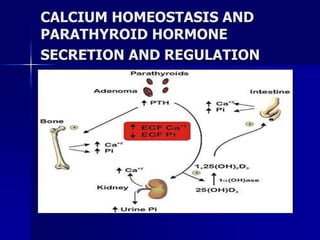
CALCIUM HOMEOSTASIS AND
PARATHYROID HORMONE
SECRETION AND REGULATION
 Parathyroid hormone (PTH) contains
84 amino acids
 Degradation into amino(N) and
carboxyl(C)-terminal fragments.
 The N-terminal fragment biologically
active and rapidly cleared
 C-terminal fragment is biologically
inert and cleared by the kidney
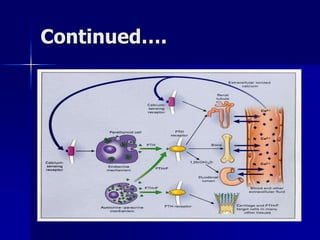
Continued….
 PTH release governed by serum ionized
calcium levels.
 PTH secreted in response to decrease in
serum-ionized calcium and inhibited by an
increase serum-ionized calcium.
 Target end organs: kidneys, skeletal system,
and intestine.
 PTH binding to receptor sites results in
cAMP 2nd messenger system activation.
 Half-life PTH few minutes.
Continued….
Etiology and Pathogenesis
of Hyperparathyroidism
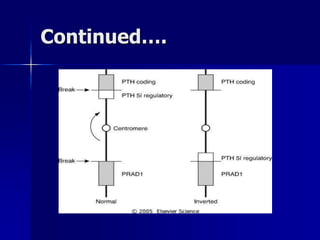
 Parathyroid adenomas (PA) considered
monoclonal or oligoclonal neoplasms.
 Propagation through clonal expansion of
cells with altered sensitivity to calcium.
 PRAD1 implicated in only some PA.
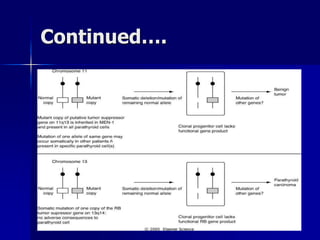
 Another mechanism involves alternation in
tumor suppressor gene expression.
Continued….
Continued….
Parathyroid Anatomy and
Histopathology: The Normal
Parathyroid Gland
 Supernumerary fifth parathyroid found
between 0.7%-5.8% patients
 5th glands found in the mediastinum
(thymus or related to the aortic arch),
thyrothymic tract
Parathyroid Gland
Location
 80% of superior parathyroid glands found at
the cricothyroid junction ~1 cm cranial to
juxtaposition of RLN & ITA.
 Inferior parathyroid glands (IPG) variable in
location.
 61% of (IPG) near the lower pole of the
thyroid gland and 26% in thyrothymic
ligament.
 Incidence of intrathyroidal parathyroid
glands ~0.5% to 3%.
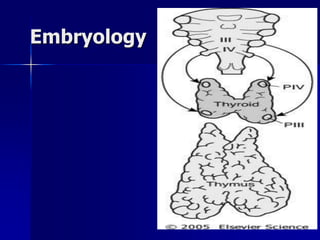
Embryology
Morphologic Characteristics
of Parathyroid Glands
 Shape-oval, bean, or teardrop
appearance or flat shape when
juxtaposed to thyroid gland.
 Color-yellowish brown to reddish
brown in normal parathyroid glands
and lighter gray tone in pathological
states.
Vascular Anatomy of the
Parathyroid Glands
 Normal parathyroid glands most commonly
are supplied by a single dominant artery
(80%).
 The length of the dominant artery supplying
glands vary from 1 to 40 mm.
 ITA is dominant blood supply to both
superior & inferior parathyroid glands most
of the time.
Histopathology of the
Parathyroid Glands
 Parathyroid gland composed of chief cells,
oxyphilic cells and intermediate cells
 Solitary parathyroid adenoma ~80%-85% of
patients with primary hyperparathyroidism
 Variations in parathyroid adenoma includes
other subtypes (oncocytic adenoma,
lipoadenoma, large clear cell adenoma,
water-clear cell adenoma, and atypical
adenoma).
Continued….
 Primary parathyroid hyperplasia-proliferation
of parenchymal cells with increase in weight
in multiple glands with absence of stimulus
for parathyroid hormone secretion.
 Two types of parathyroid hyperplasia are
seen: the common chief cell hyperplasia and
the rare water cell or clear cell hyperplasia.
Continued….
 Parathyroid carcinoma (PC) ~0.1% to 5.0% cases
of primary hyperparathyroidism.
 PC tend to be large tumors, (30% to 50% palpable
presentation).
 May measure up to 6 cm in diameter, mean ~3 cm.
 Lesion adheres to surrounding tissues including soft
tissues of the neck (thyroid gland, strap muscles,
trachea & recurrent laryngeal nerve).
 Regional metastasis rare.
 Pulmonary metastasis most common distant
metastasis site.
Continued….
 PC tends to be an indolent tumor.
 Multiple recurrences after resection
common and may occur over a 15- to
20-year period.
 Death results from from effects of
excessive PTH secretion and
uncontrolled hypercalcemia rather
than growth of the tumor mass.
Clinical features Primary
Hyperparathyroidism (PH)
 Incidence 27 cases annually per
100,000
 Prevalence PH general population
0.1%-0.3%
 Prevalence women >60 years more
than 1%
CALCIUM HOMEOSTASIS AND
PARATHYROID HORMONE
SECRETION AND REGULATION
Continued….
 Osteitis fibrosis cystica
 Nephrolithiasis
 Hypercalcemic crisis
 Osteitis fibrosis occurs ~1% of patients
 Renal stones ~10%-20% of patients have renal
stones.
 Nonspecific symptoms: malaise, fatigue,
depression, sleep disturbance, weight loss,
abdominal pains, constipation, vague
musculoskeletal pains in the extremities, and
muscular weakness
Continued….
 Kidney/Urinary Tract: 4% with nephrolithiasis
and nephrocalcinosis (stone composition, calcium
oxylate or calcium phosphate). Sx of urolithiasis:
renal colic, hematuria, pyuria.
 Skeletal System:
1. Osteitis fibrosis cystica (rare)
2. Subperiosteal erosion of the distal phalanges
3. Bone wasting and softening
4. Chondrocalcinosis as a result of bone demineralization
5. Bone pain
6. Pathologic fracture
7. Cystic bone changes
8. Bone loss: cortical bone sites sparing trabecular bone
Continued….
 Neuromuscular:
1. Muscle weakness, (proximal extremity muscle groups
with fatigue and malaise)
2. Neuromuscular syndrome improves in 80%-90% of
patients.
 Neurologic:
1. Depression, nervousness, and cognitive dysfunction
2. Deafness, dysphagia, and dysosmia
3. Many psychiatric symptoms improve after
parathyroidectomy. Fifty percent of patients with
depression or anxiety, or both will improve after surgery.
Continued….
 Cardiovascular
1. Hypertension (50% of patients)
2. Parathyroidectomy results in a reduction in BP in
minority of patients.
 Hypercalcemic syndrome
1. polydipsia and polyuria, anorexia, vomiting,
constipation, muscle weakness and fatigue, mental
status changes.
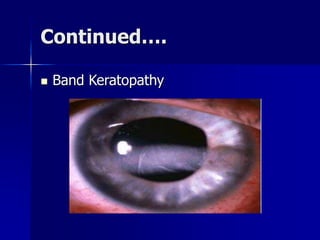
2. Metastatic calcifications at the corneal/scleral junction,
so-called band keratopathy
3. Shortened Q-T interval on electrocardiogram, ectopic
calcium deposits, and pruritus.
Continued….
 Band Keratopathy
Continued….
 Diagnosis:
1. Elevated serum Ca
2. Elevated PTH (suppressed in PTH-rp induced
hypercalcemia)
3. Other:
 Albumin
 Phosphorous
 BUN/Cr
 24-hour urine Ca (r/o FHH)
 Bone Mineral Density
Localization Studies
 Noninvasive preoperative methods
1. Ultrasonography
2. Radioiodine or technetium thyroid scan
3. Thallium-technetium scintigraphy
4. Technetium-99m sestamibi scintigraphy
5. Computed tomography scan
6. Magnetic resonance imaging
 Invasive preoperative methods
1. Fine-needle aspiration
2. Selective arteriography or digital subtraction angiography
3. Selective venous sampling for parathyroid hormone assay
4. Arterial injection of selenium-ethionine
 Intraoperative Methods
1. Intraoperative ultrasonography
2. Toluidine blue or methylene blue
3. Urinary adenosine monophosphate
4. Quick parathyroid hormone intraoperative
Sestamibi-Technetium 99m
Scintography
 Sestamibi taken up mitochondria of parathyroid cells greater
than surrounding parenchyma.
 Inject 20 to 25 millicuries of technetium-99m sestamibi.
Images obtained at 10-15 minutes then 2-3 hours after the
injection.
 Late phase preferable for detecting parathyroid adenomas, as
thyroid nodules clear uptake faster than do parathyroid
neoplasms.
 Sensitivity (solitary adenoma) ~100%, Specificity ~90%.
 False-positive:
1. Solid thyroid nodules (adenomas)
2. Hurthle cell carcinoma
3. Malignant thyroid lymph node metastases
4. No false-positive with cystic lesions of the thyroid gland
Continued….
 False-negatives
1.Smaller parathyroid adenoma size.
2.Suboptimal dosing of technetium-99m
sestamibi.
Continued….
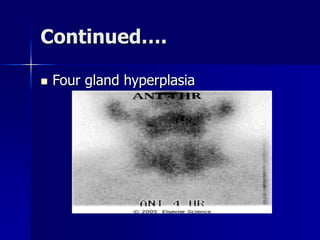
 Four gland hyperplasia
Continued….
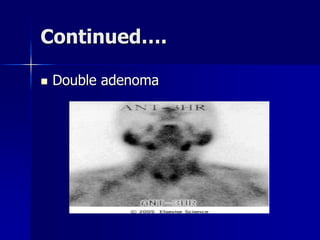
 Double adenoma
Medical Management
 Intravascular volume expansion + loop
diuretics (avoid thiazide diuretics)
 Bisphosphonates
 Calcitonin
 Plicamycin
 Estrogens therapy
 Oral phosphate salts
 Calcimimetic agents (investigational drug R-
568)
Case 1
 65 y.o. male with history of a left
thyroid mass underwent, FNA atypical
follicular lesion. Patient underwent L.
thyroid lobectomy with final diagnosis
of follicular adenoma. Patient had
been noted in past to have
asymptomatic hypercalcemia. PTH
126, 24-hour urine calcium 380mg,
Ionized Ca 1.4
Continued….
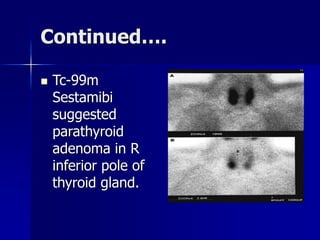
 Tc-99m
Sestamibi
suggested
parathyroid
adenoma in R
inferior pole of
thyroid gland.
Continued….
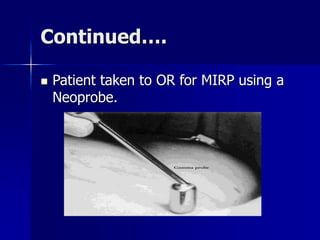
 Patient taken to OR for MIRP using a
Neoprobe.
Continued….
 664 mg right superior parathyroid
gland identified
 PTH decreased from 126 to 15
Surgical Management
 Clinical indicators for surgery*
1. Serum calcium is >1.0 mg/dL above the upper
limit of normal.
2. Creatinine clearance is reduced >30% for age in
the absence of another cause.
3. Twenty-four hour urinary calcium is >400 mg/dL.
4. Patients are younger than 50 years of age.
5. Bone mineral density measurement at the lumbar
spine, hip, or distal radius is reduced >2.5
standard deviations (by T score).
6. Patients request surgery, or patients are unsuitable
for long-term surveillance.
*Consensus conference held by the National Institutes of Health in 2002
Continued….
 Adenoma
1. Directed unilateral cervical
exploration.
2. Curative in >95% of patients
3. Preoperative localization with
technetium-99m sestamibi + IOPTH
Continued….
 MEN 1
1. Subtotal vs. total with autotransplantation.
 Men 2a-
1. 100% cure rate with no recurrences
whether total parathyroidectomy,
subtotal parathyroidectomy, or excision
of enlarged glands performed.
2. R/O pheochromocytoma prior to OR trip
(hypertensive crisis).
Continued….
 Non-MEN familial
hyperparathyroidism (NMFH).
1. Subtotal or total (autotransplant) with
bilateral cervical thymectomy.
 Familial neonatal
hyperparathyroidism.
1. Total (autotransplant) + bilateral
transcervical thymectomy
Continued….
 Renal failure-induced hyperparathyroidism.
1. Subtotal vs. total parathyroidectomy (autotransplant)
with or without cryopreservation.
 Parathyroid Carcinoma
1. en bloc resection of the tumor and areas of potential
local invasion and/or regional metastasis (ipsilateral
central neck contents including the thyroid lobe and
tracheoesophageal soft tissues, lymphatics, and
resection of soft tissues within the superior anterior
mediastinum)
2. RLN, esophageal wall, or strap muscles may require
sacrifice if the tumor adheres to them.
3. Not enough data to recommend for or against
chemotherapy or RT.
Continued….
 MIRP
1. Preoperative administration of technetium 99m sestamibi
before operation + intraoperative hand-held gamma probe.
2. Advantages:
1. Improved patient comfort postoperatively.
2. Performance of ambulatory procedures.
3. Reduced cost.
4. Avoidance of general anesthetic.
3. Disadvantages:
1. Potential for conversion to bilateral dissection in event of failed
exploration.
2. Patient anxiety when conversion needed (general anesthesia).
Conclusion
 No substitute for strong foundation
surgical embryology, anatomy, and
technique for approaching parathyroid
disease.
Bibliography
 Cummings Otolaryngology Head and
Neck Surgery. 2005.
 Rosen F., Pou A., Parathyroid
Disease. March 2002. UTMB site
 http://www.mrcophth.com/corneacom
moncases/bk.html (Image-Band
Keratopathy)

Parathyroid goda

  • 1.
    Diagnosis and Management of ParathyroidDisease BY PROF/ GOUDA ELLABBAN FOM/SCU ellabbang@yahoo.com
  • 2.
    Objectives  Review calciumhomeostasis  Understand parathyroid anatomy and histopathology  Review embryo-anatomic relationships in the central neck  Recognize the clinical features, diagnosis and surgical/medical management of hyperparathyroidism  Understand the molecular basis of localization studies
  • 3.
    CALCIUM HOMEOSTASIS AND PARATHYROIDHORMONE SECRETION AND REGULATION  Parathyroid hormone (PTH) contains 84 amino acids  Degradation into amino(N) and carboxyl(C)-terminal fragments.  The N-terminal fragment biologically active and rapidly cleared  C-terminal fragment is biologically inert and cleared by the kidney
  • 4.
    Continued….  PTH releasegoverned by serum ionized calcium levels.  PTH secreted in response to decrease in serum-ionized calcium and inhibited by an increase serum-ionized calcium.  Target end organs: kidneys, skeletal system, and intestine.  PTH binding to receptor sites results in cAMP 2nd messenger system activation.  Half-life PTH few minutes.
  • 5.
  • 6.
    Etiology and Pathogenesis ofHyperparathyroidism  Parathyroid adenomas (PA) considered monoclonal or oligoclonal neoplasms.  Propagation through clonal expansion of cells with altered sensitivity to calcium.  PRAD1 implicated in only some PA.  Another mechanism involves alternation in tumor suppressor gene expression.
  • 7.
  • 8.
  • 9.
    Parathyroid Anatomy and Histopathology:The Normal Parathyroid Gland  Supernumerary fifth parathyroid found between 0.7%-5.8% patients  5th glands found in the mediastinum (thymus or related to the aortic arch), thyrothymic tract
  • 10.
    Parathyroid Gland Location  80%of superior parathyroid glands found at the cricothyroid junction ~1 cm cranial to juxtaposition of RLN & ITA.  Inferior parathyroid glands (IPG) variable in location.  61% of (IPG) near the lower pole of the thyroid gland and 26% in thyrothymic ligament.  Incidence of intrathyroidal parathyroid glands ~0.5% to 3%.
  • 11.
  • 12.
    Morphologic Characteristics of ParathyroidGlands  Shape-oval, bean, or teardrop appearance or flat shape when juxtaposed to thyroid gland.  Color-yellowish brown to reddish brown in normal parathyroid glands and lighter gray tone in pathological states.
  • 13.
    Vascular Anatomy ofthe Parathyroid Glands  Normal parathyroid glands most commonly are supplied by a single dominant artery (80%).  The length of the dominant artery supplying glands vary from 1 to 40 mm.  ITA is dominant blood supply to both superior & inferior parathyroid glands most of the time.
  • 14.
    Histopathology of the ParathyroidGlands  Parathyroid gland composed of chief cells, oxyphilic cells and intermediate cells  Solitary parathyroid adenoma ~80%-85% of patients with primary hyperparathyroidism  Variations in parathyroid adenoma includes other subtypes (oncocytic adenoma, lipoadenoma, large clear cell adenoma, water-clear cell adenoma, and atypical adenoma).
  • 15.
    Continued….  Primary parathyroidhyperplasia-proliferation of parenchymal cells with increase in weight in multiple glands with absence of stimulus for parathyroid hormone secretion.  Two types of parathyroid hyperplasia are seen: the common chief cell hyperplasia and the rare water cell or clear cell hyperplasia.
  • 16.
    Continued….  Parathyroid carcinoma(PC) ~0.1% to 5.0% cases of primary hyperparathyroidism.  PC tend to be large tumors, (30% to 50% palpable presentation).  May measure up to 6 cm in diameter, mean ~3 cm.  Lesion adheres to surrounding tissues including soft tissues of the neck (thyroid gland, strap muscles, trachea & recurrent laryngeal nerve).  Regional metastasis rare.  Pulmonary metastasis most common distant metastasis site.
  • 17.
    Continued….  PC tendsto be an indolent tumor.  Multiple recurrences after resection common and may occur over a 15- to 20-year period.  Death results from from effects of excessive PTH secretion and uncontrolled hypercalcemia rather than growth of the tumor mass.
  • 18.
    Clinical features Primary Hyperparathyroidism(PH)  Incidence 27 cases annually per 100,000  Prevalence PH general population 0.1%-0.3%  Prevalence women >60 years more than 1%
  • 19.
    CALCIUM HOMEOSTASIS AND PARATHYROIDHORMONE SECRETION AND REGULATION
  • 20.
    Continued….  Osteitis fibrosiscystica  Nephrolithiasis  Hypercalcemic crisis  Osteitis fibrosis occurs ~1% of patients  Renal stones ~10%-20% of patients have renal stones.  Nonspecific symptoms: malaise, fatigue, depression, sleep disturbance, weight loss, abdominal pains, constipation, vague musculoskeletal pains in the extremities, and muscular weakness
  • 21.
    Continued….  Kidney/Urinary Tract:4% with nephrolithiasis and nephrocalcinosis (stone composition, calcium oxylate or calcium phosphate). Sx of urolithiasis: renal colic, hematuria, pyuria.  Skeletal System: 1. Osteitis fibrosis cystica (rare) 2. Subperiosteal erosion of the distal phalanges 3. Bone wasting and softening 4. Chondrocalcinosis as a result of bone demineralization 5. Bone pain 6. Pathologic fracture 7. Cystic bone changes 8. Bone loss: cortical bone sites sparing trabecular bone
  • 22.
    Continued….  Neuromuscular: 1. Muscleweakness, (proximal extremity muscle groups with fatigue and malaise) 2. Neuromuscular syndrome improves in 80%-90% of patients.  Neurologic: 1. Depression, nervousness, and cognitive dysfunction 2. Deafness, dysphagia, and dysosmia 3. Many psychiatric symptoms improve after parathyroidectomy. Fifty percent of patients with depression or anxiety, or both will improve after surgery.
  • 23.
    Continued….  Cardiovascular 1. Hypertension(50% of patients) 2. Parathyroidectomy results in a reduction in BP in minority of patients.  Hypercalcemic syndrome 1. polydipsia and polyuria, anorexia, vomiting, constipation, muscle weakness and fatigue, mental status changes. 2. Metastatic calcifications at the corneal/scleral junction, so-called band keratopathy 3. Shortened Q-T interval on electrocardiogram, ectopic calcium deposits, and pruritus.
  • 24.
  • 25.
    Continued….  Diagnosis: 1. Elevatedserum Ca 2. Elevated PTH (suppressed in PTH-rp induced hypercalcemia) 3. Other:  Albumin  Phosphorous  BUN/Cr  24-hour urine Ca (r/o FHH)  Bone Mineral Density
  • 26.
    Localization Studies  Noninvasivepreoperative methods 1. Ultrasonography 2. Radioiodine or technetium thyroid scan 3. Thallium-technetium scintigraphy 4. Technetium-99m sestamibi scintigraphy 5. Computed tomography scan 6. Magnetic resonance imaging  Invasive preoperative methods 1. Fine-needle aspiration 2. Selective arteriography or digital subtraction angiography 3. Selective venous sampling for parathyroid hormone assay 4. Arterial injection of selenium-ethionine  Intraoperative Methods 1. Intraoperative ultrasonography 2. Toluidine blue or methylene blue 3. Urinary adenosine monophosphate 4. Quick parathyroid hormone intraoperative
  • 27.
    Sestamibi-Technetium 99m Scintography  Sestamibitaken up mitochondria of parathyroid cells greater than surrounding parenchyma.  Inject 20 to 25 millicuries of technetium-99m sestamibi. Images obtained at 10-15 minutes then 2-3 hours after the injection.  Late phase preferable for detecting parathyroid adenomas, as thyroid nodules clear uptake faster than do parathyroid neoplasms.  Sensitivity (solitary adenoma) ~100%, Specificity ~90%.  False-positive: 1. Solid thyroid nodules (adenomas) 2. Hurthle cell carcinoma 3. Malignant thyroid lymph node metastases 4. No false-positive with cystic lesions of the thyroid gland
  • 28.
    Continued….  False-negatives 1.Smaller parathyroidadenoma size. 2.Suboptimal dosing of technetium-99m sestamibi.
  • 29.
  • 30.
  • 31.
    Medical Management  Intravascularvolume expansion + loop diuretics (avoid thiazide diuretics)  Bisphosphonates  Calcitonin  Plicamycin  Estrogens therapy  Oral phosphate salts  Calcimimetic agents (investigational drug R- 568)
  • 32.
    Case 1  65y.o. male with history of a left thyroid mass underwent, FNA atypical follicular lesion. Patient underwent L. thyroid lobectomy with final diagnosis of follicular adenoma. Patient had been noted in past to have asymptomatic hypercalcemia. PTH 126, 24-hour urine calcium 380mg, Ionized Ca 1.4
  • 33.
  • 34.
    Continued….  Patient takento OR for MIRP using a Neoprobe.
  • 35.
    Continued….  664 mgright superior parathyroid gland identified  PTH decreased from 126 to 15
  • 36.
    Surgical Management  Clinicalindicators for surgery* 1. Serum calcium is >1.0 mg/dL above the upper limit of normal. 2. Creatinine clearance is reduced >30% for age in the absence of another cause. 3. Twenty-four hour urinary calcium is >400 mg/dL. 4. Patients are younger than 50 years of age. 5. Bone mineral density measurement at the lumbar spine, hip, or distal radius is reduced >2.5 standard deviations (by T score). 6. Patients request surgery, or patients are unsuitable for long-term surveillance. *Consensus conference held by the National Institutes of Health in 2002
  • 37.
    Continued….  Adenoma 1. Directedunilateral cervical exploration. 2. Curative in >95% of patients 3. Preoperative localization with technetium-99m sestamibi + IOPTH
  • 38.
    Continued….  MEN 1 1.Subtotal vs. total with autotransplantation.  Men 2a- 1. 100% cure rate with no recurrences whether total parathyroidectomy, subtotal parathyroidectomy, or excision of enlarged glands performed. 2. R/O pheochromocytoma prior to OR trip (hypertensive crisis).
  • 39.
    Continued….  Non-MEN familial hyperparathyroidism(NMFH). 1. Subtotal or total (autotransplant) with bilateral cervical thymectomy.  Familial neonatal hyperparathyroidism. 1. Total (autotransplant) + bilateral transcervical thymectomy
  • 40.
    Continued….  Renal failure-inducedhyperparathyroidism. 1. Subtotal vs. total parathyroidectomy (autotransplant) with or without cryopreservation.  Parathyroid Carcinoma 1. en bloc resection of the tumor and areas of potential local invasion and/or regional metastasis (ipsilateral central neck contents including the thyroid lobe and tracheoesophageal soft tissues, lymphatics, and resection of soft tissues within the superior anterior mediastinum) 2. RLN, esophageal wall, or strap muscles may require sacrifice if the tumor adheres to them. 3. Not enough data to recommend for or against chemotherapy or RT.
  • 41.
    Continued….  MIRP 1. Preoperativeadministration of technetium 99m sestamibi before operation + intraoperative hand-held gamma probe. 2. Advantages: 1. Improved patient comfort postoperatively. 2. Performance of ambulatory procedures. 3. Reduced cost. 4. Avoidance of general anesthetic. 3. Disadvantages: 1. Potential for conversion to bilateral dissection in event of failed exploration. 2. Patient anxiety when conversion needed (general anesthesia).
  • 42.
    Conclusion  No substitutefor strong foundation surgical embryology, anatomy, and technique for approaching parathyroid disease.
  • 43.
    Bibliography  Cummings OtolaryngologyHead and Neck Surgery. 2005.  Rosen F., Pou A., Parathyroid Disease. March 2002. UTMB site  http://www.mrcophth.com/corneacom moncases/bk.html (Image-Band Keratopathy)