Pelvic Ring Fractures
Abdelfattah Saoud MSc, MD, PhD
Professor of Orthopaedic & Spine Surgery
Head of Ranking & Accreditation office
Ain Shams University
Head of International Scientific Relations office
School of Medicine,Ain Shams University
President, World Spinal Column Society
Educational Faculty, Cleveland Clinic Spine
Institute
High energy fractures of the pelvis are a challenging
problems both in the immediate post-injury phase and
later when definitive management is undertaken
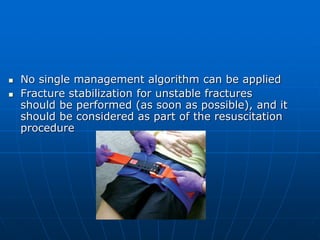
 No single management algorithm can be applied
 Fracture stabilization for unstable fractures
should be performed (as soon as possible), and it
should be considered as part of the resuscitation
procedure
 Pelvic ring is formed of two
innominate bones and the
sacrum .
 Articulation is mostly
ligamentous stable
 Another factor in stability is
Interdigitating and matching
contours of the iliac and sacral
articulating surfaces
March 21st
 The most important ligaments are:
-Sacroiliac ligaments
(Ant.,Post.,Interosseous.),
-Symphysis pubis
-Sacro-Spinous ligament
-Sacro-Tuberous ligament
- & ilio-lumbar ligament.
Diagnosis
 Clinical:
-High energy trauma,
-pain related to the fractured
area,
-symptoms and signs of
complication:
1-Shock(Internal iliac Art.
Branches injury in relation to
S.I joint ,injury of accessory
obturator vessels in relation
to the back of symphysis
pubis (pubic branches of
obturator artery of internal
iliac origin and inferior
epigastric artery which
originates from the external
iliac artery
(Corona Mortis)
2-Urological injury: Urethra ,
Radiographic diagnosis
1- of the fracture itself:
A.P view : not a true A.P
due to pelvic inclination
ant. 45 deg.
So true A.P comes by
inclinig the beam of x
ray 45 deg. Caudad=
Outlet view which is very
important to detect
vertical Shear.
 If we incline the beam 45
deg. Cephalad= inlet view
which is important to
denote ant. Post.
Displacement of hemi-
pelvis.
 C.T to plan for surgery
,some times we do it in 3
dimensional reformat.
Pelvic instability
Classification of pelvic fractures
 The two most popular scheme in use
today are the Young-Burgess
system
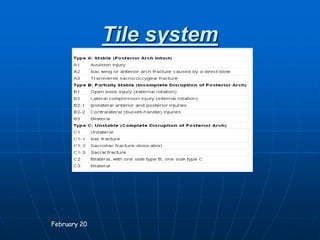
Tile system
February 20
Young and Burgess
classification
LC Transverse fracture of pubic rami, ipsilateral or
contralateral to posterior injury
I Sacral compression on side of impact
II Crescent (iliac wing) fracture on side of
impact
III LC-1 or LC-II injury on side of impact;
contralateral open-book (APC)
APC Symphyseal diastasis or
longitudinal rami fractures
I Slight widening of pubic symphysis or anterior SI
Joint; stretched but intact anterior SI, sacrotuberous, and
sacrospinous ligaments; intact posterior SI ligaments
II Widened anterior SI joint; disrupted anterior SI,
sacrotuberous, and sacrospinous ligaments; intact posterior
SI ligaments
III Complete SI joint disruption with lateral displacement,
disrupted anterior SI, sacrotuberous, and sacrospinous
ligaments; disrupted posterior SI ligaments
VS
Symphyseal diastasis or vertical
displacement anteriorly and
posteriorly, usually through the SI
joint, occasionally through the iliac
wing or sacrum
CM
Combination of other injury
patterns, LC/VS being the
most common
Denis classification of Sacral
fractures
Zone 1 - ala of the sacrum to lateral
border of the neural foramen
Zone 2 - neural foramen
Zone 3 - central portion of the sacrum and
canal
Algorithm for
management
(No consensus)
This is what our
Invention has
changed
Diagnosis of complication
 Urological injury: Ascending urethrography is the
most useful.
 Haemorrhage: Angiography(Arterial): Both for
diagnosis and treatmant by selective embolization.
Complication Cont’d
 Neurological injury:
Lumbo-sacral plexus
injury.
 Pelvic D.V .T with fatal
pulmonary embolism.
Late complication:
 Malunion :with leg length
discripency ,or if ant.
With bladder irritation
 Non union with pain
especially in relation to
S.I. joint .Rare and occurs
more in pure ligamentous
injuries
Anterior injury
Anterior injury
 Ex Fixator.
Anterior injury
 Symphyseal plate
February 20
February 20
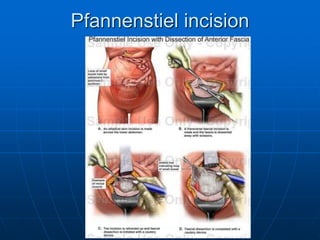
Pfannenstiel incision
Anterior injury
 Antegrade or retrograde Pubic
screw
February 20
Anterior injury
 Other methods…
Wiring
Tension band
February 20
Posterior injury
Sacral Fractures
Sacroiliac Fracture Dislocations
Crescent fracture
Indications of intervention:
1-Unstable fracture:e.g Gr. III
APC, VS
2- SIJ gap of more than 5-10
mm
3- Neurologic injury related to
post. Injury: LS trunk lesions
4- Retroperitoneal
haemorrhagae : Tamponade
Lumbosacral Pivot point
 Described by McCord et al in
1992.
 It is the axis of flix. Exten. at
the lumbo-sacral junction.
 Lies in the intersection of
middle osteoligamentous
column and L5-S1 disc.
 For constructs that cross the
Lumbosacral junction: Only
those devices that pass
ventral to this point provide a
significant biomechanical
advantage regarding the
rigidity of fixation.
Posterior injury
 Iliosacral screw
Iliosacral screw
February 20
 Iliosacral screw
February 20
Iliosacral screw
February 20
Iliosacral screw
February 20
 Iliosacral screw
February 20
Transiliac sacral bars:
- utilizes threaded
rods, compression
achieved by tightening
of threaded nuts;
- advantages
include technical ease of
insertion and limited
soft tissue dissection;
-Biomechanically
ineffective according to
McCord point and is a
real obstacle of flexion
and extension
February 20
Posterior injury
 Iliosacral plates(anterior or posterior)
Ilio inguinal aproach
Our modification
 No need to expose vessels
 Only Pfannensteil and the lateral iliac
window
 we pass plates and do indirect
reduction under ilio posoas muscle
with hip flexion
 Lumbopelvic Fixation
Lumbopelvic fixation
consists of pedicle screws
placed in L5 and or L4 that
are connected to fixation
placed into the ilium from
posterior to anterior just
cephalad to the sciatic notch
MW technique
iliac screws
(7 mm) inserted
in a Galveston
manner, and
iliosacral screws
(7 mm) to
maximize
construct
strength
Disadvantages of lumbo-sacral
stabilisation
techniques are the restriction
of waist movements and the
need a second operation to
remove the fixation due to
painful hardware.
February 20
The New Internal Fixator
Saoud & Reda Technique:
WSCJ Vol 2 issue 1, 2011
-Application of Iliac screw(polyaxial)60-100 mm, 7 mm
width on each side
-Submuscular channel connecting the two incisions
-Rod applied between the two polyaxial screw heads.
Advantages
It is a very fast & safe
technique that doesn’t
need
much experience or
fluoroscopy thus it is
suitable for
polytrauma and critically
sick patients.
Safety of application
doesn’t depend on
accurate
reduction of the sacral
fracture.
After application of the
screws they can be used
as
joysticks to manipulate
the fracture by
distraction and
compression
Very small skin incisions and the absence of any
major dissection would spare the patient any
further jeopardy to the possibly contused or
devitalized skin of this area which is a huge
advantage especially with suspected or diagnosed
Morel-Lavallée skin lesions
 May nullify need for Ext. Fixator
Treatment of Complications of
pelvic fractures
Treatment of complication
 Urological injury: Suprapubic cystostomy
 Haemorrhage: Angiography(Arterial): Both for
diagnosis and treatmant by selective embolization.
Complication Cont’d
 Neurological injury:
Treatment of Lumbo-sacral
plexus injury is by fracture
fixation and expectancy for
12-24 mns with
EMG.Results of grafting are
bad
 Pelvic D.V .T Prevention,
IVC filter
Late complication:
 Malunion :innominate
osteotomy
 Non union with pain
especially in relation to S.I.
joint .For SI fusion
 Open pelvic fractures especially with
bowel injury are emergencies.
Fixation is by Ext Fix. Or S&R
technique, may be supplemented
when patient is more stable
Anatomy - Pelvis
 Iliac bone with iliac apophysis
 Ischium with apophysis
 Pubic bones – physeal connection at
ischiopubic junction
 Sacrum – SI joint 2/3 synchondrosis,
1/3 synovial joint
 Pubic symphysis - synchondrosis
The Child’s Pelvis
 Fundamental Differences:
• Bones more malleable
• Cartilage capable of absorbing more
energy
• Joints more elastic
• Triradiate Cartilage
Ossification centers
 3 Primary Ossification Centers:
• Pubis
• Ischium
• Ilium
Anatomy
 Other Secondary Ossification Centers
of the Pelvis
• iliac crest
• ischial apophysis
• anterior inferior iliac spine
• pubic tubercle
• angle of the pubis
• ischial spine
• lateral wing of the sacrum
Secondary Ossification Center
 Iliac Crest : first seen at age 13 to 15 and
fuses at age 15 to 17 years
 Ischium : first seen at age 15 to 17 and
fuses at age 19 to 25 years
 ASIS : first seen about age 14 and fusing
at age 16
*(Important to know these secondary
ossification centers so they will not
be confused with avulsion fractures)
Elasticity of Joints
 Sacroiliac Joint and Pubic Symphysis
more elastic
 Allows significant displacement
 Allows for single break in the ring
 Thick periosteum – apparent
dislocations may have a periosteal
tube that heals like a fracture
Weakness of Cartilage
 Avulsion fractures occur more often
in children and adolescents through
apophysis
Pelvic ring fractures: Diagnosis
History and Associated Injuries
 Usually high energy injuries for pelvic ring
and acetabular fractures
 Other associated injuries
• Orthopaedic – long bone or spine fractures
• Urologic – bladder rupture
• Vascular – less frequent than in adults
Physical Examination
 A, B, C’s
 Trauma evaluation
 Orthopaedic exam all extremities and
spine
 Systematic approach to the Pelvis
Examination of the Pelvis
 Areas of contusion, abrasion, laceration,
ecchymosis, or hematoma, especially in
the perineal and pelvic areas, should be
recorded.
 Landmarks such as the anterior superior
iliac spine, crest of the ilium, sacroiliac
joints, and symphysis pubis should be
palpated.
 Carefully evaluate perineum/genital/rectal
areas in fractures with significant
displacement to rule out open fractures
Examination of the Pelvis
 Provocative Tests (ie. Compressing the
pelvic ring with anterior-posterior and
lateral compression stress)
 The range of motion of the extremities,
especially of the hip joint, should be
determined
 Neurologic and vascular exam of the lower
extremities
Radiographic Evaluation
 Standard AP Pelvis
 Judet views for acetabular involvement
 Inlet/Outlet views for pelvic ring injuries
 Computed tomography
• 2-d and 3-d reconstruction
 Cystography and/or urography if blood at
meatus or on bladder catheterization
Pelvic Avulsion Fracture Injuries
 At sites of muscle attachments
through apophyses, caused by
forceful contraction
 Iliac wing – tensor fascia lata
 Anterior superior iliac spine –
sartorius
 Anterior inferior iliac spine – rectus
femoris
 Ischium – hamstrings
 Lesser trochanter - iliopsoas
Relative Percentages of Pelvic
Avulsion Fracture Locations
ASIS Avulsion Fracture
Ischial Avulsion Fracture-
11 year old Sprinting
Ischial Avulsion Fracture CT
AIIS Avulsion – 13 yo Female
Kicking a Soccer Ball
Classification of Pelvic Injuries
in Children
Torode and Zieg modification of Watts
classification
 Type I – avulsion fractures
 Type II - Iliac wing fractures
 Type III – stable pelvic ring
injuries
 Type IV – any fracture pattern
creating a free bony fragment
(unstable pelvic ring injuries)
Tile Classification
(applicable to adolescents /
patients near skeletal maturity)
 Type A – stable
 Type B – rotationally unstable,
vertically stable
 Type C – rotationally and vertically
unstable
Treatment Options
 Bedrest
 Spica cast
 Mobilization with restricted
weightbearing
 Skeletal traction
 External fixation
 ORIF
Treatment Differences
 Pubic symphyseal and SI disruptions may
be able to be treated closed because of
potential for periosteal healing
 Children tolerate
bedrest/traction/immobilization better
than adults
 Operative fixation should spare growth
plates when possible
 When not possible consider temporary (4-
6 weeks) fixation across physes with
smooth pins
Treatment
 Most avulsion injuries, Tile A
fractures treated with restricted or
no weight bearing
 Most Tile B fractures treated non
operatively unless major deformity
 Tile C fractures may need
stabilization
Treatment Caveats
 Older children and adolescents with
pelvic injuries treated like adults
 Operative treatment in general for
pelvic injuries where posterior ring
disruptions are displaced or
unstable(Theoretically our
Saoud&Reda can be used)
 May be able to stabilize anterior ring
only, and for shorter time period if
using external fixation
Pelvic Ring Injuries- Often Crush
Mechanism and Can Have Severe
Soft Tissue Injuries as well
Plate Symphysis for Diastasis
13 year old, bilateral pubic rami
fractures with left SI disruption
subtrochanteric femur fracture
Thank You

Pelvic ring for md1

  • 1.
    Pelvic Ring Fractures AbdelfattahSaoud MSc, MD, PhD Professor of Orthopaedic & Spine Surgery Head of Ranking & Accreditation office Ain Shams University Head of International Scientific Relations office School of Medicine,Ain Shams University President, World Spinal Column Society Educational Faculty, Cleveland Clinic Spine Institute
  • 2.
    High energy fracturesof the pelvis are a challenging problems both in the immediate post-injury phase and later when definitive management is undertaken
  • 3.
     No singlemanagement algorithm can be applied  Fracture stabilization for unstable fractures should be performed (as soon as possible), and it should be considered as part of the resuscitation procedure
  • 4.
     Pelvic ringis formed of two innominate bones and the sacrum .  Articulation is mostly ligamentous stable  Another factor in stability is Interdigitating and matching contours of the iliac and sacral articulating surfaces March 21st
  • 6.
     The mostimportant ligaments are: -Sacroiliac ligaments (Ant.,Post.,Interosseous.), -Symphysis pubis -Sacro-Spinous ligament -Sacro-Tuberous ligament - & ilio-lumbar ligament.
  • 7.
    Diagnosis  Clinical: -High energytrauma, -pain related to the fractured area, -symptoms and signs of complication: 1-Shock(Internal iliac Art. Branches injury in relation to S.I joint ,injury of accessory obturator vessels in relation to the back of symphysis pubis (pubic branches of obturator artery of internal iliac origin and inferior epigastric artery which originates from the external iliac artery (Corona Mortis) 2-Urological injury: Urethra ,
  • 8.
    Radiographic diagnosis 1- ofthe fracture itself: A.P view : not a true A.P due to pelvic inclination ant. 45 deg. So true A.P comes by inclinig the beam of x ray 45 deg. Caudad= Outlet view which is very important to detect vertical Shear.
  • 9.
     If weincline the beam 45 deg. Cephalad= inlet view which is important to denote ant. Post. Displacement of hemi- pelvis.  C.T to plan for surgery ,some times we do it in 3 dimensional reformat.
  • 10.
  • 11.
    Classification of pelvicfractures  The two most popular scheme in use today are the Young-Burgess system
  • 12.
  • 13.
  • 15.
    LC Transverse fractureof pubic rami, ipsilateral or contralateral to posterior injury I Sacral compression on side of impact II Crescent (iliac wing) fracture on side of impact III LC-1 or LC-II injury on side of impact; contralateral open-book (APC)
  • 16.
    APC Symphyseal diastasisor longitudinal rami fractures I Slight widening of pubic symphysis or anterior SI Joint; stretched but intact anterior SI, sacrotuberous, and sacrospinous ligaments; intact posterior SI ligaments II Widened anterior SI joint; disrupted anterior SI, sacrotuberous, and sacrospinous ligaments; intact posterior SI ligaments III Complete SI joint disruption with lateral displacement, disrupted anterior SI, sacrotuberous, and sacrospinous ligaments; disrupted posterior SI ligaments
  • 17.
    VS Symphyseal diastasis orvertical displacement anteriorly and posteriorly, usually through the SI joint, occasionally through the iliac wing or sacrum
  • 18.
    CM Combination of otherinjury patterns, LC/VS being the most common
  • 19.
    Denis classification ofSacral fractures Zone 1 - ala of the sacrum to lateral border of the neural foramen Zone 2 - neural foramen Zone 3 - central portion of the sacrum and canal
  • 20.
  • 21.
    This is whatour Invention has changed
  • 22.
    Diagnosis of complication Urological injury: Ascending urethrography is the most useful.  Haemorrhage: Angiography(Arterial): Both for diagnosis and treatmant by selective embolization.
  • 23.
    Complication Cont’d  Neurologicalinjury: Lumbo-sacral plexus injury.  Pelvic D.V .T with fatal pulmonary embolism. Late complication:  Malunion :with leg length discripency ,or if ant. With bladder irritation  Non union with pain especially in relation to S.I. joint .Rare and occurs more in pure ligamentous injuries
  • 24.
  • 25.
  • 26.
  • 27.
  • 28.
  • 29.
    Anterior injury  Antegradeor retrograde Pubic screw February 20
  • 30.
    Anterior injury  Othermethods… Wiring Tension band February 20
  • 31.
    Posterior injury Sacral Fractures SacroiliacFracture Dislocations Crescent fracture Indications of intervention: 1-Unstable fracture:e.g Gr. III APC, VS 2- SIJ gap of more than 5-10 mm 3- Neurologic injury related to post. Injury: LS trunk lesions 4- Retroperitoneal haemorrhagae : Tamponade
  • 32.
    Lumbosacral Pivot point Described by McCord et al in 1992.  It is the axis of flix. Exten. at the lumbo-sacral junction.  Lies in the intersection of middle osteoligamentous column and L5-S1 disc.  For constructs that cross the Lumbosacral junction: Only those devices that pass ventral to this point provide a significant biomechanical advantage regarding the rigidity of fixation.
  • 33.
  • 34.
  • 35.
  • 36.
  • 37.
  • 38.
  • 39.
    Transiliac sacral bars: -utilizes threaded rods, compression achieved by tightening of threaded nuts; - advantages include technical ease of insertion and limited soft tissue dissection; -Biomechanically ineffective according to McCord point and is a real obstacle of flexion and extension February 20
  • 40.
    Posterior injury  Iliosacralplates(anterior or posterior)
  • 41.
  • 43.
    Our modification  Noneed to expose vessels  Only Pfannensteil and the lateral iliac window  we pass plates and do indirect reduction under ilio posoas muscle with hip flexion
  • 44.
     Lumbopelvic Fixation Lumbopelvicfixation consists of pedicle screws placed in L5 and or L4 that are connected to fixation placed into the ilium from posterior to anterior just cephalad to the sciatic notch
  • 46.
    MW technique iliac screws (7mm) inserted in a Galveston manner, and iliosacral screws (7 mm) to maximize construct strength
  • 47.
    Disadvantages of lumbo-sacral stabilisation techniquesare the restriction of waist movements and the need a second operation to remove the fixation due to painful hardware. February 20
  • 48.
    The New InternalFixator Saoud & Reda Technique: WSCJ Vol 2 issue 1, 2011 -Application of Iliac screw(polyaxial)60-100 mm, 7 mm width on each side -Submuscular channel connecting the two incisions -Rod applied between the two polyaxial screw heads.
  • 51.
  • 52.
    It is avery fast & safe technique that doesn’t need much experience or fluoroscopy thus it is suitable for polytrauma and critically sick patients.
  • 53.
    Safety of application doesn’tdepend on accurate reduction of the sacral fracture.
  • 54.
    After application ofthe screws they can be used as joysticks to manipulate the fracture by distraction and compression
  • 55.
    Very small skinincisions and the absence of any major dissection would spare the patient any further jeopardy to the possibly contused or devitalized skin of this area which is a huge advantage especially with suspected or diagnosed Morel-Lavallée skin lesions
  • 56.
     May nullifyneed for Ext. Fixator
  • 57.
    Treatment of Complicationsof pelvic fractures
  • 58.
    Treatment of complication Urological injury: Suprapubic cystostomy  Haemorrhage: Angiography(Arterial): Both for diagnosis and treatmant by selective embolization.
  • 59.
    Complication Cont’d  Neurologicalinjury: Treatment of Lumbo-sacral plexus injury is by fracture fixation and expectancy for 12-24 mns with EMG.Results of grafting are bad  Pelvic D.V .T Prevention, IVC filter Late complication:  Malunion :innominate osteotomy  Non union with pain especially in relation to S.I. joint .For SI fusion
  • 60.
     Open pelvicfractures especially with bowel injury are emergencies. Fixation is by Ext Fix. Or S&R technique, may be supplemented when patient is more stable
  • 61.
    Anatomy - Pelvis Iliac bone with iliac apophysis  Ischium with apophysis  Pubic bones – physeal connection at ischiopubic junction  Sacrum – SI joint 2/3 synchondrosis, 1/3 synovial joint  Pubic symphysis - synchondrosis
  • 62.
    The Child’s Pelvis Fundamental Differences: • Bones more malleable • Cartilage capable of absorbing more energy • Joints more elastic • Triradiate Cartilage
  • 63.
  • 64.
     3 PrimaryOssification Centers: • Pubis • Ischium • Ilium
  • 65.
    Anatomy  Other SecondaryOssification Centers of the Pelvis • iliac crest • ischial apophysis • anterior inferior iliac spine • pubic tubercle • angle of the pubis • ischial spine • lateral wing of the sacrum
  • 66.
    Secondary Ossification Center Iliac Crest : first seen at age 13 to 15 and fuses at age 15 to 17 years  Ischium : first seen at age 15 to 17 and fuses at age 19 to 25 years  ASIS : first seen about age 14 and fusing at age 16 *(Important to know these secondary ossification centers so they will not be confused with avulsion fractures)
  • 67.
    Elasticity of Joints Sacroiliac Joint and Pubic Symphysis more elastic  Allows significant displacement  Allows for single break in the ring  Thick periosteum – apparent dislocations may have a periosteal tube that heals like a fracture
  • 68.
    Weakness of Cartilage Avulsion fractures occur more often in children and adolescents through apophysis
  • 69.
    Pelvic ring fractures:Diagnosis History and Associated Injuries  Usually high energy injuries for pelvic ring and acetabular fractures  Other associated injuries • Orthopaedic – long bone or spine fractures • Urologic – bladder rupture • Vascular – less frequent than in adults
  • 70.
    Physical Examination  A,B, C’s  Trauma evaluation  Orthopaedic exam all extremities and spine  Systematic approach to the Pelvis
  • 71.
    Examination of thePelvis  Areas of contusion, abrasion, laceration, ecchymosis, or hematoma, especially in the perineal and pelvic areas, should be recorded.  Landmarks such as the anterior superior iliac spine, crest of the ilium, sacroiliac joints, and symphysis pubis should be palpated.  Carefully evaluate perineum/genital/rectal areas in fractures with significant displacement to rule out open fractures
  • 72.
    Examination of thePelvis  Provocative Tests (ie. Compressing the pelvic ring with anterior-posterior and lateral compression stress)  The range of motion of the extremities, especially of the hip joint, should be determined  Neurologic and vascular exam of the lower extremities
  • 73.
    Radiographic Evaluation  StandardAP Pelvis  Judet views for acetabular involvement  Inlet/Outlet views for pelvic ring injuries  Computed tomography • 2-d and 3-d reconstruction  Cystography and/or urography if blood at meatus or on bladder catheterization
  • 74.
    Pelvic Avulsion FractureInjuries  At sites of muscle attachments through apophyses, caused by forceful contraction  Iliac wing – tensor fascia lata  Anterior superior iliac spine – sartorius  Anterior inferior iliac spine – rectus femoris  Ischium – hamstrings  Lesser trochanter - iliopsoas
  • 75.
    Relative Percentages ofPelvic Avulsion Fracture Locations
  • 76.
  • 77.
  • 78.
  • 79.
    AIIS Avulsion –13 yo Female Kicking a Soccer Ball
  • 80.
    Classification of PelvicInjuries in Children Torode and Zieg modification of Watts classification  Type I – avulsion fractures  Type II - Iliac wing fractures  Type III – stable pelvic ring injuries  Type IV – any fracture pattern creating a free bony fragment (unstable pelvic ring injuries)
  • 81.
    Tile Classification (applicable toadolescents / patients near skeletal maturity)  Type A – stable  Type B – rotationally unstable, vertically stable  Type C – rotationally and vertically unstable
  • 82.
    Treatment Options  Bedrest Spica cast  Mobilization with restricted weightbearing  Skeletal traction  External fixation  ORIF
  • 83.
    Treatment Differences  Pubicsymphyseal and SI disruptions may be able to be treated closed because of potential for periosteal healing  Children tolerate bedrest/traction/immobilization better than adults  Operative fixation should spare growth plates when possible  When not possible consider temporary (4- 6 weeks) fixation across physes with smooth pins
  • 84.
    Treatment  Most avulsioninjuries, Tile A fractures treated with restricted or no weight bearing  Most Tile B fractures treated non operatively unless major deformity  Tile C fractures may need stabilization
  • 85.
    Treatment Caveats  Olderchildren and adolescents with pelvic injuries treated like adults  Operative treatment in general for pelvic injuries where posterior ring disruptions are displaced or unstable(Theoretically our Saoud&Reda can be used)  May be able to stabilize anterior ring only, and for shorter time period if using external fixation
  • 86.
    Pelvic Ring Injuries-Often Crush Mechanism and Can Have Severe Soft Tissue Injuries as well
  • 87.
  • 88.
    13 year old,bilateral pubic rami fractures with left SI disruption subtrochanteric femur fracture
  • 89.