 Circa 200 AD – Galen – the gallbladder
as a subsidiary organ for the liver &
responsible for yellow bile
 Renaissance period – Gallbladder seat
of many emotions (gall)
 1652 - Thomas Bartholin – gallbladder
part of bile tract from liver to intestine
 1654 - Thomas Glisson – formed more
detailed anatomy of liver & biliary tract
 1420 - Antonio Benevieni – 1st account of
gallstones
 1687 - Stal Pert Von Der Wiel – 1st operation
on gallstones
 1733 – Jean-Louis Petit -1st successful
removal of gallstones with fistula formation
 1859 – J.L.W. Thudichum – Two stage
cholecystostomy
 July 15, 1867 – Dr John Stough Bobbs –
Single stage cholecystostomy
 1630 & 1667 – Zambecarri & Teckoff –
proved the gall bladder not essential to life
 1878 - Theodor Kocher – refined
cholecystostomy procedure
 July 15, 1882 – Dr Langenbuch – 1st open
cholecystectomy
 1886 – cholecystotomy 27% mortality vs 12%
mortality for Langenbuch’s
cholecystectomy – became gold standard
 1940’s – Mirizzi introduced cholangiography
for CBD stones
 Gallbladder wall has
no muscularis
mucosa or
submucosa
 Predominantly
columnar epithelial
cells
 Rokitansky-Aschoff
sinuses
 Ducts of Luschka
1.Storage and concentration of
hepatic bile
2.Secretion of water and
electrolytes
3.Empting bile into the common bile
duct
controled by secretin, cholecystokinin
(CCK) and gastrin.
 Normal capacity of 40-50 mL
 Liver secretes >600 mL of bile daily
 Greatest absorptive capacity
 Concentrates bile 5-10 fold
 NaCl transport by epithelium is
driving force and water passively
absorbed
Characteristic (mEa/L) Hepatic Gallbladder
Na 160 270
K 5 10
Cl 62-112 1-10
HCO3 45 10
Ca 4 25
Water 95-98% 85-90%
Bilirubin 1.5 15
Protein (mg/dL) 250 700
Bile Acids 3-50 290-340
Phospholipids 8 40
Cholesterol (mg/dL) 60-70 350-930
Total Solids -- 125
pH 7.0 - 7.8 6.0 - 7.2
 Contraction of ampullary sphincter
(Sphincter of Oddi)
 After meal, sphincter of Oddi relaxes &
CCK released — contraction of
gallbladder
 When stimulated, 50-70% of contents
ejected over 30-40 minutes
 Refills over next 60-90 minutes
 10-20% of Europeans
and Americans carry
gallbladder stones
 Majority are
asymptomatic
 Symptoms and severe
complications - 25%
 1-2% of asymptomatic
individuals develop
symptoms per year
 Each year, an estimated
700,000
cholecystectomies (US)
 $6.5 billion (US)
 Abdominal plain film
 Ultrasound
› 95-98% sensitive, 98% specific
 Radionuclide scan – hepatobiliary
iminodiacetic acid (HIDA)
› Acute cholecystitis: 94% sensitive, 65-85% specific
› Chronic cholecystitis: 65% sensitive, 6-10%
specific
 CT scan
› 50-70% sensitive
› More expensive
 MRCP
› Cost prohibitive
 Recurrent cystic duct obstruction & inflammation
 Presents with biliary colic
 Association with meals present in only 50%
 Symptoms
› Pain duration 1-5 hours (rare >24 hrs or <1 hr)
› Nausea & vomiting present 60-70% of time
› Bloating & belching in 50%
› Fever & jaundice rare
 Exam may be normal unless during attack
 Laboratory values usually normal
 Differentials include: GERD, PUD, IBS, pancreatitis
 Treatment is elective laparoscopic cholecystectomy
 Variant of chronic cholecystitis
 lipid-laden inflammatory process
 Marked wall thickening with intramural
nodules visible on CT and US
 Cannot distinguish radiographically from
gallbladder carcinoma
 Rare disorder where chronic cholecystitis
causes mural calcification of gallbladder wall
 Cholecystectomy is warranted as there is a 30-
65% risk of underlying gallbladder carcinoma
 Large gallstone the obstructs small bowel (distal ileum
at ileocecal valve)
 Fistula between gallbladder and duodenum (can be
colon or stomach)
 Most commonly in elderly (>70) females
 History of gallstone-related symptoms present in only
50%
 Only account for <1% of SBO cases
 <0.1% of those with gallstones will develop
 Up to 25% of SBO in elderly patients who have not
had previous abdominal surgery or have a hernia
 Treat with Ex-lap and enterotomy with removal of
stone. Take back for takedown of biliary-enteric
fistula & cholecystectomy when more stable
 Most common in East
Asian population
 Most associated with
biliary strictures,
primary sclerosing
cholangitis,
choledochal cysts &
biliary tract tumors
 Spontaneous in <10%
of cases
 Treatment depends on
location & underlying
condition(s)
 7-15% of patients
undergoing
cholecystectomy have
CBD stones
 Findings of jaundice,
lightening of stool & dark
urine
 Fevers & elevated WBC
indicate cholangitis
 Serum Bilirubin has PPV
of 28-50%
 Biliary obstruction may
be partial or transient, so
labs may be normal in
up to 30%
 May have overlying pancreatitis (up to 45% of all
cases of pancreatitis)
 Dilated CBD in 58% of patients
 Ultrasound only 60-70% sensitive for CBD stones
 MRCP 95% sensitive & 89% specific
 ERCP Gold Standard
› Can both diagnose and treat 90% of time
› Pancreatitis occurs in up to 5% of Patients
 If unable to remove stone with ERCP (or none
available) need to do laparoscopic or open CBD
exploration
 Stone found in CBD within 2 years of
cholecystectomy is termed retained, >2 years is
recurrent
 Rare cause of biliary
duct obstruction
 Large stone
contained within
gallbladder
compresses the CBD
 Local spread of
inflammation from
gallbladder to CBD
may also result in
duct narrowing

Type I - no fistula present:
 Type IA - presence of
the cystic duct.
 Type IB - jbliteration of
the cystic duct.
 Types II-IV - fistula present:
Type II - defect smaller
than 33% of the CBD
diameter.
Type III - Defect 33-66%
of the CBD diameter.
Type IV - Defect larger
than 66% of the CBD
diameter
 Acute bacterial infection of biliary tract
 Most common cause of biliary obstruction as often associated
with choledocholithiasis
 Occurs in 4-7% of ERCP and PTC (Percutaneous transhepatic
cholangiography)
 Other causes of obstruction associated with cholangitis:
› Strictures, neoplasms (rare), chronic pancreatitis, congenital cysts,
duodenal diverticula
 Presentation of fever, RUQ pain, jaundice
› Charcot’s triad
 May also have Hypotension & mental status change
› Reynold’s pentad
 Lab findings: Leukocytosis, elevated alk phos, AST, ALT, Bilirubin
(direct)
 Blood cultures positive 40-50%
 CT scan or Ultrasound can help make diagnosis
 Immediate IV antibiotics and fluid
resuscitation
 Biliary decompression necessary
› Endoscopic or percutaneous
› May need open CBD exploration & T-tube
placement (higher mortality)
 Overall mortality 2% (5% with toxic
cholangitis)
 Choleststic liver disease characterized by fibrotic
strictures in the intrahepatic and extrahepatic biliary
tree in ABSENCE of any known cause.
 Associated with HLA B8/DR3, IDDM, Graves’
Disease, Sjögren’s syndrome, & Myasthenia gravis
 Clinical presentation highly variable
› Jaundice, pruritus, fatigue, abnormal LFT’s
 Mean age 30-50 years
 Male : female 3:1
 Diagnosis by ERCP
 Median survival after diagnosis 10-12 years
 Primary treatment is liver transplantation
 Sclerosing
cholangitis caused
by stones, cholangitis
or operative trauma
termed Secondary
sclerosing cholangitis
 Rare congenital
dilation of biliary
tract
 1 : 150,000 incidence
in Western countries
 Much more
common in Japan
 Female : male 8:1
 Most often
diagnosed in
infancy
 Treatment is
resection
 80-90% caused by iatrogenic
injuries
 Laparoscopic
cholecystectomy most
common
 Present days to weeks after
surgery
 May be years after surgery as
scar tissue obstructs duct
 Treatment is decompression,
drainage, possible surgical
resection.
 Stenting being used with
increasing frequency
 With ligation of CBD &
strictures, need Roux-en-Y
hepaticojejunostomy
 5th most common GI tract malignancy
 2-3 times more common in females
 75% over age 65
 5,000 new cases in US annualy
 Found incidentally in 1% to 3% of
cholecystectomy specimens
 Majority of the time, diagnosed in late
stages with distant mets
 Cholelithiasis present in 75-90% of cases
› Only 0.4% of those with gallstones develop
cancer
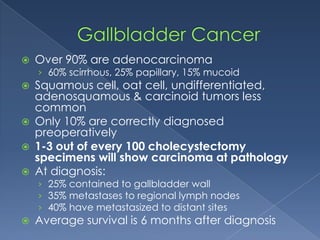
 Over 90% are adenocarcinoma
› 60% scirrhous, 25% papillary, 15% mucoid
 Squamous cell, oat cell, undifferentiated,
adenosquamous & carcinoid tumors less
common
 Only 10% are correctly diagnosed
preoperatively
 1-3 out of every 100 cholecystectomy
specimens will show carcinoma at pathology
 At diagnosis:
› 25% contained to gallbladder wall
› 35% metastases to regional lymph nodes
› 40% have metastasized to distant sites
 Average survival is 6 months after diagnosis
 Initial drainage to
cystic duct node
 Descents along CBD
nodes
 Nodes at posterior
head of pancreas
 Interaortocaval
nodes
 Can also spread by
direct invasion into
liver
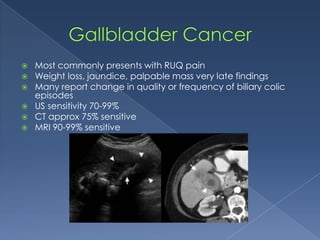
 Most commonly presents with RUQ pain
 Weight loss, jaundice, palpable mass very late findings
 Many report change in quality or frequency of biliary colic
episodes
 US sensitivity 70-99%
 CT approx 75% sensitive
 MRI 90-99% sensitive
 Tumor confined to mucosa or
submucosa (T1a) or to
muscularis (T1b) have overall
5-year survival of 100% & 85%
 Spillage of bile during
cholecystectomy can seed
abdomen
 Invasion beyond muscularis
(T2 & T3) need extended
cholecystectomy with lymph
node dissection
 Stage III has ~15% 5-year
survival
 Stage IV has median survival
of 1-3 months from diagnosis
 Majority of cases, therapy is
palliative
 Chemo & radiation hot been
shown to increase survival
Survival following radical resection
of T2 gallbladder cancer vs simple
cholecystectomy
 Uncommon tumor anywhere along intrahepatic or
extrahepatic biliary tree
 60-80% occur at bifurcation
 Most present with obstructive jaundice,
hepatomegaly, palpable gallbladder (Courvoisier’s
sign) or cirrhosis (advanced disease)
 2,500-3,000 new cases in US annualy
 Mean age in 50’s, men & women equal
 Increased risk with choledochal cysts, intrahepatic
stones, Liver flukes, dietary nitrosamines & exposure to
dioxin
 Following biliary-enteric anastomosis, 5% will develop
 Tend to spread by direct extension
 Intrahepatic tumors
(Klatskin tumors)treated
like hepatocellular
carcinoma
(hepatectomy)
 Perihilar treated with
resection with local
hepatic resection
 Distal treated like
periampullary tumors with
pancreatoduodenectomy
(Whipple)
 TNM staging
 Intrahepatic easily
visualized on CT scan
 Perihilar & distal tumors
difficult to visualize on
US and CT
 ERCP & MRCP have
near equal sensitivity
(85-95%)
 Most patients have
serum Bilirubin >10,
elevated Alk Phos &
CA 19-9
Preoperative placement of
stents in hepatic & hilar tumor
Resected Left lobe & hilum
with reconstruction
 Long-term survival
highly dependant on
stage & treatment
 For resectable
intrahepatic tumors,
overall 5-year 30-40%
 Resectable peri-hilar
tumors 10-20%
 Resectable distal
tumors 28-45%
 Median survival for all
unresectable tumors is
6-7 months
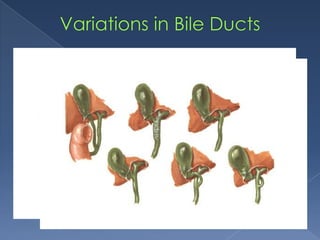
!!! Bile ducts

!!! Bile ducts

  • 3.
     Circa 200AD – Galen – the gallbladder as a subsidiary organ for the liver & responsible for yellow bile  Renaissance period – Gallbladder seat of many emotions (gall)  1652 - Thomas Bartholin – gallbladder part of bile tract from liver to intestine  1654 - Thomas Glisson – formed more detailed anatomy of liver & biliary tract
  • 4.
     1420 -Antonio Benevieni – 1st account of gallstones  1687 - Stal Pert Von Der Wiel – 1st operation on gallstones  1733 – Jean-Louis Petit -1st successful removal of gallstones with fistula formation  1859 – J.L.W. Thudichum – Two stage cholecystostomy  July 15, 1867 – Dr John Stough Bobbs – Single stage cholecystostomy
  • 5.
     1630 &1667 – Zambecarri & Teckoff – proved the gall bladder not essential to life  1878 - Theodor Kocher – refined cholecystostomy procedure  July 15, 1882 – Dr Langenbuch – 1st open cholecystectomy  1886 – cholecystotomy 27% mortality vs 12% mortality for Langenbuch’s cholecystectomy – became gold standard  1940’s – Mirizzi introduced cholangiography for CBD stones
  • 9.
     Gallbladder wallhas no muscularis mucosa or submucosa  Predominantly columnar epithelial cells  Rokitansky-Aschoff sinuses  Ducts of Luschka
  • 10.
    1.Storage and concentrationof hepatic bile 2.Secretion of water and electrolytes 3.Empting bile into the common bile duct controled by secretin, cholecystokinin (CCK) and gastrin.
  • 11.
     Normal capacityof 40-50 mL  Liver secretes >600 mL of bile daily  Greatest absorptive capacity  Concentrates bile 5-10 fold  NaCl transport by epithelium is driving force and water passively absorbed
  • 12.
    Characteristic (mEa/L) HepaticGallbladder Na 160 270 K 5 10 Cl 62-112 1-10 HCO3 45 10 Ca 4 25 Water 95-98% 85-90% Bilirubin 1.5 15 Protein (mg/dL) 250 700 Bile Acids 3-50 290-340 Phospholipids 8 40 Cholesterol (mg/dL) 60-70 350-930 Total Solids -- 125 pH 7.0 - 7.8 6.0 - 7.2
  • 13.
     Contraction ofampullary sphincter (Sphincter of Oddi)  After meal, sphincter of Oddi relaxes & CCK released — contraction of gallbladder  When stimulated, 50-70% of contents ejected over 30-40 minutes  Refills over next 60-90 minutes
  • 15.
     10-20% ofEuropeans and Americans carry gallbladder stones  Majority are asymptomatic  Symptoms and severe complications - 25%  1-2% of asymptomatic individuals develop symptoms per year  Each year, an estimated 700,000 cholecystectomies (US)  $6.5 billion (US)
  • 21.
     Abdominal plainfilm  Ultrasound › 95-98% sensitive, 98% specific  Radionuclide scan – hepatobiliary iminodiacetic acid (HIDA) › Acute cholecystitis: 94% sensitive, 65-85% specific › Chronic cholecystitis: 65% sensitive, 6-10% specific  CT scan › 50-70% sensitive › More expensive  MRCP › Cost prohibitive
  • 27.
     Recurrent cysticduct obstruction & inflammation  Presents with biliary colic  Association with meals present in only 50%  Symptoms › Pain duration 1-5 hours (rare >24 hrs or <1 hr) › Nausea & vomiting present 60-70% of time › Bloating & belching in 50% › Fever & jaundice rare  Exam may be normal unless during attack  Laboratory values usually normal  Differentials include: GERD, PUD, IBS, pancreatitis  Treatment is elective laparoscopic cholecystectomy
  • 29.
     Variant ofchronic cholecystitis  lipid-laden inflammatory process  Marked wall thickening with intramural nodules visible on CT and US  Cannot distinguish radiographically from gallbladder carcinoma
  • 30.
     Rare disorderwhere chronic cholecystitis causes mural calcification of gallbladder wall  Cholecystectomy is warranted as there is a 30- 65% risk of underlying gallbladder carcinoma
  • 31.
     Large gallstonethe obstructs small bowel (distal ileum at ileocecal valve)  Fistula between gallbladder and duodenum (can be colon or stomach)  Most commonly in elderly (>70) females  History of gallstone-related symptoms present in only 50%  Only account for <1% of SBO cases  <0.1% of those with gallstones will develop  Up to 25% of SBO in elderly patients who have not had previous abdominal surgery or have a hernia  Treat with Ex-lap and enterotomy with removal of stone. Take back for takedown of biliary-enteric fistula & cholecystectomy when more stable
  • 33.
     Most commonin East Asian population  Most associated with biliary strictures, primary sclerosing cholangitis, choledochal cysts & biliary tract tumors  Spontaneous in <10% of cases  Treatment depends on location & underlying condition(s)
  • 34.
     7-15% ofpatients undergoing cholecystectomy have CBD stones  Findings of jaundice, lightening of stool & dark urine  Fevers & elevated WBC indicate cholangitis  Serum Bilirubin has PPV of 28-50%  Biliary obstruction may be partial or transient, so labs may be normal in up to 30%
  • 35.
     May haveoverlying pancreatitis (up to 45% of all cases of pancreatitis)  Dilated CBD in 58% of patients  Ultrasound only 60-70% sensitive for CBD stones  MRCP 95% sensitive & 89% specific  ERCP Gold Standard › Can both diagnose and treat 90% of time › Pancreatitis occurs in up to 5% of Patients  If unable to remove stone with ERCP (or none available) need to do laparoscopic or open CBD exploration  Stone found in CBD within 2 years of cholecystectomy is termed retained, >2 years is recurrent
  • 37.
     Rare causeof biliary duct obstruction  Large stone contained within gallbladder compresses the CBD  Local spread of inflammation from gallbladder to CBD may also result in duct narrowing
  • 38.
     Type I -no fistula present:  Type IA - presence of the cystic duct.  Type IB - jbliteration of the cystic duct.  Types II-IV - fistula present: Type II - defect smaller than 33% of the CBD diameter. Type III - Defect 33-66% of the CBD diameter. Type IV - Defect larger than 66% of the CBD diameter
  • 40.
     Acute bacterialinfection of biliary tract  Most common cause of biliary obstruction as often associated with choledocholithiasis  Occurs in 4-7% of ERCP and PTC (Percutaneous transhepatic cholangiography)  Other causes of obstruction associated with cholangitis: › Strictures, neoplasms (rare), chronic pancreatitis, congenital cysts, duodenal diverticula  Presentation of fever, RUQ pain, jaundice › Charcot’s triad  May also have Hypotension & mental status change › Reynold’s pentad  Lab findings: Leukocytosis, elevated alk phos, AST, ALT, Bilirubin (direct)  Blood cultures positive 40-50%  CT scan or Ultrasound can help make diagnosis
  • 41.
     Immediate IVantibiotics and fluid resuscitation  Biliary decompression necessary › Endoscopic or percutaneous › May need open CBD exploration & T-tube placement (higher mortality)  Overall mortality 2% (5% with toxic cholangitis)
  • 42.
     Choleststic liverdisease characterized by fibrotic strictures in the intrahepatic and extrahepatic biliary tree in ABSENCE of any known cause.  Associated with HLA B8/DR3, IDDM, Graves’ Disease, Sjögren’s syndrome, & Myasthenia gravis  Clinical presentation highly variable › Jaundice, pruritus, fatigue, abnormal LFT’s  Mean age 30-50 years  Male : female 3:1  Diagnosis by ERCP  Median survival after diagnosis 10-12 years  Primary treatment is liver transplantation
  • 43.
     Sclerosing cholangitis caused bystones, cholangitis or operative trauma termed Secondary sclerosing cholangitis
  • 44.
     Rare congenital dilationof biliary tract  1 : 150,000 incidence in Western countries  Much more common in Japan  Female : male 8:1  Most often diagnosed in infancy  Treatment is resection
  • 45.
     80-90% causedby iatrogenic injuries  Laparoscopic cholecystectomy most common  Present days to weeks after surgery  May be years after surgery as scar tissue obstructs duct  Treatment is decompression, drainage, possible surgical resection.  Stenting being used with increasing frequency  With ligation of CBD & strictures, need Roux-en-Y hepaticojejunostomy
  • 46.
     5th mostcommon GI tract malignancy  2-3 times more common in females  75% over age 65  5,000 new cases in US annualy  Found incidentally in 1% to 3% of cholecystectomy specimens  Majority of the time, diagnosed in late stages with distant mets  Cholelithiasis present in 75-90% of cases › Only 0.4% of those with gallstones develop cancer
  • 47.
     Over 90%are adenocarcinoma › 60% scirrhous, 25% papillary, 15% mucoid  Squamous cell, oat cell, undifferentiated, adenosquamous & carcinoid tumors less common  Only 10% are correctly diagnosed preoperatively  1-3 out of every 100 cholecystectomy specimens will show carcinoma at pathology  At diagnosis: › 25% contained to gallbladder wall › 35% metastases to regional lymph nodes › 40% have metastasized to distant sites  Average survival is 6 months after diagnosis
  • 48.
     Initial drainageto cystic duct node  Descents along CBD nodes  Nodes at posterior head of pancreas  Interaortocaval nodes  Can also spread by direct invasion into liver
  • 49.
     Most commonlypresents with RUQ pain  Weight loss, jaundice, palpable mass very late findings  Many report change in quality or frequency of biliary colic episodes  US sensitivity 70-99%  CT approx 75% sensitive  MRI 90-99% sensitive
  • 50.
     Tumor confinedto mucosa or submucosa (T1a) or to muscularis (T1b) have overall 5-year survival of 100% & 85%  Spillage of bile during cholecystectomy can seed abdomen  Invasion beyond muscularis (T2 & T3) need extended cholecystectomy with lymph node dissection  Stage III has ~15% 5-year survival  Stage IV has median survival of 1-3 months from diagnosis  Majority of cases, therapy is palliative  Chemo & radiation hot been shown to increase survival Survival following radical resection of T2 gallbladder cancer vs simple cholecystectomy
  • 51.
     Uncommon tumoranywhere along intrahepatic or extrahepatic biliary tree  60-80% occur at bifurcation  Most present with obstructive jaundice, hepatomegaly, palpable gallbladder (Courvoisier’s sign) or cirrhosis (advanced disease)  2,500-3,000 new cases in US annualy  Mean age in 50’s, men & women equal  Increased risk with choledochal cysts, intrahepatic stones, Liver flukes, dietary nitrosamines & exposure to dioxin  Following biliary-enteric anastomosis, 5% will develop  Tend to spread by direct extension
  • 52.
     Intrahepatic tumors (Klatskintumors)treated like hepatocellular carcinoma (hepatectomy)  Perihilar treated with resection with local hepatic resection  Distal treated like periampullary tumors with pancreatoduodenectomy (Whipple)  TNM staging
  • 53.
     Intrahepatic easily visualizedon CT scan  Perihilar & distal tumors difficult to visualize on US and CT  ERCP & MRCP have near equal sensitivity (85-95%)  Most patients have serum Bilirubin >10, elevated Alk Phos & CA 19-9
  • 54.
    Preoperative placement of stentsin hepatic & hilar tumor Resected Left lobe & hilum with reconstruction
  • 55.
     Long-term survival highlydependant on stage & treatment  For resectable intrahepatic tumors, overall 5-year 30-40%  Resectable peri-hilar tumors 10-20%  Resectable distal tumors 28-45%  Median survival for all unresectable tumors is 6-7 months

Editor's Notes

  • #5 1420 AntonisBenevieni had the first published case of gallstones after an autopsy of a female patient died after complaining of abdominal pain where he found a grossly inflamed and gangrenous gallbladder filled with stones.In 1687 Stal Pert Von DerWiel while operating on a patient with purulent peritonitis accidentally found gallstones, but did not know what to do with them.In 1733 Jean Louis Petit suggested removal of gallstone and drainage of the gallbladder through a cutaneous fistula. His first successful surgery was in 1743, after several failed attempts. His rigid criteria of surgical intervention was modified over the years. It involved adhering the gallblader to the abdominal wall and introduction of an indwelling trochar to remove stones and bile. This continued until 1859 when JLW Thudichum proposed a two stage elective cholecystostomy.In the 1st stage, the inflamed gallblader was sewed to the anterior abdominal wall. The second stage infolved making a direct incision over that site and removing stones.In 1867, a gynecologist fron Indiana, Dr John StoughBobbs, while operating a patient with suspected ovarian cysts. Found a inflamed and adherant sac containing “bullet like structures”. He opened it and removed the stones, then closed it primairly and left it in the abdominal cavity. Thus the first recorded cholecystostomy. The patient recovered and actually outlived Dr Bobbs.
  • #6 Dr’s Zambecari &amp; Teckoff, independent of one another, determined through experiments on pigs and dogs, that the gallbladder was not essential to life.1878, Dr Kocher refined the cholecystostomy procedure.Dr Langenbuch, having observed the reports of Dr’s Kocher, Bobbs and Thudichum, observed that all these measures were only temporary andc rallied to find a definate solution to the disease.On july 15, 1882, at the age of only 27. Dr Langenbuch successfully removed the gallbladder of a 43 year old man who had been suffering from the disease for over 16 years.His initial report was ignored by the medical community. He continued with his work and tallied up a mortality report. By 1886, it showed that his procedure had only a 12% mortality vs a 27% mortality with the traditional cholecystotomy. Thus, his procedure became the gold standard.Fast forward to 1940 when Mirizzi introduced cholangiography.
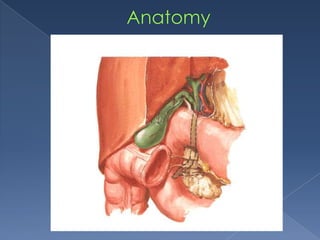
  • #8 “normal” anatomyThe gallbladder lies between segment 4 &amp; 5.The cystic artery is a branch off the right hepatic artery (90%), found in the triangle of Calot (cystic duct-lateral, CBD medial &amp; liver-superiorLymphatics are on the R side of the CBD.Parasympatheic fibers from the left (anterior) trunk of the vagus nerve.Sympathetic fibers from the T7-T10 nerves coursing through the splanchnic and celiac ganglions. Thus the shoulder pain.Multiple variations of the R hepatic artery—2nd most common is off the SMA in 17% population—ABSITEIntrahepatic bile ductBile canaliculiSegmental bile ductLobal bile ductHepatic left and right hepatic ducts