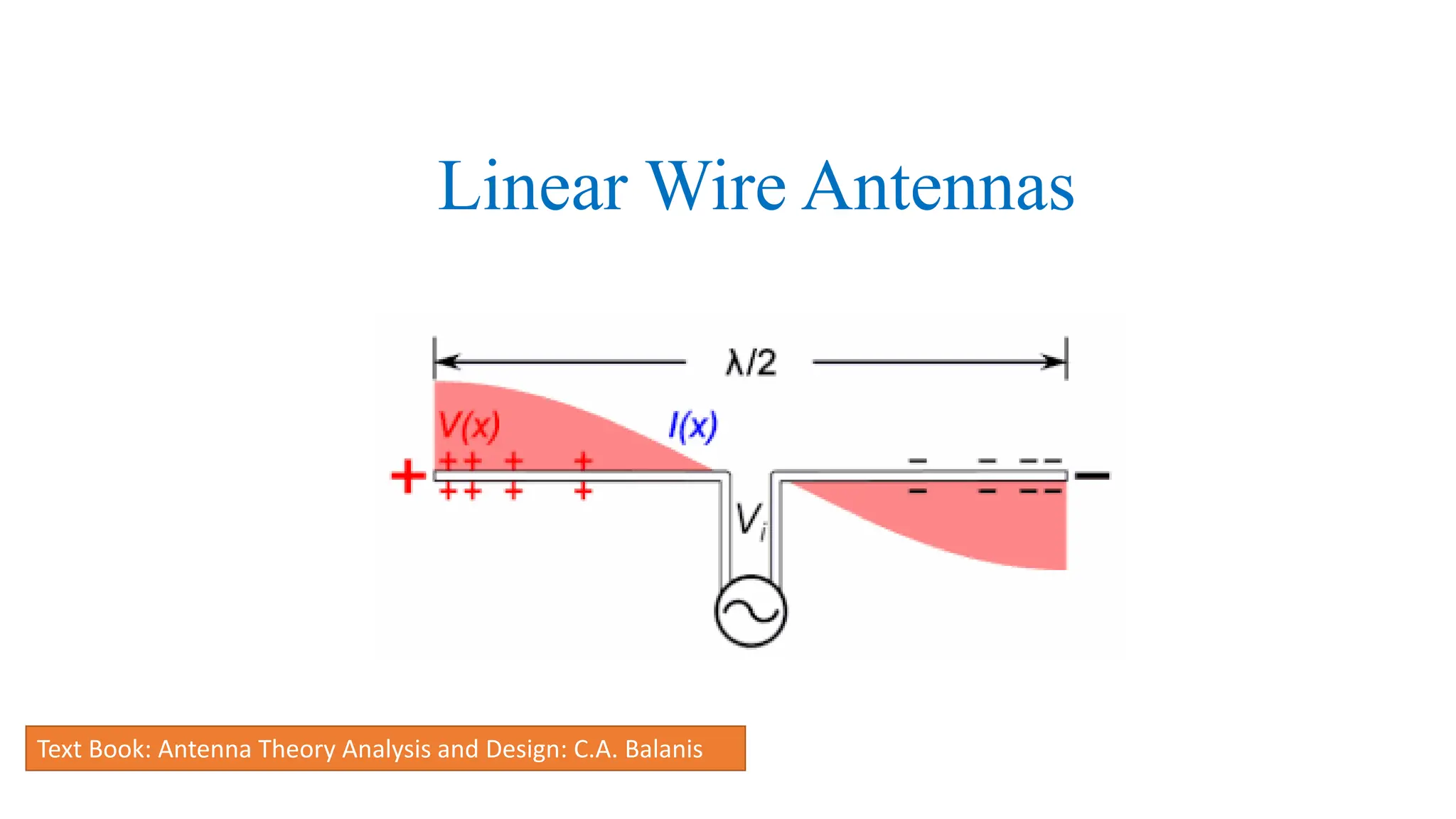
Linear Wire Antennas
Text Book: Antenna Theory Analysis and Design: C.A. Balanis
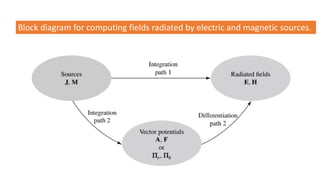
Block diagram for computing fields radiated by electric and magnetic sources.
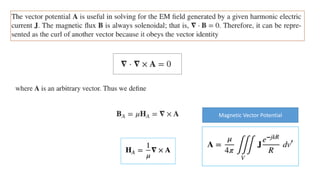
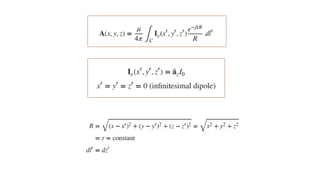
Magnetic Vector Potential
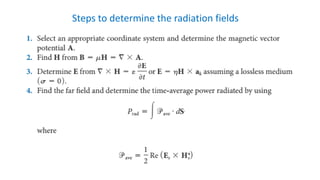
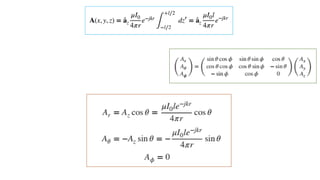
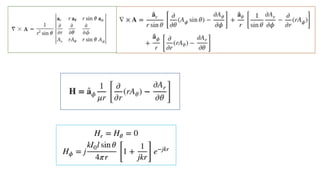
Steps to determine the radiation fields
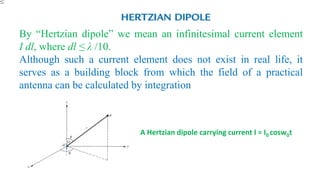
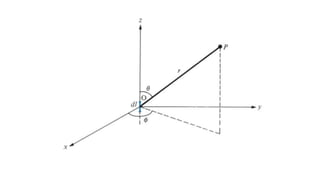
By “Hertzian dipole” we mean an infinitesimal current element
I dl, where dl ≤ λ /10.
Although such a current element does not exist in real life, it
serves as a building block from which the field of a practical
antenna can be calculated by integration
A Hertzian dipole carrying current I = I0 cosw0t
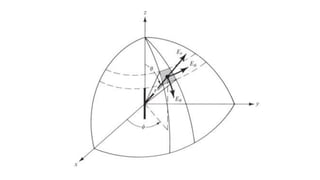
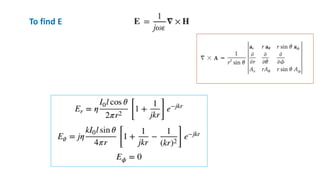
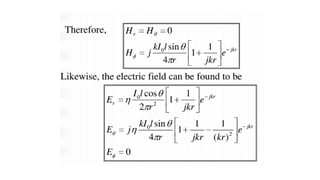
To find E
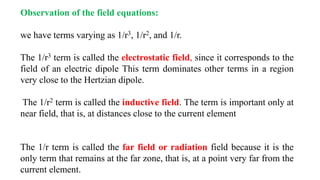
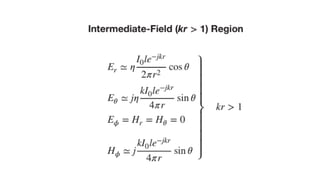
Observation of the field equations:
we have terms varying as 1/r3, 1/r2, and 1/r.
The 1/r3 term is called the electrostatic field, since it corresponds to the
field of an electric dipole This term dominates other terms in a region
very close to the Hertzian dipole.
The 1/r2 term is called the inductive field. The term is important only at
near field, that is, at distances close to the current element
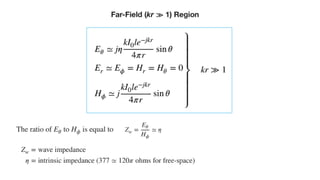
The 1/r term is called the far field or radiation field because it is the
only term that remains at the far zone, that is, at a point very far from the
current element.
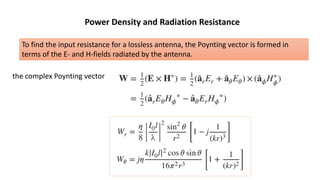
Power Density and Radiation Resistance
the complex Poynting vector
To find the input resistance for a lossless antenna, the Poynting vector is formed in
terms of the E- and H-fields radiated by the antenna.
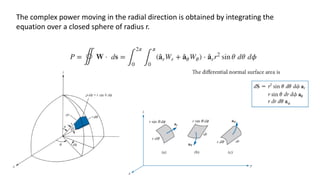
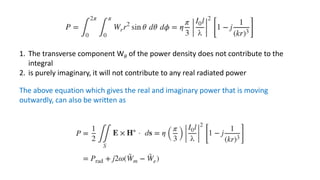
The complex power moving in the radial direction is obtained by integrating the
equation over a closed sphere of radius r.
1. The transverse component W𝜃 of the power density does not contribute to the
integral
2. is purely imaginary, it will not contribute to any real radiated power
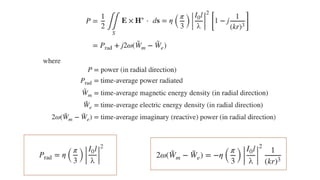
The above equation which gives the real and imaginary power that is moving
outwardly, can also be written as
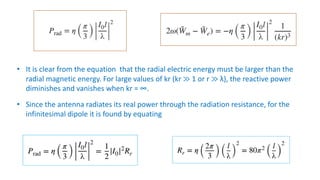
• It is clear from the equation that the radial electric energy must be larger than the
radial magnetic energy. For large values of kr (kr ≫ 1 or r ≫ λ), the reactive power
diminishes and vanishes when kr = ∞.
• Since the antenna radiates its real power through the radiation resistance, for the
infinitesimal dipole it is found by equating
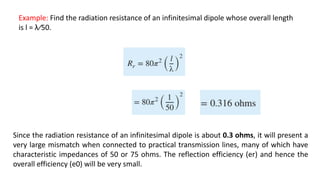
Example: Find the radiation resistance of an infinitesimal dipole whose overall length
is l = λ∕50.
Since the radiation resistance of an infinitesimal dipole is about 0.3 ohms, it will present a
very large mismatch when connected to practical transmission lines, many of which have
characteristic impedances of 50 or 75 ohms. The reflection efficiency (er) and hence the
overall efficiency (e0) will be very small.
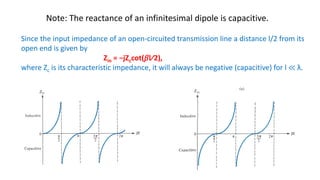
Note: The reactance of an infinitesimal dipole is capacitive.
Since the input impedance of an open-circuited transmission line a distance l/2 from its
open end is given by
Zin = −jZccot(𝛽l∕2),
where Zc is its characteristic impedance, it will always be negative (capacitive) for l ≪ λ.
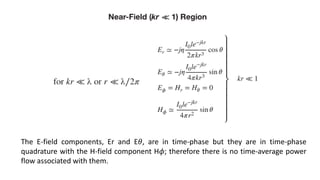
The E-field components, Er and E𝜃, are in time-phase but they are in time-phase
quadrature with the H-field component H𝜙; therefore there is no time-average power
flow associated with them.
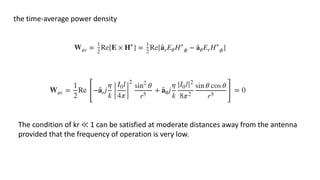
the time-average power density
The condition of kr ≪ 1 can be satisfied at moderate distances away from the antenna
provided that the frequency of operation is very low.
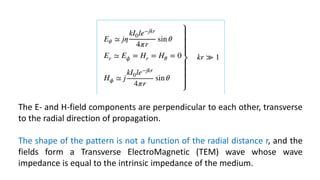
The E- and H-field components are perpendicular to each other, transverse
to the radial direction of propagation.
The shape of the pattern is not a function of the radial distance r, and the
fields form a Transverse ElectroMagnetic (TEM) wave whose wave
impedance is equal to the intrinsic impedance of the medium.
RADIATION PATTERN
An antenna radiation pattern or antenna pattern is defined as “a mathematical
function or a graphical representation of the radiation properties of the antenna as a
function of space coordinates.”
In most cases, the radiation pattern is determined in the far-field region and is
represented as a function of the directional coordinates. Radiation properties include
power flux density, radiation intensity, field strength, directivity, phase or
polarization.
A trace of the received electric (magnetic) field at a constant radius is called the
amplitude field pattern. On the other hand, a graph of the spatial variation of the
power density along a constant radius is called an amplitude power pattern
• Often the field and power patterns are normalized with respect to
their maximum value, yielding normalized field and power patterns
• field pattern (in linear scale) typically represents a plot of the
magnitude of the electric or magnetic field as a function of the
angular space.
• power pattern (in linear scale) typically represents a plot of the
square of the magnitude of the electric or magnetic field as a function
of the angular space.
• power pattern (in dB) represents the magnitude of the electric or
magnetic field, in decibels, as a function of the angular space.
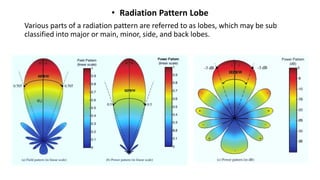
• Radiation Pattern Lobe
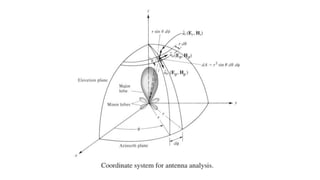
Various parts of a radiation pattern are referred to as lobes, which may be sub
classified into major or main, minor, side, and back lobes.
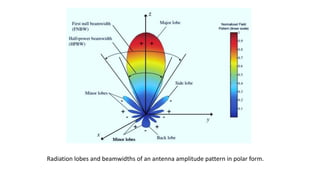
Radiation lobes and beamwidths of an antenna amplitude pattern in polar form.
A major lobe (also called main beam) is defined as “the radiation lobe
containing the direction of maximum radiation.” In Figure the major lobe is
pointing in the 𝜃 = 0 direction.
A minor lobe is any lobe except a major lobe. In Figures, all the lobes with
the exception of the major can be classified as minor lobes. A side lobe is “a
radiation lobe in any direction other than the intended lobe.” (Usually a side
lobe is adjacent to the main lobe and occupies the hemisphere in the
direction of the main beam.)
A back lobe is “a radiation lobe whose axis makes an angle of approximately
180◦ with respect to the beam of an antenna.” Usually it refers to a minor
lobe that occupies the hemisphere in a direction opposite to that of the
major (main) lobe
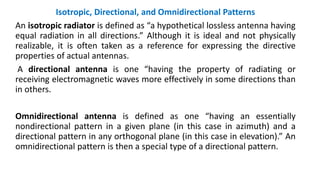
Isotropic, Directional, and Omnidirectional Patterns
An isotropic radiator is defined as “a hypothetical lossless antenna having
equal radiation in all directions.” Although it is ideal and not physically
realizable, it is often taken as a reference for expressing the directive
properties of actual antennas.
A directional antenna is one “having the property of radiating or
receiving electromagnetic waves more effectively in some directions than
in others.
Omnidirectional antenna is defined as one “having an essentially
nondirectional pattern in a given plane (in this case in azimuth) and a
directional pattern in any orthogonal plane (in this case in elevation).” An
omnidirectional pattern is then a special type of a directional pattern.
Principal Patterns
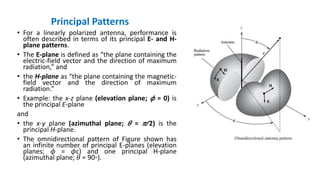
• For a linearly polarized antenna, performance is
often described in terms of its principal E- and H-
plane patterns.
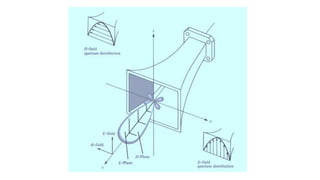
• The E-plane is defined as “the plane containing the
electric-field vector and the direction of maximum
radiation,” and
• the H-plane as “the plane containing the magnetic-
field vector and the direction of maximum
radiation.”
• Example: the x-z plane (elevation plane; 𝜙 = 0) is
the principal E-plane
and
• the x-y plane (azimuthal plane; 𝜃 = 𝜋∕2) is the
principal H-plane.
• The omnidirectional pattern of Figure shown has
an infinite number of principal E-planes (elevation
planes; 𝜙 = 𝜙c) and one principal H-plane
(azimuthal plane; 𝜃 = 90◦).
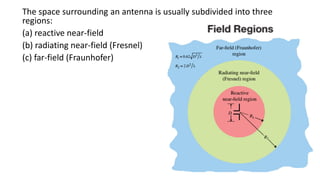
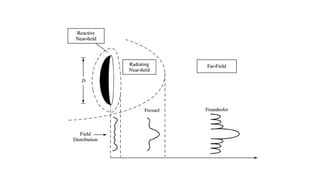
The space surrounding an antenna is usually subdivided into three
regions:
(a) reactive near-field
(b) radiating near-field (Fresnel)
(c) far-field (Fraunhofer)
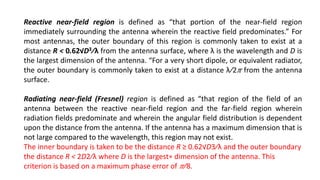
Reactive near-field region is defined as “that portion of the near-field region
immediately surrounding the antenna wherein the reactive field predominates.” For
most antennas, the outer boundary of this region is commonly taken to exist at a
distance R < 0.62√D3∕λ from the antenna surface, where λ is the wavelength and D is
the largest dimension of the antenna. “For a very short dipole, or equivalent radiator,
the outer boundary is commonly taken to exist at a distance λ∕2𝜋 from the antenna
surface.
Radiating near-field (Fresnel) region is defined as “that region of the field of an
antenna between the reactive near-field region and the far-field region wherein
radiation fields predominate and wherein the angular field distribution is dependent
upon the distance from the antenna. If the antenna has a maximum dimension that is
not large compared to the wavelength, this region may not exist.
The inner boundary is taken to be the distance R ≥ 0.62√D3∕λ and the outer boundary
the distance R < 2D2∕λ where D is the largest∗ dimension of the antenna. This
criterion is based on a maximum phase error of 𝜋∕8.
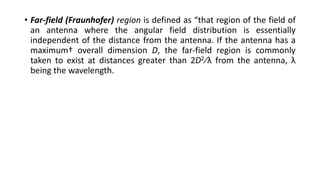
• Far-field (Fraunhofer) region is defined as “that region of the field of
an antenna where the angular field distribution is essentially
independent of the distance from the antenna. If the antenna has a
maximum† overall dimension D, the far-field region is commonly
taken to exist at distances greater than 2D2∕λ from the antenna, λ
being the wavelength.
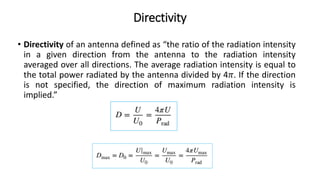
Directivity
• Directivity of an antenna defined as “the ratio of the radiation intensity
in a given direction from the antenna to the radiation intensity
averaged over all directions. The average radiation intensity is equal to
the total power radiated by the antenna divided by 4𝜋. If the direction
is not specified, the direction of maximum radiation intensity is
implied.”
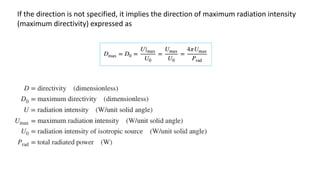
If the direction is not specified, it implies the direction of maximum radiation intensity
(maximum directivity) expressed as
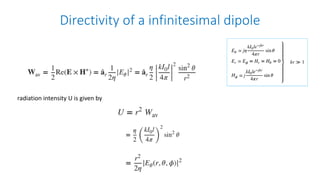
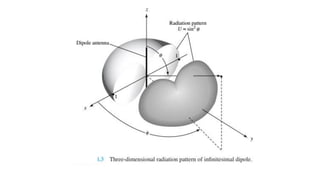
Directivity of a infinitesimal dipole
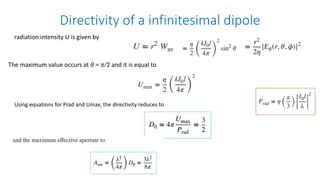
radiation intensity U is given by
Directivity of a infinitesimal dipole
radiation intensity U is given by
The maximum value occurs at 𝜃 = 𝜋∕2 and it is equal to
Using equations for Prad and Umax, the directivity reduces to
SMALL DIPOLE
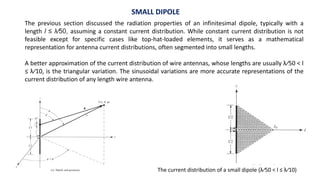
The previous section discussed the radiation properties of an infinitesimal dipole, typically with a
length l ≤ λ∕50, assuming a constant current distribution. While constant current distribution is not
feasible except for specific cases like top-hat-loaded elements, it serves as a mathematical
representation for antenna current distributions, often segmented into small lengths.
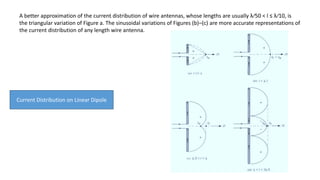
A better approximation of the current distribution of wire antennas, whose lengths are usually λ∕50 < l
≤ λ∕10, is the triangular variation. The sinusoidal variations are more accurate representations of the
current distribution of any length wire antenna.
The current distribution of a small dipole (λ∕50 < l ≤ λ∕10)
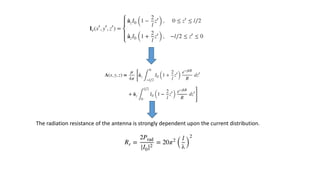
The radiation resistance of the antenna is strongly dependent upon the current distribution.
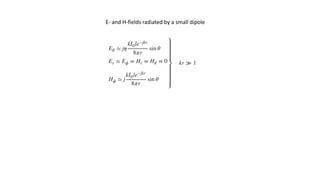
E- and H-fields radiated by a small dipole
A better approximation of the current distribution of wire antennas, whose lengths are usually λ∕50 < l ≤ λ∕10, is
the triangular variation of Figure a. The sinusoidal variations of Figures (b)–(c) are more accurate representations of
the current distribution of any length wire antenna.
Current Distribution on Linear Dipole
FINITE LENGTH DIPOLE
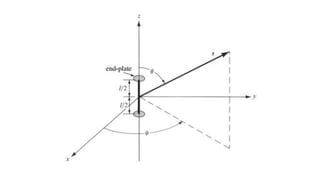
The techniques that were developed previously for infinitesimal dipole can also be used to analyze the
radiation characteristics of a linear dipole of any length. To reduce the mathematical complexities, it will be
assumed in this chapter that the dipole has a negligible diameter (ideally zero).
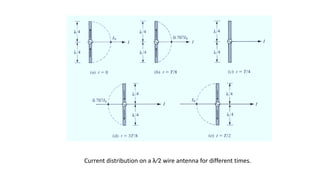
Current Distribution: For a very thin dipole (ideally zero diameter)
This distribution assumes that the antenna is center-fed and the current vanishes at the end points (z′ =
±l∕2). Experimentally it has been verified that the current in a center-fed wire antenna has sinusoidal form
with nulls at the end points.
Current distribution on a λ∕2 wire antenna for different times.
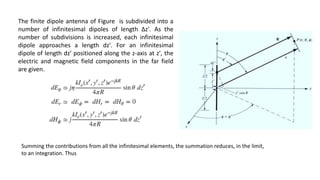
The finite dipole antenna of Figure is subdivided into a
number of infinitesimal dipoles of length Δz′. As the
number of subdivisions is increased, each infinitesimal
dipole approaches a length dz′. For an infinitesimal
dipole of length dz′ positioned along the z-axis at z′, the
electric and magnetic field components in the far field
are given.
Summing the contributions from all the infinitesimal elements, the summation reduces, in the limit,
to an integration. Thus
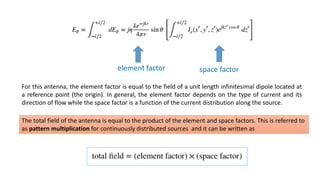
element factor space factor
For this antenna, the element factor is equal to the field of a unit length infinitesimal dipole located at
a reference point (the origin). In general, the element factor depends on the type of current and its
direction of flow while the space factor is a function of the current distribution along the source.
The total field of the antenna is equal to the product of the element and space factors. This is referred to
as pattern multiplication for continuously distributed sources and it can be written as
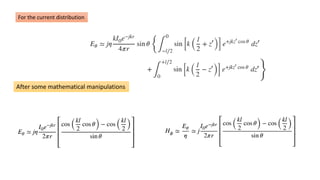
For the current distribution
After some mathematical manipulations
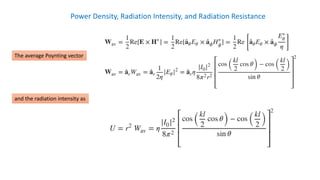
Power Density, Radiation Intensity, and Radiation Resistance
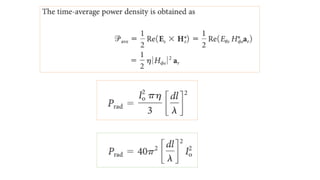
The average Poynting vector
and the radiation intensity as
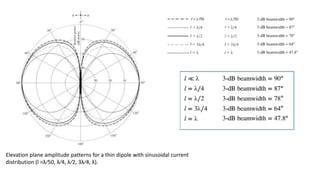
Elevation plane amplitude patterns for a thin dipole with sinusoidal current
distribution (l =λ∕50, λ∕4, λ∕2, 3λ∕4, λ).
As the length of the dipole increases beyond one wavelength (l > λ), the number of lobes begin to increase.
thin dipole of l = 1.25λ
Current distributions along the length of a linear wire antenna.
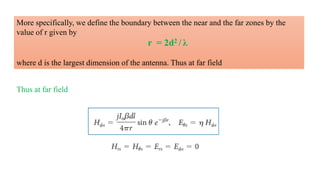
More specifically, we define the boundary between the near and the far zones by the
value of r given by
r = 2d2 / λ
where d is the largest dimension of the antenna. Thus at far field
Thus at far field
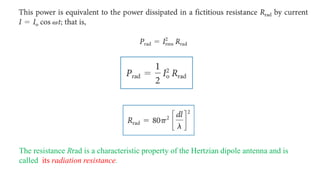
The resistance Rrad is a characteristic property of the Hertzian dipole antenna and is
called its radiation resistance.
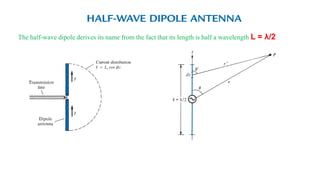
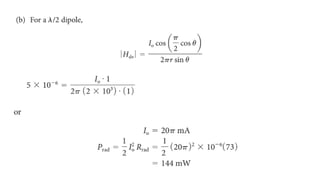
The half-wave dipole derives its name from the fact that its length is half a wavelength L = λ/2
The field due to the dipole can be easily obtained if we consider it as consisting of a
chain of Hertzian dipoles.
The magnetic vector potential at P due to a differential length dl (= dz) of the dipole
carrying a phasor current
Is = Io cos βz
We have assumed sinusoidal current distribution:
1. the sinusoidal current assumption is based on the transmission line model
of the dipole. Second, the current must vanish at the ends of the dipole.
2. A triangular current distribution is also possible but would give less accurate results.
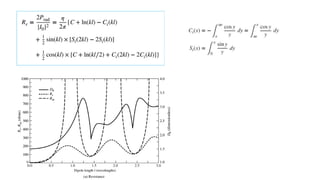
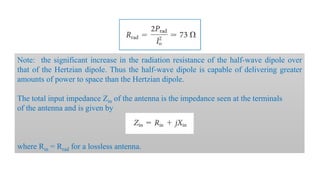
Note: the significant increase in the radiation resistance of the half-wave dipole over
that of the Hertzian dipole. Thus the half-wave dipole is capable of delivering greater
amounts of power to space than the Hertzian dipole.
The total input impedance Zin of the antenna is the impedance seen at the terminals
of the antenna and is given by
where Rin = Rrad for a lossless antenna.
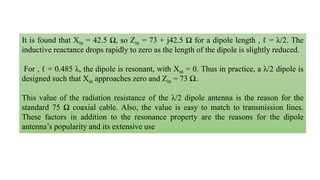
It is found that Xin = 42.5 Ω, so Zin = 73 + j42.5 Ω for a dipole length , ℓ = λ/2. The
inductive reactance drops rapidly to zero as the length of the dipole is slightly reduced.
For , ℓ = 0.485 λ, the dipole is resonant, with Xin = 0. Thus in practice, a λ/2 dipole is
designed such that Xin approaches zero and Zin = 73 Ω.
This value of the radiation resistance of the λ/2 dipole antenna is the reason for the
standard 75 Ω coaxial cable. Also, the value is easy to match to transmission lines.
These factors in addition to the resonance property are the reasons for the dipole
antenna’s popularity and its extensive use
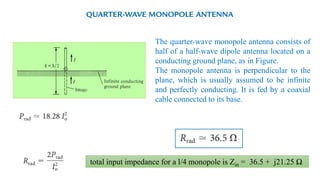
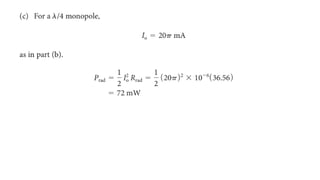
The quarter-wave monopole antenna consists of
half of a half-wave dipole antenna located on a
conducting ground plane, as in Figure.
The monopole antenna is perpendicular to the
plane, which is usually assumed to be infinite
and perfectly conducting. It is fed by a coaxial
cable connected to its base.
total input impedance for a l/4 monopole is Zin = 36.5 + j21.25 Ω
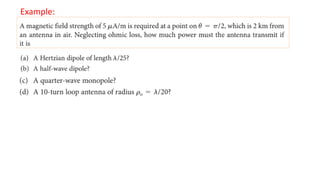
Example:
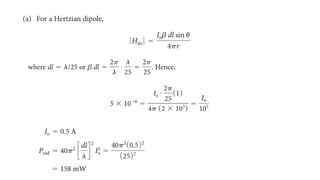
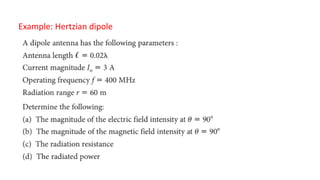
Example: Hertzian dipole
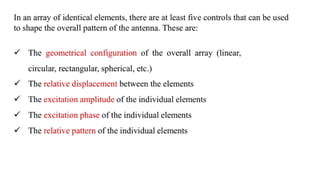
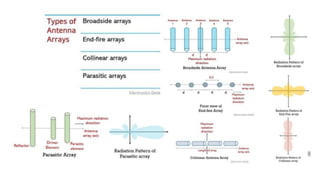
In many practical applications
(e.g., in an AM broadcast station),
it is necessary to design antennas
with more energy radiated in
some particular directions and
less in other directions.
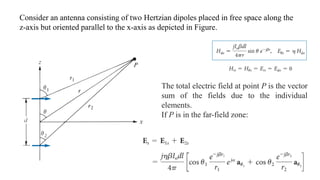
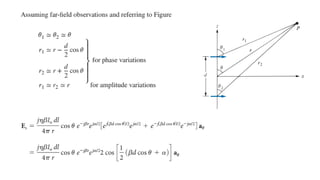
Consider an antenna consisting of two Hertzian dipoles placed in free space along the
z-axis but oriented parallel to the x-axis as depicted in Figure.
The total electric field at point P is the vector
sum of the fields due to the individual
elements.
If P is in the far-field zone:
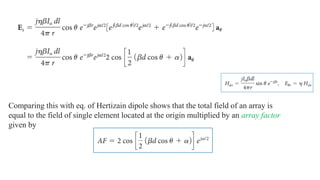
Comparing this with eq. of Hertizain dipole shows that the total field of an array is
equal to the field of single element located at the origin multiplied by an array factor
given by
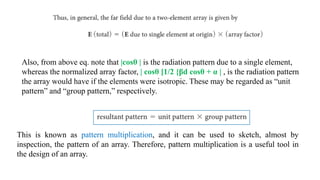
This is known as pattern multiplication, and it can be used to sketch, almost by
inspection, the pattern of an array. Therefore, pattern multiplication is a useful tool in
the design of an array.
Also, from above eq. note that |cosθ | is the radiation pattern due to a single element,
whereas the normalized array factor, | cosθ [1/2 {βd cosθ + α | , is the radiation pattern
the array would have if the elements were isotropic. These may be regarded as “unit
pattern” and “group pattern,” respectively.
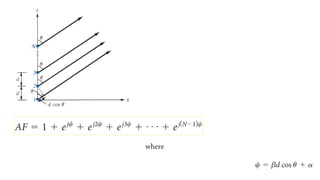
Let us now extend the results on the two-element array to the general case of N element
array:
assumption: array is linear and uniform (each element is fed with current of the same
magnitude but of progressive phase shift α
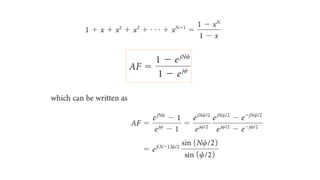
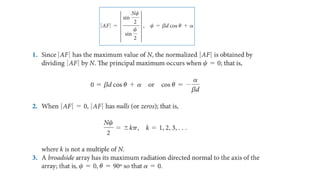
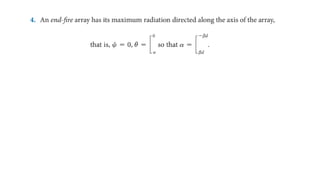
For the uniform linear array, the array factor is the sum of the contributions by all the
elements. Thus,
Antenna_Radiation equations_hertz_dipole_2024_shared.pdf

Antenna_Radiation equations_hertz_dipole_2024_shared.pdf

  • 1.
    Linear Wire Antennas TextBook: Antenna Theory Analysis and Design: C.A. Balanis
  • 2.
    Block diagram forcomputing fields radiated by electric and magnetic sources.
  • 3.
  • 4.
    Steps to determinethe radiation fields
  • 5.
    By “Hertzian dipole”we mean an infinitesimal current element I dl, where dl ≤ λ /10. Although such a current element does not exist in real life, it serves as a building block from which the field of a practical antenna can be calculated by integration A Hertzian dipole carrying current I = I0 cosw0t
  • 12.
  • 14.
    Observation of thefield equations: we have terms varying as 1/r3, 1/r2, and 1/r. The 1/r3 term is called the electrostatic field, since it corresponds to the field of an electric dipole This term dominates other terms in a region very close to the Hertzian dipole. The 1/r2 term is called the inductive field. The term is important only at near field, that is, at distances close to the current element The 1/r term is called the far field or radiation field because it is the only term that remains at the far zone, that is, at a point very far from the current element.
  • 15.
    Power Density andRadiation Resistance the complex Poynting vector To find the input resistance for a lossless antenna, the Poynting vector is formed in terms of the E- and H-fields radiated by the antenna.
  • 16.
    The complex powermoving in the radial direction is obtained by integrating the equation over a closed sphere of radius r.
  • 17.
    1. The transversecomponent W𝜃 of the power density does not contribute to the integral 2. is purely imaginary, it will not contribute to any real radiated power The above equation which gives the real and imaginary power that is moving outwardly, can also be written as
  • 19.
    • It isclear from the equation that the radial electric energy must be larger than the radial magnetic energy. For large values of kr (kr ≫ 1 or r ≫ λ), the reactive power diminishes and vanishes when kr = ∞. • Since the antenna radiates its real power through the radiation resistance, for the infinitesimal dipole it is found by equating
  • 20.
    Example: Find theradiation resistance of an infinitesimal dipole whose overall length is l = λ∕50. Since the radiation resistance of an infinitesimal dipole is about 0.3 ohms, it will present a very large mismatch when connected to practical transmission lines, many of which have characteristic impedances of 50 or 75 ohms. The reflection efficiency (er) and hence the overall efficiency (e0) will be very small.
  • 21.
    Note: The reactanceof an infinitesimal dipole is capacitive. Since the input impedance of an open-circuited transmission line a distance l/2 from its open end is given by Zin = −jZccot(𝛽l∕2), where Zc is its characteristic impedance, it will always be negative (capacitive) for l ≪ λ.
  • 22.
    The E-field components,Er and E𝜃, are in time-phase but they are in time-phase quadrature with the H-field component H𝜙; therefore there is no time-average power flow associated with them.
  • 23.
    the time-average powerdensity The condition of kr ≪ 1 can be satisfied at moderate distances away from the antenna provided that the frequency of operation is very low.
  • 26.
    The E- andH-field components are perpendicular to each other, transverse to the radial direction of propagation. The shape of the pattern is not a function of the radial distance r, and the fields form a Transverse ElectroMagnetic (TEM) wave whose wave impedance is equal to the intrinsic impedance of the medium.
  • 27.
    RADIATION PATTERN An antennaradiation pattern or antenna pattern is defined as “a mathematical function or a graphical representation of the radiation properties of the antenna as a function of space coordinates.” In most cases, the radiation pattern is determined in the far-field region and is represented as a function of the directional coordinates. Radiation properties include power flux density, radiation intensity, field strength, directivity, phase or polarization. A trace of the received electric (magnetic) field at a constant radius is called the amplitude field pattern. On the other hand, a graph of the spatial variation of the power density along a constant radius is called an amplitude power pattern
  • 29.
    • Often thefield and power patterns are normalized with respect to their maximum value, yielding normalized field and power patterns • field pattern (in linear scale) typically represents a plot of the magnitude of the electric or magnetic field as a function of the angular space. • power pattern (in linear scale) typically represents a plot of the square of the magnitude of the electric or magnetic field as a function of the angular space. • power pattern (in dB) represents the magnitude of the electric or magnetic field, in decibels, as a function of the angular space.
  • 30.
    • Radiation PatternLobe Various parts of a radiation pattern are referred to as lobes, which may be sub classified into major or main, minor, side, and back lobes.
  • 31.
    Radiation lobes andbeamwidths of an antenna amplitude pattern in polar form.
  • 32.
    A major lobe(also called main beam) is defined as “the radiation lobe containing the direction of maximum radiation.” In Figure the major lobe is pointing in the 𝜃 = 0 direction. A minor lobe is any lobe except a major lobe. In Figures, all the lobes with the exception of the major can be classified as minor lobes. A side lobe is “a radiation lobe in any direction other than the intended lobe.” (Usually a side lobe is adjacent to the main lobe and occupies the hemisphere in the direction of the main beam.) A back lobe is “a radiation lobe whose axis makes an angle of approximately 180◦ with respect to the beam of an antenna.” Usually it refers to a minor lobe that occupies the hemisphere in a direction opposite to that of the major (main) lobe
  • 33.
    Isotropic, Directional, andOmnidirectional Patterns An isotropic radiator is defined as “a hypothetical lossless antenna having equal radiation in all directions.” Although it is ideal and not physically realizable, it is often taken as a reference for expressing the directive properties of actual antennas. A directional antenna is one “having the property of radiating or receiving electromagnetic waves more effectively in some directions than in others. Omnidirectional antenna is defined as one “having an essentially nondirectional pattern in a given plane (in this case in azimuth) and a directional pattern in any orthogonal plane (in this case in elevation).” An omnidirectional pattern is then a special type of a directional pattern.
  • 35.
    Principal Patterns • Fora linearly polarized antenna, performance is often described in terms of its principal E- and H- plane patterns. • The E-plane is defined as “the plane containing the electric-field vector and the direction of maximum radiation,” and • the H-plane as “the plane containing the magnetic- field vector and the direction of maximum radiation.” • Example: the x-z plane (elevation plane; 𝜙 = 0) is the principal E-plane and • the x-y plane (azimuthal plane; 𝜃 = 𝜋∕2) is the principal H-plane. • The omnidirectional pattern of Figure shown has an infinite number of principal E-planes (elevation planes; 𝜙 = 𝜙c) and one principal H-plane (azimuthal plane; 𝜃 = 90◦).
  • 36.
    The space surroundingan antenna is usually subdivided into three regions: (a) reactive near-field (b) radiating near-field (Fresnel) (c) far-field (Fraunhofer)
  • 37.
    Reactive near-field regionis defined as “that portion of the near-field region immediately surrounding the antenna wherein the reactive field predominates.” For most antennas, the outer boundary of this region is commonly taken to exist at a distance R < 0.62√D3∕λ from the antenna surface, where λ is the wavelength and D is the largest dimension of the antenna. “For a very short dipole, or equivalent radiator, the outer boundary is commonly taken to exist at a distance λ∕2𝜋 from the antenna surface. Radiating near-field (Fresnel) region is defined as “that region of the field of an antenna between the reactive near-field region and the far-field region wherein radiation fields predominate and wherein the angular field distribution is dependent upon the distance from the antenna. If the antenna has a maximum dimension that is not large compared to the wavelength, this region may not exist. The inner boundary is taken to be the distance R ≥ 0.62√D3∕λ and the outer boundary the distance R < 2D2∕λ where D is the largest∗ dimension of the antenna. This criterion is based on a maximum phase error of 𝜋∕8.
  • 38.
    • Far-field (Fraunhofer)region is defined as “that region of the field of an antenna where the angular field distribution is essentially independent of the distance from the antenna. If the antenna has a maximum† overall dimension D, the far-field region is commonly taken to exist at distances greater than 2D2∕λ from the antenna, λ being the wavelength.
  • 40.
    Directivity • Directivity ofan antenna defined as “the ratio of the radiation intensity in a given direction from the antenna to the radiation intensity averaged over all directions. The average radiation intensity is equal to the total power radiated by the antenna divided by 4𝜋. If the direction is not specified, the direction of maximum radiation intensity is implied.”
  • 41.
    If the directionis not specified, it implies the direction of maximum radiation intensity (maximum directivity) expressed as
  • 42.
    Directivity of ainfinitesimal dipole radiation intensity U is given by
  • 43.
    Directivity of ainfinitesimal dipole radiation intensity U is given by The maximum value occurs at 𝜃 = 𝜋∕2 and it is equal to Using equations for Prad and Umax, the directivity reduces to
  • 46.
    SMALL DIPOLE The previoussection discussed the radiation properties of an infinitesimal dipole, typically with a length l ≤ λ∕50, assuming a constant current distribution. While constant current distribution is not feasible except for specific cases like top-hat-loaded elements, it serves as a mathematical representation for antenna current distributions, often segmented into small lengths. A better approximation of the current distribution of wire antennas, whose lengths are usually λ∕50 < l ≤ λ∕10, is the triangular variation. The sinusoidal variations are more accurate representations of the current distribution of any length wire antenna. The current distribution of a small dipole (λ∕50 < l ≤ λ∕10)
  • 47.
    The radiation resistanceof the antenna is strongly dependent upon the current distribution.
  • 48.
    E- and H-fieldsradiated by a small dipole
  • 49.
    A better approximationof the current distribution of wire antennas, whose lengths are usually λ∕50 < l ≤ λ∕10, is the triangular variation of Figure a. The sinusoidal variations of Figures (b)–(c) are more accurate representations of the current distribution of any length wire antenna. Current Distribution on Linear Dipole
  • 50.
    FINITE LENGTH DIPOLE Thetechniques that were developed previously for infinitesimal dipole can also be used to analyze the radiation characteristics of a linear dipole of any length. To reduce the mathematical complexities, it will be assumed in this chapter that the dipole has a negligible diameter (ideally zero). Current Distribution: For a very thin dipole (ideally zero diameter) This distribution assumes that the antenna is center-fed and the current vanishes at the end points (z′ = ±l∕2). Experimentally it has been verified that the current in a center-fed wire antenna has sinusoidal form with nulls at the end points.
  • 51.
    Current distribution ona λ∕2 wire antenna for different times.
  • 52.
    The finite dipoleantenna of Figure is subdivided into a number of infinitesimal dipoles of length Δz′. As the number of subdivisions is increased, each infinitesimal dipole approaches a length dz′. For an infinitesimal dipole of length dz′ positioned along the z-axis at z′, the electric and magnetic field components in the far field are given. Summing the contributions from all the infinitesimal elements, the summation reduces, in the limit, to an integration. Thus
  • 53.
    element factor spacefactor For this antenna, the element factor is equal to the field of a unit length infinitesimal dipole located at a reference point (the origin). In general, the element factor depends on the type of current and its direction of flow while the space factor is a function of the current distribution along the source. The total field of the antenna is equal to the product of the element and space factors. This is referred to as pattern multiplication for continuously distributed sources and it can be written as
  • 54.
    For the currentdistribution After some mathematical manipulations
  • 55.
    Power Density, RadiationIntensity, and Radiation Resistance The average Poynting vector and the radiation intensity as
  • 56.
    Elevation plane amplitudepatterns for a thin dipole with sinusoidal current distribution (l =λ∕50, λ∕4, λ∕2, 3λ∕4, λ).
  • 57.
    As the lengthof the dipole increases beyond one wavelength (l > λ), the number of lobes begin to increase. thin dipole of l = 1.25λ Current distributions along the length of a linear wire antenna.
  • 59.
    More specifically, wedefine the boundary between the near and the far zones by the value of r given by r = 2d2 / λ where d is the largest dimension of the antenna. Thus at far field Thus at far field
  • 61.
    The resistance Rradis a characteristic property of the Hertzian dipole antenna and is called its radiation resistance.
  • 62.
    The half-wave dipolederives its name from the fact that its length is half a wavelength L = λ/2
  • 63.
    The field dueto the dipole can be easily obtained if we consider it as consisting of a chain of Hertzian dipoles. The magnetic vector potential at P due to a differential length dl (= dz) of the dipole carrying a phasor current Is = Io cos βz We have assumed sinusoidal current distribution: 1. the sinusoidal current assumption is based on the transmission line model of the dipole. Second, the current must vanish at the ends of the dipole. 2. A triangular current distribution is also possible but would give less accurate results.
  • 64.
    Note: the significantincrease in the radiation resistance of the half-wave dipole over that of the Hertzian dipole. Thus the half-wave dipole is capable of delivering greater amounts of power to space than the Hertzian dipole. The total input impedance Zin of the antenna is the impedance seen at the terminals of the antenna and is given by where Rin = Rrad for a lossless antenna.
  • 65.
    It is foundthat Xin = 42.5 Ω, so Zin = 73 + j42.5 Ω for a dipole length , ℓ = λ/2. The inductive reactance drops rapidly to zero as the length of the dipole is slightly reduced. For , ℓ = 0.485 λ, the dipole is resonant, with Xin = 0. Thus in practice, a λ/2 dipole is designed such that Xin approaches zero and Zin = 73 Ω. This value of the radiation resistance of the λ/2 dipole antenna is the reason for the standard 75 Ω coaxial cable. Also, the value is easy to match to transmission lines. These factors in addition to the resonance property are the reasons for the dipole antenna’s popularity and its extensive use
  • 66.
    The quarter-wave monopoleantenna consists of half of a half-wave dipole antenna located on a conducting ground plane, as in Figure. The monopole antenna is perpendicular to the plane, which is usually assumed to be infinite and perfectly conducting. It is fed by a coaxial cable connected to its base. total input impedance for a l/4 monopole is Zin = 36.5 + j21.25 Ω
  • 67.
  • 71.
  • 72.
    In many practicalapplications (e.g., in an AM broadcast station), it is necessary to design antennas with more energy radiated in some particular directions and less in other directions.
  • 78.
    Consider an antennaconsisting of two Hertzian dipoles placed in free space along the z-axis but oriented parallel to the x-axis as depicted in Figure. The total electric field at point P is the vector sum of the fields due to the individual elements. If P is in the far-field zone:
  • 80.
    Comparing this witheq. of Hertizain dipole shows that the total field of an array is equal to the field of single element located at the origin multiplied by an array factor given by
  • 81.
    This is knownas pattern multiplication, and it can be used to sketch, almost by inspection, the pattern of an array. Therefore, pattern multiplication is a useful tool in the design of an array. Also, from above eq. note that |cosθ | is the radiation pattern due to a single element, whereas the normalized array factor, | cosθ [1/2 {βd cosθ + α | , is the radiation pattern the array would have if the elements were isotropic. These may be regarded as “unit pattern” and “group pattern,” respectively.
  • 82.
    Let us nowextend the results on the two-element array to the general case of N element array: assumption: array is linear and uniform (each element is fed with current of the same magnitude but of progressive phase shift α For the uniform linear array, the array factor is the sum of the contributions by all the elements. Thus,