DIGITAL SATELLITE COMMUNICATIONS
MSC –COURSE

Prepared by :
Nisreen Bashar AL-Madanat
Under supervision of :
Dr.Ibrahm AL-Qatawneh
OUTLINES


Objectives



Introduction



Principle of Satellite Communication



Basics of Satellites



Types of Satellite



Sources of Impairment



Frequency bands



Satellite Network Configurations



Capacity Allocation



Types of satellite categories



Application of satellite communication



Satellite Applications Overview



Summary



References
OBJECTIVES
After completing this lecture the student will be able to :
o
o
o
o
o
o
o
o
o
o
o

Discuss the concept of digital satellite communications and its
main principle.
Describe how does a satellite communication works.
Build the main block diagram of the earth station and
functioning transponder.
Discuss the advantages and disadvantage of satellite system.
Identify satellites main factors , parameters and impairments.
Identify the basic types of satellites .
Got awareness of the frequency bands and their applications .
Distinguish the satellite network configurations .
Discuss the capacity allocation .
Identify satellite categories and orbits.
Mention its applications and how satellites are used .
INTRODUCTION:










The use of satellite in communication systems has become very
common now - a- days. This is because the satellite can “see” a
very large area of the earth.
Hence satellites can form a star point of a communication net, to
link many users together, simultaneously. This will include users
widely separated geographically.
A communication satellite is a station in space that is used for
telecommunication, radio and television signals.
The construction and launch cost of a satellite are extremely high.
These costs are “distance insensitive”, that means the cost of a
short distance satellite link is approximately same as that of a
long distance link.
Therefore a satellite communication system is economical only
where the system is used continuously and a large number of
users use it.
PRINCIPLE OF SATELLITE COMMUNICATION








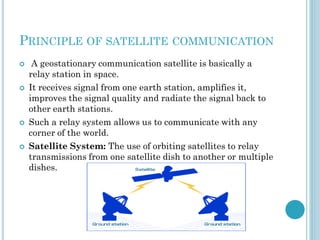
A geostationary communication satellite is basically a
relay station in space.
It receives signal from one earth station, amplifies it,
improves the signal quality and radiate the signal back to
other earth stations.
Such a relay system allows us to communicate with any
corner of the world.
Satellite System: The use of orbiting satellites to relay
transmissions from one satellite dish to another or multiple
dishes.
BASICS :HOW DOES A SATELLITE
COMMUNICATION WORK?








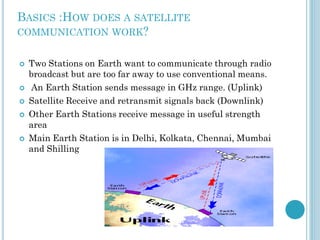
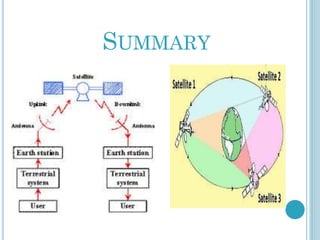
Two Stations on Earth want to communicate through radio
broadcast but are too far away to use conventional means.
An Earth Station sends message in GHz range. (Uplink)
Satellite Receive and retransmit signals back (Downlink)
Other Earth Stations receive message in useful strength
area
Main Earth Station is in Delhi, Kolkata, Chennai, Mumbai
and Shilling
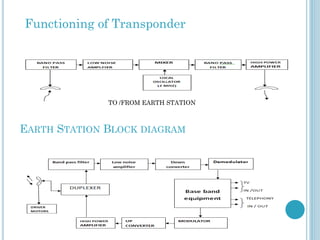
Functioning of Transponder

TO /FROM EARTH STATION

EARTH STATION BLOCK DIAGRAM
BASICS: ADVANTAGES OF SATELLITES


The advantages of satellite communication
over terrestrial communication are:

The coverage area of a satellite greatly exceeds
that of a terrestrial system.
 Transmission cost of a satellite is independent of
the distance from the center of the coverage area.
 Satellite to Satellite communication is very
precise.
 Higher Bandwidths are available for use.

BASICS: DISADVANTAGES OF SATELLITES


The disadvantages of satellite communication:

Launching satellites into orbit is costly.
 Satellite bandwidth is gradually becoming used up.
 There is a larger propagation delay in satellite
communication than in terrestrial communication.

BASICS: FACTORS IN SATELLITE
COMMUNICATION







Elevation Angle: The angle of the horizontal of the earth
surface to the center line of the satellite transmission
beam.
This effects the satellites coverage area. Ideally, you want a
elevation angle of 0 degrees, so the transmission beam
reaches the horizon visible to the satellite in all directions.
However, because of environmental factors like objects
blocking the transmission, atmospheric attenuation, and
the earth electrical background noise, there is a minimum
elevation angle of earth stations.
BASICS: FACTORS IN SATELLITE
COMMUNICATION (CONT.)


Coverage Angle: A measure of the portion of the earth
surface visible to a satellite taking the minimum elevation
angle into account.

R/(R+h) = sin(π/2 - β - θ)/sin(θ + π/2)
= cos(β + θ)/cos(θ)
R = 6370 km (earth’s radius)
h = satellite orbit height
β = coverage angle
θ = minimum elevation angle

BASICS: FACTORS IN SATELLITE
COMMUNICATION (CONT.)
Other impairments to satellite communication:






The distance between an earth station and a satellite (free
space loss).
Satellite Footprint: The satellite transmission’s strength is
strongest in the center of the transmission, and decreases
farther from the center as free space loss increases.
Atmospheric Attenuation caused by air and water can impair
the transmission. It is particularly bad during rain and fog.
BASICS: HOW SATELLITES ARE USED
Service Types


Fixed Service Satellites (FSS)

•Example: Point to Point Communication


Broadcast Service Satellites (BSS)

•Example: Satellite Television/Radio

•Also called Direct Broadcast Service (DBS).


Mobile Service Satellites (MSS)

•Example: Satellite Phones
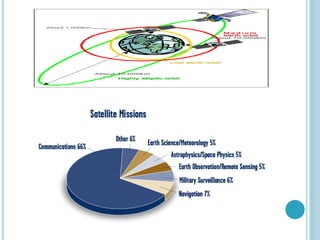
TYPES OF SATELLITES
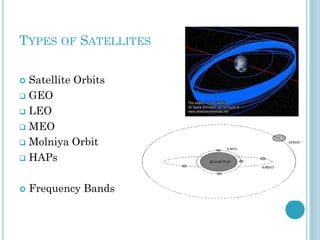
Satellite Orbits
 GEO
 LEO
 MEO
 Molniya Orbit
 HAPs




Frequency Bands
SATELLITE ORBITS











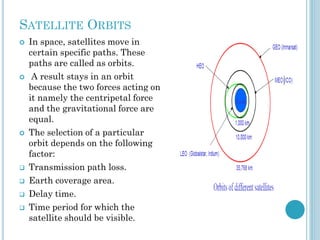
In space, satellites move in
certain specific paths. These
paths are called as orbits.
A result stays in an orbit
because the two forces acting on
it namely the centripetal force
and the gravitational force are
equal.
The selection of a particular
orbit depends on the following
factor:
Transmission path loss.
Earth coverage area.
Delay time.
Time period for which the
satellite should be visible.
GEOSTATIONARY EARTH ORBIT (GEO)





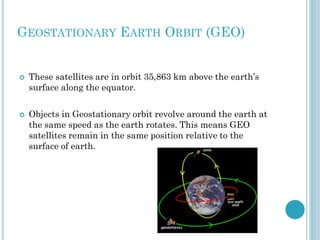
These satellites are in orbit 35,863 km above the earth’s
surface along the equator.
Objects in Geostationary orbit revolve around the earth at
the same speed as the earth rotates. This means GEO
satellites remain in the same position relative to the
surface of earth.
GEO (CONT.)













Advantages

A GEO satellite’s distance from earth gives it a large coverage area,
almost a fourth of the earth’s surface.
GEO satellites have a 24 hour view of a particular area.
These factors make it ideal for satellite broadcast and other multipoint
applications.
Disadvantages

A GEO satellite’s distance also cause it to have both a comparatively
weak signal and a time delay in the signal, which is bad for point to
point communication.
GEO satellites, centered above the equator, have difficulty broadcasting
signals to near polar regions
LOW EARTH ORBIT (LEO)







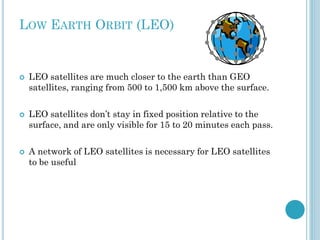
LEO satellites are much closer to the earth than GEO
satellites, ranging from 500 to 1,500 km above the surface.
LEO satellites don’t stay in fixed position relative to the
surface, and are only visible for 15 to 20 minutes each pass.
A network of LEO satellites is necessary for LEO satellites
to be useful
LEO (CONT.)






Advantages
A LEO satellite’s proximity to earth compared to a GEO satellite
gives it a better signal strength and less of a time delay, which
makes it better for point to point communication.
A LEO satellite’s smaller area of coverage is less of a waste of
bandwidth.



Disadvantages



A network of LEO satellites is needed, which can be costly





LEO satellites have to compensate for Doppler shifts cause by
their relative movement.
Atmospheric drag effects LEO satellites, causing gradual orbital
deterioration.
MEDIUM EARTH ORBIT (MEO)








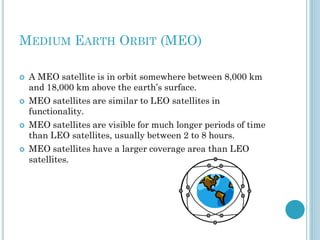
A MEO satellite is in orbit somewhere between 8,000 km
and 18,000 km above the earth’s surface.
MEO satellites are similar to LEO satellites in
functionality.
MEO satellites are visible for much longer periods of time
than LEO satellites, usually between 2 to 8 hours.
MEO satellites have a larger coverage area than LEO
satellites.
MEO (CONT.)






Advantage
A MEO satellite’s longer duration of visibility and wider
footprint means fewer satellites are needed in a MEO
network than a LEO network.
Disadvantage
A MEO satellite’s distance gives it a longer time delay and
weaker signal than a LEO satellite, though not as bad as a
GEO satellite.
OTHER ORBITS



Molniya Orbit Satellites



Used by Russia for decades.







Molniya Orbit is an elliptical orbit. The satellite remains in
a nearly fixed position relative to earth for eight hours.
A series of three Molniya satellites can act like a GEO
satellite.

Useful in near polar regions.
OTHER ORBITS (CONT.)


High Altitude Platform (HAP)



One of the newest ideas in satellite communication.







A blimp or plane around 20 km above the earth’s surface is
used as a satellite.
HAPs would have very small coverage area, but would have
a comparatively strong signal.

Cheaper to put in position, but would require a lot of them
in a network.
SOURCES OF IMPAIRMENT




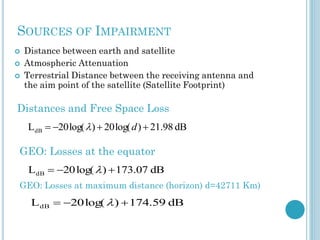
Distance between earth and satellite
Atmospheric Attenuation
Terrestrial Distance between the receiving antenna and
the aim point of the satellite (Satellite Footprint)

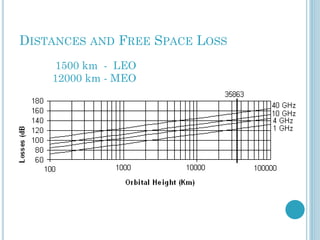
Distances and Free Space Loss
LdB  20 log(  )  20 log( d )  21.98 dB

GEO: Losses at the equator
LdB  20 log(  )  173.07 dB
GEO: Losses at maximum distance (horizon) d=42711 Km)

L dB  20 log(  )  174.59 dB
DISTANCES AND FREE SPACE LOSS
1500 km - LEO
12000 km - MEO
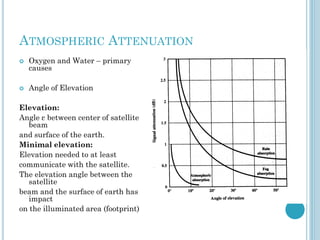
ATMOSPHERIC ATTENUATION


Oxygen and Water – primary
causes



Angle of Elevation

Elevation:
Angle ε between center of satellite
beam
and surface of the earth.
Minimal elevation:
Elevation needed to at least
communicate with the satellite.
The elevation angle between the
satellite
beam and the surface of earth has an
impact
on the illuminated area (footprint)
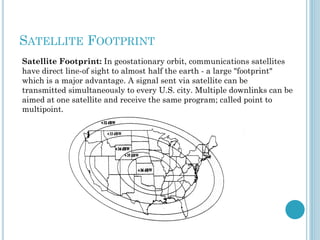
SATELLITE FOOTPRINT
Satellite Footprint: In geostationary orbit, communications satellites
have direct line-of sight to almost half the earth - a large "footprint"
which is a major advantage. A signal sent via satellite can be
transmitted simultaneously to every U.S. city. Multiple downlinks can be
aimed at one satellite and receive the same program; called point to
multipoint.
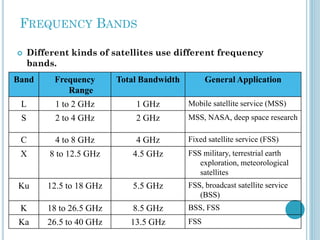
FREQUENCY BANDS


Different kinds of satellites use different frequency
bands.

Band

Frequency
Range

Total Bandwidth

General Application

L

1 to 2 GHz

1 GHz

Mobile satellite service (MSS)

S

2 to 4 GHz

2 GHz

MSS, NASA, deep space research

C

4 to 8 GHz

4 GHz

Fixed satellite service (FSS)

X
8 to 12.5 GHz

4.5 GHz

FSS military, terrestrial earth
exploration, meteorological
satellites

Ku

12.5 to 18 GHz

5.5 GHz

FSS, broadcast satellite service
(BSS)

K

18 to 26.5 GHz

8.5 GHz

BSS, FSS

Ka

26.5 to 40 GHz

13.5 GHz

FSS
SATELLITE NETWORK CONFIGURATIONS


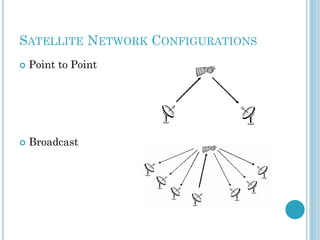
Point to Point



Broadcast
SATELLITE NETWORK CONFIGURATIONS


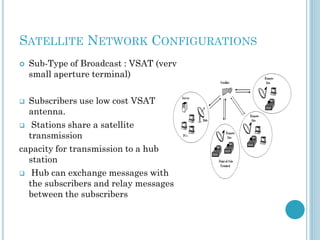
Sub-Type of Broadcast : VSAT (very
small aperture terminal)

Subscribers use low cost VSAT
antenna.
 Stations share a satellite
transmission
capacity for transmission to a hub
station
 Hub can exchange messages with
the subscribers and relay messages
between the subscribers

CAPACITY ALLOCATION



FDMA
FAMA-FDMA



DAMA-FDMA





TDMA
Advantages over FDMA



CDMA


FDMA




Satellite frequency is already broken into bands, and is
broken in to smaller channels in Frequency Division
Multiple Access (FDMA).
Overall bandwidth within a frequency band is increased
due to frequency reuse (a frequency is used by two carriers
with orthogonal polarization).

The number of sub-channels is limited by three
factors:



Thermal noise (too weak a signal will be effected by
background noise).
Intermodulation noise (too strong a signal will cause noise).



Crosstalk (cause by excessive frequency reusing).


FDMA (CONT.)






FDMA can be performed in two ways:
Fixed-assignment multiple access (FAMA): The subchannel assignments are of a fixed allotment. Ideal for
broadcast satellite communication.
Demand-assignment multiple access (DAMA): The subchannel allotment changes based on demand. Ideal for
point to point communication .
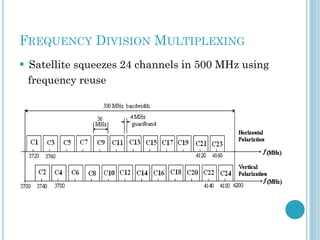
FREQUENCY DIVISION MULTIPLEXING
 Satellite squeezes 24 channels in 500 MHz using
frequency reuse
TDMA






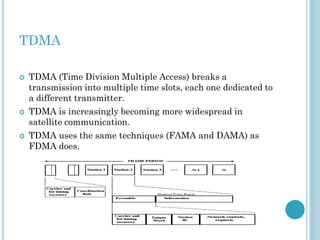
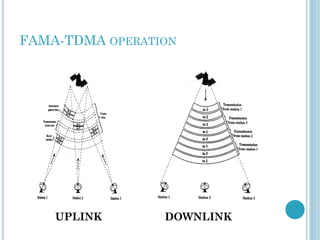
TDMA (Time Division Multiple Access) breaks a
transmission into multiple time slots, each one dedicated to
a different transmitter.
TDMA is increasingly becoming more widespread in
satellite communication.
TDMA uses the same techniques (FAMA and DAMA) as
FDMA does.
TDMA (CONT.)
Advantages of TDMA over FDMA.






Digital equipment used in time division multiplexing is
increasingly becoming cheaper.
There are advantages in digital transmission techniques.
Ex: error correction.
Lack of intermodulation noise means increased efficiency.
FAMA-TDMA OPERATION

UPLINK

DOWNLINK
TYPES OF SATELLITE CATEGORIES







Satellites are divided in four major categories as
follows:
Communication Satellite.
Weather satellite.
Remote-sensing satellite.
Scientific satellite.
COMMUNICATION SATELLITE








Geostationary satellites when used for the communication
application are called communication satellite.
They are used in applications such as point to point
communication radio broadcasting, TV transmission,
military application, Commercial application.
Communications satellites are classified based on the
coverage are as global, regional or domestic satellites.
A term “INTELSAT” is often used in satellite
communication. INTELSAT means International
Telecommunication Satellite.
These are communication satellites which are used for
communication of telephony, computer data, TV signals
etc… More than 140 nations are interconnected via the
INTELSAT system.
WEATHER SATELLITE




These satellites are used for weather prediction, for taking
the photographs of clouds. TIROS-1 was the first weather
satellite. Other weather satellites are Nimbus and
Meteosat.
India’s “INSAT” satellite is being used for three
application i.e. communications. TV transmission and
meteorology or weather prediction. Thus it is s
multipurpose satellite.
REMOTE-SENSING SATELLITES
This type of satellites can be used to find out the
condition of crops , forests or minerals
underground , condition of soil etc. Indian
satellite IRS is a remote sensing satellite.
 From the information obtained from the remote
sensing satellite detailed maps can be prepared.

SCIENTIFIC SATELLITE
These satellites are relatively simpler and of
short life span.
 They are used to carry out various scientific
studies. India’s “Aryabhatta” was a scientific
satellite.

APPLICATION OF SATELLITE COMMUNICATION








The main application of satellite communication is in the
field of communication. The communication of video signals
(TV), audio signals (telephones, satellites phones) and
computer data (internet).
To gain meteorological or weather information. The
photographs taken by the satellites are analyzed for
predicting weather.
To monitor the status of earth’s resources such as land,
forests and oceans. We can get very important information
about crops, lakes, rivers, forests, fire etc…
To spot our mineral resources, polluted areas, sources of
pollution etc….
SATELLITE APPLICATIONS OVERVIEW











Systems using geostationary satellites:
Inmarsat (International Maritime Satellite Organization)
used for voice, data, especially for ships worldwide except
Polar Regions.
MSAT (Mobile Satellite) used for voice data, mainly for
land mobile western hemisphere.
Systems using low-earth-orbit (LEO) satellite:
Iridium: major uses are voice, paging, low speed data.
Globalstar: major uses are voice paging, low speed date.
Teledesic: major uses high speed data, voice.
SATELLITE APPLICATIONS OVERVIEW
(CONT.)






Systems using little LEO satellite:

ORBCOMM: major uses are paging, short messaging, e-mail,
vehicle location.
LEO: one major uses are paging, short messaging, e-mail vehicle
location.



E-sat: major uses are remote meter reading.



Systems using Medium earth orbit (MEO):





Ellipso: major uses are voice communication using portable and
mobile terminals.
ICO (Intermediate Circular Orbit): major uses are satellite to
mobile links.
SUMMARY
REFERENCES
Satellite Communications Systems: Systems, Techniques
and Technology (5th edition ) by Michel Bousquet
 Satellite communication systems(3rd edition) by B.G.Evans
 Fundamentals of Satellite Communications, by Howard
Housman/President-MITEQ, Inc. Hauppauge, NY
11788/May 29, 2008
 Satellite Communications CSC 490:
Wireless Networking /Author: Michael Charles
 Telecommunications Glossary
from "A Technical Guide to Teleconferencing and Distance
Learning," 3rd edition

THANK YOU FOR YOUR TIME
AND ATTENTION

Digital satellite communications

  • 1.
    DIGITAL SATELLITE COMMUNICATIONS MSC–COURSE Prepared by : Nisreen Bashar AL-Madanat Under supervision of : Dr.Ibrahm AL-Qatawneh
  • 2.
    OUTLINES  Objectives  Introduction  Principle of SatelliteCommunication  Basics of Satellites  Types of Satellite  Sources of Impairment  Frequency bands  Satellite Network Configurations  Capacity Allocation  Types of satellite categories  Application of satellite communication  Satellite Applications Overview  Summary  References
  • 3.
    OBJECTIVES After completing thislecture the student will be able to : o o o o o o o o o o o Discuss the concept of digital satellite communications and its main principle. Describe how does a satellite communication works. Build the main block diagram of the earth station and functioning transponder. Discuss the advantages and disadvantage of satellite system. Identify satellites main factors , parameters and impairments. Identify the basic types of satellites . Got awareness of the frequency bands and their applications . Distinguish the satellite network configurations . Discuss the capacity allocation . Identify satellite categories and orbits. Mention its applications and how satellites are used .
  • 4.
    INTRODUCTION:      The use ofsatellite in communication systems has become very common now - a- days. This is because the satellite can “see” a very large area of the earth. Hence satellites can form a star point of a communication net, to link many users together, simultaneously. This will include users widely separated geographically. A communication satellite is a station in space that is used for telecommunication, radio and television signals. The construction and launch cost of a satellite are extremely high. These costs are “distance insensitive”, that means the cost of a short distance satellite link is approximately same as that of a long distance link. Therefore a satellite communication system is economical only where the system is used continuously and a large number of users use it.
  • 5.
    PRINCIPLE OF SATELLITECOMMUNICATION     A geostationary communication satellite is basically a relay station in space. It receives signal from one earth station, amplifies it, improves the signal quality and radiate the signal back to other earth stations. Such a relay system allows us to communicate with any corner of the world. Satellite System: The use of orbiting satellites to relay transmissions from one satellite dish to another or multiple dishes.
  • 6.
    BASICS :HOW DOESA SATELLITE COMMUNICATION WORK?      Two Stations on Earth want to communicate through radio broadcast but are too far away to use conventional means. An Earth Station sends message in GHz range. (Uplink) Satellite Receive and retransmit signals back (Downlink) Other Earth Stations receive message in useful strength area Main Earth Station is in Delhi, Kolkata, Chennai, Mumbai and Shilling
  • 7.
    Functioning of Transponder TO/FROM EARTH STATION EARTH STATION BLOCK DIAGRAM
  • 8.
    BASICS: ADVANTAGES OFSATELLITES  The advantages of satellite communication over terrestrial communication are: The coverage area of a satellite greatly exceeds that of a terrestrial system.  Transmission cost of a satellite is independent of the distance from the center of the coverage area.  Satellite to Satellite communication is very precise.  Higher Bandwidths are available for use. 
  • 9.
    BASICS: DISADVANTAGES OFSATELLITES  The disadvantages of satellite communication: Launching satellites into orbit is costly.  Satellite bandwidth is gradually becoming used up.  There is a larger propagation delay in satellite communication than in terrestrial communication. 
  • 10.
    BASICS: FACTORS INSATELLITE COMMUNICATION    Elevation Angle: The angle of the horizontal of the earth surface to the center line of the satellite transmission beam. This effects the satellites coverage area. Ideally, you want a elevation angle of 0 degrees, so the transmission beam reaches the horizon visible to the satellite in all directions. However, because of environmental factors like objects blocking the transmission, atmospheric attenuation, and the earth electrical background noise, there is a minimum elevation angle of earth stations.
  • 11.
    BASICS: FACTORS INSATELLITE COMMUNICATION (CONT.)  Coverage Angle: A measure of the portion of the earth surface visible to a satellite taking the minimum elevation angle into account. R/(R+h) = sin(π/2 - β - θ)/sin(θ + π/2) = cos(β + θ)/cos(θ) R = 6370 km (earth’s radius) h = satellite orbit height β = coverage angle θ = minimum elevation angle 
  • 12.
    BASICS: FACTORS INSATELLITE COMMUNICATION (CONT.) Other impairments to satellite communication:    The distance between an earth station and a satellite (free space loss). Satellite Footprint: The satellite transmission’s strength is strongest in the center of the transmission, and decreases farther from the center as free space loss increases. Atmospheric Attenuation caused by air and water can impair the transmission. It is particularly bad during rain and fog.
  • 13.
    BASICS: HOW SATELLITESARE USED Service Types  Fixed Service Satellites (FSS) •Example: Point to Point Communication  Broadcast Service Satellites (BSS) •Example: Satellite Television/Radio •Also called Direct Broadcast Service (DBS).  Mobile Service Satellites (MSS) •Example: Satellite Phones
  • 14.
    TYPES OF SATELLITES SatelliteOrbits  GEO  LEO  MEO  Molniya Orbit  HAPs   Frequency Bands
  • 15.
    SATELLITE ORBITS        In space,satellites move in certain specific paths. These paths are called as orbits. A result stays in an orbit because the two forces acting on it namely the centripetal force and the gravitational force are equal. The selection of a particular orbit depends on the following factor: Transmission path loss. Earth coverage area. Delay time. Time period for which the satellite should be visible.
  • 16.
    GEOSTATIONARY EARTH ORBIT(GEO)   These satellites are in orbit 35,863 km above the earth’s surface along the equator. Objects in Geostationary orbit revolve around the earth at the same speed as the earth rotates. This means GEO satellites remain in the same position relative to the surface of earth.
  • 17.
    GEO (CONT.)        Advantages A GEOsatellite’s distance from earth gives it a large coverage area, almost a fourth of the earth’s surface. GEO satellites have a 24 hour view of a particular area. These factors make it ideal for satellite broadcast and other multipoint applications. Disadvantages A GEO satellite’s distance also cause it to have both a comparatively weak signal and a time delay in the signal, which is bad for point to point communication. GEO satellites, centered above the equator, have difficulty broadcasting signals to near polar regions
  • 18.
    LOW EARTH ORBIT(LEO)    LEO satellites are much closer to the earth than GEO satellites, ranging from 500 to 1,500 km above the surface. LEO satellites don’t stay in fixed position relative to the surface, and are only visible for 15 to 20 minutes each pass. A network of LEO satellites is necessary for LEO satellites to be useful
  • 19.
    LEO (CONT.)    Advantages A LEOsatellite’s proximity to earth compared to a GEO satellite gives it a better signal strength and less of a time delay, which makes it better for point to point communication. A LEO satellite’s smaller area of coverage is less of a waste of bandwidth.  Disadvantages  A network of LEO satellites is needed, which can be costly   LEO satellites have to compensate for Doppler shifts cause by their relative movement. Atmospheric drag effects LEO satellites, causing gradual orbital deterioration.
  • 20.
    MEDIUM EARTH ORBIT(MEO)     A MEO satellite is in orbit somewhere between 8,000 km and 18,000 km above the earth’s surface. MEO satellites are similar to LEO satellites in functionality. MEO satellites are visible for much longer periods of time than LEO satellites, usually between 2 to 8 hours. MEO satellites have a larger coverage area than LEO satellites.
  • 21.
    MEO (CONT.)     Advantage A MEOsatellite’s longer duration of visibility and wider footprint means fewer satellites are needed in a MEO network than a LEO network. Disadvantage A MEO satellite’s distance gives it a longer time delay and weaker signal than a LEO satellite, though not as bad as a GEO satellite.
  • 22.
    OTHER ORBITS  Molniya OrbitSatellites  Used by Russia for decades.    Molniya Orbit is an elliptical orbit. The satellite remains in a nearly fixed position relative to earth for eight hours. A series of three Molniya satellites can act like a GEO satellite. Useful in near polar regions.
  • 23.
    OTHER ORBITS (CONT.)  HighAltitude Platform (HAP)  One of the newest ideas in satellite communication.    A blimp or plane around 20 km above the earth’s surface is used as a satellite. HAPs would have very small coverage area, but would have a comparatively strong signal. Cheaper to put in position, but would require a lot of them in a network.
  • 24.
    SOURCES OF IMPAIRMENT    Distancebetween earth and satellite Atmospheric Attenuation Terrestrial Distance between the receiving antenna and the aim point of the satellite (Satellite Footprint) Distances and Free Space Loss LdB  20 log(  )  20 log( d )  21.98 dB GEO: Losses at the equator LdB  20 log(  )  173.07 dB GEO: Losses at maximum distance (horizon) d=42711 Km) L dB  20 log(  )  174.59 dB
  • 25.
    DISTANCES AND FREESPACE LOSS 1500 km - LEO 12000 km - MEO
  • 26.
    ATMOSPHERIC ATTENUATION  Oxygen andWater – primary causes  Angle of Elevation Elevation: Angle ε between center of satellite beam and surface of the earth. Minimal elevation: Elevation needed to at least communicate with the satellite. The elevation angle between the satellite beam and the surface of earth has an impact on the illuminated area (footprint)
  • 27.
    SATELLITE FOOTPRINT Satellite Footprint:In geostationary orbit, communications satellites have direct line-of sight to almost half the earth - a large "footprint" which is a major advantage. A signal sent via satellite can be transmitted simultaneously to every U.S. city. Multiple downlinks can be aimed at one satellite and receive the same program; called point to multipoint.
  • 28.
    FREQUENCY BANDS  Different kindsof satellites use different frequency bands. Band Frequency Range Total Bandwidth General Application L 1 to 2 GHz 1 GHz Mobile satellite service (MSS) S 2 to 4 GHz 2 GHz MSS, NASA, deep space research C 4 to 8 GHz 4 GHz Fixed satellite service (FSS) X 8 to 12.5 GHz 4.5 GHz FSS military, terrestrial earth exploration, meteorological satellites Ku 12.5 to 18 GHz 5.5 GHz FSS, broadcast satellite service (BSS) K 18 to 26.5 GHz 8.5 GHz BSS, FSS Ka 26.5 to 40 GHz 13.5 GHz FSS
  • 29.
  • 30.
    SATELLITE NETWORK CONFIGURATIONS  Sub-Typeof Broadcast : VSAT (very small aperture terminal) Subscribers use low cost VSAT antenna.  Stations share a satellite transmission capacity for transmission to a hub station  Hub can exchange messages with the subscribers and relay messages between the subscribers 
  • 31.
  • 32.
    FDMA   Satellite frequency isalready broken into bands, and is broken in to smaller channels in Frequency Division Multiple Access (FDMA). Overall bandwidth within a frequency band is increased due to frequency reuse (a frequency is used by two carriers with orthogonal polarization). The number of sub-channels is limited by three factors:  Thermal noise (too weak a signal will be effected by background noise). Intermodulation noise (too strong a signal will cause noise).  Crosstalk (cause by excessive frequency reusing). 
  • 33.
    FDMA (CONT.)    FDMA canbe performed in two ways: Fixed-assignment multiple access (FAMA): The subchannel assignments are of a fixed allotment. Ideal for broadcast satellite communication. Demand-assignment multiple access (DAMA): The subchannel allotment changes based on demand. Ideal for point to point communication .
  • 34.
    FREQUENCY DIVISION MULTIPLEXING Satellite squeezes 24 channels in 500 MHz using frequency reuse
  • 35.
    TDMA    TDMA (Time DivisionMultiple Access) breaks a transmission into multiple time slots, each one dedicated to a different transmitter. TDMA is increasingly becoming more widespread in satellite communication. TDMA uses the same techniques (FAMA and DAMA) as FDMA does.
  • 36.
    TDMA (CONT.) Advantages ofTDMA over FDMA.    Digital equipment used in time division multiplexing is increasingly becoming cheaper. There are advantages in digital transmission techniques. Ex: error correction. Lack of intermodulation noise means increased efficiency.
  • 37.
  • 38.
    TYPES OF SATELLITECATEGORIES      Satellites are divided in four major categories as follows: Communication Satellite. Weather satellite. Remote-sensing satellite. Scientific satellite.
  • 39.
    COMMUNICATION SATELLITE     Geostationary satelliteswhen used for the communication application are called communication satellite. They are used in applications such as point to point communication radio broadcasting, TV transmission, military application, Commercial application. Communications satellites are classified based on the coverage are as global, regional or domestic satellites. A term “INTELSAT” is often used in satellite communication. INTELSAT means International Telecommunication Satellite. These are communication satellites which are used for communication of telephony, computer data, TV signals etc… More than 140 nations are interconnected via the INTELSAT system.
  • 40.
    WEATHER SATELLITE   These satellitesare used for weather prediction, for taking the photographs of clouds. TIROS-1 was the first weather satellite. Other weather satellites are Nimbus and Meteosat. India’s “INSAT” satellite is being used for three application i.e. communications. TV transmission and meteorology or weather prediction. Thus it is s multipurpose satellite.
  • 41.
    REMOTE-SENSING SATELLITES This typeof satellites can be used to find out the condition of crops , forests or minerals underground , condition of soil etc. Indian satellite IRS is a remote sensing satellite.  From the information obtained from the remote sensing satellite detailed maps can be prepared. 
  • 42.
    SCIENTIFIC SATELLITE These satellitesare relatively simpler and of short life span.  They are used to carry out various scientific studies. India’s “Aryabhatta” was a scientific satellite. 
  • 43.
    APPLICATION OF SATELLITECOMMUNICATION     The main application of satellite communication is in the field of communication. The communication of video signals (TV), audio signals (telephones, satellites phones) and computer data (internet). To gain meteorological or weather information. The photographs taken by the satellites are analyzed for predicting weather. To monitor the status of earth’s resources such as land, forests and oceans. We can get very important information about crops, lakes, rivers, forests, fire etc… To spot our mineral resources, polluted areas, sources of pollution etc….
  • 44.
    SATELLITE APPLICATIONS OVERVIEW        Systemsusing geostationary satellites: Inmarsat (International Maritime Satellite Organization) used for voice, data, especially for ships worldwide except Polar Regions. MSAT (Mobile Satellite) used for voice data, mainly for land mobile western hemisphere. Systems using low-earth-orbit (LEO) satellite: Iridium: major uses are voice, paging, low speed data. Globalstar: major uses are voice paging, low speed date. Teledesic: major uses high speed data, voice.
  • 45.
    SATELLITE APPLICATIONS OVERVIEW (CONT.)    Systemsusing little LEO satellite: ORBCOMM: major uses are paging, short messaging, e-mail, vehicle location. LEO: one major uses are paging, short messaging, e-mail vehicle location.  E-sat: major uses are remote meter reading.  Systems using Medium earth orbit (MEO):   Ellipso: major uses are voice communication using portable and mobile terminals. ICO (Intermediate Circular Orbit): major uses are satellite to mobile links.
  • 46.
  • 48.
    REFERENCES Satellite Communications Systems:Systems, Techniques and Technology (5th edition ) by Michel Bousquet  Satellite communication systems(3rd edition) by B.G.Evans  Fundamentals of Satellite Communications, by Howard Housman/President-MITEQ, Inc. Hauppauge, NY 11788/May 29, 2008  Satellite Communications CSC 490: Wireless Networking /Author: Michael Charles  Telecommunications Glossary from "A Technical Guide to Teleconferencing and Distance Learning," 3rd edition 
  • 49.
    THANK YOU FORYOUR TIME AND ATTENTION