D
E
P
T
O
F
E
C
E
DESING OF MICROSTRIP PATCH ANTENNA TO
CONNECT INDOOR WIRELESS DEVICES
 SUBMITTED BY
 P.Prakasham (111012013665),
M.Naveen (111012013663),
 G.Venkatesh (111012013678).
GUIDED BY
Ms.N.Thamil shelvi,
Assistant Professor(SS),
Department of ECE.
D
E
P
T
O
F
E
C
E
OUTLINE
2
 Abstract
 Literature review
 Flow diagram
 Software
 Advantages
 Applications
 Reference
D
E
P
T
O
F
E
C
E
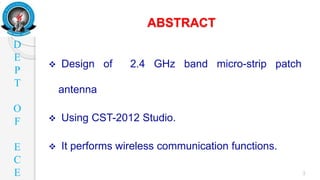
ABSTRACT
3
 Design of 2.4 GHz band micro-strip patch
antenna
 Using CST-2012 Studio.
 It performs wireless communication functions.
D
E
P
T
O
F
E
C
E
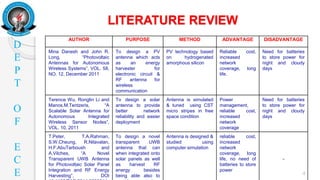
LITERATURE REVIEW
4
AUTHOR PURPOSE METHOD ADVANTAGE DISADVANTAGE
Mina Danesh and John R.
Long, “Photovoltaic
Antennas for Autonomous
Wireless Systems”, VOL. 58,
NO. 12, December 2011
To design a PV
antenna which acts
as an energy
harvester for
electronic circuit &
RF antenna for
wireless
communication
PV technology based
on hydrogenated
amorphous silicon
Reliable cost,
increased
network
coverage, long
life.
Need for batteries
to store power for
night and cloudy
days
Terence Wu, Ronglin Li and
Manos.M.Tentzeris, “A
Scalable Solar Antenna for
Autonomous Integrated
Wireless Sensor Nodes”,
VOL. 10, 2011
To design a solar
antenna to provide
better network
reliability and easier
deployment
Antenna is simulated
& tuned using CST
micro stripes in free
space condition
Power
management,
reliable cost,
increased
network
coverage
Need for batteries
to store power for
night and cloudy
days
T.Peter, T.A.Rahman,
S.W.Cheung, R.Nilavalan,
H.F.AbuTarboush and
A.Vilches, “A Novel
Transparent UWB Antenna
for Photovoltaic Solar Panel
Integration and RF Energy
Harvesting”, DOI
To design a novel
transparent UWB
antenna that can
when integrated onto
solar panels as well
as harvest RF
energy besides
being able also to
Antenna is designed &
studied using
computer simulation
reliable cost,
increased
network
coverage, long
life, no need of
batteries to store
power
-
D
E
P
T
O
F
E
C
E
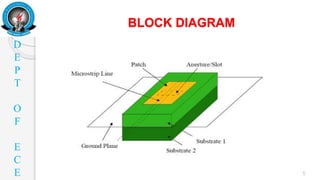
BLOCK DIAGRAM
5
D
E
P
T
O
F
E
C
E
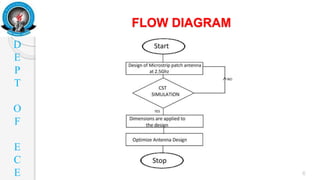
FLOW DIAGRAM
6
D
E
P
T
O
F
E
C
E
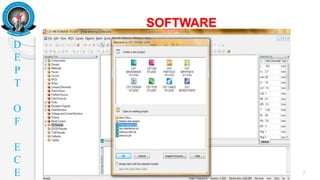
SOFTWARE
7
D
E
P
T
O
F
E
C
E
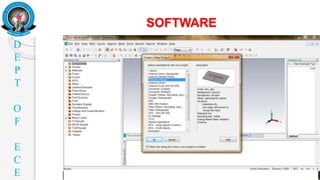
SOFTWARE
8
D
E
P
T
O
F
E
C
E
ADVANTAGES
9
 Power Management
 Increased Network coverage
 Reliable cost
 Long Life
D
E
P
T
O
F
E
C
E
APPLICATIONS
10
 WiFi(Wireless Fidelity)
 4G wireless broadband
Flexibility – multi-platforms, multi-
applications, multi-bands
D
E
P
T
O
F
E
C
E
REFERENCES
11
 D. Niyato, E. Hossain, and A. Fallahi, “Sleep and wakeup strategies in solar-
powered wireless sensor/mesh networks: Performance analysis and
optimization,” IEEE Trans. Mobile Comput., vol. 6, no. 2, pp. 221–236, Feb.
2007.
 X. Jiang, J. Polastre, and D. Culler, “Perpetual environmentally powered
sensor networks,” in Proc. IEEE Inf. Process. Sensor Netw. Symp. Apr. 2005,
pp. 463–468.
 “Chewed antennas: Huntington Botanical Gardens,” Sensor- Ware
Systems, Pasadena, CA, 2003 [Online]. Available: http://
www.sensorwaresystems.com/historical/resources/pictures/hunt-011.
shtml.
 N. Henze, A. Giere, H. Fruchting, and P. Hofmann, “GPS patch antenna with
photovoltaic solar cells for vehicular applications,” in Proc. IEEE VTC, Oct.
2003, vol. 1, pp. 50–54.
D
E
P
T
O
F
E
C
E 12

Microstrip patch antenna

  • 1.
    D E P T O F E C E DESING OF MICROSTRIPPATCH ANTENNA TO CONNECT INDOOR WIRELESS DEVICES  SUBMITTED BY  P.Prakasham (111012013665), M.Naveen (111012013663),  G.Venkatesh (111012013678). GUIDED BY Ms.N.Thamil shelvi, Assistant Professor(SS), Department of ECE.
  • 2.
    D E P T O F E C E OUTLINE 2  Abstract  Literaturereview  Flow diagram  Software  Advantages  Applications  Reference
  • 3.
    D E P T O F E C E ABSTRACT 3  Design of2.4 GHz band micro-strip patch antenna  Using CST-2012 Studio.  It performs wireless communication functions.
  • 4.
    D E P T O F E C E LITERATURE REVIEW 4 AUTHOR PURPOSEMETHOD ADVANTAGE DISADVANTAGE Mina Danesh and John R. Long, “Photovoltaic Antennas for Autonomous Wireless Systems”, VOL. 58, NO. 12, December 2011 To design a PV antenna which acts as an energy harvester for electronic circuit & RF antenna for wireless communication PV technology based on hydrogenated amorphous silicon Reliable cost, increased network coverage, long life. Need for batteries to store power for night and cloudy days Terence Wu, Ronglin Li and Manos.M.Tentzeris, “A Scalable Solar Antenna for Autonomous Integrated Wireless Sensor Nodes”, VOL. 10, 2011 To design a solar antenna to provide better network reliability and easier deployment Antenna is simulated & tuned using CST micro stripes in free space condition Power management, reliable cost, increased network coverage Need for batteries to store power for night and cloudy days T.Peter, T.A.Rahman, S.W.Cheung, R.Nilavalan, H.F.AbuTarboush and A.Vilches, “A Novel Transparent UWB Antenna for Photovoltaic Solar Panel Integration and RF Energy Harvesting”, DOI To design a novel transparent UWB antenna that can when integrated onto solar panels as well as harvest RF energy besides being able also to Antenna is designed & studied using computer simulation reliable cost, increased network coverage, long life, no need of batteries to store power -
  • 5.
  • 6.
  • 7.
  • 8.
  • 9.
    D E P T O F E C E ADVANTAGES 9  Power Management Increased Network coverage  Reliable cost  Long Life
  • 10.
    D E P T O F E C E APPLICATIONS 10  WiFi(Wireless Fidelity) 4G wireless broadband Flexibility – multi-platforms, multi- applications, multi-bands
  • 11.
    D E P T O F E C E REFERENCES 11  D. Niyato,E. Hossain, and A. Fallahi, “Sleep and wakeup strategies in solar- powered wireless sensor/mesh networks: Performance analysis and optimization,” IEEE Trans. Mobile Comput., vol. 6, no. 2, pp. 221–236, Feb. 2007.  X. Jiang, J. Polastre, and D. Culler, “Perpetual environmentally powered sensor networks,” in Proc. IEEE Inf. Process. Sensor Netw. Symp. Apr. 2005, pp. 463–468.  “Chewed antennas: Huntington Botanical Gardens,” Sensor- Ware Systems, Pasadena, CA, 2003 [Online]. Available: http:// www.sensorwaresystems.com/historical/resources/pictures/hunt-011. shtml.  N. Henze, A. Giere, H. Fruchting, and P. Hofmann, “GPS patch antenna with photovoltaic solar cells for vehicular applications,” in Proc. IEEE VTC, Oct. 2003, vol. 1, pp. 50–54.
  • 12.