Passive Optic Network


                 Presented by,
                 Manish Desai
Passive Optic Network
   Introduction
   Why PON
   PON advantages
   PON Types
   PON Establishment
   Multiplexing Techniques
   Main PON Systems
   Comparisons
   GPON in India
   Future Technologies in PON
Introduction
   Residential and small businesses demand for latest services and
    application increased exponentially.
   Creating Bottleneck problem in tradition access networks.
   PON gives solution with its low cost of deployment.
   Point to multipoint single path connection using passive splitter,
    Combiner, connectors.
   Saves maintenance cost, equipment distribution, power supply and
    more optimal and efficient utilization of optic fiber set-up.
   Most economic network with optic fiber specifications.
Why PON

   HDTV, video telephony, Live TV, Gaming services demand.

   Higher bandwidth demand for these services.

   Improved service reliability and simplicity via PON.
PON Advantages
   1Gbps speed for <20km distance
   Broadcasting takes place in downlink.
   In uplink service channel shared by users.
   No power utilization in OF network as optic splitters used and no down
    time risk.
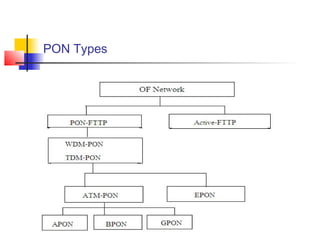
PON Types
PON Establishment
   First ATM based PON also known as APON has transmission rate of
    54Mbps.
   Introduced in 1990’s by FSAN for existing voice and phone services.
   APON was replaced by BPON due to increased bandwidth and new
    services demand.
   Effective in LAN, MAN and backbone networks.
   But higher in cost and complex.
   Further to it EPON has higher success rate due to low cost and
    simplicity, adapted in IP traffic network.
   GPON introduced after to it costs 10 times higher than EPON network.
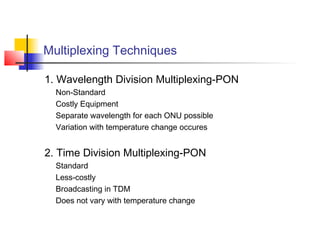
Multiplexing Techniques

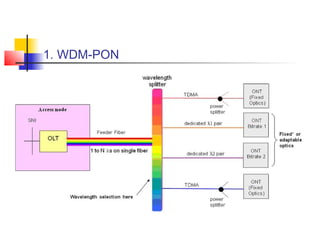
1. Wavelength Division Multiplexing-PON
  Non-Standard
  Costly Equipment
  Separate wavelength for each ONU possible
  Variation with temperature change occures


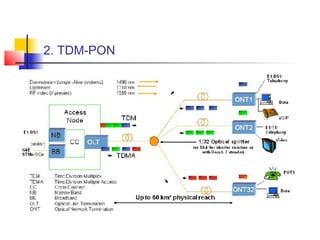
2. Time Division Multiplexing-PON
  Standard
  Less-costly
  Broadcasting in TDM
  Does not vary with temperature change
1. WDM-PON
2. TDM-PON
Main PON Systems

   APON and BPON rapidly replaced via EPON and GPON due to future
    scope and services support.

   Mainly concentrating on EPON and GPON .
Ethernet PON
   EPON taking place in Asia region

    Uses Packet data transmission scenario

    Uses standard IEEE 802.3ah (1 Gb/s),IEEE 802.3av (10Gb/s)

    Principle- Downstream direction, Upstream direction
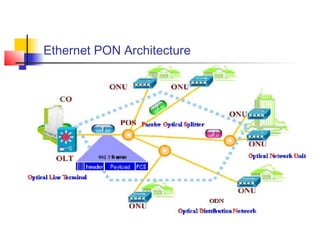
Ethernet PON Architecture
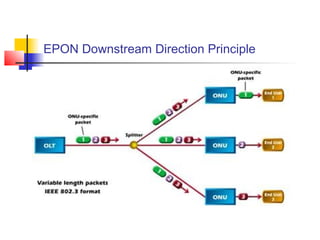
EPON Downstream Direction Principle
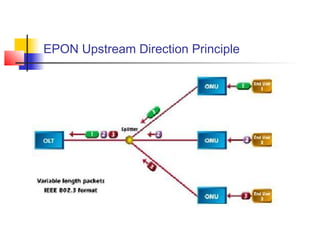
EPON Upstream Direction Principle
Gigabit PON

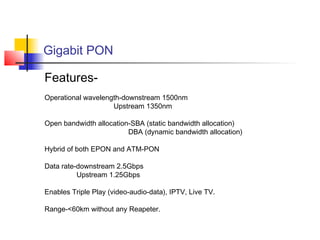
Features-
Operational wavelength-downstream 1500nm
                    Upstream 1350nm

Open bandwidth allocation-SBA (static bandwidth allocation)
                         DBA (dynamic bandwidth allocation)

Hybrid of both EPON and ATM-PON

Data rate-downstream 2.5Gbps
          Upstream 1.25Gbps

Enables Triple Play (video-audio-data), IPTV, Live TV.

Range-<60km without any Reapeter.
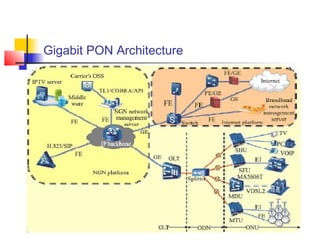
Gigabit PON Architecture
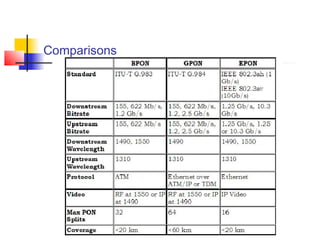
Comparisons
GPON in India
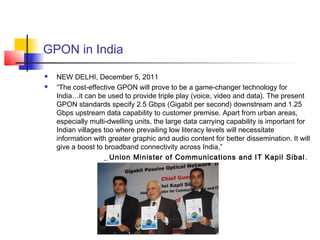
   NEW DELHI, December 5, 2011
   “The cost-effective GPON will prove to be a game-changer technology for
    India…it can be used to provide triple play (voice, video and data). The present
    GPON standards specify 2.5 Gbps (Gigabit per second) downstream and 1.25
    Gbps upstream data capability to customer premise. Apart from urban areas,
    especially multi-dwelling units, the large data carrying capability is important for
    Indian villages too where prevailing low literacy levels will necessitate
    information with greater graphic and audio content for better dissemination. It will
    give a boost to broadband connectivity across India,”
                    _ Union Minister of Communications and IT Kapil Sibal .
Future Technologies in PON

   10GPON
   1-2Gbps
   Pre-existing 1GPON platform


   10GEPON
   1-10Gbps
   IEEE 800.3av
   An Amalgamation of CWDM & TDM
   Can established on Pre-existin 1GEPON optic fiber network, the only change is
    to replace 1GEPON ONU to 10GEPON ONU
Thank You

Manish (passive optic network)

  • 1.
    Passive Optic Network Presented by, Manish Desai
  • 2.
    Passive Optic Network  Introduction  Why PON  PON advantages  PON Types  PON Establishment  Multiplexing Techniques  Main PON Systems  Comparisons  GPON in India  Future Technologies in PON
  • 3.
    Introduction  Residential and small businesses demand for latest services and application increased exponentially.  Creating Bottleneck problem in tradition access networks.  PON gives solution with its low cost of deployment.  Point to multipoint single path connection using passive splitter, Combiner, connectors.  Saves maintenance cost, equipment distribution, power supply and more optimal and efficient utilization of optic fiber set-up.  Most economic network with optic fiber specifications.
  • 4.
    Why PON  HDTV, video telephony, Live TV, Gaming services demand.  Higher bandwidth demand for these services.  Improved service reliability and simplicity via PON.
  • 5.
    PON Advantages  1Gbps speed for <20km distance  Broadcasting takes place in downlink.  In uplink service channel shared by users.  No power utilization in OF network as optic splitters used and no down time risk.
  • 6.
  • 7.
    PON Establishment  First ATM based PON also known as APON has transmission rate of 54Mbps.  Introduced in 1990’s by FSAN for existing voice and phone services.  APON was replaced by BPON due to increased bandwidth and new services demand.  Effective in LAN, MAN and backbone networks.  But higher in cost and complex.  Further to it EPON has higher success rate due to low cost and simplicity, adapted in IP traffic network.  GPON introduced after to it costs 10 times higher than EPON network.
  • 8.
    Multiplexing Techniques 1. WavelengthDivision Multiplexing-PON Non-Standard Costly Equipment Separate wavelength for each ONU possible Variation with temperature change occures 2. Time Division Multiplexing-PON Standard Less-costly Broadcasting in TDM Does not vary with temperature change
  • 9.
  • 10.
  • 11.
    Main PON Systems  APON and BPON rapidly replaced via EPON and GPON due to future scope and services support.  Mainly concentrating on EPON and GPON .
  • 12.
    Ethernet PON  EPON taking place in Asia region Uses Packet data transmission scenario Uses standard IEEE 802.3ah (1 Gb/s),IEEE 802.3av (10Gb/s) Principle- Downstream direction, Upstream direction
  • 13.
  • 14.
  • 15.
  • 16.
    Gigabit PON Features- Operational wavelength-downstream1500nm Upstream 1350nm Open bandwidth allocation-SBA (static bandwidth allocation) DBA (dynamic bandwidth allocation) Hybrid of both EPON and ATM-PON Data rate-downstream 2.5Gbps Upstream 1.25Gbps Enables Triple Play (video-audio-data), IPTV, Live TV. Range-<60km without any Reapeter.
  • 17.
  • 18.
  • 19.
    GPON in India  NEW DELHI, December 5, 2011  “The cost-effective GPON will prove to be a game-changer technology for India…it can be used to provide triple play (voice, video and data). The present GPON standards specify 2.5 Gbps (Gigabit per second) downstream and 1.25 Gbps upstream data capability to customer premise. Apart from urban areas, especially multi-dwelling units, the large data carrying capability is important for Indian villages too where prevailing low literacy levels will necessitate information with greater graphic and audio content for better dissemination. It will give a boost to broadband connectivity across India,” _ Union Minister of Communications and IT Kapil Sibal .
  • 20.
    Future Technologies inPON  10GPON  1-2Gbps  Pre-existing 1GPON platform  10GEPON  1-10Gbps  IEEE 800.3av  An Amalgamation of CWDM & TDM  Can established on Pre-existin 1GEPON optic fiber network, the only change is to replace 1GEPON ONU to 10GEPON ONU
  • 21.