Structural Analysis and Design of
Commercial cum Residential
Building
1
OBJECTIVE
• To analyse and design a multi-storey R C
building.
• Analysis and design is done with the aid of
Staad.Pro software.
• To gain design knowledge on various structural
elements like beam, column, slab, foundation etc.
2
SCOPE
• Design using software can be useful if any
additional modification has to be done in the
structure during its future life.
• To study how analysis and design is to be carried
out in Staad.Pro
3
SOFTWARE’S USED
–AUTOCAD 2016
–STAAD.Pro
–STAAD.Foundation
4
STAAD.Pro - Software used for the analysis and
design of the building
AUTOCAD 2016- Used for drafting and detailing
of the designed structural elements.
STAAD.foundation - It enables engineers to
analyze and design the underlying foundation for
the structure that are created in STAAD.Pro.
5
STAAD.Pro
• It allows structural engineers to analyze and design
virtually any type of structure through its flexible
modeling environment, advanced features and fluent
data collaboration.
• The main advantages are advanced automatic load
generation facilities for wind, area and moving loads.
• Isometric and perspective views with 3D shapes,
joint, member or elements can be obtained.
6
AUTOCAD 2016
• Computer Aided Design which are computer
based tools used to assist designers,
engineers, architects in their design activities.
• CAD is used as preparing architectural
drawings and interior design and modelling.
7
SITE DETAILS
• Site is located at NCC road, Ambalakunnu, in
Trivandrum District.
• Plot Area : 1214.4m²
• Plinth area
• Basement Floor: 200.06 m²
• First Floor
• Residential Area: 152.64m²
• Commercial Area: 73.3m²
• Parking Area : 95.4 m2
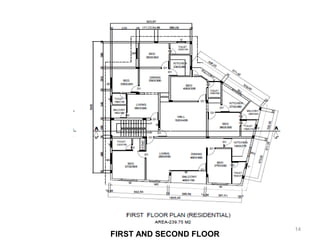
• First and second Floor area : 239.75m²
8
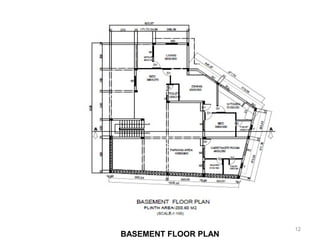
• The basement floor is designed for parking
and as well as for the residence of the
caretaker of the building .
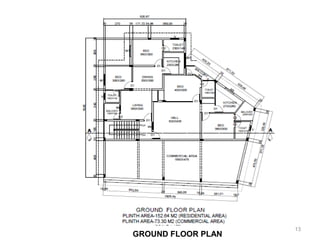
• Ground floor are exclusively for commercial
and for residential purpose.
• 1st
, 2nd
and 3rd
floors are for residential use
only.
BUILDING DETAILS
9
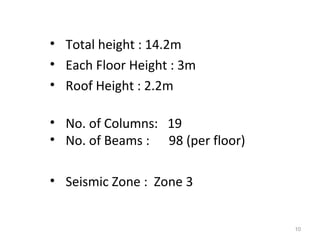
• Total height : 14.2m
• Each Floor Height : 3m
• Roof Height : 2.2m
• No. of Columns: 19
• No. of Beams : 98 (per floor)
• Seismic Zone : Zone 3
10
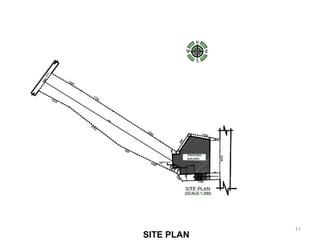
SITE PLAN
11
BASEMENT FLOOR PLAN
12
GROUND FLOOR PLAN
13
FIRST AND SECOND FLOOR
14
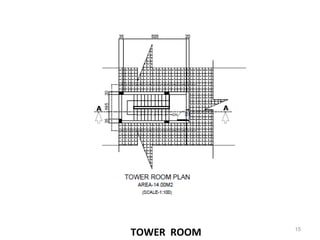
TOWER ROOM 15
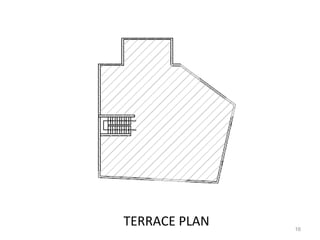
TERRACE PLAN 16
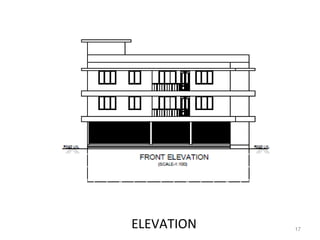
ELEVATION 17
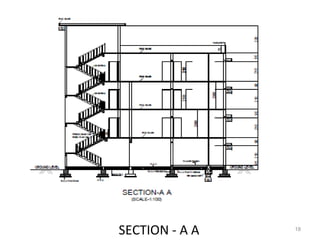
SECTION - A A 18
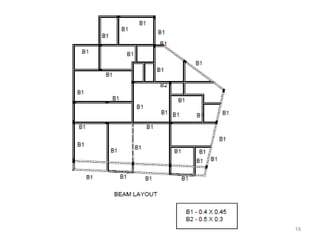
19
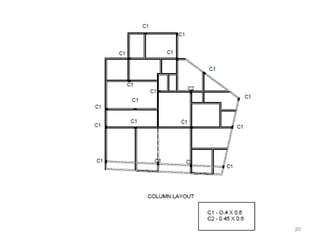
20
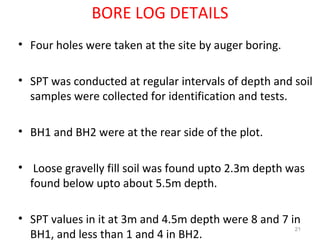
BORE LOG DETAILS
• Four holes were taken at the site by auger boring.
• SPT was conducted at regular intervals of depth and soil
samples were collected for identification and tests.
• BH1 and BH2 were at the rear side of the plot.
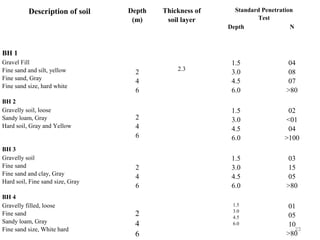
• Loose gravelly fill soil was found upto 2.3m depth was
found below upto about 5.5m depth.
• SPT values in it at 3m and 4.5m depth were 8 and 7 in
BH1, and less than 1 and 4 in BH2.
21
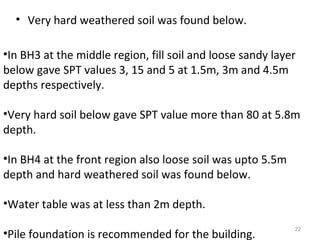
• Very hard weathered soil was found below.
•In BH3 at the middle region, fill soil and loose sandy layer
below gave SPT values 3, 15 and 5 at 1.5m, 3m and 4.5m
depths respectively.
•Very hard soil below gave SPT value more than 80 at 5.8m
depth.
•In BH4 at the front region also loose soil was upto 5.5m
depth and hard weathered soil was found below.
•Water table was at less than 2m depth.
•Pile foundation is recommended for the building.
22
Description of soil Depth
(m)
Thickness of
soil layer
Standard Penetration
Test
Depth N
BH 1
Gravel Fill
Fine sand and silt, yellow
Fine sand, Gray
Fine sand size, hard white
2
4
6
2.3
1.5
3.0
4.5
6.0
04
08
07
>80
BH 2
Gravelly soil, loose
Sandy loam, Gray
Hard soil, Gray and Yellow
2
4
6
1.5
3.0
4.5
6.0
02
<01
04
>100
BH 3
Gravelly soil
Fine sand
Fine sand and clay, Gray
Hard soil, Fine sand size, Gray
2
4
6
1.5
3.0
4.5
6.0
03
15
05
>80
BH 4
Gravelly filled, loose
Fine sand
Sandy loam, Gray
Fine sand size, White hard
2
4
6
1.5
3.0
4.5
6.0
01
05
10
>80
23
Designing Features
• Slabs
• Beams
• Columns
• Retaining Wall
• Stair Case
• Foundation
24
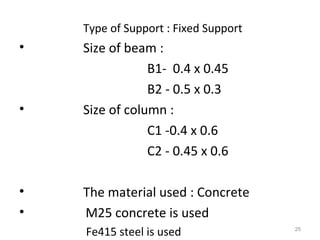
Type of Support : Fixed Support
• Size of beam :
B1- 0.4 x 0.45
B2 - 0.5 x 0.3
• Size of column :
C1 -0.4 x 0.6
C2 - 0.45 x 0.6
• The material used : Concrete
• M25 concrete is used
Fe415 steel is used 25
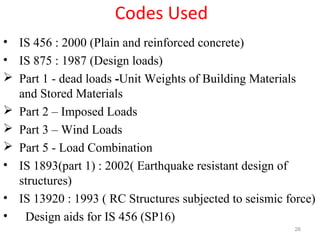
Codes Used
• IS 456 : 2000 (Plain and reinforced concrete)
• IS 875 : 1987 (Design loads)
 Part 1 - dead loads -Unit Weights of Building Materials
and Stored Materials
 Part 2 – Imposed Loads
 Part 3 – Wind Loads
 Part 5 - Load Combination
• IS 1893(part 1) : 2002( Earthquake resistant design of
structures)
• IS 13920 : 1993 ( RC Structures subjected to seismic force)
• Design aids for IS 456 (SP16)
26
Load Calculation
27
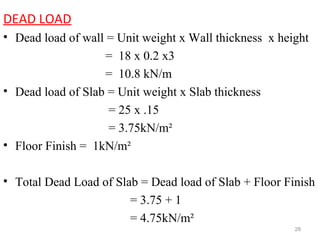
DEAD LOAD
• Dead load of wall = Unit weight x Wall thickness x height
= 18 x 0.2 x3
= 10.8 kN/m
• Dead load of Slab = Unit weight x Slab thickness
= 25 x .15
= 3.75kN/m²
• Floor Finish = 1kN/m²
• Total Dead Load of Slab = Dead load of Slab + Floor Finish
= 3.75 + 1
= 4.75kN/m²
28
• Dead load of Parapet = Unit weight x Parapet thickness
= 19 x 0.1 x 1
= 1.9 kN/m
• Dead load of Staircase = 15 kN/m
29
Sl. No OCCUPANCY CLASSIFICATION UNIFORMLY
DISTRIBUTED LOAD
kN/m2
1 Living rooms, bed rooms 2.0
2 Dining rooms, Cafeterias and Restaurants 4.0
3 Kitchen and laundries 3.0
4 Corridors, Passages, but not less than 3.0
5 Staircase 3.0
6 Toilets and Bathrooms 2.0
7 Balconies
Same as rooms to which they
give access but with a
minimum of 4.0
LIVE LOAD
Live Load for Residential Building
30
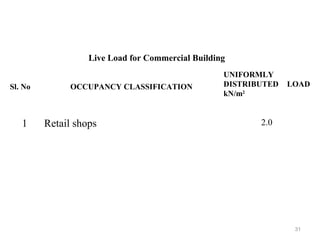
Live Load for Commercial Building
Sl. No OCCUPANCY CLASSIFICATION
UNIFORMLY
DISTRIBUTED LOAD
kN/m2
1 Retail shops 2.0
31
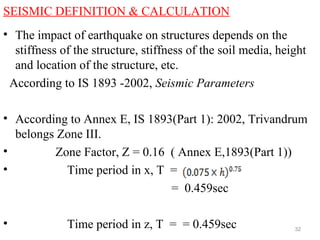
SEISMIC DEFINITION & CALCULATION
• The impact of earthquake on structures depends on the
stiffness of the structure, stiffness of the soil media, height
and location of the structure, etc.
According to IS 1893 -2002, Seismic Parameters
• According to Annex E, IS 1893(Part 1): 2002, Trivandrum
belongs Zone III.
• Zone Factor, Z = 0.16 ( Annex E,1893(Part 1))
• Time period in x, T =
= 0.459sec
• Time period in z, T = = 0.459sec 32
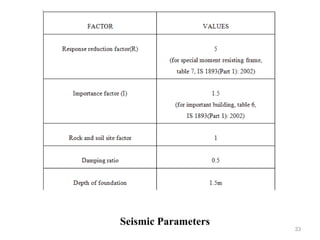
Seismic Parameters
33
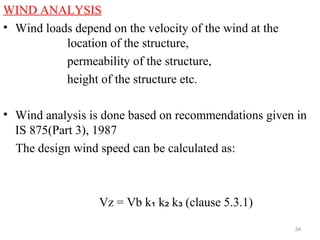
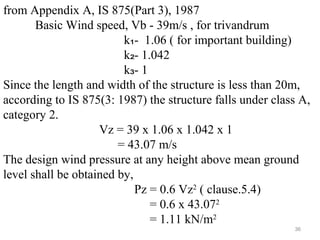
WIND ANALYSIS
• Wind loads depend on the velocity of the wind at the
location of the structure,
permeability of the structure,
height of the structure etc.
• Wind analysis is done based on recommendations given in
IS 875(Part 3), 1987
The design wind speed can be calculated as:
Vz = Vb k k k (clause 5.3.1)₁ ₂ ₃
34
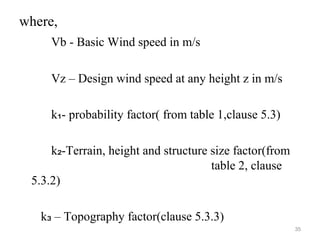
where,
Vb - Basic Wind speed in m/s
Vz – Design wind speed at any height z in m/s
k - probability factor( from table 1,clause 5.3)₁
k -Terrain, height and structure size factor(from₂
table 2, clause
5.3.2)
k – Topography factor(clause 5.3.3)₃
35
from Appendix A, IS 875(Part 3), 1987
Basic Wind speed, Vb - 39m/s , for trivandrum
k - 1.06 ( for important building)₁
k - 1.042₂
k - 1₃
Since the length and width of the structure is less than 20m,
according to IS 875(3: 1987) the structure falls under class A,
category 2.
Vz = 39 x 1.06 x 1.042 x 1
= 43.07 m/s
The design wind pressure at any height above mean ground
level shall be obtained by,
Pz = 0.6 Vz2
( clause.5.4)
= 0.6 x 43.072
= 1.11 kN/m2
36
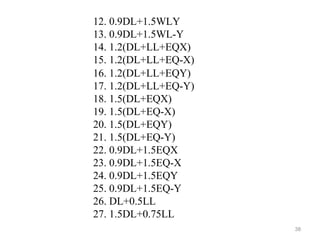
LOAD COMBINATION
1. 1.5(DL+LL)
2. 1.2(DL+LL+WLX)
3. 1.2(DL+LL+WL-X)
4. 1.2(DL+LL+WLY)
5. 1.2(DL+LL+WL-Y)
6. 1.5(DL+WLX)
7. 1.5(DL+WL-X)
8. 1.5(DL+WLY)
9. 1.5(DL+WL-Y)
10. 0.9DL+1.5WLX
11. 0.9DL+1.5WL-X
37
• The load combination between dead load, live load,
seismic load and wind load are auto generated in
Staad.Pro.
• As per IS 875(Part 5), 1987, the load combination are
16. 1.2(DL+LL+EQY)
17. 1.2(DL+LL+EQ-Y)
18. 1.5(DL+EQX)
19. 1.5(DL+EQ-X)
20. 1.5(DL+EQY)
21. 1.5(DL+EQ-Y)
22. 0.9DL+1.5EQX
23. 0.9DL+1.5EQ-X
24. 0.9DL+1.5EQY
25. 0.9DL+1.5EQ-Y
26. DL+0.5LL
27. 1.5DL+0.75LL
38
12. 0.9DL+1.5WLY
13. 0.9DL+1.5WL-Y
14. 1.2(DL+LL+EQX)
15. 1.2(DL+LL+EQ-X)
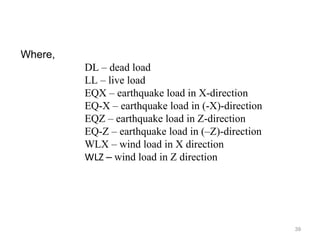
Where,
DL – dead load
LL – live load
EQX – earthquake load in X-direction
EQ-X – earthquake load in (-X)-direction
EQZ – earthquake load in Z-direction
EQ-Z – earthquake load in (–Z)-direction
WLX – wind load in X direction
WLZ – wind load in Z direction
39
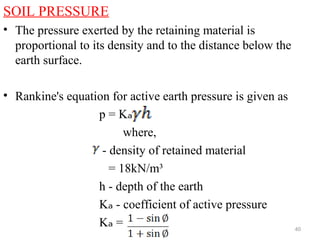
SOIL PRESSURE
• The pressure exerted by the retaining material is
proportional to its density and to the distance below the
earth surface.
• Rankine's equation for active earth pressure is given as
p = Kₐ
where,
- density of retained material
= 18kN/m³
h - depth of the earth
K - coefficient of active pressureₐ
K =ₐ 40
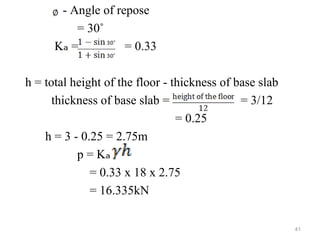
- Angle of repose
= 30˚
K = = 0.33ₐ
h = total height of the floor - thickness of base slab
thickness of base slab = = 3/12
= 0.25
h = 3 - 0.25 = 2.75m
p = Kₐ
= 0.33 x 18 x 2.75
= 16.335kN 
41
MODEL GEOMETRY
42
43
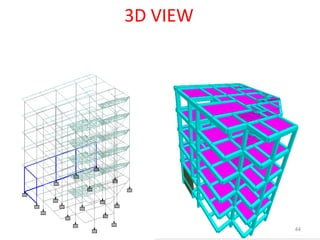
• The nodes were assigned and the corresponding beams
were added.
• The columns were produced by translational repeat.
• The section properties and support details were added.
• Load case details were assigned and analysis were
done.
3D VIEW
44
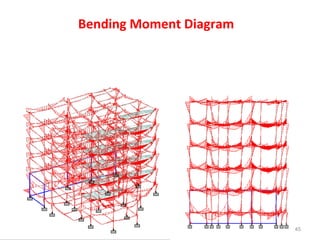
Bending Moment Diagram
45
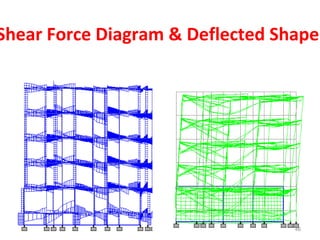
Shear Force Diagram & Deflected Shape
46
DESIGN DETAILS
47
FOUNDATION
• Pile foundation is provided.
• Design of pile cap was done using STAAD.foundation.
• Pile of diameter 50cm is used in the building.
• M 35 concrete and Fe 415 steel are adopted for design.
The support reactions from analysis results are used for the
design.
48
• The support reactions from STAAD.Pro software was
imported to STAAD.foundation and the pile cap was
designed by entering the pile diameter and load bearing
capacity of pile.
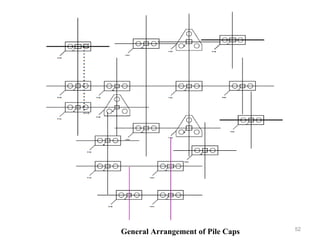
• Piles having 2 and 3 pile caps are provided on supports,
based on support reaction.
• Foundation design is done on STAAD.foundation.
49
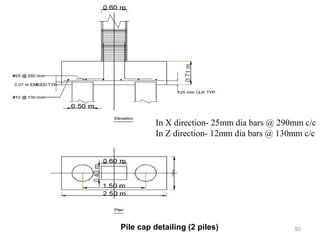
50Pile cap detailing (2 piles)
In X direction- 25mm dia bars @ 290mm c/c
In Z direction- 12mm dia bars @ 130mm c/c
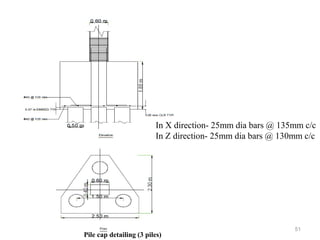
51
Pile cap detailing (3 piles)
In X direction- 25mm dia bars @ 135mm c/c
In Z direction- 25mm dia bars @ 130mm c/c
52
General Arrangement of Pile Caps
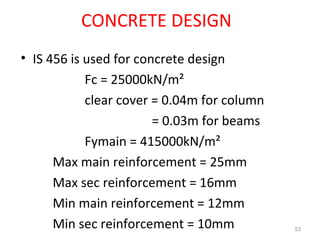
CONCRETE DESIGN
• IS 456 is used for concrete design
Fc = 25000kN/m²
clear cover = 0.04m for column
= 0.03m for beams
Fymain = 415000kN/m²
Max main reinforcement = 25mm
Max sec reinforcement = 16mm
Min main reinforcement = 12mm
Min sec reinforcement = 10mm 53
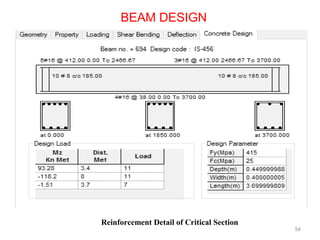
BEAM DESIGN
54
Reinforcement Detail of Critical Section
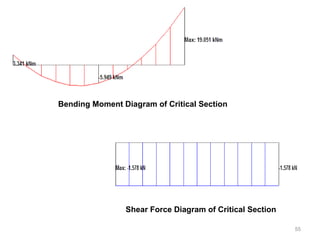
Bending Moment Diagram of Critical Section
Shear Force Diagram of Critical Section
55
56
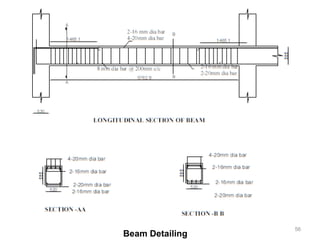
Beam Detailing
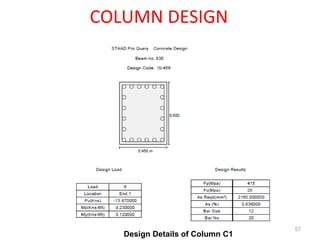
COLUMN DESIGN
Design Details of Column C1
57
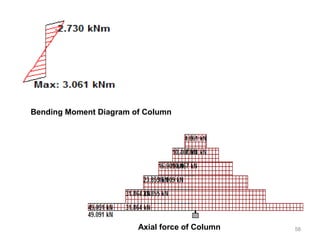
Bending Moment Diagram of Column
Axial force of Column 58
59
SLAB DESIGN
• Slabs are plate elements having their depth much
smaller than other two dimensions.
• They usually carry a uniformly distributed load from
the floors and roof of the building.
• Slab of thickness 150 mm is used in the building
and were designed as two-way slab.
• Grade of concrete M 25 is assumed for slab design.
60
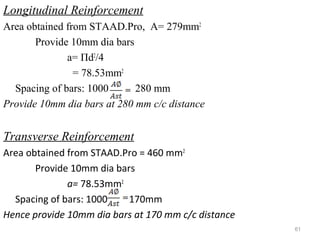
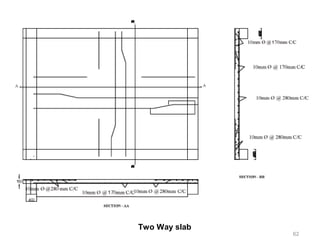
Longitudinal Reinforcement
Area obtained from STAAD.Pro, A= 279mm2
Provide 10mm dia bars
a= Пd2
/4
= 78.53mm2
Spacing of bars: 1000 280 mm
Provide 10mm dia bars at 280 mm c/c distance
Transverse Reinforcement
Area obtained from STAAD.Pro = 460 mm2
Provide 10mm dia bars
a= 78.53mm2
Spacing of bars: 1000 170mm
Hence provide 10mm dia bars at 170 mm c/c distance
61
62
Two Way slab
STAIRCASE DESIGN
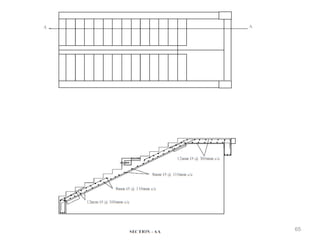
• The staircase comprises of flight of steps generally with
one or more intermediate landings provided between the
floor levels.
• Dog-Legged Staircase is designed.
• Grade of concrete = M25
• Unit weight of concrete = 25 kN/m2
• Rise = 150mm
• Thread = 300mm
• Width of landing = 2m
• Width of steps = 2m
63
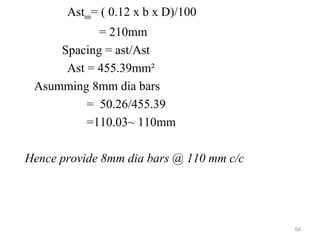
Astmin= ( 0.12 x b x D)/100
= 210mm
Spacing = ast/Ast
Ast = 455.39mm²
Asumming 8mm dia bars
= 50.26/455.39
=110.03~ 110mm
Hence provide 8mm dia bars @ 110 mm c/c
64
65
RETAINING WALL
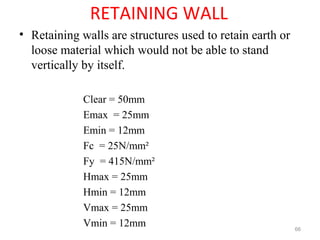
• Retaining walls are structures used to retain earth or
loose material which would not be able to stand
vertically by itself.
Clear = 50mm
Emax = 25mm
Emin = 12mm
Fc = 25N/mm²
Fy = 415N/mm²
Hmax = 25mm
Hmin = 12mm
Vmax = 25mm
Vmin = 12mm 66
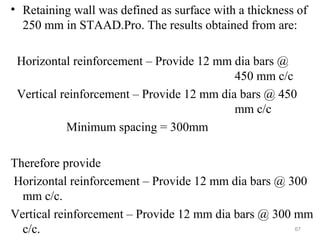
• Retaining wall was defined as surface with a thickness of
250 mm in STAAD.Pro. The results obtained from are:
Horizontal reinforcement – Provide 12 mm dia bars @
450 mm c/c
Vertical reinforcement – Provide 12 mm dia bars @ 450
mm c/c
Minimum spacing = 300mm
Therefore provide
Horizontal reinforcement – Provide 12 mm dia bars @ 300
mm c/c.
Vertical reinforcement – Provide 12 mm dia bars @ 300 mm
c/c. 67
CONCLUSION
• The project helped to gain knowledge about the
software package STAAD.Pro and AUTOCAD 2016.
• All the requirements of KBR was followed during the
execution of work.
• Detailing of each designed structural member was
done using AUTOCAD 2016.
• All the aspects of design was met while analysing and
designing of the structure was done using STAAD.Pro.
68
REFERENCE
• [1] “Design aids for reinforced concrete” SP 16-1980,
Bureau of Indian Standard, New Delhi.
• [2] “Structural Safety of Building – Loading Standard
Code of Practice”, IS 875-1964
• [3] IS 456:2000(Plain and Reinforced Concrete Code)
• [4] IS 875-Part-1(1987)-“Code of practice for design
loads(Dead load)”
• [5] IS 875-Part-2(1987)-“Code of practice for dead
load(Live load)” 69
• [6] IS 875-Part-3-“Wind loads on buildings and
Structures”
• [7] IS 875-Part-5- “Code of Practice for design
loads(Special loads and Combination)”
• [8] IS 1893-1(2002)-“Criteria foe earthquakeresistant
design of structures”
• [9] B.C Punmia, Ashok K. Jain; “Reinforced Concrete
Structures Volume I & II’, Standard publishers
Distributors, Delhi – 6”
• [10] Dr. N. Krishna Raju; “Design of RC Structures”,
CBS Publishers and Distributors, New Delhi, 2006
• [11] S. Ramamrutham and R. Narayan; “Design of
Reinforced Concrete Structures.” (conforming to IS
456). 70
Thank You
71

Analysis and design of building

  • 1.
    Structural Analysis andDesign of Commercial cum Residential Building 1
  • 2.
    OBJECTIVE • To analyseand design a multi-storey R C building. • Analysis and design is done with the aid of Staad.Pro software. • To gain design knowledge on various structural elements like beam, column, slab, foundation etc. 2
  • 3.
    SCOPE • Design usingsoftware can be useful if any additional modification has to be done in the structure during its future life. • To study how analysis and design is to be carried out in Staad.Pro 3
  • 4.
  • 5.
    STAAD.Pro - Softwareused for the analysis and design of the building AUTOCAD 2016- Used for drafting and detailing of the designed structural elements. STAAD.foundation - It enables engineers to analyze and design the underlying foundation for the structure that are created in STAAD.Pro. 5
  • 6.
    STAAD.Pro • It allowsstructural engineers to analyze and design virtually any type of structure through its flexible modeling environment, advanced features and fluent data collaboration. • The main advantages are advanced automatic load generation facilities for wind, area and moving loads. • Isometric and perspective views with 3D shapes, joint, member or elements can be obtained. 6
  • 7.
    AUTOCAD 2016 • ComputerAided Design which are computer based tools used to assist designers, engineers, architects in their design activities. • CAD is used as preparing architectural drawings and interior design and modelling. 7
  • 8.
    SITE DETAILS • Siteis located at NCC road, Ambalakunnu, in Trivandrum District. • Plot Area : 1214.4m² • Plinth area • Basement Floor: 200.06 m² • First Floor • Residential Area: 152.64m² • Commercial Area: 73.3m² • Parking Area : 95.4 m2 • First and second Floor area : 239.75m² 8
  • 9.
    • The basementfloor is designed for parking and as well as for the residence of the caretaker of the building . • Ground floor are exclusively for commercial and for residential purpose. • 1st , 2nd and 3rd floors are for residential use only. BUILDING DETAILS 9
  • 10.
    • Total height: 14.2m • Each Floor Height : 3m • Roof Height : 2.2m • No. of Columns: 19 • No. of Beams : 98 (per floor) • Seismic Zone : Zone 3 10
  • 11.
  • 12.
  • 13.
  • 14.
  • 15.
  • 16.
  • 17.
  • 18.
  • 19.
  • 20.
  • 21.
    BORE LOG DETAILS •Four holes were taken at the site by auger boring. • SPT was conducted at regular intervals of depth and soil samples were collected for identification and tests. • BH1 and BH2 were at the rear side of the plot. • Loose gravelly fill soil was found upto 2.3m depth was found below upto about 5.5m depth. • SPT values in it at 3m and 4.5m depth were 8 and 7 in BH1, and less than 1 and 4 in BH2. 21
  • 22.
    • Very hardweathered soil was found below. •In BH3 at the middle region, fill soil and loose sandy layer below gave SPT values 3, 15 and 5 at 1.5m, 3m and 4.5m depths respectively. •Very hard soil below gave SPT value more than 80 at 5.8m depth. •In BH4 at the front region also loose soil was upto 5.5m depth and hard weathered soil was found below. •Water table was at less than 2m depth. •Pile foundation is recommended for the building. 22
  • 23.
    Description of soilDepth (m) Thickness of soil layer Standard Penetration Test Depth N BH 1 Gravel Fill Fine sand and silt, yellow Fine sand, Gray Fine sand size, hard white 2 4 6 2.3 1.5 3.0 4.5 6.0 04 08 07 >80 BH 2 Gravelly soil, loose Sandy loam, Gray Hard soil, Gray and Yellow 2 4 6 1.5 3.0 4.5 6.0 02 <01 04 >100 BH 3 Gravelly soil Fine sand Fine sand and clay, Gray Hard soil, Fine sand size, Gray 2 4 6 1.5 3.0 4.5 6.0 03 15 05 >80 BH 4 Gravelly filled, loose Fine sand Sandy loam, Gray Fine sand size, White hard 2 4 6 1.5 3.0 4.5 6.0 01 05 10 >80 23
  • 24.
    Designing Features • Slabs •Beams • Columns • Retaining Wall • Stair Case • Foundation 24
  • 25.
    Type of Support: Fixed Support • Size of beam : B1- 0.4 x 0.45 B2 - 0.5 x 0.3 • Size of column : C1 -0.4 x 0.6 C2 - 0.45 x 0.6 • The material used : Concrete • M25 concrete is used Fe415 steel is used 25
  • 26.
    Codes Used • IS456 : 2000 (Plain and reinforced concrete) • IS 875 : 1987 (Design loads)  Part 1 - dead loads -Unit Weights of Building Materials and Stored Materials  Part 2 – Imposed Loads  Part 3 – Wind Loads  Part 5 - Load Combination • IS 1893(part 1) : 2002( Earthquake resistant design of structures) • IS 13920 : 1993 ( RC Structures subjected to seismic force) • Design aids for IS 456 (SP16) 26
  • 27.
  • 28.
    DEAD LOAD • Deadload of wall = Unit weight x Wall thickness x height = 18 x 0.2 x3 = 10.8 kN/m • Dead load of Slab = Unit weight x Slab thickness = 25 x .15 = 3.75kN/m² • Floor Finish = 1kN/m² • Total Dead Load of Slab = Dead load of Slab + Floor Finish = 3.75 + 1 = 4.75kN/m² 28
  • 29.
    • Dead loadof Parapet = Unit weight x Parapet thickness = 19 x 0.1 x 1 = 1.9 kN/m • Dead load of Staircase = 15 kN/m 29
  • 30.
    Sl. No OCCUPANCYCLASSIFICATION UNIFORMLY DISTRIBUTED LOAD kN/m2 1 Living rooms, bed rooms 2.0 2 Dining rooms, Cafeterias and Restaurants 4.0 3 Kitchen and laundries 3.0 4 Corridors, Passages, but not less than 3.0 5 Staircase 3.0 6 Toilets and Bathrooms 2.0 7 Balconies Same as rooms to which they give access but with a minimum of 4.0 LIVE LOAD Live Load for Residential Building 30
  • 31.
    Live Load forCommercial Building Sl. No OCCUPANCY CLASSIFICATION UNIFORMLY DISTRIBUTED LOAD kN/m2 1 Retail shops 2.0 31
  • 32.
    SEISMIC DEFINITION &CALCULATION • The impact of earthquake on structures depends on the stiffness of the structure, stiffness of the soil media, height and location of the structure, etc. According to IS 1893 -2002, Seismic Parameters • According to Annex E, IS 1893(Part 1): 2002, Trivandrum belongs Zone III. • Zone Factor, Z = 0.16 ( Annex E,1893(Part 1)) • Time period in x, T = = 0.459sec • Time period in z, T = = 0.459sec 32
  • 33.
  • 34.
    WIND ANALYSIS • Windloads depend on the velocity of the wind at the location of the structure, permeability of the structure, height of the structure etc. • Wind analysis is done based on recommendations given in IS 875(Part 3), 1987 The design wind speed can be calculated as: Vz = Vb k k k (clause 5.3.1)₁ ₂ ₃ 34
  • 35.
    where, Vb - BasicWind speed in m/s Vz – Design wind speed at any height z in m/s k - probability factor( from table 1,clause 5.3)₁ k -Terrain, height and structure size factor(from₂ table 2, clause 5.3.2) k – Topography factor(clause 5.3.3)₃ 35
  • 36.
    from Appendix A,IS 875(Part 3), 1987 Basic Wind speed, Vb - 39m/s , for trivandrum k - 1.06 ( for important building)₁ k - 1.042₂ k - 1₃ Since the length and width of the structure is less than 20m, according to IS 875(3: 1987) the structure falls under class A, category 2. Vz = 39 x 1.06 x 1.042 x 1 = 43.07 m/s The design wind pressure at any height above mean ground level shall be obtained by, Pz = 0.6 Vz2 ( clause.5.4) = 0.6 x 43.072 = 1.11 kN/m2 36
  • 37.
    LOAD COMBINATION 1. 1.5(DL+LL) 2.1.2(DL+LL+WLX) 3. 1.2(DL+LL+WL-X) 4. 1.2(DL+LL+WLY) 5. 1.2(DL+LL+WL-Y) 6. 1.5(DL+WLX) 7. 1.5(DL+WL-X) 8. 1.5(DL+WLY) 9. 1.5(DL+WL-Y) 10. 0.9DL+1.5WLX 11. 0.9DL+1.5WL-X 37 • The load combination between dead load, live load, seismic load and wind load are auto generated in Staad.Pro. • As per IS 875(Part 5), 1987, the load combination are
  • 38.
    16. 1.2(DL+LL+EQY) 17. 1.2(DL+LL+EQ-Y) 18.1.5(DL+EQX) 19. 1.5(DL+EQ-X) 20. 1.5(DL+EQY) 21. 1.5(DL+EQ-Y) 22. 0.9DL+1.5EQX 23. 0.9DL+1.5EQ-X 24. 0.9DL+1.5EQY 25. 0.9DL+1.5EQ-Y 26. DL+0.5LL 27. 1.5DL+0.75LL 38 12. 0.9DL+1.5WLY 13. 0.9DL+1.5WL-Y 14. 1.2(DL+LL+EQX) 15. 1.2(DL+LL+EQ-X)
  • 39.
    Where, DL – deadload LL – live load EQX – earthquake load in X-direction EQ-X – earthquake load in (-X)-direction EQZ – earthquake load in Z-direction EQ-Z – earthquake load in (–Z)-direction WLX – wind load in X direction WLZ – wind load in Z direction 39
  • 40.
    SOIL PRESSURE • Thepressure exerted by the retaining material is proportional to its density and to the distance below the earth surface. • Rankine's equation for active earth pressure is given as p = Kₐ where, - density of retained material = 18kN/m³ h - depth of the earth K - coefficient of active pressureₐ K =ₐ 40
  • 41.
    - Angle ofrepose = 30˚ K = = 0.33ₐ h = total height of the floor - thickness of base slab thickness of base slab = = 3/12 = 0.25 h = 3 - 0.25 = 2.75m p = Kₐ = 0.33 x 18 x 2.75 = 16.335kN  41
  • 42.
  • 43.
    43 • The nodeswere assigned and the corresponding beams were added. • The columns were produced by translational repeat. • The section properties and support details were added. • Load case details were assigned and analysis were done.
  • 44.
  • 45.
  • 46.
    Shear Force Diagram& Deflected Shape 46
  • 47.
  • 48.
    FOUNDATION • Pile foundationis provided. • Design of pile cap was done using STAAD.foundation. • Pile of diameter 50cm is used in the building. • M 35 concrete and Fe 415 steel are adopted for design. The support reactions from analysis results are used for the design. 48
  • 49.
    • The supportreactions from STAAD.Pro software was imported to STAAD.foundation and the pile cap was designed by entering the pile diameter and load bearing capacity of pile. • Piles having 2 and 3 pile caps are provided on supports, based on support reaction. • Foundation design is done on STAAD.foundation. 49
  • 50.
    50Pile cap detailing(2 piles) In X direction- 25mm dia bars @ 290mm c/c In Z direction- 12mm dia bars @ 130mm c/c
  • 51.
    51 Pile cap detailing (3 piles) In X direction-25mm dia bars @ 135mm c/c In Z direction- 25mm dia bars @ 130mm c/c
  • 52.
  • 53.
    CONCRETE DESIGN • IS456 is used for concrete design Fc = 25000kN/m² clear cover = 0.04m for column = 0.03m for beams Fymain = 415000kN/m² Max main reinforcement = 25mm Max sec reinforcement = 16mm Min main reinforcement = 12mm Min sec reinforcement = 10mm 53
  • 54.
  • 55.
    Bending Moment Diagramof Critical Section Shear Force Diagram of Critical Section 55
  • 56.
  • 57.
  • 58.
    Bending Moment Diagramof Column Axial force of Column 58
  • 59.
  • 60.
    SLAB DESIGN • Slabsare plate elements having their depth much smaller than other two dimensions. • They usually carry a uniformly distributed load from the floors and roof of the building. • Slab of thickness 150 mm is used in the building and were designed as two-way slab. • Grade of concrete M 25 is assumed for slab design. 60
  • 61.
    Longitudinal Reinforcement Area obtainedfrom STAAD.Pro, A= 279mm2 Provide 10mm dia bars a= Пd2 /4 = 78.53mm2 Spacing of bars: 1000 280 mm Provide 10mm dia bars at 280 mm c/c distance Transverse Reinforcement Area obtained from STAAD.Pro = 460 mm2 Provide 10mm dia bars a= 78.53mm2 Spacing of bars: 1000 170mm Hence provide 10mm dia bars at 170 mm c/c distance 61
  • 62.
  • 63.
    STAIRCASE DESIGN • Thestaircase comprises of flight of steps generally with one or more intermediate landings provided between the floor levels. • Dog-Legged Staircase is designed. • Grade of concrete = M25 • Unit weight of concrete = 25 kN/m2 • Rise = 150mm • Thread = 300mm • Width of landing = 2m • Width of steps = 2m 63
  • 64.
    Astmin= ( 0.12x b x D)/100 = 210mm Spacing = ast/Ast Ast = 455.39mm² Asumming 8mm dia bars = 50.26/455.39 =110.03~ 110mm Hence provide 8mm dia bars @ 110 mm c/c 64
  • 65.
  • 66.
    RETAINING WALL • Retainingwalls are structures used to retain earth or loose material which would not be able to stand vertically by itself. Clear = 50mm Emax = 25mm Emin = 12mm Fc = 25N/mm² Fy = 415N/mm² Hmax = 25mm Hmin = 12mm Vmax = 25mm Vmin = 12mm 66
  • 67.
    • Retaining wallwas defined as surface with a thickness of 250 mm in STAAD.Pro. The results obtained from are: Horizontal reinforcement – Provide 12 mm dia bars @ 450 mm c/c Vertical reinforcement – Provide 12 mm dia bars @ 450 mm c/c Minimum spacing = 300mm Therefore provide Horizontal reinforcement – Provide 12 mm dia bars @ 300 mm c/c. Vertical reinforcement – Provide 12 mm dia bars @ 300 mm c/c. 67
  • 68.
    CONCLUSION • The projecthelped to gain knowledge about the software package STAAD.Pro and AUTOCAD 2016. • All the requirements of KBR was followed during the execution of work. • Detailing of each designed structural member was done using AUTOCAD 2016. • All the aspects of design was met while analysing and designing of the structure was done using STAAD.Pro. 68
  • 69.
    REFERENCE • [1] “Designaids for reinforced concrete” SP 16-1980, Bureau of Indian Standard, New Delhi. • [2] “Structural Safety of Building – Loading Standard Code of Practice”, IS 875-1964 • [3] IS 456:2000(Plain and Reinforced Concrete Code) • [4] IS 875-Part-1(1987)-“Code of practice for design loads(Dead load)” • [5] IS 875-Part-2(1987)-“Code of practice for dead load(Live load)” 69
  • 70.
    • [6] IS875-Part-3-“Wind loads on buildings and Structures” • [7] IS 875-Part-5- “Code of Practice for design loads(Special loads and Combination)” • [8] IS 1893-1(2002)-“Criteria foe earthquakeresistant design of structures” • [9] B.C Punmia, Ashok K. Jain; “Reinforced Concrete Structures Volume I & II’, Standard publishers Distributors, Delhi – 6” • [10] Dr. N. Krishna Raju; “Design of RC Structures”, CBS Publishers and Distributors, New Delhi, 2006 • [11] S. Ramamrutham and R. Narayan; “Design of Reinforced Concrete Structures.” (conforming to IS 456). 70
  • 71.