Access Control
SecAppDev 2016
Maarten Decat
@maartendecat
maarten.decat@kuleuven.be
What is access control?
 As any security: confidentiality, integrity, availability
 Layer in between (malicious) users and the protected system
 Part of the Trusted Computing Base
2
Access control is the part of security that constrains
the actions that are performed in a system
based on access control rules.
What is access control?
3
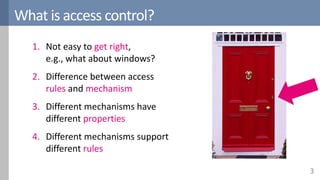
1. Not easy to get right,
e.g., what about windows?
2. Difference between access
rules and mechanism
3. Different mechanisms have
different properties
4. Different mechanisms support
different rules
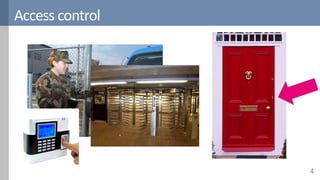
Access control
4
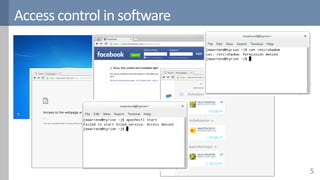
Access control in software
5
Outline
6
 Introduction
 Positioning access control
 Access control models
 How to enforce access control
 The bigger picture
 Some important technologies in practice
 Recap and conclusion
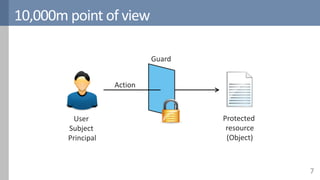
10,000m point of view
7
User
Subject
Principal
Guard
Protected
resource
(Object)
Action
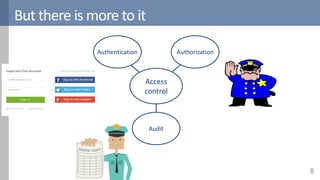
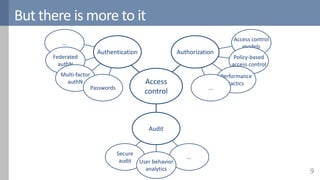
But there is more to it
8
Access
control
AuthorizationAuthentication
Audit
But there is more to it
9
Access
control
…
AuthorizationAuthentication
Audit
…
Secure
audit
Federated
authN
User behavior
analytics
Access control
models
Policy-based
access control
Performance
tactics
…
Multi-factor
authN
Passwords
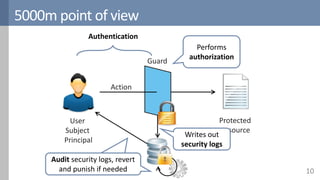
5000m point of view
10
Authentication
User
Subject
Principal
Guard
Protected
resource
Action
Writes out
security logs
Performs
authorization
Audit security logs, revert
and punish if needed
Audit security logs, revert
and punish if needed
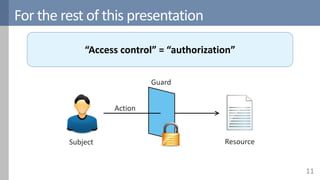
For the rest of this presentation
11
Subject
Guard
Resource
Action
“Access control” = “authorization”
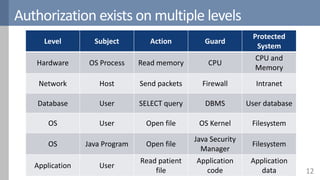
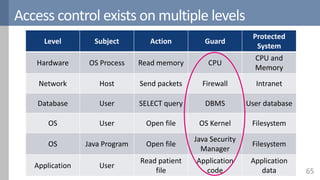
Authorization exists on multiple levels
Level Subject Action Guard
Protected
System
Hardware OS Process Read memory CPU
CPU and
Memory
Network Host Send packets Firewall Intranet
Database User SELECT query DBMS User database
OS User Open file OS Kernel Filesystem
OS Java Program Open file
Java Security
Manager
Filesystem
Application User
Read patient
file
Application
code
Application
data 12
Models, policies and mechanisms
13
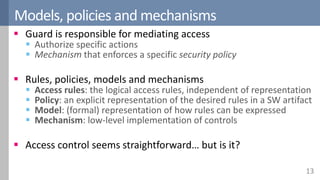
 Guard is responsible for mediating access
 Authorize specific actions
 Mechanism that enforces a specific security policy
 Rules, policies, models and mechanisms
 Access rules: the logical access rules, independent of representation
 Policy: an explicit representation of the desired rules in a SW artifact
 Model: (formal) representation of how rules can be expressed
 Mechanism: low-level implementation of controls
 Access control seems straightforward… but is it?
Challenges for access control
14
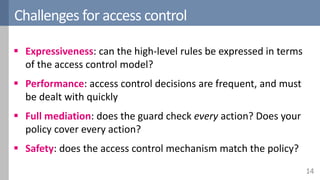
 Expressiveness: can the high-level rules be expressed in terms
of the access control model?
 Performance: access control decisions are frequent, and must
be dealt with quickly
 Full mediation: does the guard check every action? Does your
policy cover every action?
 Safety: does the access control mechanism match the policy?
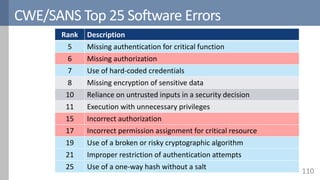
CWE/SANS Top 25 Software Errors
Rank Description
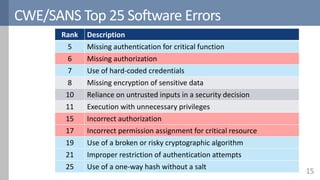
5 Missing authentication for critical function
6 Missing authorization
7 Use of hard-coded credentials
8 Missing encryption of sensitive data
10 Reliance on untrusted inputs in a security decision
11 Execution with unnecessary privileges
15 Incorrect authorization
17 Incorrect permission assignment for critical resource
19 Use of a broken or risky cryptographic algorithm
21 Improper restriction of authentication attempts
25 Use of a one-way hash without a salt
15
Outline
16
 Introduction
 Positioning access control
 Access control models
 The basics
 Who can assign permissions
 How permissions are assigned
 Advanced topics
 How to enforce access control
 The bigger picture
 Some important technologies in practice
 Recap and conclusion
The basics: the access control matrix
17
Permissions
[Lampson1971]
Resources
Subjects
18
Who can assign permissions?
19
 In general, two approaches:
1. Mandatory access control (MAC)
 By central authority
2. Discretionary access control (DAC)
 By subjects themselves
Mandatory access control (MAC)
20
 Permissions are assigned by a central authority according to a
central policy
 Good fit within organizations with a strong need for central controls
 Low flexibility and high management overhead
 Mandatory Access Control in use
 Often linked to multi-level security systems -> see later on
• E.g. Government-regulated secrecy systems, military applications
 Modern operating systems, to separate applications and processes
• E.g. Windows’ Mandatory Integrity Control, SELinux, TrustedBSD
SELinux
21
 Security-Enhanced Linux
 “A set of patches to the Linux kernel and some utilities to incorporate
a strong, flexible MAC architecture into the major subsystems of the
kernel [for] confidentiality and integrity”
 Activated by default in Fedora, Red Hat Enterprise Linux, etc
 Enforce MAC policy to processes in order to limit access to files
and network resources
 Least privilege
 Policy-based (see later on)
 Separation of policy from enforcement with well-defined policy
interfaces
 Changing a policy does not require a reboot
SELinux
22
~]$ ls -Z /usr/bin/passwd
-rwsr-xr-x. root root system_u:object_r:passwd_exec_t:s0 /usr/bin/passwd
~]$ ls -Z /etc/shadow
----------. root root system_u:object_r:shadow_t:s0 /etc/shadow
user:role:type:level
SELinux policies:
- applications running in the passwd_t domain can access files labeled
with the shadow_t type
- the passwd_t domain can be entered from the passwd_exec_t type
Discretionary access control (DAC)
23
 Permissions are set at the discretion of the resource owner
 Highly flexible policy, where permissions can be transferred
 Lack of central control makes revocation or changes difficult
 Discretionary acces control in use
 Controlling access to files
• E.g., Windows Access Control Lists (ACL), UNIX file handles
 Controlling the sharing of personal information
• E.g., Social networks
The Graham-Denning Model
 Extends the access control matrix with control and ownership
 Objects have an owner
 Subjects have a controller
 Permissions can be made
transferrable
 Matrix can be modified by 8 commands
 Creating and destroying subjects and objects
 Granting, transferring and revoking permissions
 Inspecting the authorization state
24
Alice Bob File 1 File 2 File 3
Alice control owner
owner
read
write
owner read*
Bob control
read
write
owner
read
[Graham1972]
The Graham-Denning Model
25
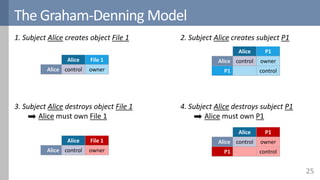
1. Subject Alice creates object File 1 2. Subject Alice creates subject P1
Alice File 1
Alice control owner
Alice P1
Alice control owner
P1 control
3. Subject Alice destroys object File 1
Alice must own File 1
Alice File 1
Alice control owner
4. Subject Alice destroys subject P1
Alice must own P1
Alice P1
Alice control owner
P1 control
The Graham-Denning Model
26
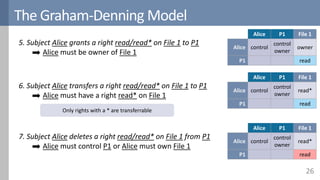
Alice P1 File 1
Alice control
control
owner
owner
P1 read
5. Subject Alice grants a right read/read* on File 1 to P1
Alice must be owner of File 1
6. Subject Alice transfers a right read/read* on File 1 to P1
Alice must have a right read* on File 1
Alice P1 File 1
Alice control
control
owner
read*
P1 read
7. Subject Alice deletes a right read/read* on File 1 from P1
Alice must control P1 or Alice must own File 1
Alice P1 File 1
Alice control
control
owner
read*
P1 read
Only rights with a * are transferrable
The Principle of Least Privilege
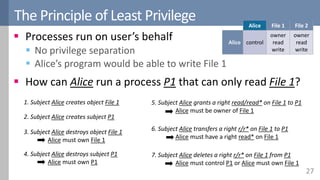
 Processes run on user’s behalf
 No privilege separation
 Alice’s program would be able to write File 1
 How can Alice run a process P1 that can only read File 1?
27
Alice File 1 File 2
Alice control
owner
read
write
owner
read
write
1. Subject Alice creates object File 1
2. Subject Alice creates subject P1
3. Subject Alice destroys object File 1
Alice must own File 1
4. Subject Alice destroys subject P1
Alice must own P1
5. Subject Alice grants a right read/read* on File 1 to P1
Alice must be owner of File 1
6. Subject Alice transfers a right r/r* on File 1 to P1
Alice must have a right read* on File 1
7. Subject Alice deletes a right r/r* on File 1 from P1
Alice must control P1 or Alice must own File 1
The Principle of Least Privilege
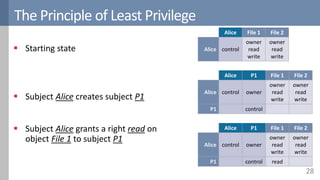
 Starting state
 Subject Alice creates subject P1
 Subject Alice grants a right read on
object File 1 to subject P1
28
Alice File 1 File 2
Alice control
owner
read
write
owner
read
write
Alice P1 File 1 File 2
Alice control owner
owner
read
write
owner
read
write
P1 control
Alice P1 File 1 File 2
Alice control owner
owner
read
write
owner
read
write
P1 control read
The Principle of Least Privilege
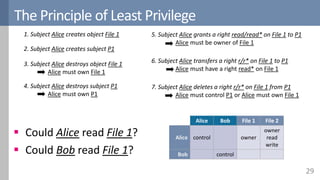
 Could Alice read File 1?
 Could Bob read File 1?
29
1. Subject Alice creates object File 1
2. Subject Alice creates subject P1
3. Subject Alice destroys object File 1
Alice must own File 1
4. Subject Alice destroys subject P1
Alice must own P1
5. Subject Alice grants a right read/read* on File 1 to P1
Alice must be owner of File 1
6. Subject Alice transfers a right r/r* on File 1 to P1
Alice must have a right read* on File 1
7. Subject Alice deletes a right r/r* on File 1 from P1
Alice must control P1 or Alice must own File 1
Alice Bob File 1 File 2
Alice control owner
owner
read
write
Bob control
The question of safety
 The access control matrix implements a security policy
 But DAC allows users to specify the access control policy
 Given a specific starting state of the matrix and a given set of
commands, can we prove any properties of all reachable states?
• E.g. (Bob, Passwords File, Read) will never be granted
 Harrison-Ruzzo-Ullman model
 Simple framework, with six commands to manipulate the matrix
 Impossible to build a security argument for the general case
 Safety can be checked for some models
30[Harrison1976]
Recap: MAC vs DAC
31
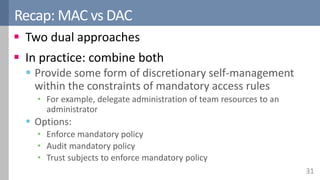
 Two dual approaches
 In practice: combine both
 Provide some form of discretionary self-management
within the constraints of mandatory access rules
• For example, delegate administration of team resources to an
administrator
 Options:
• Enforce mandatory policy
• Audit mandatory policy
• Trust subjects to enforce mandatory policy
32
How permissions are assigned
Existing models
33
 Identity-based access control
 Multi-level access control
 Role-based access control (RBAC)
 Attribute-based access control (ABAC)
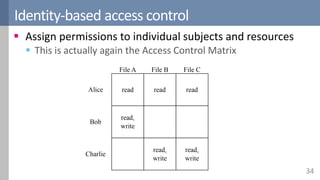
Identity-based access control
34
 Assign permissions to individual subjects and resources
 This is actually again the Access Control Matrix
File A File B
Jane
Read
Write
John Read
Read
Write
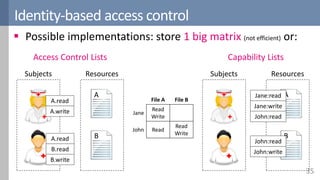
Identity-based access control
35
 Possible implementations: store 1 big matrix (not efficient) or:
Subjects Resources
A
BA.read
B.read
B.write
A.read
A.write
Access Control Lists
Subjects Resources
A
B
John:read
John:write
Jane:read
Jane:write
Capability Lists
John:read
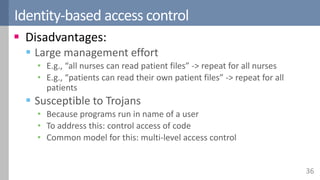
Identity-based access control
36
 Disadvantages:
 Large management effort
• E.g., “all nurses can read patient files” -> repeat for all nurses
• E.g., “patients can read their own patient files” -> repeat for all
patients
 Susceptible to Trojans
• Because programs run in name of a user
• To address this: control access of code
• Common model for this: multi-level access control
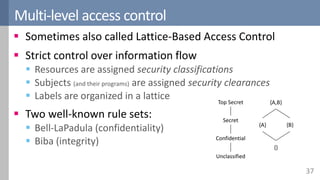
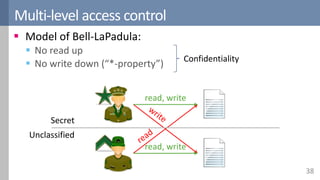
Multi-level access control
 Sometimes also called Lattice-Based Access Control
 Strict control over information flow
 Resources are assigned security classifications
 Subjects (and their programs) are assigned security clearances
 Labels are organized in a lattice
 Two well-known rule sets:
 Bell-LaPadula (confidentiality)
 Biba (integrity)
37
{A} {B}
{}
{A,B}Top Secret
Secret
Confidential
Unclassified
Multi-level access control
38
 Model of Bell-LaPadula:
 No read up
 No write down (“*-property”) Confidentiality
read, write
Unclassified
read, write
Secret
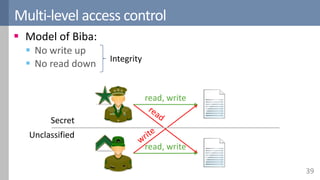
Multi-level access control
39
 Model of Biba:
 No write up
 No read down Integrity
read, write
Unclassified
read, write
Secret
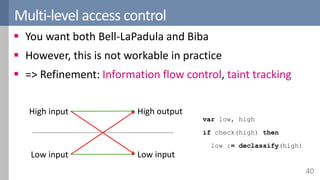
Multi-level access control
40
 You want both Bell-LaPadula and Biba
 However, this is not workable in practice
 => Refinement: Information flow control, taint tracking
var low, high
if check(high) then
low := declassify(high)
Low input
High input
Low input
High output
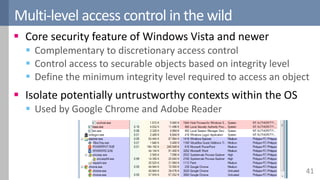
Multi-level access control in the wild
 Core security feature of Windows Vista and newer
 Complementary to discretionary access control
 Control access to securable objects based on integrity level
 Define the minimum integrity level required to access an object
 Isolate potentially untrustworthy contexts within the OS
 Used by Google Chrome and Adobe Reader
41
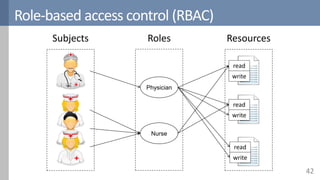
Role-based access control (RBAC)
42
Resources
read
write
read
write
read
write
Roles
Nurse
Physician
Subjects
Role-based access control (RBAC)
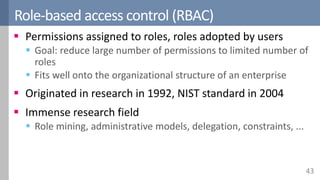
 Permissions assigned to roles, roles adopted by users
 Goal: reduce large number of permissions to limited number of
roles
 Fits well onto the organizational structure of an enterprise
 Originated in research in 1992, NIST standard in 2004
 Immense research field
 Role mining, administrative models, delegation, constraints, ...
43
Role-based access control (RBAC)
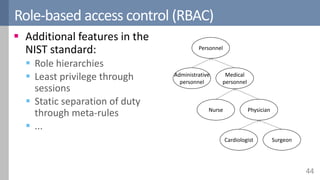
 Additional features in the
NIST standard:
 Role hierarchies
 Least privilege through
sessions
 Static separation of duty
through meta-rules
 ...
Nurse
Personnel
Administrative
personnel
Medical
personnel
Physician
Cardiologist Surgeon
44
RBAC in the wild
45
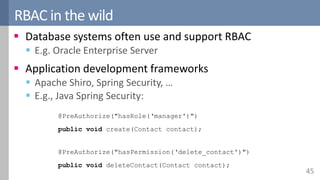
 Database systems often use and support RBAC
 E.g. Oracle Enterprise Server
 Application development frameworks
 Apache Shiro, Spring Security, …
 E.g., Java Spring Security:
@PreAuthorize("hasRole(‘manager')")
public void create(Contact contact);
@PreAuthorize("hasPermission(‘delete_contact')")
public void deleteContact(Contact contact);
Role-based access control (RBAC)
46
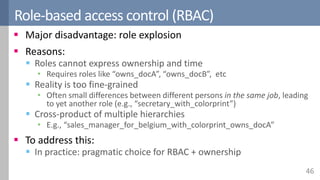
 Major disadvantage: role explosion
 Reasons:
 Roles cannot express ownership and time
• Requires roles like “owns_docA”, “owns_docB”, etc
 Reality is too fine-grained
• Often small differences between different persons in the same job, leading
to yet another role (e.g., “secretary_with_colorprint”)
 Cross-product of multiple hierarchies
• E.g., “sales_manager_for_belgium_with_colorprint_owns_docA”
 To address this:
 In practice: pragmatic choice for RBAC + ownership
Research: large number of extensions proposed
Role-based access control (RBAC)
47
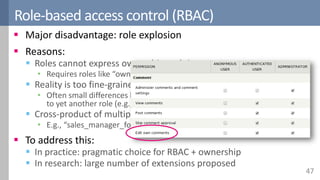
 Major disadvantage: role explosion
 Reasons:
 Roles cannot express ownership and time
• Requires roles like “owns_docA”, “owns_docB”, etc
 Reality is too fine-grained
• Often small differences between different persons in the same job, leading
to yet another role (e.g., “secretary_with_colorprint”)
 Cross-product of multiple hierarchies
• E.g., “sales_manager_for_belgium_with_colorprint_owns_docA”
 To address this:
 In practice: pragmatic choice for RBAC + ownership
 In research: large number of extensions proposed
Attribute-based Access Control (ABAC)
48
Subject
Identity
Location
Department
Resource
Type
Date
Conf. label
Action Action Type
Environment
Device Type
Timestamp
System state
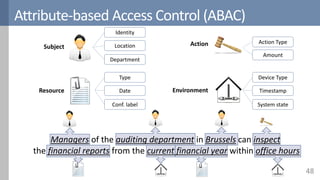
Managers of the auditing department in Brussels can inspect
the financial reports from the current financial year within office hours
Amount
Attribute-based Access Control (ABAC)
49
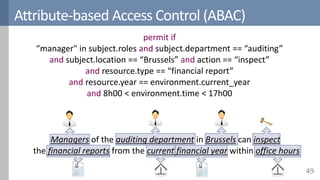
permit if
“manager" in subject.roles and subject.department == “auditing”
and subject.location == “Brussels” and action == “inspect”
and resource.type == “financial report”
and resource.year == environment.current_year
and 8h00 < environment.time < 17h00
Managers of the auditing department in Brussels can inspect
the financial reports from the current financial year within office hours
Attribute-based Access Control (ABAC)
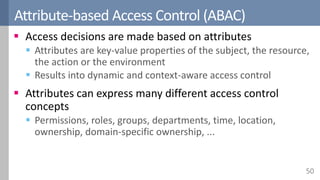
 Access decisions are made based on attributes
 Attributes are key-value properties of the subject, the resource,
the action or the environment
 Results into dynamic and context-aware access control
 Attributes can express many different access control
concepts
 Permissions, roles, groups, departments, time, location,
ownership, domain-specific ownership, ...
50
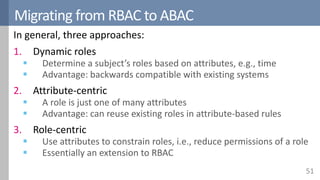
Migrating from RBAC to ABAC
51
In general, three approaches:
1. Dynamic roles
 Determine a subject’s roles based on attributes, e.g., time
 Advantage: backwards compatible with existing systems
2. Attribute-centric
 A role is just one of many attributes
 Advantage: can reuse existing roles in attribute-based rules
3. Role-centric
 Use attributes to constrain roles, i.e., reduce permissions of a role
 Essentially an extension to RBAC
ABAC is more than expressing rules
52Source: [NIST2014]
Not all rainbows and unicorns
53
Trust chain for Access Control Lists
Source: [NIST2014]
Not all rainbows and unicorns
54Trust chain for ABAC
Source: [NIST2014]
ABAC: Conclusion
55
 ABAC brings many interesting improvements compared to
previous models
 ABAC is seen by many as the next step in access control
 => Definitely something you should consider, but not a
small step to take
 Further reading: [NIST2014]
 Overview of ABAC, challenges and enterprise considerations
56
Advanced topics
Advanced topics
57
 Relationship-Based Access Control
 Originated from social networks
 Further reading: [Cheng2012, Fong2011]
 Entity-Based Access Control
 Express access rules in terms of the entities in your application
• Attributes + relationships
 Fixes limitations of ABAC
 I expect a lot of this,
but still a long way to go
 Further reading:
• [Crampton2014]
• [Bogaerts2015]
Advanced topics
58
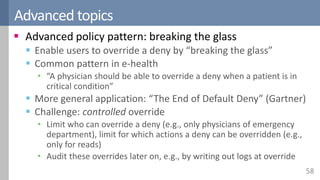
 Advanced policy pattern: breaking the glass
 Enable users to override a deny by “breaking the glass”
 Common pattern in e-health
• “A physician should be able to override a deny when a patient is in
critical condition”
 More general application: “The End of Default Deny” (Gartner)
 Challenge: controlled override
• Limit who can override a deny (e.g., only physicians of emergency
department), limit for which actions a deny can be overridden (e.g.,
only for reads)
• Audit these overrides later on, e.g., by writing out logs at override
Advanced topics
59
 Advanced policy pattern: separation of duty
 Separate duties within an organization
 Statically:
• E.g., “a manager can never also be a secretary”
• E.g., “a manager cannot approve his own funding requests”
 Dynamically:
• E.g., “if a user has had access to documents of Bank A, he or she is not
allowed to access documents of Bank B”
• Originally described in 1989 as the “Chinese wall policy”, a “commercial
security policy” in contrast to “Bell-LaPadula-style policies” [Brewer1989]
 Very relevant because of Sarbanes-Oxley, but still a hard problem
• Hard to apply to an organization
• Hard to implement well (performance issues)
Advanced topics
60
 History-based access control
 E.g., dynamic separation of duty
 E.g., limit the number of accesses
• “a user cannot watch more than 10 movies per month”
 Implementation options:
 Use log files in the policy evaluation
 Use provenance data in the policy evaluation [Nguyen2012, Nguyen2013]
 Explicitly update history attributes [Decat2015]
Advanced topics
61
 History-based access control
 E.g., dynamic separation of duty
 E.g., limit the number of accesses
• “a user cannot watch more than 10 movies per month”
 Implementation options:
 Use log files in the policy evaluation
 Use provenance data in the policy evaluation [Nguyen2012, Nguyen2013]
 Explicitly update history attributes [Decat2015]
When resource.owner == “Bank B”,
apply DenyOverrides to
Deny if
“Bank A” in subject.history
Permit performing
append(“Bank B”, subject.history)
Obligations
Advanced topics
62
 Obligations
 Early definition: “predicates that verify mandatory requirements a
subject has to perform before or during a usage exercise” [Park2004]
• Pre-obligations, ongoing-obligations
• Examples:
• User has to agree to terms and conditions (pre)
• User has to be shown an ad during watching the requested movie (ongoing)
 More pragmatic definition: action that should be performed with
permitting/denying the action
• Send an e-mail to an administrator on deny to a confidential document
• Write out log
• Update attribute
Outline
63
 Introduction
 Positioning access control
 Access control models
 How to enforce access control
 Reference monitors
 Access control in application code
• Policy-based access control
 The bigger picture
 Some important technologies in practice
 Recap and conclusion
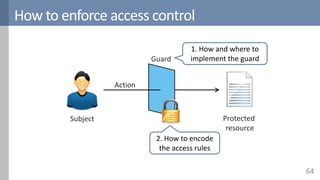
How to enforce access control
64
Subject
Guard
Protected
resource
Action
1. How and where to
implement the guard
2. How to encode
the access rules
Access control exists on multiple levels
Level Subject Action Guard
Protected
System
Hardware OS Process Read memory CPU
CPU and
Memory
Network Host Send packets Firewall Intranet
Database User SELECT query DBMS User database
OS User Open file OS Kernel Filesystem
OS Java Program Open file
Java Security
Manager
Filesystem
Application User
Read patient
file
Application
code
Application
data 65
Reference monitors
66
 Reference monitors
 Observe software execution
 Take remedial action on operations that violate a policy
 Three important security properties
 Full mediation
 Tamper proof
 Verifiable
Application
Kernel
RM
Application
Kernel
RM
RM
Kernel
Application
Traditional Interpreter Inline
[Erlingsson2004]
Example of a reference monitor
67
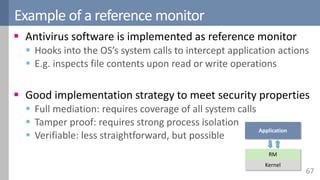
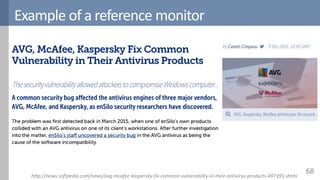
 Antivirus software is implemented as reference monitor
 Hooks into the OS’s system calls to intercept application actions
 E.g. inspects file contents upon read or write operations
 Good implementation strategy to meet security properties
 Full mediation: requires coverage of all system calls
 Tamper proof: requires strong process isolation
 Verifiable: less straightforward, but possible
Application
Kernel
RM
Example of a reference monitor
68
http://news.softpedia.com/news/avg-mcafee-kaspersky-fix-common-vulnerability-in-their-antivirus-products-497395.shtml
Application-level access control
69
 Reference monitors:
 Constrain untrusted code
 Can be applied to a program without having to modify it
 Can only reason in terms of interface operations, e.g., system calls
 Application-level access control:
 Rules reason about the concepts in your application
 Add guard to code of your application
 The same holds:
• Full mediation
• Tamper proof
• Verifiable
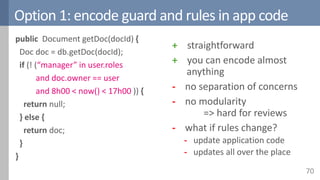
Option 1: encode guard and rules in app code
70
public Document getDoc(docId) {
Doc doc = db.getDoc(docId);
if (! (“manager” in user.roles
and doc.owner == user
and 8h00 < now() < 17h00 )) {
return null;
} else {
return doc;
}
}
+ straightforward
+ you can encode almost
anything
- no separation of concerns
- no modularity
=> hard for reviews
- what if rules change?
- update application code
- updates all over the place
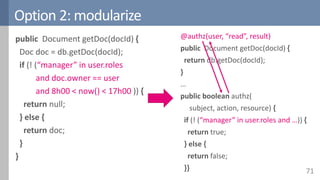
Option 2: modularize
71
public Document getDoc(docId) {
Doc doc = db.getDoc(docId);
if (! (“manager” in user.roles
and doc.owner == user
and 8h00 < now() < 17h00 )) {
return null;
} else {
return doc;
}
}
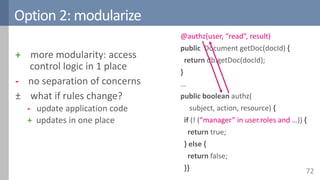
@authz(user, “read”, result)
public Document getDoc(docId) {
return db.getDoc(docId);
}
…
public boolean authz(
subject, action, resource) {
if (! (“manager” in user.roles and …)) {
return true;
} else {
return false;
}}
Option 2: modularize
72
+ more modularity: access
control logic in 1 place
- no separation of concerns
± what if rules change?
- update application code
+ updates in one place
@authz(user, “read”, result)
public Document getDoc(docId) {
return db.getDoc(docId);
}
…
public boolean authz(
subject, action, resource) {
if (! (“manager” in user.roles and …)) {
return true;
} else {
return false;
}}
Option 2: modularize - Django
73
settings.py:
AUTHENTICATION_BACKENDS = [
‘mymodule.MyBackend’
]
mymodule/backends.py:
class MyBackend(object):
...
def has_perm(self, user, perm, obj):
if obj.owner == user.id:
return True
else:
return False
https://docs.djangoproject.com/en/1.9/topics/auth/customizing
Option 2: modularize – Ruby on Rails
74
In the controller:
def show
@article = Article.find(params[:id])
authorize! :read, @article
end
In the view:
<% if can? :update, @article %>
<%= link_to "Edit",
edit_article_path(@article) %>
<% end %>
The access control code:
class Ability
include CanCan::Ability
def initialize(user)
if user.admin?
can :manage, :all
else
can :read, :all
end
end
end
https://github.com/ryanb/cancan
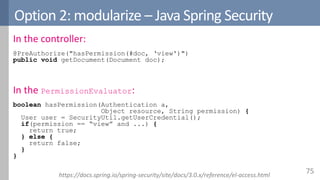
Option 2: modularize – Java Spring Security
75
In the controller:
@PreAuthorize("hasPermission(#doc, ‘view')")
public void getDocument(Document doc);
In the PermissionEvaluator:
boolean hasPermission(Authentication a,
Object resource, String permission) {
User user = SecurityUtil.getUserCredential();
if(permission == “view” and ...) {
return true;
} else {
return false;
}
}
https://docs.spring.io/spring-security/site/docs/3.0.x/reference/el-access.html
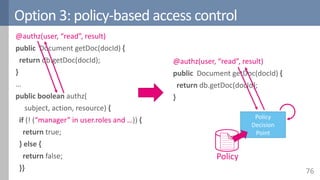
Option 3: policy-based access control
76
@authz(user, “read”, result)
public Document getDoc(docId) {
return db.getDoc(docId);
}
Policy
Decision
Point
Policy
@authz(user, “read”, result)
public Document getDoc(docId) {
return db.getDoc(docId);
}
…
public boolean authz(
subject, action, resource) {
if (! (“manager” in user.roles and …)) {
return true;
} else {
return false;
}}
Option 3: policy-based access control
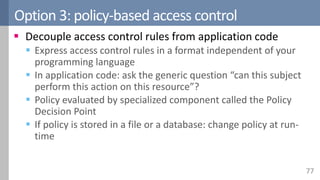
77
 Decouple access control rules from application code
 Express access control rules in a format independent of your
programming language
 In application code: ask the generic question “can this subject
perform this action on this resource”?
 Policy evaluated by specialized component called the Policy
Decision Point
 If policy is stored in a file or a database: change policy at run-
time
Advantages of PBAC
78
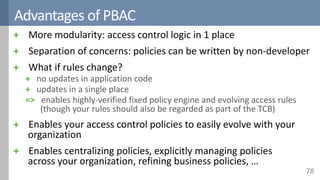
+ More modularity: access control logic in 1 place
+ Separation of concerns: policies can be written by non-developer
+ What if rules change?
+ no updates in application code
+ updates in a single place
=> enables highly-verified fixed policy engine and evolving access rules
(though your rules should also be regarded as part of the TCB)
+ Enables your access control policies to easily evolve with your
organization
+ Enables centralizing policies, explicitly managing policies
across your organization, refining business policies, …
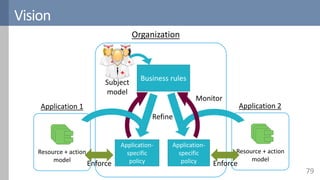
Vision
79
Resource + action
model
Application 2
Business rules
Application-
specific
policy
Refine
Subject
model
Organization
Resource + action
model
Application 1
Application-
specific
policy EnforceEnforce
Monitor
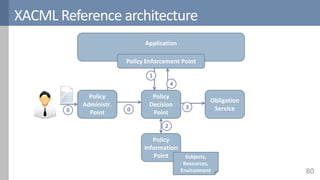
XACML Reference architecture
80
Application
Policy Enforcement Point
Obligation
Service
Policy
Decision
Point
Policy
Administr.
Point
Policy
Information
Point Subjects,
Resources,
Environment
1
2
4
30 0
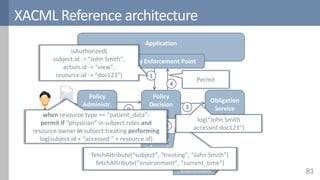
XACML Reference architecture
81
Application
Policy Enforcement Point
Obligation
Service
Policy
Decision
Point
Policy
Administr.
Point
Policy
Information
Point Subjects,
Resources,
Environment
1
2
4
30 0
isAuthorized(
subject.id -> “John Smith”,
action.id -> “view”,
resource.id -> “doc123”)
fetchAttribute(“subject”, “treating”, “John Smith”)
fetchAttribute(“environment”, “current_time”)
log(“John Smith
accessed doc123”)
when resource.type == “patient_data”:
permit if “physician” in subject.roles and
resource.owner in subject.treating performing
log(subject.id + “accessed ” + resource.id)
Permit
Policy languages
82
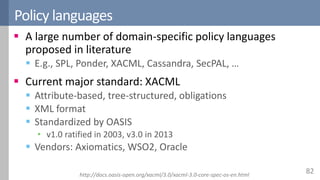
 A large number of domain-specific policy languages
proposed in literature
 E.g., SPL, Ponder, XACML, Cassandra, SecPAL, …
 Current major standard: XACML
 Attribute-based, tree-structured, obligations
 XML format
 Standardized by OASIS
• v1.0 ratified in 2003, v3.0 in 2013
 Vendors: Axiomatics, WSO2, Oracle
http://docs.oasis-open.org/xacml/3.0/xacml-3.0-core-spec-os-en.html
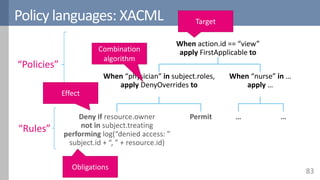
Policy languages: XACML
83
Deny if resource.owner
not in subject.treating
performing log(“denied access: ”
subject.id + “, ” + resource.id)
Permit
When “physician” in subject.roles,
apply DenyOverrides to
Obligations
Target
“Policies”
“Rules”
When action.id == “view”
apply FirstApplicable to
…
When “nurse” in …
apply …
…
Effect
Combination
algorithm
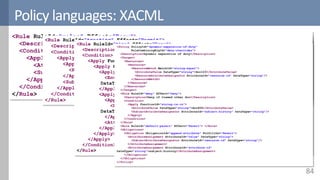
Policy languages: XACML
84
<Rule RuleId=“roles" Effect="Deny">
<Description>This is just the single rule for the above policy.</Description>
<Condition>
<Apply FunctionId="string-is-in">
<AttributeValue DataType="string">physician</AttributeValue>
<SubjectAttributeDesignator AttributeId="subject:roles" DataType="string"/>
</Apply>
</Condition>
</Rule>
<Rule RuleId=“treating" Effect="Permit">
<Description>Treating</Description>
<Condition>
<Apply FunctionId="urn:oasis:names:tc:xacml:1.0:function:string-is-in">
<Apply FunctionId="urn:oasis:names:tc:xacml:1.0:function:string-one-and-only">
<ResourceAttributeDesignator AttributeId="resource:owner" DataType="string"/>
</Apply>
<SubjectAttributeDesignator AttributeId="subject:treating" DataType="string"/>
</Apply>
</Condition>
</Rule>
<Rule RuleId=“time" Effect="Deny">
<Description>Time</Description>
<Condition>
<Apply FunctionId="not">
<Apply FunctionId="dateTime-less-than-or-equal">
<Apply FunctionId="dateTime-one-and-only">
<EnvironmentAttributeDesignator AttributeId="environment:currentDateTime"
DataType="dateTime"/>
</Apply>
<Apply FunctionId="dateTime-add-dayTimeDuration">
<Apply FunctionId="dateTime-one-and-only">
<ResourceAttributeDesignator AttributeId="resource:created"
DataType="dateTime"/>
</Apply>
<AttributeValue DataType="dayTimeDuration">P5D</AttributeValue>
</Apply>
</Apply>
</Apply>
</Condition>
</Rule>
<Policy PolicyId=“dynamic-separation-of-duty"
RuleCombiningAlgId=“deny-overrides">
<Description>Dynamic separation of duty</Description>
<Target>
<Resources>
<Resource>
<ResourceMatch MatchId="string-equal">
<AttributeValue DataType="string">doc123</AttributeValue>
<ResourceAttributeDesignator AttributeId="resource:id" DataType="string"/>
</ResourceMatch>
</Resource>
</Resources>
</Target>
<Rule RuleId="deny" Effect=“Deny">
<Description>Deny if viewed other doc</Description>
<Condition>
<Apply FunctionId="string-is-in">
<AttributeValue DataType="string">doc456</AttributeValue>
<SubjectAttributeDesignator AttributeId="subject:history" DataType="string"/>
</Apply>
</Condition>
</Rule>
<Rule RuleId=“default-permit" Effect=“Permit"> </Rule>
<Obligations>
<Obligation ObligationId="append-attribute" FulfillOn="Permit">
<AttributeAssignment AttributeId="value" DataType="string">
<SubjectAttributeDesignator AttributeId="resource:id" DataType="string"/>
</AttributeAssignment>
<AttributeAssignment AttributeId="attribute-id"
DataType="string">subject:history</AttributeAssignment>
</Obligation>
</Obligations>
</Policy>
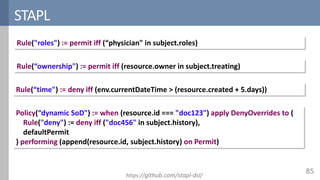
STAPL
85
Rule("roles") := permit iff (“physician" in subject.roles)
Rule(“ownership") := permit iff (resource.owner in subject.treating)
Rule(“time") := deny iff (env.currentDateTime > (resource.created + 5.days))
Policy(“dynamic SoD") := when (resource.id === "doc123") apply DenyOverrides to (
Rule("deny") := deny iff ("doc456" in subject.history),
defaultPermit
) performing (append(resource.id, subject.history) on Permit)
https://github.com/stapl-dsl/
PBAC in research: Amusa
86[Decat2015b]
PBAC in research: Amusa
87
Subject.id, subject.tenant, resource.tenant
Strict tenant isolation
Subject.tenant_credit, subject.email, …
Deny if subj.tenant_credit < action.cost
Subject.assigned_customers
Deny if not res.owner in
subj.assigned_customers
Subject.region
Deny if
subj.region != “Europe”
1. Three-layered mgmt
3. Supporting architecture 4. Low-effort API
[Decat2015b]
2. Secure policy combination
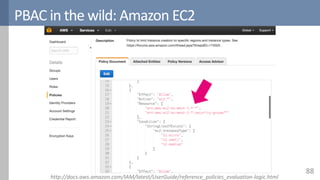
PBAC in the wild: Amazon EC2
88
http://docs.aws.amazon.com/IAM/latest/UserGuide/reference_policies_evaluation-logic.html
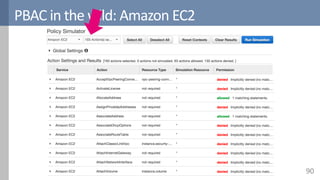
PBAC in the wild: Amazon EC2
90
Advantages of PBAC
91
+ More modularity: access control logic in 1 place
+ Separation of concerns: policies can be written by non-developer
+ What if rules change?
+ no updates in application code
+ updates in a single place
+ Enables your access control policies to easily evolve with your
organization
+ Enables centralizing policies, explicitly managing policies
across your organization, refining business policies, …
Not all rainbows and unicorns
92
 Very interesting technology, great vision to work towards
 But, externalizing authorization logic from an application is just very
hard:
 Different way of coding
 Policy languages are not self-explanatory
 Requires processes for managing policies within your organization
 Requires supporting tools such as editors and correctness tests
 Requires interoperability if you want to centralize authorization for multiple
applications
 Your trusted computing base and trust chains grow significantly
 …
 Plus, from my research experience: inherently hard to decouple
authorization logic from an application because these rules should still say
something about this application
PBAC: Conclusions
93
 PBAC:
 A lot is expected of this technology
 Enables exciting new stuff
 But imho currently still too hard to apply in practice
 My recommendation for now:
 Modularize authorization in your application code (option 2)
• Provides benefits by itself + future-proof
Outline
94
 Introduction
 Positioning access control
 Access control models
 How to enforce access control
 The bigger picture
 Some important technologies in practice
 Recap and conclusion
The bigger picture: IAM
95[Source: Gartner]
The bigger picture: IAM
96[Source: Gartner]
Outline
97
 Introduction
 Positioning access control
 Access control models
 How to enforce access control
 The bigger picture
 Some important technologies in practice
 Recap and conclusion
Federated authentication
98
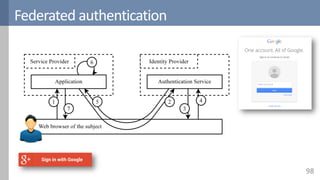
Federated authentication
99
 Externalizes authorization from a remote application
 Advantages:
 Lowers the amount of passwords and therefore password reuse
 Can be used to centralize user mgmt for an organization
 Removes the need to store passwords in an application
 Standards:
 OpenID: light-weight, fixed schema, mainly for consumer
applications, deprecated
 SAML: more heavy-weight, extensible, more suitable for
enterprise scenarios
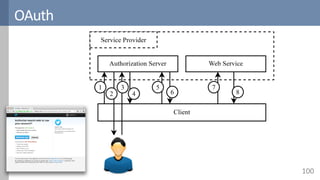
OAuth
100
OAuth
101
 Constrained delegation of access, mostly to 3rd party
applications
 For example, grant a mobile client access to your Twitter stream
 Also works well with web services and micro-service
architectures
 A simplified form of federated authorization
 OAuth 1.0 (2010) was a protocol, OAuth 2.0 (2012) is more a
framework
 Interoperability suffers…
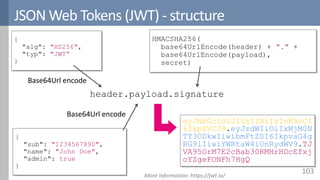
JSON Web Tokens (JWT)
102
 A recent standardized format to communicate key-value
information between parties on the web
 Commonly used for authentication or authorization info, e.g., in
OAuth
 Typically sent in the Authorization header using the Bearer schema
• Authorization: Bearer <token>
 Format: encoded JSON
 Properties: compact, URL-safe, digitally signed for integrity
https://jwt.io/
JSON Web Tokens (JWT) - structure
103
header.payload.signature
More information: https://jwt.io/
{
"alg": "HS256",
"typ": "JWT“
}
Base64Url encode
HMACSHA256(
base64UrlEncode(header) + "." +
base64UrlEncode(payload),
secret)
{
"sub": "1234567890",
"name": "John Doe",
"admin": true
}
Base64Url encode
eyJhbGciOiJIUzI1NiIsInR5cCI
6IkpXVCJ9.eyJzdWIiOiIxMjM0N
TY3ODkwIiwibmFtZSI6IkpvaG4g
RG9lIiwiYWRtaW4iOnRydWV9.TJ
VA95OrM7E2cBab30RMHrHDcEfxj
oYZgeFONFh7HgQ
OpenID Connect
104
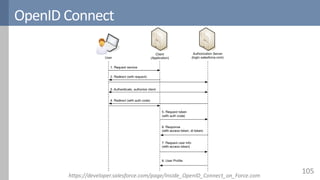
 Identity layer on top of the OAuth 2.0
 Achieves many of the authentication features of OpenID,
but in a more API-friendly and app-friendly way
 Get basic user info from AuthZ Server of OAuth, get more details
from user mgmt API using the OAuth token
 OpenID is considered deprecated, OpenID Connect (OIDC)
is considered the successor
http://openid.net/connect/
OpenID Connect
105https://developer.salesforce.com/page/Inside_OpenID_Connect_on_Force.com
Outline
106
 Introduction
 Positioning access control
 Access control models
 How to enforce access control
 The bigger picture
 Recap and conclusion
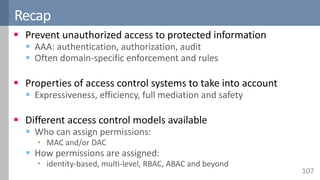
Recap
 Prevent unauthorized access to protected information
 AAA: authentication, authorization, audit
 Often domain-specific enforcement and rules
 Properties of access control systems to take into account
 Expressiveness, efficiency, full mediation and safety
 Different access control models available
 Who can assign permissions:
• MAC and/or DAC
 How permissions are assigned:
• identity-based, multi-level, RBAC, ABAC and beyond
107
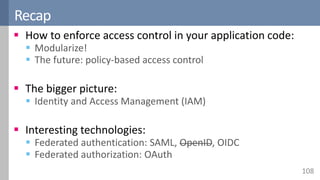
Recap
 How to enforce access control in your application code:
 Modularize!
 The future: policy-based access control
 The bigger picture:
 Identity and Access Management (IAM)
 Interesting technologies:
 Federated authentication: SAML, OpenID, OIDC
 Federated authorization: OAuth
108
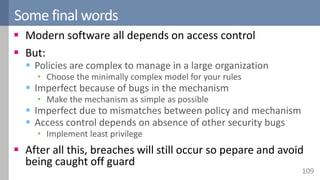
Some final words
109
 Modern software all depends on access control
 But:
 Policies are complex to manage in a large organization
• Choose the minimally complex model for your rules
 Imperfect because of bugs in the mechanism
• Make the mechanism as simple as possible
 Imperfect due to mismatches between policy and mechanism
 Access control depends on absence of other security bugs
• Implement least privilege
 After all this, breaches will still occur so pepare and avoid
being caught off guard
CWE/SANS Top 25 Software Errors
Rank Description
5 Missing authentication for critical function
6 Missing authorization
7 Use of hard-coded credentials
8 Missing encryption of sensitive data
10 Reliance on untrusted inputs in a security decision
11 Execution with unnecessary privileges
15 Incorrect authorization
17 Incorrect permission assignment for critical resource
19 Use of a broken or risky cryptographic algorithm
21 Improper restriction of authentication attempts
25 Use of a one-way hash without a salt
110
References
111
 [Bogaerts2015] Bogaerts, J., Decat, M., Lagaisse, B., and Joosen, W. Entity-based access
control: supporting more expressive access control policies. ACSAC 2015
 [Brewer1989] Brewer, D., and Nash, M. The Chinese Wall security policy. In IEEE Security and
Privacy, 1989
 [Cheng2012] Cheng, Y., Park, J., and Sandhu, R. A User-to-User Relationship-Based Access
Control Model for Online Social Networks. 2012
 [Crampton2014] Crampton, J., and Sellwood, J. Path Conditions and Principal Matching: A
New Approach to Access Control. SACMAT 2014
 [Decat2015] Decat, M., Lagaisse, B., and Joosen, W. Scalable and secure concurrent
evaluation of history-based access control policies. ACSAC ’15
 [Decat2015b] Decat, M., Bogaerts, J., Lagaisse, B., and Joosen, W. Amusa: Middleware for
Efficient Access Control Management of Multi-tenant SaaS Applications. SAC 2015
 [Erlingsson2004] Erlingsson, Úlfar. The inlined reference monitor approach to security policy
enforcement. 2004.
 [Fong2011] Fong, P. W. Relationship-based Access Control: Protection Model and Policy
Language, CODASPY 2011
References
112
 [Graham1972] G. Scott Graham and Peter J. Denning. Protection: principles and practice.
AFIPS 1972
 [Harrison1976] Michael A. Harrison, Walter L. Ruzzo, and Jeffrey D. Ullman. Protection in
operating systems. 1976
 [Kuhn2010] Kuhn, D. R., Coyne, E. J., and Weil, T. R. Adding attributes to role-based access
control. 2010
 [Lampson1971] Lampson, B. W. Protection. ACM SIGOPS Operating Systems Review, 1971
 [Nguyen2012] Park, J., Nguyen, D., and Sandhu, R. A provenance-based access control
model. Privacy, Security and Trust (PST) 2012
 [Nguyen2013] Nguyen, D., Park, J., and Sandhu, R. A provenance-based access control model
for dynamic separation of duties. Privacy, Security and Trust (PST) 2013
 [NIST2014] Hu, V., Ferraiolo, D., Kuhn, R., Schnitzer, A., Sandlin, K., Miller, R., and Scarfone, K.
Guide to Attribute Based Access Control (ABAC) Definition and Considerations. NIST 2014.
 [Park2004] Park, Jaehong, and Ravi Sandhu. The UCON ABC usage control model. ACM
Transactions on Information and System Security (TISSEC), 2004
Accreditation
113
 Red door: http://gomighty.com/user/meg/
 Banking application: https://kbctouch.kbc.be/
 Login form: https://w3layouts.com/wp-content/uploads/2014/01/facebook-twitter-google-login.jpg
 Policy man halt: https://pixabay.com/static/uploads/photo/2012/04/01/18/03/policeman-
23796_960_720.png
 Policy man traffic fine: http://www.buyautoinsurance.com/wp-content/featured-
content/seatbelt/images/traffic-ticket.png
Access Control
SecAppDev 2016
Maarten Decat
maarten.decat@kuleuven.be
/in/maartendecat
http://maarten.decat.me/
@maartendecat

An overview of access control

  • 1.
    Access Control SecAppDev 2016 MaartenDecat @maartendecat maarten.decat@kuleuven.be
  • 2.
    What is accesscontrol?  As any security: confidentiality, integrity, availability  Layer in between (malicious) users and the protected system  Part of the Trusted Computing Base 2 Access control is the part of security that constrains the actions that are performed in a system based on access control rules.
  • 3.
    What is accesscontrol? 3 1. Not easy to get right, e.g., what about windows? 2. Difference between access rules and mechanism 3. Different mechanisms have different properties 4. Different mechanisms support different rules
  • 4.
  • 5.
  • 6.
    Outline 6  Introduction  Positioningaccess control  Access control models  How to enforce access control  The bigger picture  Some important technologies in practice  Recap and conclusion
  • 7.
    10,000m point ofview 7 User Subject Principal Guard Protected resource (Object) Action
  • 8.
    But there ismore to it 8 Access control AuthorizationAuthentication Audit
  • 9.
    But there ismore to it 9 Access control … AuthorizationAuthentication Audit … Secure audit Federated authN User behavior analytics Access control models Policy-based access control Performance tactics … Multi-factor authN Passwords
  • 10.
    5000m point ofview 10 Authentication User Subject Principal Guard Protected resource Action Writes out security logs Performs authorization Audit security logs, revert and punish if needed Audit security logs, revert and punish if needed
  • 11.
    For the restof this presentation 11 Subject Guard Resource Action “Access control” = “authorization”
  • 12.
    Authorization exists onmultiple levels Level Subject Action Guard Protected System Hardware OS Process Read memory CPU CPU and Memory Network Host Send packets Firewall Intranet Database User SELECT query DBMS User database OS User Open file OS Kernel Filesystem OS Java Program Open file Java Security Manager Filesystem Application User Read patient file Application code Application data 12
  • 13.
    Models, policies andmechanisms 13  Guard is responsible for mediating access  Authorize specific actions  Mechanism that enforces a specific security policy  Rules, policies, models and mechanisms  Access rules: the logical access rules, independent of representation  Policy: an explicit representation of the desired rules in a SW artifact  Model: (formal) representation of how rules can be expressed  Mechanism: low-level implementation of controls  Access control seems straightforward… but is it?
  • 14.
    Challenges for accesscontrol 14  Expressiveness: can the high-level rules be expressed in terms of the access control model?  Performance: access control decisions are frequent, and must be dealt with quickly  Full mediation: does the guard check every action? Does your policy cover every action?  Safety: does the access control mechanism match the policy?
  • 15.
    CWE/SANS Top 25Software Errors Rank Description 5 Missing authentication for critical function 6 Missing authorization 7 Use of hard-coded credentials 8 Missing encryption of sensitive data 10 Reliance on untrusted inputs in a security decision 11 Execution with unnecessary privileges 15 Incorrect authorization 17 Incorrect permission assignment for critical resource 19 Use of a broken or risky cryptographic algorithm 21 Improper restriction of authentication attempts 25 Use of a one-way hash without a salt 15
  • 16.
    Outline 16  Introduction  Positioningaccess control  Access control models  The basics  Who can assign permissions  How permissions are assigned  Advanced topics  How to enforce access control  The bigger picture  Some important technologies in practice  Recap and conclusion
  • 17.
    The basics: theaccess control matrix 17 Permissions [Lampson1971] Resources Subjects
  • 18.
    18 Who can assignpermissions?
  • 19.
    Who can assignpermissions? 19  In general, two approaches: 1. Mandatory access control (MAC)  By central authority 2. Discretionary access control (DAC)  By subjects themselves
  • 20.
    Mandatory access control(MAC) 20  Permissions are assigned by a central authority according to a central policy  Good fit within organizations with a strong need for central controls  Low flexibility and high management overhead  Mandatory Access Control in use  Often linked to multi-level security systems -> see later on • E.g. Government-regulated secrecy systems, military applications  Modern operating systems, to separate applications and processes • E.g. Windows’ Mandatory Integrity Control, SELinux, TrustedBSD
  • 21.
    SELinux 21  Security-Enhanced Linux “A set of patches to the Linux kernel and some utilities to incorporate a strong, flexible MAC architecture into the major subsystems of the kernel [for] confidentiality and integrity”  Activated by default in Fedora, Red Hat Enterprise Linux, etc  Enforce MAC policy to processes in order to limit access to files and network resources  Least privilege  Policy-based (see later on)  Separation of policy from enforcement with well-defined policy interfaces  Changing a policy does not require a reboot
  • 22.
    SELinux 22 ~]$ ls -Z/usr/bin/passwd -rwsr-xr-x. root root system_u:object_r:passwd_exec_t:s0 /usr/bin/passwd ~]$ ls -Z /etc/shadow ----------. root root system_u:object_r:shadow_t:s0 /etc/shadow user:role:type:level SELinux policies: - applications running in the passwd_t domain can access files labeled with the shadow_t type - the passwd_t domain can be entered from the passwd_exec_t type
  • 23.
    Discretionary access control(DAC) 23  Permissions are set at the discretion of the resource owner  Highly flexible policy, where permissions can be transferred  Lack of central control makes revocation or changes difficult  Discretionary acces control in use  Controlling access to files • E.g., Windows Access Control Lists (ACL), UNIX file handles  Controlling the sharing of personal information • E.g., Social networks
  • 24.
    The Graham-Denning Model Extends the access control matrix with control and ownership  Objects have an owner  Subjects have a controller  Permissions can be made transferrable  Matrix can be modified by 8 commands  Creating and destroying subjects and objects  Granting, transferring and revoking permissions  Inspecting the authorization state 24 Alice Bob File 1 File 2 File 3 Alice control owner owner read write owner read* Bob control read write owner read [Graham1972]
  • 25.
    The Graham-Denning Model 25 1.Subject Alice creates object File 1 2. Subject Alice creates subject P1 Alice File 1 Alice control owner Alice P1 Alice control owner P1 control 3. Subject Alice destroys object File 1 Alice must own File 1 Alice File 1 Alice control owner 4. Subject Alice destroys subject P1 Alice must own P1 Alice P1 Alice control owner P1 control
  • 26.
    The Graham-Denning Model 26 AliceP1 File 1 Alice control control owner owner P1 read 5. Subject Alice grants a right read/read* on File 1 to P1 Alice must be owner of File 1 6. Subject Alice transfers a right read/read* on File 1 to P1 Alice must have a right read* on File 1 Alice P1 File 1 Alice control control owner read* P1 read 7. Subject Alice deletes a right read/read* on File 1 from P1 Alice must control P1 or Alice must own File 1 Alice P1 File 1 Alice control control owner read* P1 read Only rights with a * are transferrable
  • 27.
    The Principle ofLeast Privilege  Processes run on user’s behalf  No privilege separation  Alice’s program would be able to write File 1  How can Alice run a process P1 that can only read File 1? 27 Alice File 1 File 2 Alice control owner read write owner read write 1. Subject Alice creates object File 1 2. Subject Alice creates subject P1 3. Subject Alice destroys object File 1 Alice must own File 1 4. Subject Alice destroys subject P1 Alice must own P1 5. Subject Alice grants a right read/read* on File 1 to P1 Alice must be owner of File 1 6. Subject Alice transfers a right r/r* on File 1 to P1 Alice must have a right read* on File 1 7. Subject Alice deletes a right r/r* on File 1 from P1 Alice must control P1 or Alice must own File 1
  • 28.
    The Principle ofLeast Privilege  Starting state  Subject Alice creates subject P1  Subject Alice grants a right read on object File 1 to subject P1 28 Alice File 1 File 2 Alice control owner read write owner read write Alice P1 File 1 File 2 Alice control owner owner read write owner read write P1 control Alice P1 File 1 File 2 Alice control owner owner read write owner read write P1 control read
  • 29.
    The Principle ofLeast Privilege  Could Alice read File 1?  Could Bob read File 1? 29 1. Subject Alice creates object File 1 2. Subject Alice creates subject P1 3. Subject Alice destroys object File 1 Alice must own File 1 4. Subject Alice destroys subject P1 Alice must own P1 5. Subject Alice grants a right read/read* on File 1 to P1 Alice must be owner of File 1 6. Subject Alice transfers a right r/r* on File 1 to P1 Alice must have a right read* on File 1 7. Subject Alice deletes a right r/r* on File 1 from P1 Alice must control P1 or Alice must own File 1 Alice Bob File 1 File 2 Alice control owner owner read write Bob control
  • 30.
    The question ofsafety  The access control matrix implements a security policy  But DAC allows users to specify the access control policy  Given a specific starting state of the matrix and a given set of commands, can we prove any properties of all reachable states? • E.g. (Bob, Passwords File, Read) will never be granted  Harrison-Ruzzo-Ullman model  Simple framework, with six commands to manipulate the matrix  Impossible to build a security argument for the general case  Safety can be checked for some models 30[Harrison1976]
  • 31.
    Recap: MAC vsDAC 31  Two dual approaches  In practice: combine both  Provide some form of discretionary self-management within the constraints of mandatory access rules • For example, delegate administration of team resources to an administrator  Options: • Enforce mandatory policy • Audit mandatory policy • Trust subjects to enforce mandatory policy
  • 32.
  • 33.
    Existing models 33  Identity-basedaccess control  Multi-level access control  Role-based access control (RBAC)  Attribute-based access control (ABAC)
  • 34.
    Identity-based access control 34 Assign permissions to individual subjects and resources  This is actually again the Access Control Matrix
  • 35.
    File A FileB Jane Read Write John Read Read Write Identity-based access control 35  Possible implementations: store 1 big matrix (not efficient) or: Subjects Resources A BA.read B.read B.write A.read A.write Access Control Lists Subjects Resources A B John:read John:write Jane:read Jane:write Capability Lists John:read
  • 36.
    Identity-based access control 36 Disadvantages:  Large management effort • E.g., “all nurses can read patient files” -> repeat for all nurses • E.g., “patients can read their own patient files” -> repeat for all patients  Susceptible to Trojans • Because programs run in name of a user • To address this: control access of code • Common model for this: multi-level access control
  • 37.
    Multi-level access control Sometimes also called Lattice-Based Access Control  Strict control over information flow  Resources are assigned security classifications  Subjects (and their programs) are assigned security clearances  Labels are organized in a lattice  Two well-known rule sets:  Bell-LaPadula (confidentiality)  Biba (integrity) 37 {A} {B} {} {A,B}Top Secret Secret Confidential Unclassified
  • 38.
    Multi-level access control 38 Model of Bell-LaPadula:  No read up  No write down (“*-property”) Confidentiality read, write Unclassified read, write Secret
  • 39.
    Multi-level access control 39 Model of Biba:  No write up  No read down Integrity read, write Unclassified read, write Secret
  • 40.
    Multi-level access control 40 You want both Bell-LaPadula and Biba  However, this is not workable in practice  => Refinement: Information flow control, taint tracking var low, high if check(high) then low := declassify(high) Low input High input Low input High output
  • 41.
    Multi-level access controlin the wild  Core security feature of Windows Vista and newer  Complementary to discretionary access control  Control access to securable objects based on integrity level  Define the minimum integrity level required to access an object  Isolate potentially untrustworthy contexts within the OS  Used by Google Chrome and Adobe Reader 41
  • 42.
    Role-based access control(RBAC) 42 Resources read write read write read write Roles Nurse Physician Subjects
  • 43.
    Role-based access control(RBAC)  Permissions assigned to roles, roles adopted by users  Goal: reduce large number of permissions to limited number of roles  Fits well onto the organizational structure of an enterprise  Originated in research in 1992, NIST standard in 2004  Immense research field  Role mining, administrative models, delegation, constraints, ... 43
  • 44.
    Role-based access control(RBAC)  Additional features in the NIST standard:  Role hierarchies  Least privilege through sessions  Static separation of duty through meta-rules  ... Nurse Personnel Administrative personnel Medical personnel Physician Cardiologist Surgeon 44
  • 45.
    RBAC in thewild 45  Database systems often use and support RBAC  E.g. Oracle Enterprise Server  Application development frameworks  Apache Shiro, Spring Security, …  E.g., Java Spring Security: @PreAuthorize("hasRole(‘manager')") public void create(Contact contact); @PreAuthorize("hasPermission(‘delete_contact')") public void deleteContact(Contact contact);
  • 46.
    Role-based access control(RBAC) 46  Major disadvantage: role explosion  Reasons:  Roles cannot express ownership and time • Requires roles like “owns_docA”, “owns_docB”, etc  Reality is too fine-grained • Often small differences between different persons in the same job, leading to yet another role (e.g., “secretary_with_colorprint”)  Cross-product of multiple hierarchies • E.g., “sales_manager_for_belgium_with_colorprint_owns_docA”  To address this:  In practice: pragmatic choice for RBAC + ownership Research: large number of extensions proposed
  • 47.
    Role-based access control(RBAC) 47  Major disadvantage: role explosion  Reasons:  Roles cannot express ownership and time • Requires roles like “owns_docA”, “owns_docB”, etc  Reality is too fine-grained • Often small differences between different persons in the same job, leading to yet another role (e.g., “secretary_with_colorprint”)  Cross-product of multiple hierarchies • E.g., “sales_manager_for_belgium_with_colorprint_owns_docA”  To address this:  In practice: pragmatic choice for RBAC + ownership  In research: large number of extensions proposed
  • 48.
    Attribute-based Access Control(ABAC) 48 Subject Identity Location Department Resource Type Date Conf. label Action Action Type Environment Device Type Timestamp System state Managers of the auditing department in Brussels can inspect the financial reports from the current financial year within office hours Amount
  • 49.
    Attribute-based Access Control(ABAC) 49 permit if “manager" in subject.roles and subject.department == “auditing” and subject.location == “Brussels” and action == “inspect” and resource.type == “financial report” and resource.year == environment.current_year and 8h00 < environment.time < 17h00 Managers of the auditing department in Brussels can inspect the financial reports from the current financial year within office hours
  • 50.
    Attribute-based Access Control(ABAC)  Access decisions are made based on attributes  Attributes are key-value properties of the subject, the resource, the action or the environment  Results into dynamic and context-aware access control  Attributes can express many different access control concepts  Permissions, roles, groups, departments, time, location, ownership, domain-specific ownership, ... 50
  • 51.
    Migrating from RBACto ABAC 51 In general, three approaches: 1. Dynamic roles  Determine a subject’s roles based on attributes, e.g., time  Advantage: backwards compatible with existing systems 2. Attribute-centric  A role is just one of many attributes  Advantage: can reuse existing roles in attribute-based rules 3. Role-centric  Use attributes to constrain roles, i.e., reduce permissions of a role  Essentially an extension to RBAC
  • 52.
    ABAC is morethan expressing rules 52Source: [NIST2014]
  • 53.
    Not all rainbowsand unicorns 53 Trust chain for Access Control Lists Source: [NIST2014]
  • 54.
    Not all rainbowsand unicorns 54Trust chain for ABAC Source: [NIST2014]
  • 55.
    ABAC: Conclusion 55  ABACbrings many interesting improvements compared to previous models  ABAC is seen by many as the next step in access control  => Definitely something you should consider, but not a small step to take  Further reading: [NIST2014]  Overview of ABAC, challenges and enterprise considerations
  • 56.
  • 57.
    Advanced topics 57  Relationship-BasedAccess Control  Originated from social networks  Further reading: [Cheng2012, Fong2011]  Entity-Based Access Control  Express access rules in terms of the entities in your application • Attributes + relationships  Fixes limitations of ABAC  I expect a lot of this, but still a long way to go  Further reading: • [Crampton2014] • [Bogaerts2015]
  • 58.
    Advanced topics 58  Advancedpolicy pattern: breaking the glass  Enable users to override a deny by “breaking the glass”  Common pattern in e-health • “A physician should be able to override a deny when a patient is in critical condition”  More general application: “The End of Default Deny” (Gartner)  Challenge: controlled override • Limit who can override a deny (e.g., only physicians of emergency department), limit for which actions a deny can be overridden (e.g., only for reads) • Audit these overrides later on, e.g., by writing out logs at override
  • 59.
    Advanced topics 59  Advancedpolicy pattern: separation of duty  Separate duties within an organization  Statically: • E.g., “a manager can never also be a secretary” • E.g., “a manager cannot approve his own funding requests”  Dynamically: • E.g., “if a user has had access to documents of Bank A, he or she is not allowed to access documents of Bank B” • Originally described in 1989 as the “Chinese wall policy”, a “commercial security policy” in contrast to “Bell-LaPadula-style policies” [Brewer1989]  Very relevant because of Sarbanes-Oxley, but still a hard problem • Hard to apply to an organization • Hard to implement well (performance issues)
  • 60.
    Advanced topics 60  History-basedaccess control  E.g., dynamic separation of duty  E.g., limit the number of accesses • “a user cannot watch more than 10 movies per month”  Implementation options:  Use log files in the policy evaluation  Use provenance data in the policy evaluation [Nguyen2012, Nguyen2013]  Explicitly update history attributes [Decat2015]
  • 61.
    Advanced topics 61  History-basedaccess control  E.g., dynamic separation of duty  E.g., limit the number of accesses • “a user cannot watch more than 10 movies per month”  Implementation options:  Use log files in the policy evaluation  Use provenance data in the policy evaluation [Nguyen2012, Nguyen2013]  Explicitly update history attributes [Decat2015] When resource.owner == “Bank B”, apply DenyOverrides to Deny if “Bank A” in subject.history Permit performing append(“Bank B”, subject.history) Obligations
  • 62.
    Advanced topics 62  Obligations Early definition: “predicates that verify mandatory requirements a subject has to perform before or during a usage exercise” [Park2004] • Pre-obligations, ongoing-obligations • Examples: • User has to agree to terms and conditions (pre) • User has to be shown an ad during watching the requested movie (ongoing)  More pragmatic definition: action that should be performed with permitting/denying the action • Send an e-mail to an administrator on deny to a confidential document • Write out log • Update attribute
  • 63.
    Outline 63  Introduction  Positioningaccess control  Access control models  How to enforce access control  Reference monitors  Access control in application code • Policy-based access control  The bigger picture  Some important technologies in practice  Recap and conclusion
  • 64.
    How to enforceaccess control 64 Subject Guard Protected resource Action 1. How and where to implement the guard 2. How to encode the access rules
  • 65.
    Access control existson multiple levels Level Subject Action Guard Protected System Hardware OS Process Read memory CPU CPU and Memory Network Host Send packets Firewall Intranet Database User SELECT query DBMS User database OS User Open file OS Kernel Filesystem OS Java Program Open file Java Security Manager Filesystem Application User Read patient file Application code Application data 65
  • 66.
    Reference monitors 66  Referencemonitors  Observe software execution  Take remedial action on operations that violate a policy  Three important security properties  Full mediation  Tamper proof  Verifiable Application Kernel RM Application Kernel RM RM Kernel Application Traditional Interpreter Inline [Erlingsson2004]
  • 67.
    Example of areference monitor 67  Antivirus software is implemented as reference monitor  Hooks into the OS’s system calls to intercept application actions  E.g. inspects file contents upon read or write operations  Good implementation strategy to meet security properties  Full mediation: requires coverage of all system calls  Tamper proof: requires strong process isolation  Verifiable: less straightforward, but possible Application Kernel RM
  • 68.
    Example of areference monitor 68 http://news.softpedia.com/news/avg-mcafee-kaspersky-fix-common-vulnerability-in-their-antivirus-products-497395.shtml
  • 69.
    Application-level access control 69 Reference monitors:  Constrain untrusted code  Can be applied to a program without having to modify it  Can only reason in terms of interface operations, e.g., system calls  Application-level access control:  Rules reason about the concepts in your application  Add guard to code of your application  The same holds: • Full mediation • Tamper proof • Verifiable
  • 70.
    Option 1: encodeguard and rules in app code 70 public Document getDoc(docId) { Doc doc = db.getDoc(docId); if (! (“manager” in user.roles and doc.owner == user and 8h00 < now() < 17h00 )) { return null; } else { return doc; } } + straightforward + you can encode almost anything - no separation of concerns - no modularity => hard for reviews - what if rules change? - update application code - updates all over the place
  • 71.
    Option 2: modularize 71 publicDocument getDoc(docId) { Doc doc = db.getDoc(docId); if (! (“manager” in user.roles and doc.owner == user and 8h00 < now() < 17h00 )) { return null; } else { return doc; } } @authz(user, “read”, result) public Document getDoc(docId) { return db.getDoc(docId); } … public boolean authz( subject, action, resource) { if (! (“manager” in user.roles and …)) { return true; } else { return false; }}
  • 72.
    Option 2: modularize 72 +more modularity: access control logic in 1 place - no separation of concerns ± what if rules change? - update application code + updates in one place @authz(user, “read”, result) public Document getDoc(docId) { return db.getDoc(docId); } … public boolean authz( subject, action, resource) { if (! (“manager” in user.roles and …)) { return true; } else { return false; }}
  • 73.
    Option 2: modularize- Django 73 settings.py: AUTHENTICATION_BACKENDS = [ ‘mymodule.MyBackend’ ] mymodule/backends.py: class MyBackend(object): ... def has_perm(self, user, perm, obj): if obj.owner == user.id: return True else: return False https://docs.djangoproject.com/en/1.9/topics/auth/customizing
  • 74.
    Option 2: modularize– Ruby on Rails 74 In the controller: def show @article = Article.find(params[:id]) authorize! :read, @article end In the view: <% if can? :update, @article %> <%= link_to "Edit", edit_article_path(@article) %> <% end %> The access control code: class Ability include CanCan::Ability def initialize(user) if user.admin? can :manage, :all else can :read, :all end end end https://github.com/ryanb/cancan
  • 75.
    Option 2: modularize– Java Spring Security 75 In the controller: @PreAuthorize("hasPermission(#doc, ‘view')") public void getDocument(Document doc); In the PermissionEvaluator: boolean hasPermission(Authentication a, Object resource, String permission) { User user = SecurityUtil.getUserCredential(); if(permission == “view” and ...) { return true; } else { return false; } } https://docs.spring.io/spring-security/site/docs/3.0.x/reference/el-access.html
  • 76.
    Option 3: policy-basedaccess control 76 @authz(user, “read”, result) public Document getDoc(docId) { return db.getDoc(docId); } Policy Decision Point Policy @authz(user, “read”, result) public Document getDoc(docId) { return db.getDoc(docId); } … public boolean authz( subject, action, resource) { if (! (“manager” in user.roles and …)) { return true; } else { return false; }}
  • 77.
    Option 3: policy-basedaccess control 77  Decouple access control rules from application code  Express access control rules in a format independent of your programming language  In application code: ask the generic question “can this subject perform this action on this resource”?  Policy evaluated by specialized component called the Policy Decision Point  If policy is stored in a file or a database: change policy at run- time
  • 78.
    Advantages of PBAC 78 +More modularity: access control logic in 1 place + Separation of concerns: policies can be written by non-developer + What if rules change? + no updates in application code + updates in a single place => enables highly-verified fixed policy engine and evolving access rules (though your rules should also be regarded as part of the TCB) + Enables your access control policies to easily evolve with your organization + Enables centralizing policies, explicitly managing policies across your organization, refining business policies, …
  • 79.
    Vision 79 Resource + action model Application2 Business rules Application- specific policy Refine Subject model Organization Resource + action model Application 1 Application- specific policy EnforceEnforce Monitor
  • 80.
    XACML Reference architecture 80 Application PolicyEnforcement Point Obligation Service Policy Decision Point Policy Administr. Point Policy Information Point Subjects, Resources, Environment 1 2 4 30 0
  • 81.
    XACML Reference architecture 81 Application PolicyEnforcement Point Obligation Service Policy Decision Point Policy Administr. Point Policy Information Point Subjects, Resources, Environment 1 2 4 30 0 isAuthorized( subject.id -> “John Smith”, action.id -> “view”, resource.id -> “doc123”) fetchAttribute(“subject”, “treating”, “John Smith”) fetchAttribute(“environment”, “current_time”) log(“John Smith accessed doc123”) when resource.type == “patient_data”: permit if “physician” in subject.roles and resource.owner in subject.treating performing log(subject.id + “accessed ” + resource.id) Permit
  • 82.
    Policy languages 82  Alarge number of domain-specific policy languages proposed in literature  E.g., SPL, Ponder, XACML, Cassandra, SecPAL, …  Current major standard: XACML  Attribute-based, tree-structured, obligations  XML format  Standardized by OASIS • v1.0 ratified in 2003, v3.0 in 2013  Vendors: Axiomatics, WSO2, Oracle http://docs.oasis-open.org/xacml/3.0/xacml-3.0-core-spec-os-en.html
  • 83.
    Policy languages: XACML 83 Denyif resource.owner not in subject.treating performing log(“denied access: ” subject.id + “, ” + resource.id) Permit When “physician” in subject.roles, apply DenyOverrides to Obligations Target “Policies” “Rules” When action.id == “view” apply FirstApplicable to … When “nurse” in … apply … … Effect Combination algorithm
  • 84.
    Policy languages: XACML 84 <RuleRuleId=“roles" Effect="Deny"> <Description>This is just the single rule for the above policy.</Description> <Condition> <Apply FunctionId="string-is-in"> <AttributeValue DataType="string">physician</AttributeValue> <SubjectAttributeDesignator AttributeId="subject:roles" DataType="string"/> </Apply> </Condition> </Rule> <Rule RuleId=“treating" Effect="Permit"> <Description>Treating</Description> <Condition> <Apply FunctionId="urn:oasis:names:tc:xacml:1.0:function:string-is-in"> <Apply FunctionId="urn:oasis:names:tc:xacml:1.0:function:string-one-and-only"> <ResourceAttributeDesignator AttributeId="resource:owner" DataType="string"/> </Apply> <SubjectAttributeDesignator AttributeId="subject:treating" DataType="string"/> </Apply> </Condition> </Rule> <Rule RuleId=“time" Effect="Deny"> <Description>Time</Description> <Condition> <Apply FunctionId="not"> <Apply FunctionId="dateTime-less-than-or-equal"> <Apply FunctionId="dateTime-one-and-only"> <EnvironmentAttributeDesignator AttributeId="environment:currentDateTime" DataType="dateTime"/> </Apply> <Apply FunctionId="dateTime-add-dayTimeDuration"> <Apply FunctionId="dateTime-one-and-only"> <ResourceAttributeDesignator AttributeId="resource:created" DataType="dateTime"/> </Apply> <AttributeValue DataType="dayTimeDuration">P5D</AttributeValue> </Apply> </Apply> </Apply> </Condition> </Rule> <Policy PolicyId=“dynamic-separation-of-duty" RuleCombiningAlgId=“deny-overrides"> <Description>Dynamic separation of duty</Description> <Target> <Resources> <Resource> <ResourceMatch MatchId="string-equal"> <AttributeValue DataType="string">doc123</AttributeValue> <ResourceAttributeDesignator AttributeId="resource:id" DataType="string"/> </ResourceMatch> </Resource> </Resources> </Target> <Rule RuleId="deny" Effect=“Deny"> <Description>Deny if viewed other doc</Description> <Condition> <Apply FunctionId="string-is-in"> <AttributeValue DataType="string">doc456</AttributeValue> <SubjectAttributeDesignator AttributeId="subject:history" DataType="string"/> </Apply> </Condition> </Rule> <Rule RuleId=“default-permit" Effect=“Permit"> </Rule> <Obligations> <Obligation ObligationId="append-attribute" FulfillOn="Permit"> <AttributeAssignment AttributeId="value" DataType="string"> <SubjectAttributeDesignator AttributeId="resource:id" DataType="string"/> </AttributeAssignment> <AttributeAssignment AttributeId="attribute-id" DataType="string">subject:history</AttributeAssignment> </Obligation> </Obligations> </Policy>
  • 85.
    STAPL 85 Rule("roles") := permitiff (“physician" in subject.roles) Rule(“ownership") := permit iff (resource.owner in subject.treating) Rule(“time") := deny iff (env.currentDateTime > (resource.created + 5.days)) Policy(“dynamic SoD") := when (resource.id === "doc123") apply DenyOverrides to ( Rule("deny") := deny iff ("doc456" in subject.history), defaultPermit ) performing (append(resource.id, subject.history) on Permit) https://github.com/stapl-dsl/
  • 86.
    PBAC in research:Amusa 86[Decat2015b]
  • 87.
    PBAC in research:Amusa 87 Subject.id, subject.tenant, resource.tenant Strict tenant isolation Subject.tenant_credit, subject.email, … Deny if subj.tenant_credit < action.cost Subject.assigned_customers Deny if not res.owner in subj.assigned_customers Subject.region Deny if subj.region != “Europe” 1. Three-layered mgmt 3. Supporting architecture 4. Low-effort API [Decat2015b] 2. Secure policy combination
  • 88.
    PBAC in thewild: Amazon EC2 88 http://docs.aws.amazon.com/IAM/latest/UserGuide/reference_policies_evaluation-logic.html
  • 89.
    PBAC in thewild: Amazon EC2 90
  • 90.
    Advantages of PBAC 91 +More modularity: access control logic in 1 place + Separation of concerns: policies can be written by non-developer + What if rules change? + no updates in application code + updates in a single place + Enables your access control policies to easily evolve with your organization + Enables centralizing policies, explicitly managing policies across your organization, refining business policies, …
  • 91.
    Not all rainbowsand unicorns 92  Very interesting technology, great vision to work towards  But, externalizing authorization logic from an application is just very hard:  Different way of coding  Policy languages are not self-explanatory  Requires processes for managing policies within your organization  Requires supporting tools such as editors and correctness tests  Requires interoperability if you want to centralize authorization for multiple applications  Your trusted computing base and trust chains grow significantly  …  Plus, from my research experience: inherently hard to decouple authorization logic from an application because these rules should still say something about this application
  • 92.
    PBAC: Conclusions 93  PBAC: A lot is expected of this technology  Enables exciting new stuff  But imho currently still too hard to apply in practice  My recommendation for now:  Modularize authorization in your application code (option 2) • Provides benefits by itself + future-proof
  • 93.
    Outline 94  Introduction  Positioningaccess control  Access control models  How to enforce access control  The bigger picture  Some important technologies in practice  Recap and conclusion
  • 94.
    The bigger picture:IAM 95[Source: Gartner]
  • 95.
    The bigger picture:IAM 96[Source: Gartner]
  • 96.
    Outline 97  Introduction  Positioningaccess control  Access control models  How to enforce access control  The bigger picture  Some important technologies in practice  Recap and conclusion
  • 97.
  • 98.
    Federated authentication 99  Externalizesauthorization from a remote application  Advantages:  Lowers the amount of passwords and therefore password reuse  Can be used to centralize user mgmt for an organization  Removes the need to store passwords in an application  Standards:  OpenID: light-weight, fixed schema, mainly for consumer applications, deprecated  SAML: more heavy-weight, extensible, more suitable for enterprise scenarios
  • 99.
  • 100.
    OAuth 101  Constrained delegationof access, mostly to 3rd party applications  For example, grant a mobile client access to your Twitter stream  Also works well with web services and micro-service architectures  A simplified form of federated authorization  OAuth 1.0 (2010) was a protocol, OAuth 2.0 (2012) is more a framework  Interoperability suffers…
  • 101.
    JSON Web Tokens(JWT) 102  A recent standardized format to communicate key-value information between parties on the web  Commonly used for authentication or authorization info, e.g., in OAuth  Typically sent in the Authorization header using the Bearer schema • Authorization: Bearer <token>  Format: encoded JSON  Properties: compact, URL-safe, digitally signed for integrity https://jwt.io/
  • 102.
    JSON Web Tokens(JWT) - structure 103 header.payload.signature More information: https://jwt.io/ { "alg": "HS256", "typ": "JWT“ } Base64Url encode HMACSHA256( base64UrlEncode(header) + "." + base64UrlEncode(payload), secret) { "sub": "1234567890", "name": "John Doe", "admin": true } Base64Url encode eyJhbGciOiJIUzI1NiIsInR5cCI 6IkpXVCJ9.eyJzdWIiOiIxMjM0N TY3ODkwIiwibmFtZSI6IkpvaG4g RG9lIiwiYWRtaW4iOnRydWV9.TJ VA95OrM7E2cBab30RMHrHDcEfxj oYZgeFONFh7HgQ
  • 103.
    OpenID Connect 104  Identitylayer on top of the OAuth 2.0  Achieves many of the authentication features of OpenID, but in a more API-friendly and app-friendly way  Get basic user info from AuthZ Server of OAuth, get more details from user mgmt API using the OAuth token  OpenID is considered deprecated, OpenID Connect (OIDC) is considered the successor http://openid.net/connect/
  • 104.
  • 105.
    Outline 106  Introduction  Positioningaccess control  Access control models  How to enforce access control  The bigger picture  Recap and conclusion
  • 106.
    Recap  Prevent unauthorizedaccess to protected information  AAA: authentication, authorization, audit  Often domain-specific enforcement and rules  Properties of access control systems to take into account  Expressiveness, efficiency, full mediation and safety  Different access control models available  Who can assign permissions: • MAC and/or DAC  How permissions are assigned: • identity-based, multi-level, RBAC, ABAC and beyond 107
  • 107.
    Recap  How toenforce access control in your application code:  Modularize!  The future: policy-based access control  The bigger picture:  Identity and Access Management (IAM)  Interesting technologies:  Federated authentication: SAML, OpenID, OIDC  Federated authorization: OAuth 108
  • 108.
    Some final words 109 Modern software all depends on access control  But:  Policies are complex to manage in a large organization • Choose the minimally complex model for your rules  Imperfect because of bugs in the mechanism • Make the mechanism as simple as possible  Imperfect due to mismatches between policy and mechanism  Access control depends on absence of other security bugs • Implement least privilege  After all this, breaches will still occur so pepare and avoid being caught off guard
  • 109.
    CWE/SANS Top 25Software Errors Rank Description 5 Missing authentication for critical function 6 Missing authorization 7 Use of hard-coded credentials 8 Missing encryption of sensitive data 10 Reliance on untrusted inputs in a security decision 11 Execution with unnecessary privileges 15 Incorrect authorization 17 Incorrect permission assignment for critical resource 19 Use of a broken or risky cryptographic algorithm 21 Improper restriction of authentication attempts 25 Use of a one-way hash without a salt 110
  • 110.
    References 111  [Bogaerts2015] Bogaerts,J., Decat, M., Lagaisse, B., and Joosen, W. Entity-based access control: supporting more expressive access control policies. ACSAC 2015  [Brewer1989] Brewer, D., and Nash, M. The Chinese Wall security policy. In IEEE Security and Privacy, 1989  [Cheng2012] Cheng, Y., Park, J., and Sandhu, R. A User-to-User Relationship-Based Access Control Model for Online Social Networks. 2012  [Crampton2014] Crampton, J., and Sellwood, J. Path Conditions and Principal Matching: A New Approach to Access Control. SACMAT 2014  [Decat2015] Decat, M., Lagaisse, B., and Joosen, W. Scalable and secure concurrent evaluation of history-based access control policies. ACSAC ’15  [Decat2015b] Decat, M., Bogaerts, J., Lagaisse, B., and Joosen, W. Amusa: Middleware for Efficient Access Control Management of Multi-tenant SaaS Applications. SAC 2015  [Erlingsson2004] Erlingsson, Úlfar. The inlined reference monitor approach to security policy enforcement. 2004.  [Fong2011] Fong, P. W. Relationship-based Access Control: Protection Model and Policy Language, CODASPY 2011
  • 111.
    References 112  [Graham1972] G.Scott Graham and Peter J. Denning. Protection: principles and practice. AFIPS 1972  [Harrison1976] Michael A. Harrison, Walter L. Ruzzo, and Jeffrey D. Ullman. Protection in operating systems. 1976  [Kuhn2010] Kuhn, D. R., Coyne, E. J., and Weil, T. R. Adding attributes to role-based access control. 2010  [Lampson1971] Lampson, B. W. Protection. ACM SIGOPS Operating Systems Review, 1971  [Nguyen2012] Park, J., Nguyen, D., and Sandhu, R. A provenance-based access control model. Privacy, Security and Trust (PST) 2012  [Nguyen2013] Nguyen, D., Park, J., and Sandhu, R. A provenance-based access control model for dynamic separation of duties. Privacy, Security and Trust (PST) 2013  [NIST2014] Hu, V., Ferraiolo, D., Kuhn, R., Schnitzer, A., Sandlin, K., Miller, R., and Scarfone, K. Guide to Attribute Based Access Control (ABAC) Definition and Considerations. NIST 2014.  [Park2004] Park, Jaehong, and Ravi Sandhu. The UCON ABC usage control model. ACM Transactions on Information and System Security (TISSEC), 2004
  • 112.
    Accreditation 113  Red door:http://gomighty.com/user/meg/  Banking application: https://kbctouch.kbc.be/  Login form: https://w3layouts.com/wp-content/uploads/2014/01/facebook-twitter-google-login.jpg  Policy man halt: https://pixabay.com/static/uploads/photo/2012/04/01/18/03/policeman- 23796_960_720.png  Policy man traffic fine: http://www.buyautoinsurance.com/wp-content/featured- content/seatbelt/images/traffic-ticket.png
  • 113.
    Access Control SecAppDev 2016 MaartenDecat maarten.decat@kuleuven.be /in/maartendecat http://maarten.decat.me/ @maartendecat