
Functional Verification Techniques
Sameh El-Ashry
Digital Verification Engineer
©2016
1
Agenda
• Companies.
• Digital Design Flow.
• Functional Verification.
• Simulation and Emulation.
• Design for Test (DFT).
• Power Aware Simulation.
• Verification as a Career and Interesting Questions.
2
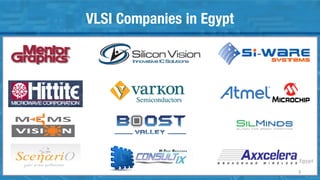
VLSI Companies in Egypt
3
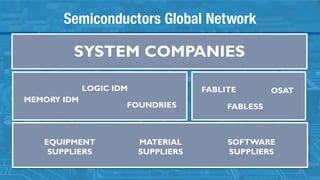
Semiconductors Global Network
SYSTEM COMPANIES
MEMORY IDM
LOGIC IDM
FOUNDRIES
FABLITE
FABLESS
EQUIPMENT
SUPPLIERS
MATERIAL
SUPPLIERS
SOFTWARE
SUPPLIERS
OSAT
4
Fablite & Fabless & OSATLogic & Memory IDM & Foundries
LamRESEARCH
INDUSTRY ECO SYSTEM
5
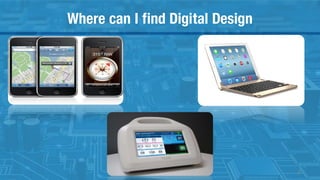
Where can I find Digital Design
6
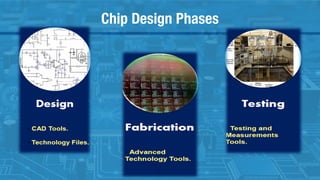
Chip Design Phases
7
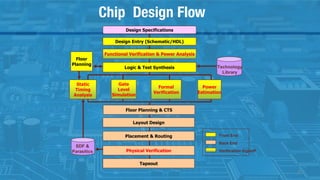
Chip Design Flow
9/5/2016 Verification with System 8
Design Specifications
Floor
Planning
Technology
Library
SDF &
Parasitics
Design Entry (Schematic/HDL)
Functional Verification & Power Analysis
Logic & Test Synthesis
Layout Design
Placement & Routing
Static
Timing
Analysis
Gate
Level
Simulation
Formal
Verification
Power
Estimation
Physical Verification
Tapeout
Front End
Back End
Verification Signoff
Floor Planning & CTS
8
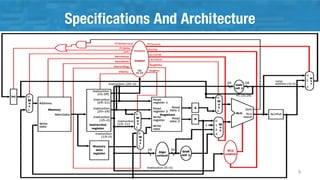
Specifications And Architecture
9
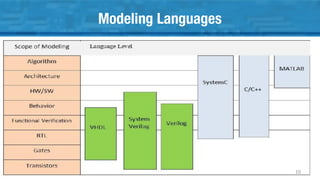
Modeling Languages
10
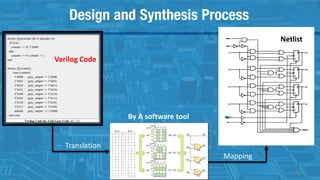
Design and Synthesis Process
Translation
Mapping
Verilog Code
Netlist
By A software tool
11
What is the difference between verification
and testing?
12
Why we need functional verification?
▪ To build confidence and stay in business.
▪ A primary purpose for functional verification is to detect failures so that
bugs can be identified and corrected before it gets shipped to costumer.
▪ A single mistake (bug) may lead to a chip failure.
▪ Not all bugs are caused by coding errors.There are possibilities that error
may in the specification itself.
▪ Sometimes miscommunications between teams may lead to wrong
design.
13
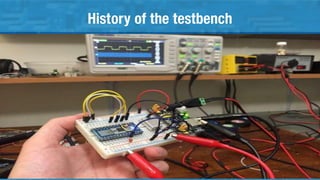
History of the testbench
14
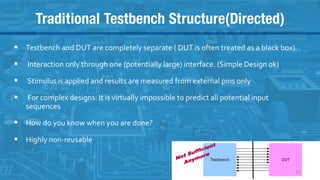
Traditional Testbench Structure(Directed)
 Testbench and DUT are completely separate ( DUT is often treated as a black box).
 Interaction only through one (potentially large) interface. (Simple Design ok)
 Stimulus is applied and results are measured from external pins only
 For complex designs: It is virtually impossible to predict all potential input
sequences
 How do you know when you are done?
 Highly non-reusable
15
Linear Testbench Example
//DUT (Design Under Test)
module adder(a,b,c);
//code start
input [15:0] a;
input [15:0] b;
output [16:0] c;
assign c = a + b;
endmodule
// Testbench Code
module top();
reg [15:0] a;
reg [15:0] b;
wire [16:0] c;
adder DUT(a,b,c); //DUT Instantiation
initial
begin
a = 16'h45; //apply the stimulus
b = 16'h12;
#10
$display("a=%0d,b=%0d,c=%0d",a,b,c);
end
endmodule
16
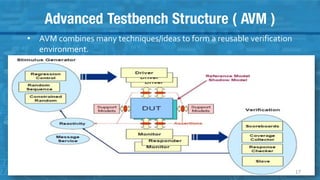
Advanced Testbench Structure ( AVM )
• AVM combines many techniques/ideas to form a reusable verification
environment.
17
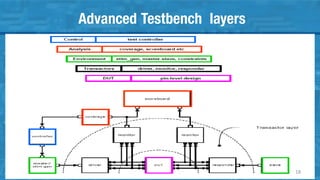
Advanced Testbench layers
18
Verification is no longer just running tests
• Advanced test benches need architecture and
design.
• Always more to be verified in a lesser time (need
innovation).
• Multiple aspects of verification (Functional, Formal,
Power, performance, emulation)
• VIP (Verification IP) based approach.
• Debug challenges.
19
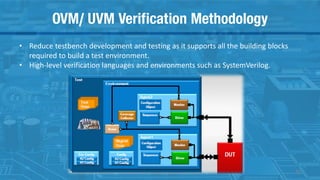
OVM/ UVM Verification Methodology
20
• Reduce testbench development and testing as it supports all the building blocks
required to build a test environment.
• High-level verification languages and environments such as SystemVerilog.
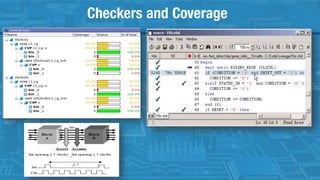
Checkers and Coverage
21
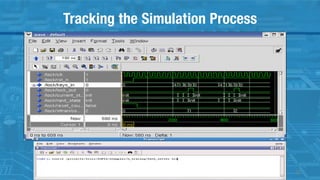
Tracking the Simulation Process
22
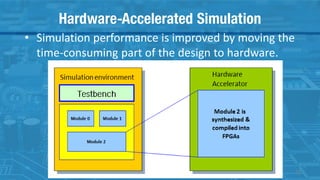
Hardware-Accelerated Simulation
• Simulation performance is improved by moving the
time-consuming part of the design to hardware.
23
Hardware-Accelerated Simulation
• Challenges
– Improves speed but degrades on HW-SW communication
– Abstracting HW-SW communication at transaction level rather than
cycle level desired for better speeds
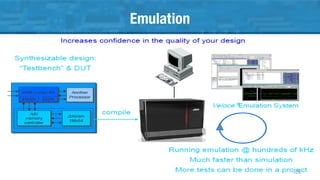
• HW Emulation
– Full mapping of HW into an emulator (array of FPGAs)
– More like a real target system. Speed up possible up to 1000X
simulation
– Debug is a challenge with limited visibility
– Usually used for HW+SW co-verification
24
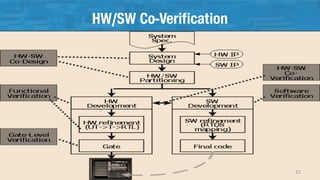
HW/SW Co-Verification
25
Platform definition
Ansi-C
DSP model
System SW
Algorithms
Platform HW
IP library
ARM, AMBA,
peripherals …
IP
ADRES, DFE …
RTL model
platform
TLM model
platform
chip
Functional MATLAB
Optimized & quantized
MATLAB
MATLAB-over-the-air
validation
= functional simulation
= simulation HW/SW
= Real time
HW demonstration
= Emulation (FPGA-based)
RTL
refinement
RTL2GDSII
mapped on &
simulated with
platform
mapped on &
emulated with
platform
mapped on chip
runs real-time
ConvergensC
MATLAB® to C Synthesis
Digital WL Design Flow
26
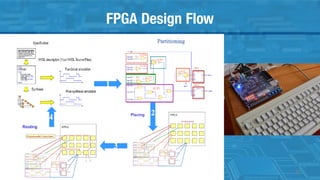
FPGA Design Flow
27
Emulation
28
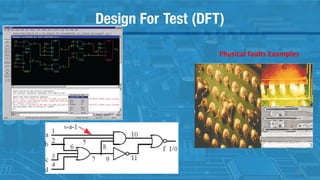
Design For Test (DFT)
Physical faults Examples
29
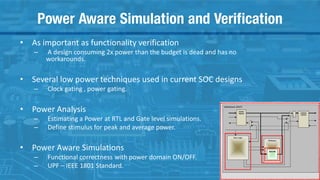
Power Aware Simulation and Verification
30
• As important as functionality verification
– A design consuming 2x power than the budget is dead and has no
workarounds.
• Several low power techniques used in current SOC designs
– Clock gating , power gating.
• Power Analysis
– Estimating a Power at RTL and Gate level simulations.
– Define stimulus for peak and average power.
• Power Aware Simulations
– Functional correctness with power domain ON/OFF.
– UPF – IEEE 1801 Standard.
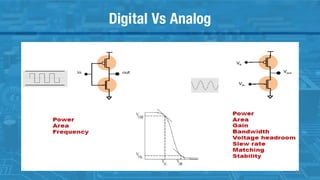
Digital Vs Analog
31
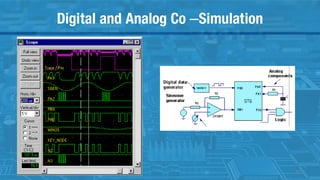
Digital and Analog Co –Simulation
32
Verification Engineer Skills
• Demanding both hardware and software skills.
• Digital logic , Analog, Computer Architecture and
memories.
• HDLs like SystemVerilog.
• Software Programming concepts such as OOP to use
it in UVM.
• Scripting languages for automation and regression.
33
Verification Career - Confusions
34
• Is there any career path for verification
engineers ?
• Can I move from Verification to Design in my
career ?
• Can I move from verification to Software
Engineer ?
• Is it possible to move from frontend to
backend in my career ?
• Can I become a good verification engineer if I
don’t like programming ?
Verification Career - Facts
35
• Verification Engineer has a solid career path
• Two decades back- Design engineer tested their designs.
• Today – Verification of a design needs dedicated skills.
• Verification is increasingly complex and critical.
• Verification consumes majority of the project time (Avg – 70
%).
• Increasing demand for verification engineers (12% compound
annual growth rate as per industry survey).
• Verification engineers are involved in project from early stage
of the design.
References
36
• ASIC Digital Design Flow from concept to IC , Amr lofty, Intel.
• Electronic Systems Design from Specifications to production, Khaled Salah,
Mentor-graphics.
• Verification Engineer - Opportunities and Career Path, Ramdas M,
AppliedMicro.
Presented by Sameh El-Ashry
samehelashry@ieee.org
https://eg.linkedin.com/pub/sameh-el-ashry/3b/560/22b
37

Functional verification techniques EW16 session

  • 1.
    Functional Verification Techniques SamehEl-Ashry Digital Verification Engineer ©2016 1
  • 2.
    Agenda • Companies. • DigitalDesign Flow. • Functional Verification. • Simulation and Emulation. • Design for Test (DFT). • Power Aware Simulation. • Verification as a Career and Interesting Questions. 2
  • 3.
  • 4.
    Semiconductors Global Network SYSTEMCOMPANIES MEMORY IDM LOGIC IDM FOUNDRIES FABLITE FABLESS EQUIPMENT SUPPLIERS MATERIAL SUPPLIERS SOFTWARE SUPPLIERS OSAT 4
  • 5.
    Fablite & Fabless& OSATLogic & Memory IDM & Foundries LamRESEARCH INDUSTRY ECO SYSTEM 5
  • 6.
    Where can Ifind Digital Design 6
  • 7.
  • 8.
    Chip Design Flow 9/5/2016Verification with System 8 Design Specifications Floor Planning Technology Library SDF & Parasitics Design Entry (Schematic/HDL) Functional Verification & Power Analysis Logic & Test Synthesis Layout Design Placement & Routing Static Timing Analysis Gate Level Simulation Formal Verification Power Estimation Physical Verification Tapeout Front End Back End Verification Signoff Floor Planning & CTS 8
  • 9.
  • 10.
  • 11.
    Design and SynthesisProcess Translation Mapping Verilog Code Netlist By A software tool 11
  • 12.
    What is thedifference between verification and testing? 12
  • 13.
    Why we needfunctional verification? ▪ To build confidence and stay in business. ▪ A primary purpose for functional verification is to detect failures so that bugs can be identified and corrected before it gets shipped to costumer. ▪ A single mistake (bug) may lead to a chip failure. ▪ Not all bugs are caused by coding errors.There are possibilities that error may in the specification itself. ▪ Sometimes miscommunications between teams may lead to wrong design. 13
  • 14.
    History of thetestbench 14
  • 15.
    Traditional Testbench Structure(Directed) Testbench and DUT are completely separate ( DUT is often treated as a black box).  Interaction only through one (potentially large) interface. (Simple Design ok)  Stimulus is applied and results are measured from external pins only  For complex designs: It is virtually impossible to predict all potential input sequences  How do you know when you are done?  Highly non-reusable 15
  • 16.
    Linear Testbench Example //DUT(Design Under Test) module adder(a,b,c); //code start input [15:0] a; input [15:0] b; output [16:0] c; assign c = a + b; endmodule // Testbench Code module top(); reg [15:0] a; reg [15:0] b; wire [16:0] c; adder DUT(a,b,c); //DUT Instantiation initial begin a = 16'h45; //apply the stimulus b = 16'h12; #10 $display("a=%0d,b=%0d,c=%0d",a,b,c); end endmodule 16
  • 17.
    Advanced Testbench Structure( AVM ) • AVM combines many techniques/ideas to form a reusable verification environment. 17
  • 18.
  • 19.
    Verification is nolonger just running tests • Advanced test benches need architecture and design. • Always more to be verified in a lesser time (need innovation). • Multiple aspects of verification (Functional, Formal, Power, performance, emulation) • VIP (Verification IP) based approach. • Debug challenges. 19
  • 20.
    OVM/ UVM VerificationMethodology 20 • Reduce testbench development and testing as it supports all the building blocks required to build a test environment. • High-level verification languages and environments such as SystemVerilog.
  • 21.
  • 22.
  • 23.
    Hardware-Accelerated Simulation • Simulationperformance is improved by moving the time-consuming part of the design to hardware. 23
  • 24.
    Hardware-Accelerated Simulation • Challenges –Improves speed but degrades on HW-SW communication – Abstracting HW-SW communication at transaction level rather than cycle level desired for better speeds • HW Emulation – Full mapping of HW into an emulator (array of FPGAs) – More like a real target system. Speed up possible up to 1000X simulation – Debug is a challenge with limited visibility – Usually used for HW+SW co-verification 24
  • 25.
  • 26.
    Platform definition Ansi-C DSP model SystemSW Algorithms Platform HW IP library ARM, AMBA, peripherals … IP ADRES, DFE … RTL model platform TLM model platform chip Functional MATLAB Optimized & quantized MATLAB MATLAB-over-the-air validation = functional simulation = simulation HW/SW = Real time HW demonstration = Emulation (FPGA-based) RTL refinement RTL2GDSII mapped on & simulated with platform mapped on & emulated with platform mapped on chip runs real-time ConvergensC MATLAB® to C Synthesis Digital WL Design Flow 26
  • 27.
  • 28.
  • 29.
    Design For Test(DFT) Physical faults Examples 29
  • 30.
    Power Aware Simulationand Verification 30 • As important as functionality verification – A design consuming 2x power than the budget is dead and has no workarounds. • Several low power techniques used in current SOC designs – Clock gating , power gating. • Power Analysis – Estimating a Power at RTL and Gate level simulations. – Define stimulus for peak and average power. • Power Aware Simulations – Functional correctness with power domain ON/OFF. – UPF – IEEE 1801 Standard.
  • 31.
  • 32.
    Digital and AnalogCo –Simulation 32
  • 33.
    Verification Engineer Skills •Demanding both hardware and software skills. • Digital logic , Analog, Computer Architecture and memories. • HDLs like SystemVerilog. • Software Programming concepts such as OOP to use it in UVM. • Scripting languages for automation and regression. 33
  • 34.
    Verification Career -Confusions 34 • Is there any career path for verification engineers ? • Can I move from Verification to Design in my career ? • Can I move from verification to Software Engineer ? • Is it possible to move from frontend to backend in my career ? • Can I become a good verification engineer if I don’t like programming ?
  • 35.
    Verification Career -Facts 35 • Verification Engineer has a solid career path • Two decades back- Design engineer tested their designs. • Today – Verification of a design needs dedicated skills. • Verification is increasingly complex and critical. • Verification consumes majority of the project time (Avg – 70 %). • Increasing demand for verification engineers (12% compound annual growth rate as per industry survey). • Verification engineers are involved in project from early stage of the design.
  • 36.
    References 36 • ASIC DigitalDesign Flow from concept to IC , Amr lofty, Intel. • Electronic Systems Design from Specifications to production, Khaled Salah, Mentor-graphics. • Verification Engineer - Opportunities and Career Path, Ramdas M, AppliedMicro.
  • 37.
    Presented by SamehEl-Ashry samehelashry@ieee.org https://eg.linkedin.com/pub/sameh-el-ashry/3b/560/22b 37