Submitted to: submitted by:
Dr. Ranjeeta Bhari Monika Rani
Punjabi university , patiala 19011006
Msc(hon’s)BT
3rd sem
intro
 Functional food is a food with certain beneficial
effects on one or more target functions in the
body beyond the basic nutritional effects with a
result the improved health state and well being
or reduction of risk of diseases. It is consumed
as a part of a normal diet and is not used in
the form of pill or capsule or any other form of
dietary supplemen
history
 The first definition of functional foods has been
established in Japan. In 1991, the Japanese
law entered the work definition “foods for
specified health use” (FOSHU) which allowed
the first health claims on the food labeling
 categorized as:
 Vitamins and minerals fortification (e.g., vit C, folic acid, calcium,
iron).
 Cholesterol reduction (e.g., omega-3 fatty acids, phytosterols).
 Dietary fiber (e.g. nondigestible carbohydrates and lignin).
 Probiotics, prebiotics, and synbiotics (e.g., yoghourt, kefir, fruits,
vegetables).
 Phytochemicals (e.g., phenolic compounds, carotenoids, lycopene
 Functional Foods Can Be –
• conventional foods containing natural bioactive
substances (example: oat betaglucan, rich fruit and
vegetables in lycopene and lutein).
 a food in which a component has been added;
• foods that have been modified by enrichment with
bioactive substances (example : margarine with
phytosterol added, calcium fortified orange juice, folic
acid-rich pomegranate, energy drinks with ginseng and
guarana)
• foods for special dietary use (examples: gluten-free
foods, lactose-free products, infant food).
How food can be functional ?
 A food can become functional by using any of the
following ways:
 eliminating a component that causes harmful effects
when consumed (eg allergenic proteins).
 increasing the concentration of a natural component
present in the food up to a point where it can induce
beneficial effects (eg, fortification with a micronutrient to
increase daily intake over recommended).
 addition of a component which is not normally present in
many foods and which is not necessary as a macro- or
micronutrient but for whose beneficial effects it has been
used (e.g., non-vitamin anti-oxidants i.e. the hydrophilic
polyphenols plus the their glycosides or prebiotic
fructan).
 Replacing a component, usually macro-nutrient (fatty
acids) that is excessive with a component with beneficial
effects (modified starch).
 increasing the bioavailability or stability of a recognized
component for its functional effects or reducing the
potential risk of the disease.
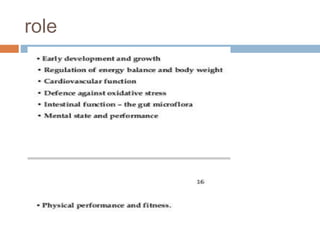
role
milk and dairy products as
functional foods
 dairy Products are generally considered an excellent
source of high quality protein,calcium , vitamins
riboflavin ,niacin, vit.B-6,vit.B-12 ,organic acids,
biologically active components .eg
yogurt
Usually made from milk (rarely, from cream) inoculated with
Streptococcus thermophilus and either Lactobacillus
acidophilus or Lactobacillus bulgaricus.
Turkish in origin
Benefits of yogurt
 Constipation
 Diarrheal diseases
 Colon cancer
 Inflammatory bowel diseases
 Allergies
Cheese
 Cheese
 Cheese is a very good source of protein and calcium. It is also a
good source of phosphorus, iodine and selenium.
 calcium role
 maintaining the strength and density of bones
 Help protect colon cells from cancer-causing chemicals
 Help prevent the bone loss that can occur deu to menopause or
rheumatoid arthritis
 Help prevent migraine headaches in those who suffer from them
 Reduce PMS symptoms during the luteal phase (the second half) of
the menstrual cycle
Seafood products as functional
foods
 Fish is an important dietary constituent of several population
groups, it serves as rich source of
 high quality proteins, vitamins, minerals and lipids, besides
being the largest source of n-3 series polyunsaturated fatty
acids, especially the eicosapentaenoic (EPA) and
docosahexaenoic (DHA), which bring several benefits to
human organism .
fishes rich in (n-3) fatty acids

 salmon, tuna, mackerel, sardines and herring
SEAFOOD –NUTRITIONAL
BENEFITS
 High quality protein
 High in omega-3 fatty acids
 Low in saturated fat
 Contributes to a healthy heart
 Contributes to proper growth and development of
children
 Source of vitamins and minerals
Health benefits
 reduces
 Coronary heart disease
 High blood pressure
 Irregular heart beat
 Diabetes
 Rheumatoid arthritis
Oat products as functional foods
 Cereals are the rich source of energy, protein, carbohydrate, B-
complex vit. and minerals. • Also a rich source of phytate (salts of
Ca, Mg, and K) and phenolic acid (antioxidant, anticarcinogenic
activity)
 • Oats (Avena sativa) are a cereal commonly eaten in the form of
oatmeal or rolled oats.
 • Oats are loaded with dietary fiber (containing more than any other
grain) and have a range of healthy cholesterol-lowering properties.
 • Active ingredient of oat is soluble fiber (1-3) (1-4)-B-D-glucan
Health benefits
 • Oats may reduce the risk of coronary artery disease.
 • Oats may help lower the risk of colorectal cancer.
 • Oats may help lower blood pressure.
 • Stabilizes blood sugar and reduces risk of diabetes.
 • Oats Help Control Blood Pressure.
application
references
www.google.com

Functional foods

  • 1.
    Submitted to: submittedby: Dr. Ranjeeta Bhari Monika Rani Punjabi university , patiala 19011006 Msc(hon’s)BT 3rd sem
  • 2.
    intro  Functional foodis a food with certain beneficial effects on one or more target functions in the body beyond the basic nutritional effects with a result the improved health state and well being or reduction of risk of diseases. It is consumed as a part of a normal diet and is not used in the form of pill or capsule or any other form of dietary supplemen
  • 3.
    history  The firstdefinition of functional foods has been established in Japan. In 1991, the Japanese law entered the work definition “foods for specified health use” (FOSHU) which allowed the first health claims on the food labeling
  • 5.
     categorized as: Vitamins and minerals fortification (e.g., vit C, folic acid, calcium, iron).  Cholesterol reduction (e.g., omega-3 fatty acids, phytosterols).  Dietary fiber (e.g. nondigestible carbohydrates and lignin).  Probiotics, prebiotics, and synbiotics (e.g., yoghourt, kefir, fruits, vegetables).  Phytochemicals (e.g., phenolic compounds, carotenoids, lycopene
  • 6.
     Functional FoodsCan Be – • conventional foods containing natural bioactive substances (example: oat betaglucan, rich fruit and vegetables in lycopene and lutein).  a food in which a component has been added; • foods that have been modified by enrichment with bioactive substances (example : margarine with phytosterol added, calcium fortified orange juice, folic acid-rich pomegranate, energy drinks with ginseng and guarana) • foods for special dietary use (examples: gluten-free foods, lactose-free products, infant food).
  • 7.
    How food canbe functional ?  A food can become functional by using any of the following ways:  eliminating a component that causes harmful effects when consumed (eg allergenic proteins).  increasing the concentration of a natural component present in the food up to a point where it can induce beneficial effects (eg, fortification with a micronutrient to increase daily intake over recommended).
  • 8.
     addition ofa component which is not normally present in many foods and which is not necessary as a macro- or micronutrient but for whose beneficial effects it has been used (e.g., non-vitamin anti-oxidants i.e. the hydrophilic polyphenols plus the their glycosides or prebiotic fructan).  Replacing a component, usually macro-nutrient (fatty acids) that is excessive with a component with beneficial effects (modified starch).  increasing the bioavailability or stability of a recognized component for its functional effects or reducing the potential risk of the disease.
  • 9.
  • 10.
    milk and dairyproducts as functional foods  dairy Products are generally considered an excellent source of high quality protein,calcium , vitamins riboflavin ,niacin, vit.B-6,vit.B-12 ,organic acids, biologically active components .eg yogurt Usually made from milk (rarely, from cream) inoculated with Streptococcus thermophilus and either Lactobacillus acidophilus or Lactobacillus bulgaricus. Turkish in origin
  • 11.
    Benefits of yogurt Constipation  Diarrheal diseases  Colon cancer  Inflammatory bowel diseases  Allergies
  • 12.
    Cheese  Cheese  Cheeseis a very good source of protein and calcium. It is also a good source of phosphorus, iodine and selenium.  calcium role  maintaining the strength and density of bones  Help protect colon cells from cancer-causing chemicals  Help prevent the bone loss that can occur deu to menopause or rheumatoid arthritis  Help prevent migraine headaches in those who suffer from them  Reduce PMS symptoms during the luteal phase (the second half) of the menstrual cycle
  • 13.
    Seafood products asfunctional foods  Fish is an important dietary constituent of several population groups, it serves as rich source of  high quality proteins, vitamins, minerals and lipids, besides being the largest source of n-3 series polyunsaturated fatty acids, especially the eicosapentaenoic (EPA) and docosahexaenoic (DHA), which bring several benefits to human organism .
  • 14.
    fishes rich in(n-3) fatty acids   salmon, tuna, mackerel, sardines and herring
  • 15.
    SEAFOOD –NUTRITIONAL BENEFITS  Highquality protein  High in omega-3 fatty acids  Low in saturated fat  Contributes to a healthy heart  Contributes to proper growth and development of children  Source of vitamins and minerals
  • 16.
    Health benefits  reduces Coronary heart disease  High blood pressure  Irregular heart beat  Diabetes  Rheumatoid arthritis
  • 17.
    Oat products asfunctional foods  Cereals are the rich source of energy, protein, carbohydrate, B- complex vit. and minerals. • Also a rich source of phytate (salts of Ca, Mg, and K) and phenolic acid (antioxidant, anticarcinogenic activity)  • Oats (Avena sativa) are a cereal commonly eaten in the form of oatmeal or rolled oats.  • Oats are loaded with dietary fiber (containing more than any other grain) and have a range of healthy cholesterol-lowering properties.  • Active ingredient of oat is soluble fiber (1-3) (1-4)-B-D-glucan
  • 18.
    Health benefits  •Oats may reduce the risk of coronary artery disease.  • Oats may help lower the risk of colorectal cancer.  • Oats may help lower blood pressure.  • Stabilizes blood sugar and reduces risk of diabetes.  • Oats Help Control Blood Pressure.
  • 19.
  • 20.