
MULTIPLE CHOICE QUESTIONS
SUBJECT-AUTOMOBILE
ENGINEERING
BY
INDRANIL MANDAL
ASSISTANT PROFESSOR
DEPARTMENT-MECHANICAL ENGINEERING
IDEAL INSTITUTE OF ENGINEERING
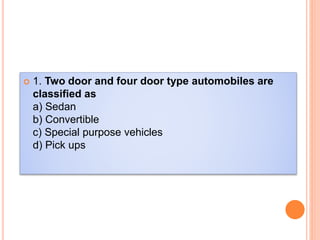
 1. Two door and four door type automobiles are
classified as
a) Sedan
b) Convertible
c) Special purpose vehicles
d) Pick ups
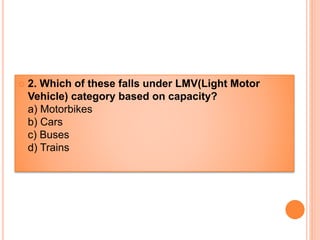
 2. Which of these falls under LMV(Light Motor
Vehicle) category based on capacity?
a) Motorbikes
b) Cars
c) Buses
d) Trains
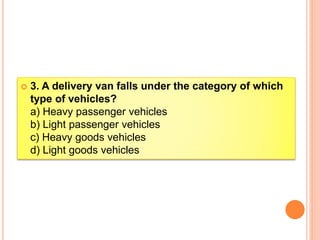
 3. A delivery van falls under the category of which
type of vehicles?
a) Heavy passenger vehicles
b) Light passenger vehicles
c) Heavy goods vehicles
d) Light goods vehicles
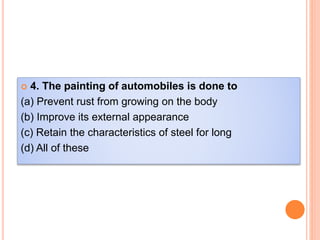
 4. The painting of automobiles is done to
(a) Prevent rust from growing on the body
(b) Improve its external appearance
(c) Retain the characteristics of steel for long
(d) All of these
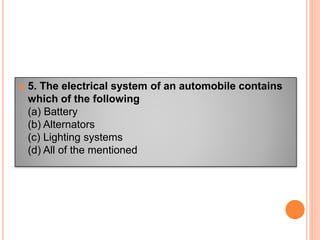
 5. The electrical system of an automobile contains
which of the following
(a) Battery
(b) Alternators
(c) Lighting systems
(d) All of the mentioned
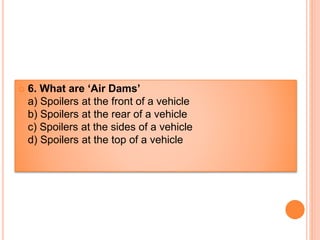
 6. What are ‘Air Dams’
a) Spoilers at the front of a vehicle
b) Spoilers at the rear of a vehicle
c) Spoilers at the sides of a vehicle
d) Spoilers at the top of a vehicle
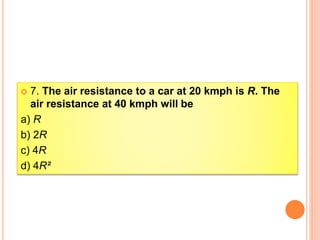
 7. The air resistance to a car at 20 kmph is R. The
air resistance at 40 kmph will be
a) R
b) 2R
c) 4R
d) 4R²
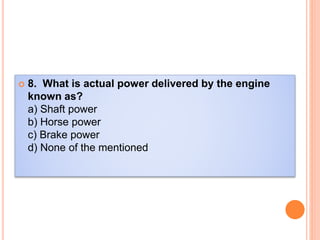
 8. What is actual power delivered by the engine
known as?
a) Shaft power
b) Horse power
c) Brake power
d) None of the mentioned
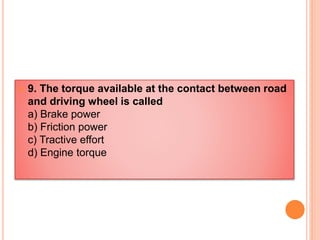
 9. The torque available at the contact between road
and driving wheel is called
a) Brake power
b) Friction power
c) Tractive effort
d) Engine torque
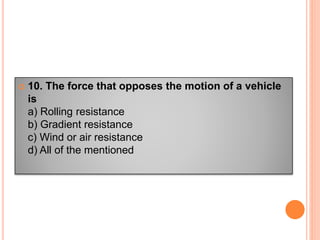
 10. The force that opposes the motion of a vehicle
is
a) Rolling resistance
b) Gradient resistance
c) Wind or air resistance
d) All of the mentioned
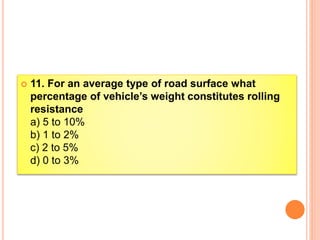
 11. For an average type of road surface what
percentage of vehicle’s weight constitutes rolling
resistance
a) 5 to 10%
b) 1 to 2%
c) 2 to 5%
d) 0 to 3%
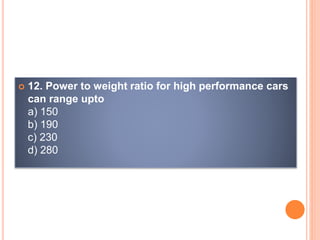
 12. Power to weight ratio for high performance cars
can range upto
a) 150
b) 190
c) 230
d) 280
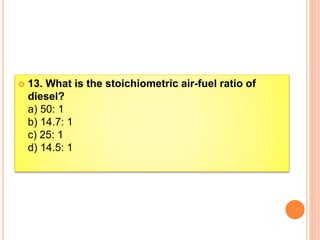
 13. What is the stoichiometric air-fuel ratio of
diesel?
a) 50: 1
b) 14.7: 1
c) 25: 1
d) 14.5: 1
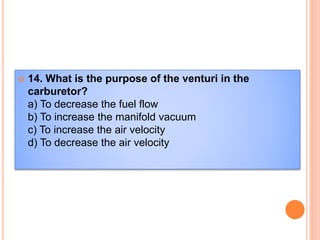
 14. What is the purpose of the venturi in the
carburetor?
a) To decrease the fuel flow
b) To increase the manifold vacuum
c) To increase the air velocity
d) To decrease the air velocity
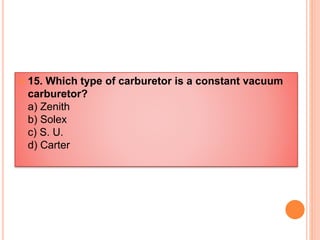
 15. Which type of carburetor is a constant vacuum
carburetor?
a) Zenith
b) Solex
c) S. U.
d) Carter
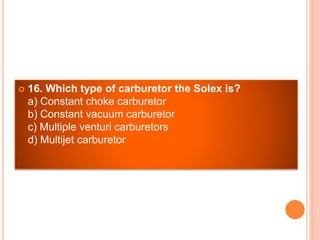
 16. Which type of carburetor the Solex is?
a) Constant choke carburetor
b) Constant vacuum carburetor
c) Multiple venturi carburetors
d) Multijet carburetor
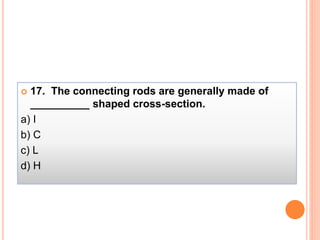
 17. The connecting rods are generally made of
__________ shaped cross-section.
a) I
b) C
c) L
d) H
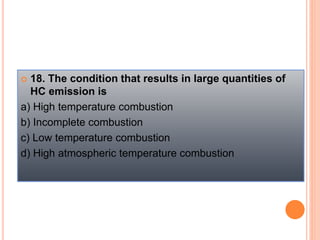
 18. The condition that results in large quantities of
HC emission is
a) High temperature combustion
b) Incomplete combustion
c) Low temperature combustion
d) High atmospheric temperature combustion
 19. The octane rating of petrol commercially
available is
a) 85-95
b) 95-100
c) 100-110
d) 110-125
 20. The acid used in automobile battery is
a) Hydrochloric acid
b) Hydrofluoric acid
c) Nitric acid
d) Sulphuric acid
 21. The piston compression rings are made of
a) Cast iron
b) Steel
c) Aluminium
d) Bronze
 22. The ignition coil is used to
a) Step up current
b) Step down current
c) Step up voltage
d) Step down voltage
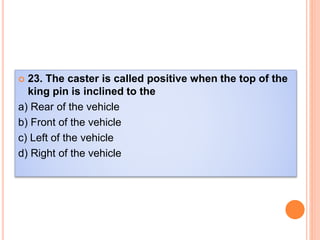
 23. The caster is called positive when the top of the
king pin is inclined to the
a) Rear of the vehicle
b) Front of the vehicle
c) Left of the vehicle
d) Right of the vehicle
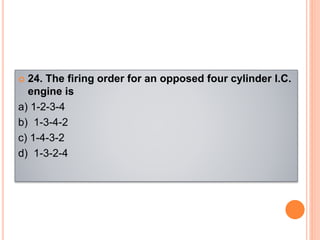
 24. The firing order for an opposed four cylinder l.C.
engine is
a) 1-2-3-4
b) 1-3-4-2
c) 1-4-3-2
d) 1-3-2-4
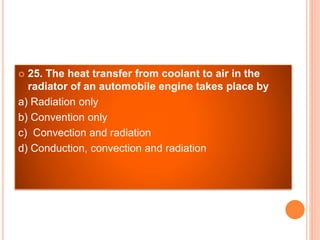
 25. The heat transfer from coolant to air in the
radiator of an automobile engine takes place by
a) Radiation only
b) Convention only
c) Convection and radiation
d) Conduction, convection and radiation
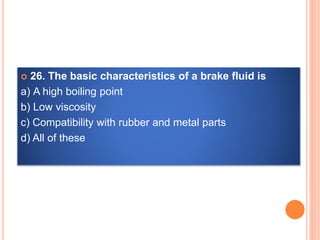
 26. The basic characteristics of a brake fluid is
a) A high boiling point
b) Low viscosity
c) Compatibility with rubber and metal parts
d) All of these
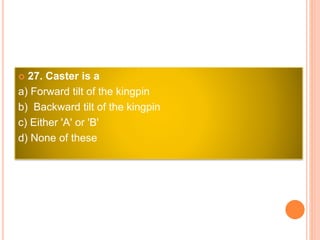
 27. Caster is a
a) Forward tilt of the kingpin
b) Backward tilt of the kingpin
c) Either 'A' or 'B'
d) None of these
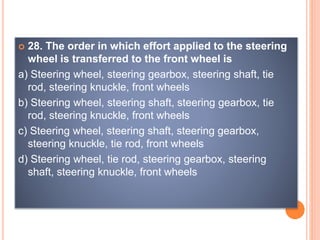
 28. The order in which effort applied to the steering
wheel is transferred to the front wheel is
a) Steering wheel, steering gearbox, steering shaft, tie
rod, steering knuckle, front wheels
b) Steering wheel, steering shaft, steering gearbox, tie
rod, steering knuckle, front wheels
c) Steering wheel, steering shaft, steering gearbox,
steering knuckle, tie rod, front wheels
d) Steering wheel, tie rod, steering gearbox, steering
shaft, steering knuckle, front wheels
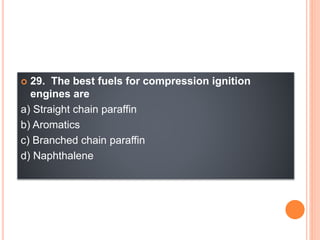
 29. The best fuels for compression ignition
engines are
a) Straight chain paraffin
b) Aromatics
c) Branched chain paraffin
d) Naphthalene
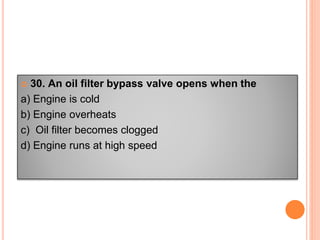
 30. An oil filter bypass valve opens when the
a) Engine is cold
b) Engine overheats
c) Oil filter becomes clogged
d) Engine runs at high speed
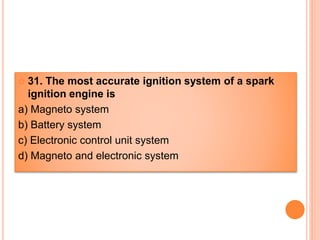
 31. The most accurate ignition system of a spark
ignition engine is
a) Magneto system
b) Battery system
c) Electronic control unit system
d) Magneto and electronic system
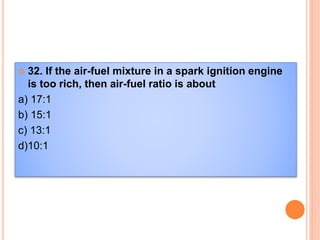
 32. If the air-fuel mixture in a spark ignition engine
is too rich, then air-fuel ratio is about
a) 17:1
b) 15:1
c) 13:1
d)10:1
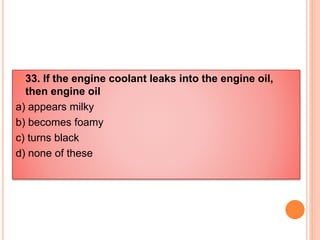
 33. If the engine coolant leaks into the engine oil,
then engine oil
a) appears milky
b) becomes foamy
c) turns black
d) none of these
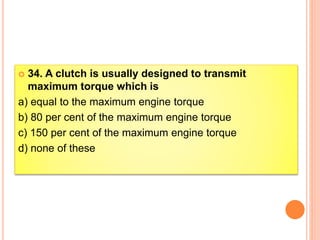
 34. A clutch is usually designed to transmit
maximum torque which is
a) equal to the maximum engine torque
b) 80 per cent of the maximum engine torque
c) 150 per cent of the maximum engine torque
d) none of these
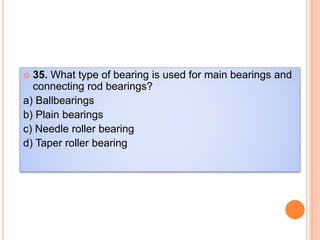
 35. What type of bearing is used for main bearings and
connecting rod bearings?
a) Ballbearings
b) Plain bearings
c) Needle roller bearing
d) Taper roller bearing
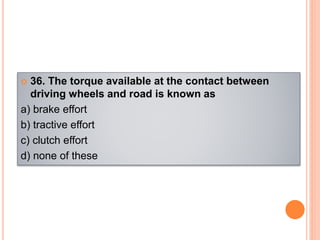
 36. The torque available at the contact between
driving wheels and road is known as
a) brake effort
b) tractive effort
c) clutch effort
d) none of these
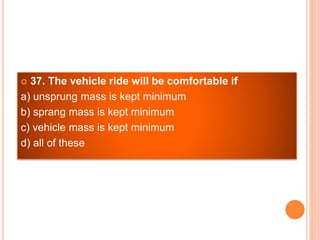
 37. The vehicle ride will be comfortable if
a) unsprung mass is kept minimum
b) sprang mass is kept minimum
c) vehicle mass is kept minimum
d) all of these
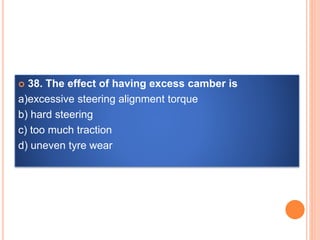
 38. The effect of having excess camber is
a)excessive steering alignment torque
b) hard steering
c) too much traction
d) uneven tyre wear
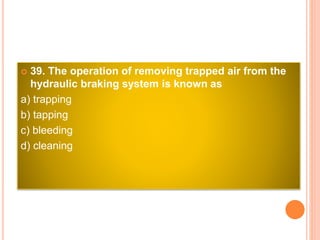
 39. The operation of removing trapped air from the
hydraulic braking system is known as
a) trapping
b) tapping
c) bleeding
d) cleaning
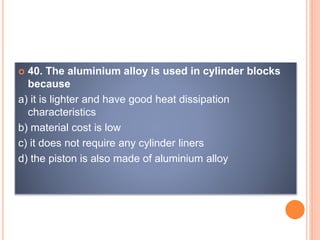
 40. The aluminium alloy is used in cylinder blocks
because
a) it is lighter and have good heat dissipation
characteristics
b) material cost is low
c) it does not require any cylinder liners
d) the piston is also made of aluminium alloy
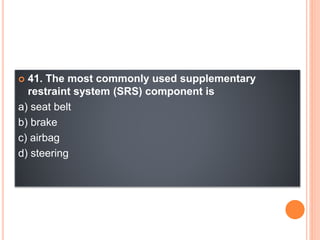
 41. The most commonly used supplementary
restraint system (SRS) component is
a) seat belt
b) brake
c) airbag
d) steering
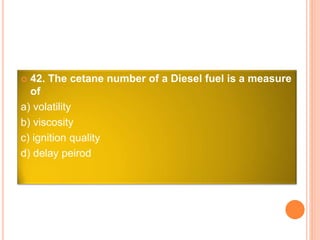
 42. The cetane number of a Diesel fuel is a measure
of
a) volatility
b) viscosity
c) ignition quality
d) delay peirod
 43. The component that connects the steering rack
to the knuckles is
a) tie-rod
b) sector gear
c) pivot
d) spline
 44. Which of the following is the port fuel – injection
system?
a) D – MPFI
b) L – MPFI
c) GDI
d) TBI
 45. The mechanical efficiency (ηm) of an I.C. engine
is equal to (where I.P. = Indicated power, B.P. = Brake
power and F.P. = Frictional power)
a) I.P/B.P.
b) B.P/I.P.
c) B.P/F.P.
d) F.P/B.P.
 46. The combustion process in a Diesel engine is a
a) Constant volume process
b) Constant pressure process
c) Constant temperature process
d) Adiabatic process
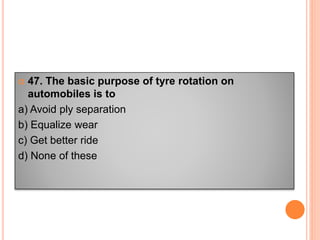
 47. The basic purpose of tyre rotation on
automobiles is to
a) Avoid ply separation
b) Equalize wear
c) Get better ride
d) None of these
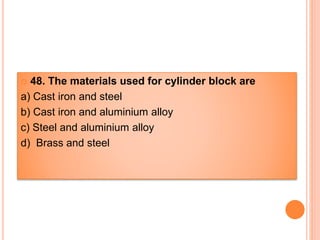
 48. The materials used for cylinder block are
a) Cast iron and steel
b) Cast iron and aluminium alloy
c) Steel and aluminium alloy
d) Brass and steel
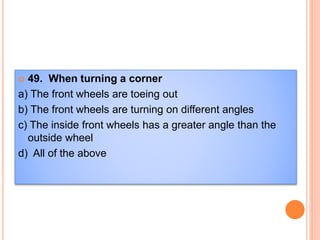
 49. When turning a corner
a) The front wheels are toeing out
b) The front wheels are turning on different angles
c) The inside front wheels has a greater angle than the
outside wheel
d) All of the above
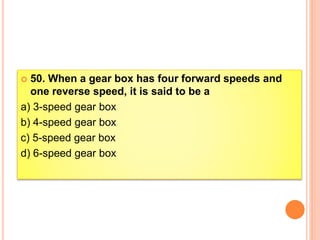
 50. When a gear box has four forward speeds and
one reverse speed, it is said to be a
a) 3-speed gear box
b) 4-speed gear box
c) 5-speed gear box
d) 6-speed gear box
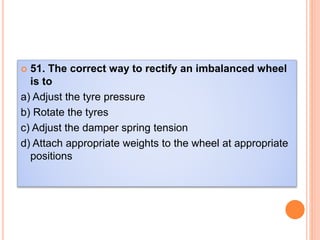
 51. The correct way to rectify an imbalanced wheel
is to
a) Adjust the tyre pressure
b) Rotate the tyres
c) Adjust the damper spring tension
d) Attach appropriate weights to the wheel at appropriate
positions
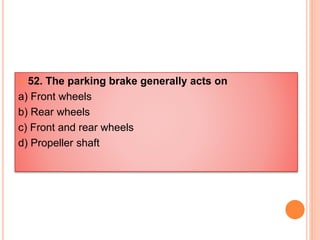
 52. The parking brake generally acts on
a) Front wheels
b) Rear wheels
c) Front and rear wheels
d) Propeller shaft
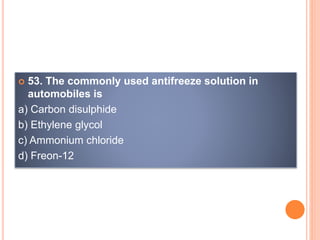
 53. The commonly used antifreeze solution in
automobiles is
a) Carbon disulphide
b) Ethylene glycol
c) Ammonium chloride
d) Freon-12
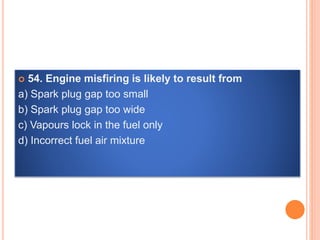
 54. Engine misfiring is likely to result from
a) Spark plug gap too small
b) Spark plug gap too wide
c) Vapours lock in the fuel only
d) Incorrect fuel air mixture
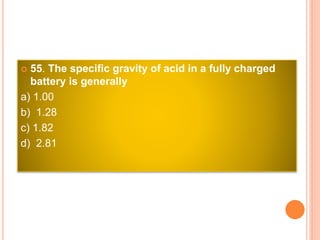
 55. The specific gravity of acid in a fully charged
battery is generally
a) 1.00
b) 1.28
c) 1.82
d) 2.81
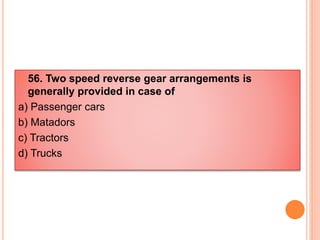
 56. Two speed reverse gear arrangements is
generally provided in case of
a) Passenger cars
b) Matadors
c) Tractors
d) Trucks
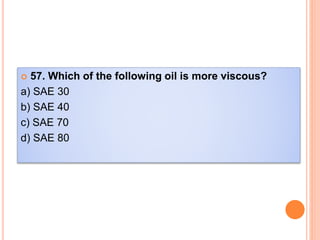
 57. Which of the following oil is more viscous?
a) SAE 30
b) SAE 40
c) SAE 70
d) SAE 80
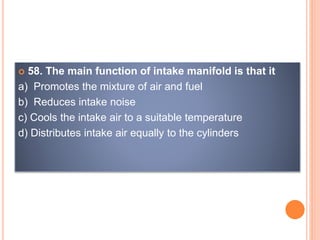
 58. The main function of intake manifold is that it
a) Promotes the mixture of air and fuel
b) Reduces intake noise
c) Cools the intake air to a suitable temperature
d) Distributes intake air equally to the cylinders
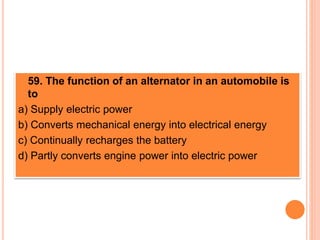
 59. The function of an alternator in an automobile is
to
a) Supply electric power
b) Converts mechanical energy into electrical energy
c) Continually recharges the battery
d) Partly converts engine power into electric power
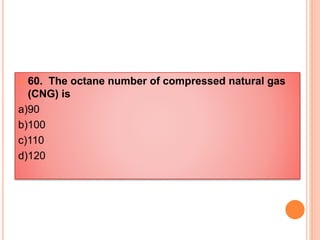
 60. The octane number of compressed natural gas
(CNG) is
a)90
b)100
c)110
d)120
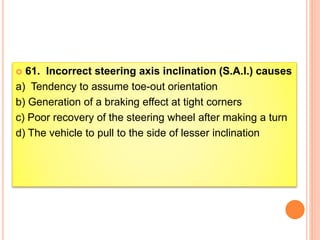
 61. Incorrect steering axis inclination (S.A.I.) causes
a) Tendency to assume toe-out orientation
b) Generation of a braking effect at tight corners
c) Poor recovery of the steering wheel after making a turn
d) The vehicle to pull to the side of lesser inclination
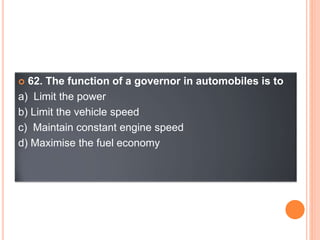
 62. The function of a governor in automobiles is to
a) Limit the power
b) Limit the vehicle speed
c) Maintain constant engine speed
d) Maximise the fuel economy
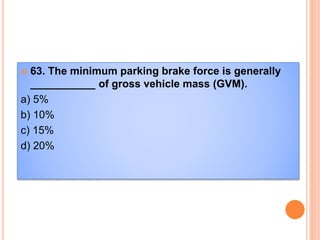
 63. The minimum parking brake force is generally
___________ of gross vehicle mass (GVM).
a) 5%
b) 10%
c) 15%
d) 20%
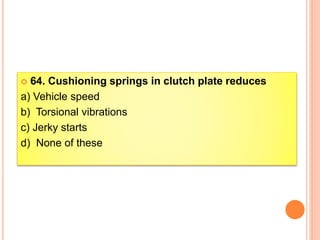
 64. Cushioning springs in clutch plate reduces
a) Vehicle speed
b) Torsional vibrations
c) Jerky starts
d) None of these
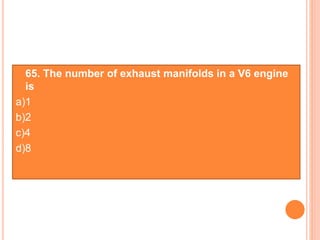
 65. The number of exhaust manifolds in a V6 engine
is
a)1
b)2
c)4
d)8
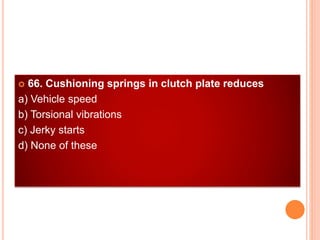
 66. Cushioning springs in clutch plate reduces
a) Vehicle speed
b) Torsional vibrations
c) Jerky starts
d) None of these
 67. Tachometer in a vehicle measures
a) Speed
b) Distance
c) Engine r.p.m.
d) Fuel consumption
 68. Odometer is an instrument used for
measurement of
a) Power
b) Fuel consumption
c) Engine r.p.m.
d) Distance
 69. Two general types of tyres are
a) Tube type and tubeless
b) Solid and tubeless
c) Air and pneumatic
d) Split rim and drop centre
 70. Petrol that detonates easily is called
a) High octane petrol
b) High octane petrol
c) Unleaded petrol
d) Blended fuel
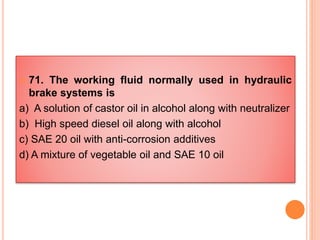
 71. The working fluid normally used in hydraulic
brake systems is
a) A solution of castor oil in alcohol along with neutralizer
b) High speed diesel oil along with alcohol
c) SAE 20 oil with anti-corrosion additives
d) A mixture of vegetable oil and SAE 10 oil
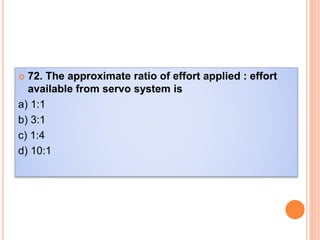
 72. The approximate ratio of effort applied : effort
available from servo system is
a) 1:1
b) 3:1
c) 1:4
d) 10:1
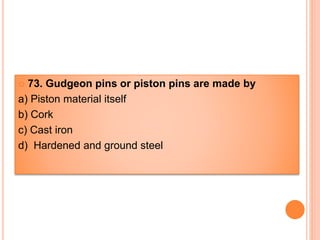
 73. Gudgeon pins or piston pins are made by
a) Piston material itself
b) Cork
c) Cast iron
d) Hardened and ground steel
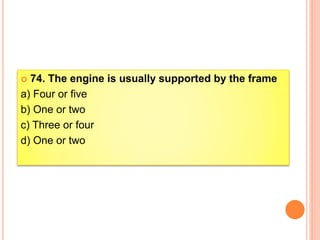
 74. The engine is usually supported by the frame
a) Four or five
b) One or two
c) Three or four
d) One or two
 75. The automobile chassis consists of the engine,
frame, power train, wheels, steering and …………..
a) Braking system
b) Wind shield
c) The doors
d) Luggage boot
 76. Leaf spring for vehicles are nipped to
a) Ensure that all leaves are uniformly stressed during
loading
b) Improve the load carrying capacity of spring
c) To increase the interleaf friction
d) To vary the effective length of the spring
 77. Two advantages of using helical gears rather
than spur gears in a transmission system are
a) Strength and cost
b) Strength and less end thrust
c) Noise level and strength
d) Noise level and economy
 78. The parking brakes employed in vehicles are
operated
a) Mechanically
b) Hydraulically
c) Pneumatically
d) None of these
 79. One effect of detonation is
a) Delay in ignition
b) Loss of power
c) Overheating of engine
d) Overcooling of engine
 80. When the top of the wheel is tilted outward, then
it is called
a) Positive camber
b) Negative camber
c) Positive caster
d) Negative caster
 81. If clearance volume of I.C. engines is increased,
the compression ratio will
a) Increase
b) Decrease
c) Remain constant
d) Be doubled
 82. The engine oil is stored in _________ when the
engine is not running.
a) Oil pan
b) Cylinder head
c) Oil pump
d) Separate oil tank
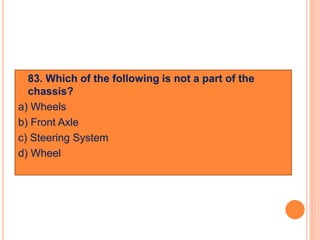
 83. Which of the following is not a part of the
chassis?
a) Wheels
b) Front Axle
c) Steering System
d) Wheel
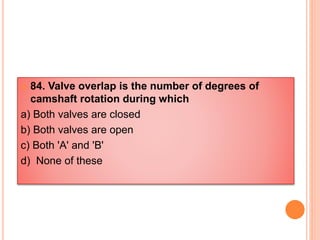
 84. Valve overlap is the number of degrees of
camshaft rotation during which
a) Both valves are closed
b) Both valves are open
c) Both 'A' and 'B'
d) None of these
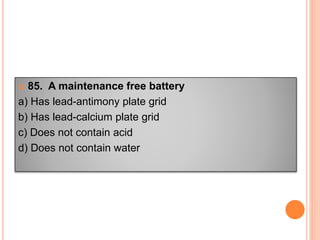
 85. A maintenance free battery
a) Has lead-antimony plate grid
b) Has lead-calcium plate grid
c) Does not contain acid
d) Does not contain water
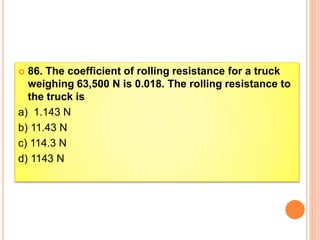
 86. The coefficient of rolling resistance for a truck
weighing 63,500 N is 0.018. The rolling resistance to
the truck is
a) 1.143 N
b) 11.43 N
c) 114.3 N
d) 1143 N
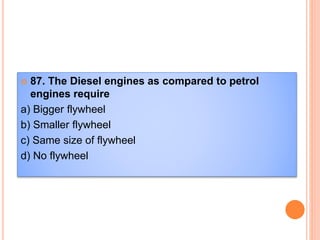
 87. The Diesel engines as compared to petrol
engines require
a) Bigger flywheel
b) Smaller flywheel
c) Same size of flywheel
d) No flywheel
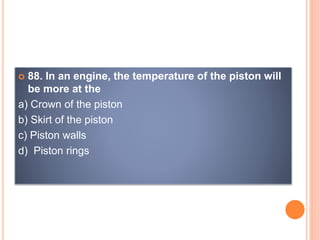
 88. In an engine, the temperature of the piston will
be more at the
a) Crown of the piston
b) Skirt of the piston
c) Piston walls
d) Piston rings
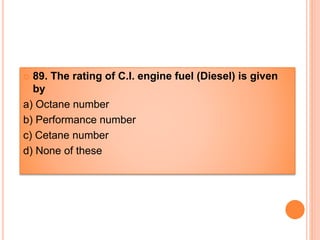
 89. The rating of C.I. engine fuel (Diesel) is given
by
a) Octane number
b) Performance number
c) Cetane number
d) None of these
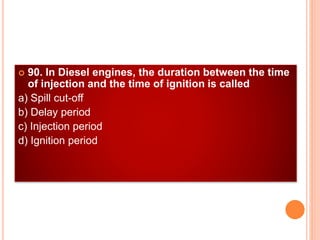
 90. In Diesel engines, the duration between the time
of injection and the time of ignition is called
a) Spill cut-off
b) Delay period
c) Injection period
d) Ignition period
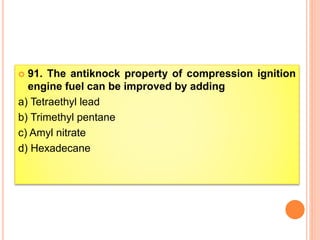
 91. The antiknock property of compression ignition
engine fuel can be improved by adding
a) Tetraethyl lead
b) Trimethyl pentane
c) Amyl nitrate
d) Hexadecane
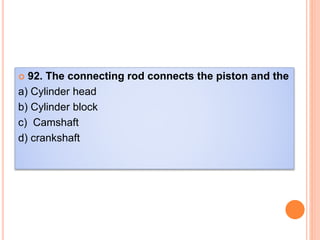
 92. The connecting rod connects the piston and the
a) Cylinder head
b) Cylinder block
c) Camshaft
d) crankshaft
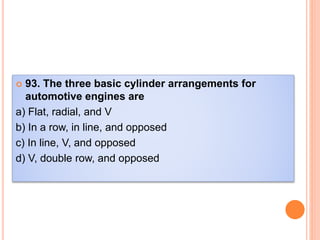
 93. The three basic cylinder arrangements for
automotive engines are
a) Flat, radial, and V
b) In a row, in line, and opposed
c) In line, V, and opposed
d) V, double row, and opposed
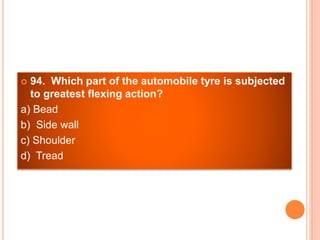
 94. Which part of the automobile tyre is subjected
to greatest flexing action?
a) Bead
b) Side wall
c) Shoulder
d) Tread
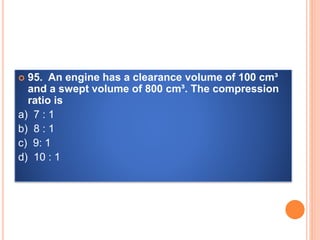
 95. An engine has a clearance volume of 100 cm³
and a swept volume of 800 cm³. The compression
ratio is
a) 7 : 1
b) 8 : 1
c) 9: 1
d) 10 : 1
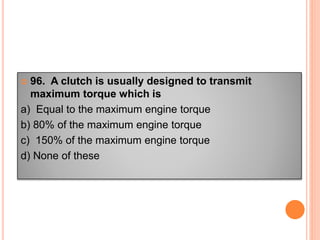
 96. A clutch is usually designed to transmit
maximum torque which is
a) Equal to the maximum engine torque
b) 80% of the maximum engine torque
c) 150% of the maximum engine torque
d) None of these
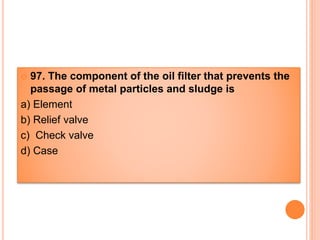
 97. The component of the oil filter that prevents the
passage of metal particles and sludge is
a) Element
b) Relief valve
c) Check valve
d) Case
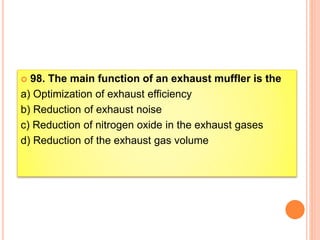
 98. The main function of an exhaust muffler is the
a) Optimization of exhaust efficiency
b) Reduction of exhaust noise
c) Reduction of nitrogen oxide in the exhaust gases
d) Reduction of the exhaust gas volume
 99. In automobiles G.V.W. refers to
a) Gross vehicle width
b) Gross vehicle weight
c) Gross vehicle wheel base
d) Gross vehicle wheel track
 100. The size of engine cylinder is referred in terms of
its
a) Diameter and bore
b) Displacement and efficiency
c) Bore and stroke
d) Bore and length
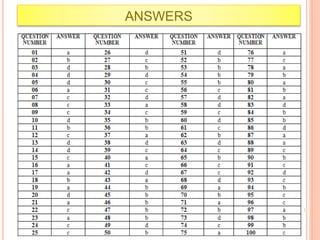
ANSWERS
Multiple choice questions Subject -Automobile Engineering

Multiple choice questions Subject -Automobile Engineering

  • 1.
    MULTIPLE CHOICE QUESTIONS SUBJECT-AUTOMOBILE ENGINEERING BY INDRANILMANDAL ASSISTANT PROFESSOR DEPARTMENT-MECHANICAL ENGINEERING IDEAL INSTITUTE OF ENGINEERING
  • 2.
     1. Twodoor and four door type automobiles are classified as a) Sedan b) Convertible c) Special purpose vehicles d) Pick ups
  • 3.
     2. Whichof these falls under LMV(Light Motor Vehicle) category based on capacity? a) Motorbikes b) Cars c) Buses d) Trains
  • 4.
     3. Adelivery van falls under the category of which type of vehicles? a) Heavy passenger vehicles b) Light passenger vehicles c) Heavy goods vehicles d) Light goods vehicles
  • 5.
     4. Thepainting of automobiles is done to (a) Prevent rust from growing on the body (b) Improve its external appearance (c) Retain the characteristics of steel for long (d) All of these
  • 6.
     5. Theelectrical system of an automobile contains which of the following (a) Battery (b) Alternators (c) Lighting systems (d) All of the mentioned
  • 7.
     6. Whatare ‘Air Dams’ a) Spoilers at the front of a vehicle b) Spoilers at the rear of a vehicle c) Spoilers at the sides of a vehicle d) Spoilers at the top of a vehicle
  • 8.
     7. Theair resistance to a car at 20 kmph is R. The air resistance at 40 kmph will be a) R b) 2R c) 4R d) 4R²
  • 9.
     8. Whatis actual power delivered by the engine known as? a) Shaft power b) Horse power c) Brake power d) None of the mentioned
  • 10.
     9. Thetorque available at the contact between road and driving wheel is called a) Brake power b) Friction power c) Tractive effort d) Engine torque
  • 11.
     10. Theforce that opposes the motion of a vehicle is a) Rolling resistance b) Gradient resistance c) Wind or air resistance d) All of the mentioned
  • 12.
     11. Foran average type of road surface what percentage of vehicle’s weight constitutes rolling resistance a) 5 to 10% b) 1 to 2% c) 2 to 5% d) 0 to 3%
  • 13.
     12. Powerto weight ratio for high performance cars can range upto a) 150 b) 190 c) 230 d) 280
  • 14.
     13. Whatis the stoichiometric air-fuel ratio of diesel? a) 50: 1 b) 14.7: 1 c) 25: 1 d) 14.5: 1
  • 15.
     14. Whatis the purpose of the venturi in the carburetor? a) To decrease the fuel flow b) To increase the manifold vacuum c) To increase the air velocity d) To decrease the air velocity
  • 16.
     15. Whichtype of carburetor is a constant vacuum carburetor? a) Zenith b) Solex c) S. U. d) Carter
  • 17.
     16. Whichtype of carburetor the Solex is? a) Constant choke carburetor b) Constant vacuum carburetor c) Multiple venturi carburetors d) Multijet carburetor
  • 18.
     17. Theconnecting rods are generally made of __________ shaped cross-section. a) I b) C c) L d) H
  • 19.
     18. Thecondition that results in large quantities of HC emission is a) High temperature combustion b) Incomplete combustion c) Low temperature combustion d) High atmospheric temperature combustion
  • 20.
     19. Theoctane rating of petrol commercially available is a) 85-95 b) 95-100 c) 100-110 d) 110-125
  • 21.
     20. Theacid used in automobile battery is a) Hydrochloric acid b) Hydrofluoric acid c) Nitric acid d) Sulphuric acid
  • 22.
     21. Thepiston compression rings are made of a) Cast iron b) Steel c) Aluminium d) Bronze
  • 23.
     22. Theignition coil is used to a) Step up current b) Step down current c) Step up voltage d) Step down voltage
  • 24.
     23. Thecaster is called positive when the top of the king pin is inclined to the a) Rear of the vehicle b) Front of the vehicle c) Left of the vehicle d) Right of the vehicle
  • 25.
     24. Thefiring order for an opposed four cylinder l.C. engine is a) 1-2-3-4 b) 1-3-4-2 c) 1-4-3-2 d) 1-3-2-4
  • 26.
     25. Theheat transfer from coolant to air in the radiator of an automobile engine takes place by a) Radiation only b) Convention only c) Convection and radiation d) Conduction, convection and radiation
  • 27.
     26. Thebasic characteristics of a brake fluid is a) A high boiling point b) Low viscosity c) Compatibility with rubber and metal parts d) All of these
  • 28.
     27. Casteris a a) Forward tilt of the kingpin b) Backward tilt of the kingpin c) Either 'A' or 'B' d) None of these
  • 29.
     28. Theorder in which effort applied to the steering wheel is transferred to the front wheel is a) Steering wheel, steering gearbox, steering shaft, tie rod, steering knuckle, front wheels b) Steering wheel, steering shaft, steering gearbox, tie rod, steering knuckle, front wheels c) Steering wheel, steering shaft, steering gearbox, steering knuckle, tie rod, front wheels d) Steering wheel, tie rod, steering gearbox, steering shaft, steering knuckle, front wheels
  • 30.
     29. Thebest fuels for compression ignition engines are a) Straight chain paraffin b) Aromatics c) Branched chain paraffin d) Naphthalene
  • 31.
     30. Anoil filter bypass valve opens when the a) Engine is cold b) Engine overheats c) Oil filter becomes clogged d) Engine runs at high speed
  • 32.
     31. Themost accurate ignition system of a spark ignition engine is a) Magneto system b) Battery system c) Electronic control unit system d) Magneto and electronic system
  • 33.
     32. Ifthe air-fuel mixture in a spark ignition engine is too rich, then air-fuel ratio is about a) 17:1 b) 15:1 c) 13:1 d)10:1
  • 34.
     33. Ifthe engine coolant leaks into the engine oil, then engine oil a) appears milky b) becomes foamy c) turns black d) none of these
  • 35.
     34. Aclutch is usually designed to transmit maximum torque which is a) equal to the maximum engine torque b) 80 per cent of the maximum engine torque c) 150 per cent of the maximum engine torque d) none of these
  • 36.
     35. Whattype of bearing is used for main bearings and connecting rod bearings? a) Ballbearings b) Plain bearings c) Needle roller bearing d) Taper roller bearing
  • 37.
     36. Thetorque available at the contact between driving wheels and road is known as a) brake effort b) tractive effort c) clutch effort d) none of these
  • 38.
     37. Thevehicle ride will be comfortable if a) unsprung mass is kept minimum b) sprang mass is kept minimum c) vehicle mass is kept minimum d) all of these
  • 39.
     38. Theeffect of having excess camber is a)excessive steering alignment torque b) hard steering c) too much traction d) uneven tyre wear
  • 40.
     39. Theoperation of removing trapped air from the hydraulic braking system is known as a) trapping b) tapping c) bleeding d) cleaning
  • 41.
     40. Thealuminium alloy is used in cylinder blocks because a) it is lighter and have good heat dissipation characteristics b) material cost is low c) it does not require any cylinder liners d) the piston is also made of aluminium alloy
  • 42.
     41. Themost commonly used supplementary restraint system (SRS) component is a) seat belt b) brake c) airbag d) steering
  • 43.
     42. Thecetane number of a Diesel fuel is a measure of a) volatility b) viscosity c) ignition quality d) delay peirod
  • 44.
     43. Thecomponent that connects the steering rack to the knuckles is a) tie-rod b) sector gear c) pivot d) spline
  • 45.
     44. Whichof the following is the port fuel – injection system? a) D – MPFI b) L – MPFI c) GDI d) TBI
  • 46.
     45. Themechanical efficiency (ηm) of an I.C. engine is equal to (where I.P. = Indicated power, B.P. = Brake power and F.P. = Frictional power) a) I.P/B.P. b) B.P/I.P. c) B.P/F.P. d) F.P/B.P.
  • 47.
     46. Thecombustion process in a Diesel engine is a a) Constant volume process b) Constant pressure process c) Constant temperature process d) Adiabatic process
  • 48.
     47. Thebasic purpose of tyre rotation on automobiles is to a) Avoid ply separation b) Equalize wear c) Get better ride d) None of these
  • 49.
     48. Thematerials used for cylinder block are a) Cast iron and steel b) Cast iron and aluminium alloy c) Steel and aluminium alloy d) Brass and steel
  • 50.
     49. Whenturning a corner a) The front wheels are toeing out b) The front wheels are turning on different angles c) The inside front wheels has a greater angle than the outside wheel d) All of the above
  • 51.
     50. Whena gear box has four forward speeds and one reverse speed, it is said to be a a) 3-speed gear box b) 4-speed gear box c) 5-speed gear box d) 6-speed gear box
  • 52.
     51. Thecorrect way to rectify an imbalanced wheel is to a) Adjust the tyre pressure b) Rotate the tyres c) Adjust the damper spring tension d) Attach appropriate weights to the wheel at appropriate positions
  • 53.
     52. Theparking brake generally acts on a) Front wheels b) Rear wheels c) Front and rear wheels d) Propeller shaft
  • 54.
     53. Thecommonly used antifreeze solution in automobiles is a) Carbon disulphide b) Ethylene glycol c) Ammonium chloride d) Freon-12
  • 55.
     54. Enginemisfiring is likely to result from a) Spark plug gap too small b) Spark plug gap too wide c) Vapours lock in the fuel only d) Incorrect fuel air mixture
  • 56.
     55. Thespecific gravity of acid in a fully charged battery is generally a) 1.00 b) 1.28 c) 1.82 d) 2.81
  • 57.
     56. Twospeed reverse gear arrangements is generally provided in case of a) Passenger cars b) Matadors c) Tractors d) Trucks
  • 58.
     57. Whichof the following oil is more viscous? a) SAE 30 b) SAE 40 c) SAE 70 d) SAE 80
  • 59.
     58. Themain function of intake manifold is that it a) Promotes the mixture of air and fuel b) Reduces intake noise c) Cools the intake air to a suitable temperature d) Distributes intake air equally to the cylinders
  • 60.
     59. Thefunction of an alternator in an automobile is to a) Supply electric power b) Converts mechanical energy into electrical energy c) Continually recharges the battery d) Partly converts engine power into electric power
  • 61.
     60. Theoctane number of compressed natural gas (CNG) is a)90 b)100 c)110 d)120
  • 62.
     61. Incorrectsteering axis inclination (S.A.I.) causes a) Tendency to assume toe-out orientation b) Generation of a braking effect at tight corners c) Poor recovery of the steering wheel after making a turn d) The vehicle to pull to the side of lesser inclination
  • 63.
     62. Thefunction of a governor in automobiles is to a) Limit the power b) Limit the vehicle speed c) Maintain constant engine speed d) Maximise the fuel economy
  • 64.
     63. Theminimum parking brake force is generally ___________ of gross vehicle mass (GVM). a) 5% b) 10% c) 15% d) 20%
  • 65.
     64. Cushioningsprings in clutch plate reduces a) Vehicle speed b) Torsional vibrations c) Jerky starts d) None of these
  • 66.
     65. Thenumber of exhaust manifolds in a V6 engine is a)1 b)2 c)4 d)8
  • 67.
     66. Cushioningsprings in clutch plate reduces a) Vehicle speed b) Torsional vibrations c) Jerky starts d) None of these
  • 68.
     67. Tachometerin a vehicle measures a) Speed b) Distance c) Engine r.p.m. d) Fuel consumption
  • 69.
     68. Odometeris an instrument used for measurement of a) Power b) Fuel consumption c) Engine r.p.m. d) Distance
  • 70.
     69. Twogeneral types of tyres are a) Tube type and tubeless b) Solid and tubeless c) Air and pneumatic d) Split rim and drop centre
  • 71.
     70. Petrolthat detonates easily is called a) High octane petrol b) High octane petrol c) Unleaded petrol d) Blended fuel
  • 72.
     71. Theworking fluid normally used in hydraulic brake systems is a) A solution of castor oil in alcohol along with neutralizer b) High speed diesel oil along with alcohol c) SAE 20 oil with anti-corrosion additives d) A mixture of vegetable oil and SAE 10 oil
  • 73.
     72. Theapproximate ratio of effort applied : effort available from servo system is a) 1:1 b) 3:1 c) 1:4 d) 10:1
  • 74.
     73. Gudgeonpins or piston pins are made by a) Piston material itself b) Cork c) Cast iron d) Hardened and ground steel
  • 75.
     74. Theengine is usually supported by the frame a) Four or five b) One or two c) Three or four d) One or two
  • 76.
     75. Theautomobile chassis consists of the engine, frame, power train, wheels, steering and ………….. a) Braking system b) Wind shield c) The doors d) Luggage boot
  • 77.
     76. Leafspring for vehicles are nipped to a) Ensure that all leaves are uniformly stressed during loading b) Improve the load carrying capacity of spring c) To increase the interleaf friction d) To vary the effective length of the spring
  • 78.
     77. Twoadvantages of using helical gears rather than spur gears in a transmission system are a) Strength and cost b) Strength and less end thrust c) Noise level and strength d) Noise level and economy
  • 79.
     78. Theparking brakes employed in vehicles are operated a) Mechanically b) Hydraulically c) Pneumatically d) None of these
  • 80.
     79. Oneeffect of detonation is a) Delay in ignition b) Loss of power c) Overheating of engine d) Overcooling of engine
  • 81.
     80. Whenthe top of the wheel is tilted outward, then it is called a) Positive camber b) Negative camber c) Positive caster d) Negative caster
  • 82.
     81. Ifclearance volume of I.C. engines is increased, the compression ratio will a) Increase b) Decrease c) Remain constant d) Be doubled
  • 83.
     82. Theengine oil is stored in _________ when the engine is not running. a) Oil pan b) Cylinder head c) Oil pump d) Separate oil tank
  • 84.
     83. Whichof the following is not a part of the chassis? a) Wheels b) Front Axle c) Steering System d) Wheel
  • 85.
     84. Valveoverlap is the number of degrees of camshaft rotation during which a) Both valves are closed b) Both valves are open c) Both 'A' and 'B' d) None of these
  • 86.
     85. Amaintenance free battery a) Has lead-antimony plate grid b) Has lead-calcium plate grid c) Does not contain acid d) Does not contain water
  • 87.
     86. Thecoefficient of rolling resistance for a truck weighing 63,500 N is 0.018. The rolling resistance to the truck is a) 1.143 N b) 11.43 N c) 114.3 N d) 1143 N
  • 88.
     87. TheDiesel engines as compared to petrol engines require a) Bigger flywheel b) Smaller flywheel c) Same size of flywheel d) No flywheel
  • 89.
     88. Inan engine, the temperature of the piston will be more at the a) Crown of the piston b) Skirt of the piston c) Piston walls d) Piston rings
  • 90.
     89. Therating of C.I. engine fuel (Diesel) is given by a) Octane number b) Performance number c) Cetane number d) None of these
  • 91.
     90. InDiesel engines, the duration between the time of injection and the time of ignition is called a) Spill cut-off b) Delay period c) Injection period d) Ignition period
  • 92.
     91. Theantiknock property of compression ignition engine fuel can be improved by adding a) Tetraethyl lead b) Trimethyl pentane c) Amyl nitrate d) Hexadecane
  • 93.
     92. Theconnecting rod connects the piston and the a) Cylinder head b) Cylinder block c) Camshaft d) crankshaft
  • 94.
     93. Thethree basic cylinder arrangements for automotive engines are a) Flat, radial, and V b) In a row, in line, and opposed c) In line, V, and opposed d) V, double row, and opposed
  • 95.
     94. Whichpart of the automobile tyre is subjected to greatest flexing action? a) Bead b) Side wall c) Shoulder d) Tread
  • 96.
     95. Anengine has a clearance volume of 100 cm³ and a swept volume of 800 cm³. The compression ratio is a) 7 : 1 b) 8 : 1 c) 9: 1 d) 10 : 1
  • 97.
     96. Aclutch is usually designed to transmit maximum torque which is a) Equal to the maximum engine torque b) 80% of the maximum engine torque c) 150% of the maximum engine torque d) None of these
  • 98.
     97. Thecomponent of the oil filter that prevents the passage of metal particles and sludge is a) Element b) Relief valve c) Check valve d) Case
  • 99.
     98. Themain function of an exhaust muffler is the a) Optimization of exhaust efficiency b) Reduction of exhaust noise c) Reduction of nitrogen oxide in the exhaust gases d) Reduction of the exhaust gas volume
  • 100.
     99. Inautomobiles G.V.W. refers to a) Gross vehicle width b) Gross vehicle weight c) Gross vehicle wheel base d) Gross vehicle wheel track
  • 101.
     100. Thesize of engine cylinder is referred in terms of its a) Diameter and bore b) Displacement and efficiency c) Bore and stroke d) Bore and length
  • 102.